
Billion Dollar Loser: Complete Chapter-by-Chapter Summary

Welcome to "Billion Dollar Loser," the epic story of WeWork, Adam Neumann, and the great startup delusion of the 2010s. This book dives into the rise and spectacular fall of one of the most ambitious—and ultimately disastrous—companies in modern history.
The title itself, "Billion Dollar Loser," captures the tragic irony at the heart of this tale: a company that briefly became the most valuable startup in the world, only to collapse into chaos. It's not just a story about real estate or bad accounting; it's a deeper look at how charisma, hubris, and a perfect storm of investor greed can turn a shared office space into a financial fantasy.
Join us as we explore the journey from a quirky idea in a Tribeca apartment to a global empire that shook Wall Street, and ultimately, why it all came crashing down. This is the story of how a "community" became a cult, and how the promise of the future was sold as a product. Let's get started.

This slide captures the DNA of the two founders behind WeWork, Adam Neumann and Miguel McKelvey, and the unique philosophy that drove their empire.
Look at Adam on the left. His background is defined by a nomadic childhood in an Israeli Kibbutz, a collective farm where everyone worked different jobs but received the same pay. He saw the cracks in that utopia early on: some worked 16 hours a day while others only half, yet the income remained identical. That frustration with forced equality planted a seed. His profile is fascinating—a highly charismatic, severely dyslexic man driven by a deep need for belonging and massive wealth. He didn't just want to work; he wanted to engineer a community where everyone felt like they belonged.
On the right stands Miguel McKelvey. He was raised in an Oregon matriarchal commune, which gave him a different perspective on community living. His profile describes him as a towering 6'8" architect who understood how physical space could engineer human connection. While Adam provided the vision of the community, Miguel provided the architectural blueprint for it.
The center of this image defines their fusion: "The Capitalist Kibbutz." This is the core thesis of WeWork. It represents the radical idea of blending communal utopian ideals with aggressive capitalist ambition. They took the concept of "Community as a Service"—a phrase you see right here—and turned it into a global phenomenon. They realized that people weren't just looking for desks; they were looking for a tribe. By combining Miguel's ability to design spaces that foster connection with Adam's drive to build a scalable, profitable business, they created something that felt like a home but operated like a high-growth tech company. This specific alignment of their backgrounds and personalities is what allowed them to disrupt the entire office rental industry.

On this slide, we see the "Arbitrage Illusion"—a stark divide between the story tech companies tell and the messy reality of the real estate they actually occupy. On the left, the narrative paints a picture of a physical social network with infinite scalability, promising to disrupt a $15 trillion market. But look through that glass wall to the right: the reality is traditional office subletting, bound by fixed physical constraints and massive capital expenditures. Instead of a true network effect, the valuation model is often just a direct arbitrage game—taking on long-term lease liabilities to collect short-term rental income. This disconnect between the soaring tech multiples and the rigid brick-and-mortar costs is the core tension that defined WeWork's journey, masking the fundamental nature of their business as a real estate play rather than a software one.

WeWork's early days were a whirlwind of aggressive growth and bold bets. By 2014, after securing significant funding from JPMorgan Chase, the company's valuation skyrocketed to $1.5 billion, cementing its status as a top unicorn. This capital influx fueled an ambitious expansion strategy, leading Adam to open a new headquarters at 222 Broadway, a former set from the movie "Wall Street." The space was designed to reflect his grand vision, overlooking the atrium with an air of ambition.
However, not everyone was convinced by this rapid ascent. At a 2011 conference in Berlin, while Adam dazzled investors with his community rhetoric, a skeptical industry peer named Hillman noticed something off. The room was packed with real estate representatives rather than fellow co-working operators, creating an atmosphere that felt more like a cult than a collaborative community. Hillman later wrote about his confusion, noting that Adam seemed more focused on courting investors than engaging with peers.
This tension between community ideals and investor appeasement deepened as Adam's influence grew. He began to view himself as the central figure, telling employees, "I am WeWork." This statement became a defining characteristic of the company's culture, embedding a sense of loyalty but also setting the stage for future conflicts. As the company expanded, the gap between its promised community values and the reality of its operations widened, leaving early employees like Lisa Skae to question whether the true spirit of community was being preserved amidst the relentless pursuit of scale.
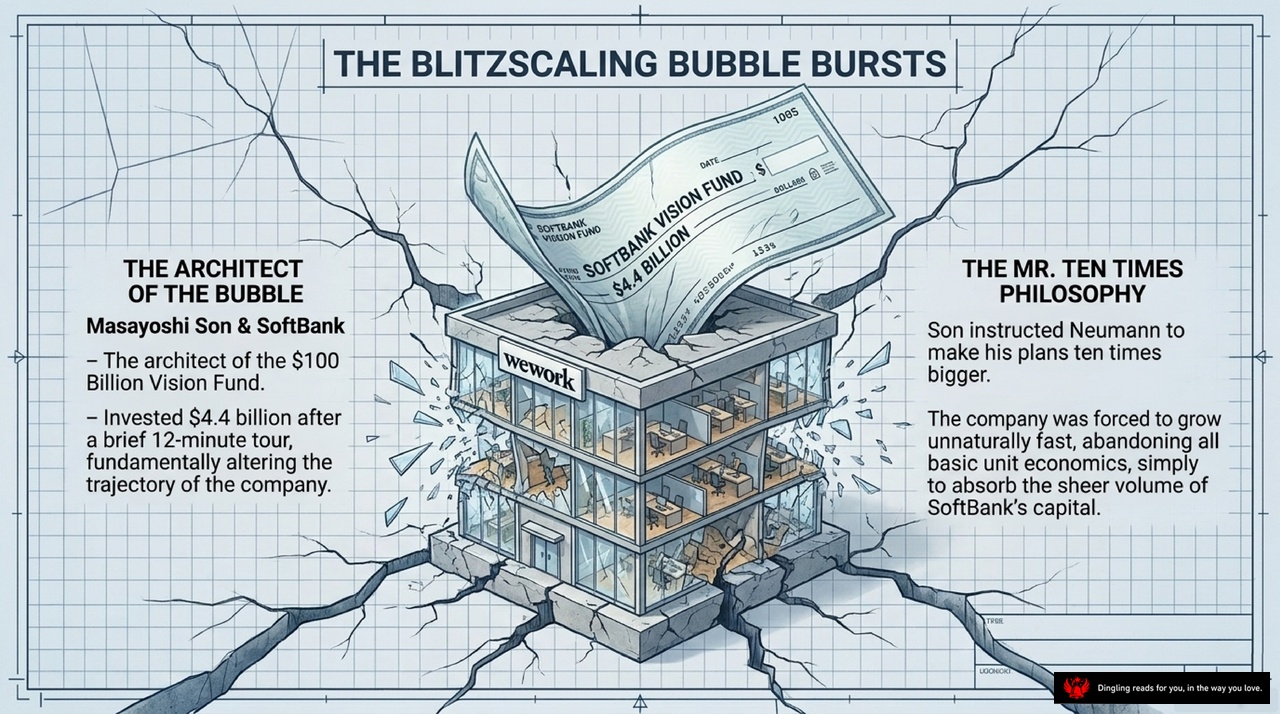
The image captures the explosive moment when the "Blitzscaling Bubble" finally bursts, centering on the "Mr. Ten Times Philosophy" that drove WeWork's reckless ascent. On the left, we see the architect of this bubble: Masayoshi Son and SoftBank. The graphic highlights a staggering $4.4 billion check from the SoftBank Vision Fund, poured into WeWork after a mere 12-minute tour. This wasn't just an investment; it was a catalyst that fundamentally altered the company's trajectory, turning a struggling startup into a global giant overnight.
On the right, the slide explains the core driver behind this madness: the "Mr. Ten Times Philosophy." This wasn't a suggestion; it was a command. Son instructed the founders to make their plans ten times bigger. This philosophy forced WeWork to grow unnaturally fast, abandoning all basic unit economics. The company stopped trying to build a profitable business model and instead simply absorbed the sheer volume of SoftBank's capital to look big. The cracks in the foundation, depicted by the crumbling building labeled "WeWork," symbolize how this unsustainable growth strategy eventually led to the inevitable collapse of the bubble.
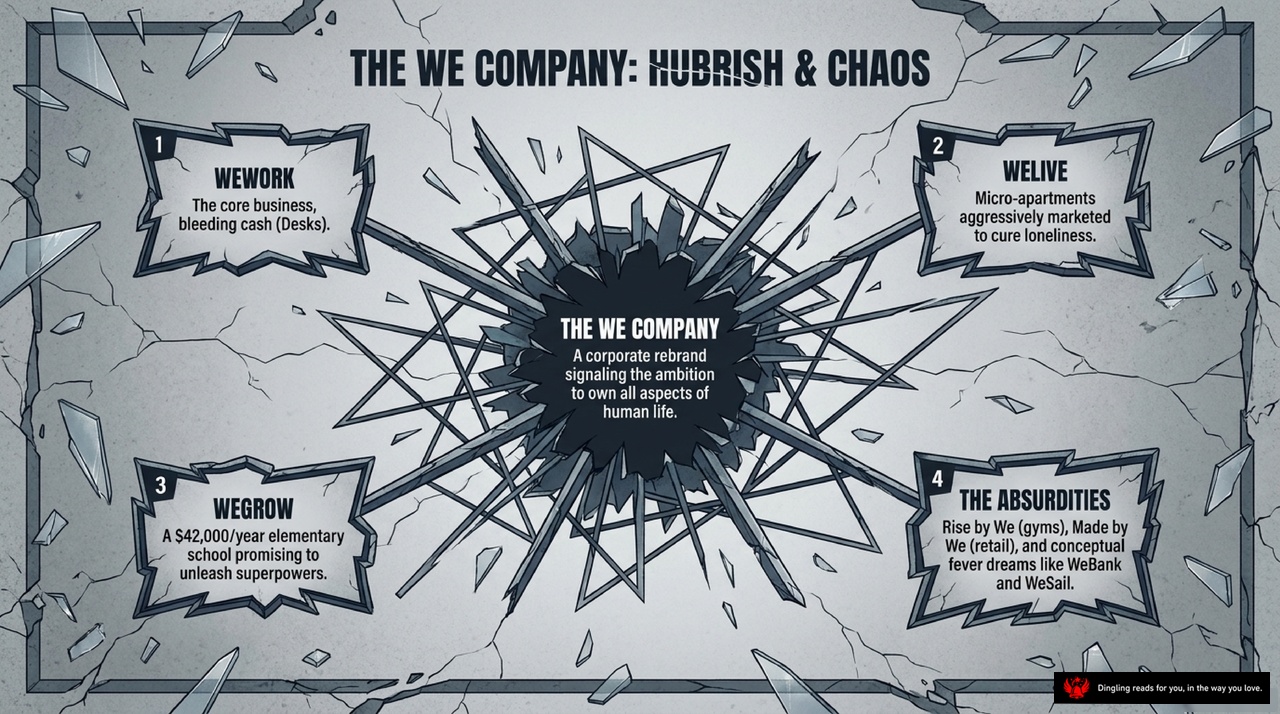
The image vividly captures the chaotic reality of "The We Company," a corporate rebrand that signaled an audacious ambition to own every facet of human life. At the center, the explosion of shattered glass symbolizes the fragility of this empire, which was built on a foundation of hubris and disorder.
Let's look at the four pillars of this chaos. First, we have **WeWork**, the core business that was essentially bleeding cash on desks. Instead of just renting space, they were trying to sell a lifestyle. Then there's **WeLive**, their aggressive push into micro-apartments marketed as the cure for loneliness. It was a desperate attempt to monetize social isolation.
But the absurdity didn't stop there. **WeGrow** was a $42,000-a-year elementary school promising to unleash superpowers in children, a concept that sounded great in a pitch deck but fell apart in reality. And finally, we have **The Absurdities**: from WeGyms and Made by We retail to conceptual fever dreams like WeBank and WeSail. These weren't just business diversifications; they were a delusion of grandeur.
This slide perfectly illustrates the narrative of a company that lost its way. What started as a community-focused office space evolved into a sprawling, incoherent empire where the "We" prefix was slapped onto everything, regardless of whether it made sense. The result was a corporate identity that was less about genuine connection and more about a desperate, often comical, grab for relevance across every possible industry.
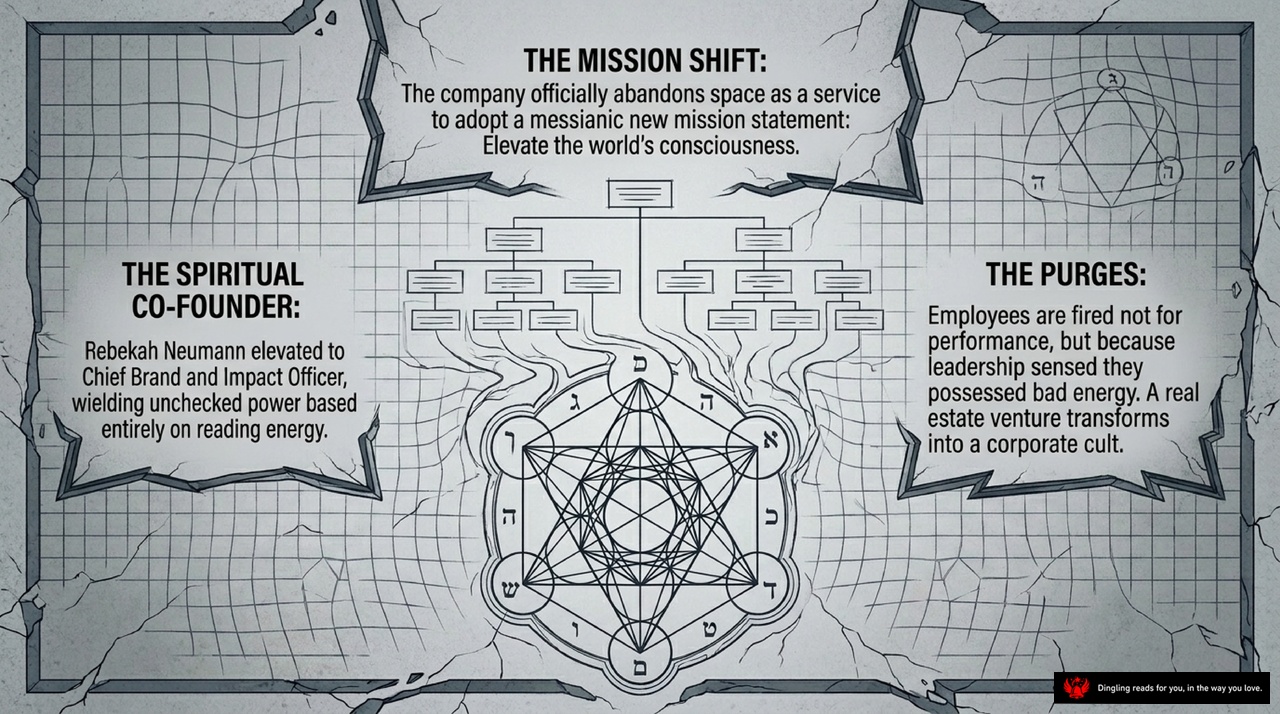
Look at this blueprint. It's not just an org chart; it's a map of a corporate cult taking over a real estate company. This slide captures the dark turning point where WeWork stopped being a flexible workspace provider and started chasing something far more abstract and dangerous.
First, notice the top center: "The Mission Shift." The company officially abandoned its core business of providing office space to adopt a messianic new mission statement: "Elevate the world's consciousness." That is the moment the business logic completely disconnected from reality.
On the left, we see "The Spiritual Co-Founder." This refers to Rebekah Neumann, who was elevated to Chief Brand and Impact Officer. The text describes her wielding unchecked power based entirely on reading energy. She wasn't managing marketing metrics; she was managing vibes, turning the company into a personality-driven cult rather than a structured enterprise.
On the right, "The Purges." This is where the toxicity hit the floor. Employees were fired not for performance or financial results, but because leadership sensed they possessed "bad energy." The slide explicitly states that a real estate venture transformed into a corporate cult.
In the center, that complex geometric symbol represents the chaotic hierarchy that replaced professional management. The entire organization was now structured around spiritual alignment and the whims of the founders, rather than operational efficiency or customer value. This was the era where the promise of community was twisted into an exclusionary, judgmental environment that drove talent away and terrified investors.

Look closely at this shattered glass effect. It represents the moment WeWork's carefully constructed illusion finally cracked under the weight of its own contradictions. The image highlights three critical failures that led to the company's collapse: The Metric, The Grift, and The Hubris.
First, look at "The Metric." This refers to the fabricated financial measure known as Community-Adjusted EBITDA. It was a tool designed to hide the brutal reality of their business model by excluding basic operational expenses, creating a false picture of profitability to seduce investors.
Then, there's "The Grift." This points to a blatant conflict of interest where the CEO personally trademarked the word "We" and charged his own company nearly $6 million for the rights to use it. It was a self-dealing transaction that prioritized personal gain over shareholder value.
Finally, "The Hubris." This section exposes a prospectus dedicated to "The Energy of We," featuring an all-male board and a succession plan that allowed the founder's wife to single-handedly name the next CEO. This wasn't just corporate governance; it was a display of unchecked arrogance and a complete disregard for accountability.
Together, these three elements show how a community-driven vision was twisted into a mechanism for fraud, greed, and delusion, ultimately leading to the company's downfall.

The image captures the dramatic collapse of WeWork's empire, illustrating a narrative arc defined by destruction and betrayal. It breaks down the fall into three critical phases: The Backlash, The Plunge, and The Bailout & Exit.
First, we see **The Backlash**, where Wall Street dissected the S-1 filing. The illusion of a revolutionary tech company was mathematically destroyed, exposing the fragility of their valuation model.
Next, **The Plunge** follows immediately. In a matter of weeks, the valuation was violently slashed from $47 billion down to just $10 billion. This catastrophic drop forced the humiliating pull of the IPO, ending the public market dream overnight.
Finally, **The Bailout & Exit** reveals the human cost. Facing imminent bankruptcy, SoftBank launched a massive bailout to save the company. However, the exit came at a steep price for the insiders: Neumann stepped down with a staggering $1 billion golden parachute, while the employees were left holding worthless stock options. The rubble at the bottom, spelling out "We," serves as a stark reminder of the broken promise to the community that once believed in this vision.

WeWork stands as the ultimate proof that a charismatic founder and FOMO-driven investors can temporarily bend reality, but they can never rewrite the basic laws of business gravity. This slide captures the essence of the 2010s venture capital boom, an era where grand narratives and free-flowing capital masked fundamentally broken unit economics. WeWork showed us that if the market is willing to reward the illusion of scale so blindly over the reality of profit, the question remains: who is truly to blame for the bubble—the visionary who sold the dream, or the system that financed it? The answer lies in understanding that while the illusion of community and the promise of a tech-driven future captivated the world, the underlying financial model could not sustain itself. No amount of storytelling or strategic pivots could overcome the fundamental disconnect between revenue and cost, leaving the company vulnerable to the inevitable crash when the capital ran dry.