
Elon Musk: Tesla, SpaceX, and the Quest for a Fantastic Future: Complete Chapter-by-Chapter Summary
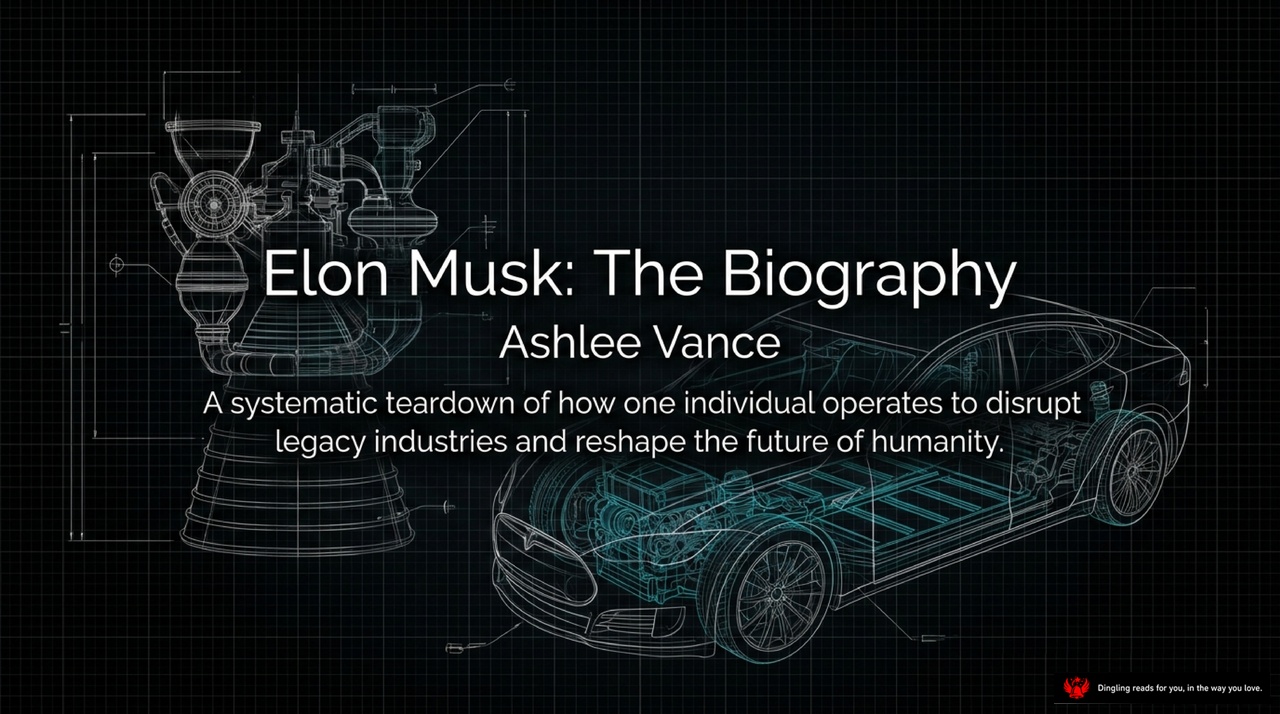
Welcome to today's session on "Elon Musk: The Biography" by Ashlee Vance. This isn't just a story about a man; it's a systematic teardown of how one individual operates to disrupt legacy industries and reshape the future of humanity.
Imagine a blueprint, where every line represents a radical shift in how we live and work. On the left, you see the intricate engineering of a rocket engine, symbolizing the audacity to conquer the stars. On the right, the skeletal frame of a sleek electric car, representing the disruption of the automotive world. These aren't just machines; they are the physical manifestations of a single vision.
The book explores how Elon Musk, driven by a deep-seated belief that humanity needs to become a multi-planetary species, systematically dismantled the status quo. From the skies with SpaceX to the roads with Tesla, he didn't just innovate; he rewrote the rules of physics, energy, and transportation. This biography peels back the layers of his mind, showing us the relentless logic and sheer willpower required to turn these blueprints from sketches on a screen into the reality that defines our future.
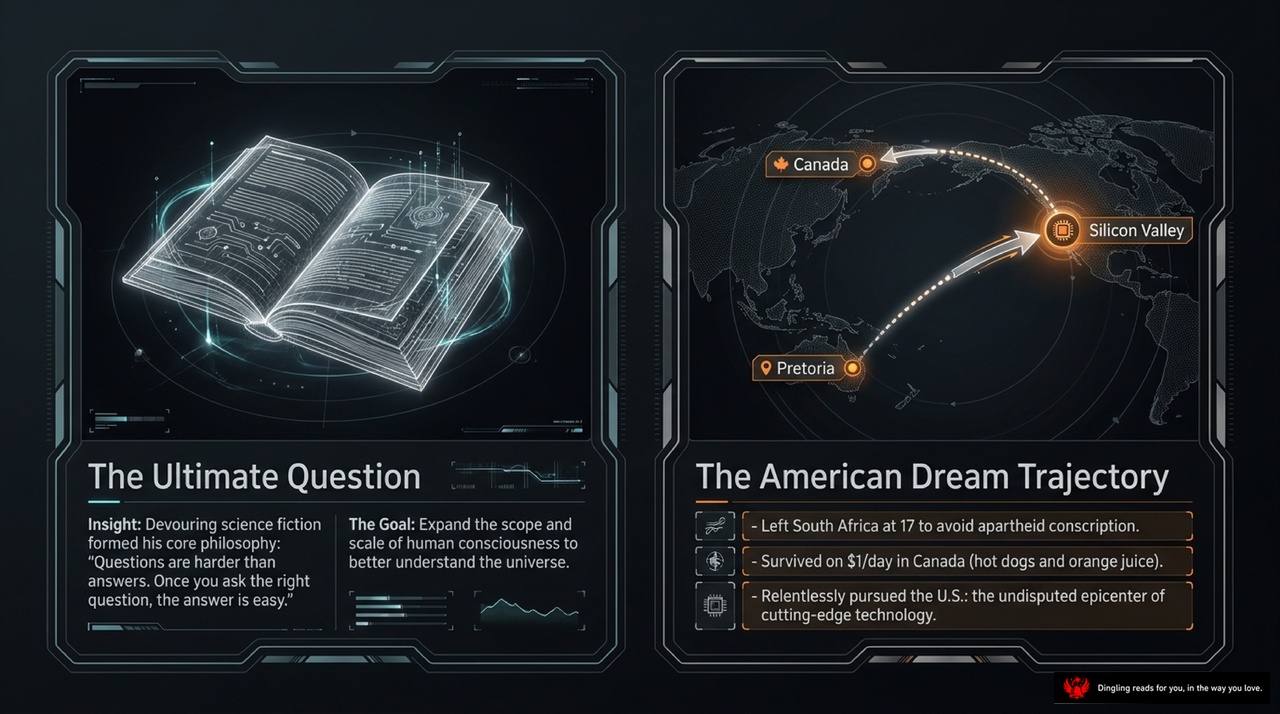
On the left, we see "The Ultimate Question," capturing the core philosophy that shaped Elon's worldview: "Questions are harder than answers." This insight wasn't just a quote; it was forged in the fires of reading science fiction as a child. Those stories taught him that once you ask the right question, the path to the answer becomes surprisingly clear. This mindset drove his entire journey, from understanding the universe to solving humanity's biggest challenges.
On the right, the slide maps "The American Dream Trajectory," tracing the physical and mental journey from Pretoria to Silicon Valley. It starts with leaving South Africa at 17 to escape conscription, surviving on just $1 a day in Canada eating hot dogs and orange juice. That grit was the fuel. Then came the relentless pursuit of the U.S., viewed as the undisputed epicenter of cutting-edge technology. This wasn't just a move for wealth; it was a strategic migration to the only place where he believed the future was being built. From that humble beginning in a small Canadian town to the heart of innovation in Silicon Valley, this trajectory laid the foundation for everything that followed.

Look at this timeline. It maps the evolution of a true polymath, showing how Elon Musk transformed from a software millionaire into the chief designer of orbital rockets. The journey starts with the "10-Year-Old Prodigy" phase, where he built and sold "Blaster" video game code for $500, proving his commercial instinct early on. But the real pivot happens with "The Hardware Shift." While others were coding, Musk absorbed Soviet-era liquid-propellant rocket manuals right there on a beach in Rio. This was the critical moment he moved from digital abstraction to physical engineering. He transitioned from a software millionaire to the lead engineer of orbital rockets, effectively bypassing traditional aerospace credentials that took decades to earn. As the graphic reminds us, "Don't fear new fields. You can learn anything from a book." That mindset allowed him to master complex physics and engineering, turning his software background into a superpower for building the future of space travel.

Look at this timeline. It tells the story of how the Silicon Valley playbook was actually written. It all starts with a simple, radical idea: Start from zero, iterate relentlessly, and target archaic industries ripe for digital disruption.
Let's look at the first case study on the left: 1995, Zip2. This was the moment of media disruption. Elon and his brother Kimbal took a measly $2,000 and a bold vision to bring the legacy media industry into the digital age. They didn't just build a website; they built the digital infrastructure for newspapers. The result? Compaq acquired them, and at just 28 years old, Elon walked away with his first $22 million. It was a proof of concept that you could disrupt traditional giants with code.
Now, fast forward to the right side of the screen: 1999, the Finance Revolution with X.com and PayPal. The vision here was even more ambitious—a borderless, seamless global online payment system. The execution was legendary, forming the so-called "PayPal Mafia" through grueling 100-hour work weeks. They didn't just create a payment tool; they created the plumbing for the entire internet economy. When eBay acquired PayPal for $1.5 billion, Elon netted $180 million.
These two stories illustrate the core Silicon Valley paradigm perfectly. It's not about having a degree or a massive budget; it's about identifying an outdated industry, building a better version from scratch, and iterating until you dominate. Whether it's digitizing maps or digitizing money, the pattern remains the same: start small, think big, and disrupt the status quo.

Look at this "Orbital Blueprint." This isn't just a sci-fi concept; it's the actual master plan Elon Musk is executing to save humanity. The image breaks down three interconnected nodes that form the backbone of his vision for human preservation.
On the left, we see SpaceX. Their goal is simple but existential: make humanity a multi-planetary species. This is about creating a backup for human consciousness, ensuring that if Earth ever fails, we have a home in the stars.
In the bottom left, you see Tesla Motors. Their mission is to accelerate the transition to sustainable energy. Why? Because without solving the climate crisis, there is no Earth left to colonize. They are preventing atmospheric collapse, securing the planet we need to leave.
On the right, SolarCity aims to create a scalable, decentralized solar energy grid. This fuels the electric vehicle ecosystem independently of fossil fuels. It's the energy layer that powers the cars and the future cities.
The center of this image is the key: "Interconnected nodes for human preservation." These three companies aren't working in silos; they are deeply integrated. The energy from SolarCity powers the cars from Tesla, which drives the logistics needed for SpaceX to launch, and SpaceX ensures the long-term survival of the species that relies on that energy. It's a self-sustaining loop designed to take us from a fragile single-planet species to a resilient multi-planetary civilization.
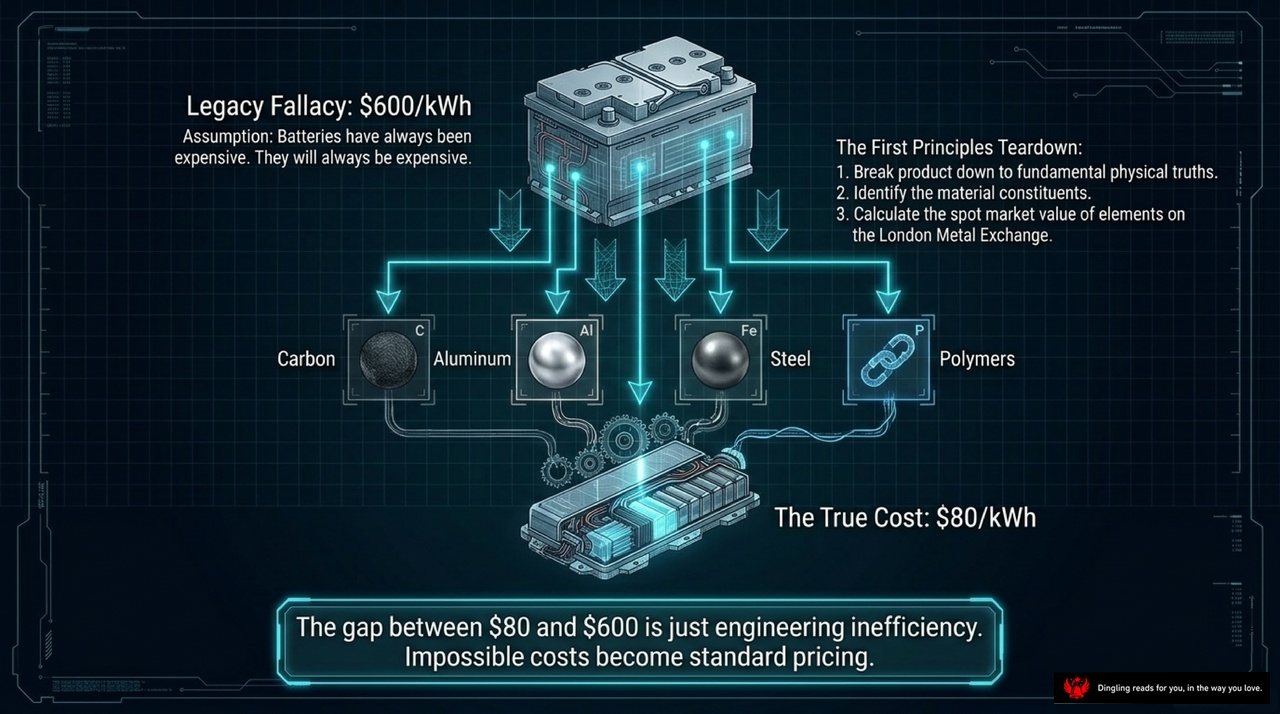
Imagine a world where the cost of storing energy is stuck in the past, trapped by a "Legacy Fallacy." We've been told that batteries will always be expensive, priced around $600 per kilowatt-hour. We've accepted this as the standard, assuming that high costs are just the nature of the technology. But what if that's simply an engineering inefficiency?
Let's break it down using first principles. Instead of looking at the battery as a black box, let's tear it apart and look at the fundamental physical truths inside. What are we actually buying? It's just raw materials: Carbon, Aluminum, Steel, and Polymers. If you identify these constituents and calculate their spot market value on the London Metal Exchange, the math changes completely. The true cost of these materials is only about $80 per kilowatt-hour.
So, why the gap between $80 and $600? The difference isn't in the materials; it's in the assembly. The high price tag is built on complex, inefficient manufacturing processes and outdated assumptions. By stripping away the inefficiency and focusing on the fundamental truth, we see that the impossible cost of $600 is just a standard pricing error. The real potential is a true cost of $80. This shift in thinking—from accepting the status quo to understanding the raw materials—is the key to unlocking a revolution in energy storage.
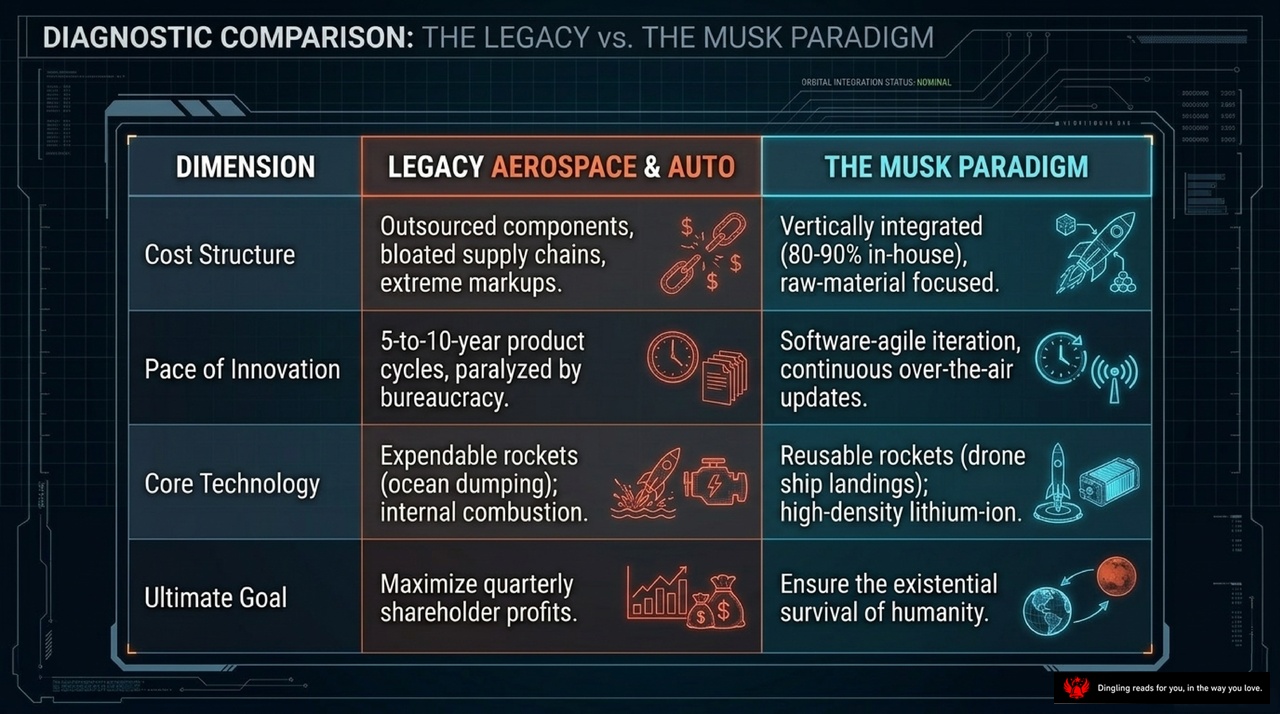
Look at this side-by-side comparison. On the left, you have the "Legacy" model—the traditional way aerospace and auto industries have operated for decades. It's defined by outsourced components, bloated supply chains, and extreme markups. Their innovation is slow, trapped in 5-to-10-year cycles by bureaucracy. Their rockets are disposable, their engines rely on internal combustion, and their ultimate goal? Simply maximizing quarterly shareholder profits.
Now, look at the right side: "The Musk Paradigm." This is a complete inversion of the old rules. Instead of outsourcing, Musk went vertically integrated, controlling 80 to 90 percent of the supply chain in-house and focusing directly on raw materials. He replaced slow hardware cycles with software-agile iteration and continuous over-the-air updates. Instead of throwing rockets away into the ocean, he engineered reusable systems with drone ship landings and high-density lithium-ion batteries. And here is the most critical shift: the goal isn't just short-term profit. It's ensuring the existential survival of humanity by making space travel accessible.
This table isn't just about rockets or cars; it's about a fundamental change in how we think about building the future. It moves us from a business that serves the past to an industry that engineers the next step for our species.
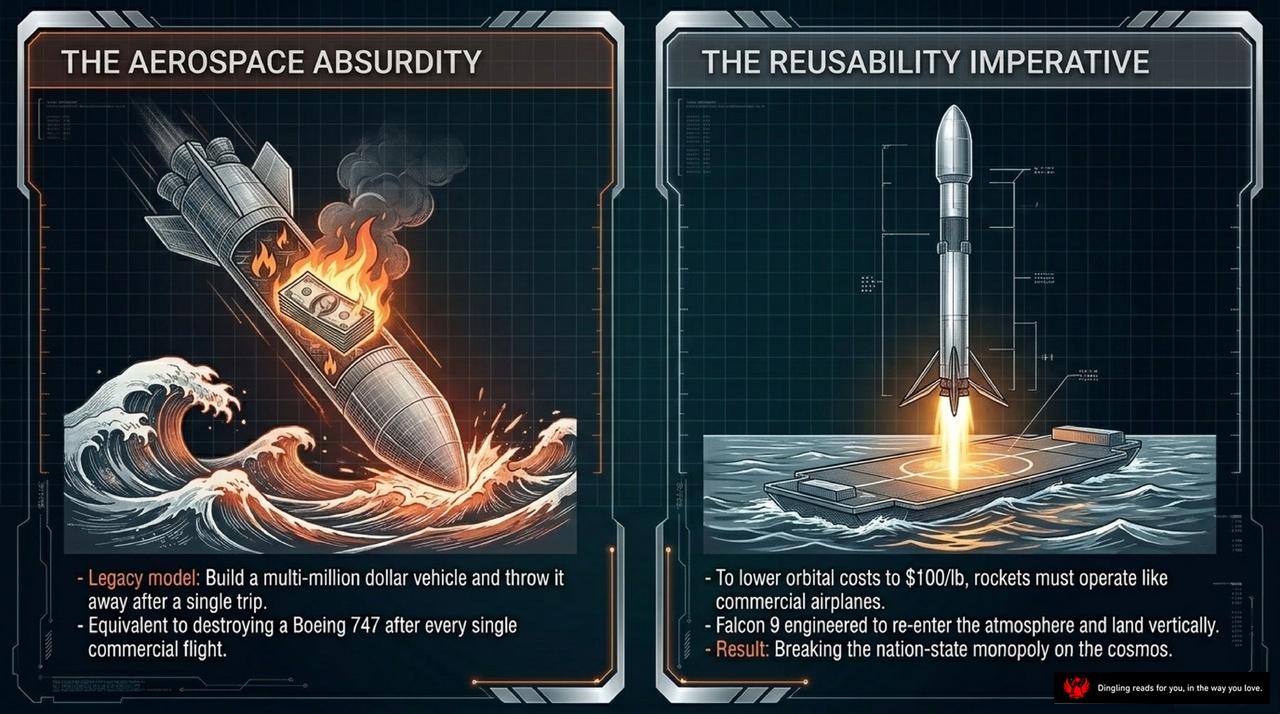
Look at this split-screen comparison. On the left, we see the old way: "The Aerospace Absurdity." It's a multi-million dollar rocket crashing into the ocean, burning cash. The text calls this the "Legacy model"—building a vehicle just to throw it away after one trip. It's like destroying a Boeing 747 after every single commercial flight. That's not just wasteful; it's insanity.
But on the right, we see the solution: "The Reusability Imperative." Here, the Falcon 9 isn't crashing; it's landing vertically on a drone ship. Why? Because to make space travel affordable, costs must drop to just $100 per pound. That's the only way rockets can operate like commercial airplanes. By engineering the Falcon 9 to re-enter the atmosphere and land safely, SpaceX broke the nation-state monopoly on the cosmos. This shift from a disposable, absurd model to a reusable, efficient one is the single most important breakthrough in the history of human exploration.
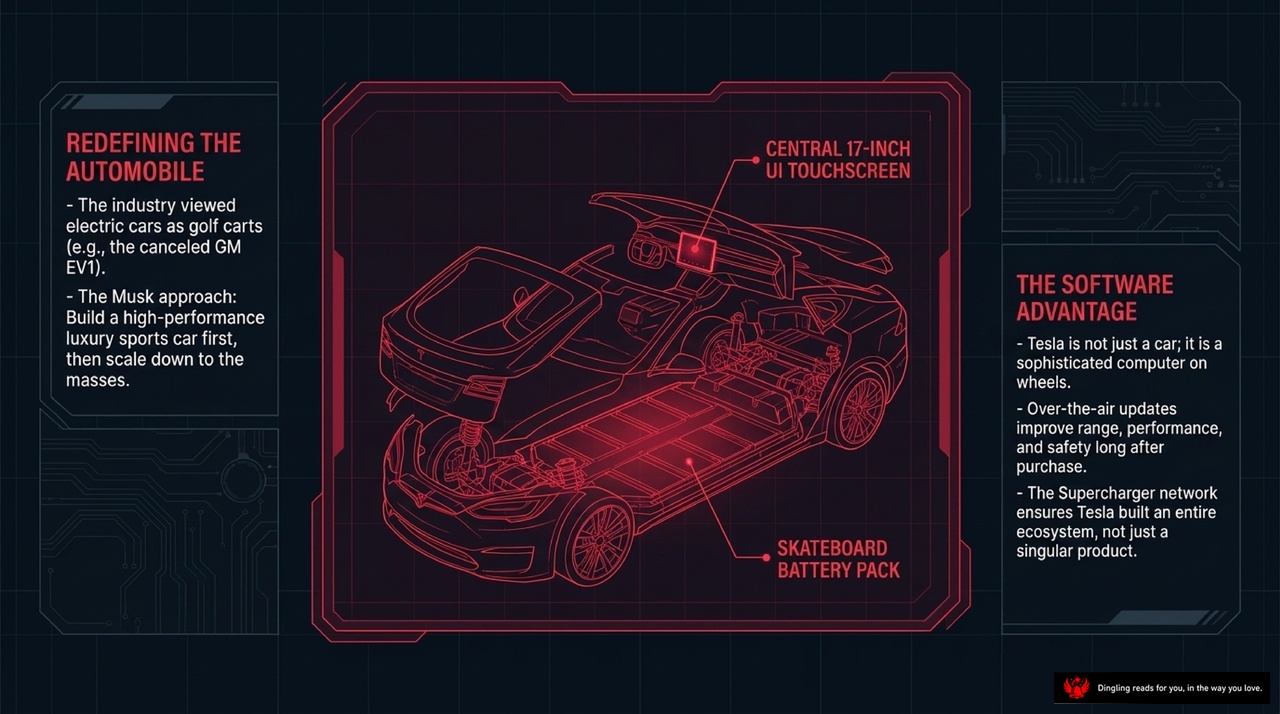
Imagine a car that isn't just a machine, but a sophisticated computer on wheels. This is the core of Tesla's revolution, and it all starts with redefining what an automobile actually is. While the traditional industry dismissed electric vehicles as nothing more than golf carts—remember the canceled GM EV1?—Elon Musk saw a different path. He decided to build a high-performance luxury sports car first, and then scale that technology down to the masses.
Look at the blueprint in the center. This is the Roadster, the vehicle that changed everything. Notice the skateboard battery pack running right through the floor. By placing the battery low and centrally, Tesla drastically lowered the vehicle's center of gravity, making it incredibly stable and handling better than any gas-powered sports car of its time.
But the hardware is only half the story. The real magic lies in the software. Look at that central 17-inch UI touchscreen. In a traditional car, you have a cluster of buttons and knobs. In a Tesla, the entire interface is software-driven. This means the car is always evolving. Through over-the-air updates, Tesla can improve range, boost performance, and even enhance safety long after you've purchased the vehicle. It's like buying a computer that gets smarter every day.
This software advantage is what creates the true ecosystem. It's not just about selling a car; it's about building a network. With the Supercharger network, Tesla ensured that owners could travel anywhere without range anxiety, creating a reliable infrastructure that competitors simply didn't have. By combining a revolutionary battery architecture with a constantly updating operating system, Tesla didn't just build a car; they built the future of mobility.
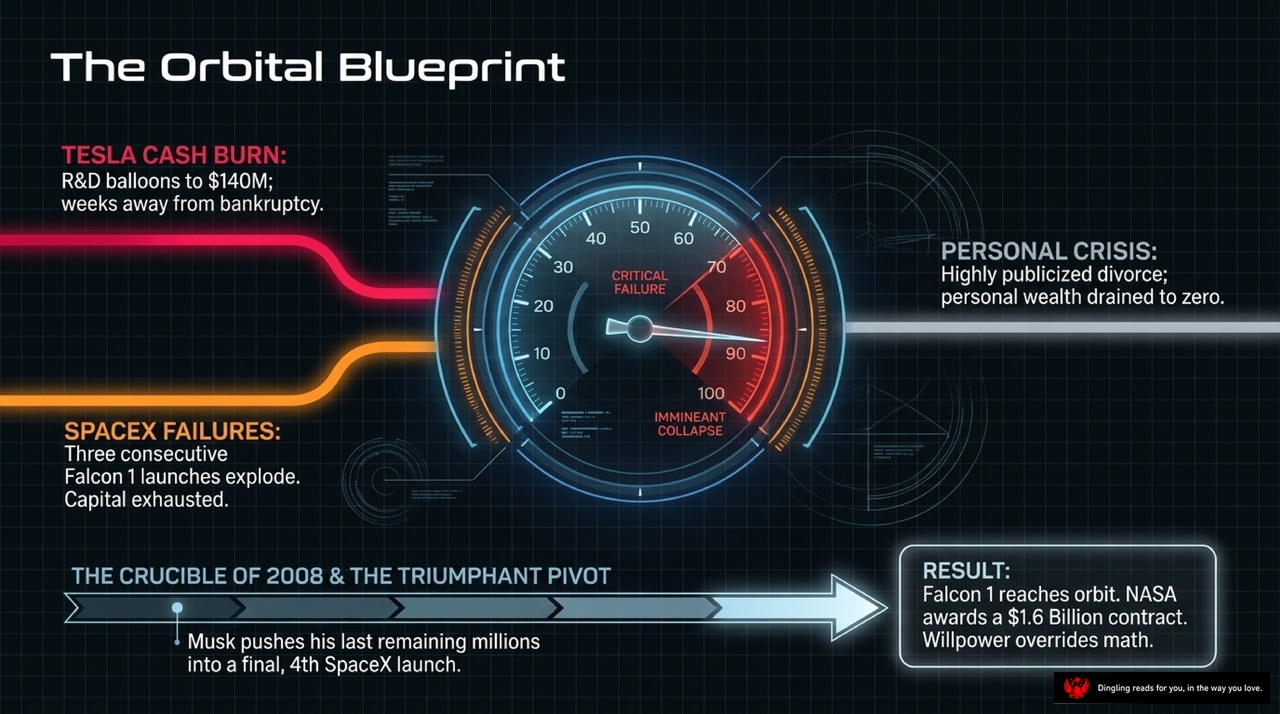
Look at this dashboard. It reads like the final chapter of a thriller. On the left, we see "Tesla Cash Burn," where R&D costs ballooned to $140 million, leaving the company mere weeks away from bankruptcy. Below that, "SpaceX Failures" shows three consecutive Falcon 1 launches exploding, completely exhausting their capital. On the right, the "Personal Crisis" highlights a highly publicized divorce that drained Musk's personal wealth to zero.
In the center, a gauge screams "Critical Failure" and "Imminent Collapse." This was the absolute bottom in 2008. But look at the arrow at the bottom: "The Crucible of 2008 & The Triumphant Pivot." While the world saw a man on the brink of ruin, Musk pushed his last remaining millions into a final, fourth SpaceX launch. The result? The Falcon 1 reached orbit. NASA awarded a $1.6 billion contract. It was a moment where sheer willpower literally overrode the math.
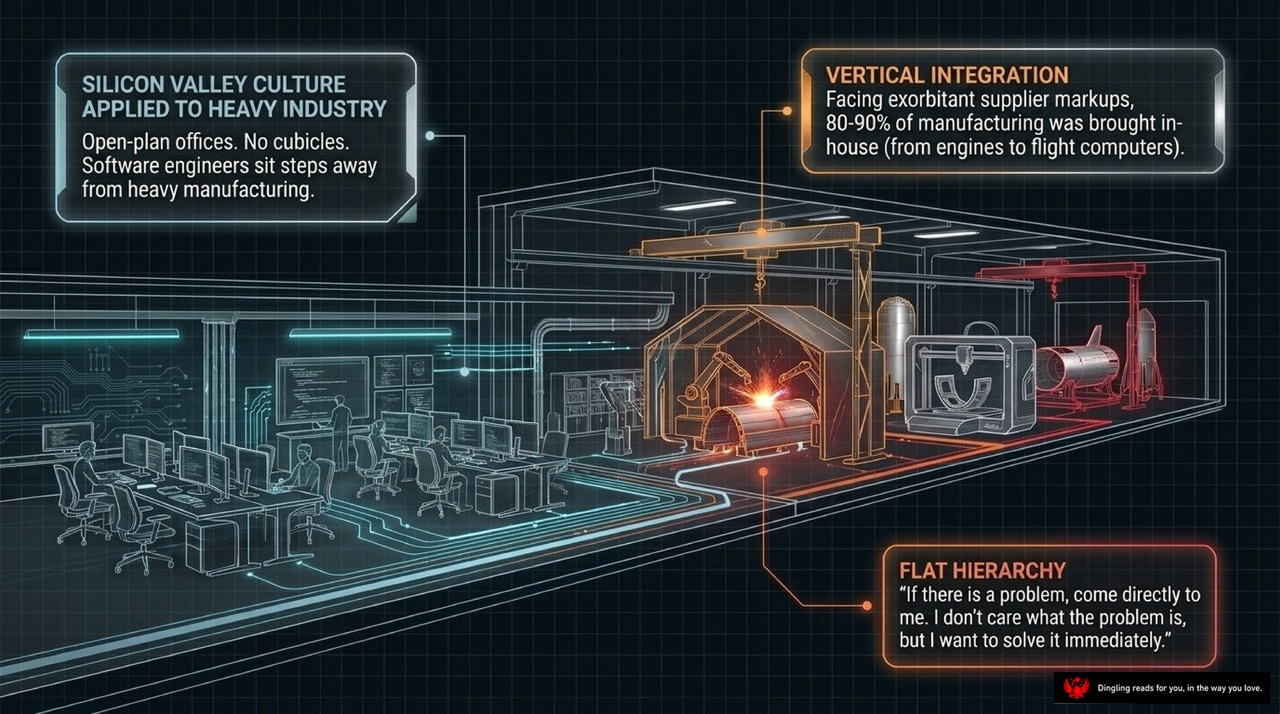
Look at this blueprint of a modern factory. Notice how the blue office space on the left flows directly into the orange manufacturing zone on the right. This visual represents a radical shift in how we think about heavy industry: bringing Silicon Valley culture into the steel and silicon world.
First, look at the open-plan layout. The text highlights "no cubicles" and engineers sitting steps away from the machines. This isn't just about aesthetics; it's about breaking down the walls between software and hardware. When the coders writing the flight computer sit right next to the engineers welding the rocket engine, collaboration happens in real-time, not through endless email chains.
Then, look at the "Vertical Integration" box. It points to the heavy machinery inside. Instead of outsourcing to suppliers with huge markups, companies like SpaceX now bring 80 to 90 percent of manufacturing in-house. From engines to flight computers, they control the entire chain. This eliminates bottlenecks and allows for the rapid iteration that defines the tech industry, but now applied to aerospace.
Finally, see the quote about the "Flat Hierarchy" at the bottom. It captures the spirit of this entire operation: "If there is a problem, come directly to me." There are no middle managers slowing things down. If an engineer on the factory floor sees a flaw, they don't wait for permission; they go straight to the leader to solve it immediately. This direct line of communication is what allows these companies to move at the speed of thought, turning complex industrial challenges into solvable puzzles.

Today's slide breaks down the Musk Algorithm into its core operating system: reasoning from first principles and accepting extreme existential risk.
First, reason from first principles. This means stripping every problem down to its fundamental physical truths. You have to ignore analogies, legacy industry habits, and the way things have always been done. If physics allows it, it is a purely engineering problem. Look at how Musk approached battery costs. Everyone said batteries were expensive and that was just how it was. But by breaking them down to raw materials—carbon, aluminum, steel—and checking the spot market price, he realized the cost was actually a fraction of what the market charged. He didn't just optimize the existing system; he rebuilt it from the ground up based on reality, not tradition.
Second, accept extreme existential risk. Do not optimize for safe quarterly returns. If the objective is vital to the survival or expansion of human consciousness, pursue it even if the probability of failure is exceptionally high. Think about SpaceX. For four consecutive launches, the Falcon 1 rocket failed. The company ran out of money, and Musk had to borrow from friends to keep the team alive. The odds of success looked slim, and the risk of total loss was real. Yet, he didn't retreat to a safe, low-risk path. He doubled down because the goal—making humanity a multi-planetary species—was too important to gamble on a safe outcome.
These two pillars form the engine behind everything Musk has built. Whether it's disrupting the auto industry with the Model S, revolutionizing space travel, or creating a new model for solar energy with SolarCity, the logic remains the same: go back to the basics and be willing to bet your life's work on a vision that matters for the future of humanity.

Look at this screen. We are deep into the "Musk Algorithm," specifically the brutal reality of execution and iteration. This isn't about pretty slides or perfect plans; it's about how you actually build the future when the pressure is crushing.
First, notice the blue box: "Merge Software Agility with Heavy Manufacturing." This is the core paradox Musk solved. For decades, hardware was treated like a slow, rigid beast. You design, you wait five years, you hope it works. Musk flipped the script. He treated rocket engines and car chassis like software code. He demanded relentless iteration, testing things to destruction, and deploying design changes directly on the factory floor. No more waiting for legacy cycles. If a part fails, you fix it tomorrow, not in five years. This mindset turned massive, expensive manufacturing into something agile and responsive.
But agility alone isn't enough. Look at the red box below: "Tolerate Massive Pain." This is where the rubber meets the road. The CEO is the ultimate shock absorber. Musk isn't managing from an office; he's leading from the front lines of the factory floor. He works 80 to 100-hour weeks because he believes that starting a company is like eating glass and staring into the abyss. It is physically and mentally painful. You have to be willing to absorb that pain, to push through the chaos, and to lead by example.
So, the algorithm is simple but terrifying: treat your hardware like software to move fast, and accept massive pain to stay focused. It's the only way to turn a crazy vision into reality.
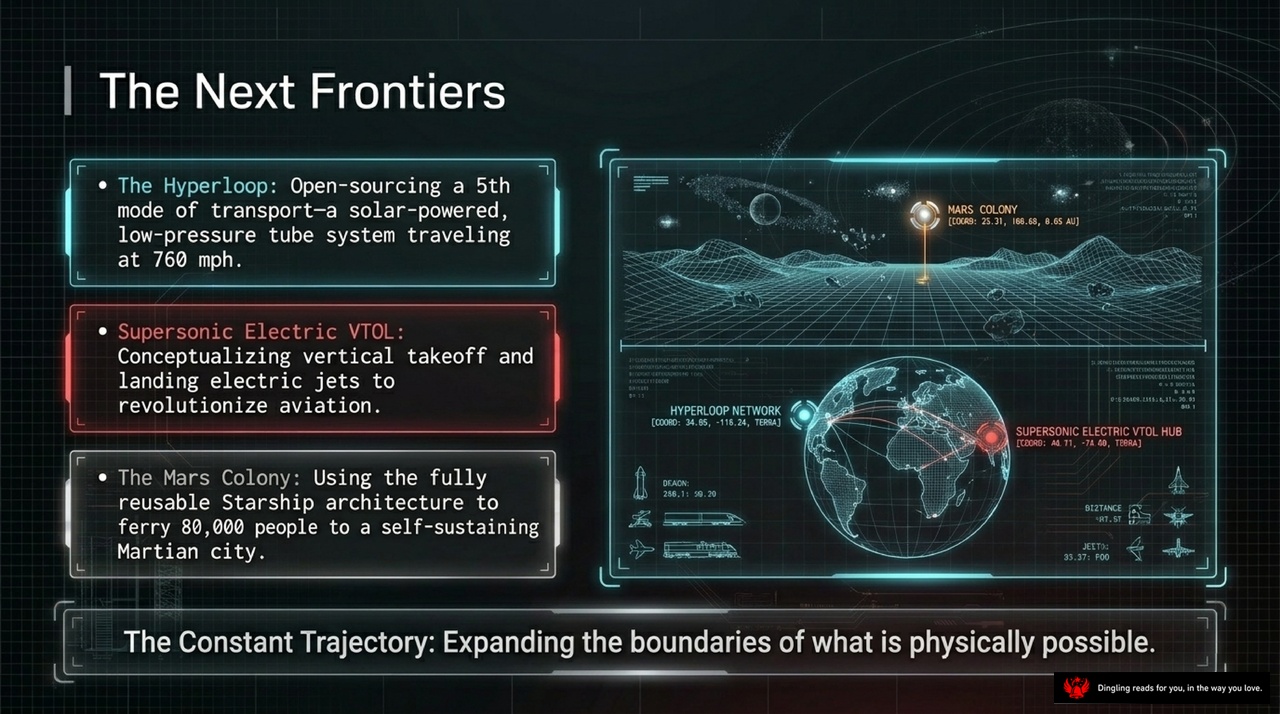
Imagine a future where the sky isn't just for birds, but for electric jets that can take off and land vertically at supersonic speeds. This isn't science fiction; it's one of the next frontiers we're exploring. On the left, you see "Supersonic Electric VTOL," a concept designed to revolutionize aviation by making air travel faster and more accessible than ever before.
But the vision goes even further. Look at the top right of the screen: "The Mars Colony." This represents the ultimate frontier—using our fully reusable Starship architecture to ferry 80,000 people to a self-sustaining city on Mars. We are no longer just dreaming of visiting other planets; we are planning to live there.
And what about our daily commute? Enter "The Hyperloop." Visualized in the network diagram on the right, this is a fifth mode of transport: a solar-powered, low-pressure tube system capable of traveling at 760 miles per hour. It promises to shrink distances, turning a trip from San Francisco to Los Angeles into a mere 30-minute journey for just $20.
All these ideas—the Hyperloop, supersonic electric jets, and the Mars colony—share a common thread. As the bottom banner states, this is "The Constant Trajectory." It's about expanding the boundaries of what is physically possible. We are constantly pushing past the limits of speed, distance, and gravity, turning yesterday's impossible dreams into tomorrow's reality.
Elon Musk didn't just build companies; he built a reproducible algorithm for human progress. By discarding analogies, reasoning from fundamental physics, and applying software-style iteration to heavy manufacturing, he dismantled the monopolies of the automotive, aerospace, and energy sectors. He proved that an individual's extreme willpower and risk tolerance can literally alter the trajectory of human history.
If one mind, armed with first principles and relentless execution, can commercialize spaceflight and force the global transition to sustainable energy... What legacy are you leaving on the blueprint of the future?