
Biography of Ren Zhengfei: Complete Chapter-by-Chapter Summary
Welcome to the definitive story of Ren Zhengfei, the extraordinary leader who transformed a six-person startup into a global technology empire. Today, we dive into the biography of Ren Zhengfei, titled "Sun Like."
This is the journey of a man who rose from humble beginnings in a poor family in Guizhou to become the architect of one of the world's most powerful tech giants. His path was not easy; it was forged in the fires of historical turmoil, personal loss, and relentless competition. But through it all, his vision remained clear: to build something that could stand alongside the world's greatest nations.
This book captures the full arc of his life—from his early struggles and military service to the daring decision to leave the army and start Huawei in a tiny office in Shenzhen. It explores how he navigated massive challenges, from losing millions in early business ventures to facing down global giants like AT&T and Cisco.
Whether you're interested in leadership lessons, the history of China's rise, or the secrets behind building a resilient company, this biography offers deep insights. It's not just a story about one man; it's a testament to the power of perseverance, the importance of selflessness, and the belief that ordinary people can achieve extraordinary things.
Get ready to be inspired by the life of Ren Zhengfei and the legacy of Huawei. This is a story you won't want to miss.
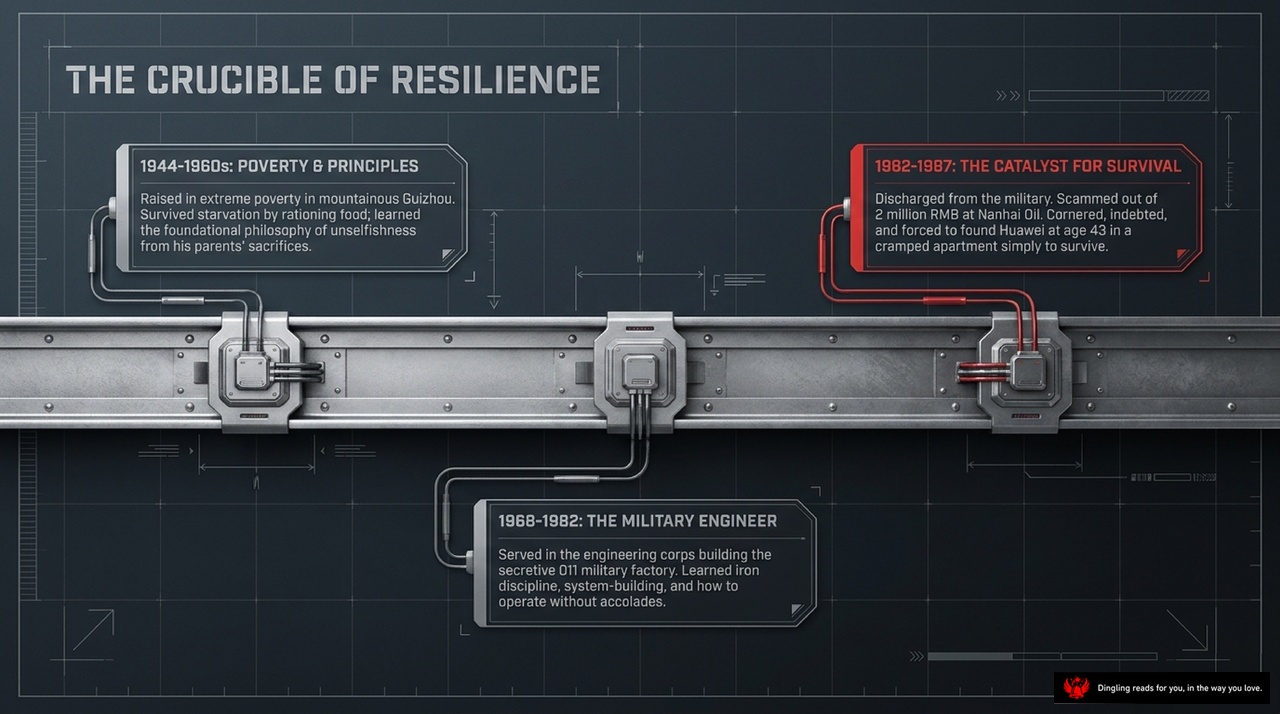
Picture this: a rugged timeline, built like a steel railway track, mapping the raw, unfiltered journey of a man who built a tech giant from absolute nothing. This slide, titled "The Crucible of Resilience," breaks down the three defining eras of Ren Zhengfei's life.
First, look at the left. From 1944 to the 1960s, we see "Poverty & Principles." Ren was raised in extreme poverty in the mountains of Guizhou. The text highlights how he survived starvation by rationing food, learning the foundational philosophy of unselfishness directly from his parents' sacrifices. It was here that he learned that survival often demands putting others before oneself.
Move to the center. The timeline shifts to 1968 through 1982: "The Military Engineer." This was his crucible for discipline. He served in the engineering corps, building the secretive 011 military factory. Here, he learned iron discipline, system-building, and crucially, how to operate without accolades. He got used to a quiet life where he shouldn't expect awards, a mindset that would later define his leadership style.
Finally, the red box on the right: 1982 to 1987, labeled "The Catalyst for Survival." This is where the real fire started. Discharged from the military, he was scammed out of 2 million RMB at Nanhai Oil. Cornered, indebted, and forced to start over, he founded Huawei at age 43 in a cramped apartment simply to survive. That moment of total ruin became the spark that lit the future of a global powerhouse.
This timeline isn't just dates; it's the proof that resilience isn't about avoiding failure, but about how you rebuild when everything is taken away.

The image outlines a classic "underdog" strategy: capturing the fragmented rural periphery first to accumulate capital and combat experience, before eventually conquering the urban centers dominated by international giants. This isn't just a marketing slogan; it was Huawei's battlefield blueprint.
In the early days, while Western giants like Lucent and Alcatel built "urban fortresses" with high profit margins and fortified relationships, they largely ignored the neglected, low-margin rural networks. Huawei saw an opportunity there. Instead of fighting head-on in crowded cities, they deployed rugged, localized support exactly where foreign competitors refused to go.
This strategy worked brilliantly. By capturing the fragmented rural periphery, Huawei accumulated the necessary capital, scale, and combat experience. They turned these remote areas into a base of operations, building a resilient network that the giants couldn't easily penetrate. As the company grew stronger, they used this momentum to gradually encroach on the urban markets.
The synthesis insight is clear: by patiently building from the outside in, Huawei eventually choked out the established players and conquered the urban centers. It was a masterclass in strategic patience, proving that even the smallest player can defeat the biggest giants by playing their own game.

Look at this timeline of Huawei's evolution. It starts with the HA-X, which was essentially a reselling agent for generic Hong Kong switches. Sure, it was profitable, but let's be real—it was highly vulnerable. It wasn't building anything of its own.
Then came the HJD48. This was the first autonomous leap into proprietary, small-scale analog switches. This was the moment Huawei stopped just selling other people's products and started engineering its own destiny. It proved they could do it.
But the real game-changer was the JK1000. Think of this as the Bureau Analog stepping stone into larger networks. It was crucial, but the text is clear: it was immediately threatened by the global digital shift. The analog era was ending, and Huawei couldn't stay in the past. They had to move fast or die.
So, they made the ultimate pivot to the C&C08 Digital Switch. This was the breakthrough. It was a high-stakes bet where they put all their capital on digital architecture. It wasn't just about survival anymore; it was about proving mastery over core telecom IP. This single product secured their future and transformed them from a local player into a global contender.
The image captures the essence of their journey: from a vulnerable reseller to a digital powerhouse. But the stakes were incredibly high. As the quote on the screen says, Ren Zhengfei put it all on the line: "If the research fails, I will have to jump off the building." That level of commitment is what turned a risky leap into a defining technology era.

Imagine a corporate operating system that was built for the wrong market. In the early days, Huawei's growth exploded faster than its management could handle, leading to chaotic supply chains, massive R&D waste, and unpredictable operations. It was a classic startup struggle, but Huawei needed to scale globally, which required a different set of rules.
The solution was a radical transformation: upgrading the corporate OS by cutting feet to fit American shoes. This meant implementing Western management templates, specifically IBM's Integrated Product Development and Integrated Supply Chain methodologies. The goal was simple yet demanding: to achieve predictable, scalable innovation. By restructuring HR and performance evaluations to align with international standards, Huawei forced itself to evolve from a chaotic entity into a highly efficient, predictable enterprise. This wasn't just about copying; it was about the painful but necessary process of adapting a Chinese giant to the rigorous standards of the global stage, ensuring that every engineer and every process was optimized for world-class performance.
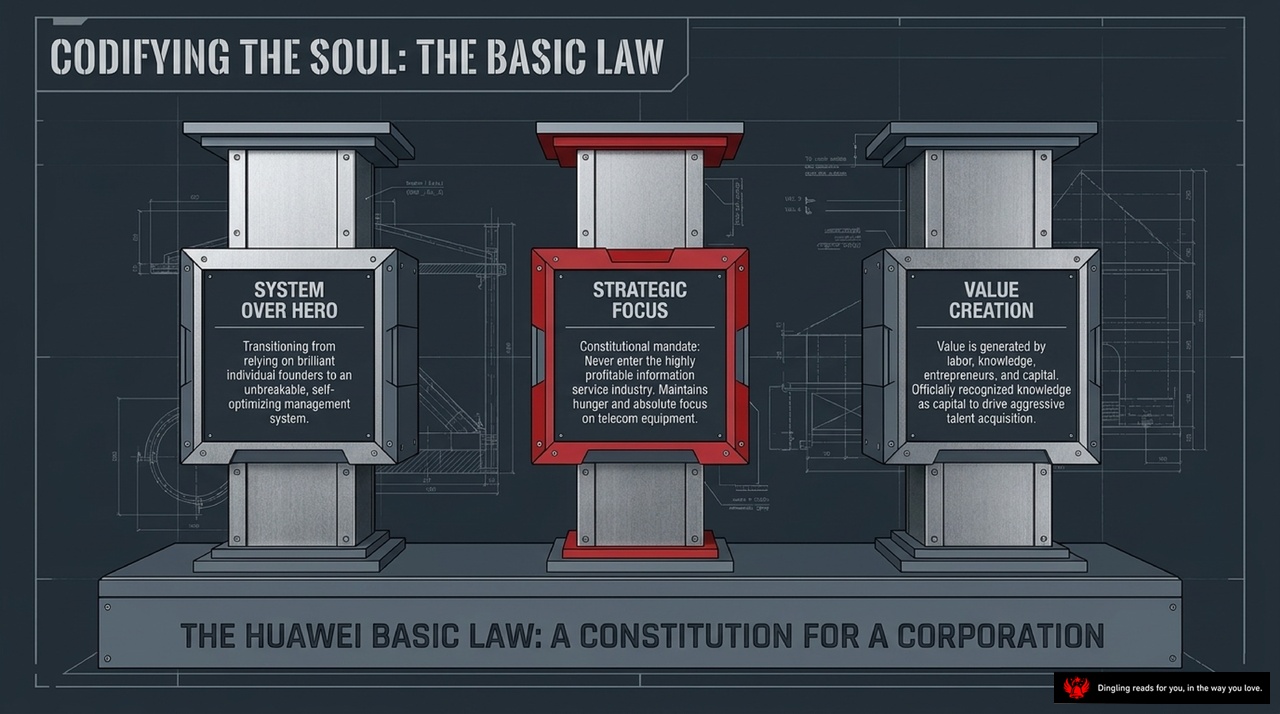
Codifying the soul: the basic law. This slide breaks down the three pillars that transformed Huawei from a small startup into a global powerhouse.
First, look at "System over Hero." This is about moving away from relying on a single brilliant founder to building an unbreakable, self-optimizing management system. It's the shift from personal charisma to institutional strength.
Next, we have "Strategic Focus." The core mandate here is clear: never enter the highly profitable information service industry. Instead, maintain a hunger and an absolute focus on telecom equipment. This discipline kept Huawei on its chosen path, avoiding the distractions of other lucrative sectors.
Finally, "Value Creation." Value is generated by labor, knowledge, entrepreneurs, and capital. Officially recognized knowledge is treated as capital to drive aggressive talent acquisition. This philosophy ensures that innovation and people remain at the center of the company's growth.
Together, these three elements form the Huawei Basic Law—a constitution for a corporation that guides every decision and defines the company's enduring soul.

Incentive Engineering isn't just about paying people; it's about fundamentally changing how they think about their work. Look at this circular diagram—it represents a powerful, four-stage engine that transforms employees from passive workers into active owners.
The journey begins at Stage 1 with Extreme Output. This is where employees endure high pressure and maximum dedication, pushing their limits to achieve results. But raw effort isn't enough; that's why Stage 2 introduces Uncapped Reward. By combining high base salaries with massive, performance-based bonuses, the company ensures that top performers are financially recognized for their contributions.
Once employees see the direct link between their effort and their income, Stage 3 kicks in with Virtual Equity. Top performers are granted stock options based on merit, giving them a real stake in the company's long-term success. This bridges the gap between being an employee and being a shareholder. Finally, Stage 4 solidifies this transformation through Shared Ownership. The founder dilutes their personal stake to transform thousands of employees into genuine shareholders, creating a unified collective front.
The synthesis insight here is clear: when employees act like owners, the resulting power is unmatched. This unified approach creates a fierce, motivated workforce that domestic rivals simply cannot match financially or culturally. It's a system designed to ensure that no one, not even the most dedicated contributor, ever loses out.

The image you see here perfectly captures the "Wolf Culture Ecosystem" that defines Huawei's DNA. It's not just a metaphor; it's the operating system for how Ren Zhengfei built a global giant from a small garage startup.
Let's break down these three core pillars. First, look at the "Pack Mentality." The graphic explains that success relies on coordinated team execution rather than solitary genius. In Huawei's early days, when they were facing massive odds against international giants, individual ego was the enemy. Ren famously subordinated personal ambition to the collective attack. He didn't want lone wolves; he needed a pack. This is why he could push his entire team to work 24-hour shifts in freezing conditions in Yiwu to debug equipment, or why he could make tough decisions like firing top executives during the "stir-frying cadres" event to keep the organization agile. In this ecosystem, the group always wins over the individual.
Next, notice the "Bloodthirsty Scent." This represents a hyper-sensitivity to market shifts and unarticulated customer needs. It's about smelling an opportunity before the competition wakes up. This instinct drove Huawei to enter markets others ignored, like the harsh terrains of Africa or the competitive landscapes of Eastern Europe. Whether it was responding to a telecom operator's complaint at 3 AM or spotting a gap in the enterprise network before Cisco fully realized it, Huawei's team was always scanning the horizon. They didn't just wait for orders; they hunted for them, anticipating needs that hadn't even been voiced yet.
Finally, there is "Resilience in the Cold." The image highlights the capacity to endure extreme hardship and grueling conditions. Think of the engineers sleeping under desks to accelerate R&D, or the team enduring the political and economic storms in Russia and the US. This resilience wasn't just about toughness; it was about survival. When the US imposed sanctions, when cash flow dried up, and when facing existential threats, the pack didn't scatter. They dug in. This endurance, exemplified by their "mattress culture" and unwavering commitment to zero defects, allowed them to outlast competitors who couldn't handle the pressure.
Together, these three elements—Pack Mentality, Bloodthirsty Scent, and Resilience in the Cold—created a formidable force. They transformed a group of strangers into a unified organism, capable of conquering any market, from the remote villages of Africa to the tech hubs of America. That is the true power of the Wolf Culture Ecosystem.

Look at this matrix titled "Domestic Conquest & Competitor Matrix." It visually maps the brutal battle for survival within China's telecom industry, plotting companies based on their reliance on government subsidies versus market forces, and their operational agility versus complacency.
On the left, in the zone of high government reliance and low agility, we see "The Fallen Giants": Great Dragon and Datang. The slide describes them as state-backed research institutes with a fatal flaw: arrogance and a refusal to adapt. They relied on past monopolies rather than future innovation, eventually getting left behind.
Contrast that with the red zone on the right: "The Survivors." Here sit Huawei and ZTE. Their profile is starkly different—market-driven and desperate for survival. The slide highlights Huawei's specific edge: massive R&D bets and an extreme obsession with customer service that allowed it to outpace ZTE's moderate approach, crowning it the domestic king.
This visual perfectly captures the lesson from the text: while giants like Great Dragon and Datang collapsed due to a rigid, state-dependent mindset, the survivors like Huawei thrived by embracing market forces, investing heavily in innovation, and relentlessly focusing on the customer. It's a clear divide between those who let the government carry them and those who had to fight to stay alive.

Look at this strategic map of Huawei's global expansion. We are seeing the evolution from "Third World Trench Warfare" to "Penetrating the Fortresses."
It all started in the volatile, low-margin markets of Africa, Latin America, and the Middle East. This was the phase of survival. While Western giants ignored these regions, Huawei entered, winning on rugged durability and aggressive pricing. They built initial global capital by enduring years of zero sales in places like Russia to establish a foothold, securing critical national transmission contracts through sheer persistence.
Once the foundation was set, Huawei moved to Western Europe—the true fortresses. Here, the target was Germany and the UK. The tactic shifted to out-hustling European incumbents with blistering reaction times. Huawei opened massive R&D centers and delivered highly customized service, turning local skepticism into trust. By targeting key players like British Telecom and Dutch telecom giants, they didn't just sell equipment; they integrated themselves into the very fabric of these nations' networks.
This phased approach—starting in the trenches, holding the northern foothold, and finally penetrating the fortresses—allowed Huawei to bypass the initial dominance of Western tech giants. They didn't try to conquer the world all at once; they conquered the margins first, used those resources to upgrade their technology, and then marched directly into the heart of the global market. This is the power of a patient, calculated, and relentless global campaign.
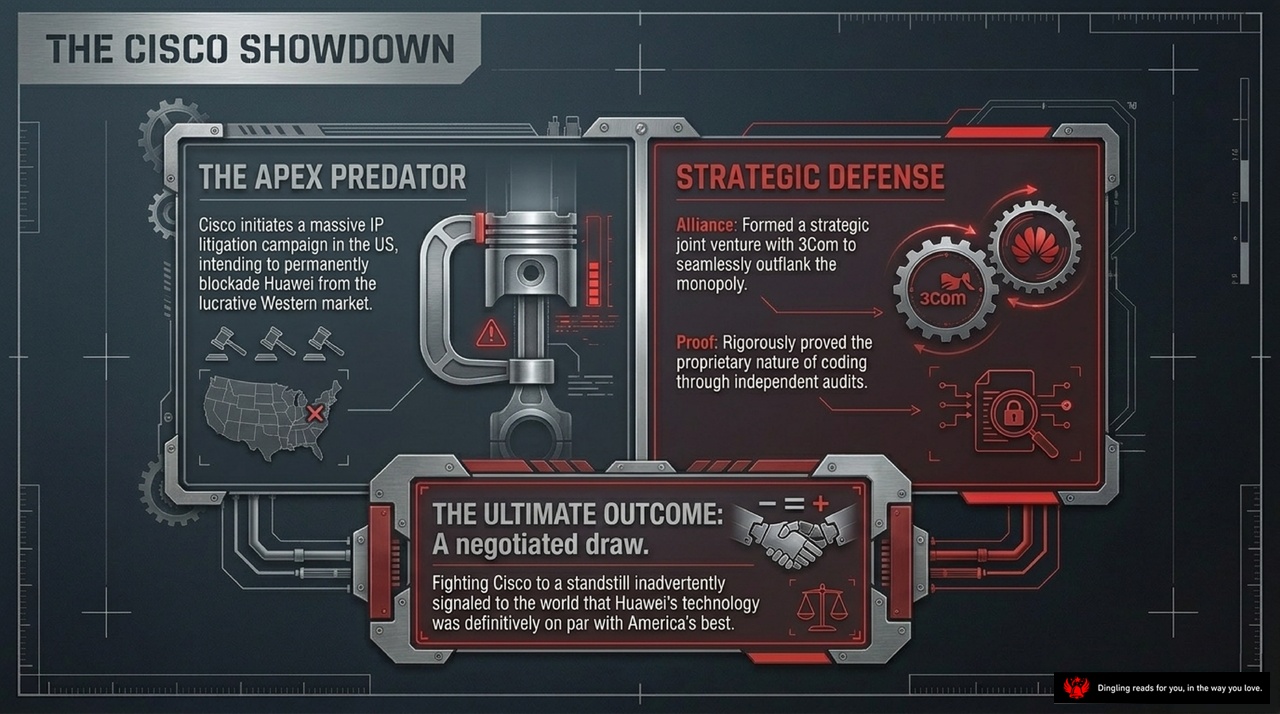
The Cisco Showdown: A Negotiated Draw.
On the left, we see "The Apex Predator." Cisco launched a massive IP litigation campaign in the US, aiming to permanently block Huawei from the lucrative Western market. But look at the "Strategic Defense" on the right. Huawei didn't just fight alone; they formed a strategic joint venture with 3Com to seamlessly outflank the monopoly. More importantly, they rigorously proved the proprietary nature of their coding through independent audits, turning the tables on the accuser.
The ultimate outcome, displayed at the bottom, was a negotiated draw. Fighting Cisco to a standstill inadvertently signaled to the world that Huawei's technology was definitively on par with America's best. This wasn't just a legal victory; it was a strategic masterstroke that validated Huawei's place on the global stage.
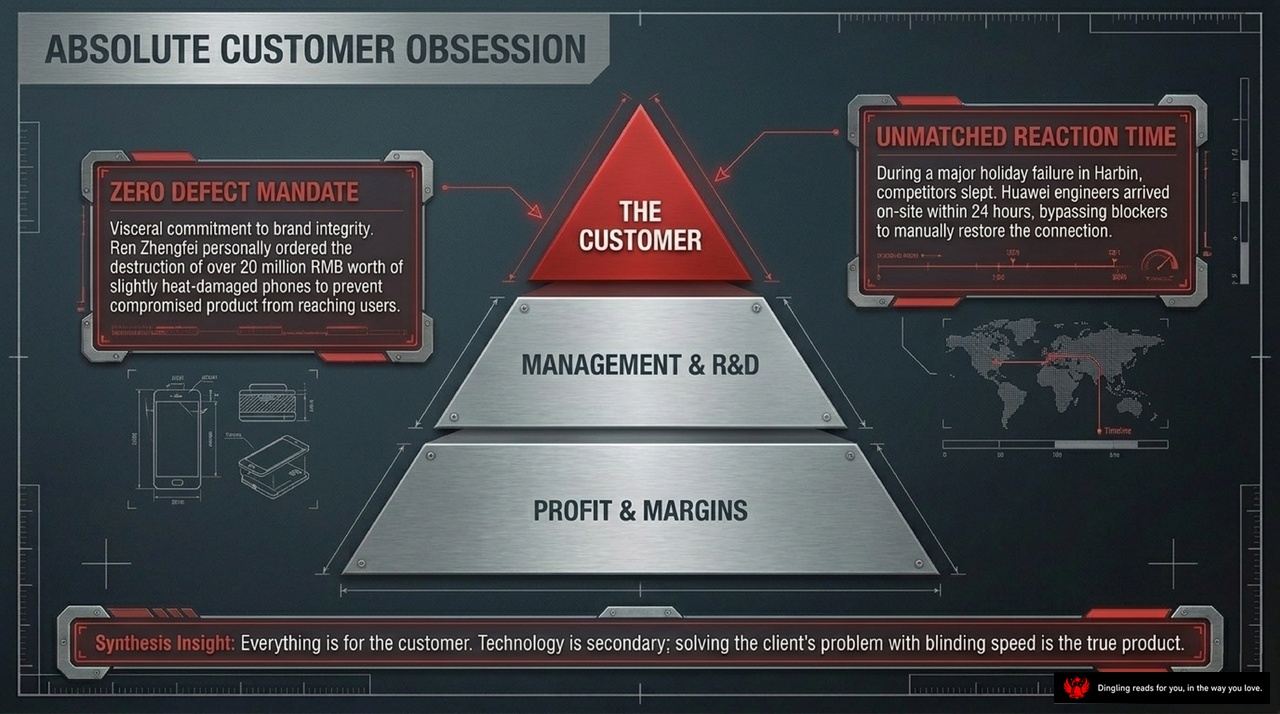
Absolute Customer Obsession isn't just a slogan; it's the operating system of Huawei. Look at this pyramid: at the very top sits the customer, with Management, R&D, and Profit all built beneath them to serve that single point. This is the "Zero Defect Mandate." We see Ren Zhengfei personally ordering the destruction of over 20 million RMB worth of phones simply because they were slightly heat-damaged. To him, a compromised product reaching the user is an unforgivable failure. It's a visceral commitment to brand integrity that costs money but saves trust.
On the other side, we have "Unmatched Reaction Time." While competitors slept during a major holiday failure in Harbin, Huawei engineers arrived on-site within 24 hours, bypassing blockers to manually restore the connection. This speed isn't just about logistics; it's the true product. As the synthesis insight at the bottom states: everything is for the customer. Technology is secondary; solving the client's problem with blinding speed is what actually wins the market. When you put the customer above profit and even above your own convenience, you build a fortress that no competitor can breach.
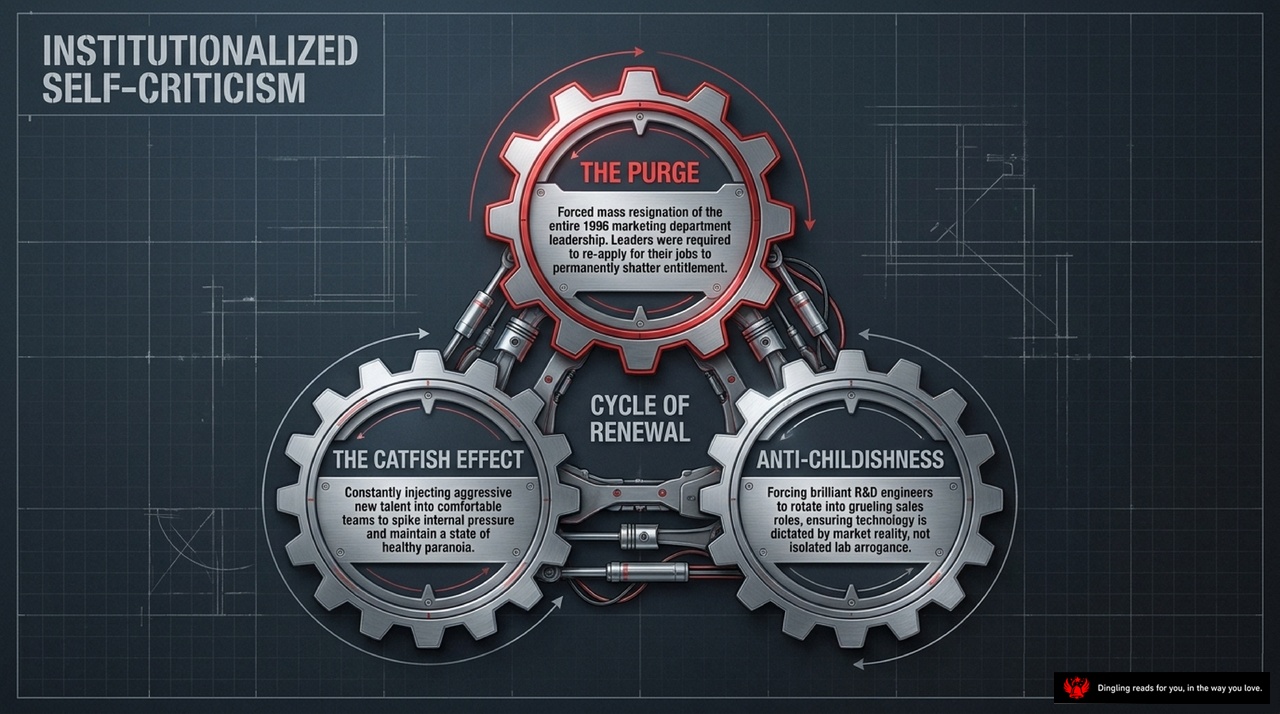
Institutionalized Self-Critism isn't just a slogan; it's a survival mechanism built into the very gears of Huawei's success. Look at this cycle of renewal: it starts with "The Purge." This wasn't about cruelty; it was a deliberate strategy to shatter entitlement. By forcing mass resignations and requiring leaders to re-apply for their jobs, Ren Zhengfei ensured that no one ever felt safe or comfortable. This constant disruption prevents stagnation and keeps the organization hungry for improvement.
Driving this engine is "The Catfish Effect." Huawei constantly injects aggressive new talent into comfortable teams, creating a state of healthy paranoia. This external pressure forces internal teams to spike their performance, ensuring that complacency never takes root. It's a reminder that comfort is the enemy of innovation.
Finally, we have "Anti-Childishness." This is about forcing brilliant R&D engineers out of their ivory towers and rotating them into grueling sales roles. Why? To ensure that technology is dictated by market reality, not isolated lab arrogance. By grounding their engineering in the messy reality of customer needs, Huawei avoids building products nobody wants.
Together, these three mechanisms form a powerful flywheel. It's a system designed to kill the comfortable and empower the adaptable, ensuring that Huawei remains a relentless force in a changing world.

The paradoxical leader embodies a fascinating duality, perfectly illustrated by the contrast between the Corporate General and the Humble Civilian. On one side, we see the aggressive, visionary force willing to bet billions on digital switching and cloud computing, cultivating a fierce, unrelenting culture to drive explosive growth. Yet, on the other side lies the deeply unselfish, low-profile figure who refuses the spotlight, takes public taxis, and eats from a standard tray in the communal canteen. This isn't a contradiction; it is a deliberate strategy. As the synthesis insight reveals, true leadership involves building an invincible system first, and then deliberately stepping back into the shadows. By creating a robust structure that outlives the hero, the leader ensures the organization's longevity, proving that the greatest act of strength is knowing when to let go of the center stage.
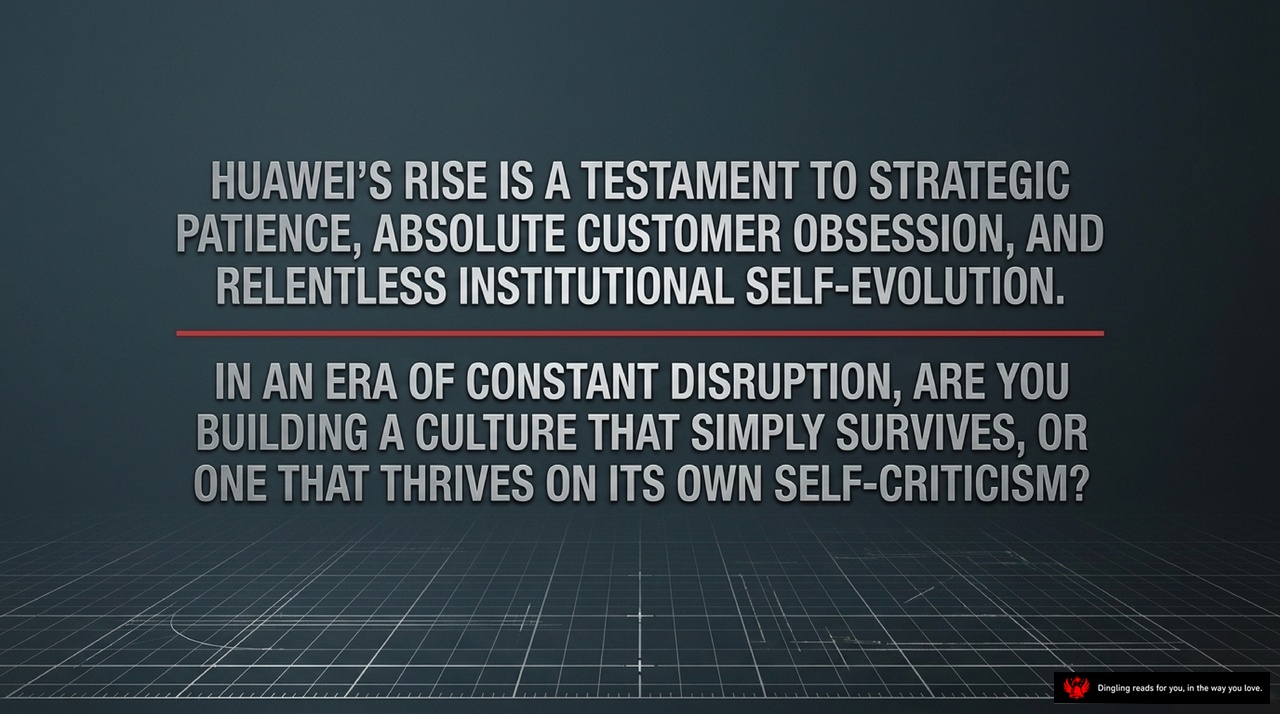
Huawei's rise isn't just a story of luck; it's a powerful testament to three core pillars: strategic patience, an absolute obsession with the customer, and a relentless drive for institutional self-evolution. In an era defined by constant disruption, the real question isn't whether you can survive the storm, but whether you've built a culture that thrives on its own self-criticism.
Look at the evidence in the text. When facing the "Century Lawsuit" against Cisco, Huawei didn't just defend itself; they pivoted. They realized that to win, they had to stop being just a technology company and become a market-driven one. This meant adopting IPD—Integrated Product Development—from IBM, fundamentally changing how they built products to match customer needs. Later, when their supply chain efficiency lagged behind global standards, Ren Zhengfei didn't ignore the gap. He made the painful decision to restructure, merging departments and introducing outsourcing to achieve zero inventory and week-long delivery.
This is the essence of "self-evolution." It's about admitting when you are wrong and changing course immediately. Huawei learned that relying on past glory, like the success of their early switches, was a death sentence. They constantly challenged their own "wolf culture," realizing that an overly aggressive mindset could burn out their people. So, they shifted from pure "wolf" tactics to a more human-centric approach, valuing employee well-being alongside fierce competition.
Ultimately, this journey proves that in a volatile world, the companies that last are those that never stop questioning their own methods. Are you building a fortress to hide in, or a ship capable of evolving as the ocean changes? That choice defines whether you simply survive or truly thrive.