
Blink: Complete Chapter-by-Chapter Summary

Welcome to Blink by Malcolm Gladwell. Imagine a city street captured inside a human eye, symbolizing how our minds process the world in split-second glances. This book explores the hidden power of thinking without thinking. While we often rely on months of rational analysis to make big decisions, Gladwell argues that our subconscious can often deliver better answers in mere seconds. From art experts spotting fakes in two seconds to psychologists predicting marriage outcomes from fifteen minutes of conversation, the evidence is clear: sometimes, trusting your instinct is smarter than overthinking. We aren't just reacting randomly; we are using an adaptive unconscious that scans for patterns and signals faster than our conscious mind ever could. But this power isn't without risks, as we'll see when intuition gets hijacked by bias. So, let's dive into the fascinating world of the blink.

On the left, we see the story of the Getty Kouros, a masterpiece that took a team of lawyers, geologists, and scientists over 14 months to authenticate. They ran every test, analyzed the marble, and concluded it was a genuine 6th-century BC statue. But on the right, look at that timer: just two seconds. That's all it took for world-class art historians to feel a sudden, gut-wrenching repulsion the moment they saw it. They were right; the statue was a fake.
This is the core mechanism at play here: thin-slicing. It's our unconscious ability to find patterns and behaviors based on very narrow slices of experience. While the experts spent a year gathering massive data, these historians relied on rapid cognition. Their brains instantly processed subtle cues—the awkward fingering, the "too new" feel, the lack of burial marks—that the slow, logical analysis eventually missed.
This slide teaches us a powerful lesson: sometimes, a split-second intuitive judgment can be far more accurate than months of rational analysis. Our subconscious is a high-speed processor, constantly scanning for the truth, even when our conscious mind hasn't caught up yet.

Imagine your brain as a locked room, a high-speed supercomputer running in the background while you sleep. This is the Adaptive Unconscious, and it’s doing the heavy lifting for you.
First, it’s Fast and Frugal. It processes massive amounts of data silently and instantly, far faster than your conscious mind ever could. You don't feel it happening, but it's constantly analyzing your environment.
Second, this information is Unreachable. Think of that locked door in the diagram. You might know something is wrong or feel a sudden intuition, but you can't consciously explain *why* you know it. You simply can't access the logic behind your gut feeling.
Finally, this system speaks through Physiological Tells. Your body reacts before your brain does. We see this clearly in the Iowa Gambling Task, where players' palm sweat glands reacted to dangerous decks 70 cards before they consciously figured out the game.
This is the power of the locked room: it makes split-second decisions based on patterns your conscious mind has missed, guiding you toward safety or truth before you even realize you've made a choice.

Imagine you are walking into a professor's office for a simple language test. You're given a string of words like "worry," "Florida," "old," and "lonely." You scramble to make sentences, completely unaware that these specific words are secretly priming your brain to think about aging. When you finally walk out, your subconscious has already done its work: your steps are noticeably slower than when you walked in. You didn't choose to move like an elder, but your brain did it for you.
This is the power of the adaptive unconscious. It's a hidden processor that shapes our behavior long before our conscious mind even notices. The same thing happens with politeness. If you're subconsciously primed with words like "respect" and "thankful," you'll wait patiently in line. But if you're primed with "rudeness," you'll cut in line within minutes. We often think we are in control, but we are actually following a script written by invisible cues.
But here's the catch: this rapid, intuitive thinking isn't always perfect. Sometimes, it traps us in the "Warren Harding Illusion." We might judge a candidate as a future president just because they look handsome and sound deep, ignoring the fact that they lack substance. Our brains are wired to take shortcuts, and sometimes those shortcuts lead us straight into bias.
So, how do we navigate this? We can't just rely on our gut. We need to understand that our instant judgments are often based on incomplete data or hidden biases. By recognizing when our subconscious is hijacking our decisions, we can pause, reflect, and make choices that are truly in our best interest.

Imagine you are sitting in a professor's office, tasked with a simple word puzzle. You grab four words from a list of five—maybe words like "Florida," "gray," or "bingo"—and scramble them into sentences. You finish the test, feel relieved, and head out the door. But here is the twist: when you walk down the hallway afterward, you are walking significantly slower than when you entered. You didn't know it, but those subtle words had already hijacked your behavior, nudging your adaptive unconscious to think about aging.
This slide illustrates a powerful truth: **The Subconscious is a Servant to Context**. Our behavior is often not a choice we make consciously, but a reaction to invisible environmental cues. Look at the flow here: **The Input** consists of exposure to words associated with aging, which feeds into **The Subconscious Black Box**. This box absorbs the context without notifying your conscious mind, acting like a silent processor. The result is **The Output**: you physically slow down.
The lesson is stark and humbling. We are constantly on autopilot, and our free will is highly susceptible to external priming. We think we are in control, but subtle environmental triggers are constantly steering our actions, proving that our "choices" are often just responses to the world around us.

Imagine a military exercise where one side wins by relying on complex data, while the other wins by trusting their gut. In the 2002 "Millennium Challenge," the Blue Force, representing the US military, spent $250 million building a perfect digital war room. They used advanced systems to analyze every detail of the Red Force, believing that more information meant better decisions. They were right to value data, but they fell into a trap: they got lost in the noise.
In contrast, the Red Force, led by General Van Riper, rejected the computer's logic. He trusted his soldiers to make spontaneous decisions under pressure. When the Blue Force destroyed the Red Force's communication towers, they assumed the enemy was paralyzed. But Van Riper used messengers and hand signals, completely bypassing the Blue Force's sensors. The result was shocking: the Blue Force, drowning in analysis, was crushed by a small, flexible team that reacted instantly.
This failure teaches us a critical lesson about thin-slicing. The Blue Force tried to understand everything, which actually blinded them to the real threat. They were like the doctors in the hospital case we discussed earlier—collecting too many symptoms and missing the heart of the problem. The Red Force, however, knew that in a chaotic environment, you can't analyze everything. You have to focus on the essential goal and let your subconscious handle the rest.
This is the power of spontaneous behavior. It's not about ignoring logic; it's about using logic to set a clear direction, then trusting your intuition to navigate the details. Think of it like improvisational theater. Great improvisers don't plan every line; they accept whatever happens and react instantly. That same "yes, and" mentality allowed the Red Force to adapt and win.
But here's the catch: this rapid cognition only works if you aren't misled by superficial distractions. Remember the Warren Harding error? We often let our brains trick us with surface-level cues. In the military exercise, the Blue Force trusted their "perfect" data, but they failed to see the human element—the enemy's creativity and adaptability.
So, how do we avoid this trap? We need to create "white space." Just as we saw in the courtroom drama, time pressure forces us into a narrow, instinct-driven mode where we lose the ability to read people or situations accurately. By slowing down, by creating a moment of pause, we allow our conscious mind to check our instincts. We filter out the noise and focus on what truly matters.
The real skill isn't just reacting fast; it's knowing when to trust your gut and when to step back and think. In a world overflowing with data, the ability to simplify, to spot the few key signals that matter, and to act on them without hesitation, is the ultimate competitive advantage. Don't let the complexity of the moment drown out your intuition. Trust your training, trust your team, and trust that sometimes, the best decision is the one you make before you have all the answers.
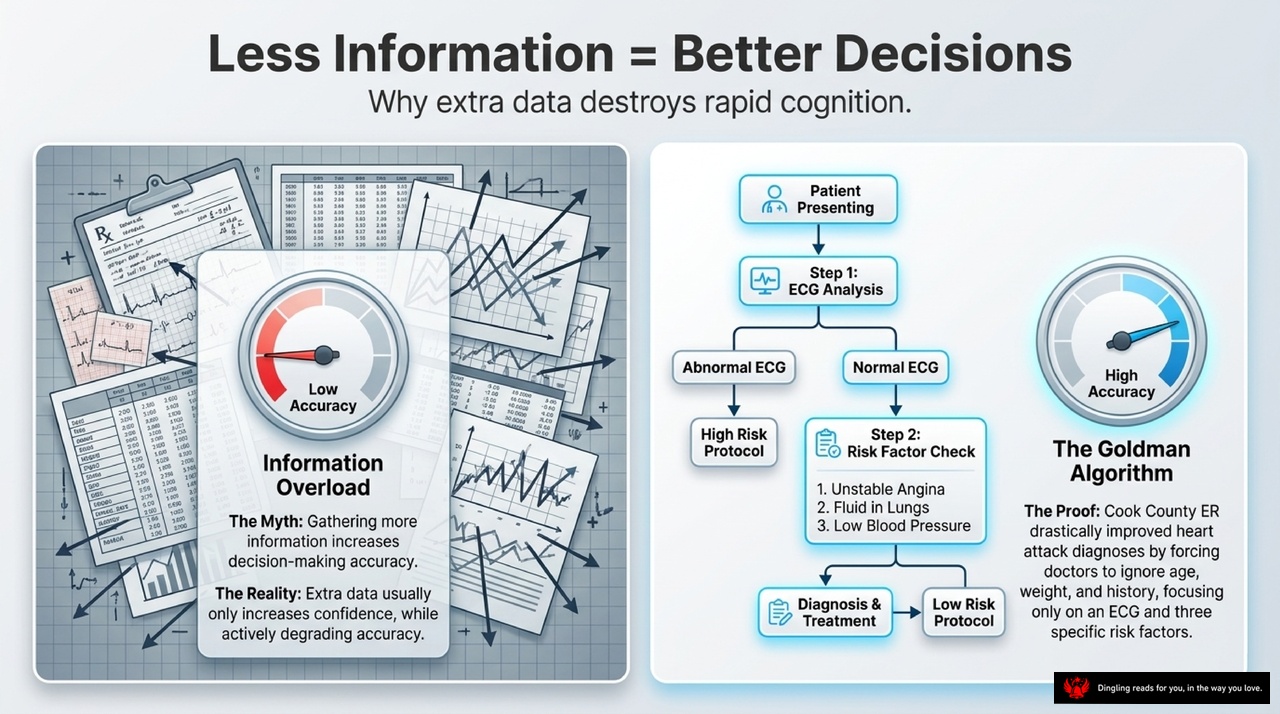
Imagine a world where the best decisions aren't made by gathering endless data, but by knowing exactly what to ignore. This slide challenges the modern obsession with "information overload." On the left, we see the trap: a chaotic pile of charts, graphs, and medical records drowning us in noise. The text warns us that the myth of "more data equals better accuracy" is actually a lie. In reality, extra information often inflates our confidence while actively degrading our actual accuracy. It's like trying to navigate a storm by staring at a map that keeps changing every second.
But look at the solution on the right: The Goldman Algorithm. This is the power of simplicity. Instead of analyzing a patient's entire life history, age, or weight, this system strips everything away. It focuses on just three critical risk factors: unstable angina, fluid in the lungs, and low blood pressure. By combining this with a simple ECG check, doctors can predict heart attack risks with near-perfect accuracy. The gauge on the far right shows "High Accuracy"—a stark contrast to the "Low Accuracy" caused by information overload on the left.
This isn't just about medicine; it's about the art of rapid cognition. The proof lies in Cook County ER, where forcing doctors to ignore age and history and focus only on these specific signals drastically improved diagnoses. It teaches us a profound lesson: sometimes, the fastest way to the truth is to look at less. By filtering out the noise and focusing on the few signals that truly matter, we can make decisions that are not only faster but far more reliable than any complex analysis could ever be.

Imagine your brain as a high-speed processor that never stops working, even when you think you're just sitting still. It's constantly scanning the world, making split-second decisions before you even have time to blink. But here's the catch: this incredible ability isn't always perfect. Sometimes, our brain gets tricked by the very environment we're in.
Consider this experiment: walk into a professor's office and complete a simple word puzzle. Now, before you leave, you'll notice something strange—your walk will feel noticeably slower. Why? Because the words you just used, like "old," "gray," and "lonely," didn't just sit on the page. They slipped directly into your adaptive unconscious, the part of your brain that handles instant reactions. Your brain didn't consciously decide to walk slowly; it simply reacted to the subtle cues it absorbed, guiding your behavior without you ever knowing.
This isn't about mind control; it's about how easily our intuition can be shaped by invisible signals. We often believe we are the masters of our choices, but in reality, our subconscious is constantly pulling the strings. When we try to explain these automatic reactions, we often invent stories that don't match the truth. We think we chose to walk slowly because we were tired, but the real reason was those few words on a piece of paper.
The lesson is clear: our instant judgments are powerful tools, but they are fragile. They can be hijacked by context, bias, and hidden influences. To make better decisions, we need to be aware that our intuition isn't always objective. We must learn to question our first impressions and understand that sometimes, the most obvious answers are actually the ones our brain is trying to trick us into seeing.

Who Should Trust Their Blink? The architecture of expert intuition.
Today's slide breaks down the critical difference between how novices and masters process their gut feelings. Look at the first dimension: First Reaction. Novices are driven by familiarity, often confusing "different" with "bad." Think of hating a new chair design just because it looks unfamiliar. Experts, however, are driven by deep patterns. They can distinguish a genuinely bad product from something that is simply innovative.
Next, consider Vocabulary. Novices lack the terminology to explain their physical sensations, leaving them stuck with vague feelings. Experts possess an extreme vocabulary to decode the subconscious, much like professional food tasters. Then, look at The Locked Room. For the novice, this mental space is empty, defaulting to superficial societal biases. For the expert, it is filled with thousands of hours of conscious training and observation.
Finally, the actionable advice is clear. Do not trust a novice's immediate reaction to disruptive innovation. Instead, trust the expert's blink. Their subconscious is highly calibrated, allowing them to see what others miss.
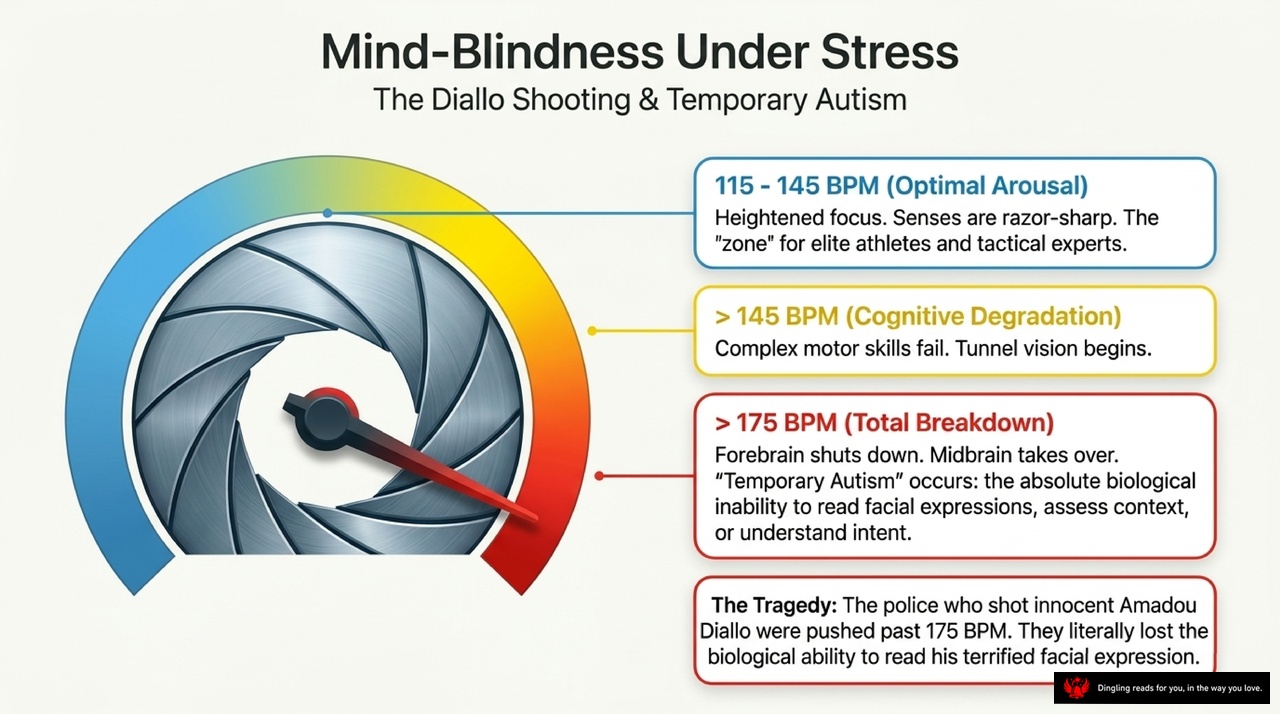
Mind-Blindness Under Stress. This slide visualizes the terrifying biological switch that flips when our heart rate crosses a critical threshold. Look at that dial. Up to 145 beats per minute, we are in the zone—heightened focus, razor-sharp senses. But once we push past 175 BPM, something catastrophic happens. The prefrontal cortex, our seat of reason and empathy, literally shuts down. The midbrain takes over, triggering what experts call "temporary autism."
In this state, we lose the biological ability to read facial expressions, assess context, or understand intent. We become blind to human nuance, seeing only a threat. This wasn't just theory; it was the reality in the tragic shooting of Amadou Diallo. The officers involved weren't necessarily racists by design, but the chase had pushed their heart rates past that 175 BPM breaking point. In those few seconds, their brains were hijacked by a survival mode so primal they couldn't see Diallo's terrified face. They didn't just misinterpret his actions; they lost the capacity to interpret them entirely. This is the danger of stress-induced mind-blindness: when the noise of fear drowns out the signal of humanity, tragedy becomes inevitable.

Under extreme pressure, our brains don't just slow down—they literally shut off the part responsible for thinking and start acting like animals. When a threat looms, the prefrontal cortex goes offline, and we enter a "fight-or-flight" mode that feels like an argument with a dog. In this state, vision narrows, logic vanishes, and we become blind to evidence that contradicts our fears.
This is exactly what happened on that fateful night in the Bronx. Four officers, heart rates spiking past 175 beats per minute, mistook a man simply checking his pocket for reaching for a gun. They weren't racists by nature, but the stress had hijacked their ability to read the situation. They saw a weapon where there was none, just as we all might when we're terrified.
The solution? Create "White Space." This isn't just physical distance; it's the crucial gap between a threat and a response that gives our subconscious time to process reality instead of panic. Research shows that slowing down is the only way to override these deep-seated biases. Even in high-stakes situations like police work, creating that extra second of space allows us to switch from a rigid, animalistic reaction back to a human, thoughtful judgment. We can't control our instincts, but we can engineer the environment to give them a better chance to be right.

Imagine a woman standing behind a screen, playing her instrument. She is invisible to the judges, yet her music is heard clearly. This image captures the essence of "Controlling the Aperture"—fixing a broken system by filtering out the noise that distorts our judgment.
For decades, classical orchestras were rife with bias. Conductors couldn't separate what they saw from what they heard. They saw a woman and subconsciously assumed she lacked the power or technique for a "masculine" instrument like the tuba. The result was stark: women made up only 5% of major orchestras.
The solution was surprisingly simple but profound: blind auditions. By placing a physical screen between the musician and the judges, the orchestra eliminated the visual cue. Suddenly, talent became the only variable. The results were explosive. Within a few years, the percentage of women in major orchestras jumped from 5% to nearly 50%.
This isn't just about music; it's a lesson for all of us. We cannot magically erase our implicit biases. Our brains are wired to make rapid, often flawed, snap judgments based on surface-level information. But we *can* design our environments and processes to filter those biases out. Whether it's a hiring interview, a medical diagnosis, or a courtroom verdict, the lesson remains the same: if we want to see talent and truth clearly, we must control the aperture. We need to build the screens that separate the signal from the noise, allowing us to judge based on merit alone, not on who we think someone is.

When our subconscious mind dictates our reality in the blink of an eye, what are you doing to program yours? This isn't just a rhetorical question; it's the core challenge we face every single day. Our split-second decisions are only as good as the training we give them and the environments we place them in.
Think about the tragic events that unfold in mere seconds, like the fatal shooting in the Bronx where a young man was misinterpreted as a threat. In those heart-stopping moments, the officers' brains entered a high-alert "fight or flight" mode. Their vision narrowed, their logic froze, and they relied entirely on rigid, instinctual patterns rather than actually reading the situation. They saw a gun where there was none, and a neutral glance where there was curiosity. This is what happens when we fail to train our intuition properly.
We often assume our gut feelings are infallible, but they are merely reflections of our past experiences and current biases. If we feed our subconscious fear, prejudice, or noise, it will generate dangerous realities for us. However, we have the power to change this. By actively removing blinding biases and unnecessary noise from our environment, we can master the extraordinary power of rapid cognition.
The lesson is clear: you are the architect of your own reality. Every time you make a snap judgment, you are either reinforcing a harmful pattern or building a more accurate one. The question remains for you to answer: are you intentionally programming your mind to see the truth, or are you letting it run on autopilot, driven by hidden assumptions and untrained instincts?