
Blink: The Power of Thinking Without Thinking: Complete Chapter-by-Chapter Summary
Ever had a gut feeling that hit you like a lightning bolt—maybe about a person, a choice, or even a fake painting? Malcolm Gladwell’s Blink is all about those split-second decisions: the power of thinking without thinking. It dives into how our brains process tiny, crucial slices of information in the blink of an eye—sometimes with brilliant accuracy, other times with fatal flaws. From art experts spotting forgeries in a glance to doctors diagnosing issues before test results come back, Gladwell unpacks why these quick judgments work, when they fail, and how we can learn to trust (or question) that quiet voice in our heads. Let’s explore the hidden science behind the decisions we make without even realizing it.
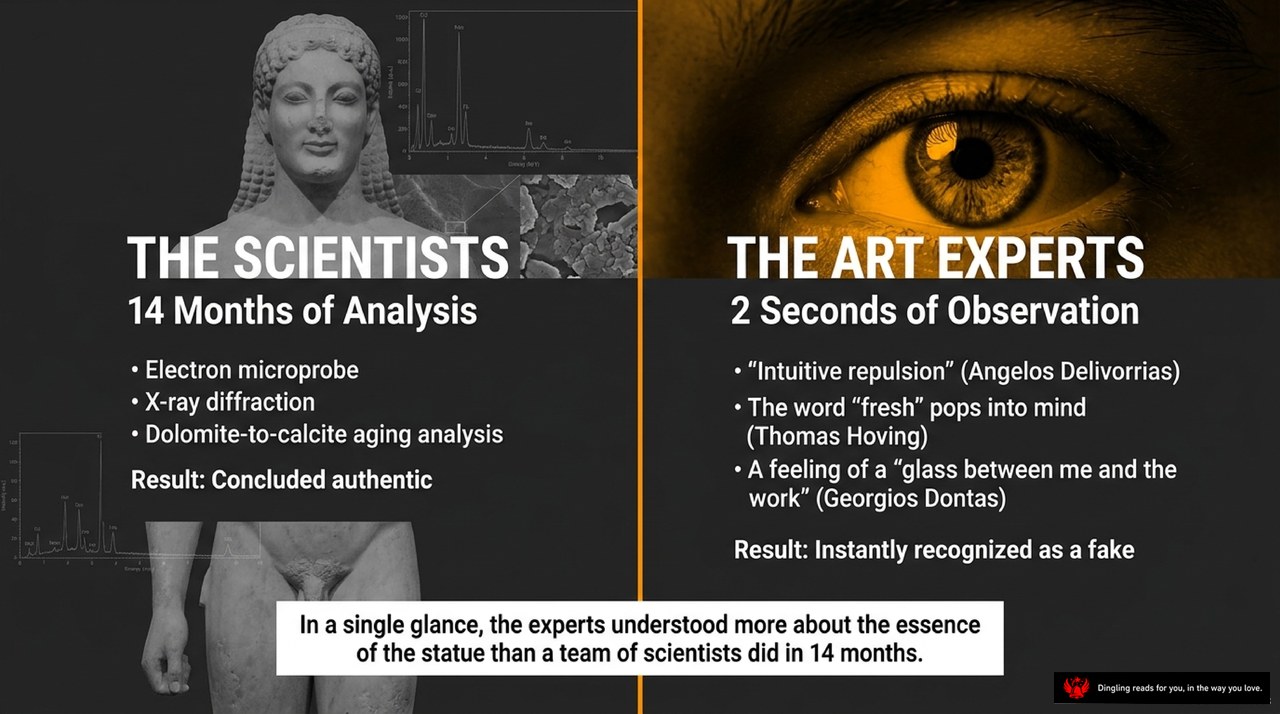
Let me set the scene for you. A team of scientists spends 14 whole months putting a Greek statue under every test imaginable—electron microprobes, X-ray diffraction, even studying how dolomite marble turns to calcite over centuries. Their verdict? It’s the real deal, a rare masterpiece from 6th-century BC. But then, a group of art experts walks in, glances at it for two seconds, and says, “That’s a fake.” How does that happen?
The Getty Museum thought they had all the proof. They checked the marble (from Samos island, just like ancient Greek statues), the calcite layer (which takes hundreds of years to form naturally), even the ownership history (a Swiss doctor had it since the 1930s). For 14 months, every scientific test screamed “authentic.”
But the experts? They didn’t need labs. Angelos Delivorrias felt an “intuitive repulsion” the second he laid eyes on it. Thomas Hoving? The word “fresh” popped into his head—like it was just carved yesterday, not 2,000 years old. Georgios Dontas said it felt like there was a “glass between me and the work” — something was off about its connection to the past. These weren’t random guesses; they were years of studying every tiny detail of Greek art—how nails are shaped, the subtle wear of age—kicking in in an instant.
As the slide puts it: In a single glance, the experts understood more about the essence of the statue than the scientists did in 14 months. That’s thin-slicing—our brain’s ability to take a tiny snippet of info (a two-second look) and make a spot-on call, thanks to deep, unconscious expertise.
Later, we found out the experts were right. The statue was a fake, made with old marble but carved recently. The scientists missed the small, essential details the experts saw immediately. This isn’t about bashing science—it’s about realizing that sometimes, our fast, intuitive judgments (when built on real knowledge) can be more accurate than slow, data-heavy analysis. Makes you think, doesn’t it? What else are we missing when we only trust numbers over our gut?
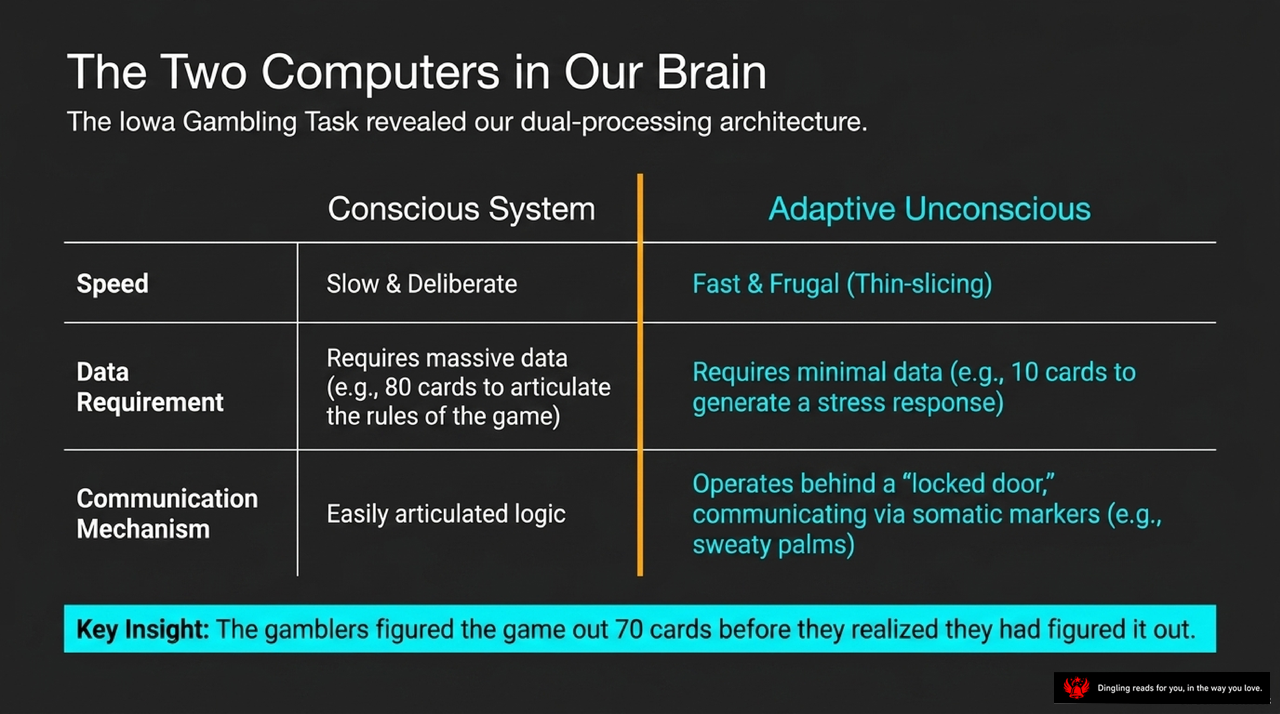
Have you ever had a gut feeling that something was off, even if you couldn’t put it into words? That’s your brain’s two systems at play—like having two computers running side by side, as the Iowa Gambling Task revealed.
Let’s break down that task. Participants were given four decks of cards: some offered big immediate rewards but came with huge hidden losses, others had smaller consistent wins with minimal risks. The conscious system—our slow, deliberate computer—needs a ton of data to make sense of things. It took most people about 80 cards to consciously articulate why the safer decks were better. That’s the part of your brain that writes the “why” behind your choices, using clear, easily explained logic.
Then there’s the adaptive unconscious—our fast, frugal system that does thin-slicing. It doesn’t need mountains of data; just 10 cards were enough for it to pick up on the risky patterns. How does it communicate? Through somatic markers—physical cues like sweaty palms or a tightness in your chest. It operates behind a “locked door”; you don’t see the calculations, but you feel the result.
The key insight here is mind-blowing: Gamblers actually figured out the game 70 cards before they realized they had. Their unconscious had already flagged the risky decks (hello, sweaty palms!) after just 10 cards, but their conscious mind needed 70 more to catch up and turn that intuition into words.
This isn’t just a lab trick—it’s how we navigate daily life. When you meet someone and instantly click (or not), that’s your fast system. When you later explain why you liked them, that’s your slow system. Understanding these two systems helps you trust your gut when it matters, but also know when to slow down and analyze. It’s all about balancing those quick, instinctual calls with the thoughtful, deliberate ones.
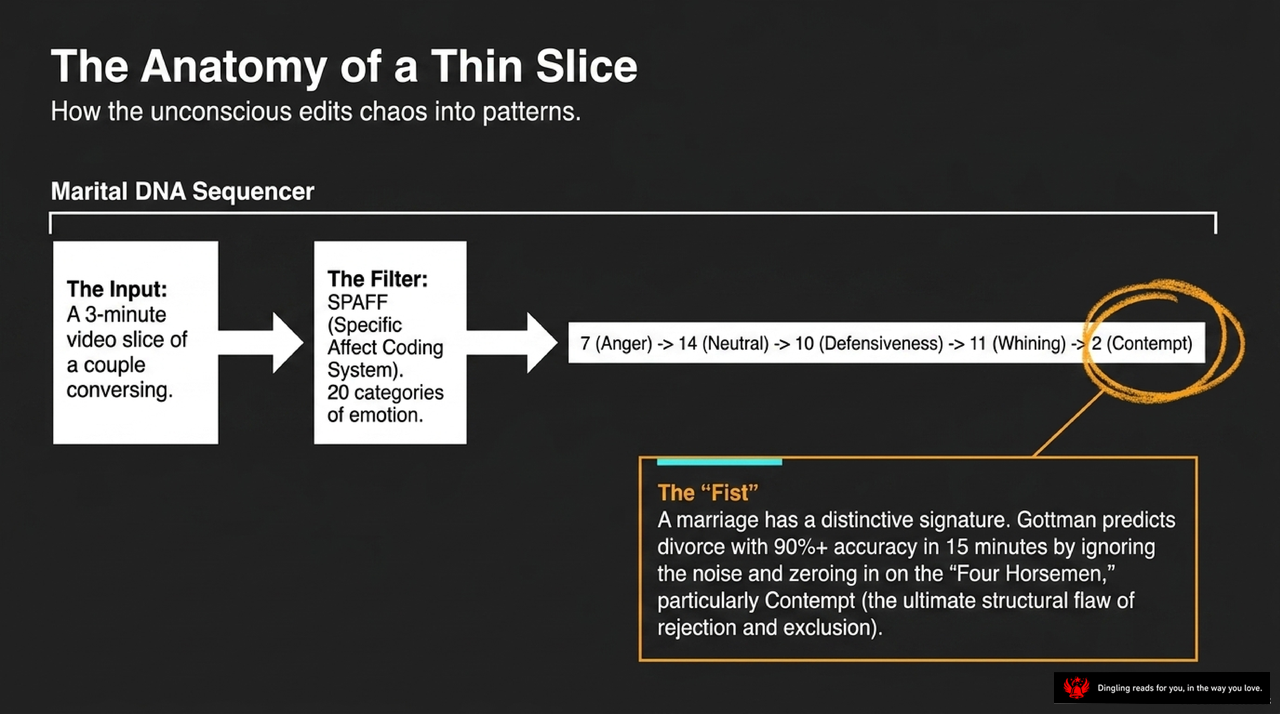
Ever wondered how a relationship expert can tell if a couple will stay together or split—just by watching them chat for 15 minutes? That’s exactly what psychologist John Gottman did in his famous “Love Lab.”
He brought couples in, hooked them up to sensors (tracking heart rate, sweat, even how much they fidgeted), and asked them to talk about a conflict—like Bill and Susan, who bickered over whether to keep their big puppy. Then, his team used this coding system called SPAFF to label every single emotion in their conversation: anger was 7, defensiveness 10, that eye-roll you do when your partner’s being ridiculous? That’s contempt—code 2, and it’s a huge red flag.
Here’s the mind-blowing part: Gottman could predict divorce with over 90% accuracy after just 15 minutes of watching. Even 3 minutes was enough for a pretty solid guess. How? Because he focused on thin slices—those tiny, revealing moments that tell the whole story of a relationship.
He found that happy marriages need at least five positive interactions (like laughing, listening, or saying something kind) for every one negative one. If that ratio drops, the relationship starts to crumble. And the worst of the worst? Contempt. It’s that feeling of superiority—like you think your partner’s beneath you. Gottman says it’s the number one predictor of divorce. Worse, it’s bad for your health too—people who feel contempt often have weaker immune systems.
Take Bill and Susan: Bill was defensive, using “yes but” all the time, and Susan kept rolling her eyes (that’s contempt). Those small moments aren’t just silly arguments—they’re cracks in the foundation.
So what’s the takeaway? It’s not about never fighting. It’s about how we fight. Those split-second reactions, the tiny gestures—they’re the thin slices that show what our relationships are really made of. And once we notice them, we can start to fix things before it’s too late.
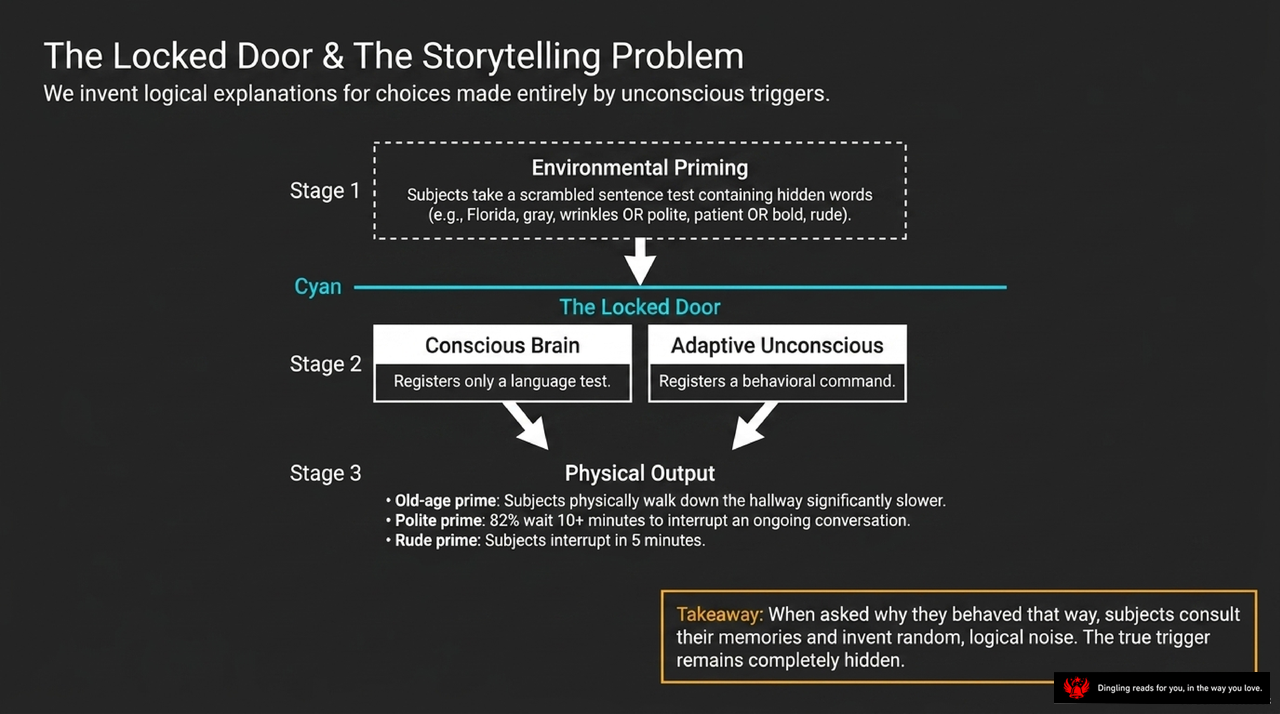
Ever caught yourself doing something and thinking, “Why did I just do that?” Today we’re diving into two fascinating concepts: the locked door between our conscious and unconscious minds, and the storytelling problem that follows.
First, let’s talk about environmental priming. Imagine you’re taking a scrambled sentence test—you’re focused on arranging words like “gray,” “wrinkles,” or “polite” into coherent phrases. What you don’t realize is those words are secretly sending signals to your brain.
That’s where the locked door comes in. Your conscious brain thinks it’s just a language exercise. But your adaptive unconscious? It’s picking up those hidden words as a behavioral command. It’s like a secret channel your unconscious uses, but your conscious self is totally in the dark.
The result? Physical actions you can’t explain. If the words primed old age, you might walk down the hallway way slower than normal. If they primed politeness, 82% of people would wait 10 minutes or more to interrupt a conversation. Rude words? You’d cut in after just 5 minutes.
But here’s the twist: when someone asks why you acted that way, you don’t mention the scrambled words. Instead, you make up a logical story. Maybe you say “I was feeling tired” or “I wanted to be respectful.” You pull reasons from your memory to create a coherent explanation, even though the real trigger is hidden behind that locked door. Our brains hate uncertainty, so we fill in the gaps—even if those gaps are with made-up reasons.
This is the storytelling problem: we invent logical explanations for choices driven entirely by unconscious triggers, and we don’t even know we’re doing it. The true cause stays locked away, while we spin tales to make sense of our own actions.
Have you ever written something off just because it looked weird? Let’s talk about the Aeron chair—you know, that mesh office chair you see in every modern workspace now. When Herman Miller first designed it in the 90s, it was anything but conventional: no plush padding, just a sleek, insect-like frame with breathable mesh. Early testers hated it—they called it the “death chair” and gave it a comfort score of 4.75 out of 10. Even after the team fixed the comfort issues, people still thought it was ugly, giving it an aesthetics score of 6. But Herman Miller took a leap of faith and launched it anyway.
What happened next? It slowly gained traction in design circles, won a slew of awards, and eventually became their best-selling chair ever. Now, people think it’s stylish—its aesthetics score has jumped to 8. Why the shift? Regular folks judged it by its appearance at first, but experts recognized its ergonomic brilliance.
This connects to a fascinating strawberry jam experiment. When regular people were asked to explain why they liked a particular jam, their judgments got worse—they started using vague terms like “texture” to justify their choices, and their picks didn’t align with experts. But experts, who had trained their taste buds over years, could trust their intuition without overanalyzing.
Then there’s Kenna, a musician with a unique mix of 80s new wave and hip-hop. Industry pros loved him—his low-budget music video got 475 plays on MTV2, and fans sang along at his shows. But market research said his music had no core audience. The problem? The data confused his novelty with being bad.
The lesson here? First impressions can be deceiving, especially if we’re not experts. But trained intuition—like the experts who saw the Aeron’s value or Kenna’s potential—can cut through superficial judgments. Sometimes, you have to look beyond the surface to see the real worth.
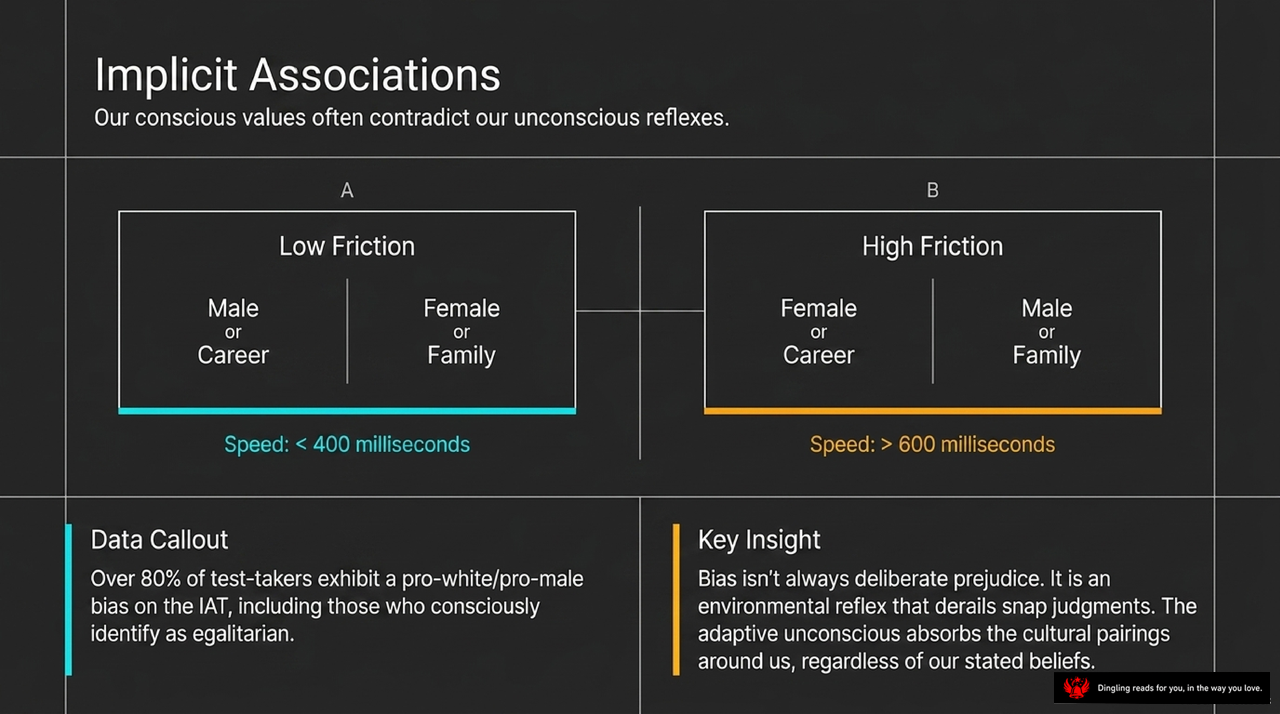
Let’s dive into implicit associations—those quiet, hidden connections our brains make without us even noticing. The slide hits it right: our conscious values often butt heads with our unconscious reflexes, and the Implicit Association Test (IAT) lays this bare.
Look at the two boxes here: Low Friction vs High Friction. When we pair "male" with "career" or "female" with "family," our brains zip through that—under 400 milliseconds. But swap them: "female" with "career" or "male" with "family"? Suddenly it’s high friction, taking over 600 milliseconds. That lag isn’t random; it’s a sign our brains have been wired to link certain groups to certain roles, even if we don’t intend to.
And the data here is striking: over 80% of IAT test-takers show a pro-white or pro-male bias—including people who consciously identify as egalitarian. This isn’t about being a bigot; it’s an environmental reflex. Our brains soak up all the cultural pairings around us—from TV shows to ads to everyday chatter—and those associations stick, whether we agree with them or not.
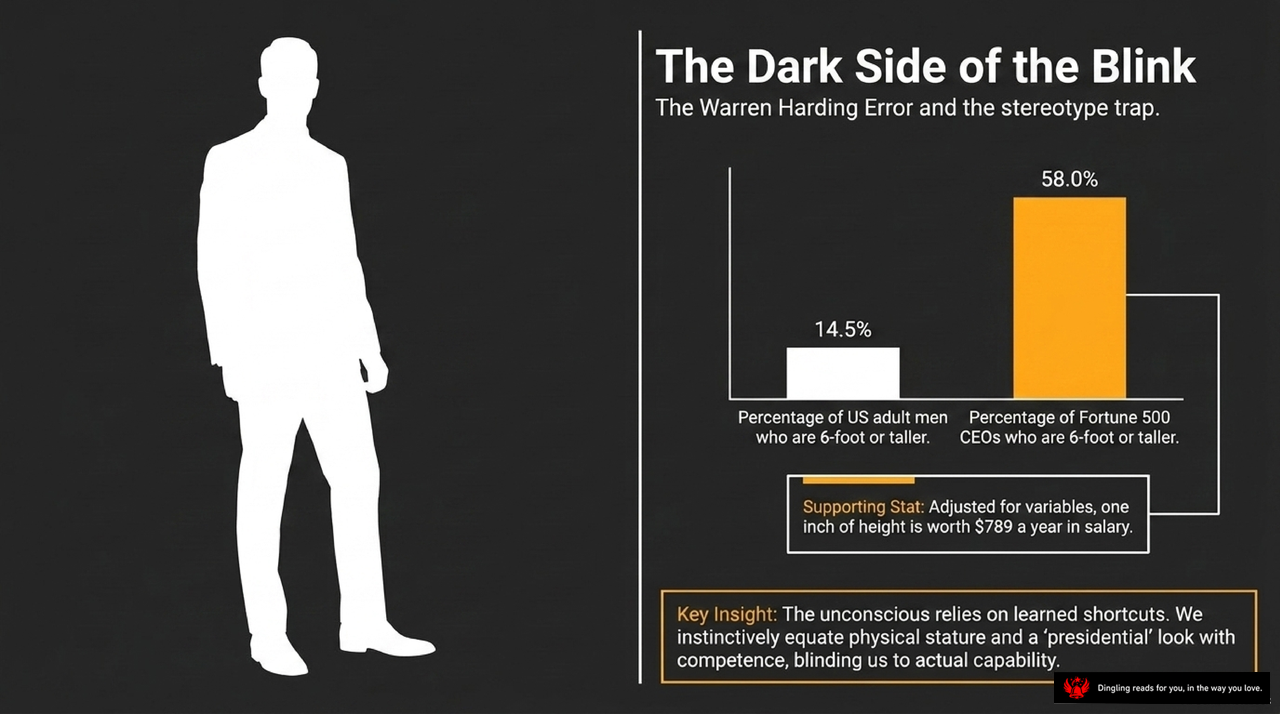
Take height, for instance. 58% of Fortune 500 CEOs are over 6 feet tall, but only 14.5% of American men are that height. Our brains unconsciously tie height to leadership, even if the person’s skills don’t align. Or race: studies find people might unconsciously avoid eye contact with someone of a different race, or rate a job candidate lower without realizing why.
The key takeaway? Bias isn’t always deliberate. It’s the hidden patterns our brains pick up from the world. Recognizing that is the first step to changing how we react.
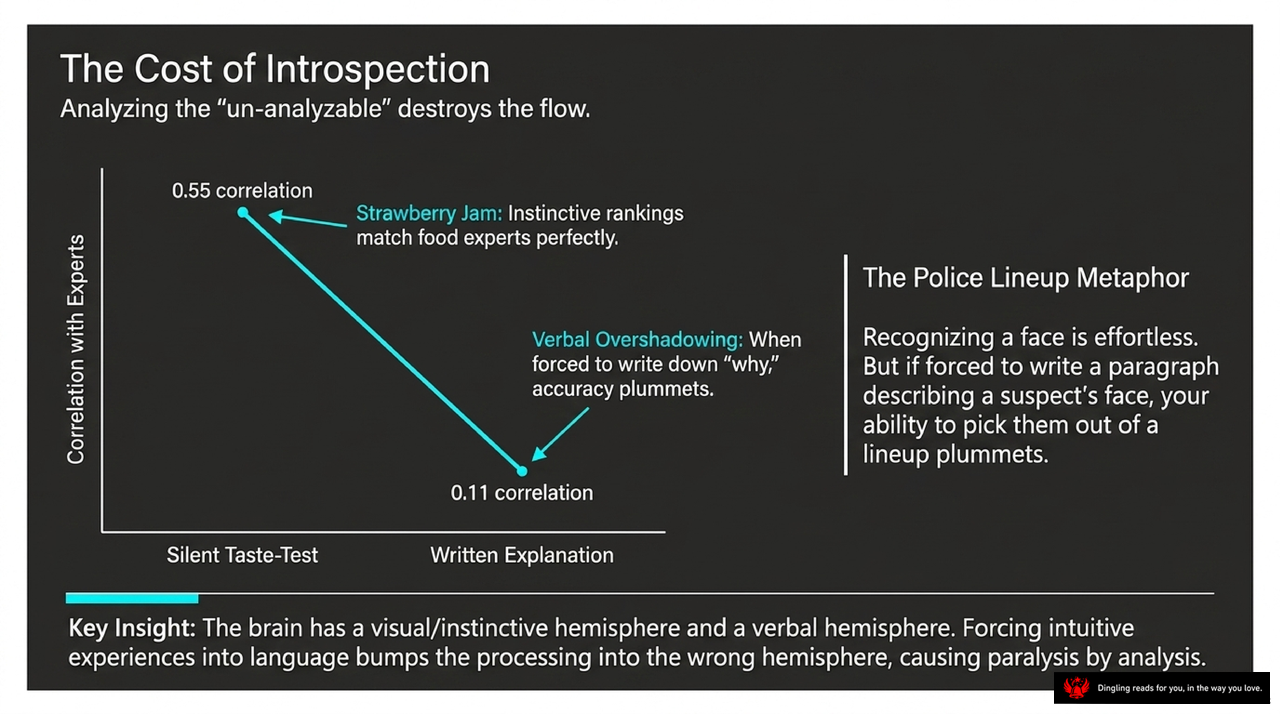
Let’s dive into the cost of overthinking—because sometimes, trying to analyze the unanalyzable just kills the flow. Take strawberry jam, for example: when people did a silent taste test, their rankings matched food experts almost perfectly, with a 0.55 correlation. But when they were forced to write down why they liked a certain jam? That correlation plummeted to 0.11. They started overexplaining, using words that didn’t capture their actual taste buds’ intuition—this is verbal overshadowing, and it’s a real problem.
Think about the police lineup metaphor here. Recognizing a face is effortless, right? You see someone, and you just know it’s them. But if you have to write a paragraph describing their face—like the shape of their nose or the color of their eyes—suddenly, you can’t pick them out of a lineup as easily. Your brain switches from using that intuitive, visual part to the verbal, analytical side, and it messes everything up.
The key insight here is that our brain has two hemispheres: one visual and instinctive, the other verbal and logical. When we force an intuitive experience into words, we’re shoving it into the wrong hemisphere. It’s like using a wrench to hammer a nail—wrong tool, wrong result, leading to paralysis by analysis.
I remember a story about a fire lieutenant called to a kitchen fire. Everything seemed normal at first, but he had a gut feeling something was off: the fire was too hot, too quiet. He didn’t stop to explain why—he just yelled for his team to evacuate. Seconds later, the floor collapsed; the fire was actually in the basement. If he’d overanalyzed every detail, his team might not have made it out alive.
So next time you have a strong intuition, don’t overthink it. Sometimes your brain already knows the answer—you don’t need to put it into words to trust it. Overanalysis can break the flow of that quick, accurate judgment we all have inside us.

Let’s start with a tragedy that lays bare a critical truth about human performance under extreme stress: the 1999 shooting of Amadou Diallo. Four police officers, responding to a call in the Bronx, encountered Diallo—an unarmed immigrant—outside his apartment. In just 2.5 seconds, they fired 41 shots, killing him. Why did their instincts fail so catastrophically? The answer lies in how stress hijacks our brains, as shown in this Heart Rate Activation Curve.
Most days, we operate in Zone 1: 60 to 115 BPM, where our cognitive function is baseline—we think clearly, process details, and read social cues easily. Then there’s Zone 2: 115 to 145 BPM, peak arousal. This is when athletes like Larry Bird see the court in slow motion, their senses sharpened to perfection. But cross the 145 BPM threshold, and you enter Zone 3: Breakdown.
Here, cognitive collapse sets in. Vision narrows—you can’t see the big picture. Hearing diminishes—you miss crucial sounds. That’s exactly what happened to those officers: their heart rates spiked way above 145, turning their world into a tunnel of fear.
The key insight? Above 145 BPM, we become temporarily “autistic.” We lose the ability to read other people’s minds or pick up on subtle emotional cues. In this survival-induced mind-blindness, our brains default to rigid, catastrophic stereotypes. The officers saw Diallo reaching for his wallet and misinterpreted it as a gun—because their stressed brains couldn’t process the nuance of his fear or confusion.
This isn’t just about police. It’s about any high-stress moment: a doctor in an ER, a soldier in combat, even you in a heated argument. When stress pushes us past that 145 BPM mark, our ability to make smart, empathetic decisions vanishes. Understanding this curve helps us recognize when we’re at risk of mind-blindness—and maybe, prevent the next tragedy.
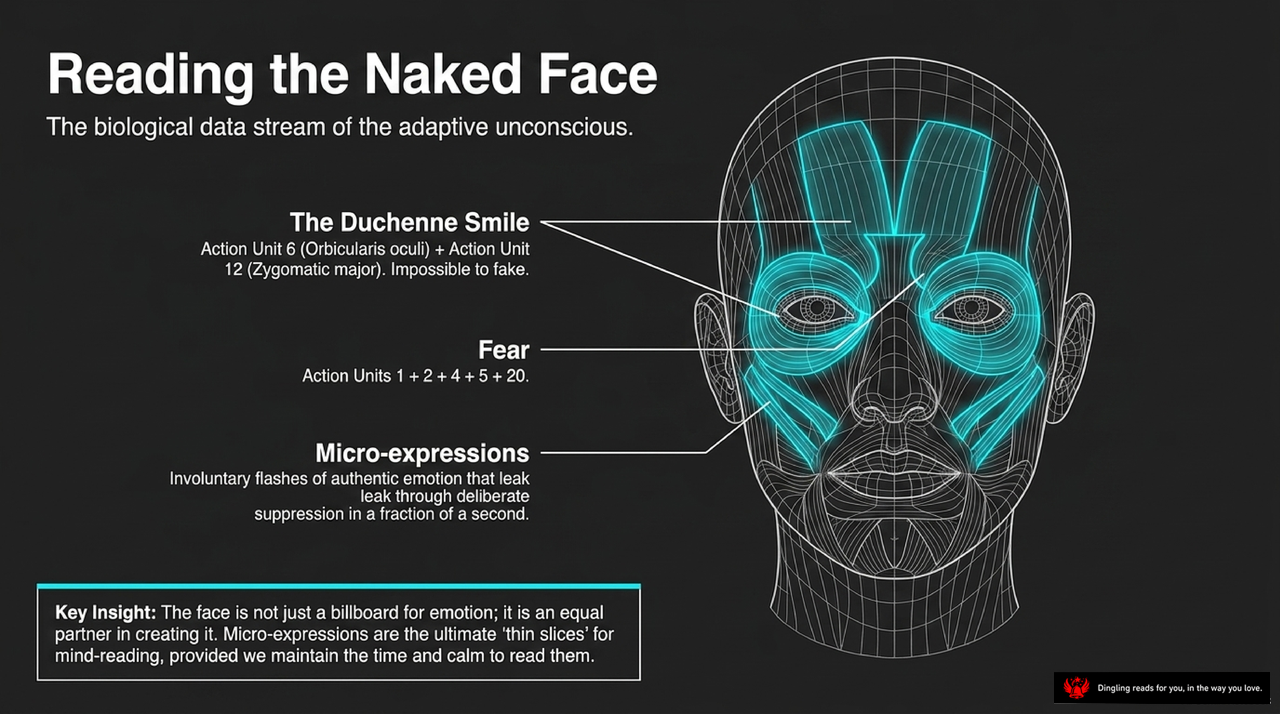
Ever wondered what your face is really telling the world? Today, we’re exploring “Reading the Naked Face”—the idea that our faces are biological data streams, pouring out clues from our adaptive unconscious without us even noticing.
First, let’s talk about the Duchenne Smile. You know those fake grins people plaster on for selfies? This one’s the genuine article. It uses two specific muscle groups: Action Unit 6 (the orbicularis oculi that crinkle your eyes) and Action Unit 12 (the zygomatic major that lifts your cheeks). And here’s the kicker—you can’t fake this smile. Your brain won’t let you activate those eye muscles unless you’re truly feeling happy.
Then there’s fear. When we’re scared, our face lights up a whole sequence of Action Units: 1, 2, 4, 5, and 20. That means eyebrows shoot up and together, eyes widen, nose wrinkles, lips stretch thin. These moves are automatic—your body reacts before you even realize you’re afraid.
But maybe the most intriguing piece is micro-expressions. These are tiny, involuntary flashes of authentic emotion that last just a fraction of a second—like 1/25 to 1/5 of a second. They leak through when we’re trying to suppress how we really feel. Think about a time you had to pretend you loved a gift you hated—your face probably flickered with a micro-expression of disgust before you could cover it up.
The key insight here? Our face isn’t just a billboard for emotion; it’s an equal partner in creating it. When you force a smile, your body actually starts to feel happier. And micro-expressions? They’re the ultimate “thin slices” for mind-reading—if we take the time and stay calm enough to notice them.
So next time you’re chatting with someone, slow down and look closer. Those little eye crinkles, the split-second frown—they’re telling you more than words ever could. Our faces are talking; we just need to learn how to listen.

Let’s dive into synthesis—specifically, how to create structure for spontaneity. The question we’re answering here is: How do we harness our rapid, intuitive thinking without falling into the bias traps we’ve explored?
Imagine two circles overlapping. On one side, there are rigid rules—things like clear constraints, intentional environment design, and using only the most essential data. On the other, there’s unconscious freedom—your gut instinct, thin-slicing information in an instant, and acting quickly. The sweet spot where these meet? That’s engineered spontaneity.
Take the military example: Paul Van Riper’s Red Team crushed the data-obsessed Blue Team in the Millennium Challenge exercise. Blue Team had all the high-tech tools and complex plans, but Van Riper’s crew operated with initiative and minimal communication—they called it “in command and out of control.” They didn’t stick to a strict script; instead, they had core goals and trusted their trained instincts to adapt.
Or think about improv comedy. Those actors create brilliant spontaneous scenes, but it’s not chaos. They follow rigid underlying rules—like always agreeing with the other person’s idea. That structure gives them the freedom to be creative without the scene falling apart.
The key insight here is crucial: Spontaneity isn’t random. If you want to trust your blink—your quick judgment—you can’t just wing it. You have to carefully engineer the environment where your instincts operate. That means setting the right constraints, giving clear guidelines, and making sure the context helps your intuition shine instead of leading it astray.
So it’s not about picking structure or spontaneity. It’s about merging them. When you build the right framework, your intuition can do its best work—fast, accurate, and free from those bias traps that trip us up.
Alright, let’s paint a picture: You’re in the ER with chest pain. The doctors are flipping through your entire medical history—every test, every past illness, every prescription. They’re furiously typing, checking screens, and you think, “Wow, they’re being thorough.” But what if all that extra info is actually making them worse at diagnosing you?
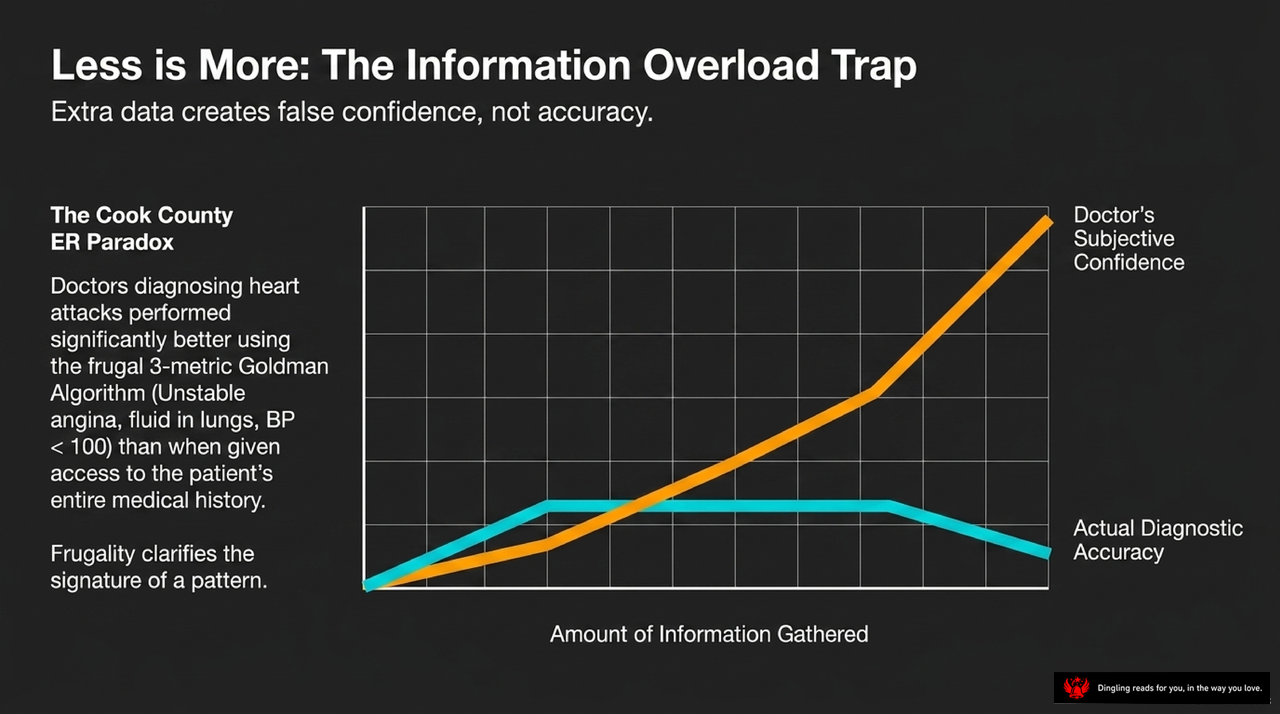
That’s exactly what this slide is about: Less is More: The Information Overload Trap. The key line here says it all—extra data creates false confidence, not accuracy.
Let’s talk about the Cook County ER Paradox. Doctors there were trying to figure out who was having a heart attack. When they used this super simple 3-metric Goldman Algorithm—just looking at unstable angina, fluid in the lungs, and blood pressure below 100—they did way better than when they had access to the patient’s entire medical history.
Why? Because frugality clarifies the signature of a pattern. When you have too much data, you get stuck in the weeds. You start overanalyzing every tiny detail instead of focusing on the few key things that actually predict a heart attack.
Look at that graph: The orange line is the doctor’s subjective confidence—it shoots up as they gather more info. They feel like they know exactly what’s going on. But the teal line? That’s actual diagnostic accuracy. It doesn’t climb with more data. In fact, it might even dip. So they’re more confident, but not more right.
This isn’t just for ER docs. Think about your own life—whether you’re choosing a new phone, hiring someone, or even picking a restaurant. Do you really need to read 50 reviews, or are you just making yourself feel better without improving your decision? Sometimes, less really is more. You just have to know which few things matter most.
The takeaway here? Don’t confuse more information with better decisions. The next time you’re drowning in data, ask yourself: What are the 3 key things I actually need to know? Chances are, that’s all you need to get it right.
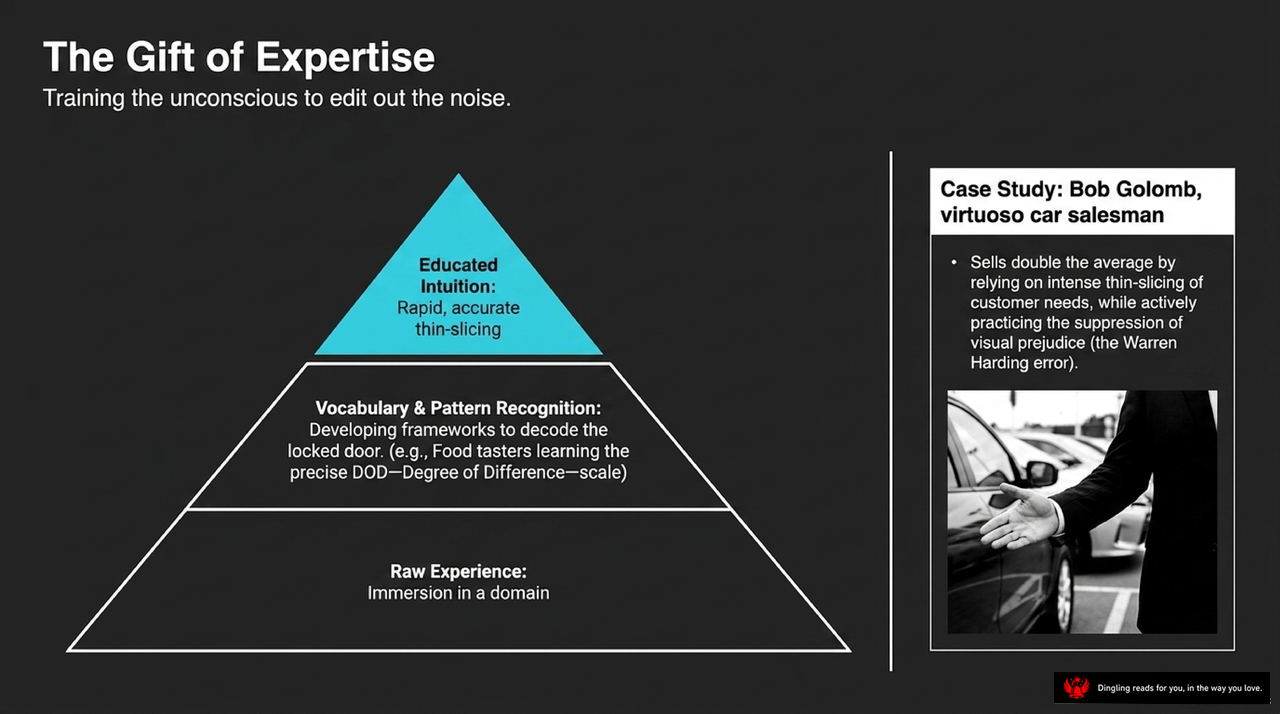
Let’s dive into the gift of expertise—this is all about training your unconscious to cut through the noise so you can make those quick, spot-on judgments. Think of it as a skill pyramid:
At the base, there’s raw experience—total immersion in your field. You can’t skip this; it’s the foundation. Then, you move up to vocabulary and pattern recognition: building frameworks to decode what’s really going on. Like food tasters who master the precise Degree of Difference (DOD) scale to pick up on subtle flavor shifts—they’ve got a language and structure to turn their gut feelings into clear insights.
And at the top? Educated intuition: rapid, accurate thin-slicing. That’s when your brain takes all that experience and pattern knowledge, filters out the irrelevant stuff, and gives you a perfect call in a blink.
Take Bob Golomb, a virtuoso car salesman. He sells twice as many cars as the average person, and here’s his secret: he uses intense thin-slicing to read customer needs—like picking up on their unspoken worries or how much they know about cars—while actively fighting the Warren Harding error, you know, judging people by their looks.
Bob lives by the rule: never judge a book by its cover. The farmer in work boots? He might pull out cash and buy a truck on the spot. The teen with their parents? They could be the ones calling the shots. He follows up with every customer, even if they don’t buy, just to say thanks. And he focuses on real signals—confidence, trust, what they’re actually asking for—instead of getting distracted by appearances.
That’s the gift of expertise in action: turning years of immersion and pattern-building into that sharp, noise-free intuition that gets results. It’s not magic—it’s training your brain to see what matters, fast.
Ever had a first impression that turned out totally wrong? Like, you saw someone and immediately made a judgment, only to realize later you were way off? Today, we’re talking about how one simple change fixed a huge bias in the classical music world—all thanks to understanding how our brains make quick decisions.
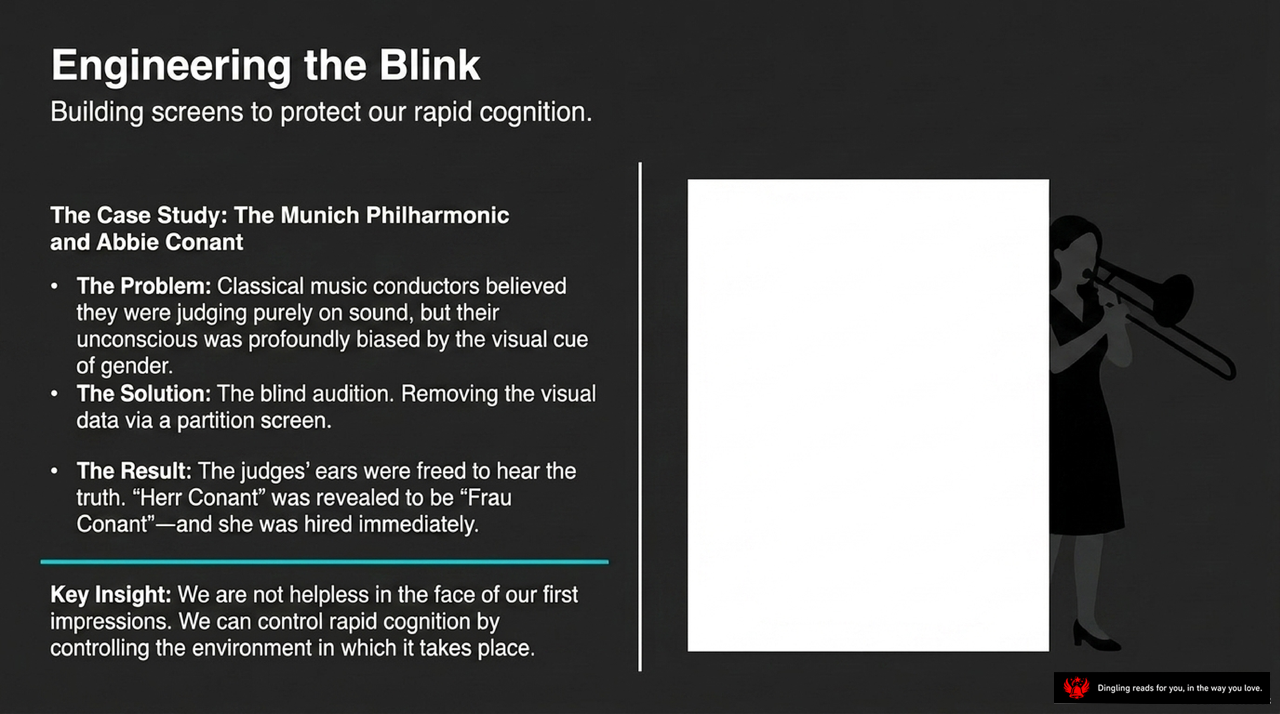
The slide here is called “Engineering the Blink” — building screens to protect our rapid cognition. Let’s dive into the case study: the Munich Philharmonic and Abbie Conant. The problem? Classical music conductors swore they judged musicians purely on their sound. But their unconscious minds were actually biased by the visual cue of gender. They didn’t even realize it—they thought their ears were doing all the work.
The solution? A blind audition. They put a partition screen between the conductor and the musician, so the judge couldn’t see who was playing. And the result? The judges’ ears were freed to hear the truth. Abbie Conant, a talented trombonist, played her audition. The judges loved her—they even called her “Herr Conant” because they assumed she was a man. When they found out she was a woman? They hired her immediately.
The key insight here is huge: We’re not helpless against our first impressions. We can control our rapid cognition by controlling the environment where it happens. That screen didn’t change the conductors’ brains—it just removed the thing that was skewing their judgment.
This isn’t just about music. Think about job interviews—what if we removed names from resumes to avoid bias? Or how doctors might make better quick diagnoses if they focus on symptoms instead of a patient’s appearance? Small changes to the environment can make our quick decisions fairer and more accurate. And that’s the power of engineering the blink—using what we know about our brains to make better choices, one screen (or one small adjustment) at a time.
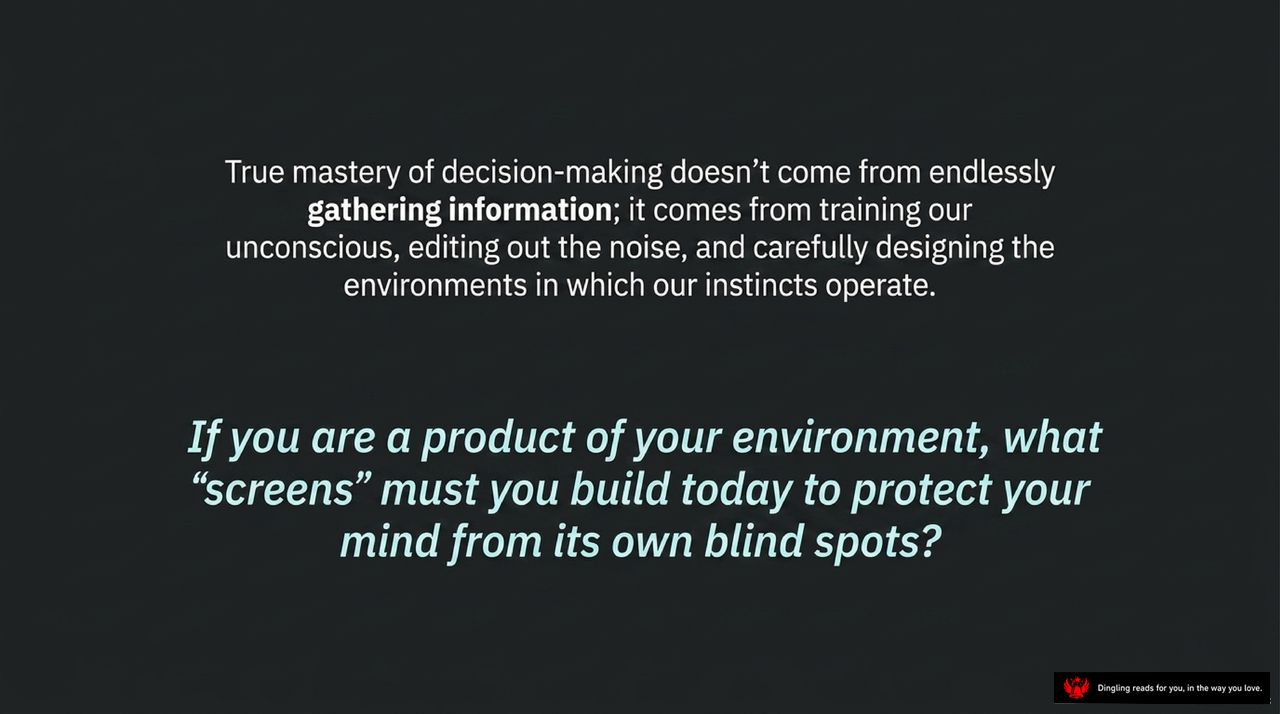
Ever found yourself scrolling through 50 restaurant reviews or staring at a spreadsheet for hours, only to still feel stuck on a decision? We’ve all bought into the idea that more info equals better choices—but what if that’s dead wrong?
The slide here cuts to the chase: true decision-making mastery isn’t about hoarding data. It’s about training that gut feeling we often dismiss, cutting through the noise, and building environments where our instincts work for us, not against us.
Take the story from the book about Cook County Hospital’s ER. Doctors used to drown in details when diagnosing chest pain—smoking history, cholesterol levels, all sorts of extra info—leading to messy, inconsistent calls. Then they switched to a simple algorithm focusing only on critical signs: ECG results, blood pressure, fluid in the lungs. Suddenly, their decisions got way more accurate, and they stopped wasting time on irrelevant stuff. That’s editing out the noise.
Or think about classical music auditions. For years, orchestras were mostly male because judges let gender bias creep into split-second judgments. Then they added a screen between the player and the judge—no more seeing who was playing, just hearing. And boom, female musicians started getting hired left and right. That’s designing the environment to protect against blind spots.
Which brings us to the second question: if we’re products of our environment, what “screens” do we need to build today? Maybe it’s turning off phone notifications to focus, using blind resumes when hiring to avoid name bias, or setting a 10-minute timer for small decisions so we don’t overthink.
Our instincts are powerful, but they need help. We don’t have to let noise or bias cloud our judgment. By training our gut and shaping our surroundings, we can make faster, smarter decisions—without all the extra hassle. The best choices often come not from endless research, but from knowing what to ignore and how to set ourselves up for success.