
Blitzscaling: Complete Chapter-by-Chapter Summary

Welcome to Blitzscaling, the strategic blueprint for building massively valuable companies in an age of uncertainty. This isn't just about growing fast; it's a deliberate choice to prioritize speed over efficiency when the stakes are highest. As the title suggests, we are here to explore how Reid Hoffman and Chris Yeh define a path where companies sacrifice short-term perfection to seize market dominance before competitors can catch up. In a world where technology accelerates everything from software to traditional industries, the ability to move quickly is no longer an advantage—it's a survival requirement. We'll dive into the core philosophy that challenges traditional business logic, showing you how to turn uncertainty into your greatest competitive edge.

The graph you see here perfectly captures the physics of speed, illustrating the fundamental trade-off between certainty and efficiency. Notice the three distinct curves: the "Classic Startup" follows a slow, steady S-curve, prioritizing efficiency and correctness. The "Fast Scaling" curve moves quicker but still respects operational limits. But then, look at the orange line—Blitzscaling. It starts slow, but once it hits a critical threshold, it explodes upward with terrifying velocity.
The text on the slide defines this clearly: Blitzscaling is the deliberate sacrifice of operational efficiency to achieve maximum speed when facing high uncertainty. It's not about being perfect; it's about being fast enough to win.
Let's look at the three boxes at the bottom that explain the mechanics of this strategy. First, "The Goal": cross the critical threshold of scale before competitors even realize the race has begun. Speed is your weapon against uncertainty. Second, "The Trade-off": you must be willing to burn capital and accept systemic chaos. You are trading efficiency for a First-Scaler Advantage. Finally, "The Reality": imagine jumping off a cliff while assembling an airplane on the way down, strapping on jet engines before you've even finished the wings. It sounds reckless, but as we've seen with companies like Airbnb and Tencent, this is the only way to dominate markets that move too fast for traditional business logic.

Imagine your business as a high-performance engine. To reach the speed of a rocket, you need massive fuel intake, but you also need to manage the friction that inevitably builds up. This slide perfectly captures the "Blitzscaling" trade-off: Thrust versus Friction.
On the left, we have the "Intakes"—the propellants of scale. These are your fuel sources. First, a massive and rapidly expanding Total Addressable Market. Second, leveraging existing networks for distribution. Third, high gross margins of 60% to 80% or more, which provide the cash to fund aggressive expansion without waiting for profitability. And fourth, network effects. This is the ultimate multiplier; every new node exponentially increases the value of the entire system, creating a flywheel effect that is hard to stop once it starts.
On the right, we see "The Structural Friction"—the limits that try to slow you down. The first limiter is a lack of Product/Market Fit. It's like pumping fuel into an engine with no spark; no matter how much you push, you won't move. The second limiter is operational scalability limits. As you grow at hyper-speed, your human infrastructure often breaks under the G-force. Traditional management structures, hiring processes, and customer support systems simply cannot keep up with the velocity required to win.
The core lesson here is that Blitzscaling isn't about ignoring friction; it's about deciding which lever to pull. Do you prioritize getting the fuel intake massive enough to overcome the friction, or do you spend too much time polishing the engine to ensure it's perfect before starting? In the uncertain world of startups, the strategy is clear: maximize the intakes to build a moat, and accept that you will run hot. You must move fast enough that your scale becomes a defense against the friction that inevitably tries to stop you.

Think about the five network topologies that allow first-scalers to dominate: Direct, Indirect, Two-Sided, Local, and Compatibility. These aren't just abstract concepts; they are the architectural blueprints for building an unshakeable lock-in advantage.
Look at the Direct model, exemplified by WeChat. Here, the platform becomes inherently more valuable simply as usage increases. Every new user adds value for everyone else, creating a self-reinforcing cycle that is incredibly hard to break.
Then there's the Indirect model, like iOS. Increased adoption incentivizes third-party developers to create complementary goods. The more users you have, the more valuable your app store becomes, which attracts more developers, which in turn attracts even more users. It's a virtuous loop.
Next is the Two-Sided model, seen in giants like Uber and Airbnb. Increases in one user group exponentially benefit a complementary group. More drivers mean faster rides for users, which attracts more riders, which brings in more drivers. This dynamic creates a powerful liquidity engine that competitors struggle to replicate.
We also see the Local model, which was crucial for early Facebook. Value spikes within concentrated, localized micro-networks. By dominating a specific campus or town first, a platform creates a stronghold that is difficult for outsiders to penetrate, eventually allowing it to expand globally.
Finally, there's Compatibility, represented by Microsoft Word. Dominance forces the entire ecosystem to adopt your format. If everyone uses your file type, it becomes the standard, locking users in regardless of their preference for other tools.
When you architect your business to trigger one or more of these five topologies, you stop competing on price or features and start competing on network structure. That is how you build a multiplier effect that sustains long-term growth.
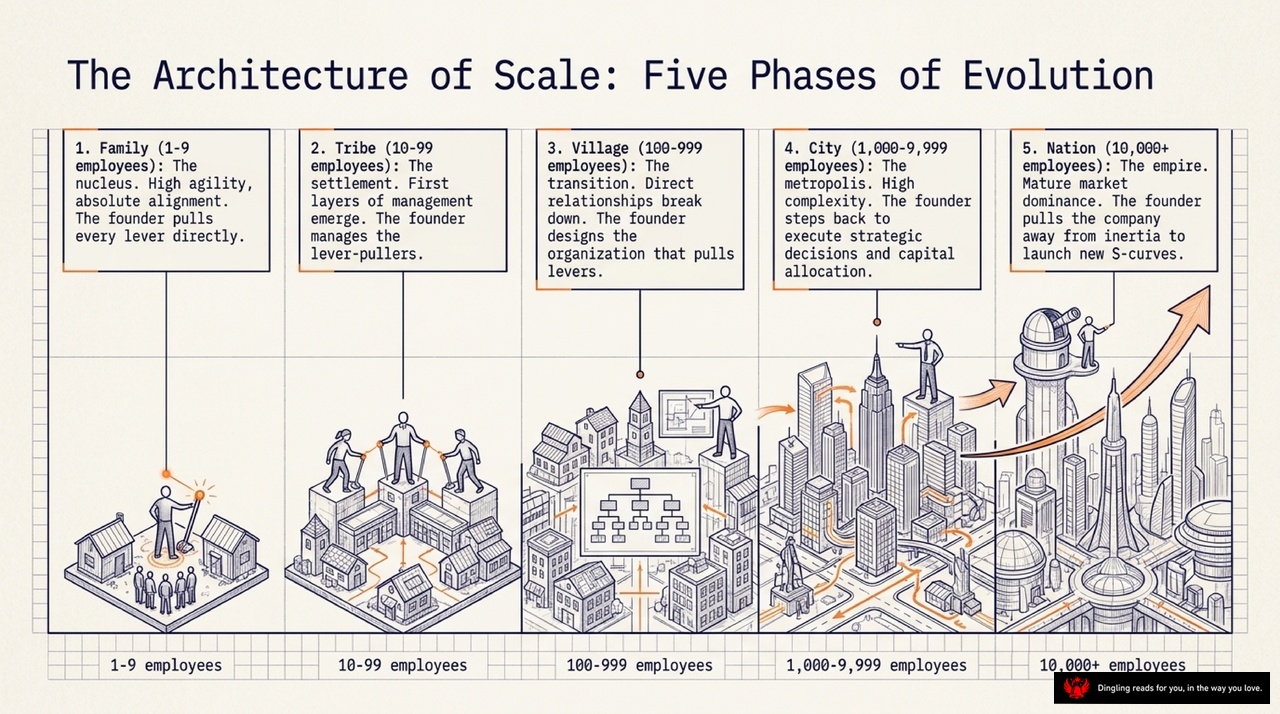
So, how do you actually launch a lightning expansion? It starts with a single, critical decision: Is speed your winning factor right now?
Look at the five dimensions we need to evaluate. First, do you have the "First Mover Advantage"? It's not just about being first; it's about being the first to reach critical mass in a specific market. Think of MercadoLibre in South America. While giants like Amazon and eBay were focused elsewhere, they missed the nuances of the local market. MercadoLibre stepped in, built trust, and created a barrier that no one could break. If that advantage is already gone, your speed won't matter.
Second, consider the steepness of the learning curve. The faster you move, the more data and experience you accumulate, leaving competitors far behind. Take Netflix. Every shift—from DVDs to streaming to original content—gave them exclusive insights into what users wanted, creating a moat that later entrants couldn't climb.
Third, ask yourself: what's the competition doing? Often, a startup's only chance against a resource-rich giant is sheer speed. Remember Airbnb in 2011? When Wimdu rushed in with massive funding, Airbnb refused to be bought. Instead, they chose lightning expansion, opening nine international branches in a year and doubling their orders tenfold. They didn't wait for perfection; they waited for nothing but momentum.
Fourth, look at the market environment. You don't need a booming economy to succeed. Google's search business grew rapidly even when the market was sluggish in 2002, simply because they were fast enough to capture share before anyone else noticed.
Finally, and most importantly, do you have the "Faster is Better" mindset? This means tolerating uncertainty and inefficiency. In 2015, ClassPass doubled its workforce in just three months by skipping traditional hiring processes. But remember, speed isn't always the answer. LinkedIn initially chose a slower, steady path because the competition wasn't urgent. Only when the market demanded it did they accelerate.
Think of lightning expansion like a jet engine's afterburner. It gives you incredible thrust for a short burst, but you can't run it forever. You need to watch for warning signs: slowing growth metrics, worsening unit economics, or dropping operational efficiency. When these appear, it's time to pull the plug.
This strategy isn't for every business. A local bakery selling artisanal bread doesn't need to go viral. But for companies where speed builds an unassailable moat, lightning expansion is the only way to win.

In today's business landscape, the old playbook is dead. What used to work for stable corporations—slow, perfect execution, and rigid planning—will actually kill a blitzscaling startup. You have to re-program your operating system.
Look at the left side: Traditional MBA Wisdom. It tells you to hire the "right" person, wait months for perfection, polish your product until it's flawless, and maintain operational harmony with clear titles. It prioritizes stability and low risk. But in the real world of blitzscaling, this is a trap.
Now, look at the right side: Blitzscaling Reality. Here, you hire the "right now" person. You need stage-specific mercenaries who can move fast, even if they aren't perfect for the next decade. You embrace the "embarrassing launch." If you aren't embarrassed by your Version 1, you launched too late. Data beats intuition every time.
You also have to tolerate "bad" management. Reorganize multiple times a year. Promote people before they are ready. Why? Because chaos is the cost of speed. You need adaptability and velocity, not low friction. And finally, don't just raise what you need to avoid dilution. Raise excess capital. Hoard cash to buy a margin of error. You will make expensive, unpredictable mistakes, and that's okay. That buffer is your insurance against the unknown.
The counter-intuitive truth is this: in a world defined by uncertainty, speed is the only competitive advantage that matters. You must be willing to break the rules of conventional management to win the game of the future.

Imagine you are the CEO of a high-growth startup, and your dashboard is flashing red with a dozen urgent alerts. Your instinct screams to put out every fire immediately. But today, we're learning a counter-intuitive rule: sometimes, the smartest move is to let some fires burn.
This slide introduces the "Triage Protocol," a strategic framework for deciding what to fix right now and what to ignore. It maps problems based on two axes: the level of "Existential Threat" and the level of "Urgency or Noise."
Look at the top-right quadrant, labeled "Extinguish Immediately." This is your Q2 zone: High Threat, High Urgency. Think of a server collapse. If your system can't handle transaction volume, growth halts instantly. If your distribution engine is broken, you die silently. These are non-negotiable. You must fix these immediately, no matter the cost.
Now, look at the bottom-right quadrant, the one labeled "Let it Burn." This is Q3: Low Threat, High Urgency. These are the noisy, painful problems that scream for attention. Think of angry customer support queues or messy code. It feels terrible to ignore them, but if your growth is still exponential, you can afford to let these burn. Why? Because if you stop to fix every minor complaint or clean up every line of code today, you lose the momentum needed to build a support hub or a scalable infrastructure later. You trade short-term comfort for long-term scale.
Finally, look at the top-left quadrant, Q1: High Threat, Low Urgency. This includes things like core product-market fit. If your fundamental business model is broken, you won't notice it for months, but when you do, it's too late. These are the silent killers. You must fix these immediately, even if they don't feel urgent yet.
The lesson here is simple but powerful: Blitzscaling requires the discipline to ignore highly urgent but non-lethal problems to save the company from quiet, existential threats. Don't be distracted by the noise. Protect the core, extinguish the fires that kill you, and let the rest burn until you have the power to put them out.

Let's talk about the hard truth behind every tech giant's success: before the automation takes over, there's usually a lot of messy, inefficient manual labor. As this slide illustrates, that "manual crank" isn't a bug; it's the necessary friction to jumpstart the automated flywheel.
Look at Airbnb's early days. In Phase 1, they were in "Pure Hustle" mode. The founders didn't have a camera team or an app. They rented cameras, manually knocked on doors in Brooklyn, and photographed apartments by hand. It was completely unscalable. Why did they do it? Because you can't write code to solve a problem you haven't proven exists yet.
Once they proved the model, they moved to Phase 2: Patched Networks. They hired contract photographers via Craigslist and tracked payments on chaotic spreadsheets. It was still manual, still inefficient, but it was building the network. Only after reaching critical mass in Phase 3 did they finally write the code to fully automate photographer dispatch and payments.
The lesson is clear: don't skip the grind. Manual effort builds the trust and the data you need to eventually scale. If you try to build software too early, you're just spinning a wheel that has no momentum yet.

The transition from a scrappy startup to a global powerhouse isn't just about hiring more people; it's a complete cultural metamorphosis. As you can see on this slide, we're moving from the chaotic, high-risk "Pirate Phase" to the disciplined, structured "Navy Phase."
Think of your early days as a pirate crew. You operate with asymmetrical vectors and unpredictable trajectories. There's no formation, no formal rules, and no legal compliance. You thrive on rule-breaking and adaptability, comfortable operating on the edge of failure because you have nothing to lose. It's pure offense, a guerrilla warfare strategy that wins the beachhead.
But the moment you want to build an empire, that pirate mindset becomes a liability. You can't scale chaos. You must evolve into the Navy. This means shifting from guerrilla ops to synchronized formation and disciplined execution. You need structured defense and scalable leadership. Suddenly, legal compliance isn't a burden; it's a foundation. The CEO steps away from being the "Chief Problem Solver" and becomes the "Fleet Commander," setting the course rather than rowing every boat.
Here is the hard truth at the bottom: pirates rarely make good admirals. If you cling to the early rule-breakers too long, they will drag your organized fleet down. To survive the transition from a family to a nation, you must have the courage to gracefully transition those early disruptors out. You must sacrifice the very traits that made you successful to build the organization capable of sustaining success.
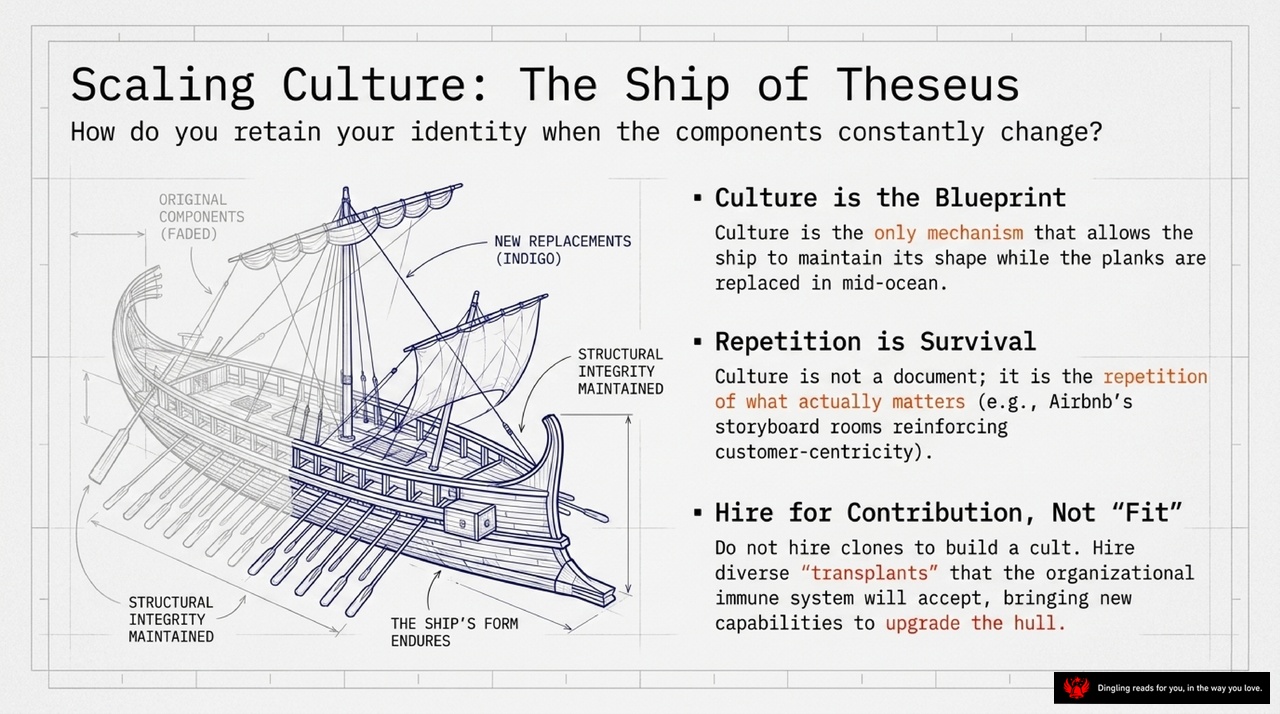
Imagine a ship sailing across the ocean, where every single plank is replaced while it's still moving. This is the Ship of Theseus—a perfect metaphor for scaling your culture. As your team grows from a handful of friends to thousands of employees, your original people fade away, and new hires join the ship. But here's the critical question: How do you retain your identity when the components constantly change?
The answer lies in three non-negotiable principles. First, culture is the blueprint. It is the only mechanism that allows the ship to maintain its shape even as the planks are replaced mid-ocean. Without this, the ship drifts apart.
Second, repetition is survival. Culture isn't just a document you read; it is the repetition of what actually matters. Think about Airbnb's storyboard rooms—those aren't just meetings; they are daily reinforcements of customer-centricity. If you stop repeating the core values, you stop being who you are.
Finally, hire for contribution, not "fit." Do not hire clones to build a cult. Instead, recruit diverse "transplants" that your organizational immune system will accept. These new people bring fresh capabilities to upgrade the hull, making the ship stronger without losing its form.
In short, to scale successfully, you must protect the ship's enduring form while welcoming new components. That is how you survive the journey.

So, how do we actually upgrade a company's nervous system as it scales? The slide breaks this down into two critical shifts.
First, we move from dialogue to broadcast. In the "Tribe" stage, your CEO can just gather everyone in a room to align on the mission. It works because it's a direct dialogue structure. But as you hit the "City" stage with hundreds or thousands of employees, that "prairie dog" communication fails. You can't just talk to everyone anymore. You have to engineer formal, asynchronous broadcast mechanisms—think weekly emails or transparent all-hands meetings—to push context all the way to the edges of your organization.
Second, we shift from inspiration to data. In the early "Family" stage, you have no users and no data, so the founder's intuition drives the product. But at scale, opinion must be overruled by facts. You need to track actual behavior, not just hopes. The rule here is simple: establish three to five core lagging metrics and ensure your localized teams have real-time dashboards to monitor sudden shifts. This moves you from guessing to knowing.

The dual epicenters of Silicon Valley and China have both mastered the physics of blitzscaling, but their engines run on completely different fuels. On the left, you see the origin story of Silicon Valley: a map highlighting San Francisco, Palo Alto, and Stanford. This region's superpower isn't just innovation; it's an unmatched concentration of risk capital, a deep pool of scaling talent, and a history of rapid capability transitions. It's the perfect laboratory where the right people and money collide to create the next big thing.
But look at the right side. This is China, described as the ultimate fertile ground. The map shows a web of hyper-accelerated development velocity connecting Beijing, Shanghai, and Shenzhen. Here, the environment makes Silicon Valley look like slow motion. The secret weapon? The '996' engine—a 9-to-9, 6-days-a-week work culture that generates unprecedented speed. Combined with a fiercely competitive environment that breeds hyper-resilient models, this ecosystem creates a pressure cooker for growth.
Consider the WeChat miracle: a rogue 10-person team built the app in just two months. Sixteen months later, it had 100 million users. That is a pace no Western executive can easily match. The conclusion is stark and urgent: Western executives must study Eastern speed, or risk being out-scaled globally. The lesson here is that while Silicon Valley builds on resources and culture, China's dominance comes from an obsession with velocity. To compete, the West cannot just copy the technology; they must fundamentally rethink their tolerance for speed and uncertainty.

The Red Queen's Race: Multi-Threading
Look at this chart. It tells a brutal truth about business: no market is infinitely valuable. If you stop running, you die. Survival isn't about staying still; it's about launching new initiatives before your original engine stalls.
Think about the shift from single-thread to multi-thread. Early startups execute one thing perfectly. But mature companies? They must manage competing product lines that might cannibalize each other. It's painful, but necessary. Take Amazon as the blueprint. It started as a single-thread bookstore. Then, it used its logistics infrastructure to launch multi-threaded dominance in retail, digital goods, and cloud computing—AWS. One business fueling another.
Here is the imperative: In this world, you have to run with all your might just to stay in the same place. If you want to get somewhere else, you must run at least twice as fast. That's why you see New Engine 1, New Engine 2, and New Engine 3 shooting off into the future. Once you hit that maturity or stall point, the only way forward is to start a new race. You can't coast. You must accelerate.

As you transition from a challenger to a dominant incumbent, your relationship with risk must evolve. Think of your company not just as a family or a tribe, but as a city or even a nation. In these later stages, your duty shifts from simple survival to managing an entire ecosystem. You are no longer just a player; you are the mayor, responsible for the stability of everyone inside your walls.
This slide illustrates that critical shift through a powerful metaphor: the Protective Structural Shield. Just as a dome protects a city, your company must build robust defenses against the very fires you might have ignored in earlier phases. Issues like diversity, platform toxicity, or unchecked growth that seemed manageable when you were small can become systemic societal risks once you dominate the market.
To fix what burned, you need a proactive Defense Protocol. You must regulate your own negative externalities before society is forced to do it for you. Power demands systemic accountability. Whether it's building a defense and stability architecture or ensuring your structural shield is strong enough, the goal is clear: responsible scaling. Speed is vital, but without a commitment to ethical imperatives, rapid growth can become a liability. True dominance requires the courage to slow down, fix the cracks, and protect the ecosystem you've built.

Look at this engine schematic. It's not just a machine; it's a blueprint for a radical shift in how we think about growth. The slide calls this "The Speed Imperative."
Blitzscaling is often misunderstood as just aggressive expansion, but it's actually something much more deliberate. It is the calculated reconstruction of your entire organizational engine while you are still in mid-air. To succeed, you have to make a hard choice: you must abandon the safety of efficiency and embrace operational chaos. You have to unlearn traditional management rules to seize the defining markets of tomorrow.
This brings us to a critical question posed at the bottom of the slide: "When the market window opens, will you risk everything to assemble the rocket in flight, or watch from the ground as someone else claims the stars?"
Consider the stakes. If you wait to build a perfect, stable engine on the ground, you might miss the window entirely. History shows us that in uncertain environments, the ability to launch imperfectly and iterate at speed is often the only way to win. It requires the courage to prioritize speed over perfection, accepting short-term inefficiencies to build a long-term monopoly.
So, the real challenge isn't just about moving faster; it's about having the conviction to fly without a fully assembled wing. Will you be the one building the rocket in flight, or the one watching from the sidelines?