
Blue Ocean Strategy: Complete Chapter-by-Chapter Summary
Welcome to the world of *Blue Ocean Strategy* by W. Chan Kim and Renée Mauborgne. Imagine a vast, calm ocean where the water is clear and there are no competitors—this is the "Blue Ocean." In contrast, the "Red Ocean" represents the bloody, crowded markets we all know today, where companies fight fiercely for a shrinking slice of existing demand.
The core idea here is simple yet revolutionary: instead of competing in these crowded Red Oceans, you should create uncontested market space. By doing so, you make competition irrelevant. Think of Cirque du Soleil; they didn't try to outspend traditional circuses on famous stars or exotic animals. Instead, they reinvented the circus entirely, attracting a new audience of adults who wanted a theatrical, artistic experience. They didn't fight for the same customers; they created a whole new market.
This book offers a systematic approach to achieving this. It teaches us that true growth comes not from outperforming rivals, but from making them irrelevant by opening up these vast, uncharted waters. Let's dive in and explore how you can do the same.
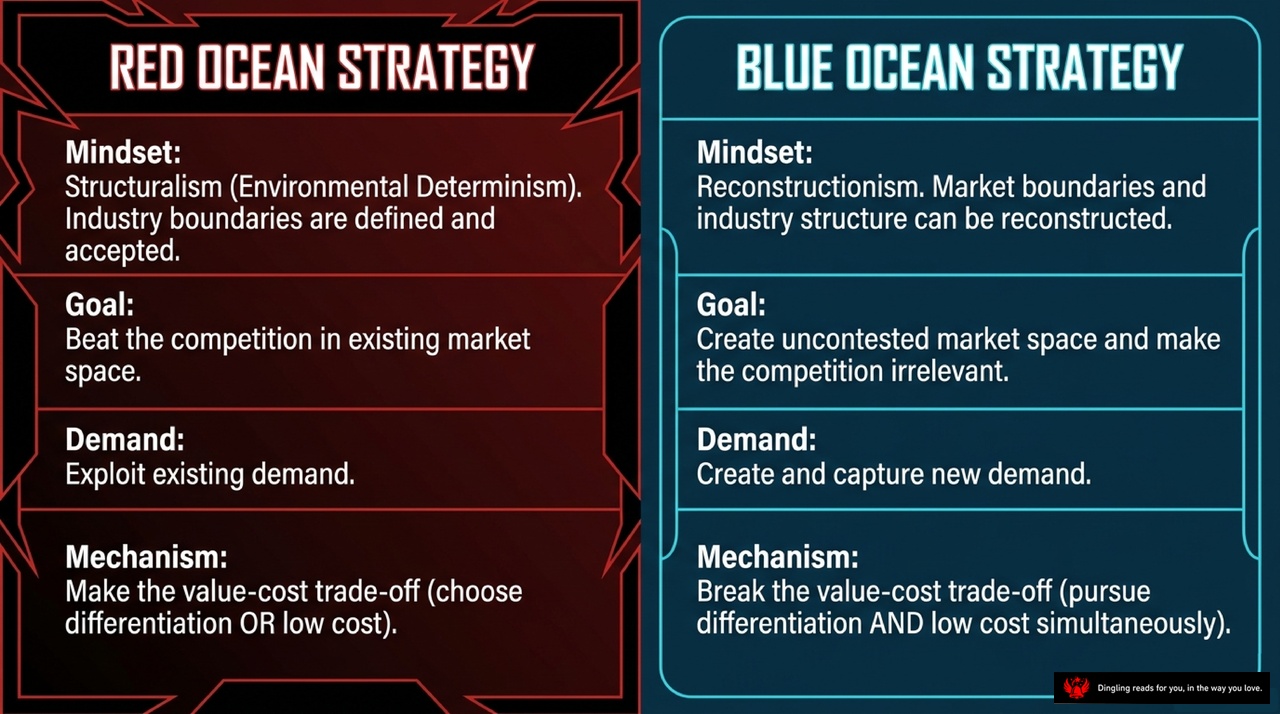
Let's dive into the core battle between two opposing mindsets: the Red Ocean and the Blue Ocean. On the left, you see the Red Ocean Strategy. It's built on structuralism, accepting that industry boundaries are fixed. The goal here is simple but brutal: beat the competition in existing market space. You're just exploiting demand that already exists, forcing a trade-off where you must choose between differentiation or low cost. It's a zero-sum game where value and cost are mutually exclusive.
Now, look at the Blue Ocean on the right. This is where the game changes completely. The mindset shifts to reconstructionism—believing that market boundaries can be redrawn. The goal isn't to beat rivals, but to make competition irrelevant by creating uncontested market space. Instead of fighting for existing demand, you create and capture new demand. Most importantly, you break the value-cost trade-off. You don't have to choose; you pursue differentiation AND low cost simultaneously.
Think of Cirque du Soleil. Traditional circuses were stuck in the Red Ocean, spending fortunes on animals and stars to fight for shrinking audiences. They chose one or the other. But Cirque du Soleil stepped into the Blue Ocean. They cut the expensive animals and stars, then added storytelling and artistic elegance. They didn't just compete; they redefined the industry, proving that you can be both unique and affordable. This slide captures the essence of true innovation: moving from fighting for a slice of the pie to creating a whole new table.

Value Innovation is the engine that powers the Blue Ocean strategy, and it completely defies the old belief that you have to choose between high value and low cost. As the slide shows, the magic happens when you do two things at once: you eliminate or reduce the factors the industry competes on to lower costs, while simultaneously raising and creating elements the industry has never offered to boost buyer value.
Think of Cirque du Soleil. Instead of spending millions on expensive animals and celebrity stars to compete with traditional circuses, they cut those costs entirely. But they didn't just save money; they created something new by adding artistic storytelling and elegant performances. This allowed them to attract a completely new audience of adults and business travelers who would never have stepped foot in a circus before. They didn't just innovate the product; they innovated the entire value proposition.
This is the key difference from standard product innovation. True value innovation is a leap forward for both the company and the buyer. It's not just about technology; it's about aligning utility, price, and cost simultaneously. When you successfully execute this, you break the trade-off that has trapped industries in red ocean competition for decades, creating a new market space where you don't have to fight for a share of existing demand. You simply create the demand.

Look at this graph. On the left, you see the traditional circus model—think Ringling Bros. They piled up the cost on star performers, animal shows, and fancy concessions, but their value curve is flat and crowded. Everyone is competing on the same factors, driving prices down and profits into the ground. That's the Red Ocean.
Now, look at the blue line on the right. That's Cirque du Soleil. They didn't try to outspend the old circus. Instead, they did the exact opposite. They slashed the cost of animal shows and star performers—factors that were driving up costs without adding real value. But then, they radically increased value in areas the industry ignored: they added a compelling theme, a refined environment, and artistic music and dance.
This creates a massive gap between the two curves. That's the essence of a Blue Ocean Strategy. As the text on the right explains, it relies on three traits: Focus, so you don't waste effort on every competitive factor; Divergence, where your value curve stands apart from the industry average; and a Compelling Tagline that tells a clear story, like "We reinvented the circus." By breaking the rules of the industry and creating new demand, they opened up an entire new market space where competition simply didn't exist.

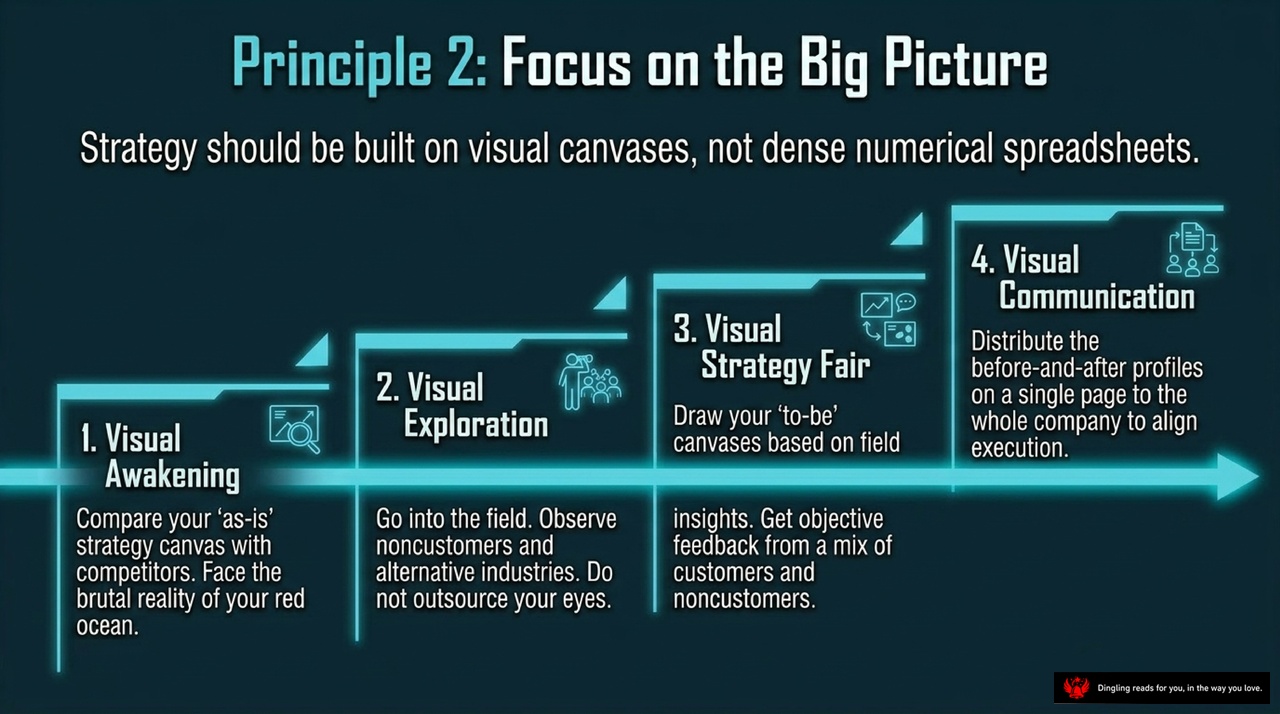
Most companies still plan like they're stuck in a red ocean, drowning in spreadsheets and trying to outspend competitors on the same things. But to create a true blue ocean, you need to stop looking at numbers and start looking at the big picture. That's why the second principle of blue ocean strategy is all about focusing on the entire strategic landscape, not just getting lost in the details.
Instead of writing long, boring strategic plans, you should use a value curve map. Think of it as a visual tool that shows exactly where your company stands compared to everyone else. It highlights where you invest resources, what customers actually get, and where the real opportunities lie. A successful blue ocean strategy needs three things: it must be focused, it must be distinct from the competition, and it needs a clear, compelling theme that everyone understands instantly.
Take the European financial services group EFS as an example. They used this map to expose a major problem: their online banking site was slow because they focused on convenience but ignored speed. By visualizing their strategy, they realized their old approach was broken. They then went out to talk to real customers and non-customers, discovering that people didn't care about fancy account managers; they just wanted speed, security, and accuracy. This led them to a new strategy: cut the costs on unnecessary support and focus entirely on making transactions fast and reliable. They branded it as "The FedEx of corporate forex," giving their employees a clear mission and a path to success. This visual approach not only aligned their strategy but also made it easy for everyone in the company to understand and execute, turning a complex business transformation into a clear, shared vision.
Let's dive into the first principle of our Blue Ocean Strategy: Reconstructing Market Boundaries.
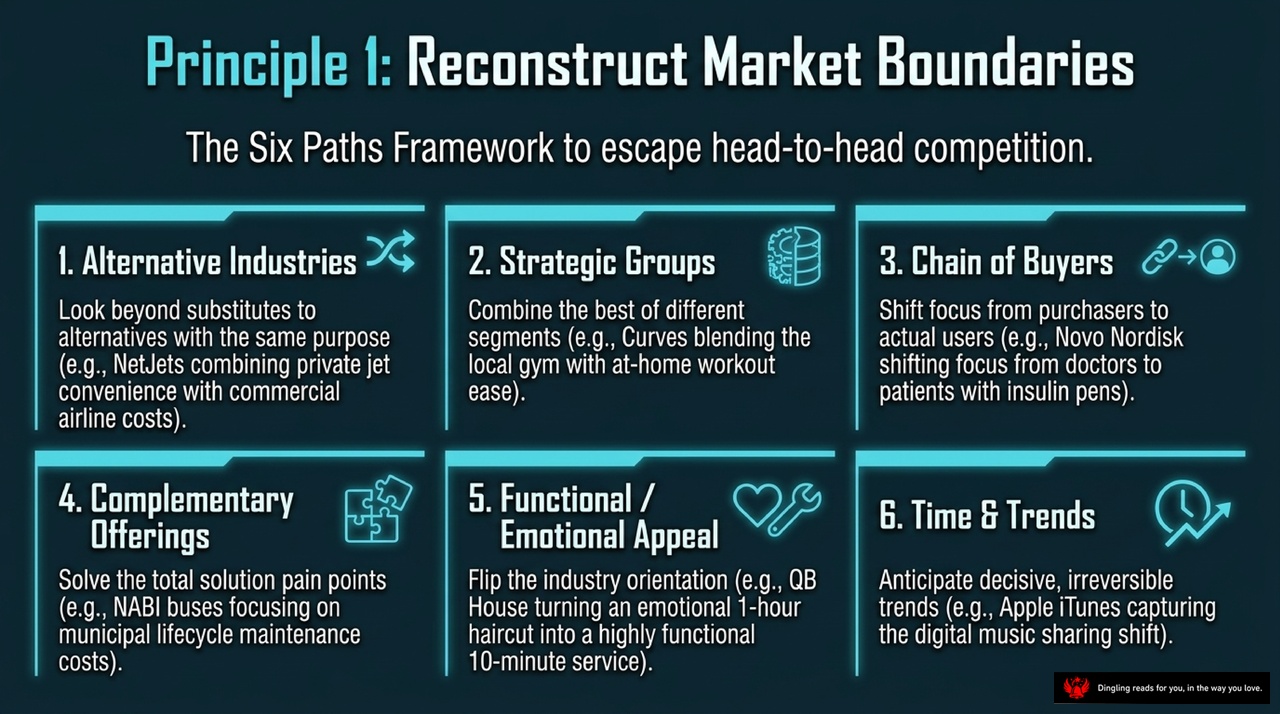
Imagine you're stuck in a crowded room, fighting over the same pie. That's the "Red Ocean." But what if you could walk out the door and bake a completely new pie? That's the Blue Ocean. The challenge isn't predicting the future; it's simply looking at the data from a fresh angle. To do this, we use the "Six Paths Framework."
First, look beyond your industry to **Alternative Industries**. Don't just compete with your direct rivals; look at what other industries solve the same problem. Take NetJets: instead of fighting commercial airlines or private jet owners, they combined the convenience of private jets with the low cost of commercial flights, creating a whole new market.
Second, combine **Strategic Groups**. Why choose between high-end luxury and low-cost budget? Why not the best of both? Curves Fitness did exactly this by blending the social aspect of a gym with the convenience and low cost of a home workout, targeting a specific group of women who were previously underserved.
Third, shift your focus along the **Chain of Buyers**. Who is actually using your product? Novo Nordisk stopped selling insulin to doctors and started designing pens for the patients themselves, solving a daily pain point that doctors couldn't address.
Fourth, look at **Complementary Offerings**. Don't just sell the product; solve the total problem. NABI buses didn't compete on the initial purchase price like everyone else; they focused on the total lifecycle cost for the city, including maintenance and fuel, which actually lowered the long-term bill for the buyer.
Fifth, flip between **Functional and Emotional Appeal**. If everyone is selling on emotion, switch to function. QB House turned a one-hour, full-service haircut into a ten-minute, efficient wash-and-go, capturing the time-starved professional.
Finally, anticipate **Time and Trends**. Don't just react to the future; capture the irreversible shift. Apple didn't just sell music; they tapped into the irreversible trend of digital sharing with iTunes, changing how the world consumes music forever.
By applying these six paths, you stop competing for a shrinking share of an existing market and instead create uncontested market space.
So, we've walked through the six ways to rebuild market boundaries, the power of visual strategy, and how to structure a winning business model. Now, we arrive at the final piece of the puzzle: execution. Creating a blue ocean is only half the battle; the real challenge is actually getting there.
Here's the hard truth: executing a blue ocean strategy is significantly harder than a red ocean one. Why? Because you aren't just competing within existing rules; you're trying to break them. This means your employees are stepping out of their comfort zones, and that creates massive internal resistance.
The book identifies four key barriers you'll face: cognitive barriers where staff just don't see the need to change, resource constraints, misaligned incentives, and internal political fights that can kill a strategy before it starts. Traditional change management often fails here because it tries to mobilize everyone, which is slow and expensive.
Instead, the authors propose a "Pivotal Point Leadership" approach. The idea is simple but powerful: don't try to move the whole organization at once. Instead, find the few critical factors that have an extraordinary impact on performance. If you can shift just those few points, the entire organization will follow.
Think of the New York Police Department under Bill Bratton. When he took over, crime was soaring, morale was low, and the budget was frozen. Yet, in less than two years, he turned New York into the safest city in America. How? He didn't use abstract data to convince his team. He took middle management and himself onto the subway at night. They saw the graffiti, the loitering, and the danger firsthand. This visceral experience broke the cognitive barrier instantly. No more arguing; everyone saw the brutal reality.
He also optimized resources by focusing only on "hot spots" of crime and eliminating "cold spots" where police time was wasted. To keep everyone aligned, he used "Fishbowl Management." Twice a week, commanders gathered to publicly report their crime stats. This transparency created a culture where no one could hide poor performance, and everyone felt the pressure to succeed.
Finally, the ultimate key to execution isn't just about tactics; it's about trust. The book introduces the "Fair Process" framework, built on three E's: Engagement, Explanation, and Expectation. You must engage employees in the decision-making process, explain the reasoning behind the strategy clearly, and set clear expectations for what success looks like. When people feel respected and heard, they don't just follow orders; they become true partners in the transformation. That is how you turn a bold new strategy into a self-sustaining reality.
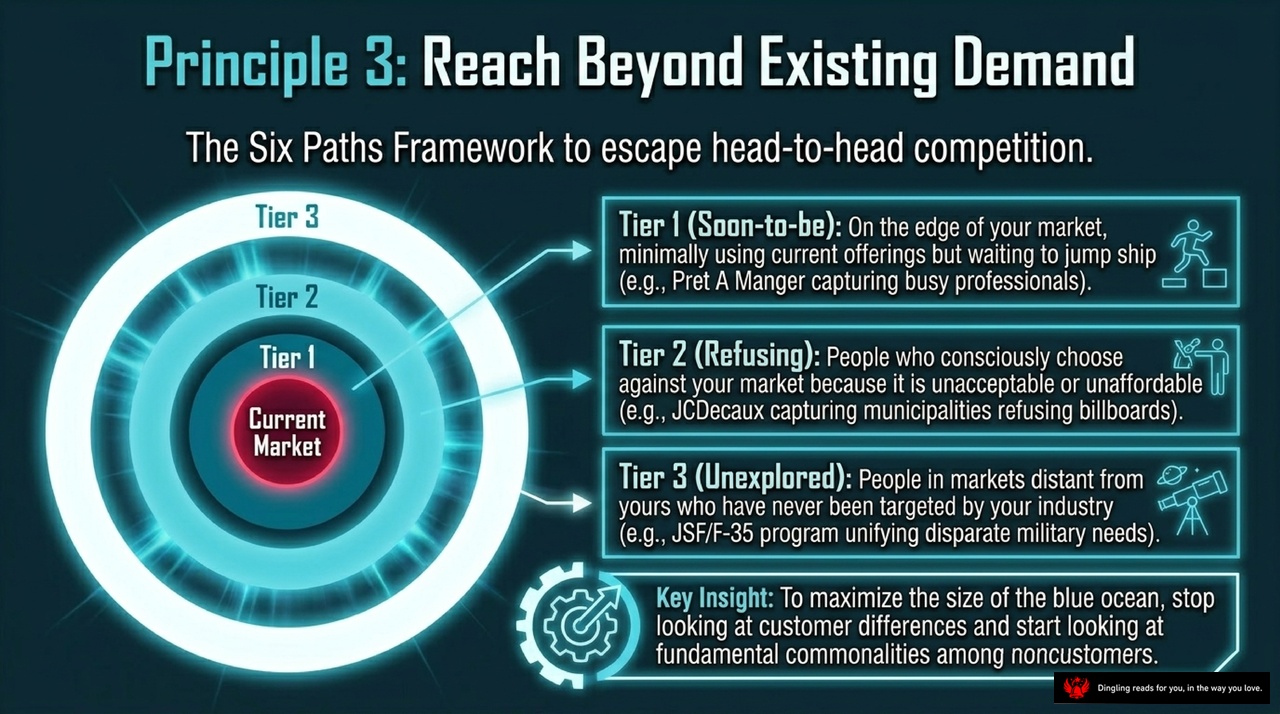
Principle 3: Reach Beyond Existing Demand. This is your golden ticket to escaping the bloody competition of the red ocean. Instead of fighting for scraps with your current customers, you need to look outward. The framework breaks this down into three distinct tiers of non-customers.
First, look at Tier 1: the Soon-to-be. These are people on the very edge of your market who are using your products minimally but are ready to jump ship the moment something better comes along. Think of Pret A Manger capturing busy professionals who are tired of traditional cafes. They are your next big opportunity.
Next, move to Tier 2: the Refusing. These customers consciously choose to stay away from your industry because they find it unacceptable or simply unaffordable. Take JCDecaux, which successfully captured municipalities that were actively refusing traditional billboard advertising. They didn't sell to people who already loved ads; they solved the problem for those who hated them.
Finally, reach for Tier 3: the Unexplored. These are people in markets entirely distant from yours who have never been targeted by your industry at all. A classic example is the JSF/F-35 program, which unified disparate military needs across different branches into one solution.
The key insight here is simple but powerful: to maximize the size of your blue ocean, stop obsessing over the differences between your existing customers. Instead, start looking for the fundamental commonalities among these non-customers. By reaching beyond existing demand, you don't just grow your market; you redefine it.

So, you've figured out how to find the Blue Ocean and mapped out your strategy. But here's the real test: can you build a business model that actually makes money? That's where Principle 4 comes in—getting the strategic sequence right. You can't just jump into execution; you need a specific order to minimize risk. Think of it as a four-step checklist: Buyer Utility, Price, Cost, and Adoption.
First, ask yourself: does this create exceptional value for the buyer? Does it remove the biggest blocks stopping them from using your product? If the answer is no, rethink everything. Take Ford's Model T; before it existed, cars were luxury items for the rich, stuck in mud and hard to fix. Ford didn't try to make a fancier car; he solved the utility problem. He made a durable, easy-to-drive vehicle that anyone could use. That's the foundation.
Once you've nailed the utility, move to price. Don't start with a niche audience and try to expand later. Instead, set a strategic price that appeals to the mass of your target buyers right from the start. Use the "Price Corridor of the Mass" to find that sweet spot. If your price is too high or too low, you're leaving money on the table or scaring off customers.
Next, look at your costs. Can you actually deliver that value at your target price? If not, you need to innovate your cost structure. Streamline operations, cut out unnecessary features, or find smarter ways to produce. It's not about cutting corners; it's about designing a cost structure that supports your low price and high value simultaneously.
Finally, address adoption. Have you thought about the hurdles? Will employees, partners, or the public resist this? You need to tackle these fears upfront. If you ignore this, even the best idea can fail.
When you follow this sequence—Utility, Price, Cost, Adoption—you transform a great idea into a commercially viable Blue Ocean. It's the difference between a fantasy and a sustainable business.

Execution: Overcoming Key Organizational Hurdles. Let's talk about the gap between a brilliant strategy and its actual execution. Even the best ideas fail without the right leadership approach. This slide outlines four critical hurdles and how to tackle them.
First, the Cognitive Hurdle. Leaders often get stuck in "red ocean" thinking, relying on spreadsheets instead of reality. The solution? Wake people up by making them experience the truth directly. Don't just show numbers; have managers meet angry customers or ride the subway themselves to feel the pulse of the market.
Next, the Resource Hurdle. We often face limited means, but the fix isn't asking for more money. Instead, stop pouring resources into "cold spots." Redirect your budget to the "hot spots" where it actually moves the needle, and engage in "horse trading" to get what you need from other departments.
Then, the Motivational Hurdle. Change requires fast action, but you can't move the whole army at once. Zoom in on the "Kingpins"—the key influencers. Put them in a transparent "fishbowl" where their performance is visible to all. This enforces accountability and creates a culture where everyone knows the game is fair.
Finally, the Political Hurdle. Internal opposition is inevitable. Your strategy? Leverage "angels"—your allies who benefit from the change. Silence the "devils" who resist by using indisputable facts, and secure a "consigliere" to help you navigate the power dynamics. By mastering these four areas, you turn execution from a risk into your greatest advantage.

So, how do we actually make this happen? How do we turn these brilliant strategies into real-world results? The book introduces a powerful concept called the "Fair Process," which consists of three key pillars, often referred to as the "3 E's."
First, we have **Engagement**. This means involving the people directly affected by strategic decisions. Instead of just telling them what to do, you ask for their input and let them debate the merits of the ideas. When employees feel their voices matter, they take ownership.
Second is **Explanation**. You must ensure that everyone understands exactly *why* final decisions are made the way they are. It's not enough to just announce a new rule; you need to communicate the reasoning behind it so everyone is aligned on the vision.
Third is **Expectation Clarity**. This is about stating clearly what the new rules of the game will be. Who is responsible for what? What are the new targets? Ambiguity kills execution, so you need to leave no room for guesswork.
When you combine these three elements—Engagement, Explanation, and Expectation Clarity—you create something powerful. The outcome is intellectual and emotional recognition. Employees feel respected and understood, which leads to trust, genuine commitment, and voluntary cooperation. This is the secret to building execution directly into your strategy.

Sustainable growth doesn't come from fighting a losing battle over shrinking profit pools. It comes from Value Innovation—aligning utility, price, and cost to make competition irrelevant. Instead of getting stuck in a dying Red Ocean, where you're just trying to win a war against rivals, you need to chart a course to create your own Blue Ocean. The question is simple but critical: are you fighting to survive in a crowded, shrinking market, or are you inventing a new market space where you're the only player? This shift from competing to creating is what separates the companies that thrive long-term from those that eventually fade away.