
Brain Repair: Complete Chapter-by-Chapter Summary

Welcome to today's session on "Brain Repair," a neuroscientific guide by Yao Nailin. We're diving into the complex but fascinating journey of understanding our imperfections, decoding our mental glitches, and healing our perfectly imperfect minds.
Imagine your brain not as a static machine, but as a living, breathing network that constantly repairs itself. This slide beautifully captures that essence with its intricate, glowing neural pathways. Our goal today is to move beyond simple self-help tips and look at the deep biological and psychological mechanisms at play.
We'll explore how the brain responds to challenges like depression and anxiety, why sleep is the ultimate repair tool, and how habits and addiction hijack our reward systems. Whether you're navigating stress, struggling with focus, or simply curious about your own mind, understanding these processes is the first step toward true repair. Let's begin this journey into the architecture of the human mind.

Evolution doesn't aim for perfection; it favors adaptation. As this slide illustrates, there is no such thing as a "perfectly normal" brain. The statistical average we often chase is actually a biological myth. Look at the two extremes here: on the left, we have hyper-focus and impulsivity, often labeled as outliers or abnormalities, while on the right, we see high empathy and apathy.
The truth is, what we call "abnormalities" are often just traits pushed to the very edges of the survival spectrum. A perfectly normal brain is a biological pseudo-proposition. Our minds are shaped by survival, leaving us with vulnerabilities that are the exact same mechanisms responsible for our greatest talents.
Consider the cost of genius: in nature, imperfection is the raw material for brilliance. The traits that make us struggle—like our tendency to overthink or our emotional intensity—are the very things that allow us to innovate, empathize, and thrive. We aren't broken; we are simply adapted differently. Embrace your unique wiring.

Depression isn't just a feeling of sadness; it's a physiological "brain cold." Think of it as your body getting sick, but instead of a fever, your brain is under siege by stress and inflammation.
The process starts at Node 1: the HPA Axis Overdrive. When you face chronic environmental stress, your body goes into overdrive, pumping out too much cortisol. This locks your body in a state of continuous alarm, like a car stuck in "emergency brake" mode.
Next, we hit Node 2: The Inflammatory Breach. Because of that constant stress, inflammatory markers cross the blood-brain barrier. Your microglial cells—your brain's immune defenders—mistake this stress for a physical infection and go into overdrive. It's like your brain is fighting a flu that no one can see.
Finally, this toxic mix of cortisol and inflammation leads to Node 3: Hippocampal Atrophy. The hippocampus is the part of your brain responsible for memory and regulating emotions. Under this chemical assault, up to 20% of these brain cells actually die. That's why depression often comes with memory loss and an inability to feel joy. Your brain literally shrinks when it's under this kind of chronic, untreated stress.

Have you ever wondered why chasing a reward feels so addictive, even when the actual happiness is fleeting? Today, we're diving into the "Dopamine Illusion." As the slide illustrates, dopamine isn't the currency of happiness; it's the fuel for desire. Look at the left side: "The Expectation Gap." Notice that massive spike in dopamine? That doesn't happen when you enjoy the reward. It happens while you're hunting for it. It answers the question, "How much do I want this?" It drives the pursuit, the craving, and the obsession, not the joy itself.
Now, look at the right side: "The Hedonic Treadmill." This is the addiction trap. When we get those high-frequency, random rewards, our brain adapts. The neurons on those steps show us exactly what happens—our receptors down-regulate. We need more intense stimuli just to feel normal again. We keep running up the stairs, chasing higher highs, only to find ourselves stuck in a pathological loop where we need bigger doses just to feel a baseline level of sanity.
So, the next time you feel that rush of anticipation, remember: you're not chasing happiness. You're chasing the illusion of it. Dopamine fuels the hunt, but it rarely delivers the satisfaction we think we'll find.

Imagine a mental seesaw balancing two powerful brain networks: the blue, focused Attention Network and the pink, creative Default Mode Network. In a neurotypical brain, this system works like a well-oiled mechanism. When you focus on a task, the Attention Network actively suppresses the Default Mode Network. This stops your daydreaming, allowing you to execute and concentrate without distraction.
However, for some, specifically those with ADHD, this seesaw tips dangerously. The brain fails to suppress the Default Mode Network during focused tasks. This creates an imbalance where distant, unrelated thoughts interrupt the present moment, causing that familiar feeling of distractibility. But here is the fascinating twist: this very "glitch" offers an evolutionary advantage. By allowing the daydreaming network to run concurrently with active attention, the brain can connect disparate concepts that a focused mind might miss. This unique ability to juggle two worlds simultaneously fuels high creativity and out-of-the-box thinking, turning a potential deficit into a superpower.

So, we've covered a lot of ground on mental health, from the mechanics of OCD and anxiety to the brain's response to stress. But let's pivot to something that often gets misunderstood: psychopathy. When most people hear the word, they think of Hannibal Lecter—a masked, cold-blooded monster. That's a pop-culture stereotype, not the reality. In psychiatry, true psychopathy is actually quite rare, affecting only about 1% of the general population, though it's significantly more common in prisons, where it can range from 15% to 35%.
The core trait isn't necessarily being a criminal, but a specific lack of empathy, or what we call "cold-bloodedness." Here's the fascinating part: psychopaths aren't incapable of feeling pain or empathy; they can actually choose to turn it off. Neuroimaging shows that when they imagine someone else suffering, their pain-processing brain regions go silent, while their reward centers light up, making them feel pleasure instead. This is due to structural differences in their prefrontal cortex, which impairs their ability to learn from punishment or consider long-term consequences.
However, this isn't a life sentence written in stone. Environment plays a massive role, especially during the transition from age 9 to 18. A study highlighted a brilliant scientist who possessed the very brain markers of a psychopath and carried a "warrior gene" in his family, yet he grew up to be a pro-social contributor because he was raised in a loving home. This proves that while the biology sets the stage, the script is often written by our upbringing.
Interestingly, there's a surprising link between psychopathy and creativity. Research suggests that traits like disinhibition and a lack of fear—often seen in psychopathic individuals—can fuel innovation. These individuals aren't bound by social rules or the fear of failure, allowing them to take risks that others avoid. So, while the label "psychopath" sounds terrifying, in specific contexts, these traits can be channeled into high-impact creativity and leadership, turning what society fears into a powerful engine for progress.

Psychopaths aren't monsters; they are humans with a broken empathy switch. Look at this diagram comparing a neurotypical brain to a psychopathic one. The key difference lies in the mirror neuron system, which is our brain's built-in mechanism for automatically simulating the pain of others. For most of us, this system is "Always On," allowing us to feel empathy involuntarily. However, in the psychopathic brain, there is a manual override that defaults to "Off."
This doesn't mean they lack empathy circuitry entirely. Instead, they possess the unique cognitive ability to manually toggle this switch. They can choose to activate empathy to manipulate others or turn it off completely to avoid remorse. This explains why they can appear charming and socially adept while remaining emotionally detached from the suffering they cause. It's not a lack of capacity, but a deliberate choice to suppress the very human connection that defines our shared experience.

Sleep isn't just about resting your body; it's a mechanical, nightly brain wash. When you wake up, your brain is packed with anatomical neurons, but it's also cluttered with toxic debris like amyloid-beta. This buildup happens while you're awake. However, once you enter sleep, something dramatic shifts. Your brain cells literally shrink by up to 60%. This massive reduction creates wide gaps between the neurons, opening up a highway for cerebrospinal fluid to rush through. This is the glymphatic system in action. Instead of passive rest, sleep becomes an aggressive neuro-maintenance session. The fluid actively flushes out those toxic biological wastes linked to Alzheimer's. So, the next time you hit the pillow, remember: you're not just sleeping; you're giving your brain a deep, essential clean.
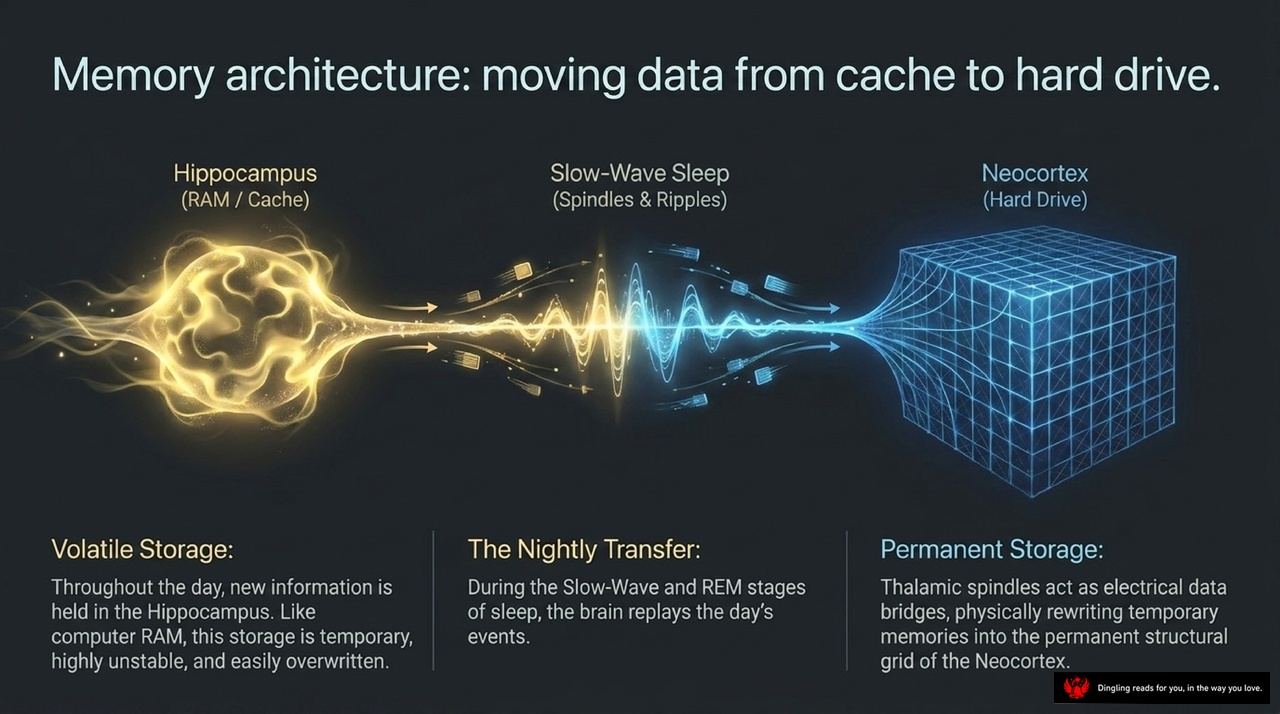
Imagine your brain not as a static organ, but as a high-performance computer constantly managing its data flow. Today's slide visualizes a critical process: how your brain moves information from temporary storage to permanent memory. On the left, we see the **Hippocampus**, acting like your computer's **RAM or Cache**. Throughout the day, this region holds new information as **Volatile Storage**. It's fast but fragile—temporary, unstable, and easily overwritten if you don't act quickly.
But how do we keep what matters? Enter **Slow-Wave Sleep**, the bridge in the middle. This is the **Nightly Transfer** phase. During deep sleep, specifically the stages involving **Spindles and Ripples**, your brain doesn't just rest; it actively replays the day's events. It acts like a backup utility, taking those fleeting, unstable memories from the hippocampus and rewriting them into the **Neocortex**, which functions like your **Hard Drive**.
On the right sits the **Neocortex**, representing **Permanent Storage**. Thanks to **Thalamic spindles** acting as electrical data bridges, the brain physically rewrites these temporary traces into a permanent structural grid. This biological "save function" ensures that your experiences aren't lost to the chaos of daily life, transforming your fleeting moments into lasting knowledge.

Welcome back to our deep dive into brain science. Today, we're shifting our focus from the abstract concepts of mental health to the very physical reality of how your gut directly controls your mind. The slide you see here introduces a revolutionary concept: the "gut-brain axis." It challenges the old idea that mental health happens only inside your skull.
Look at the diagram. That red line labeled "The Vagus Nerve" is the critical connection. Think of it as a bidirectional fiber-optic cable physically linking your digestive system to your brain. This is the "Vagus Highway."
The text on the right explains why this matters. Your gut isn't just a stomach; it houses an independent nervous system and produces a massive percentage of the body's neurotransmitters. This is often called "The Second Brain."
But here is the critical takeaway: brain diseases don't always start in the brain. The slide highlights "Pathological Invaders." Inflammation, toxic proteins, and pathogens in your gut microbiome can travel directly up this Vagus nerve into your brain stem. This physical connection means that issues in your digestion—like anxiety, Parkinson's, or even depression—can originate from the gut.
So, the message is clear: to truly understand and improve your mental health, you have to look outside your head. Your gut is not just a passenger in your body; it is a co-pilot that sends constant signals to your brain, shaping your mood, your stress response, and even your long-term neurological health.

Neuroplasticity is a lifelong physical metamorphosis. This slide shatters the "Static Brain Myth," reminding us that the adult brain isn't a crystallized rock; it's a highly dynamic, moldable ecosystem that physically alters its structure based on your daily actions. Think of it as a city where the roads are built by your habits.
When you actively learn new skills, you are "Thickening the Wires." This process triggers myelination, wrapping your nerve fibers in fatty insulation that vastly accelerates signal speed. Essentially, learning literally speeds up your brain's internet. Conversely, when you stop using certain pathways, "Disuse" sets in. These neural routes become dim and fraying, eventually leading to "Synaptic Pruning." To conserve energy, your brain aggressively dismantles networks that are no longer used. This is the biological truth behind the saying, "You become what you practice."
So, whether you are strengthening your neural pathways through deliberate learning or letting them fade through neglect, remember this: your brain is constantly reshaping itself to match your life.
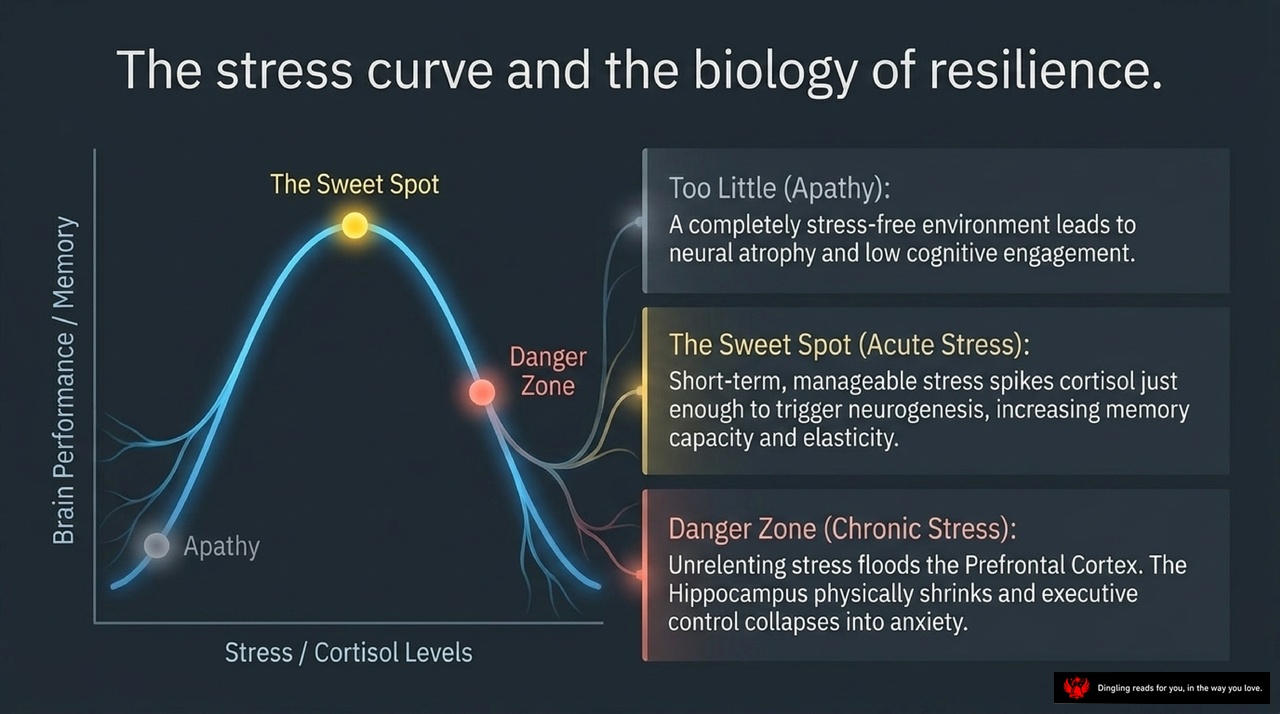
Look at this curve on the screen. It's not just a graph; it's a map of how our brains actually perform under pressure. We often think stress is the enemy, something to eliminate at all costs. But the science tells a different story.
On the far left, we see "Apathy." This is the danger zone of having *too little* stress. When we live in a completely stress-free environment, our brains literally start to atrophy. We lose cognitive engagement, and creativity dies. It's a quiet, slow fade.
Then, as we move right, we hit the peak: "The Sweet Spot." This is acute stress. Think of it as a manageable challenge. When stress spikes just enough, it triggers neurogenesis—literally growing new brain cells. It boosts memory capacity and makes our neural connections more elastic. This is where high performance lives.
But if we keep climbing past that peak, we enter the "Danger Zone" of chronic stress. Here, relentless cortisol floods the prefrontal cortex, the part of our brain responsible for executive control. The hippocampus, our memory center, physically shrinks. We lose our ability to make rational decisions, and anxiety takes over.
So, the biology of resilience isn't about avoiding stress. It's about finding that sweet spot—enough pressure to grow, but not so much that we break.

Aging gracefully isn't just about slowing down; it's about the brain's clever strategy to stay happy. As we move from young adulthood into late adulthood, our brains undergo a fascinating transformation. While the physical structure of the brain might shrink and the speed of processing raw information slows, our minds actually optimize for joy. This is known as the "Positivity Effect."
Think of it as a built-in filter. Our aging brains actively rewire themselves to prioritize positive memories while automatically filtering out negative experiences. It's a trade-off: we sacrifice some raw data retention to gain emotional stability and happiness. This happens because the connection between our executive center, the prefrontal cortex, and our emotion center, the amygdala, becomes more efficient.
So, while we might not remember every detail of a day as vividly as we did in our twenties, we remember the good times more clearly. This biological shift allows us to navigate life's challenges with a lighter heart, proving that getting older can actually mean getting happier.
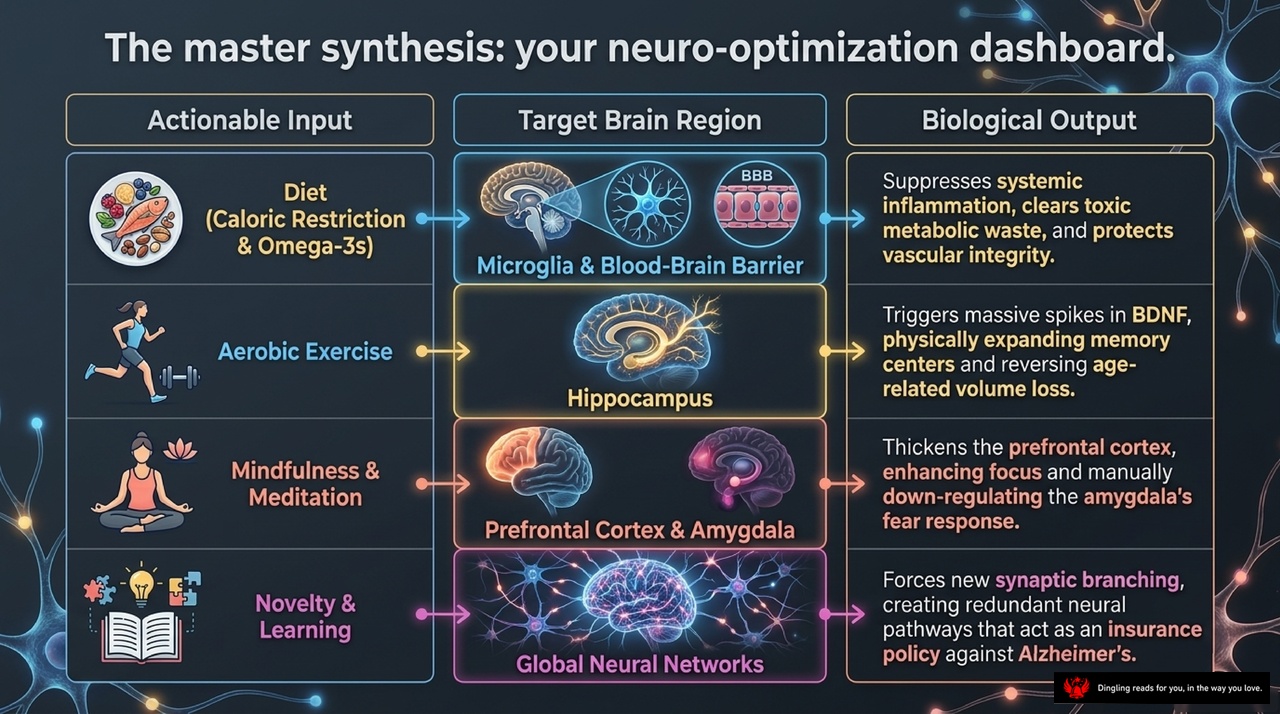
Imagine your brain isn't just a static organ, but a dynamic dashboard you can actively optimize. This slide breaks down the master synthesis of neuro-optimization, linking four actionable inputs to specific brain regions and their powerful biological outputs.
Let's start with diet, specifically caloric restriction and Omega-3s. This input targets your microglia and the blood-brain barrier. The result? It suppresses systemic inflammation, clears out toxic metabolic waste, and protects the integrity of your blood vessels, essentially cleaning the hardware of your mind.
Next, consider aerobic exercise. This directly stimulates your hippocampus, the seat of memory and emotion. The biological output is massive: it triggers huge spikes in BDNF, a protein that physically expands memory centers and reverses age-related volume loss. It's literally building more brain real estate.
Then there's mindfulness and meditation. This practice targets the prefrontal cortex and the amygdala. The outcome is a thickened prefrontal cortex that enhances focus, while simultaneously down-regulating the amygdala's fear response. You're essentially upgrading your executive control center and calming your internal alarm system.
Finally, novelty and learning force new synaptic branching across your global neural networks. This creates redundant neural pathways that act as an insurance policy against Alzheimer's. By constantly introducing new challenges, you ensure your brain remains resilient and adaptable.
In short, by strategically managing your diet, movement, mindset, and learning, you aren't just hoping for a better life; you are biologically engineering a sharper, healthier, and more resilient brain.
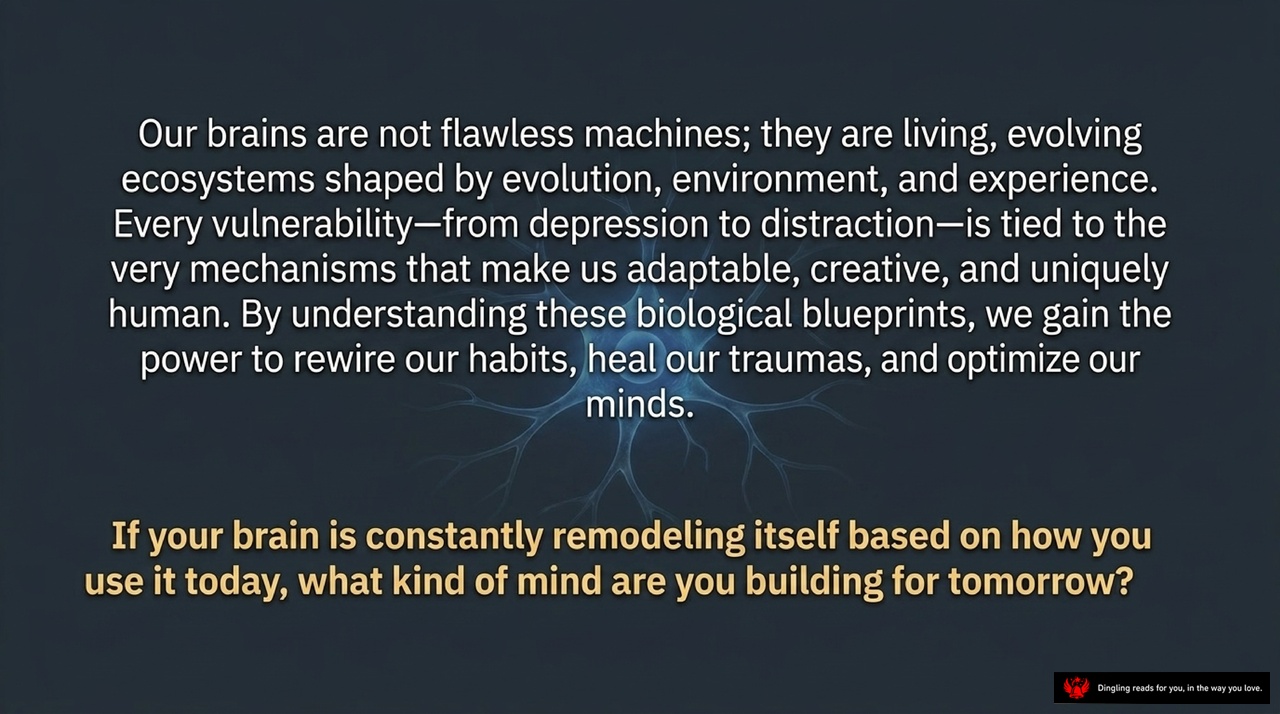
Our brains aren't flawless machines; they are living, evolving ecosystems shaped by evolution, environment, and experience. Every vulnerability—from depression to distraction—is tied to the very mechanisms that make us adaptable, creative, and uniquely human. By understanding these biological blueprints, we gain the power to rewire our habits, heal our traumas, and optimize our minds. If your brain is constantly remodeling itself based on how you use it today, what kind of mind are you building for tomorrow?