
Brandwashed: Complete Chapter-by-Chapter Summary
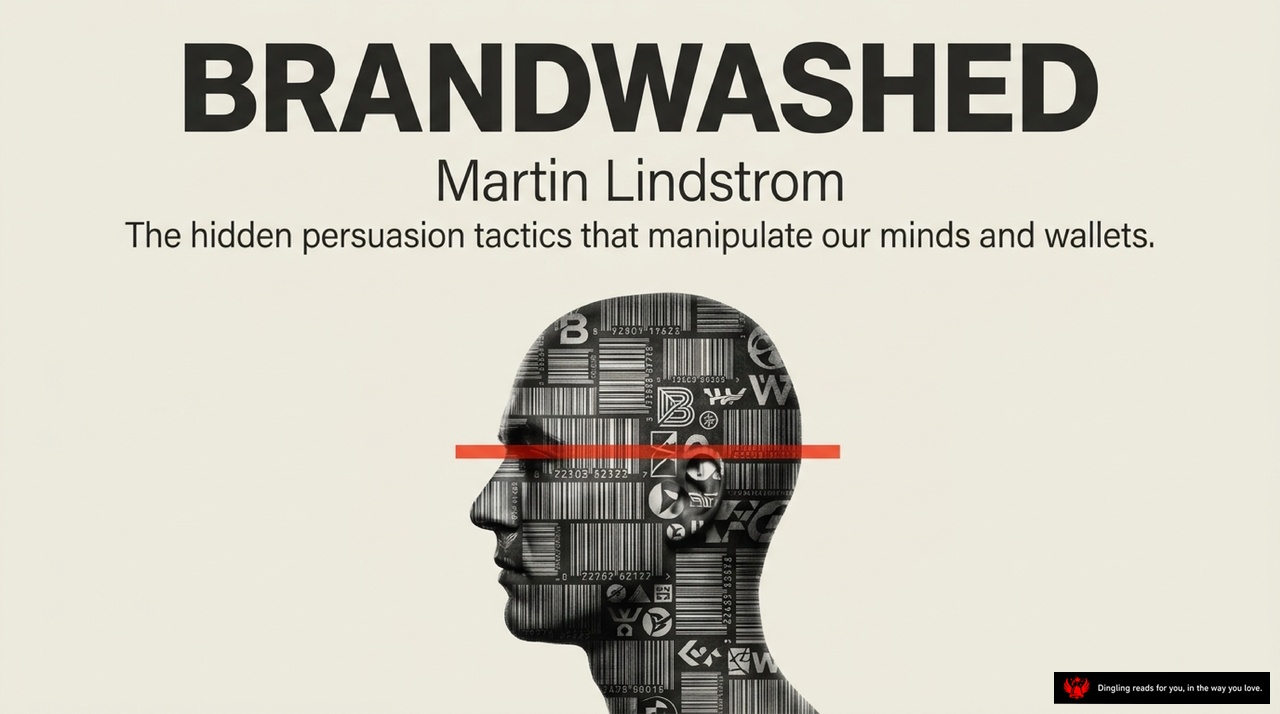
Welcome to *Brandwashed*, where the invisible hand of marketing reaches into your very soul.
Look at this image: a human head constructed entirely from barcodes, logos, and corporate symbols. That isn't just art; it's a map of your mind. As author Martin Lindstrom tells us, brands are the hidden persuasion tactics that manipulate not just our wallets, but our minds themselves.
Think about it: before you even realize you're buying something, a brand has already hijacked your decision. Whether it's the subtle scent of a store, a celebrity's face on a box, or the fear that you're missing out if you don't join the crowd, every purchase is a carefully engineered response.
This book isn't just about shopping; it's about waking up. It reveals how companies use everything from fetal development to social media algorithms to program your desires. We aren't the masters of our consumption; we are the products. But once you see the strings being pulled, you can finally choose to unplug.

We often believe our shopping choices are the result of cold, hard logic. But the reality is far more calculated and far less rational. Look at this split: only 20% of your decision comes from conscious logic, while a massive 80% is driven by subconscious programming.
Modern marketers aren't just selling products; they are bypassing your rational filters to target your deepest fears, primal desires, and biological wiring. Using advanced fMRI technology and cognitive psychology, they turn your brain into a precision instrument. They don't wait for you to choose; they program your response to specific stimuli before you even realize you've been influenced.
Think about it: when you see a familiar logo, your brain doesn't analyze the price or the quality. It triggers an emotional reaction instantly, often rooted in childhood memories or deep-seated anxieties. You aren't picking the item that best fits your needs; you're responding to a script written long before you were born. We think we are the drivers of our own consumption, but often, we are just passengers in a vehicle designed by someone else.

Welcome back. Today, we're diving deep into the science of how your tastes are actually written in your DNA before you're even born. The slide you see right now, titled "Biological Vulnerability: Programming from the Womb," reveals a startling truth: your preferences for sound, smell, and taste aren't just learned habits; they are biological programs installed while you were still a fetus.
Look at the diagram on the left. It highlights three critical inputs: Auditory, Olfactory, and how they travel through the amniotic fluid and placenta to reach the fetus. This is where the magic—and the manipulation—begins.
Let's start with the ears. The slide points to "The Mall Experiment." It's fascinating because it shows how Asian shopping centers strategically pump cherry scents and soothing music into the air. But here's the kicker: they play music that the pregnant mothers themselves loved during their childhood. The result? A year later, when these mothers brought their babies back to those same malls, the infants instantly calmed down. Why? Because the babies were exposed to those specific sounds and scents in the womb, creating a lifelong, subconscious connection to that environment.
Now, look at the bottom left showing "Olfactory Input." This is the "Kopiko Effect." A Filipino candy brand distributed coffee-flavored sweets to pregnant mothers. Years later, children who had never tasted the candy found that its aroma had a profound calming effect on them. Their taste preferences were literally wired through the amniotic fluid. The brand didn't just market to the mother; they marketed directly to the baby's developing palate.
This proves that your "biological vulnerability" starts the moment you take your first breath of life. Before you can even speak or make a conscious choice, brands have already accessed your senses through your mother, programming your future habits, preferences, and even emotional triggers. You are far more vulnerable than you ever imagined because your first customer experience happened inside your mother's womb.

The "Morgensons" experiment proves that your best friend is the most dangerous salesperson you'll ever meet. In this social experiment, a perfect family was filmed for eight weeks, subtly showing off their favorite brands to their neighbors. The result? Their neighbors didn't just watch; they bought the exact same products.
Why does this work so well? Because when we see someone we trust using something, our brain stops thinking logically and starts feeling desire. It's not about the product's features; it's about the social approval of fitting in. This is the power of peer pressure.
Think about your own life. Do you really need that specific pair of shoes just because your best friend wears them? Or do you buy it to avoid standing out? We are constantly watching others, from the people in our immediate circle to the strangers scrolling through Instagram. If everyone else is doing it, we feel safe doing it too. This "herd mentality" is a massive driver of modern consumption.
But it doesn't stop with adults. The impact is even stronger with teenagers. Research shows that teens are far more dependent on brands than adults to define their identity. They use logos as a shield to say, "I belong here." This is why brands target kids so aggressively; the younger they are, the deeper the brand loyalty lasts.
So, the next time you feel an urge to buy something just because it's "trending" or your friend likes it, pause and ask yourself: Am I buying this because I need it, or because I'm afraid of being left out? The Morgensons experiment reminds us that the most powerful marketing message isn't on TV; it's whispered by the people we love and trust.
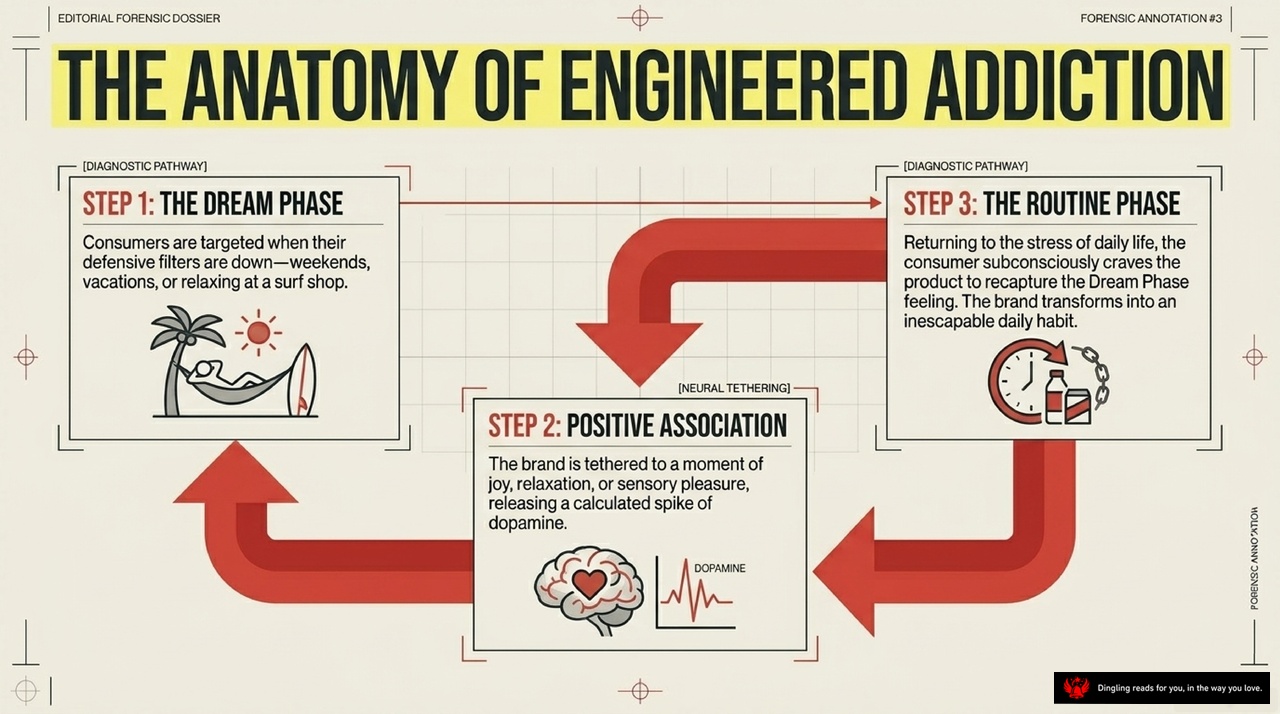
The brain doesn't just process information; it gets hijacked by the people around us. Look at this cycle of "Engineered Addiction." It starts with a dream, moves to a positive association, and ends in an inescapable routine. But the most dangerous part isn't the brand itself—it's the invisible force of peer pressure that locks us into this loop.
Think about your own life. How often have you bought something simply because your friends were talking about it? Or maybe you saw a "bestseller" list and thought, "If everyone else is doing it, I must not be missing out." That's exactly what happens here. When we see others using a product, our brain's rational decision-making center shuts down, and our emotional side takes over. We crave what the group wants.
This is why social media is so powerful. Seeing a friend "like" a brand or share a photo with a specific product creates a hidden pressure to conform. It's not just about the item; it's about belonging. Studies show that when we see others downloading the same song or buying the same shoes, our brains light up with anxiety if we don't follow suit. We want to fit in, so we buy in.
Even our parents are targets. Kids today are smarter marketers than we ever were. They know how to manipulate their parents into buying the "cool" brands like Nike or Vans. They use the same tactics: social proof and the fear of being left out. And once that habit is formed, the cycle continues. We return to the stress of daily life, craving that moment of joy the brand promised us, and we buy again to recapture that feeling.
So, the next time you feel that sudden urge to buy something you don't really need, pause and ask yourself: Is this a genuine need, or am I just trying to prove I belong? Because in the anatomy of engineered addiction, the most powerful salesperson isn't an ad or a celebrity—it's the person standing right next to you.
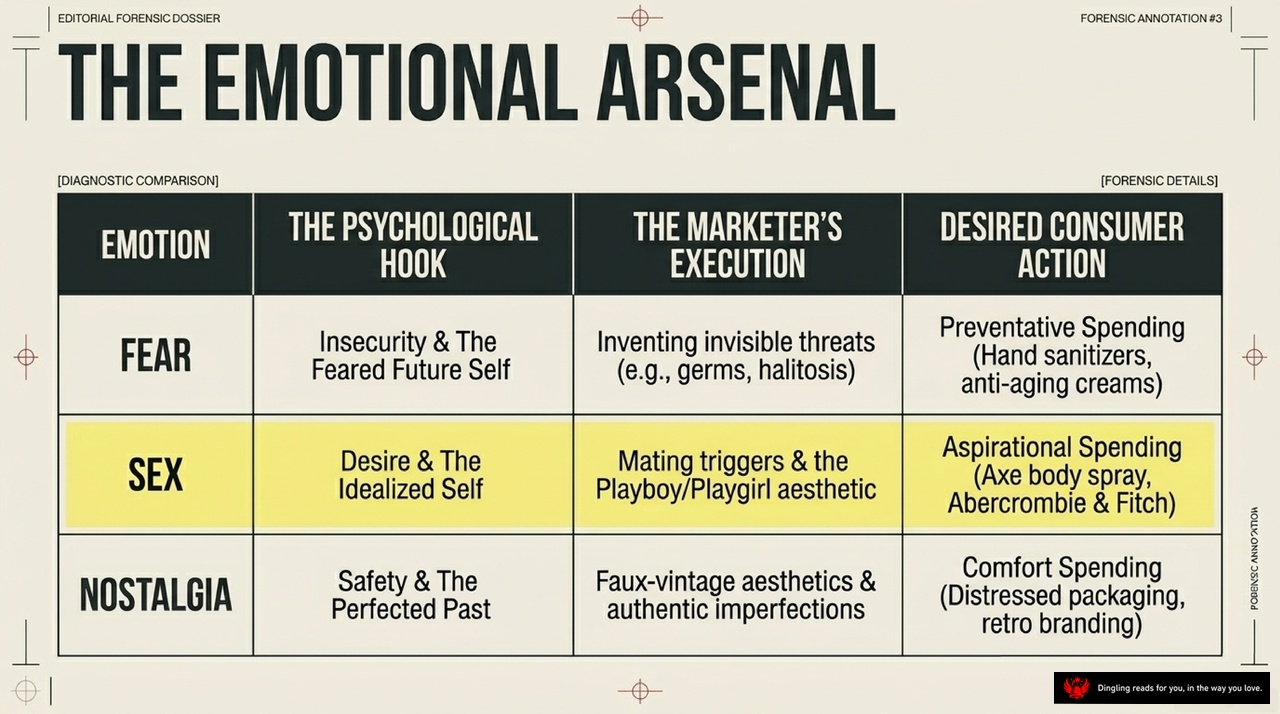
Welcome to the final piece of our emotional arsenal: the power of your peers. We've looked at fear, sex, and nostalgia, but today we're tackling the most pervasive force in modern marketing: peer pressure. It's not just about what your friends buy; it's about how their choices hijack your brain.
Think about that moment in a crowded bookstore or a supermarket aisle. You walk past a book or a product you've never heard of, and suddenly, you see a "Bestseller" list or a sign saying, "Most bought this week." You don't even think about it. You just assume that if everyone else is buying it, it must be the right choice. This is the psychological hook at work: the fear of missing out and the desire to belong. Marketers know that humans are wired to mimic. We want what others want because it signals safety and social acceptance.
You've likely seen this in action. Maybe you bought a specific brand of sneakers just because your cousin had them, or you downloaded a song simply because it was trending on a chart. But here's the darker truth: this influence is so powerful that it can override your own judgment. Studies show that when we see others choosing something, our brains light up in a way that feels like a craving. We aren't just following trends; we are being herded.
This is exactly why companies invest so heavily in "social proof." They create fake bestseller lists, hire actors to look like happy customers, or even manipulate algorithms on platforms like Amazon to show you what "other people" are buying. They turn strangers into a silent chorus telling you what to buy. And it works incredibly well, especially on teenagers whose brains are still developing and who desperately need to define their identity through what they own.
But the impact goes even deeper. It's not just about products; it's about lifestyle. When you see your neighbors grilling with a specific brand of tools or your friends posting photos with a certain car, you start to believe that using those products is the key to being part of that successful, happy group. The marketing message isn't "Buy this product"; it's "Don't be left out."
So, the next time you find yourself reaching for a product you didn't really need, just because it seemed popular, take a step back. Ask yourself: Am I buying this because I truly need it, or am I buying it to fit in? Understanding this invisible force is the first step to reclaiming your freedom from the herd.

Weaponized Anxiety: The Fear & Guilt Cocktail. Welcome to Forensic Annotation #3, where we dissect the exact psychological triggers brands use to drain your wallet.
Look at the first panel: The Avian Flu Profit. This is "Invisible Death Marketing." Brands don't sell you safety; they sell you relief from a phantom threat. During global scares, they position their products as the ultimate shield against invisible death, even when science says standard sanitizers don't stop airborne viruses. They aren't protecting you from germs; they're selling you peace of mind against a fear that doesn't exist.
Move to the second panel: The Aquafresh Tomato. This is a visceral metaphor designed to hack your subconscious. Marketers use shocking imagery, like pressing a toothbrush into a ripe tomato to mimic bleeding gums. Why? To trigger your deep-seated dread of the dentist. They bypass your logic and go straight to your fear center, making you feel that without their product, you are in pain. It's a shortcut to panic.
Finally, the third panel: Manufactured Guilt. This targets parents, specifically mothers. Convenience foods are engineered to require you to add a fresh egg or meat. It's a psychological loophole. It alleviates a mother's guilt over feeding her family processed food by creating a false sense of home cooking. The box says "Baking Mix," but the real sale is on the guilt mitigation. You aren't buying flour; you're buying the reassurance that you are a good mom.
So, here is the takeaway: Brands weaponize fear to sell you safety, use visceral metaphors to sell you pain relief, and engineer guilt to sell you convenience. They don't just sell products; they sell the antidote to your own anxieties.
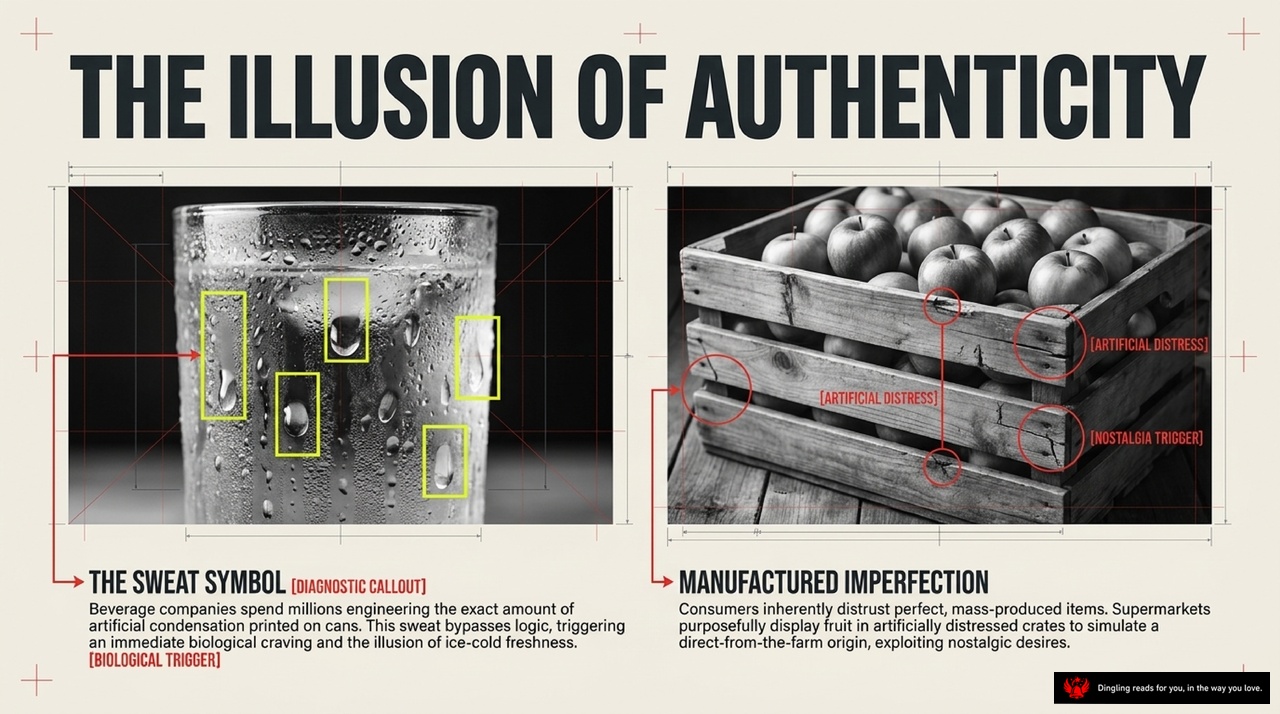
The illusion of authenticity isn't just about what you buy; it's about how brands engineer your reality to make you feel like you've found the "real" thing. Look at this glass of water. Those perfect, glistening droplets aren't natural condensation; they are a carefully calculated marketing trick. Beverage companies spend millions engineering this exact amount of artificial sweat on cans. Why? Because it bypasses your logic and triggers an immediate biological craving for ice-cold freshness. It creates a diagnostic callout that makes the product feel alive and refreshing before you even take a sip.
Now, shift your gaze to the crate of apples. This is the power of manufactured imperfection. Consumers inherently distrust perfect, mass-produced items. That's why supermarkets purposely display fruit in artificially distressed crates with rough edges and cracks. These aren't accidents; they are a nostalgia trigger designed to simulate a direct-from-the-farm origin. By exploiting our desire for the rustic and the authentic, brands convince us that this imperfect-looking crate holds a superior, more genuine product.
In a world saturated with perfection, we are desperate for flaws that feel real. Whether it's the sweat on a soda can or the weathered wood of a crate, these are psychological shortcuts. They allow brands to sell an illusion of authenticity, convincing us that we are holding onto something genuine when, in reality, we are just buying a perfectly crafted lie.
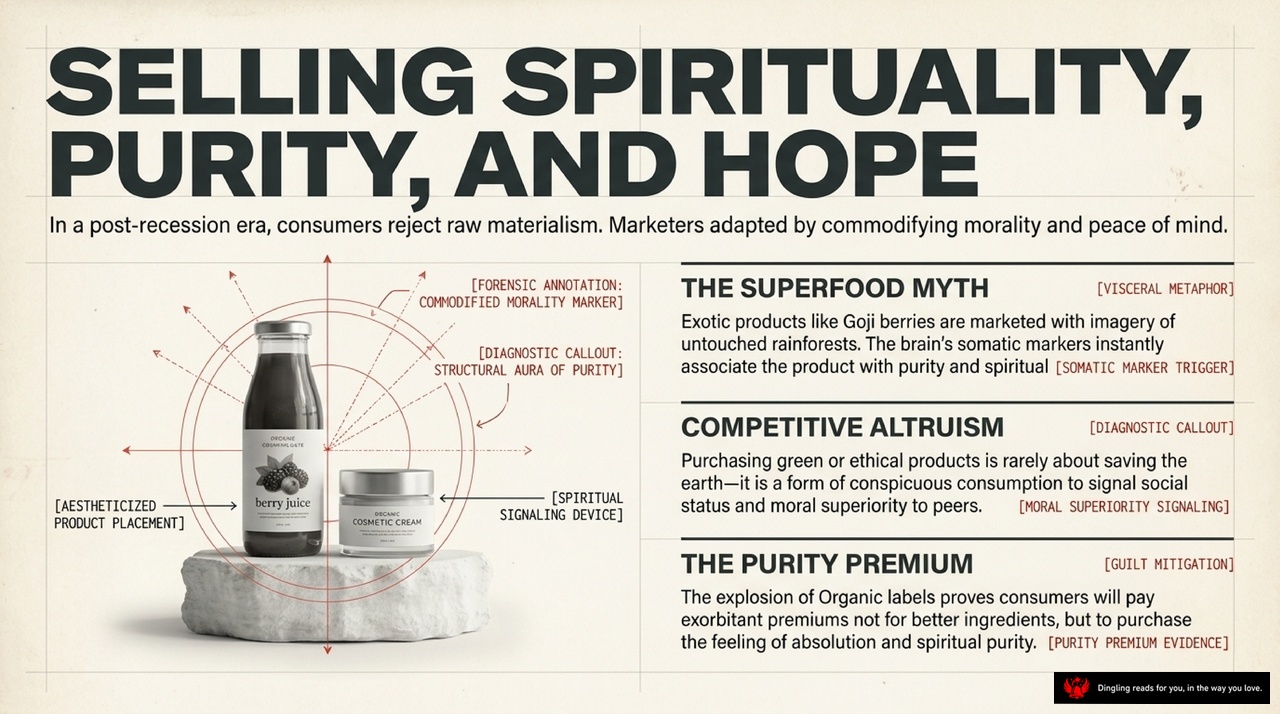
In the modern marketplace, we aren't just buying products; we're buying a spiritual upgrade. As the slide illustrates, in a post-recession era, consumers have rejected raw materialism. Instead, marketers have adapted by commodifying morality and peace of mind, selling us spirituality, purity, and hope.
Look at the "Superfood Myth" section. Products like Goji berries aren't marketed simply as food; they are wrapped in imagery of untouched rainforests. This triggers a somatic marker in our brains, instantly associating the product with purity and a spiritual connection to nature. We don't just want the berry; we want the feeling of being close to the wild.
Then there's the concept of "Competitive Altruism." Purchasing green or ethical products is rarely about actually saving the earth. It's a form of conspicuous consumption—a way to signal social status and moral superiority to your peers. It's a diagnostic callout that says, "I am a good person."
This leads to the "Purity Premium." The explosion of organic labels proves that consumers will pay exorbitant premiums not for better ingredients, but to purchase the feeling of absolution and spiritual purity. We are paying a premium to mitigate guilt and feel like we've done the right thing.
Finally, look at the product placement. These items are aestheticized and positioned as spiritual signaling devices. Whether it's a bottle of berry juice or a jar of organic cream, they are designed to act as a commodified morality marker. We are buying the aura of purity, hoping that the product itself can cleanse our conscience and elevate our spirit.

Social contagion and the pixie dust effect: we don't buy celebrity-endorsed products because we like the product. We buy them to absorb the celebrity's traits. Look at the diagram on the left: the celebrity acts as the forensic marker for trait origin, while the product serves as the transmission vehicle, absorption conduit, and mimicry device, all flowing directly into the consumer ego, which is the diagnostic callout for trait integration. On the right, consider the transference of power: fMRI scans reveal that when a trusted expert or celebrity endorses an item, the brain's risk-assessment and independent decision-making centers literally shut down. This is the magic dissipation warning known as the Royal Tupperware effect: celebrities must carefully manage their Pixie Dust, because if they become too accessible or mundane, the psychological magic immediately dissipates. Finally, we have the empathy mirror. Wearing a celebrity's brand triggers empathetic neurological mirroring, causing us to subconsciously believe we are absorbing their talent, beauty, or power through proximity to the product. This is how social contagion hijacks our logic, turning admiration into ownership.

Look at this diagram: "The Ultimate Trojan Horse." It's all about Word-of-Mouth. The Morgenson Experiment was a covert social test where a highly attractive family was placed in a wealthy neighborhood to softly pitch brands to their peers. Notice the red arrows flowing from the "Morgenson House" to the surrounding targets. That's the infection vector and trusted peer transmission in action.
The results are staggering. First, they bypass our mental filters. Unlike TV ads that trigger defensive skepticism, peer recommendations light up our brain's social-emotional centers, making us feel a genuine craving. Second, look at the infection rate. Friends bought an average of three recommended products each, completely unaware it was a deliberate marketing ploy. Finally, there's the halo of trust. Even after being told the Morgensons were undercover marketers, neighbors stated they still trusted the recommendations and would continue buying.
This proves that the most powerful salesperson isn't a celebrity or an expert, but the person standing right next to you. When we trust someone, we stop thinking and start feeling, which is exactly where brands want us to be.

Welcome to the post-privacy consumer. You think you're in control, but the reality is far stranger: you are already inside a 100-billion-dollar data mining industry that knows your psychological profile before you do. Look at this wall of text behind me. It's not random gibberish; it's your digital shadow. Every credit card receipt, every search query, and even the car accessories you bought are being fed into predictive algorithms.
Let's break down what this means for your life. First, consider the Chrome Accessory Tell. Data mining has revealed intimate behavioral truths that you never intended to share. For example, consumers who buy chrome car accessories are highly likely to miss credit card payments, while buyers of carbon monoxide detectors tend to pay on time. Your digital footprint is leaking secrets about your financial reliability.
Second, there is algorithmic price discrimination. Tracking software analyzes your digital footprint in real-time. If browsing high-end cameras signals that you have a premium budget, algorithms will instantly hide budget options and lock you into higher prices. You aren't just shopping; you are being priced based on your data.
Finally, we live in the Mirror World. Our digital shadows dictate the physical reality marketers present to us, creating bespoke ecosystems of temptation tailored specifically for you. You don't see the ads; you see a world that was built just for you. This is the new normal of consumption.
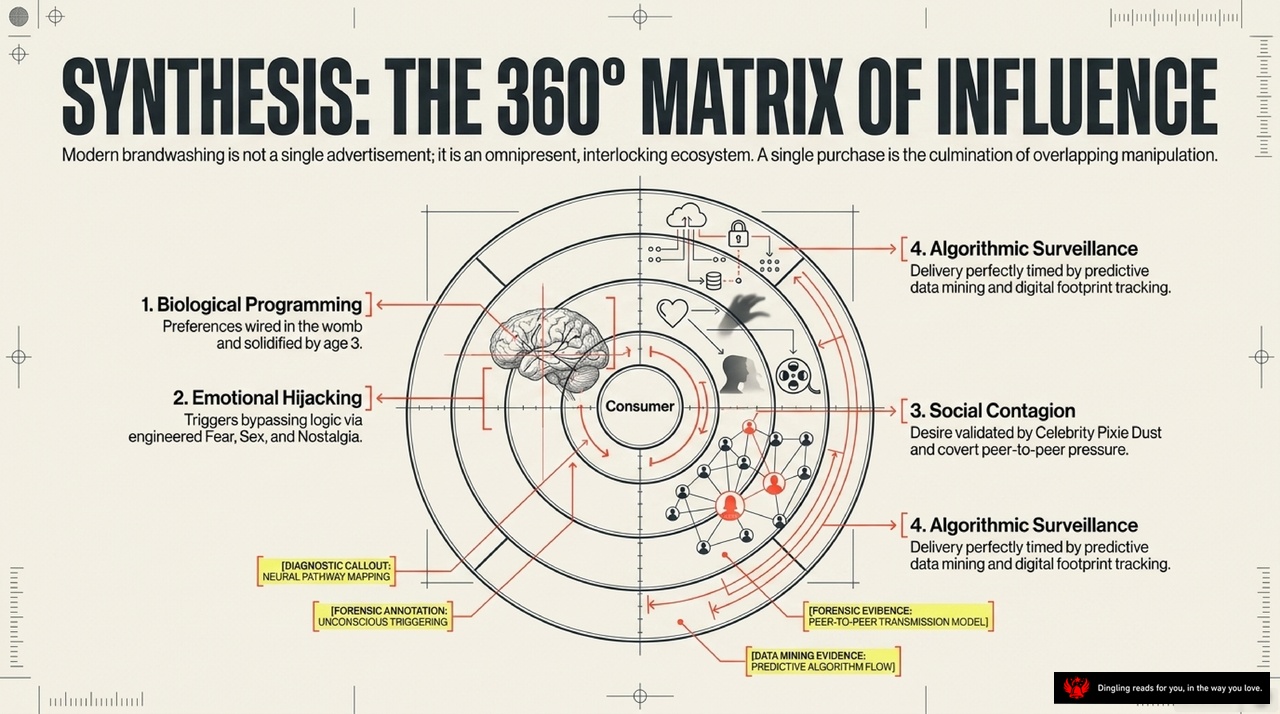
Welcome to the final synthesis of our journey into the hidden mechanics of influence. Look at this 360-degree matrix. It reveals a terrifying truth: modern brandwashing isn't just a single advertisement; it's an omnipresent, interlocking ecosystem where every purchase is the culmination of overlapping manipulation.
At the very center lies the consumer, but they are never alone. Surrounding them is a concentric ring of control. On the inner circle, we see the biological roots. This starts with **Biological Programming**, where preferences are wired in the womb and solidified by age three, followed by **Emotional Hijacking**, which bypasses our logic using engineered fear, sex, and nostalgia.
Moving outward, the influence expands through **Social Contagion**. We see how desire is validated by celebrity "pixie dust" and covert peer-to-peer pressure. Finally, the outermost layer is **Algorithmic Surveillance**. This is where predictive data mining and digital footprint tracking deliver products perfectly timed to your subconscious needs.
From the moment we are fetuses to the algorithms tracking our every click, we are being guided by this invisible matrix. We aren't just buying products; we are being led through a maze designed long before we were born.

Imagine a question mark, but instead of ink, it's made of a barcode. It's a stark reminder of the central question we face today: If every choice you make has been programmed by someone else, what is the true price of your free will?
From the womb to our digital footprints, an invisible architecture of marketing is continuously engineering our desires, fears, and daily choices. It transforms our most intimate psychological vulnerabilities into corporate profit.
Think about your childhood. Did you choose your first toy or the cereal you loved? Often, no. Brands like Lego or Cheerios were planted in our brains before we could even read. Studies show that by age three, children are already recognizing brand logos, and by age ten, they have hundreds of them stored in their memories. Marketing doesn't wait until we are adults; it starts in the womb. Pregnant women are targeted with scents, music, and even specific foods, conditioning the fetus to prefer those flavors and brands for life.
As we grow, the pressure mounts. We aren't just buying products; we are buying identity. Who are we? What do we belong to? When we see a logo on a friend's jacket or a celebrity's handbag, our brains light up with a sense of belonging. We crave the "permission" that comes from being part of a group, a trend, or a lifestyle.
But here is the darkest truth: this isn't about us choosing what we want. It's about brands choosing us. They map our fears, our insecurities, and our deepest desires, then serve us the exact product we need to feel safe, cool, or successful. We think we are free, but in reality, we are just walking through a maze they built, buying the tickets they sold us.