
Built to Last: Complete Chapter-by-Chapter Summary

Welcome to *Built to Last*, the definitive guide to how the world's most enduring companies actually get built. Today, we're stepping into the minds of Jim Collins and Jerry Porras to uncover the architectural principles behind organizations that don't just survive—they thrive for generations.
Forget the idea that success is about a single charismatic leader or a brilliant, one-time idea. Those are what we call "clock watchers"—people who just tell the time. True visionary companies are "clock builders." They create self-sustaining systems that keep ticking long after the founders are gone. Think of it like this: a clock watcher might be a brilliant inventor who creates a great product, but a clock builder creates the entire organization that makes that product possible, ensuring it lasts forever.
In this book, we explore the DNA of these giants. We look at companies like 3M, Disney, and GE, which have survived wars, economic crashes, and changing markets. They aren't perfect, but they are resilient. They don't chase short-term profits at all costs; instead, they pursue a core purpose—whether it's improving lives or bringing joy—and let profit follow naturally.
But here's the most important lesson: building a lasting company isn't about balancing old ways with new trends. It's about a powerful dynamic we call the "Tao." You must preserve your core values while simultaneously stimulating progress. Your mission and values should never change, but everything else—your products, strategies, and even your management style—must evolve to meet the future.
So, are you a clock watcher or a clock builder? The choice you make today determines whether your company is just a hit of the moment or a legacy that lasts. Let's dive in and learn how to build an organization that can withstand the test of time.

Imagine a world where time isn't just something you check on a wrist, but something you build. This slide captures the fundamental shift that separates fleeting success from enduring greatness: the difference between "Time Telling" and "Clock Building."
On the left, we see "Time Telling." It represents relying on a single, fragile connection—a charismatic leader or a single "great idea." The image shows a man pointing to the sun, a fragile link that breaks when the sun sets or the leader leaves. This is the trap of the "myth of the great idea" or the "charismatic leader." History proves that all leaders eventually die, and products eventually fade. If your company depends on one hero or one lucky break, it has a single point of failure. It's just telling the time for today, not building a mechanism for tomorrow.
On the right, we see "Clock Building." Here, the focus shifts from a person to a machine. Look at those interlocking gears: an autonomous system, a self-sustaining structure, and an enduring mechanism. This is the ultimate creation—the company itself. Instead of betting on a visionary architect who might pass away, visionary leaders design an institution capable of surviving multiple generations of CEOs and shifting market tides. They don't just tell the time; they build a clock that keeps ticking long after the original creator is gone.
The contrast is clear: do you want to be the hero of a single moment, or the architect of a lasting legacy? High-performing companies choose to build the clock. They create systems that allow the organization to pivot, innovate, and thrive independently of any single individual. As we move forward, remember this blueprint: your goal isn't to be the sun; your goal is to build the gears that make the world turn.

Welcome to the Master Horologist's Blueprint. Today, we're diving into the true genius of visionary companies: The Genius of the AND.
Most of us are trained to think in terms of binary choices—the "Tyranny of the OR." We believe we must pick one path: either chase profit or hold onto values, or stick to tradition while ignoring change. But visionary companies reject this false choice entirely. They don't accept rational trade-offs; instead, they embrace paradoxes, holding seemingly contradictory ideals simultaneously to achieve unprecedented alignment.
Look at the blueprint in front of you. It's a blueprint for enduring enterprise, and it rests on four powerful pairs of "ANDs."
First, they balance Purpose Beyond Profit AND the Pragmatic Pursuit of Profit. These companies don't treat money as the ultimate goal. Instead, they see profit as a means to achieve a higher purpose. Just like Merck, which prioritized saving lives over revenue, or Johnson & Johnson, which put customers before shareholders. The irony? By prioritizing the right things, they actually earned more money in the long run.
Second, they master Ideological Control AND Operational Autonomy. Think of it as a cult-like dedication to core values, paired with total freedom for execution. Take 3M or Disney. They have a rigid, almost religious belief in their mission, yet they give their employees massive autonomy to innovate. They demand loyalty to the idea, but freedom in the details.
Third, they hold Fixed Core Values AND Vigorous, Relentless Change. This is the Yin and Yang of success. They know what never changes—their core principles—but they know everything else must evolve. As Walmart's founder said, you can't do what worked yesterday. They protect their soul while constantly reinventing their body.
Finally, they combine a Long-Term Horizon AND Strict Short-Term Execution. They dream big—like Boeing's goal to dominate the jet age or GE's ambition to be the world's most respected company—but they execute with ruthless discipline today to build that future tomorrow.
The lesson is clear: You don't choose between these opposites. You do both. You hold the steady center while spinning the outer rings. That is the secret to building a company that lasts for generations.

Pragmatic Idealism: Profit as Oxygen, Not Purpose. Look at this blueprint. It illustrates a crucial distinction that separates the truly enduring companies from the rest. On the left, we see the structure: Core Ideology at the foundation, with Purpose spiraling around it, and Profit flowing through the system.
On the right, we break this down into two layers. Layer one is Core Values—your organization's essential, enduring tenets. These are the rules you hold regardless of whether they offer a competitive advantage. You do not compromise them for financial gain. Layer two is Purpose. This is the fundamental reason for your existence beyond simply making money. It's a guiding star that can never be fully achieved, always pushing you forward.
Consider the quote from George W. Merck at the bottom: "Medicine is for the patient. It is not for the profits. The profits follow." This is the essence of pragmatic idealism. High-performing companies don't treat profit as the destination; they treat it as oxygen. Without it, the organization suffocates, but oxygen is never the purpose of life. The purpose is the value you create for your customers, your society, or your users. When you get that right, the profits follow naturally. If you flip the script and make money the primary goal, you lose your way, and eventually, you lose your market. True longevity comes from building an organization that serves a higher purpose, letting profit be the fuel that keeps the engine running, not the reason for the journey.
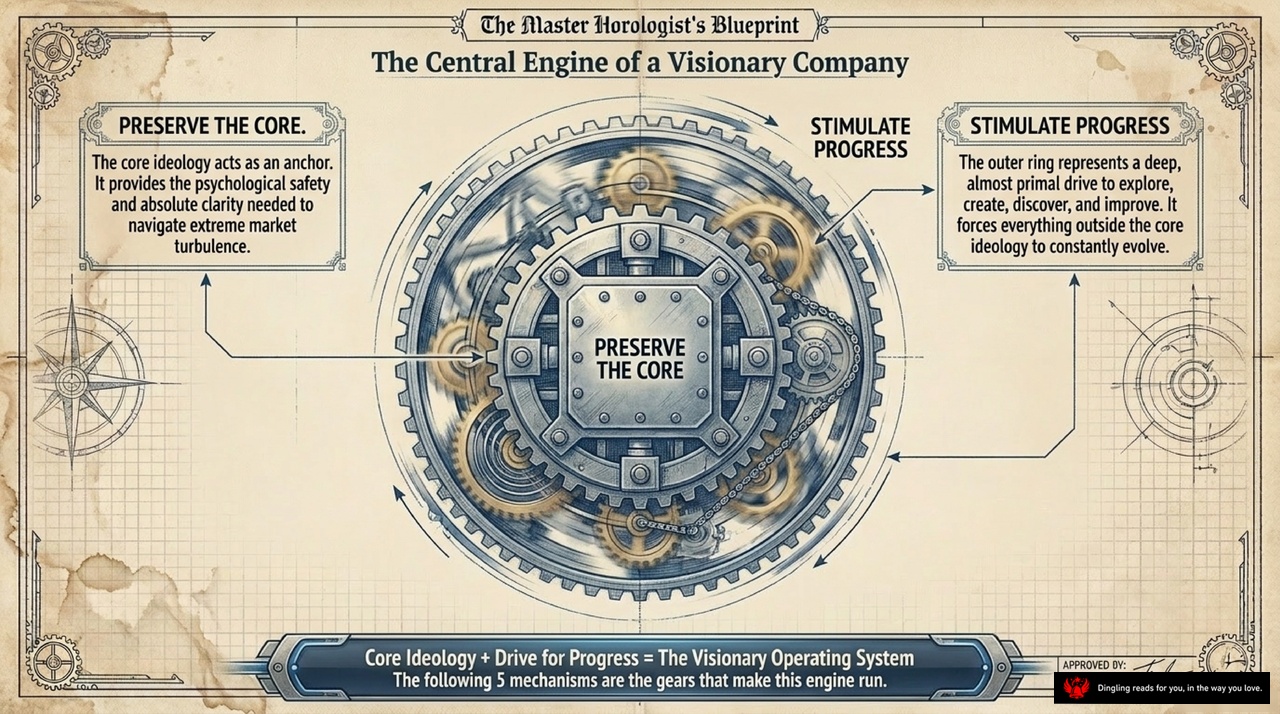
Imagine your company as a complex clockwork mechanism. To build a visionary enterprise that lasts for generations, you need two distinct gears turning in perfect harmony.
First, look at the inner core: **Preserve the Core**. This is your anchor. Your core ideology acts as a psychological safety net, providing the absolute clarity needed to navigate extreme market turbulence. It's the unchanging foundation that ensures you never lose your way, no matter how chaotic the world gets.
But a static core isn't enough. You also need the outer ring to spin: **Stimulate Progress**. This represents that deep, primal drive to explore, create, discover, and improve. It forces everything outside your core ideology to constantly evolve. Without this, your company would stagnate.
These two forces aren't opposites; they are a dynamic partnership. The core gives you stability so you can take risks, while the drive for progress ensures you don't get stuck in the past. When you combine a steadfast Core Ideology with an insatiable Drive for Progress, you create what we call **The Visionary Operating System**.
Think of these five mechanisms we've discussed—audacious goals, a clan-like culture, evolutionary progress, self-renewing management, and self-improvement—as the precise gears that make this engine run. It's not about choosing between stability and change; it's about mastering both simultaneously. That is the blueprint for a company that doesn't just survive, but thrives for centuries.

What if the secret to building a legendary company isn't about finding the perfect idea or relying on a charismatic leader, but rather about setting a goal so bold that it feels impossible? This slide introduces our first mechanism: B.H.A.G.s—Big, Hairy, Audacious Goals.
Think about the moon landing. President Kennedy didn't vaguely say we should "strengthen our space program." He set a clear, compelling target: land a man on the moon and bring him back safely within a decade. Experts said the odds were only 50%, but that specific coordinate unified the entire nation and propelled us forward.
Look at Boeing in the 1950s. While competitors were stuck with propeller planes, Boeing bet 25% of its net worth on the 707, aiming to dominate the civil aviation market. They were told they only made military bombers, yet they chased a moonshot trajectory that put them decades ahead of the competition. Or consider IBM in the 1960s, which gambled billions on the 360 system, effectively rendering their own existing products obsolete just to dominate the future.
These aren't just empty slogans. A true B.H.A.G. must be clear and compelling, requiring little explanation while falling completely outside your comfort zone. It acts as a unifying focal point, forcing the organization to transcend its current capabilities. When you set a goal that is so far beyond the horizon, it creates momentum that outlasts any single leader. It's the difference between a clock that keeps time forever and a clockmaker who just tells the time. By aiming for the ultimate target coordinates, you build an organization capable of enduring enterprise, proving that the highest growth comes from daring to aim for the stars.
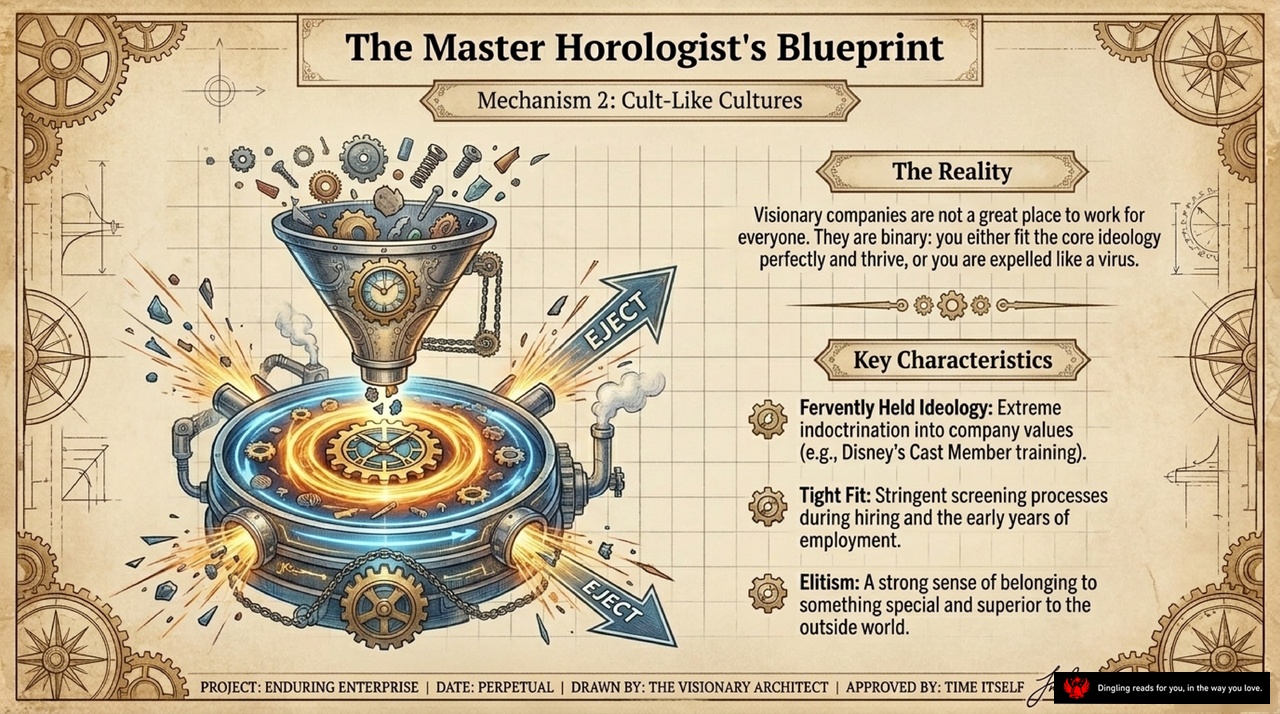
Imagine a world where your company isn't just a workplace, but a tribe—a place where you don't just work, you belong. This slide, "Mechanism 2: Cult-Like Cultures," reveals a hard truth that many leaders try to hide: visionary companies are not great places for everyone. In fact, they operate on a binary principle. You either fit the core ideology perfectly and thrive, or you are expelled like a virus.
Look at the diagram. It's a funnel of intense filtering. These companies demand a "Fervently Held Ideology," often involving extreme indoctrination. Think of Disney's "Cast Member" training or the intense rituals at companies like Nosy Quan. It's not about being nice; it's about total alignment.
But why go this far? The answer lies in the "Tight Fit." These organizations use stringent screening processes during hiring and the early years of employment. They aren't looking for the most skilled candidate on paper; they are looking for the most compatible soul. If you can't internalize their values, you don't belong.
Finally, notice the "EJECT" arrows. This is the "Elitism" aspect. These companies foster a strong sense of belonging to something special and superior to the outside world. They create an in-group mentality that drives performance. It sounds intense, almost cultish, but the research shows that this "cult-like" culture is the secret engine that allows these organizations to survive for a century. It's not about creating a comfortable environment; it's about building a fortress of shared belief that can withstand any market storm.

Think about how evolution works in nature. Charles Darwin taught us that the best species aren't crafted by a divine designer; they emerge from a process of variation and selection, where the fittest survive and the rest fade away. Now, imagine applying this same biological logic to your business.
The slide you see right here is the blueprint for what we call "Evolutionary Progress." It's the third mechanism of the Master Horologist's Blueprint, and it flips the script on how we usually think about strategy.
Look at the center of the image. We call this "The Principle." The text there says, "Try a lot of stuff and keep what works." This is the essence of high-performing companies. They don't rely on brilliant, top-down planning from the start. Instead, they thrive on opportunistic experimentation and productive failure.
Notice the branches spreading out from the core. Many of them are marked with big red X's. These represent the failures. In the traditional view, failure is something to be avoided at all costs. But for a visionary company, failure is actually a necessary cost of evolution. Just like 3M, which famously accepts that mistakes will be made, these companies treat dead ends not as disasters, but as data points that tell them what *not* to do.
Then, look at the path that eventually glows gold. This is the result of "Pruning & Selection of Failures." By ruthlessly cutting off the branches that don't work, the company channels its energy into the few ideas that show promise. You see this in action with companies like Johnson & Johnson. They might stumble into a new product line—like baby powder or Band-Aids—by accident, through a customer complaint or a moment of improvisation. But because they have a mechanism to test these small ideas incrementally, they eventually grow these accidental sparks into enduring giants.
The ultimate goal, shown on the far right, is "Enduring Growth" and "Successful Adaptation." This golden path leads to a company that can survive for generations, not because it predicted the future perfectly, but because it built a system that could adapt to it.
So, the takeaway is simple but profound: Don't wait for the perfect plan. Give it a try—and quick! Act before conditions demand it. Accept that your initial ideas might be wrong, and that's okay. Take small steps, test your hypotheses, and give your team the room they need to explore. When you combine this Darwinian approach with your core values, you stop trying to be a clock that tells the time, and you become the horologist who builds a machine that can keep ticking for centuries.

Look at this blueprint: "The Master Horologist's Blueprint." Notice the title right at the top? It's not about a CEO savior; it's about the company itself. The core message here is "Mechanism 4: Home-Grown Management."
Let's break down why this matters. On the left, we have "The Principle": promote from within to preserve the core. Visionary companies don't just hope for talent; they systematically cultivate leadership pipelines decades in advance.
But what happens when you ignore this? That's "The Threat of the Savior." Bringing in a high-profile external CEO to shake things up often destroys the core ideology. Visionary companies rely on insiders who have truly internalized the company's DNA.
Now, look at the center. This is the "Company Matrix." Imagine it as a complex machine. A robot is climbing the stairs, representing the internal growth of leaders. This structure protects the "Core Ideology" on the right. When an "External CEO Hire" tries to break in, the shield of home-grown culture deflects it, causing sparks and damage.
Finally, let's look at the data and the example. The "Data Point" is staggering: across 1,700 combined years of visionary company history, only 4 CEOs were hired from the outside. That's less than 1%.
And the "Example"? Jack Welch. Everyone thinks he was an external savior, but he wasn't. He was a carefully cultivated product of GE's internal horology. He grew up inside the company for 20 years before taking the helm.
The lesson is clear: your greatest asset isn't a famous outsider. It's the people you've nurtured for decades. Build your own clock, don't just wait for someone to tell you the time.

So, here is the truth that often gets lost in the noise of corporate strategy: writing a beautiful mission statement or a inspiring vision on a piece of paper is not enough. In fact, for the truly enduring companies, those declarations are just the very beginning. The real magic happens when you stop talking about your core ideas and start embedding them into the very fabric of your organization.
Think about Ford in the 80s. Their written mission statement didn't save them from near-bankruptcy. What did? Action. They didn't just post slogans on the wall; they shut down entire production lines when quality dipped, empowered employees to design cars, and rewrote labor contracts to share profits. That's how you turn words into reality.
Look at Merck. They had a noble goal to serve humanity long ago, but they became a great company because they built a university-like research environment, protected their scientists from marketing pressure, and refused to release drugs that weren't better than the competition. Even their recruitment standards were as high as the Ivy League.
And then there's Hewlett-Packard. They didn't just say they valued people; they made it structural. They rejected the industry obsession with market share, promoted from within, and even locked the storage room door to show that no one was above the rules of respect.
The lesson is clear: you can't have a high-achieving company without a high-achieving culture that lives in every policy, every hire, and every decision. If your actions don't match your words, you're just building a house of cards. The enduring companies are the ones that align their entire operation around their core beliefs, creating an environment where the right thing to do is simply the only thing to do.
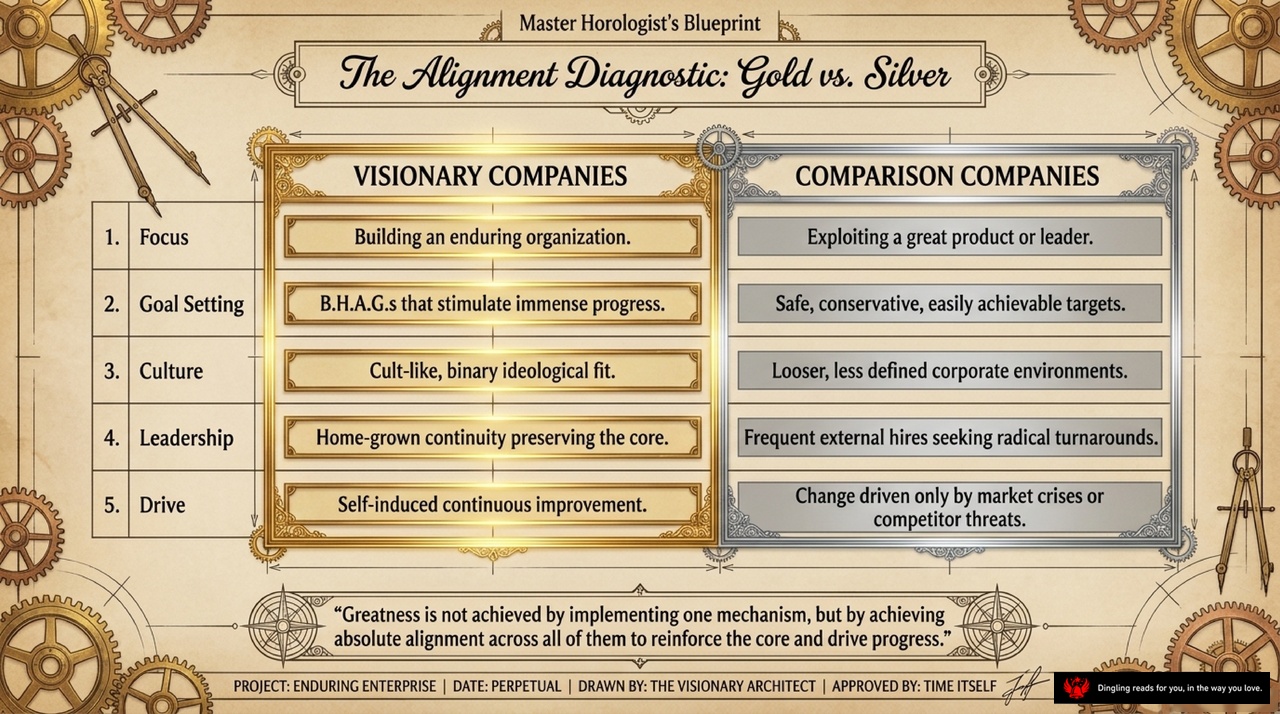
Look at this blueprint. We're comparing two types of companies: the "Visionary Companies," our Gold Medalists, and the "Comparison Companies," our Silver Medalists. The difference isn't just about being a better product or having a smarter leader; it's about the entire DNA of the organization.
Visionary companies are obsessed with building an enduring organization. They don't rely on exploiting a single great product or a charismatic leader. Instead, they set bold, B.H.A.G. goals that stimulate immense progress, whereas comparison companies settle for safe, conservative targets that are easy to hit.
The culture is also worlds apart. Visionary companies foster a cult-like, binary ideological fit where everyone truly believes in the mission. In contrast, comparison companies operate in looser, less defined environments where no one really knows what they stand for. Leadership tells the same story: Visionary companies prioritize home-grown continuity to preserve the core, while comparison companies constantly hire external leaders looking for quick, radical turnarounds. Finally, look at the drive. Visionary companies are fueled by self-induced continuous improvement, constantly trying to beat themselves. Comparison companies only change when forced by market crises or competitor threats.
As the quote at the bottom reminds us, greatness isn't achieved by one mechanism, but by achieving absolute alignment across all of these areas to reinforce the core and drive progress. It's the difference between building a clock that keeps ticking long after the founder is gone, versus just telling the time for a single day.

Look at this intricate clockwork mechanism. It's not just a pretty image; it represents the very heart of what makes a visionary company endure. As the text on your screen asks: Are you merely telling time, or are you building a clock that will tick long after you are gone?
This distinction is everything. Most founders think success comes from a single brilliant idea or a charismatic leader who can carry the company on their shoulders. But our research tells a different story. Building a visionary company isn't about being a great "time-teller"—someone who just shows the time for a moment. It's about being a "clock-builder."
Think about it this way: If you hire someone to tell you the exact time every day, they are indispensable as long as they are there. But if you build a reliable clock, that clock keeps ticking accurately even after you leave, even after the person who wound it is gone.
High-performing companies like 3M, Hewlett-Packard, and Walmart didn't succeed because of one lucky product or one magical CEO. They succeeded because they built a self-sustaining organization. They focused on unyielding core values and a relentless drive for progress. They created a system where the company itself becomes the ultimate creator, not the individual leaders.
So, when you look at your own organization, ask yourself the hard question on the slide: Are you just waiting for the next leader to save the day, or are you building a robust, evolving machine that can thrive for generations? Because the only way to truly win is to build the clock, not just tell the time.