
Capital in the Twenty-First Century: Complete Chapter-by-Chapter Summary
Hey everyone, welcome to today's session. The book we’re breaking down today is *Capital in the Twenty-First Century* by leading economist Thomas Piketty.
This landmark work draws on decades of rigorous cross-country historical data analysis, laying out a clear, eye-opening argument for how the unchecked return on capital in modern times threatens the very foundations of democratic societies. No stuffy academic jargon, no confusing formulas, we’re breaking down all its core takeaways in plain, relatable terms for you today.
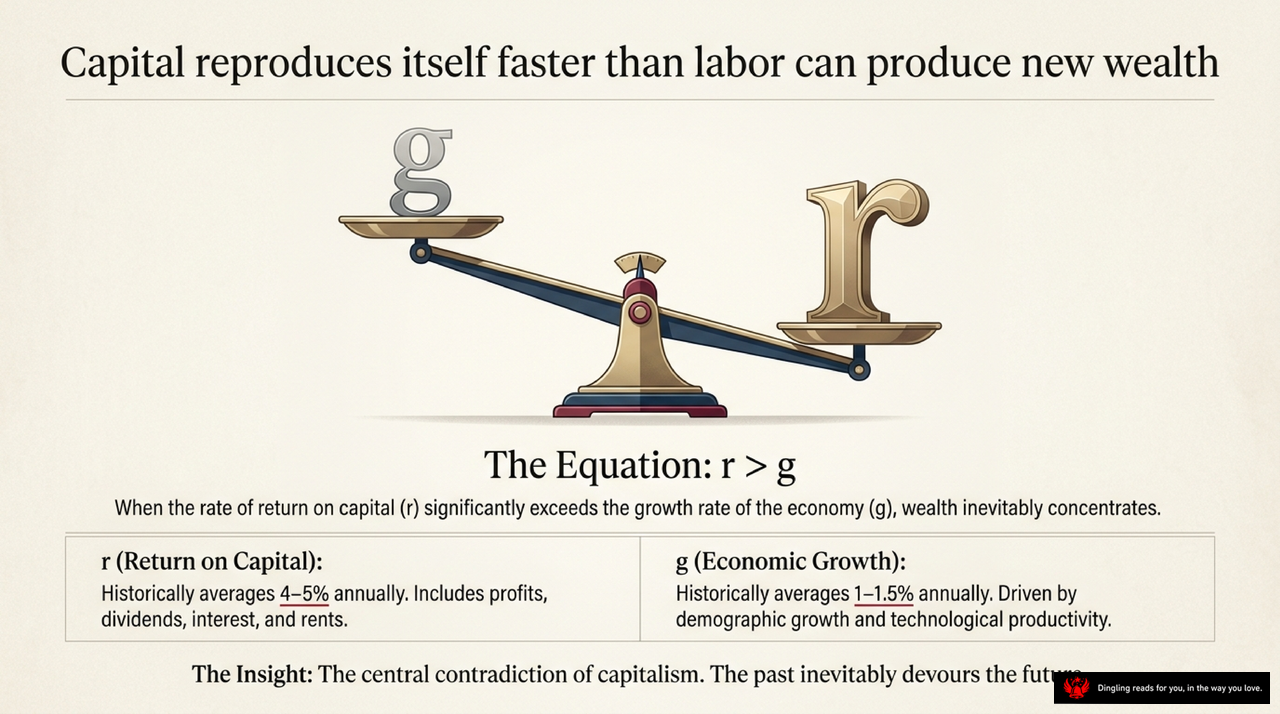
Let’s break down the single most underrated rule that explains why wealth inequality keeps widening across the US and most of the developed world. The core thesis here is simple: Capital reproduces itself faster than labor can produce new wealth, which boils down to the famous, game-changing equation r > g.
First, what do those letters stand for? r is the average return on capital, all the income you get just from owning assets: stock dividends, rental property income, bond interest, and business profits. Historically, that number has stayed remarkably consistent, averaging 4 to 5% every single year for hundreds of years. On the other side, g stands for overall economic growth, the total new wealth the whole economy generates each year, driven by population growth and gains from new technology and worker productivity. Long term, that number only averages 1 to 1.5% annually.
That classic balance scale you see here tilts hard toward r, no contest. When the return you get just from owning money and assets beats the overall growth of the entire economy by that wide a margin, wealth inevitably concentrates in the hands of people who already own capital. You don’t even have to work a full time job to get richer if you’re already wealthy: you can reinvest a small slice of your annual capital gains, and your pile of wealth will compound faster than any regular person could ever save up from a 40 hour a week paycheck.
This is the central contradiction of modern capitalism: the past inevitably devours the future. Old, accumulated wealth from prior generations grows faster than any new wealth you can earn with your own labor, and that’s exactly why upward mobility feels so much harder for most working Americans today.
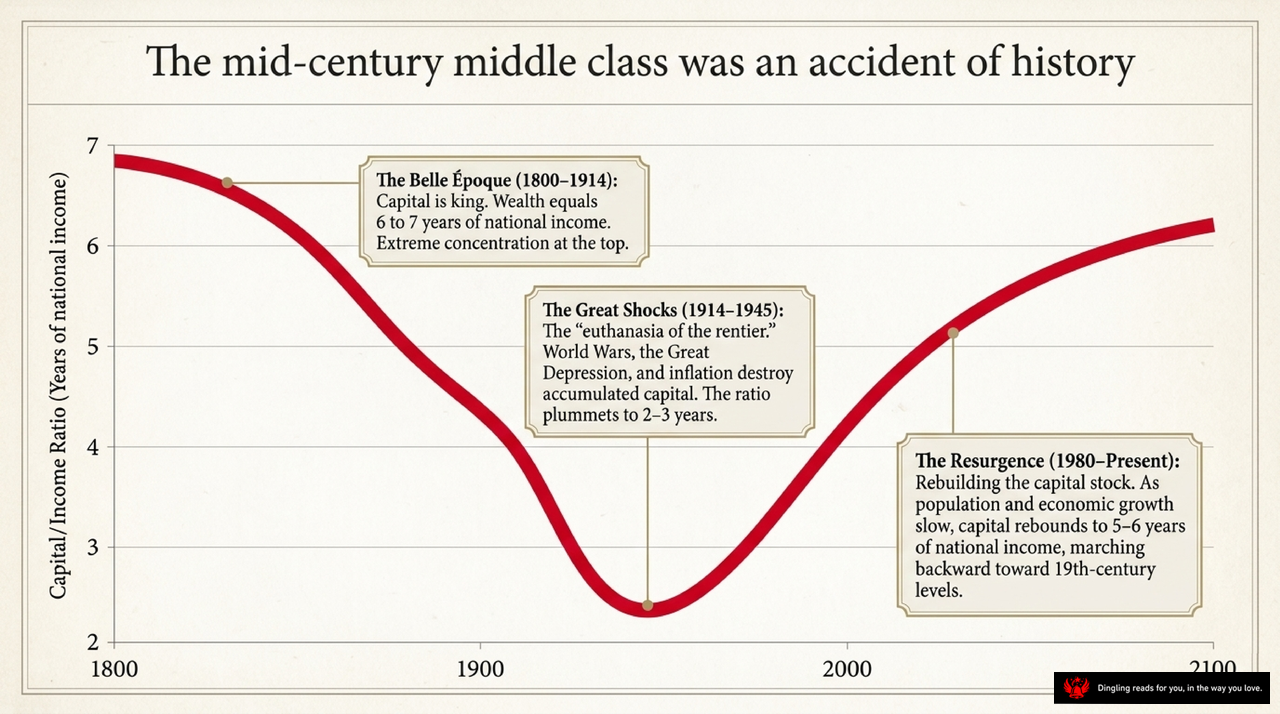
Let’s break down this super clear U-shaped curve that explains why the iconic mid-century American middle class we all romanticize was actually a total accident of history, not some permanent, guaranteed feature of modern capitalism.
What we’re tracking here is the capital-to-national-income ratio, which measures how many full years of a country’s total annual economic output its entire accumulated national wealth is worth. Back in the Belle Époque, running from 1800 all the way to 1914, capital was absolutely king: total wealth hovered at 6 to 7 full years of national income, and almost all of that capital was locked up in the hands of a tiny, ultra-wealthy top tier, with almost no wealth left over for regular working families.
Then came the Great Shocks period from 1914 to 1945, what economists famously call the “euthanasia of the rentier.” Two catastrophic world wars, the decade-long Great Depression, and decades of runaway inflation completely wiped out massive chunks of existing accumulated capital. That capital-to-income ratio plummeted all the way down to just 2 to 3 years of national income, and the old wealthy class of inherited, passive rentiers lost most of their power. That’s the exact moment the broad, prosperous middle class popped up, almost by default, because there was no giant hoard of old capital hoarded at the very top to hog all the economic gains.
Fast forward to the Resurgence phase starting in 1980 right up to today: we’ve spent the last 40 years steadily rebuilding that national capital stock, and as population growth slows and overall broad economic growth cools, that capital to income ratio is already rebounding back to 5 to 6 years of national income. We are literally marching backwards toward the exact same extreme wealth concentration levels we saw back in the 19th century, which is why that post-war middle class stability feels more and more out of reach for most working people right now.
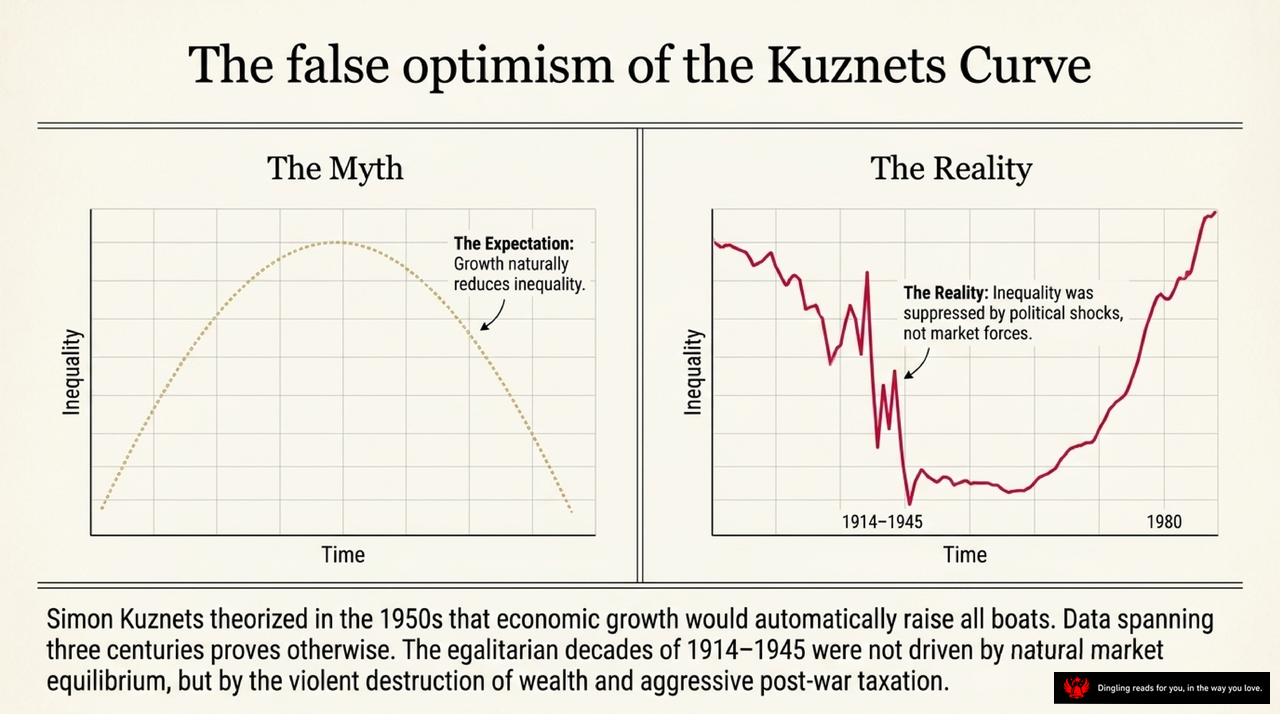
You’ve probably run into that popular, feel-good economic claim that as a country gets richer, inequality will naturally shrink all on its own, no extra policy work required. That’s exactly the false optimism of the Kuznets Curve we’re breaking down here. Back in the 1950s, economist Simon Kuznets first put forward this theory that economic growth would automatically raise all boats, drawing that neat, idealized dotted upside-down curve you see under The Myth section. The whole expectation was that inequality would first rise as industrialization took off, then peak and steadily fall as more people got access to jobs and rising wages, all driven by market forces alone. But three full centuries of real world data completely blows that myth apart, which is exactly what the chart under The Reality side shows. Look at that sharp, steep drop in inequality between 1914 and 1945: that dip didn’t happen because markets naturally balanced things out. Inequality was actively suppressed by massive political shocks, the violent destruction of huge accumulated wealth during two world wars, and the aggressive, steep progressive post-war taxation that broke up old concentrated fortunes. After that temporary egalitarian lull, once those policies started getting rolled back starting around 1980, inequality didn’t keep trending down like Kuznets predicted. It just kept climbing higher and higher, reaching levels that outstrip even the pre-WWI peak. There is no automatic, self-correcting market mechanism that makes inequality disappear on its own. The old optimistic idea that you just sit back and wait for growth to fix everything? It never held up, and the last 40 years of real data proves that beyond a shadow of a doubt.
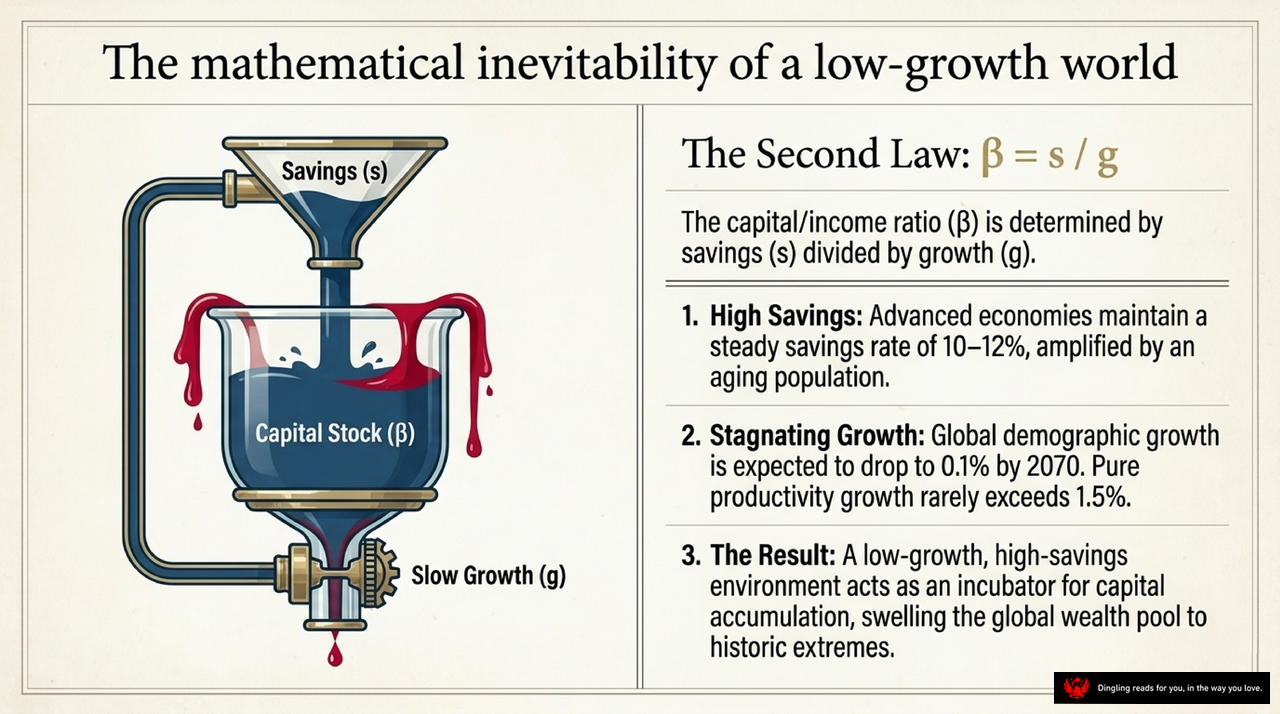
Let’s break down this super intuitive model that explains exactly why we’re heading straight for a low-growth, high-wealth-concentration future, starting with this core idea: The mathematical inevitability of a low-growth world.
You can see the full dynamic play out right in this funnel diagram: all the savings pour into the top, fill up the capital stock tank in the middle, and only trickle out at the very bottom through the tight, restricted slow growth valve. That’s the whole logic behind what’s called the Second Law here, written as β = s / g. What that says is super straightforward: the capital-to-income ratio β, basically how much total accumulated wealth an economy holds compared to its total yearly economic output, equals your long-run savings rate divided by your overall economic growth rate.
Now plug in the real, observable numbers we see playing out across the global economy right now. First, we have High Savings: every major advanced economy maintains a steady 10 to 12% annual savings rate, and that number only gets amplified as the population ages, since older households tend to stash away far more of their income instead of spending it. Second, we’re staring down Stagnating Growth: UN demographic projections say global population growth will drop all the way to 0.1% by 2070, and even the absolute upper bound for pure productivity growth almost never tops 1.5% across long historical timelines.
When you combine those two factors, you get the final, predictable result: this low-growth, high-savings environment acts as a near-perfect incubator for capital accumulation. All that saved capital isn’t getting spread out by fast rising wages or rapid expansion of new industries, it just piles up, swelling the total global wealth pool to historic extremes no one has seen in modern times. It’s not some conspiracy or policy failure, it’s just basic arithmetic.
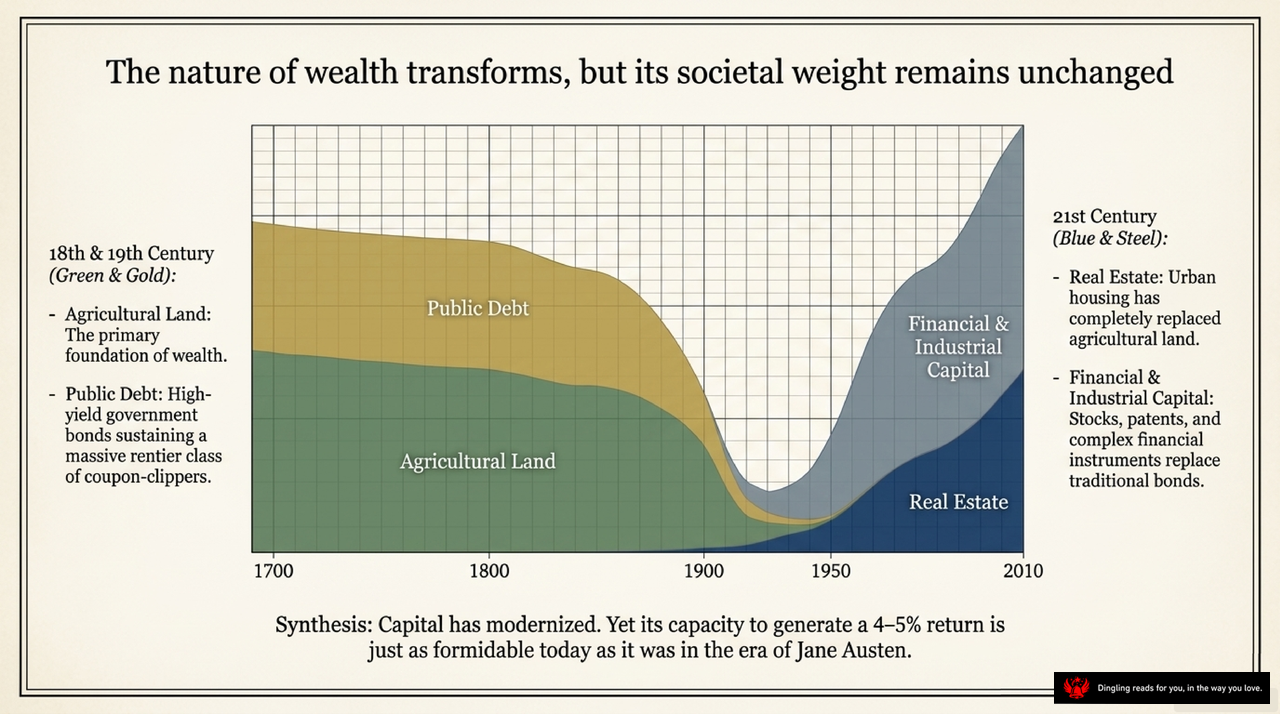
This chart breaks down one of the most surprising long-term patterns in global wealth, and the headline hits the nail on the head: The nature of wealth transforms, but its societal weight remains unchanged.
Back in the 18th and 19th century, what we call the Green & Gold era, the entire global wealth system was built on two pillars. Agricultural land was the unshakable primary foundation of all wealth, and high-yield government public debt bonds sustained a massive rentier class that lived entirely off their coupon payments, no actual work required. That’s the world Jane Austen wrote about, where the only path to real, effortless wealth was owning land or steady government bonds.
Fast forward to the 21st century, our Blue & Steel era, and all those old assets look totally obsolete. Urban real estate has completely replaced agricultural land as the biggest store of household wealth, and modern financial and industrial capital—stocks, patents, all kinds of complex financial instruments—have taken the place of those old traditional government bonds.
But here’s the big reveal the data makes clear: Capital has fully modernized, yet its capacity to generate that consistent 4 to 5% annual return is just as formidable today as it was in Austen’s time. That’s the U-shape you see on the graph: after mid-century shocks from two world wars and the Great Depression crashed the value of old wealth, capital’s share of total national wealth has climbed right back to 1800s levels. We just swapped out what our wealth is made of, but the core power that comes from owning capital, rather than working for a paycheck, never shifted at all.
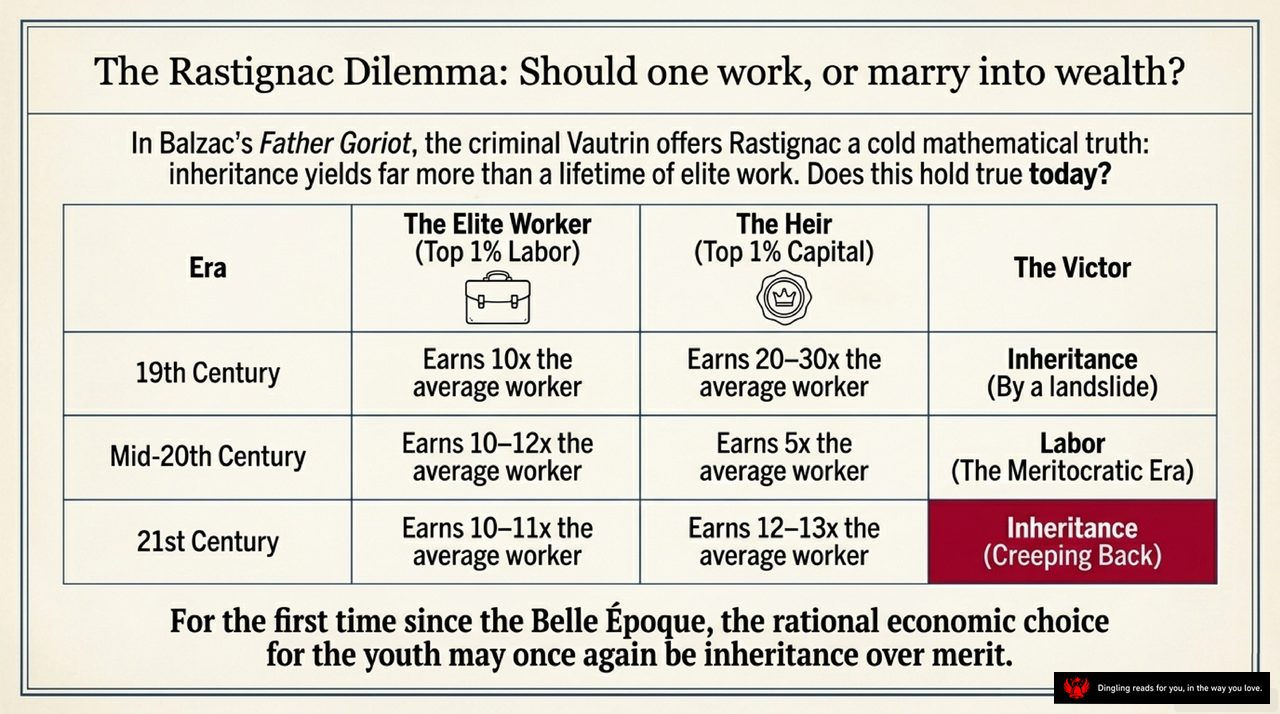
Let’s talk about the Rastignac Dilemma today — that age-old question: should you grind your whole life to climb the career ladder, or just marry into a wealthy family and skip all the hassle?
This isn’t some made-up internet hot take, it’s pulled straight from Balzac’s classic novel *Father Goriot*. The character Vautrin lays out a cold, unflinching mathematical truth to the young, ambitious Rastignac back in the 19th century: the wealth you get from inheritance will outearn you putting in decades of work even if you’re part of the top 1% of elite professionals by a landslide.
But does that hold true today? Let’s run the numbers across three different eras. Back in the 19th century, the top 1% of elite workers earned 10 times what the average worker made, but heirs who held top 1% capital pulled in 20 to 30 times the average pay. Inheritance won, no contest, by a total landslide.
By the mid-20th century, the tables had completely turned. Top tier workers were making 10 to 12 times the average wage, while heirs only earned 5 times that baseline. Labor was the clear winner, that was the full-on meritocratic era everyone talks about where hard work and personal effort actually paid off way more than old family money.
Fast forward to the 21st century, though, the tide is shifting again. Top 1% workers still pull 10 to 11 times the average income, but heirs are now making 12 to 13 times the average. Inheritance is creeping back as the better financial bet. For the first time since the old Belle Époque, the rational economic choice for a lot of young people might once again be chasing inherited wealth instead of grinding their way up through merit.
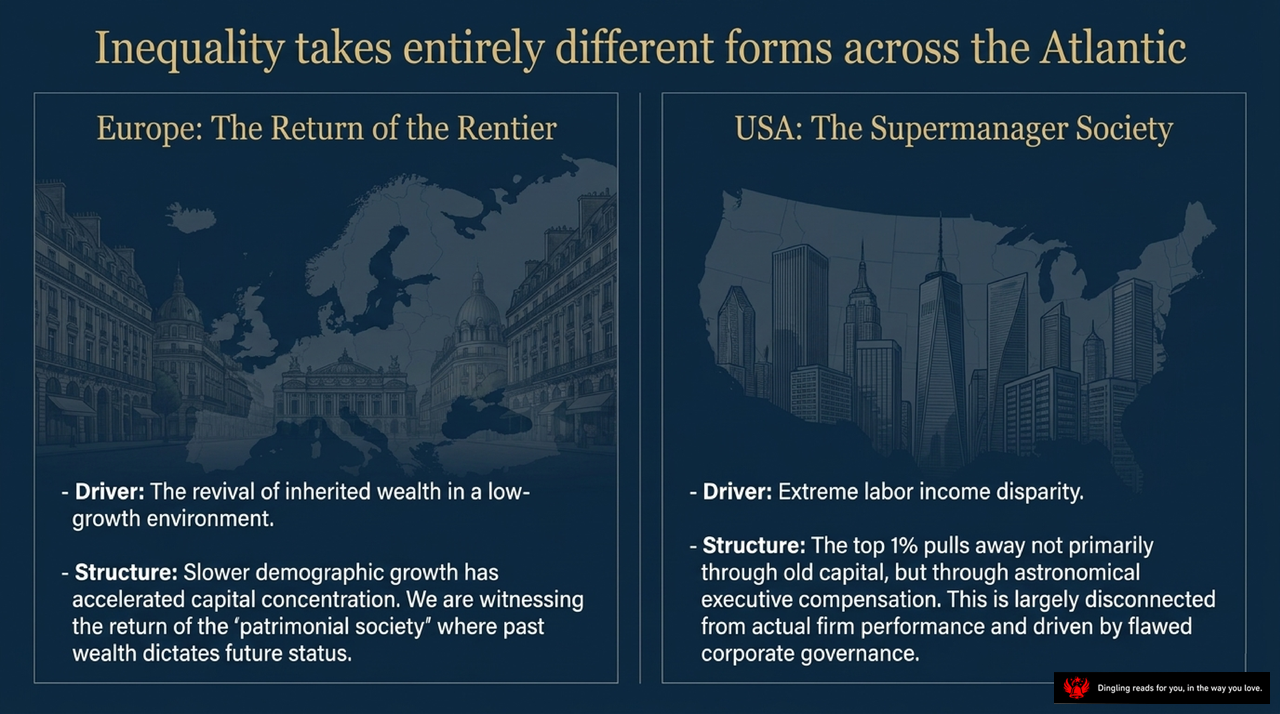
You might think wealth inequality works the exact same way across every wealthy developed nation, but the data makes it clear that inequality takes entirely different forms across the Atlantic, and that’s exactly why the gap feels so distinct when you compare daily life in Western Europe versus the US.
Over on the European side, we’re witnessing The Return of the Rentier. The whole system is driven by the revival of inherited wealth in a low-growth economic environment. Slower demographic growth across the continent has accelerated capital concentration far faster than most analysts predicted even 30 years ago. We are effectively watching the return of the “patrimonial society” there, where past accumulated wealth dictates future social status far more than individual effort or career advancement does for most regular people.
But the US follows a totally different playbook, this is what researchers refer to as The Supermanager Society. The core driver here isn’t hoarded old family capital, it’s extreme labor income disparity. The top 1% pulls away from the rest of the population not primarily through multi-generational inherited fortunes, but through astronomical executive compensation. Most of these sky-high C-suite pay packages are largely disconnected from actual real-world firm performance, and they’re propped up almost entirely by deeply flawed corporate governance norms that let top executives negotiate their own pay with barely any meaningful oversight. Neither system leads to fair outcomes, but these two very different paths to inequality create completely separate sets of social challenges, and you can never craft a working solution if you misdiagnose which version you’re dealing with.
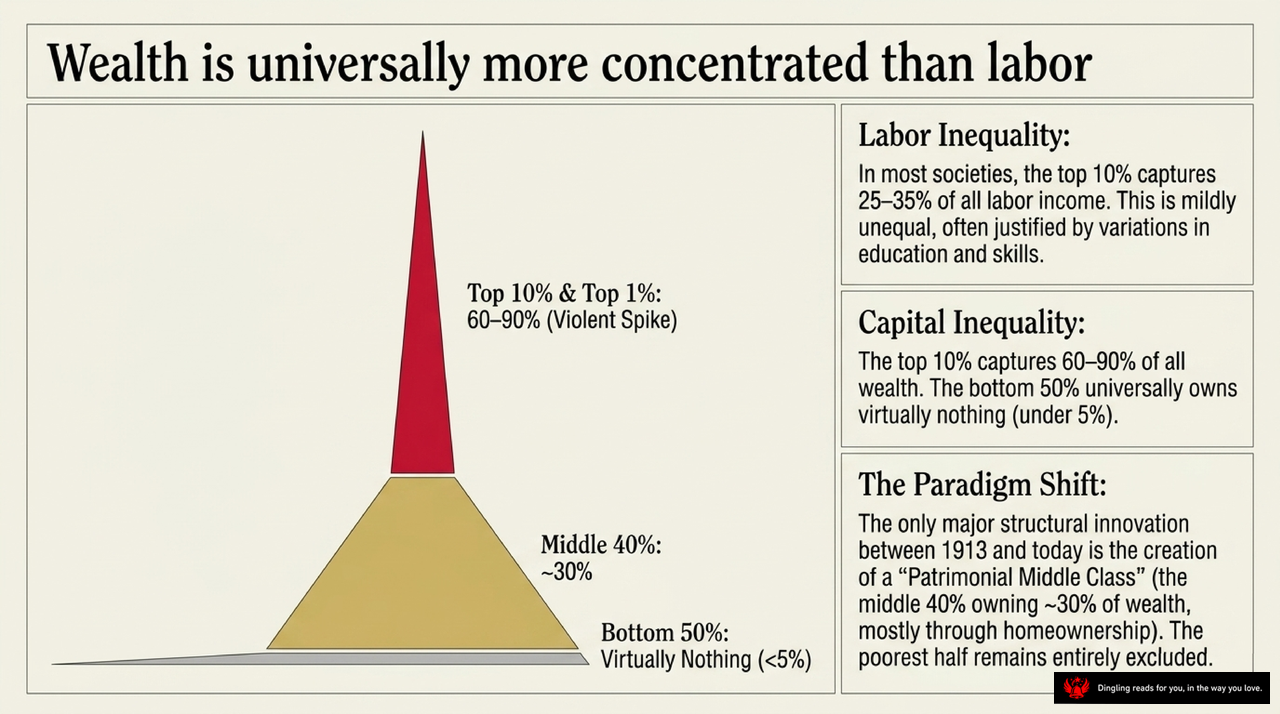
You’ve probably heard all kinds of takes on economic inequality, but the fact laid out on this slide is impossible to argue with: Wealth is universally more concentrated than labor.
Let’s break this down simply. First, labor inequality is relatively mild across nearly every modern society. The top 10% of earners only take home 25 to 35% of all total labor income, a gap most people even consider reasonable, often justified by differences in education background, specialized job skills, and years of professional experience.
Capital inequality, though, is on a completely different level. The top 10% of the population captures 60 to 90% of all accumulated wealth, while the bottom 50% universally owns virtually nothing, less than 5% of total wealth combined. That’s the sharp, violent spike at the very peak of this pyramid, sitting way above the middle 40% tier that controls roughly 30% of all wealth.
This marks a huge paradigm shift that’s played out over the last century. The only major structural innovation between 1913 and today is the creation of this “Patrimonial Middle Class”, that middle 40% group that holds ~30% of total wealth, almost entirely built through homeownership. Even with this historic rise of a middle class that owns real assets, the poorest half of the population remains entirely excluded from meaningful wealth building, locked out of the long term, compounding gains that come from owning capital.
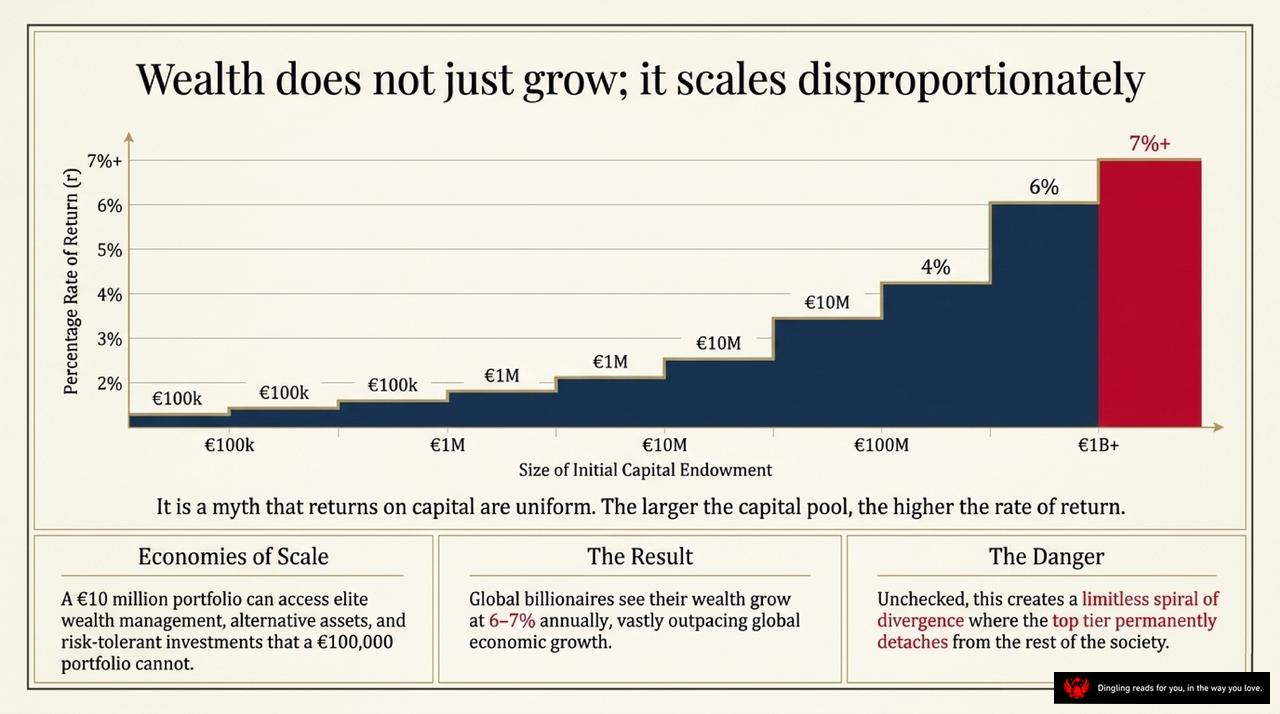
Most of us grow up assuming all invested capital earns roughly the same rate of return, right? You put $100k in the market, you get the same percentage yield as someone who dropped a million? That’s a total myth, as this chart spells out so clearly.
The big truth we’re laying out here is that wealth does not just grow; it scales disproportionately. Look at the bars along the graph: someone with a €100k portfolio is barely pulling in a 1% return, barely beating inflation, basically treading water year over year. But once you hit €1M, your returns jump to 2%, €10M pushes that up to 3.5%, €100M lands at 4%, and the second you cross the €1B+ threshold? You’re earning 7% or more every single year.
This isn’t random luck, that’s pure economies of scale at work. A €10 million portfolio can afford elite dedicated wealth management teams, access exclusive alternative assets, and take on higher risk long term investments that someone with $100k in their 401k could never even get invited to.
The end result? Global billionaires see their wealth grow at 6 to 7% annually, vastly outpacing the 1.5 to 2% global economic growth rate that the rest of us are tied to. Left completely unchecked, this creates a limitless spiral of divergence where the top tier permanently detaches from the rest of the society. You can’t out-earn this gap with a regular 9-to-5 paycheck, because the people who already hold all the capital are earning far more on their existing money every year than most people could save their entire working lives.
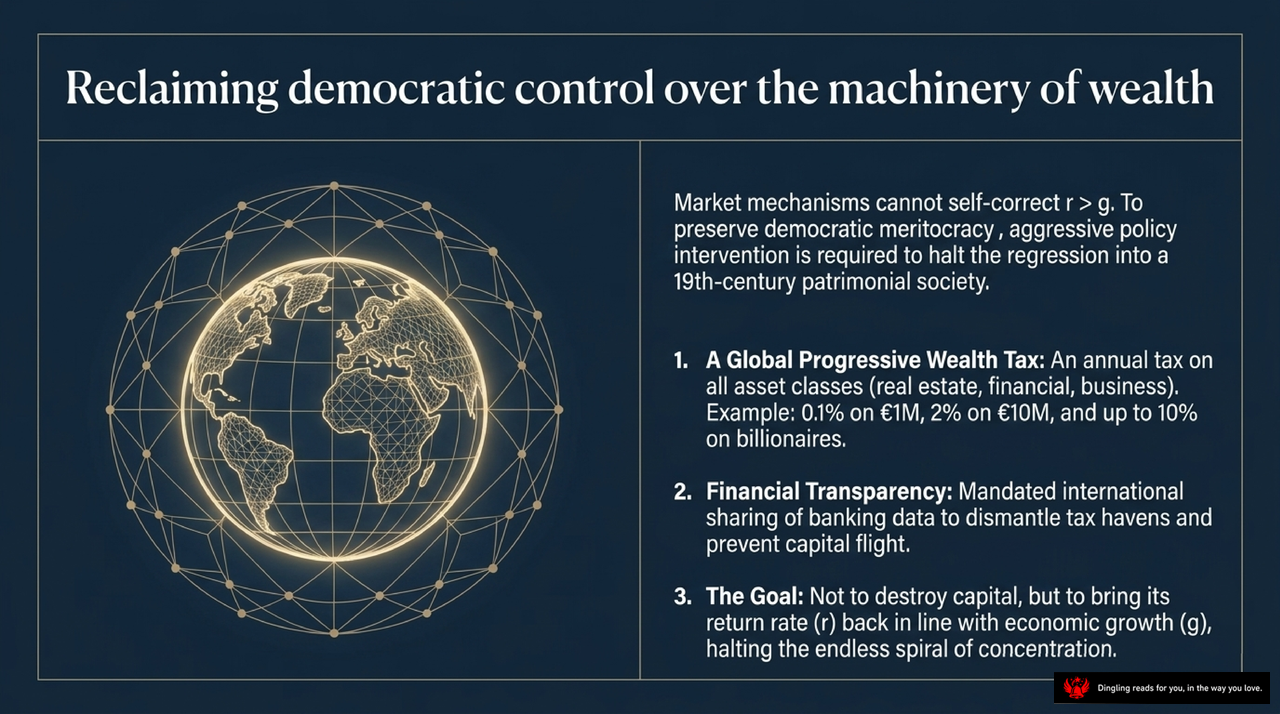
Alright, let’s break down the actionable framework we’re laying out to reclaim democratic control over the machinery of global wealth.
For far too long, policymakers have bought into the myth that market mechanisms will automatically self-correct the dynamic where r, the rate of return on capital, permanently outpaces g, the overall economic growth rate. But every piece of long-term historical data we’ve covered blows that myth apart. If we sit back and do nothing, we will steadily regress right back to a 19th-century-style patrimonial society, where inherited fortunes dominate every part of public life, and the promise of democratic meritocracy becomes nothing more than an empty, unachievable talking point.
To stop that slide, we need targeted, aggressive coordinated policy intervention, starting with two core pillars. First, we implement a Global Progressive Wealth Tax: a small annual tax applied across every single asset class, from residential real estate to financial portfolios to private business holdings. The tiered structure would be gentle for most people, hitting 0.1% on fortunes over €1 million, 2% for assets above €10 million, and scaling all the way up to 10% for billionaires.
Second, we mandate full global financial transparency, with automatic, mandatory cross-border sharing of all banking data to dismantle tax havens that hide trillions in unreported wealth, and prevent unregulated capital flight that drains resources out of local communities.
Make no mistake, this framework does not exist to destroy capital or punish success. The entire goal is to bring the return rate on capital r back into alignment with economic growth g, halting that endless, self-feeding spiral of extreme wealth concentration.

Let’s walk through this core wrap-up that ties every key point we’ve covered together. History makes one thing crystal clear: capitalism has no natural, built-in mechanism to stop extreme wealth from getting more and more concentrated in the hands of a tiny group. Right now, as global economic growth continues to slow across nearly every major market, the returns on existing capital are accelerating faster than most people’s wages or the overall growth rate of the economy. That trend is on track to resurrect a society where old inherited wealth overshadows new innovation, where the money your grandparents or parents made decades ago matters far more than the new ideas, effort, or talent you bring to the table. It’s a future where the past effectively devours the possibilities of the next generation.
That brings us to the big, unavoidable question we all have to grapple with: if the very machinery of capitalism inherently pulls more power and more wealth into the grasp of a small elite over time, are we willing to let the democratic equality that so many of us have taken for granted for generations become nothing more than a relic of the past? This isn’t some abstract, distant doomsday scenario. You can already see the early signs playing out across the US right now: skyrocketing home prices that lock entire generations of young people out of home ownership, stagnant wages that haven’t kept up with costs for 40 years, and a shrinking middle class that can barely afford basic healthcare or higher education no matter how many hours they put in at work. That’s the exact trajectory we’re on if we don’t push back against this unregulated concentration of wealth.