
Capitalism and Freedom: Complete Chapter-by-Chapter Summary
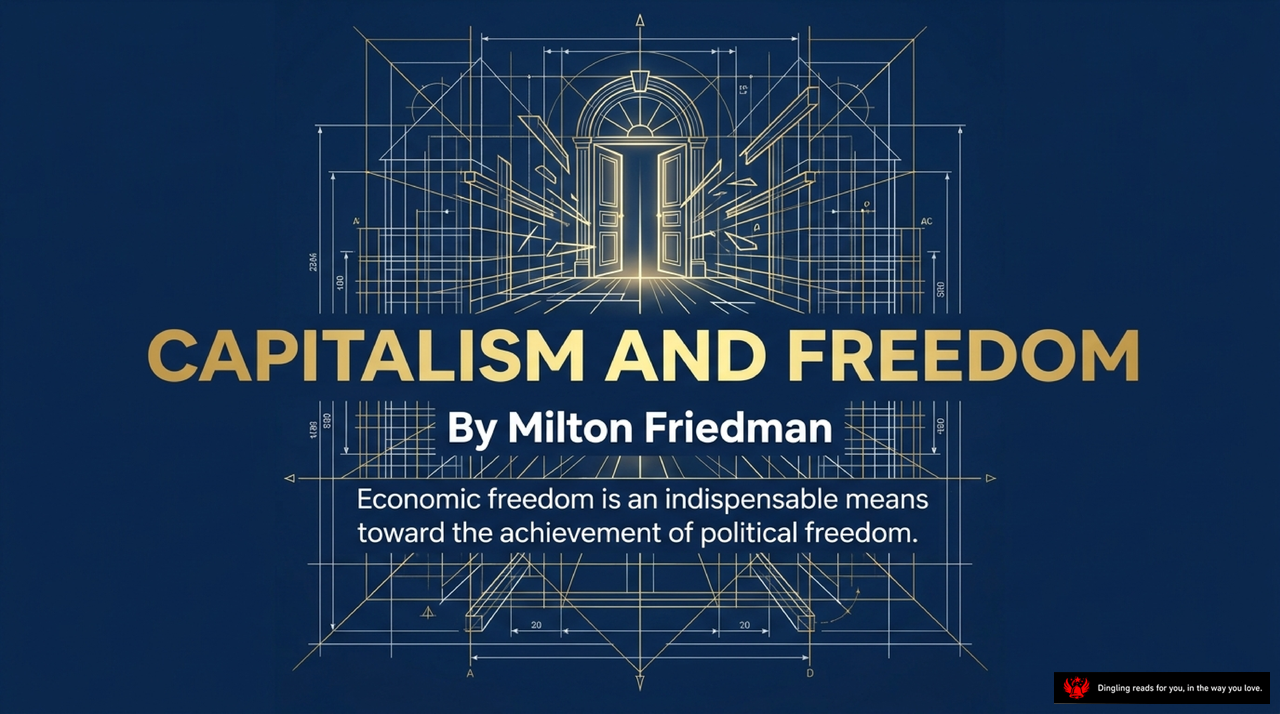
Welcome everyone. Today we’re opening a book that fundamentally changed how we see liberty: Capitalism and Freedom by Milton Friedman. Many people think politics and economics are separate things. But Friedman argues otherwise. As you see on the screen, he states: Economic freedom is an indispensable means toward the achievement of political freedom. He says you can’t have true political freedom without economic liberty. It’s not just about wealth; it’s about power. If you control the economy, you control the people. So, how do we build a free society? That’s what we’re exploring today. Let’s dive in.
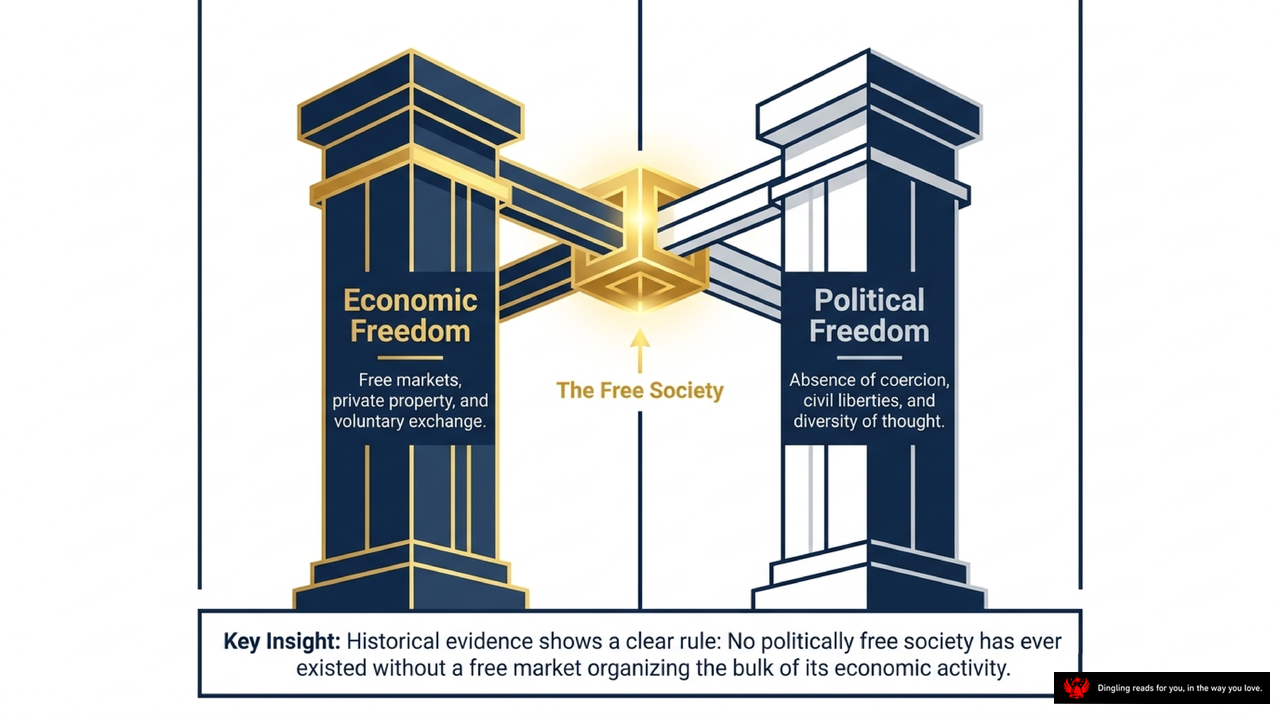
Take a moment to look at this visual. It illustrates the two pillars holding up a free society: Economic Freedom and Political Freedom. Economic Freedom is defined by free markets, private property, and voluntary exchange. Political Freedom is about the absence of coercion, civil liberties, and diversity of thought. Together, they form The Free Society. But the Key Insight at the bottom is the most critical part. Historical evidence shows a clear rule: No politically free society has ever existed without a free market organizing the bulk of its economic activity.
Many people mistakenly believe politics and economics are separate silos. They think they can have a democratic government without a free market. But history tells a different story. If the state controls the economy, it inevitably controls your livelihood. If it controls your livelihood, it can easily control your speech and your thoughts. That's why a free market is essential. It separates economic power from political power. When you have a competitive market, businesses answer to consumers, not politicians. This creates a vital check and balance that protects your civil liberties. Without that economic foundation, political freedom becomes fragile. So, building a truly free society means protecting both, but remember, the market is the bedrock. You cannot have one without the other. This is why we must defend economic freedom as fiercely as political freedom. The market isn't just about money; it's the structure that safeguards your ability to live freely.
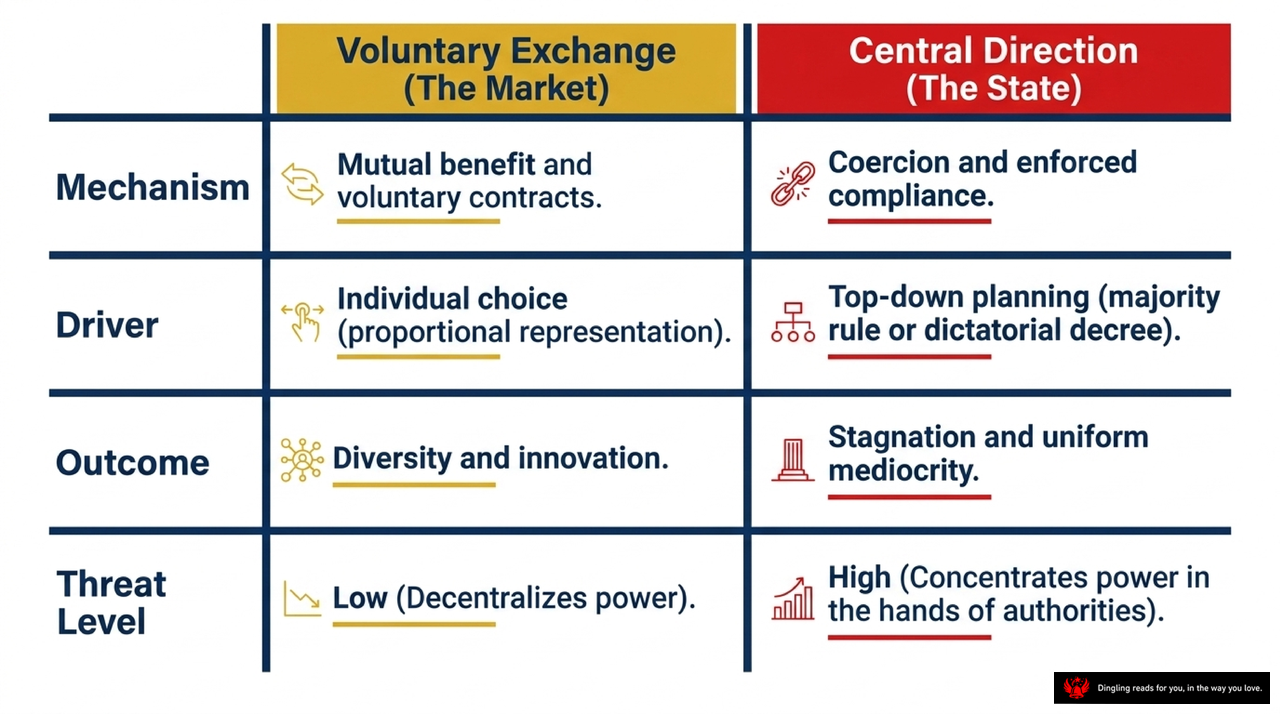
Welcome to this section. We are looking at the fundamental difference between how a free market operates versus how a centralized state operates. This chart breaks it down into four critical areas that define our society.
First, the mechanism. On the left, you have voluntary exchange, which is the market. It runs on mutual benefit and voluntary contracts. You enter an agreement because you want to, not because you're forced. It's about cooperation without coercion. On the right, you have central direction, which is the state. Its mechanism is coercion and enforced compliance. You follow the rules because you have to, often through the threat of force.
Second, the driver. The market is driven by individual choice. It's about proportional representation of your own interests and preferences. The state, however, is driven by top-down planning. It relies on majority rule or dictatorial decrees imposed from above, often ignoring individual nuances in favor of a single goal.
Third, the outcome. When you have a market, you get diversity and innovation. Freedom to choose leads to a variety of ideas, products, and solutions. In contrast, central direction leads to stagnation and uniform mediocrity. When everyone is forced to follow a central plan, creativity dies, and society becomes rigid and unresponsive to change.
Finally, the threat level. The market decentralizes power, keeping the threat to individual liberty low. It prevents any single group from holding all the cards. The state, on the other hand, concentrates power in the hands of authorities. This creates a high threat to freedom. If you control the economy, you inevitably control the people, and that is the ultimate danger to liberty.
As the text explains, this isn't just about economics; it's about political freedom. The market separates economic power from political power, allowing them to check each other. Without this separation, as seen in socialist or totalitarian systems, the state becomes the sole source of power, crushing dissent and innovation. This chart proves why voluntary exchange is the bedrock of a free society. We must choose the path that protects our liberty. Remember, economic freedom is the prerequisite for political freedom. Without the market, the state has no checks, and freedom is lost. This is why we must defend the free market against central direction.
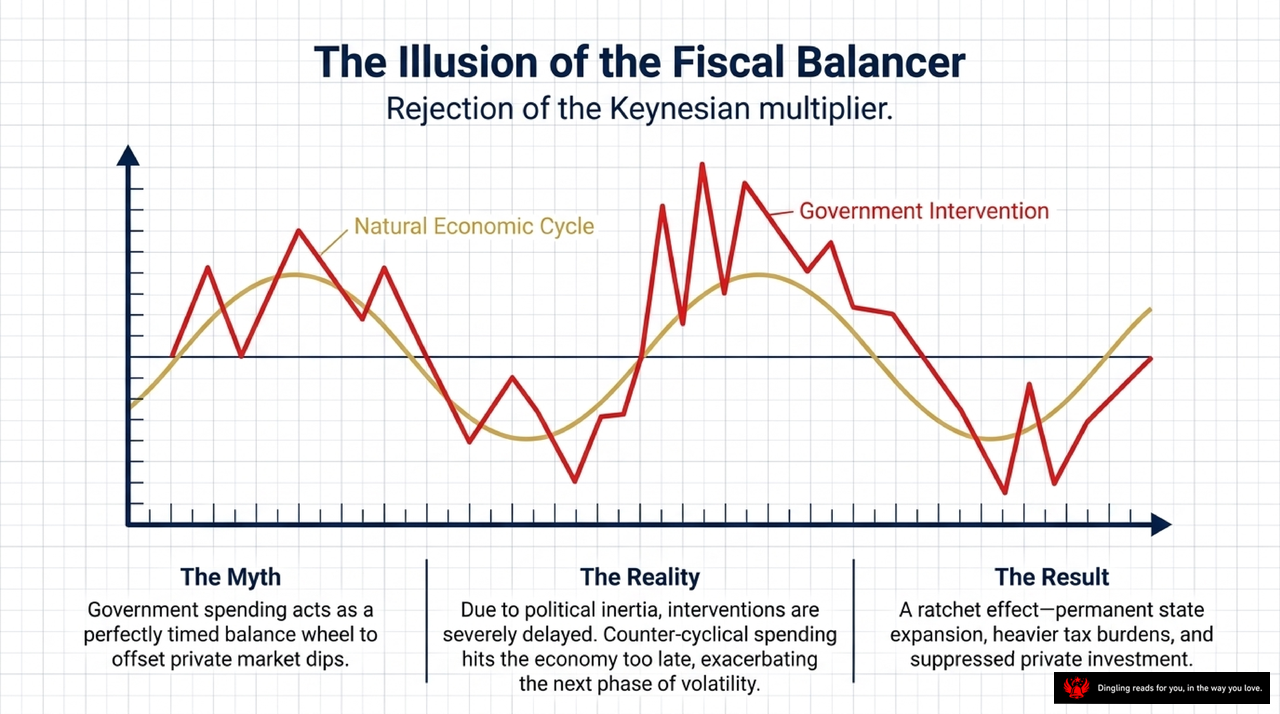
Let's dive into a big misconception in economics: The Illusion of the Fiscal Balancer. Look at this graph. The smooth yellow curve represents the natural economic cycle. Sure, it has ups and downs, but it's self-correcting. Now, look at that jagged red line. That's Government Intervention. Notice how the red line follows the yellow one but with much higher volatility? That's the problem.
The Myth, right here on the bottom left, suggests that government spending acts as a perfectly timed balance wheel to offset private market dips. It's the classic Keynesian multiplier argument. The belief is that politicians can time their spending perfectly to catch the economy right when it needs a boost, stabilizing the cycle without adding chaos.
But let's look at The Reality. This is where the illusion cracks. Due to political inertia, interventions are severely delayed. Bureaucracy and politics move slower than the economy. By the time the spending bills are passed, the recession is often already over. So, counter-cyclical spending hits the economy too late. Instead of stabilizing things, it actually exacerbates the next phase of volatility. You're pushing on a string that's already moving, and you make the bounce worse.
And finally, The Result. This isn't just a temporary fix; it creates a ratchet effect. Every time the government intervenes, it doesn't just balance the books; it expands permanently. We see permanent state expansion, heavier tax burdens, and suppressed private investment. The government grows, and the private sector shrinks. It's a one-way street toward more control.
So, when we talk about the Keynesian multiplier, we have to reject it. The data shows that government spending doesn't actually kick-start the engine. Instead, it adds friction. The natural cycle is better left alone, because political delays turn a manageable dip into a prolonged crisis. We need to stop trying to be the economy's savior and let the market do what it does best. The illusion of control is dangerous, and the cost of that illusion is your economic freedom.
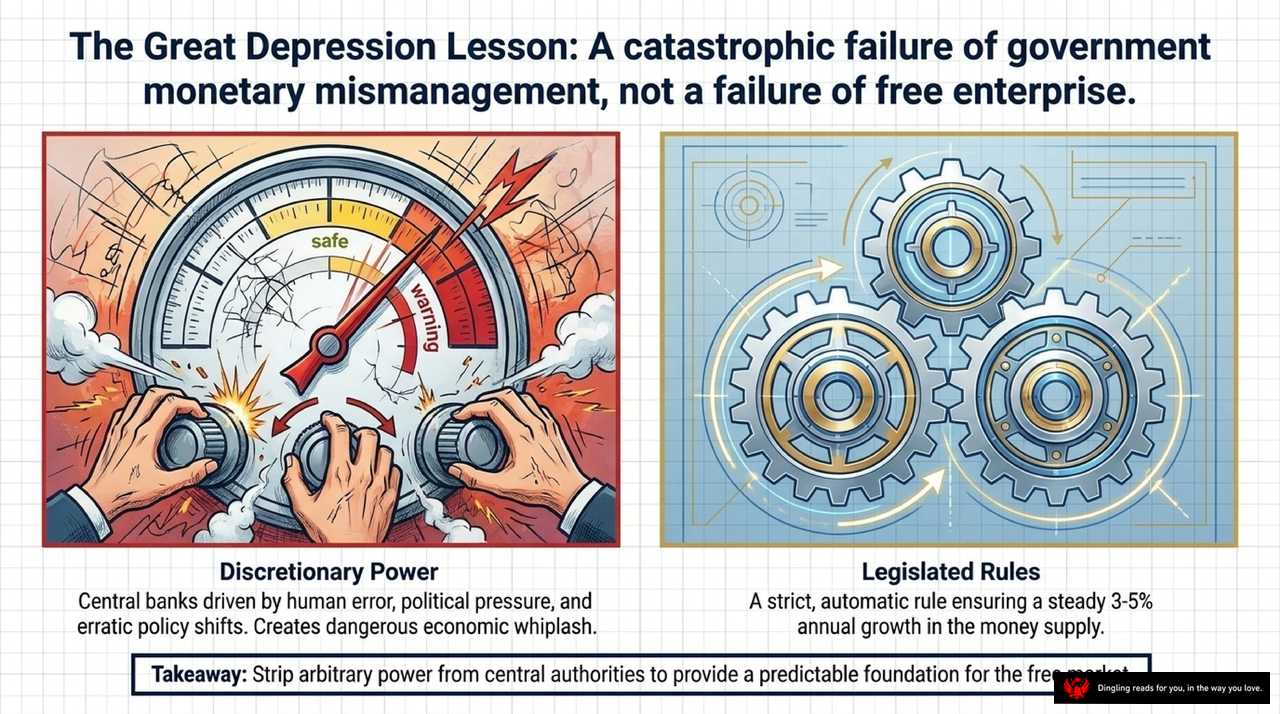
The title of this slide hits home: The Great Depression Lesson. It wasn't the failure of free enterprise that brought us down; it was a catastrophic failure of government monetary mismanagement. Look at the left side. We call this "Discretionary Power." This represents the Federal Reserve and central banks trying to steer the economy with human hands. But look at that gauge—it's spiking into the "warning" zone. Why? Because central banks are driven by human error, political pressure, and erratic policy shifts. When leaders try to force the economy, they create dangerous economic whiplash. We saw this in the 1930s. The Fed didn't stop the bank runs; they actually made things worse by letting the money supply crash.
Now, look at the right side. This is the alternative: "Legislated Rules." Instead of trusting a person to make the right call, we trust a machine. The image shows gears turning smoothly. This represents a strict, automatic rule. My recommendation is simple: mandate that the money supply grows by a steady 3-5% every year. No guessing, no political interference. Just like the First Amendment protects speech with a general rule rather than judging every sentence, monetary policy should follow a predictable path.
Why does this matter? Because the current system puts economic stability in the hands of a few individuals. That is a recipe for disaster. Giving a small group the power to control the money supply is inherently unstable. It relies on their character, and history shows they will make mistakes. The Great Depression wasn't caused by the stock market crash in 1929, but by the Fed's failure to act in 1930 and 1931.
So, what is the takeaway? We need to strip arbitrary power from central authorities. We need to provide a predictable foundation for the free market. If businesses and families know exactly what to expect regarding inflation and interest rates, they can plan for the future without fear. This isn't about ending the Fed; it's about ending their discretion. It's about building a system where the rules are known in advance, not decided on the day. That is how we prevent the next Great Depression before it starts. By moving from discretionary power to legislated rules, we create a stable environment where innovation and growth can flourish naturally, without the constant threat of policy shifts that disrupt the economy. This is the core lesson we must learn from history.
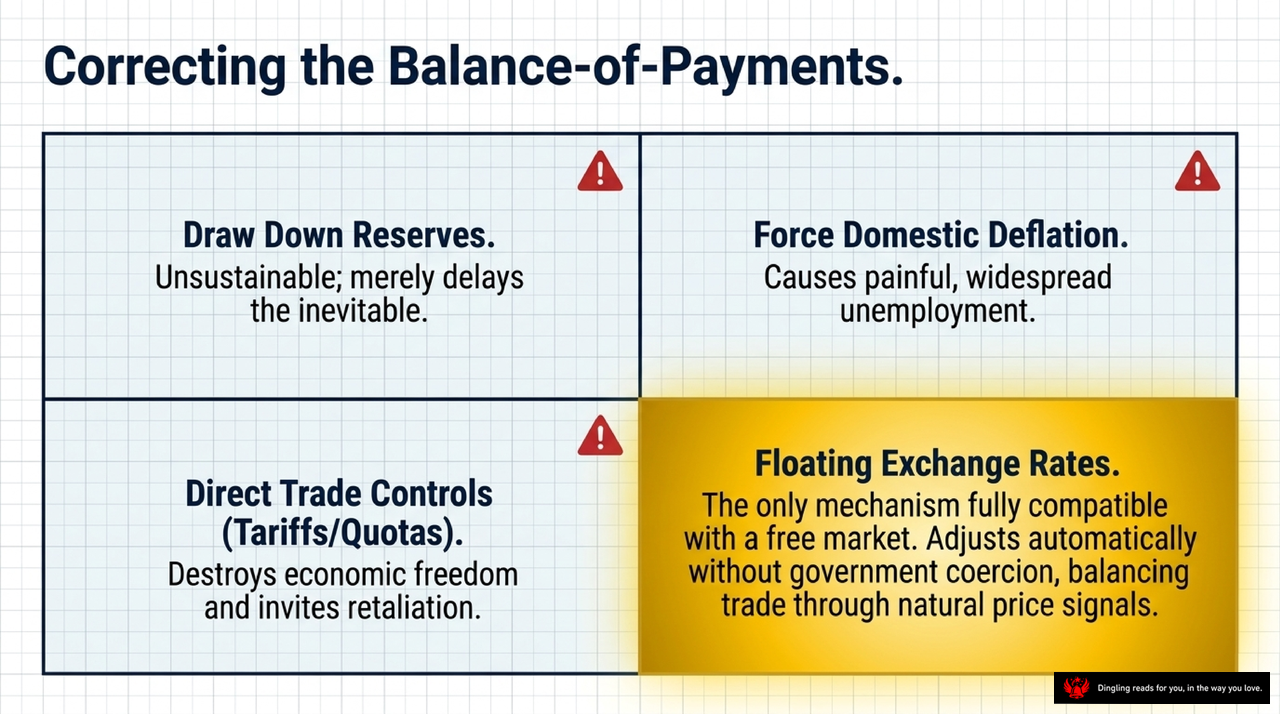
Let's talk about a problem that usually keeps economists and politicians up at night: the Balance of Payments. When a country spends more abroad than it earns, what do they do? Most governments have a few standard, but deeply flawed, answers.
First, you could try to **Draw Down Reserves**. But here's the hard truth: that's unsustainable. It's just delaying the inevitable crash. It's like trying to keep a fire going by adding more fuel until you run out.
Second, they might try to **Force Domestic Deflation**. This sounds scary, but it's painful. It causes widespread unemployment because prices drop, and people lose jobs. It hurts the very workers the government claims to be protecting.
Third, and this is a big one, governments often turn to **Direct Trade Controls**, like tariffs and quotas. This destroys economic freedom and just invites retaliation from other countries. It creates a trade war, not a solution. It's a zero-sum game that hurts everyone.
So, if all those options are dead ends, what's the answer? The only mechanism that's truly compatible with a free market is **Floating Exchange Rates**.
Here's why this is the winner. It adjusts automatically without government coercion. It balances trade through natural price signals. Instead of the government stepping in to fix the problem, the market does it for us. It relies on natural price signals to find the right balance. If our currency is too strong, it becomes cheaper for foreigners to buy our goods, boosting our exports. If it's too weak, our imports become expensive, naturally curbing demand.
This isn't about letting the market run wild without rules; it's about letting the price mechanism do its job. It removes the need for painful deflation or restrictive trade barriers. It allows for real, voluntary trade between nations.
Many free-market advocates actually oppose this because they're afraid of instability, but that's a misunderstanding. We support floating rates because we want the market to stabilize itself, not freeze it. We want the currency to float like a boat on water, adjusting to the currents of global trade.
So, the lesson here is clear: To correct the balance of payments without destroying your economy or your freedom, you need flexible exchange rates. It's the only way to maintain a free market on the global stage. It's the only way to keep trade free, fair, and voluntary.
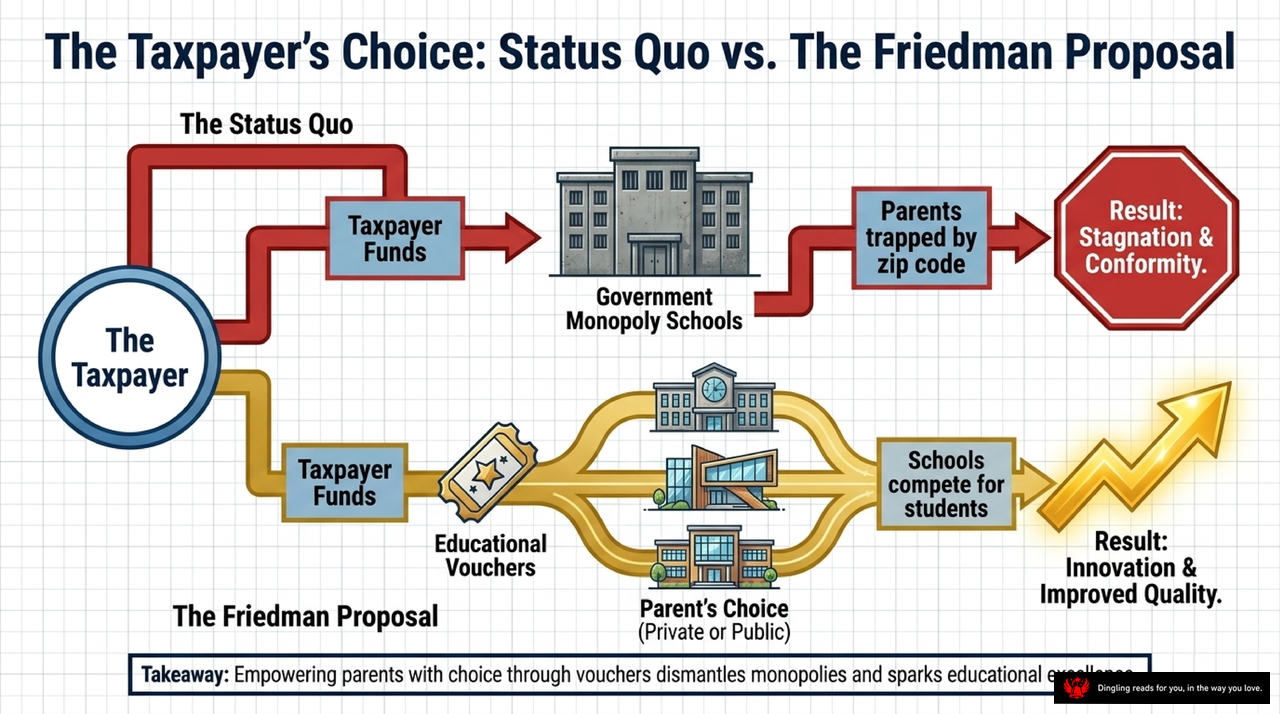
So, let's look at this slide. It lays out a fundamental choice: The Status Quo versus The Friedman Proposal.
At the top, we see the current system. Taxpayer money goes straight to Government Monopoly Schools. In this setup, Parents are trapped by zip code. You can't choose a better school if you live in a specific area. The result is Stagnation and Conformity. The text notes that the current public system often fails to match the original intention of education, creating inefficiencies. It mentions that money is often wasted on non-essential things like buildings or social dances, while good teachers go unrewarded.
Now, look at the bottom path: The Friedman Proposal. This changes the flow completely. Taxpayer funds go to Educational Vouchers instead of directly to a specific school. This gives Parents Choice—Private or Public. Suddenly, Schools compete for students.
Why does this matter? Because competition drives quality. If schools have to win over parents, they innovate and improve. The text argues that vouchers introduce a market mechanism into education. Parents can send kids to any compliant private school, using a subsidy equivalent to the public cost. This dismantles the monopoly. Vocational education, for instance, shouldn't be government-run at all, but market-driven.
The takeaway is clear: Empowering parents with choice through vouchers dismantles monopolies and sparks educational excellence. Instead of a one-size-fits-all government mandate, we get a diverse landscape where quality matters. It's about shifting power from the bureaucracy to the family. That's the core of the argument here.
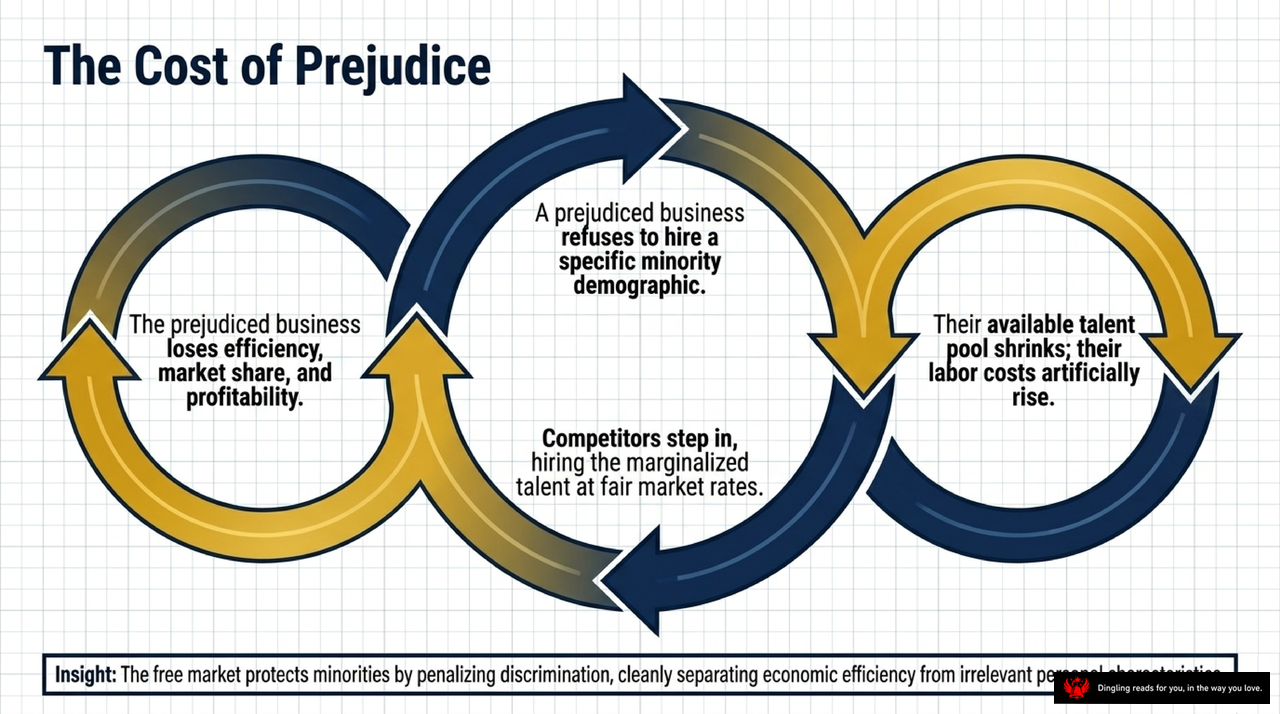
Take a look at this cycle here. It illustrates the hidden, economic cost of prejudice. It starts with a business deciding to refuse hiring a specific minority group. At first glance, it might seem like a moral choice, but from a business perspective, it's a strategic error. By excluding a group of people, that business is artificially shrinking its own talent pool. With fewer candidates to choose from, they end up paying higher wages to attract the few qualified people left. This is the labor cost rising on the right side of the diagram.
Meanwhile, competitors who don't discriminate are stepping in. They hire the marginalized talent at fair market rates, gaining a competitive edge. Because they have a wider pool of talent and lower costs, they become more efficient. Over time, the prejudiced business loses market share and profitability, as shown on the left.
This isn't about the market being nice to minorities. It's about the market being efficient. As the book explains, discrimination is essentially a taste—like preferring a specific brand of coffee—but it comes with a price. In a free market, producers naturally ignore irrelevant characteristics like race or belief because focusing on them reduces efficiency. Employers have a strong incentive to avoid these preferences because it hurts their bottom line.
Think about the history. In the Middle Ages, Jews faced persecution, yet they could still work in the market sector. Or look at the post-Civil War South; despite laws restricting Black people, their private property rights were respected, allowing them to build wealth. This happened because the market logic was stronger than the prejudice.
So, the free market actually protects minorities by penalizing discrimination. It doesn't force businesses to hire anyone; it just makes discrimination too expensive to sustain. This is different from government mandates like Fair Employment Legislation, which can actually interfere with voluntary contracts. The market mechanism does the heavy lifting, protecting people by making exclusion simply bad for business.
The insight at the bottom is crucial: The free market protects minorities by penalizing discrimination, cleanly separating economic efficiency from irrelevant personal characteristics. This means that if we want to protect minority groups, we shouldn't rely on forced quotas or bans on hiring. Instead, we should ensure that the market is truly free. If businesses can compete on merit without government interference, the competition will naturally drive out the prejudiced ones. It's a powerful argument that economic freedom and minority protection aren't separate issues; they are deeply connected. When you remove the barriers to entry, the market rewards talent over prejudice.
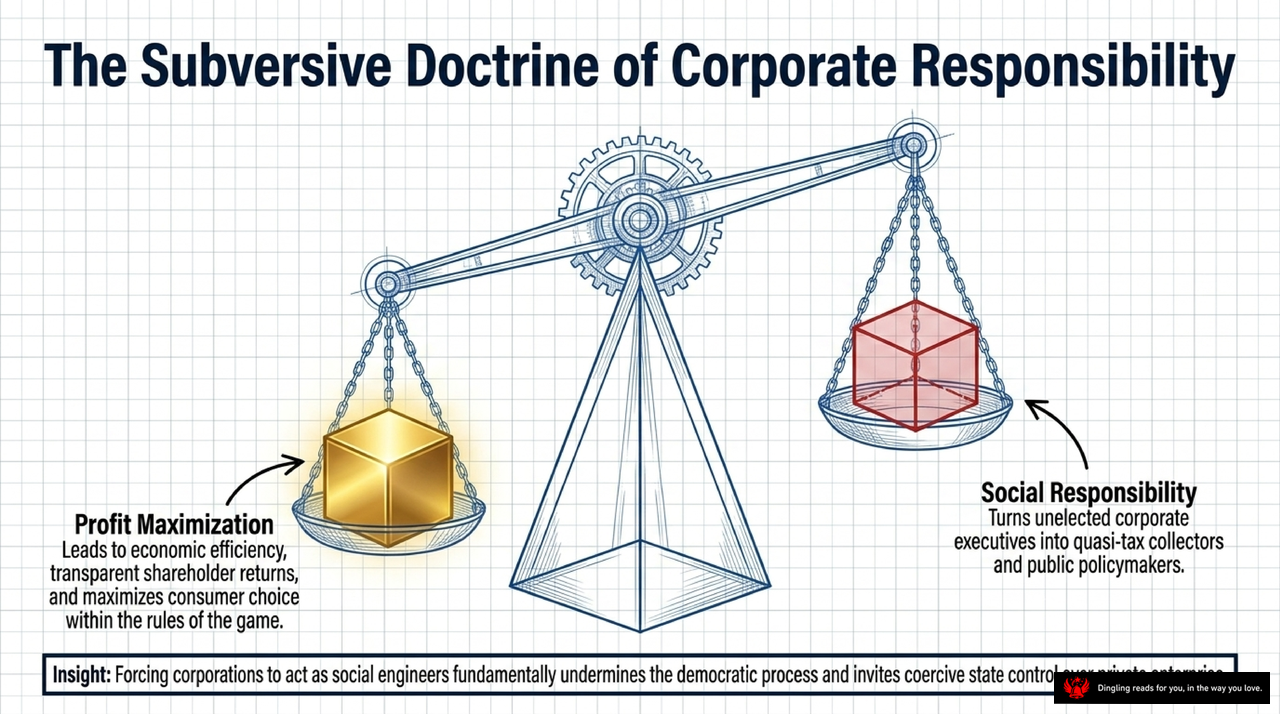
Look at this scale. It represents the two biggest debates in modern business. On the left, we have Profit Maximization. On the right, Social Responsibility. Which side do you think is right?
Let's look at the left side first. Profit Maximization. It sounds cold, but it's actually the engine of a free society. When companies focus on profit, they naturally drive economic efficiency. They have to listen to you, the consumer, because if they don't, you take your money elsewhere. This system leads to transparent shareholder returns and maximizes consumer choice within the rules of the game. It keeps the power of business separate from the power of the state. In fact, a free market reduces discrimination because employers only care about efficiency, not your background or beliefs. They have a strong incentive to ignore discrimination because it costs them money. This is why capitalism is actually a powerful force for equality.
Now, look at the right side. Social Responsibility. This is where things get dangerous. The text on the slide says it 'Turns unelected corporate executives into quasi-tax collectors and public policymakers.' Think about that. We didn't vote for the CEO of a tech giant. Yet, if we force them to decide on social issues, they become de facto politicians. This blurs the line between private enterprise and public service. It is a subversion of democracy.
This brings us to the Insight at the bottom. It states: 'Forcing corporations to act as social engineers fundamentally undermines the democratic process and invites coercive state control.' Why? Because when the government tells a private company what is 'good' for society, it stops being a private enterprise and starts acting like a government agency. It invites coercive state control.
Furthermore, when companies are forced to take on social roles, they often end up acting as tax collectors for the state or engaging in price controls that lead to shortages and black markets. As the text notes, corporate charity often just shifts power away from the owners to the managers, creating a 'corporate state' that is far removed from individual liberty. It creates a situation where the government and big business become one.
The real lesson here is simple. In a free economy, the only social responsibility a company has is to follow the laws and make a profit. That is how you protect freedom. Anything beyond that is just an excuse for the government to expand its control over your life. So, keep the scale balanced, but let profit be the weight that drives the engine of liberty. Don't let the state tell the market how to play.

Let's dive into a concept that affects almost every job you might ever hold: Occupational Licensure. Look at this slide. It's titled "The Ladder to Monopoly." It shows exactly how a profession can evolve from something helpful into something restrictive.
At the bottom, we have Registration. This is the first rung. It's supposed to be harmless record-keeping. The state tracks practitioners just for taxation or basic legal accountability. If you want to sell a gun or run a business, you register. It's neutral. It doesn't stop you; it just tracks you.
Then, you climb up to Certification. This is where it gets a bit more involved. Here, the state guarantees a practitioner's competence. This actually makes sense. It informs consumers so they know who is qualified. Crucially, this step does not restrict others from practicing. It sets a standard but leaves the door open.
But the ladder gets dangerous at the very top. This is Licensure. And look at the description on the right side. It says "Coercive monopoly." This is where the real problem lies. This step is controlled by incumbent practitioners—groups like the American Medical Association. They use this power to artificially restrict supply.
Here's the catch: when you restrict supply, you raise prices. This system is designed to deny individuals the freedom to choose a profession. It's not about safety anymore; it's about protecting the existing players from new competition.
Why does this happen? It's a classic case of special interest groups lobbying for laws that benefit them. Practitioners are concentrated and organized, while consumers are scattered and busy. So, the rules get written to protect the practitioner, not the public. A prime example is the medical field. The AMA controls who gets into medical school. By controlling the supply of doctors, they can artificially restrict entry.
The result? We end up with a situation where the state acts as a gatekeeper for a private club. We pay higher prices for services, and we lose the freedom to innovate or enter the market. We also lose the ability to experiment with new methods. So, the next time you see a new license requirement, remember this ladder. Ask yourself: Is this protecting me, or is it just a wall built by the people who already have the job? Don't let the "safety" excuse hide the reality of monopoly.
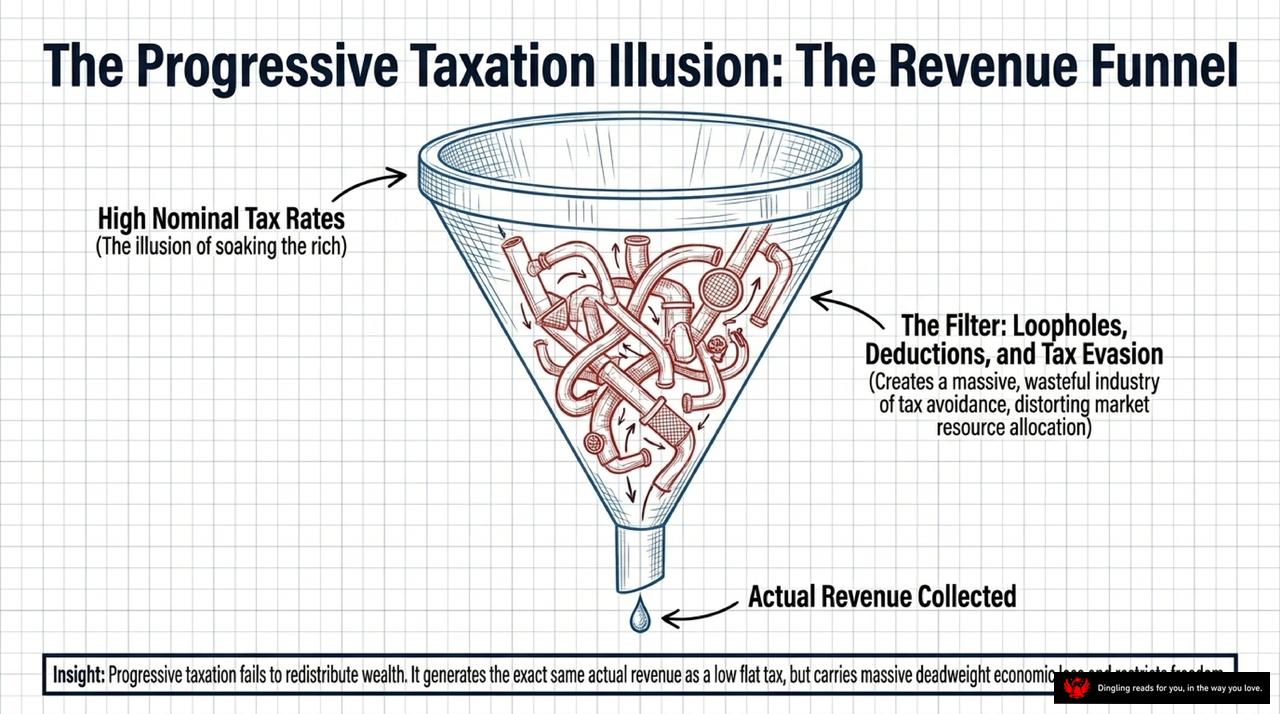
Welcome back to the book club. Today, we are looking at a diagram titled 'The Progressive Taxation Illusion: The Revenue Funnel.' This visual captures a critical economic argument that often gets lost in political noise.
At the top of the funnel, we see 'High Nominal Tax Rates.' The rhetoric is clear: the goal is to 'soak the rich.' It implies that if we simply raise the tax rate on high earners, we will capture a massive amount of wealth. But look inside the funnel. It's not empty. It's filled with a chaotic tangle of pipes labeled 'The Filter: Loopholes, Deductions, and Tax Evasion.'
This filter is the reality of the system. It creates a massive, wasteful industry of tax avoidance. Instead of the government capturing the revenue, resources are diverted into complex legal structures, tax shelters, and evasion tactics. This distorts market resource allocation and creates significant deadweight economic costs, meaning resources are wasted on fighting the system rather than creating value.
So, what comes out the bottom? 'Actual Revenue Collected.' Here is the counter-intuitive insight from the book. Progressive taxation fails to redistribute wealth effectively. In fact, it generates the exact same actual revenue as a low flat tax. The difference isn't in the money collected; it's in the cost and the freedom.
Why does this happen? The text explains that high tax rates actually discourage people from entering high-risk industries. They protect existing wealth by blocking new competition. Meanwhile, loopholes mean the actual tax rate is often far lower than the nominal rate. The book suggests a flat tax with a broad base could raise the same amount of money without the distortion.
So, when we look at this funnel, we see that the 'illusion' is the headline rate. The reality is a system that restricts freedom and creates inefficiency without achieving the redistribution goals. The revenue is the same, but the freedom cost is much higher. We need to look past the nominal numbers and see what actually gets collected, and what gets lost in the process. This insight challenges the assumption that higher rates equal more fairness, showing instead that they often just equal more complexity and less freedom.
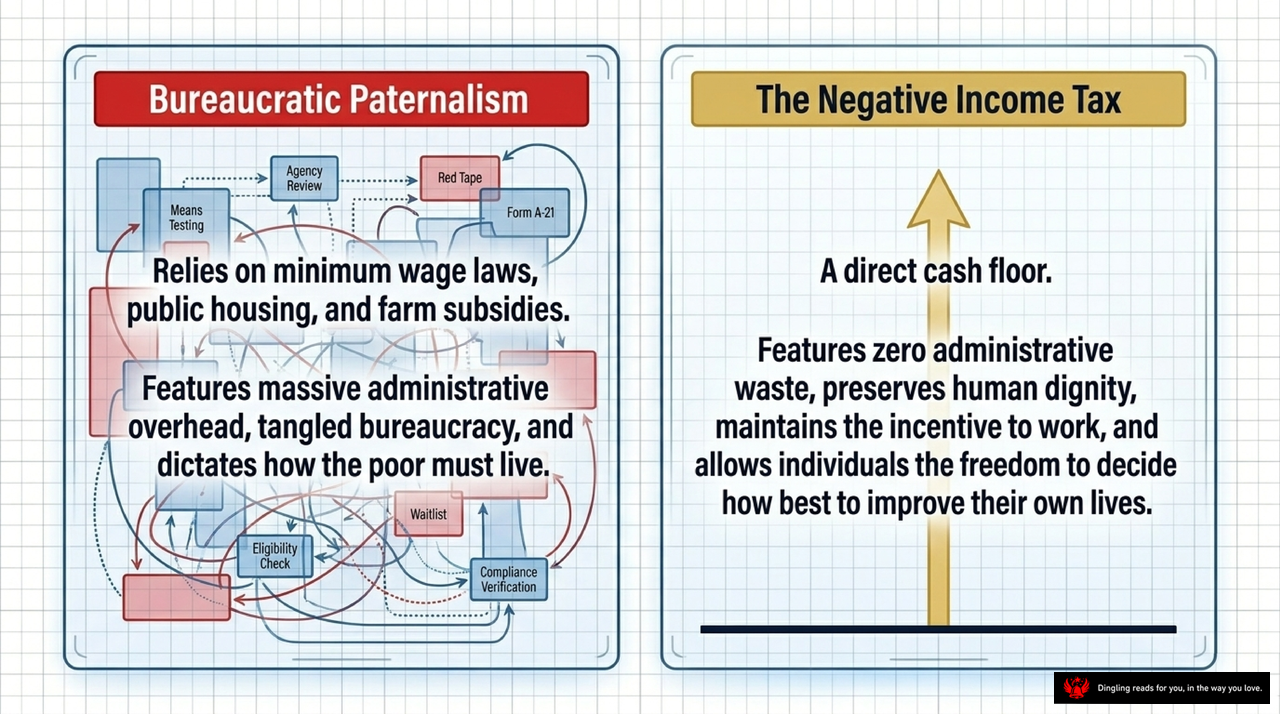
Let's look at this slide. It presents a stark contrast between two approaches to social welfare. On the left, we have "Bureaucratic Paternalism." This is the traditional welfare model we often see today. It relies on minimum wage laws, public housing, and farm subsidies. But look closely at that flowchart. It's a nightmare of complexity. You have means testing, agency reviews, red tape, forms like A-21, eligibility checks, waitlists, and compliance verification. This system features massive administrative overhead and tangled bureaucracy. The book argues that this approach dictates how the poor must live. It treats recipients like children who need constant supervision, rather than adults capable of managing their own lives. It creates a system where the government decides what you can eat, where you can live, and how you spend your time, all under the guise of helping you.
Now, look at the right side. This is "The Negative Income Tax." This is the alternative proposed by the book. It features a direct cash floor. Instead of forcing you into specific programs, the government guarantees a minimum income. If your income falls below a certain threshold, you receive a subsidy. The beauty of this system is that it features zero administrative waste. There are no endless forms, no waiting lists, and no compliance checks that drain your resources. It preserves human dignity because it treats you as an independent individual. It maintains the incentive to work because you keep the money you earn, unlike traditional welfare that often punishes success. Most importantly, it allows individuals the freedom to decide how best to improve their own lives. You can use that cash for food, education, or business, not just for what the government approves.
The book makes it clear that while the bureaucratic system claims to help, it often creates more problems than it solves through its complexity and control. The Negative Income Tax offers a cleaner, more efficient path. It combines the safety net with the freedom of the market. It is a direct cash floor that respects individual liberty while still providing the necessary support. This is the core of what a free society should look like when addressing poverty. We need to move away from controlling the poor and towards empowering them.
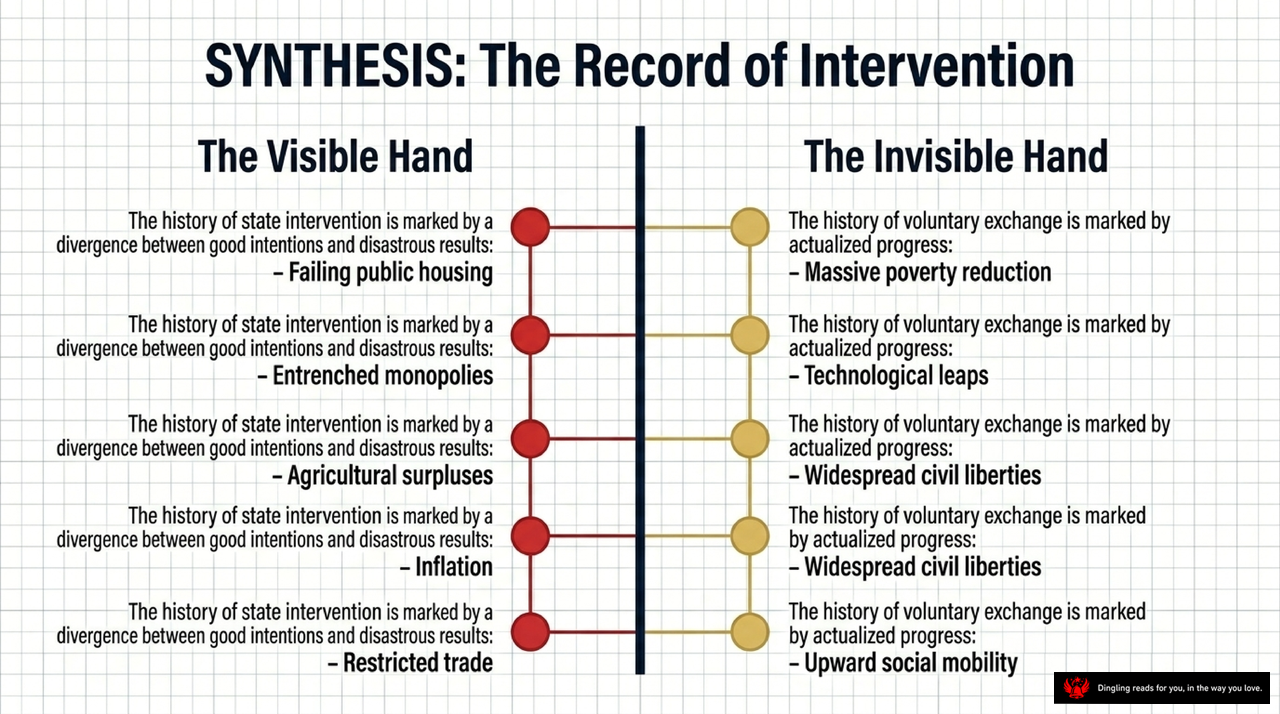
Let's take a moment to look at this synthesis slide. It really encapsulates the entire argument we've been making throughout this book. The title is 'The Record of Intervention,' and it splits the world into two very different paths: The Visible Hand versus The Invisible Hand.
On the left side, we have The Visible Hand. This represents state intervention. The text here makes a crucial point: the history of state intervention is marked by a divergence between good intentions and disastrous results. We see a list of failures here: failing public housing, entrenched monopolies, agricultural surpluses, inflation, and restricted trade. Think about public housing. We often think it's a noble idea to help the poor, but history shows it often fails to solve the problem and can actually make things worse. Or look at inflation. That's usually the result of government messing with the money supply, not the market. Even things like agricultural surpluses or trade restrictions come from government trying to control the economy, which usually ends up hurting everyone involved. The core issue is that the government's good intentions rarely translate into good outcomes because it lacks the price signals and feedback loops the market provides. When the government creates monopolies, it restricts competition.
Now, look at the right side. This is The Invisible Hand. It represents voluntary exchange. The text says the history of voluntary exchange is marked by actualized progress. This is where we see the real benefits. We see massive poverty reduction, technological leaps, widespread civil liberties, and upward social mobility. When people are free to trade and cooperate, wealth gets created, technology advances, and people move up the ladder. It's not magic; it's the result of individual choices adding up. Notice how civil liberties are listed here. A free market actually protects freedom better than a government that can force compliance.
So, what does this tell us? It's a stark contrast. When we rely on the Visible Hand, we get bad results. When we rely on the Invisible Hand, we get progress. The evidence is clear. We need to stop trying to manage the economy with good intentions and start trusting the proven results of voluntary exchange. That's the real record of history.

Let's take a moment to wrap up with a quick summary of today's core insights. The great advances of civilization have never come from centralized government. True progress is born from the decentralized, voluntary cooperation of individuals operating in a free market. We need to understand that protecting this economic freedom is the ultimate prerequisite for preserving our political and civil liberties. It's not just about money; it's about the very structure of our society. When we allow the market to function freely, we separate economic power from political power. This separation creates a natural check against tyranny.
Now, let's turn to the question that challenges us all. If history continually proves that concentrated power endangers the very citizens it claims to protect, why do we keep sacrificing our individual freedoms in exchange for the illusion of government security? This is the central paradox of our time. We are often told that security comes from the state. We are told that regulations protect us, that licenses ensure quality, that centralized planning guarantees stability. But history shows us a different story.
When power concentrates, it inevitably expands. What starts as a safety net often becomes a cage. We see this in how governments grow, how regulations pile up, and how individual choices get restricted in the name of the greater good. The illusion is that the government is the protector. But often, it is the threat.
Think about the trade-offs we make daily. We give up our right to choose our doctors, our right to trade freely, or even our right to speak freely, believing that a stronger authority will keep us safe. But in doing so, we weaken the very institutions that make us free. We've seen throughout this book how specific policies, from licensing to welfare programs, often have the opposite effect of what they promise. They restrict the very choices they claim to protect.
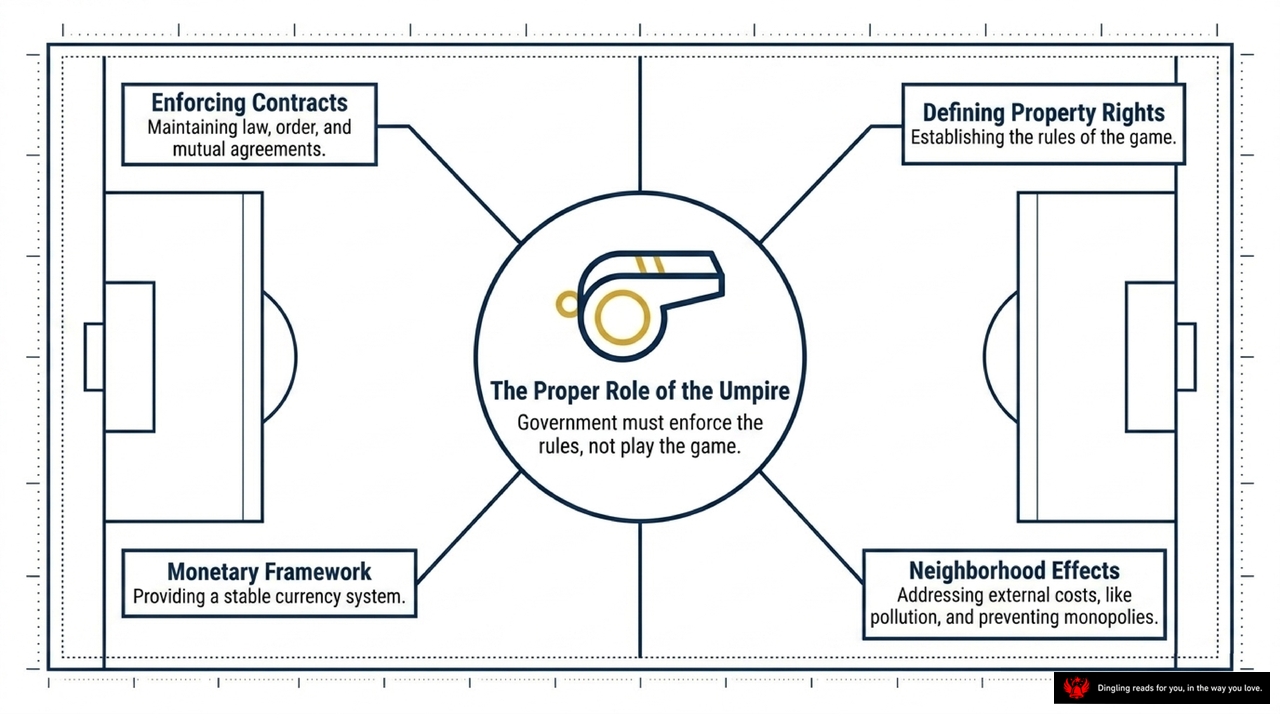
So, what is the solution? It's not about dismantling the government entirely, but about redefining its role. We need a government that acts as a referee, not a player. We need to trust in the decentralized power of individuals and the market, rather than the centralized power of the state.
Ultimately, preserving our freedom starts with understanding that economic liberty is the foundation of political liberty. If we lose the former, the latter cannot survive. So, let's ask ourselves again: are we willing to protect our freedom, or are we comfortable trading it away for a promise that often doesn't deliver? The choice is ours.
Remember, true security isn't found in the hands of a few, but in the freedom of many. We must be vigilant against the temptation of convenience over liberty. Because once we surrender our freedom, it is very difficult to get it back. That is the real lesson of history.