


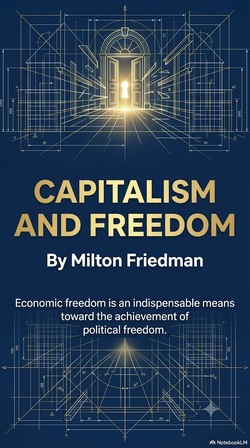
Friedman argues that economic freedom protects political liberty better than government control.
Your Review
Friedman argues that economic freedom protects political liberty better than government control.


Hard to ignore the Amish story about freedom.

Friedman proves economic freedom protects political liberty, using the Amish and Hollywood blacklist to show how markets shield dissent.

Friedman proves economic freedom is essential for political liberty, not just a financial concept.

Friedman shows how Amish farmers prove that forced taxes hurt freedom.

Friedman argues that regulatory capture turns agencies like the ICC from protecting consumers into tools for big business, which ultimately concentrates power and harms ordinary people instead.
The analysis of the Great Depression reveals that the Fed's failure to act as a lender of last resort caused the money supply to collapse, proving that government mismanagement destroys prosperity just as much as market failure does.

Friedman uses the Hollywood blacklist example brilliantly to show how free markets protected dissidents when government censorship tried to silence them, proving that economic freedom is the real shield for political liberty.

I found the Amish farmers story powerful because it shows how forcing Social Security taxes actually violated their religious freedom by punishing them for refusing state control over their lives.

This book is short and clear.
Good points about Amish farmers but the argument feels a bit extreme when applied to modern welfare systems.

Economic freedom is the best defense against tyranny.

Friedman uses the Hollywood blacklist example to show how private market incentives protected writers when government censorship tried to silence them, proving economic freedom shields political liberty.

The book argues that mixing economic control with political freedom creates tyranny. When the government manages the economy, it concentrates power and reduces individual autonomy. For example, the Amish farmers were forced to sell their livestock to pay Social Security taxes they refused to pay. This coercion showed that economic rules directly limit personal choices. Without free markets to disperse power, citizens lose the ability to speak freely or resist authority. The text clearly explains how separating economic and political power protects society from oppression. I agree that a government acting only as a referee, not a player, is necessary to maintain true liberty. This insight challenges modern policies that expand state control over daily life.

The data shows that progressive income taxes punish entrepreneurs who take risks while protecting inherited wealth, which slows growth and prevents ordinary people from climbing the economic ladder.
Free markets reduce poverty.
Friedman proves that economic freedom is the only real shield against political tyranny, using clear examples.

Economic freedom is the foundation of political liberty and we must protect it from government overreach.

Government bailouts after 2008 proved Friedman right by merging economic and political power, allowing big banks to take risks while taxpayers paid the bill for their failures.

Friedman proves that separating economic and political power protects everyone's rights, using clear examples like the Hollywood blacklist and Churchill's struggle against the BBC monopoly. He argues that when the government controls jobs or media, dissent becomes impossible because people depend on the state for survival. In contrast, free markets disperse power among millions, allowing even unpopular voices to find an audience if they can offer value. For instance, screenwriters worked under pseudonyms during the blacklist because studios cared about profit, not politics. Similarly, private broadcasters could have aired Churchill's warnings about Hitler if they weren't blocked by a state monopoly. This separation prevents any single group from dominating others, whether a dictator or a bureaucratic elite. While some policies like welfare or minimum wage laws seem helpful, Friedman shows they often harm the poor by reducing jobs or creating dependency. His solution of a negative income tax respects individual choice while still helping those in need. Ultimately, the book makes a compelling case that true political freedom cannot exist without the economic freedom to choose your work, spend your money, and speak your mind without fear of losing your livelihood.