
Capitalism in America: Complete Chapter-by-Chapter Summary
Welcome to our deep dive into the history of American prosperity. Today, we are exploring the book *Prosperity and Recession* by Alan Greenspan and Adrian Wooldridge.
This presentation captures a sweeping 400-year narrative of how a rugged wilderness transformed into the greatest economic engine in human history. At the heart of this story lies the relentless force of creative destruction.
We begin by looking at the backdrop of this transformation. The image behind us blends an old-world map with modern financial charts, symbolizing the journey from the colonial era to today's global markets. It is a visual reminder that the path to prosperity was never a straight line. Instead, it was defined by cycles of growth and decline, where old industries were dismantled to make way for new ones.
As we move forward in this series, we will examine how the United States evolved from a collection of agrarian colonies into an industrial powerhouse, and eventually into a global superpower. We will see how innovation, often driven by risk-takers and disruptors, fueled this ascent, while also causing significant pain and disruption along the way.
So, let's start our journey by understanding the foundational principles that shaped this incredible economic story.
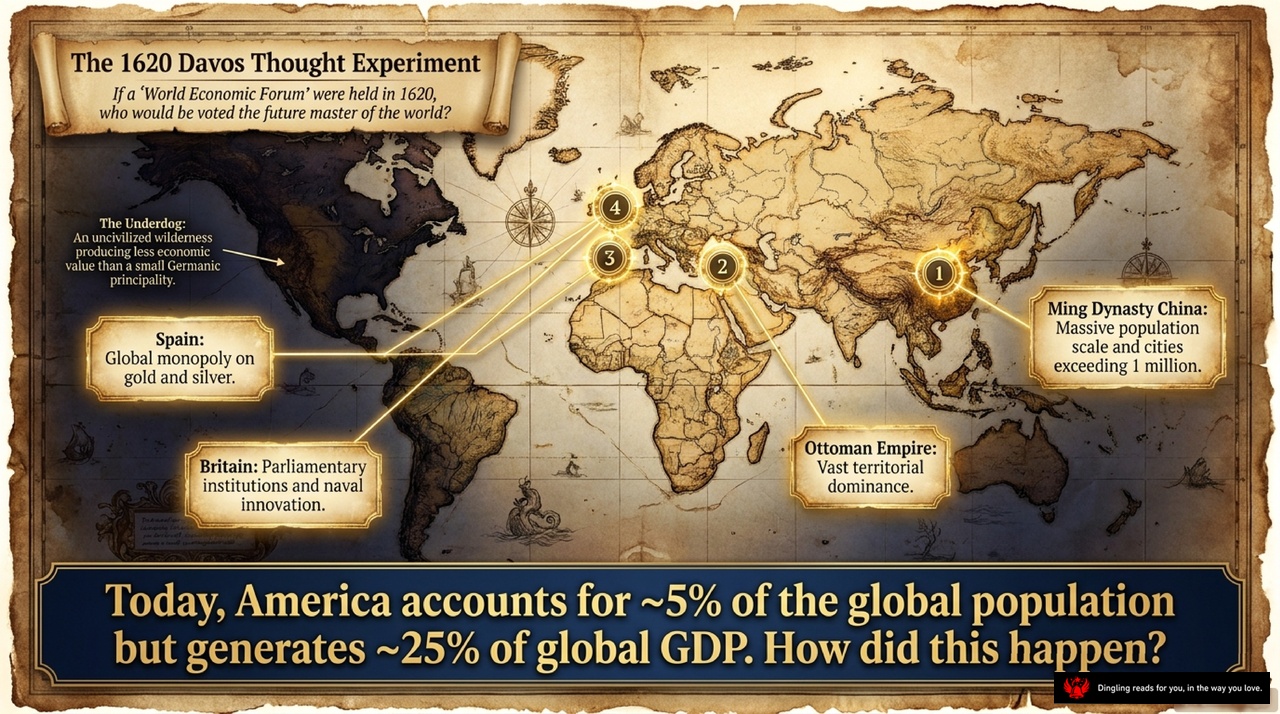
Imagine stepping back to 1620 and holding a global power ranking. If you were a voter at the very first Davos, you'd be stunned. The map shows Ming Dynasty China as the giant with massive cities, while Spain sat atop a gold monopoly, and the Ottoman Empire controlled vast territories. America? It was just "The Underdog"—an uncivilized wilderness producing less value than a small German principality. Britain, with its parliamentary innovations, was the clear favorite to rule the world.
Fast forward to today, and the script has flipped completely. Look at the bottom of the slide: America now accounts for only about 5% of the global population but generates roughly 25% of the world's GDP. How did this happen? It wasn't luck. It was a relentless transformation. From a struggling agrarian society, America rode waves of innovation—canals, railroads, electricity, and the internet—to overtake the industrial giants of Europe. While other nations focused on empire and tradition, America embraced a culture of "creative destruction," constantly tearing down old limits to build something new. Today, that underdog is the engine of the global economy, proving that a small nation with a big idea can indeed master the world.

Welcome to the blueprint of the American Economy. Today, we're breaking down the three essential pillars that hold up this massive structure: Productivity, Creative Destruction, and Politics.
First, look at Productivity. This is our ultimate metric for success. It's about the ability to generate more output from a given set of inputs—labor, capital, and geography. Without this engine driving the baseline standard of living, the whole system stalls.
Next, we have Creative Destruction. Think of this as the perennial gale. It is the violent, disruptive engine of innovation that ruthlessly replaces old, less efficient assets with new technologies. It's the force that turns the past into the future, no matter how painful the transition.
Finally, we have Politics. This acts as the shock absorber. It encompasses the societal and governmental mechanisms used to manage, manipulate, or mitigate the collateral damage caused by economic disruption.
Together, these three pillars define the unique rhythm of the American story.

Creative destruction is the essential fact about capitalism, a concept famously articulated by Joseph Schumpeter. It's the engine that drives progress, a relentless cycle where innovation births new opportunities while simultaneously destroying old ones. Look at this diagram: it starts with breakthroughs like Bessemer steel or microchips entering the market. This sparks an obsolescence phase, where old assets, factories, and jobs are rendered economically unviable. But this isn't a failure; it triggers a massive resource reallocation. Capital and labor aggressively flow toward these new, higher-yield frontiers, fueling a productivity boom where the standard of living doubles and the cost of basic inputs plummets.
This cycle is exactly what allowed America to transform from a rural agrarian society into a global industrial powerhouse. Between the Civil War and World War I, this mechanism was in overdrive. The introduction of the Bessemer process slashed steel costs, making skyscrapers and railroads possible. The invention of the internal combustion engine didn't just create the automobile industry; it destroyed the dominance of horses and carriages, freeing up millions of workers and creating entirely new markets for rubber, glass, and gasoline. Even the rise of the corporate giant, from Rockefeller's Standard Oil to Carnegie's steel empire, was a form of creative destruction. They consolidated fragmented industries into efficient monopolies, which, despite the "robber baron" label, lowered costs and standardized quality for the average consumer.
However, this engine runs hot. As the slide notes, America possessed an exceptionally high societal tolerance for this pain. When the old ways died—when a blacksmith's shop closed or a canal became obsolete—American society allowed inefficient businesses to fail quickly rather than propping them up with subsidies. This painful transition is what fueled the "Roaring Twenties," where mass electrification and the assembly line liberated consumers from the constraints of custom-made, expensive goods. We traded the uncertainty of the past for the abundance of the present. But this same cycle eventually hit a wall. As the old industrial structures became too rigid to adapt, and as the benefits of innovation began to concentrate in the hands of a few while the middle class struggled to keep up, the momentum of creative destruction slowed. Understanding this cycle is key to understanding why America soared for so long, and why it now faces the challenge of restarting the engine in a new era.

Welcome back to our journey through the American story. Today, we're stepping into the era known as "The Commercial Republic," spanning from 1776 to 1860. This was the foundational period where the United States transformed from a collection of colonies into a unified, powerful nation.
Let's look at the three pillars that built this new powerhouse: Law, Technology, and Demographics.
First, under Law, the Founders made a revolutionary move. In 1788, the US Constitution banned interstate tariffs, instantly creating the largest unified commercial market in the world. By removing barriers between states, they turned the entire country into one giant shop, setting the stage for unprecedented growth.
Second, Technology played a massive role through democratized innovation. Article I, Section 8 of the Constitution protected intellectual property, ensuring that inventors could profit from their ideas. Furthermore, US patent registration fees were set at just 5% of Britain's, which unleashed grassroots invention and encouraged ordinary people to create. This low barrier to entry meant that innovation wasn't just for the elite; it was for everyone.
Finally, Demographics drove a unique economic engine. There was a severe labor shortage relative to the vast land available. This scarcity forced a rapid adoption of labor-saving machinery. A perfect example is McCormick's reaper, which mechanized farming and boosted productivity.
The core message here, as highlighted in the corner, is that the Founders shifted the focus from dividing existing resources to creating new ones. They embedded property rights into the national DNA, prioritizing the creation of wealth over the redistribution of what already existed. This mindset of building something new rather than fighting over the old is what truly defined the Commercial Republic and set the stage for America's future rise.
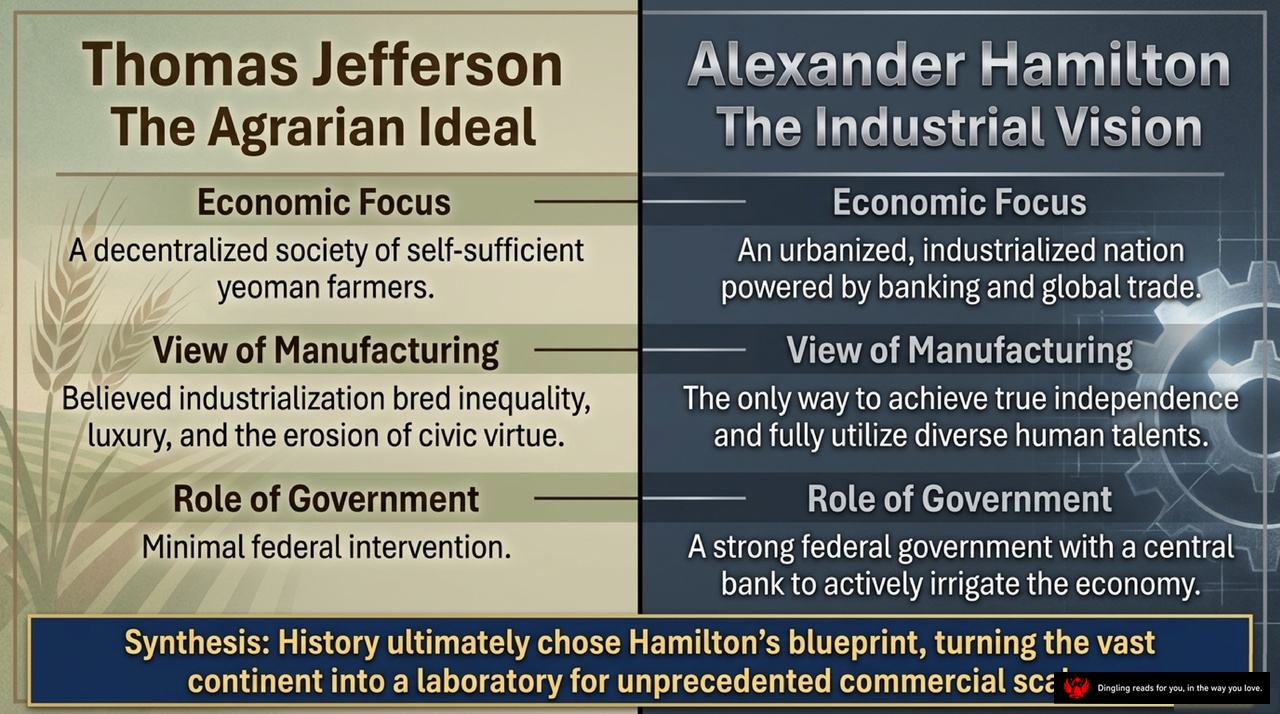
The image on your screen perfectly captures the central tension that defined the first century of American history: the clash between Thomas Jefferson's agrarian ideal and Alexander Hamilton's industrial vision. Jefferson dreamed of a decentralized society of self-sufficient yeoman farmers, viewing manufacturing as a threat to civic virtue. Hamilton, conversely, championed an urbanized, industrialized nation powered by banking and global trade, arguing that manufacturing was the only path to true independence. While history initially seemed to favor Jefferson, the reality of the 19th century told a different story. As the text reveals, the American continent ultimately embraced Hamilton's blueprint, transforming into a laboratory for unprecedented commercial scale. This industrial vision didn't just create factories; it fueled three revolutionary shifts: a resource revolution that tapped coal and iron, a transportation revolution that made the nation compact with railroads, and an information revolution that connected markets instantly. By the time the Civil War arrived, the North's industrial might had decisively outmatched the South's slave-based agrarian economy, proving that Hamilton's path was the one that would build a global superpower.

Look at this blueprint of American capitalism from 1865 to 1914. This wasn't just a period of growth; it was a complete transformation of how the world worked. Think of it as a massive industrial machine where three key inputs fed into a powerhouse to create something entirely new.
First, the inputs. On the left, you see vast land, raw materials like coal and iron, and massive immigration. By 1890, 87% of Chicagoans were immigrants or their children. This influx provided the labor force that fueled the engine.
On the right, you see the scale and the network. The scale is represented by giants like U.S. Steel, which by 1901 became the world's first billion-dollar corporation, employing 250,000 workers. But it wasn't just about big companies; it was about the network. Railroads bound the continent together. By 1905, 14% of the world's total rail mileage passed through Chicago alone, connecting the West to the East and shrinking the distance between them.
Now, here is the crucial insight in the gold box: The "Robber Barons" were ruthless monopolists, but their primary economic function was actually driving down the cost of basic inputs. Between 1867 and 1901, the price of steel plummeted by 83.5%. This wasn't just corporate greed; it was a force that sparked a massive rise in living standards. Because steel became so cheap, everything from skyscrapers to household appliances became affordable for the average person.
So, while we often hear about the wealth concentration of that era, this slide reminds us that the true triumph of capitalism in this period was making the building blocks of modern life accessible to everyone. It was a trade-off where the cost of production dropped so low that prosperity could finally take root.

Look at this diagram titled "The Political Backlash: Progressivism." It captures a pivotal moment in American history where the engine of unchecked capitalism began to sputter, forcing a dramatic shift in how the government operated. On the left, you see "Corporate Consolidation," represented by those grinding gears. This symbolizes the sheer scale of monopolies that emerged by the turn of the century. As the text explains, these massive trusts triggered immense collateral damage. Farmers were squeezed by the Gold Standard, while workers were crushed by unsafe industrial conditions. The machinery was running so hot, it was actually burning the people who built it.
This pressure cooker eventually boiled over into "Populist Anger" on the right. The image shows a voting box overflowing with demands for "Free Silver," an "Eight-Hour Day," and "Power to the People." This wasn't just noise; it was a roar. William Jennings Bryan's famous 1896 "Cross of Gold" speech mobilized a massive agrarian rage, permanently shifting the Democratic Party away from pure laissez-faire capitalism. The public was no longer willing to accept the status quo.
In the center stands the anchor labeled "The Reformers." This represents the political response to that chaos. Presidents Teddy Roosevelt and Woodrow Wilson stepped in to save capitalism from destroying itself. Instead of letting the market run wild, they introduced antitrust laws to break up the giants, established the Federal Reserve in 1913 to stabilize the currency, and implemented the federal income tax. They transitioned America from a wild frontier into a managed economy. The rope in the middle shows the tension between these forces, but the anchor held firm, proving that when the system threatened to crash, the government was finally ready to pull it back.

The Roaring 20s vs. The 1929 Crash
On the left, we see "The Boom." This wasn't just luck; it was the result of mass production and electrification. For the first time, a culture of credit-fueled consumerism emerged. People weren't just buying necessities; they were buying radios, cars, and homes on installment plans. This created a massive wave of optimism and spending.
But look at the red line labeled "Consumer Debt." While the Dow Jones skyrocketed, so did the debt burden. This wasn't sustainable. On the right, "The Bust" shows exactly why. Highly leveraged toxic assets caused a contagion of bank failures. The Federal Reserve made a critical mistake by raising interest rates, which shrunk the money supply by a third. This sudden tightening choked off the economy.
The graph in the center tells the tragic story of 1929. The sharp peak represents the crash, followed by a devastating plunge. The result? Real GDP fell 25%, and unemployment hit 25%. The boom had turned into a bust, leaving millions without jobs and hope.
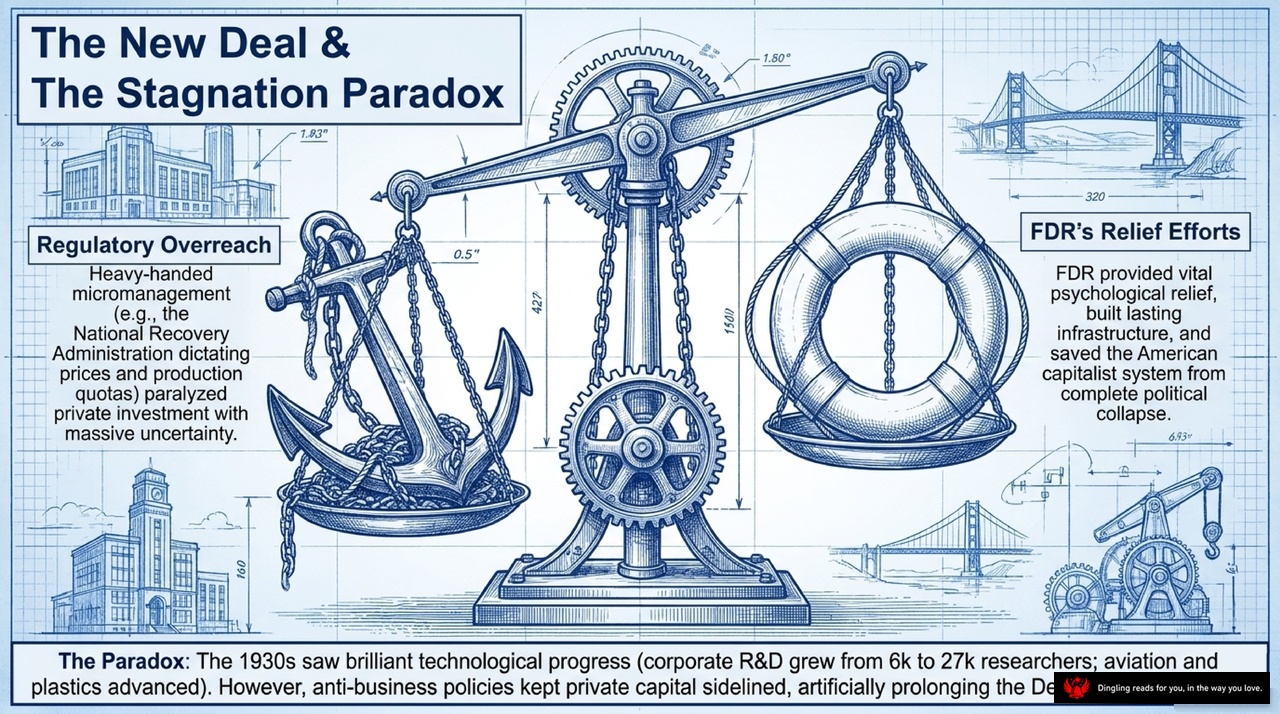
The image presents a striking visual metaphor for the "Stagnation Paradox" of the 1930s, weighing two opposing forces on a scale. On one side, an anchor labeled "Regulatory Overreach" pulls the economy down, representing the heavy-handed micromanagement of the era. We see this vividly in the text's description of the National Recovery Administration, which dictated prices and production quotas. This kind of anti-business policy paralyzed private investment by creating massive uncertainty, effectively acting as a weight that kept capital sidelined despite the era's brilliant technological progress.
On the other side, a lifebuoy labeled "FDR's Relief Efforts" offers a counterbalance. While the anchor weighed down the system, FDR's interventions provided vital psychological relief and built lasting infrastructure, saving the American capitalist system from complete political collapse. The paradox lies here: even as the 1930s saw corporate R&D soar from 6,000 to 27,000 researchers and advancements in aviation and plastics, anti-business policies artificially prolonged the Depression. The scale in the image captures this tension perfectly—the struggle between the drag of excessive regulation and the life-saving buoyancy of relief efforts, ultimately defining a decade where innovation existed in the shadows of stagnation.
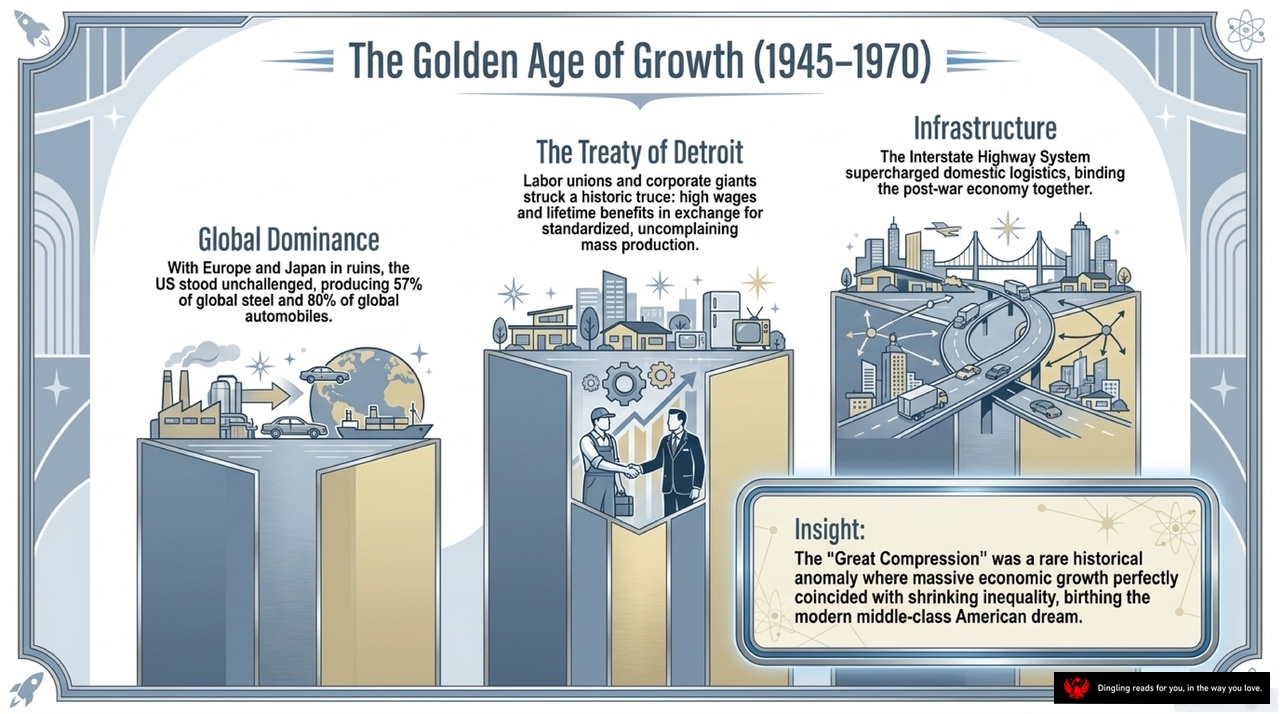
Welcome back to our deep dive into the American economic story. Today, we're looking back at that incredible era known as "The Golden Age of Growth," spanning from 1945 to 1970. It was a time when the United States didn't just grow; it transformed into a global powerhouse, setting the standard for modern capitalism.
So, what made this period so special? It all came down to three massive pillars. First, **Global Dominance**. Following World War II, while Europe and Japan were still rebuilding from the ruins, the US stood unchallenged. We controlled 57% of the world's steel and a staggering 80% of global automobile production. This wasn't just about having factories; it was about having the ultimate advantage in the marketplace.
Second, we had the legendary **"Treaty of Detroit."** This was a historic agreement where labor unions and corporate giants shook hands. In exchange for standardized, uncomplaining mass production, workers got high wages and lifetime benefits. It was a perfect balance that created the modern middle-class American dream, ensuring that prosperity was shared, not just hoarded at the top.
Third, there was **Infrastructure**. The construction of the Interstate Highway System supercharged domestic logistics. These roads bound the post-war economy together, allowing goods and people to move faster than ever before. It was the physical engine that drove the entire machine.
The result of this perfect storm was a phenomenon economists call the **"Great Compression."** For the first time in history, massive economic growth coincided with shrinking inequality. Everyone, from the factory worker to the CEO, saw their standard of living rise. It was a rare historical anomaly where the economy grew for everyone, truly birthing the modern middle-class American dream.

The 1970s didn't just feel like a rough patch; for many Americans, it was a decade where the very ground beneath them seemed to turn to mud. We call this era "Stagflation," a terrifying economic paradox where high inflation and high unemployment danced together, breaking the old rules that economists thought were unbreakable. Look at that chart: instead of the smooth trade-off you'd expect, the economy shattered into a chaotic anomaly.
Why did this happen? The triggers were brutal. First, the "Guns and Butter" policy of the Vietnam War drained the treasury while the Great Society programs demanded endless spending, creating unsustainable deficits. Then, the 1973 Oil Crisis exposed our energy vulnerabilities, sending prices skyrocketing. Finally, the "Treaty of Detroit" collapsed. Rigid, bloated American manufacturers were blindsided by agile, high-quality Japanese competitors who offered better cars at lower prices. The result was devastating: productivity growth halved, the trade deficit returned for the first time since 1893, and inflation peaked at a staggering 14.8% in 1980. A pervasive sense of national decline took hold, shattering the confidence that had defined the post-war boom.
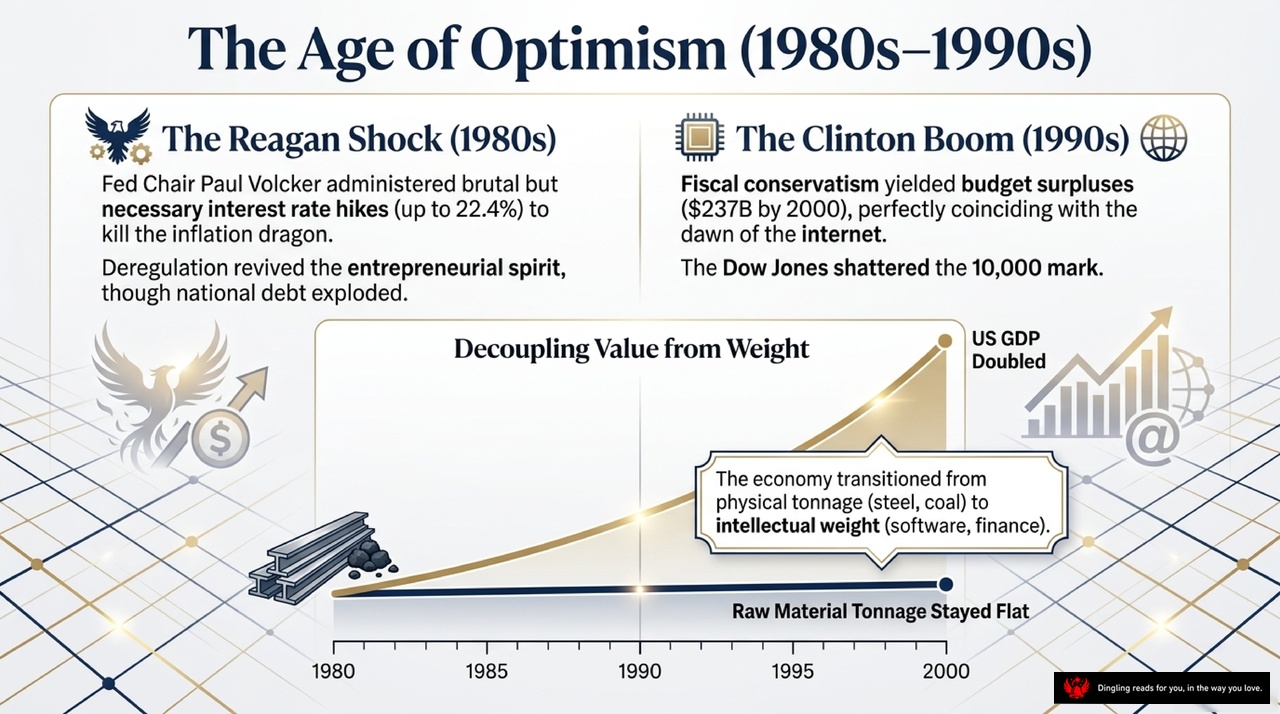
Welcome back to the Age of Optimism, spanning the 1980s and 1990s. This era wasn't just about good times; it was a fundamental transformation of how America created value.
On the left, we see the "Reagan Shock." It started with a painful but necessary reality check. Fed Chair Paul Volcker administered brutal interest rate hikes, pushing rates up to a staggering 22.4%, specifically designed to kill the inflation dragon that was choking the economy. While this caused short-term pain, deregulation followed, which revived the entrepreneurial spirit. Yes, national debt exploded during this time, but the door was opened for innovation.
On the right, we have the "Clinton Boom." By the 1990s, the focus shifted to fiscal conservatism. This discipline yielded massive budget surpluses—reaching $237 billion by 2000. This stability perfectly coincided with the dawn of the internet. As a result, the Dow Jones shattered the 10,000 mark, symbolizing a new era of wealth creation.
But the most profound change here isn't just in the charts or the policies; it's in the bottom graph. Look at that line labeled "Decoupling Value from Weight." In 1980, the economy was still tied to physical tonnage—steel, coal, and raw materials. You can see those materials stayed flat, but the curve shooting upward represents "intellectual weight." The economy transitioned from physical bulk to software and finance. While raw material tonnage stayed flat, US GDP doubled by the year 2000. We moved from an economy based on what you could carry, to one based on what you could think. That is the true story of this optimistic age.

The Great Recession of 2008 wasn't just a financial hiccup; it was a catastrophic collapse of the very foundation of our global economy. As the slide illustrates, this disaster unfolded in four distinct stages, starting with a dangerous setup. For years, a massive glut of savings from emerging markets poured into the United States, driving interest rates down and fueling an unsustainable housing bubble. This excess liquidity fed directly into highly leveraged financial institutions, which created increasingly complex and toxic risk-transfer instruments.
Then came the catalyst: the housing market stalled. Suddenly, that leverage turned toxic, triggering a chain reaction where contagion instantly froze global liquidity. The result was a total collapse, represented by that shattering gold bar. The aftermath was devastatingly slow. The recovery became the weakest in post-war history, with GDP growth lagging far behind the 90s. But beyond the numbers, the crisis stripped away the illusion of wealth, revealing a deeper, pre-existing structural decay in US productivity that we are still grappling with today.

America's Fading Dynamism: The Engine Stalls
Look at this dashboard. It paints a stark picture of a nation losing its momentum, with three critical metrics all pointing downward. First, we see a **Decline in Startups**. Business creation rates have hit their lowest point since the 1980s. The spirit of the "creative destruction" that once drove America is fading. Instead of bold entrepreneurs disrupting the status quo, we are seeing the rise of a "Complacent Class." Americans are moving less, taking fewer career risks, and clustering in ideological bubbles rather than chasing opportunity.
This lack of mobility directly feeds into our second metric: **Labor Immobility**. When people stop moving and stop taking risks, the economy stagnates. This connects to our third, most alarming metric: **Plunging Productivity**. Non-farm business output growth has stalled, dropping below historical averages. The engine that once powered the world is sputtering.
Why is this happening? The slide identifies two major symptoms choking this growth. On the left, we have **Corporate Entrenchment**. Dominant firms are no longer innovating to win; instead, they are building barriers to protect themselves from competition. They are fortifying their positions rather than pushing forward. On the right, we see **Regulatory Chokehold**. Exponentially growing rules, occupational licensing, and bureaucracy are stifling grassroots innovation. While well-intentioned, these layers of red tape are protecting incumbents and making it nearly impossible for new ideas to take root.
The result is clear: a dynamic America is becoming a static one. Without new startups, without a mobile workforce, and without productivity growth, the future looks uncertain. The era of boundless expansion may be over, replaced by an era of defensive consolidation and bureaucratic friction.
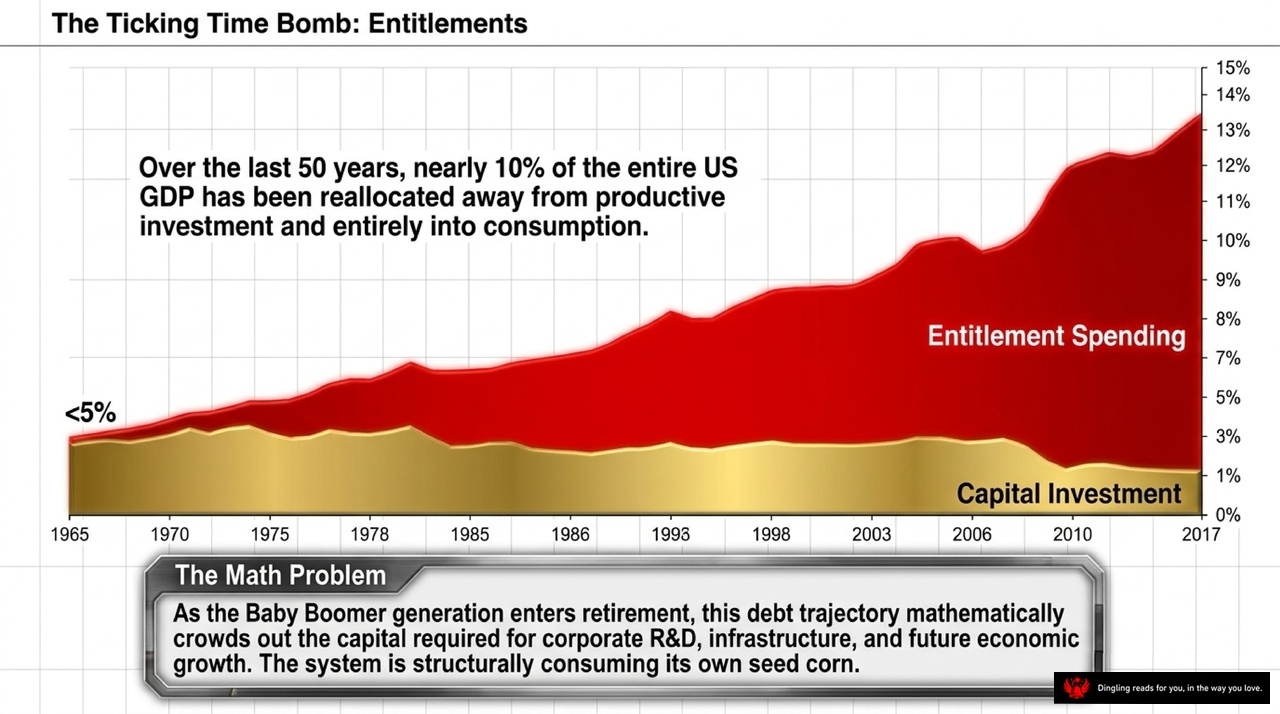
The ticking time bomb of entitlements is no longer a distant warning; it is a mathematical reality crowding out our future. Look at this chart: over the last 50 years, nearly 10% of the entire US GDP has been reallocated away from productive investment and entirely into consumption. The red area, labeled "Entitlement Spending," has skyrocketed from under 5% in 1965 to over 14% by 2017, while "Capital Investment," represented by the gold band, has stagnated at a fraction of that size.
This isn't just about numbers; it's a structural crisis. As the Baby Boomer generation enters retirement, this debt trajectory mathematically crowds out the capital required for corporate R&D, infrastructure, and future economic growth. We are essentially consuming our own seed corn. The system is designed to fund the past at the expense of the future, leaving the capital needed for innovation and growth dangerously depleted.
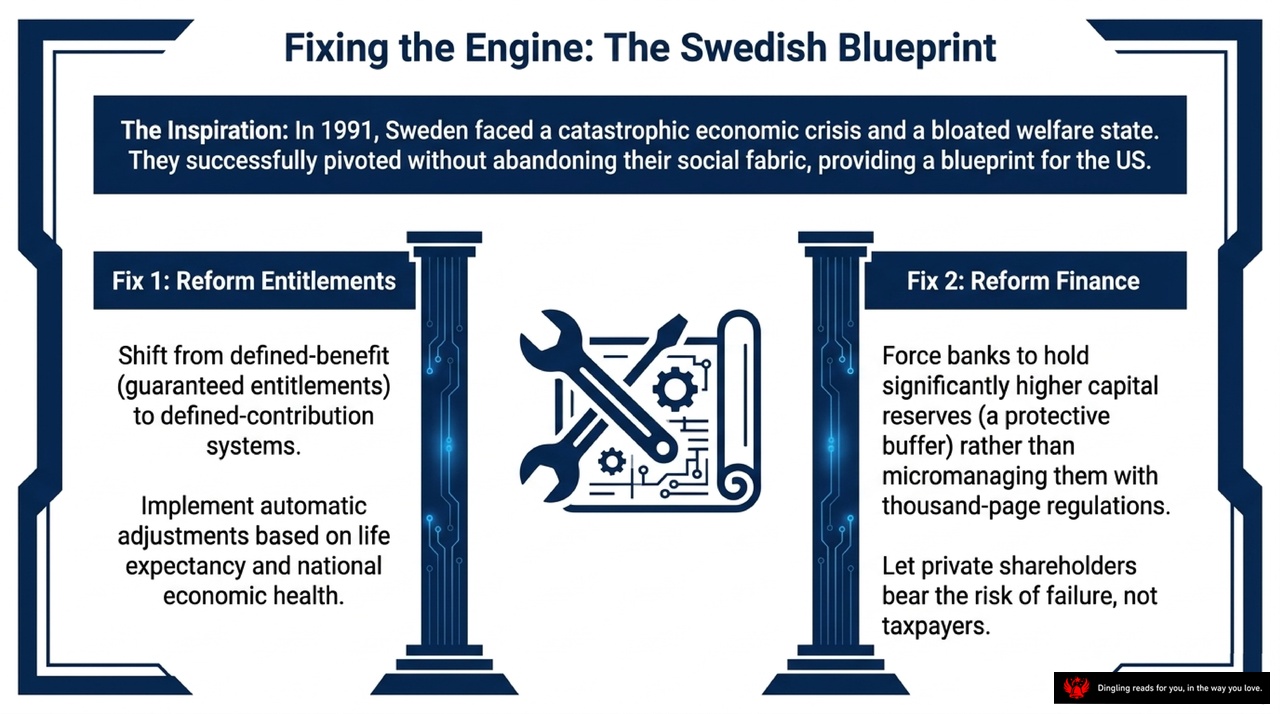
Imagine a time when the American "engine" sputtered and threatened to stall. In 1991, Sweden faced exactly that kind of catastrophe: a bloated welfare state crushing economic growth. Yet, instead of abandoning their social fabric, they performed a remarkable pivot, proving that you can fix the engine without dismantling the car. Today, we are looking at that Swedish blueprint as a potential roadmap for America.
The first fix is about reforming entitlements. Instead of sticking to defined-benefit systems where the government guarantees specific payouts, we need to shift toward defined-contribution models. Think of it as moving from a fixed promise to a savings account that grows with you. To make this sustainable, we must implement automatic adjustments based on life expectancy and the nation's economic health, ensuring the system breathes with reality rather than rigidity.
The second fix targets finance. For decades, we've micromanaged banks with thousands of pages of regulations. The Swedish approach suggests a different path: force banks to hold significantly higher capital reserves, creating a protective buffer against failure. This isn't about control; it's about resilience. By letting private shareholders bear the risk of failure rather than taxpayers, we create a system where banks are naturally incentivized to stay safe.
The lesson is clear: true progress comes from smart structural changes, not just band-aids on a broken system.

For the past four centuries, America's greatest superpower has been its willingness to endure the painful, recurring storm of creative destruction. It is this very willingness to let the old break so the new can rise that has fueled our unprecedented progress. Yet today, we find ourselves trapped not in an inescapable swamp of low growth, but in a self-made cage built from regulatory overreach and unsustainable consumption. The keys to this cage remain right in our pocket.
As we prioritize protecting the present over building the future, have we lost the courage to endure the destruction required for our next great era of creation? The challenge isn't about stopping change; it's about having the bravery to embrace it again.