
Catching Up to America: Complete Chapter-by-Chapter Summary

Welcome to today's session on "The Logic of Catch-Up Growth" by Zhu Tian. We are diving into the story behind the most unprecedented economic rise in modern history.
This presentation aims to uncover the true differentiating cultural engines that powered China's rapid ascent. While many observers point to policy or institutions, we will explore why certain nations succeeded where others failed. By looking beyond surface-level data and understanding the deep-seated cultural drivers, we can better grasp the forces that shaped the past and guide us toward a clearer understanding of the future.
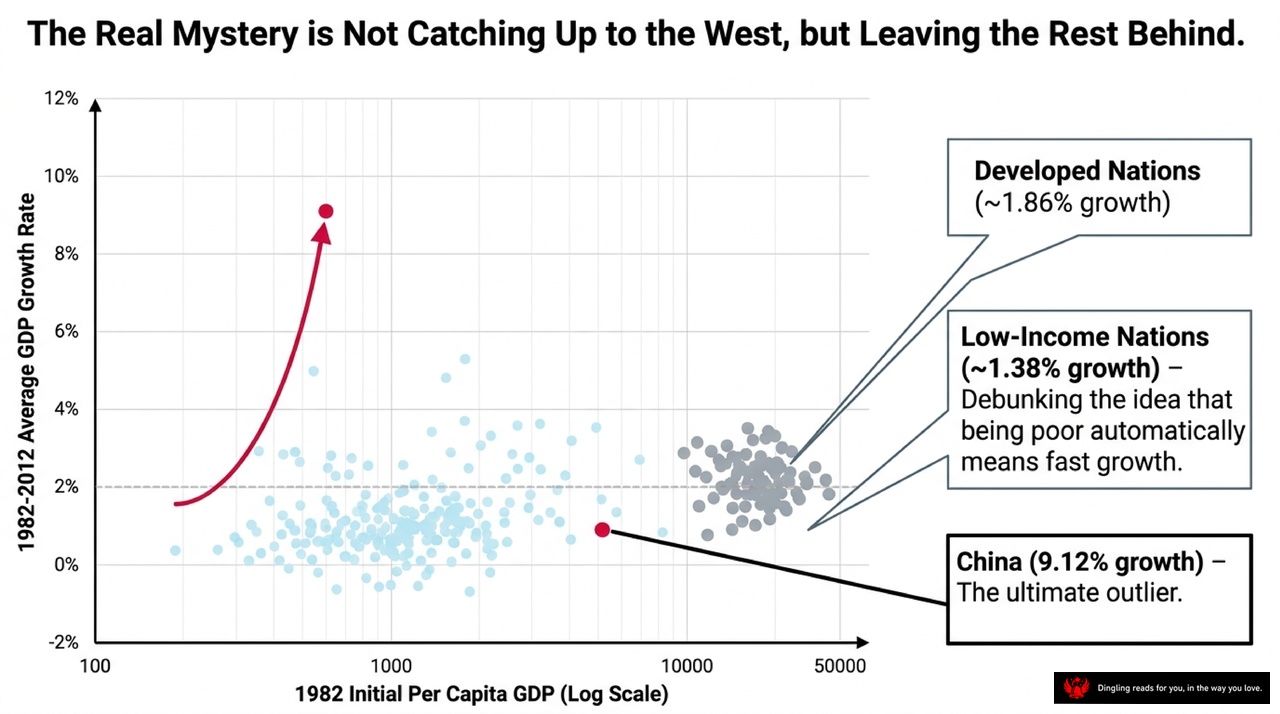
The real mystery isn't about catching up to the West; it's about leaving everyone else behind. Look at this chart: it reveals a startling truth that defies common sense. Most people assume that being poor automatically means you'll grow faster, a theory known as the "catch-up effect." But the data tells a different story. Between 1982 and 2012, low-income nations actually grew at only 1.38% annually, which is slower than the 1.86% average for developed nations. Poverty doesn't guarantee speed.
Then there is China. Marked clearly on the graph as the ultimate outlier, China achieved a staggering 9.12% average growth rate during that same period. This isn't just fast; it's an anomaly. While the rest of the developing world struggled to keep pace with the West, China surged past them all. It didn't just catch up to the US, UK, and Japan; it left emerging giants like Brazil and Mexico in the dust, and completely outran low-income countries like Kenya and Haiti.
So, what explains this? If low starting points don't guarantee growth, and if other developing nations tried similar reforms without this result, what made China unique? The answer lies not in simple economics, but in a deeper cultural engine that turned population and savings into a relentless growth machine, setting the stage for the next chapter of our story.

The slide you're looking at tackles the myths surrounding China's economic rise. It lists four popular theories—the Low-Base Effect, the Demographic Dividend, Export-Led Growth, and the idea of "Perfect" Institutions—and then uses hard data to debunk each one.
First, the Low-Base Effect suggests that because China started from such a low income level in 1980, it should have grown faster than others. But the data shows the opposite: low-income nations globally have averaged a stagnant 1.38% growth rate, far slower than developed economies. So, starting poor doesn't automatically mean you'll grow fast.
Next, the Demographic Dividend. Many argue that China's massive working-age population created a direct boost. However, this global demographic benefit added only about 0.5% to China's annual growth. It helped, but it wasn't the magic engine everyone thought it was.
Then, we have Export-Led Growth. The theory claims China rode the globalization wave with cheap labor. But look at the numbers: in 2012, China's export-to-GDP ratio was just 27%. That's actually lower than Mexico's 33% and right in line with the global average. If exports were the secret sauce, Mexico should have outpaced China, but it didn't.
Finally, the myth of "Perfect" Institutions. Critics often praise China's unique governance. Yet, 2017 Heritage Foundation data ranked China's economic freedom below even Nigeria and Tanzania. This proves that having a strong state or specific policies isn't the differentiator; in fact, China's institutional metrics were below the world average.
The bottom line? None of these standard explanations hold up under global scrutiny. If they did, every developing country with cheap labor or a young population should be growing like China. They aren't. The real puzzle lies elsewhere, which we'll explore next.
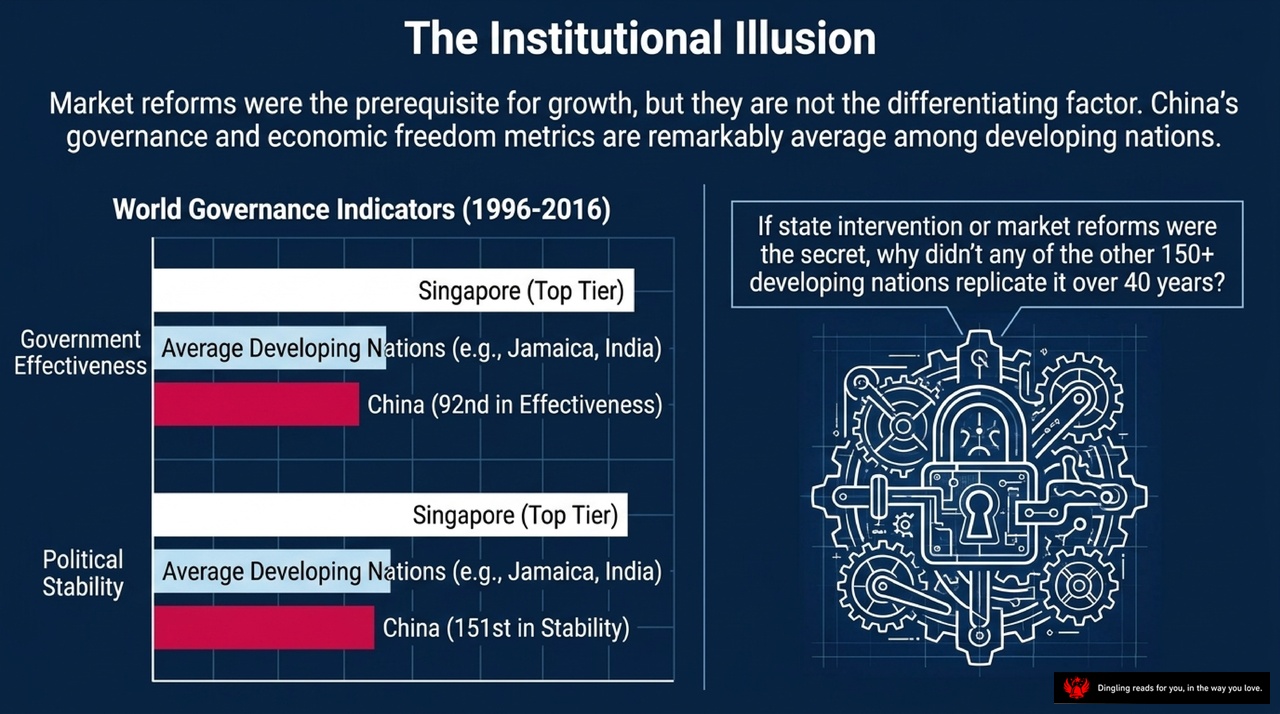
The Institutional Illusion. Here's the core takeaway: Market reforms were a necessary starting point, but they aren't the magic key that explains China's unique success. In fact, if state intervention or high market freedom were the real secrets, you'd expect to see a wave of success across the 150+ developing nations that have tried similar paths over the last 40 years. Yet, they haven't.
Look at the data on the left. We're comparing Government Effectiveness and Political Stability from 1996 to 2016. Singapore sits in the top tier in both categories. China, by contrast, ranks 92nd in effectiveness and a low 151st in stability—right around the average for other developing nations like Jamaica and India.
So, if the answer were simply "better government" or "more freedom," why is China the outlier while its peers remain stuck? The chart shows that China's governance metrics are remarkably average among developing countries. This visual proves the point: the standard explanations of state power or market liberalization simply don't hold up when you look at the global comparison. China's rise cannot be explained by copying the policies of others, because the others are doing the same things and getting nowhere near the same results.

Standard economics often gets it wrong because it looks only at the surface. It tells us that growth is driven by the "three horses of carriage": investment, consumption, and exports. But this is a trap. These are demand-side factors that explain short-term fluctuations, not the long-term engines of prosperity.
Look at the diagram on your screen. The top layer shows "Catch-Up Growth" and "Proximate Causes" like capital investment and tech progress. These are the gears we see turning. But if we strip away the surface, we hit the bedrock. This is where the real story lies.
The book argues that China's miracle wasn't just about pouring money into infrastructure or boosting exports. Those are symptoms, not causes. The true differentiator is the culture beneath the waterline. Specifically, a deep-rooted ethic of thrift and a fierce commitment to education.
Why does this matter? Because without high savings, you can't fund the massive investment needed for catch-up growth. And without a culture that values learning, you can't build the human capital required to master new technologies. Many other developing nations tried to copy China's investment and export models but failed because they lacked this cultural foundation. They didn't have the same drive to save or the same obsession with education.
So, the lesson here is clear: don't just look at the GDP numbers or the factories. Look at the values that drive the people. It's the invisible bedrock of institutions, geography, and culture that ultimately determines why some nations soar while others stay stuck. That is the anatomy of the miracle.
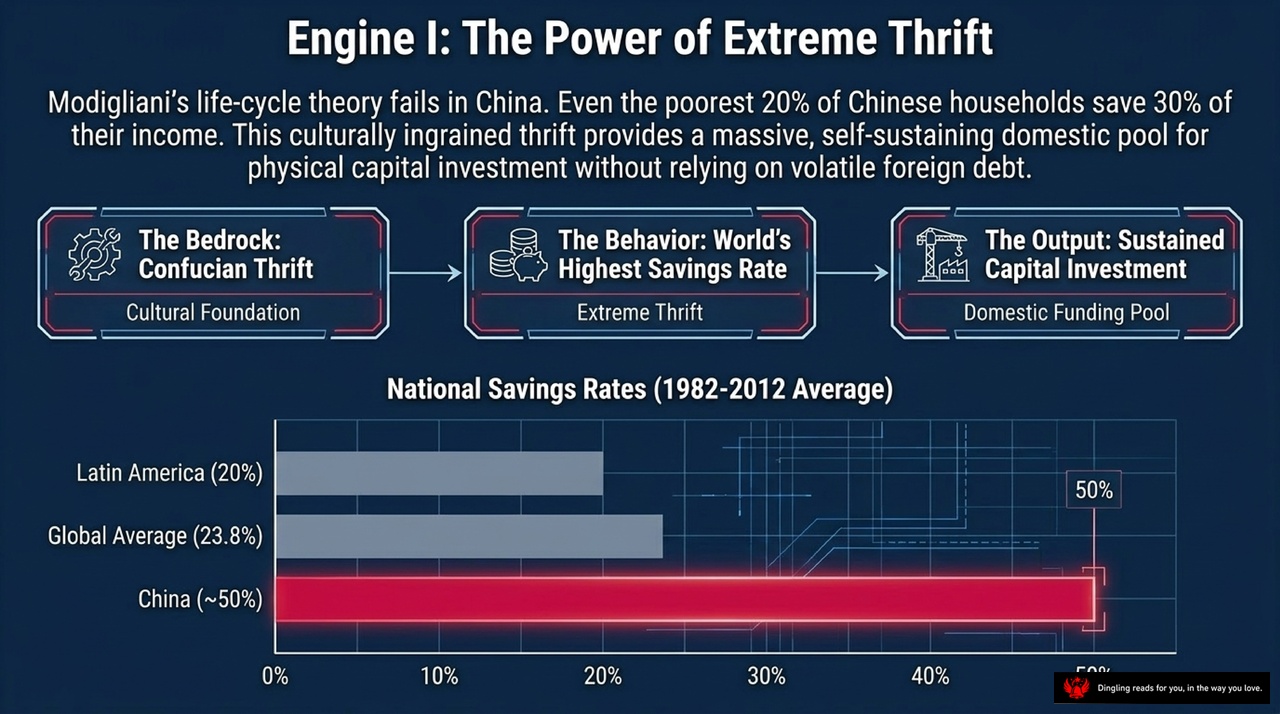
Now, let's dive into the engine that truly powered China's rise, and it wasn't just about hard work or government policy alone. It was about a deep cultural habit that became a financial superpower: extreme thrift.
Look at this chart. While the global average savings rate hovers around 24% and Latin America sits at 20%, China stands out in red, with a savings rate of nearly 50%. This isn't just a number; it's the bedrock of an entire economic strategy.
This massive pool of savings comes directly from what we call "Confucian Thrift." For decades, the average Chinese household saved 30% of their income, even the poorest 20%. This culturally ingrained discipline provided a self-sustaining domestic pool for capital investment. In simpler terms, China didn't need to rely on volatile foreign debt to build its factories and infrastructure; they funded it themselves.
Because of this, China achieved the world's highest savings rate, which directly translated into sustained capital investment. This unique advantage allowed China to accumulate physical capital at a speed no other developing nation could match. While other countries struggled to convert their savings into growth, China's ability to keep its money home and reinvest it created a virtuous cycle of expansion.
So, the next time you hear about China's economic miracle, remember this: the secret wasn't just in the factories or the markets, but in the wallets of ordinary citizens. That cultural commitment to saving built the financial engine that drove the rest of the world to take notice.

Let's talk about the engine that actually drives China's long-term success. It's not just about building factories or pouring money into infrastructure; it's about the quality of the people and the culture behind them. This slide, titled "Engine II: Human Capital & The Education Ethos," breaks down exactly how that works.
Look at the left side. This radar chart shows China's cultural values based on the World Values Survey. Notice how sharply the red line peaks for "Hard Work" at 75.3% and "Thrift" at 50.7%. These aren't just statistics; they are the bedrock of China's economic model. While many countries prioritize independence or tolerance, China's deep-seated cultural reverence for learning and frugality creates a workforce primed to absorb, adapt, and eventually innovate global technology. This non-utilitarian approach to learning is what turns a population into a powerful engine.
Now, look at the graph on the right. This plots PISA educational quality against GDP per capita. You can see two distinct clusters. On the bottom left, you have "Developing Nations" with low education quality and low income. But look at the top right, where "Developed Nations" sit with high quality and high income. China and Vietnam are highlighted here as "The East Asian Outliers." Even though China's GDP per capita is lower than the developed nations, its educational quality is surprisingly high, placing it much closer to the top right quadrant than other developing countries.
This visual proves the book's core argument: economic growth is driven by the quality of education, not just the number of years spent in school. By combining a hardworking, thrifty culture with high-quality education, China has created a unique trajectory that separates it from the rest of the developing world. This human capital is the true secret to its rise.
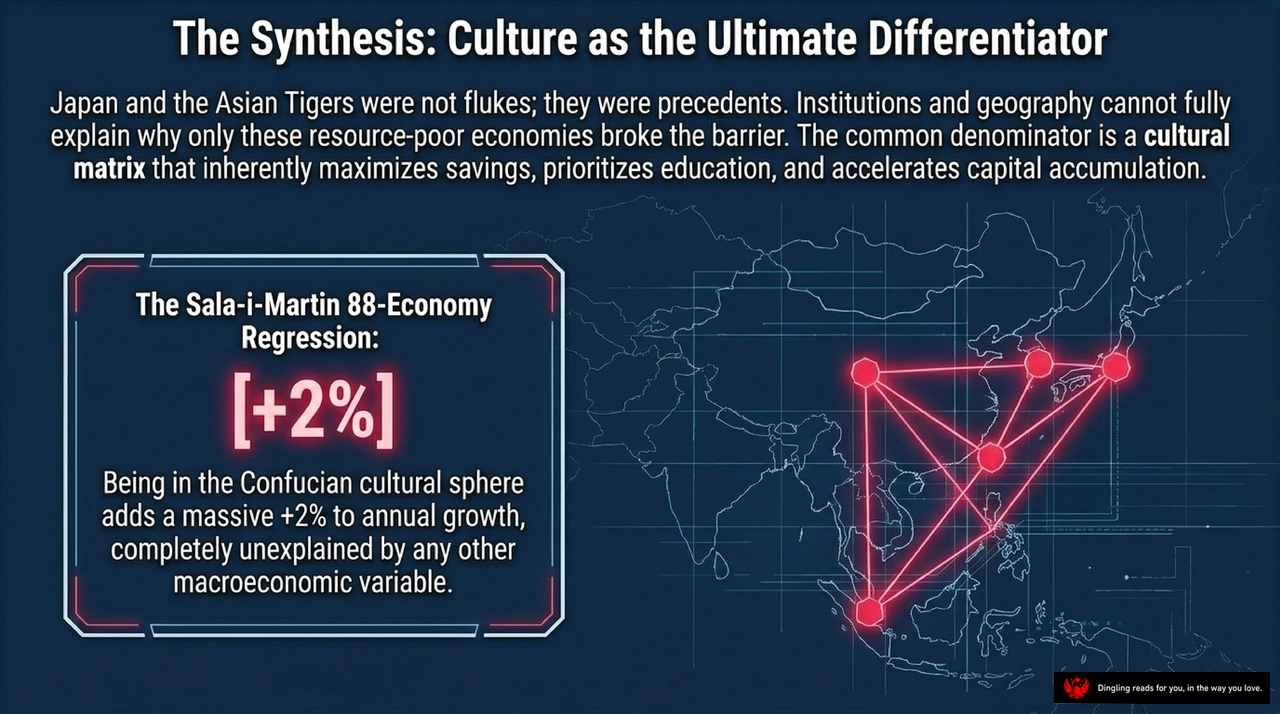
The synthesis of the book's data points to one ultimate differentiator: culture. While institutions and geography fail to fully explain why resource-poor economies like Japan and the "Asian Tigers" broke through, the common denominator is a cultural matrix that inherently maximizes savings, prioritizes education, and accelerates capital accumulation. This isn't just theory; it's hard math. The Sala-i-Martin 88-Economy Regression reveals a staggering fact: simply being part of the Confucian cultural sphere adds a massive +2% to annual growth, a boost completely unexplained by any other macroeconomic variable. Look at the map connecting these nations; their success wasn't luck, but a precedent set by a shared value system. This cultural advantage, rooted in diligence, trust, and an obsession with education, transformed demographic shifts into real economic power, creating a growth engine that no other developing nation could replicate.

The slide clearly states that the so-called "Middle-Income Trap" is actually a statistical mirage. It argues that developing nations aren't truly "trapped" at middle income because most never grew fast enough to begin with. The chart illustrates this with the "Threshold Timeline," showing how Japan, South Korea, Singapore, and Taiwan all followed a similar path where economic growth naturally decelerates as they approach the 30% US income threshold. China's red curve mirrors this historical trajectory, proving that slowing growth is a sign of convergence, not a mystical trap.
The book text supports this by explaining that while the concept of a "trap" is popular, data shows that once economies reach a certain level relative to the US, growth naturally slows down due to convergence. The slide highlights that China, despite recent slowdowns, is simply following the same pattern as the "Asian Tigers" like South Korea and Japan. The key takeaway is that this deceleration is a normal part of economic development, not a failure. The chart visually reinforces that as relative income to the US increases, the growth rate inevitably drops for all these economies, confirming that the fear of getting stuck is largely unfounded. China's future lies in continuing this natural convergence, not in avoiding a trap that statistically doesn't exist for those who have already achieved significant growth.

The slowdown we're seeing isn't a mechanical failure of China's engine; it was a deliberate shift in the policy steering wheel. Look at that timeline: we moved from a 2013 peak of 18.8% in fixed asset investment down to a mere 0.5% by 2018. This wasn't an accident. It was a calculated "demand-side shock" designed to stop blind, reckless spending on infrastructure and factories.
The chart highlights three specific brakes that were applied. First, the "Environmental Factory Shutdowns"—closing down polluting plants to force sustainability. Second, the "De-leveraging Campaigns," which targeted the massive debt buildup in the system. And third, the "Anti-Corruption Sweeps," cleaning up the governance to stop corruption-driven investment.
The core message here is clear: China's recent deceleration is the direct result of prioritizing long-term environmental health and anti-corruption over short-term, blind fixed-asset investment. The government chose to cool down the economy intentionally to fix structural problems, proving that this slowdown is a feature of a new, more sustainable policy direction, not a breakdown of the system itself.

The tech war is often framed as a derailment, but the reality is far more nuanced: it's actually just a speedbump. While the U.S. imposes embargoes on frontier technologies, the paradoxical result is an explosion in domestic R&D. Instead of falling behind, China is being forced to accelerate its own innovation cycle, transitioning from a master of imitation to a global leader in patent applications. Look at the data from 2018: while the United States filed roughly 600,000 patent applications, China surged past 1.5 million. This massive leap wasn't accidental; it was fueled by the very pressure the U.S. created. The "Catalyst Loop" shows that when external access is denied, internal drive intensifies. Far from stopping China's rise, these geopolitical friction points are simply temporary hurdles that ultimately reinforce its long-term trajectory as a top-tier innovation power.

Look at this striking red line cutting across the map. It symbolizes a new era: the Multipolar Reality. The slide challenges a common myth—that China's rise was just luck or a perfect policy manual. The text makes it clear: China's unprecedented growth wasn't about flawless institutions or demographic timing. It was about market reforms unlocking a deep cultural engine. Specifically, a culture of extreme thrift and relentless human capital accumulation.
Think about this: the "China Miracle" is robust and internally driven. While the world focused on copying China's policies, the real secret was in its cultural DNA. The slide asks us a tough question: If a nation's rise is written in its culture rather than its policy manuals, are we truly ready to compete? The old blueprints of Western dominance no longer apply. We are entering a world where the rules have changed, and the old guard is facing a competitor whose strength comes from within, not just from external mandates. This is the reality we must prepare for.