
Che Guevara: A Revolutionary Life: Complete Chapter-by-Chapter Summary

Welcome to the definitive story of Che Guevara. This isn't just a biography; it's the saga of the tragic, romantic hero who abandoned a life of privilege to become the twentieth century's ultimate icon of revolution. Born into an aristocratic family in Argentina, Ernesto Guevara de la Serna grew up with the world on a silver platter. His parents were wealthy landowners, and he was raised with every advantage money could buy. But beneath that polished surface lay a crack in the foundation. A lifelong battle with asthma forced him out of traditional schooling, leaving his education to his mother, who secretly instilled in him a sense of equality. His grandmother, a fierce atheist and free thinker, was his true hero, planting the seeds of rebellion that would one day consume him.
As a young man, Che didn't just observe the world; he felt its pain. He watched the Spanish Civil War unfold, sympathizing with the refugees and realizing that the gap between the rich and the poor was a chasm no amount of personal kindness could bridge. He even stopped a rich kid from bullying a disabled man, only to learn that the poor man hated him for it—a harsh lesson that individual charity couldn't fix systemic injustice.
Then came the journey that changed everything. In 1952, he traded his comfortable life for a motorcycle and a map, traveling through South America. From the slums of Lima to the leper colonies of Peru, he saw the brutal reality of colonial oppression. He met doctors, miners, and indigenous people who were crushed by poverty and ignored by the elite. He realized that the revolution wouldn't come from the city's elite, but from the forgotten masses. He stopped seeing himself as an Argentine doctor and started seeing himself as a Latin American revolutionary. He famously declared that Latin America was one unified, mixed nation, and that their struggle was a single, continental cause.
By the time he returned to Argentina, the boy who loved sports and medicine was gone. In his place stood a hardened thinker, obsessed with justice and armed with a new mission. He earned his medical degree, but he knew a diploma wasn't enough. He had to change the world. So, he packed his bags again, heading toward Cuba, where he would join Fidel Castro, and eventually, march into the jungles of the Congo and Bolivia, forever chasing the dream of a fairer world. This is the story of how a privileged heir became a global martyr for the cause of the oppressed.
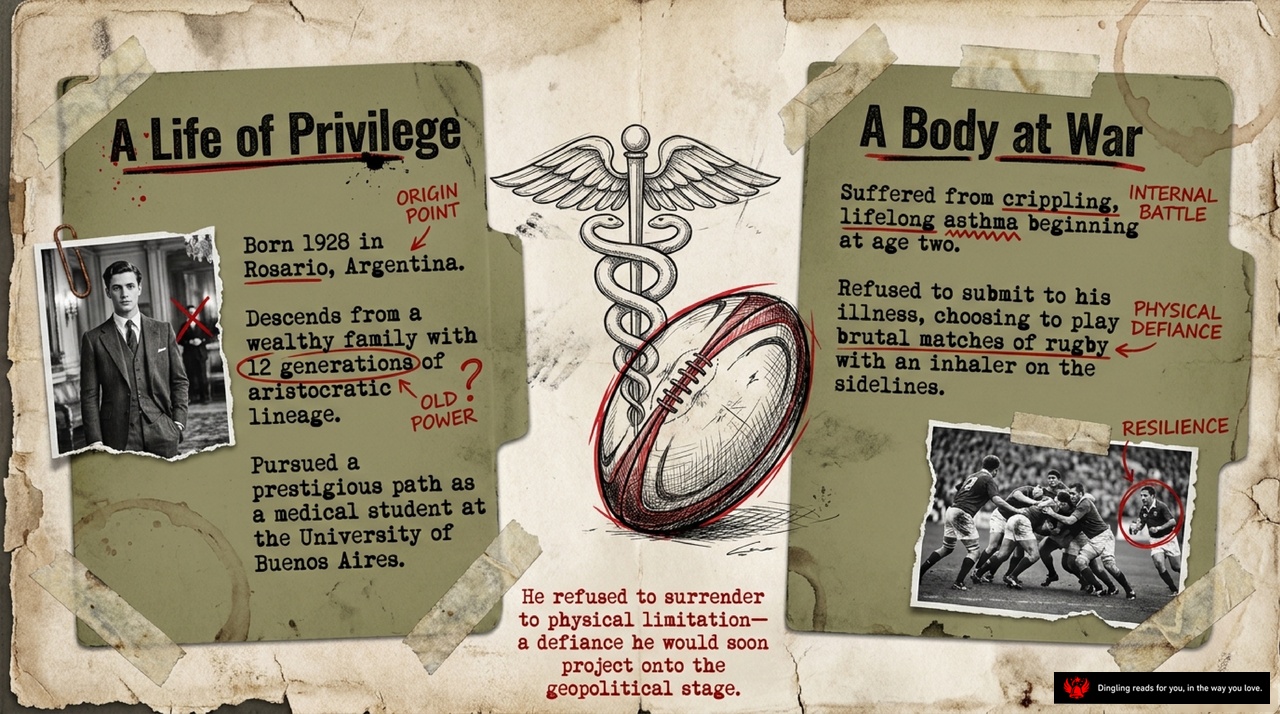
Born in 1928, Ernesto Guevara was raised in a world of immense privilege, the heir to twelve generations of Argentine aristocracy. Yet, from the moment he was two years old, his life took a different turn. He suffered from crippling, lifelong asthma—a constant internal battle that would define his character.
Instead of letting this illness break him, Guevara chose physical defiance. He refused to submit to his limitations, often playing brutal matches of rugby with an inhaler tucked safely on the sidelines. This resilience wasn't just about sports; it was the foundation of his spirit. He learned to fight against his own body, and that same willpower would soon be projected onto the geopolitical stage.
His journey from a privileged young man to a revolutionary icon wasn't about escaping his past, but about mastering his own body and, eventually, the world.

In 1965, Ernesto Che Guevara made a bold, life-altering decision that would take him far from the revolutionary triumphs of Cuba. He packed his bags, leaving behind the relative safety of the Caribbean, to lead a small band of fighters into the dense, unforgiving jungles of the Congo. His goal was ambitious and idealistic: to ignite a revolution in a newly independent nation, proving that the Cuban model could be exported across the globe.
However, the reality on the ground in the Congo was a harsh lesson in cultural and strategic differences. Guevara arrived with a clear vision, but he found himself fighting not just an enemy army, but a fundamental disconnect with his own troops. The Congolese fighters held onto deep-seated local beliefs, like the mythical "Dawa" potion that could stop bullets, which clashed directly with Guevara's disciplined, modern military approach. Communication broke down, discipline evaporated, and the mission quickly spiraled out of control.
The situation deteriorated rapidly. Internal conflicts tore the group apart, and external pressure from the government forces, aided by American military advisors, made survival nearly impossible. One by one, his comrades fell. The once-hopeful expedition turned into a tragic struggle for survival in a hostile environment. Guevara, who had dreamed of being the savior of the Third World, found himself isolated and defeated, realizing that his specific brand of revolution could not simply be imposed on a different culture.
This failure in the Congo was a devastating personal blow. It shattered his confidence and marked the end of his international revolutionary career. Just months later, driven by a renewed, desperate hope to make one final stand, he would move on to Bolivia, unaware that this next chapter would ultimately be his final one.
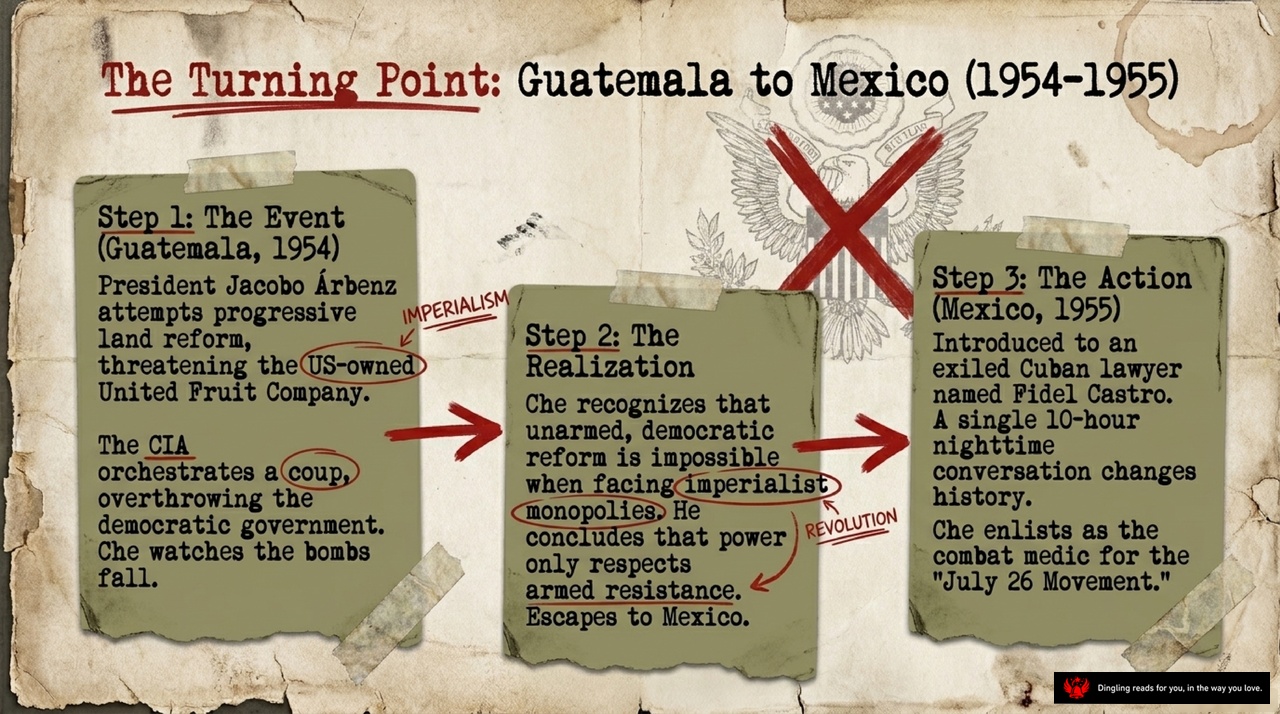
Step 1: Guatemala, 1954. President Árbenz tries to fix land reform, but he's threatening the US-owned United Fruit Company. The CIA orchestrates a coup, overthrowing the democratic government. Che watches the bombs fall.
Step 2: The realization. He recognizes that unarmed, democratic reform is impossible when facing imperialist monopolies. He concludes that power only respects armed resistance. He escapes to Mexico.
Step 3: Mexico, 1955. Introduced to an exiled Cuban lawyer named Fidel Castro. A single 10-hour nighttime conversation changes history. He enlists as the combat medic for the "July 26 Movement."
This is the turning point. From Guatemala to Mexico, 1954 to 1955. What started as a failed democratic experiment in Guatemala became the spark for a global revolution. When Che realized that peaceful reform wouldn't work against imperialist monopolies, he made a hard choice. He escaped to Mexico, met Fidel Castro, and within ten hours, they forged a bond that would change the world. That's when the revolution truly began.
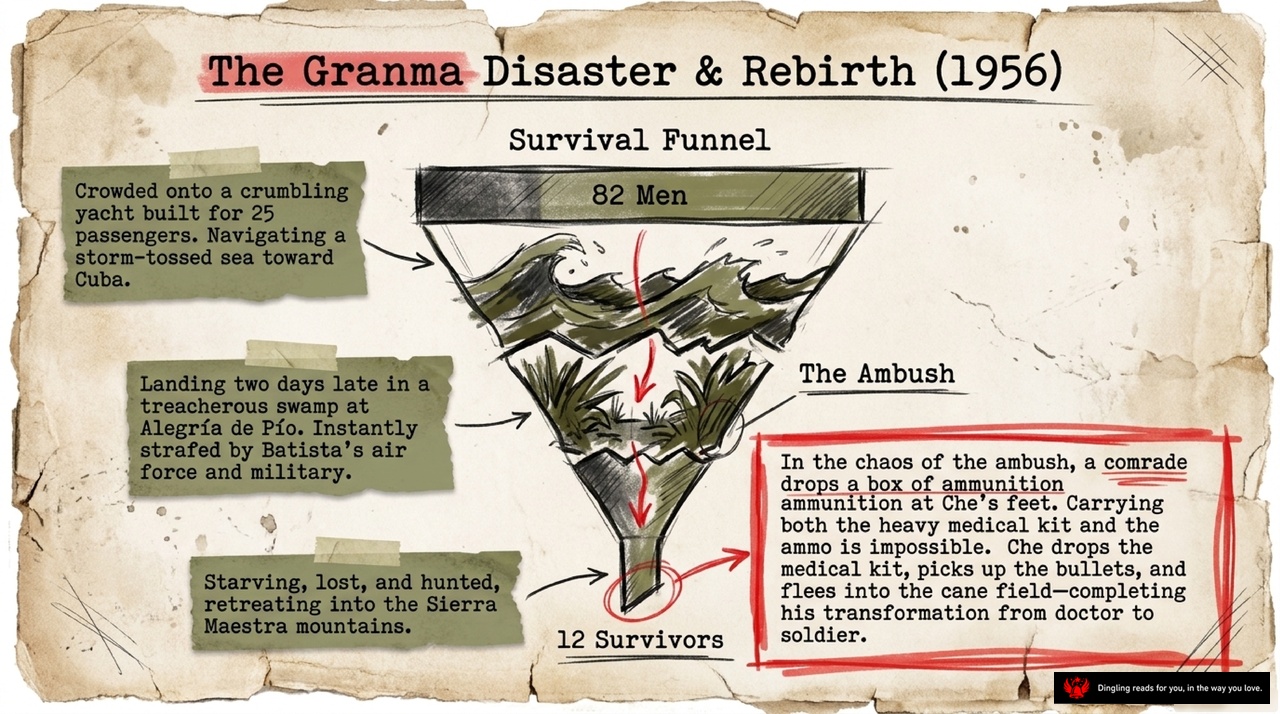
The Granma Disaster & Rebirth (1956) isn't just a title; it's the brutal story of how 82 men were funneled down from hope to survival. Imagine a crumbling yacht built for 25, dangerously overcrowded with revolutionaries, battling a storm-tossed sea toward Cuba. That's where it starts. But the real nightmare hits when they land two days late in a treacherous swamp at Alegría de Pío. They are instantly strafed by Batista's air force and military, turning their arrival into a massacre.
Starving, lost, and hunted, the survivors retreat into the Sierra Maestra mountains, emerging as only 12. But amidst this chaos, a pivotal moment occurs during The Ambush. In the confusion, a comrade drops a box of ammunition at Che's feet. Carrying both the heavy medical kit and the ammo is impossible. Che makes the ultimate choice: he drops the medical kit, picks up the bullets, and flees into the cane field. In that split second, he completes his transformation from doctor to soldier. This sacrifice defines the rest of his journey, proving that to save the revolution, he had to leave his old life behind.

The Foco Theory isn't just a historical footnote; it's a blueprint for how a tiny, underdog force can topple a massive empire. Look at this gear mechanism in the center. It illustrates the core logic: a small, highly mobile vanguard—the "Foco"—doesn't wait for a revolution to happen. Instead, it creates the conditions for one through relentless action.
The cycle starts with **Hit**. You launch surprise attacks against isolated military outposts. Why? To grab weapons and, more importantly, to shatter the enemy's morale. Once you've struck, you immediately **Run**. You retreat instantly into inaccessible, rugged terrain—think of the Sierra Maestra—avoiding prolonged frontal combat where your numbers are a disadvantage.
But hitting and running isn't enough. You must **Survive**. This means maintaining absolute discipline. You endure hunger, sickness, and total isolation. You execute traitors and bandits to establish moral authority. Without this, the cycle breaks. Finally, you **Mobilize**. You win the trust of the local peasantry by paying for their food, providing medical care, and promising land reform. You repeat this cycle with growing numbers.
This is the essence of the Foco Theory: a small group takes the fight to the powerful, creates chaos and opportunity, and then builds a popular army from the ashes. It's a strategy born from desperation but executed with surgical precision.
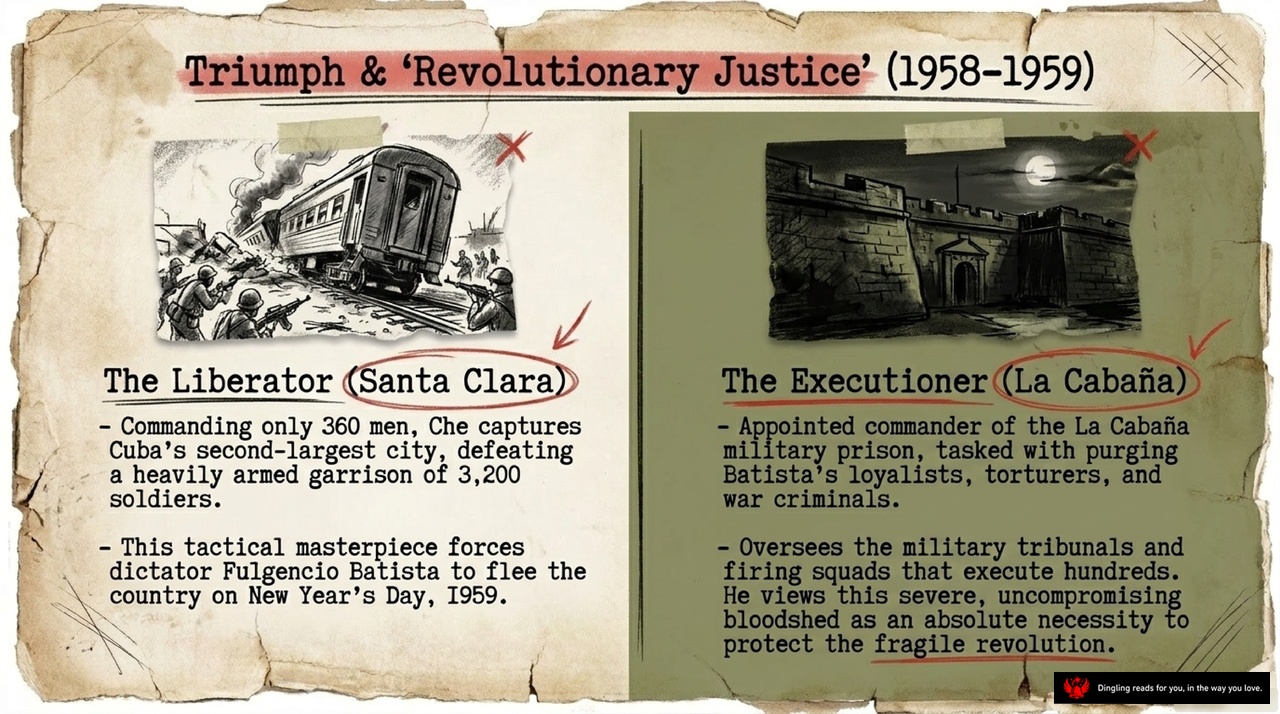
On this slide, we see the final, bloody chapter of the Cuban Revolution, split into two stark realities: the triumph of liberation and the harsh cost of "revolutionary justice."
First, look at the left side: **The Liberator, Santa Clara.** This represents the high point of the revolution. In January 1959, Che led a tiny force of only 360 men against a heavily armed garrison of 3,200 soldiers. It was a tactical masterpiece. By capturing Cuba's second-largest city, he forced dictator Fulgencio Batista to flee the country on New Year's Day, 1959. The image of the train and the soldiers captures that decisive moment where the old order collapsed.
But the right side of the slide, **The Executioner, La Cabaña**, shows the dark flip side of victory. Once the war ended, Che was appointed commander of the La Cabaña military prison. His task was grim: purging Batista's loyalists, torturers, and war criminals. He oversaw military tribunals and firing squads that executed hundreds. To Che, this severe, uncompromising bloodshed wasn't a crime; he viewed it as an absolute necessity to protect the fragile revolution.
This duality defines Che's legacy in those final months. He was both the hero who freed the nation and the judge who settled its scores, believing that to build a new Cuba, the old evil had to be ruthlessly destroyed.
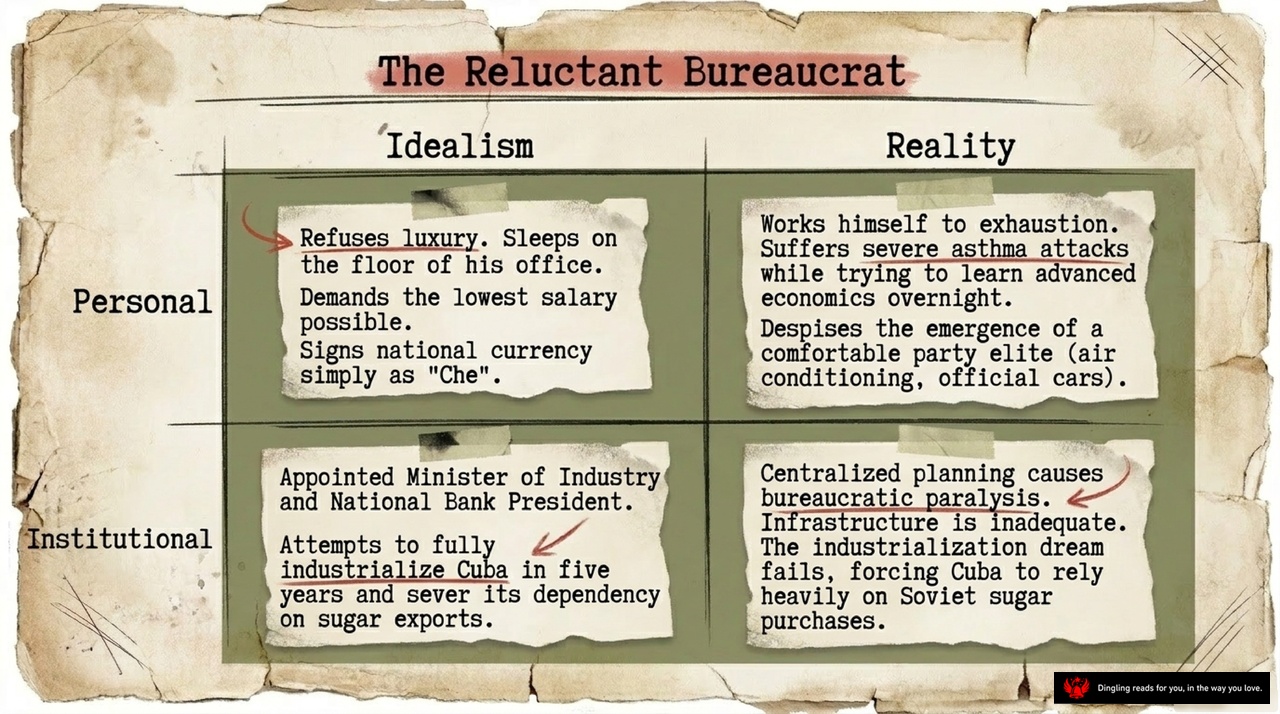
The slide before us captures the tragic irony of Che Guevara's final chapter: the "Reluctant Bureaucrat." On the left, under "Idealism," we see the man who refused luxury, sleeping on office floors and signing currency simply as "Che." On the right, under "Reality," we see the exhaustion that followed—severe asthma attacks while studying advanced economics overnight, and a deep disdain for the very comfort he was now surrounded by.
This disconnect wasn't just personal; it was institutional. The slide highlights how his appointment as Minister of Industry and National Bank President led to a grand plan: fully industrializing Cuba in five years. But as the "Reality" column shows, centralized planning caused bureaucratic paralysis. Infrastructure remained inadequate, and the industrialization dream failed, forcing Cuba to rely heavily on Soviet sugar purchases.
This failure created a bitter rift. Guevara realized that handing the economy's lifeline to foreign powers was no better than the old colonial dependency. He wanted to break free, but the system he helped build was too rigid. This frustration drove him to leave Cuba, seeking a new battlefield in Africa and eventually Bolivia, where he hoped to ignite a revolution from the ground up, away from the constraints of state bureaucracy.
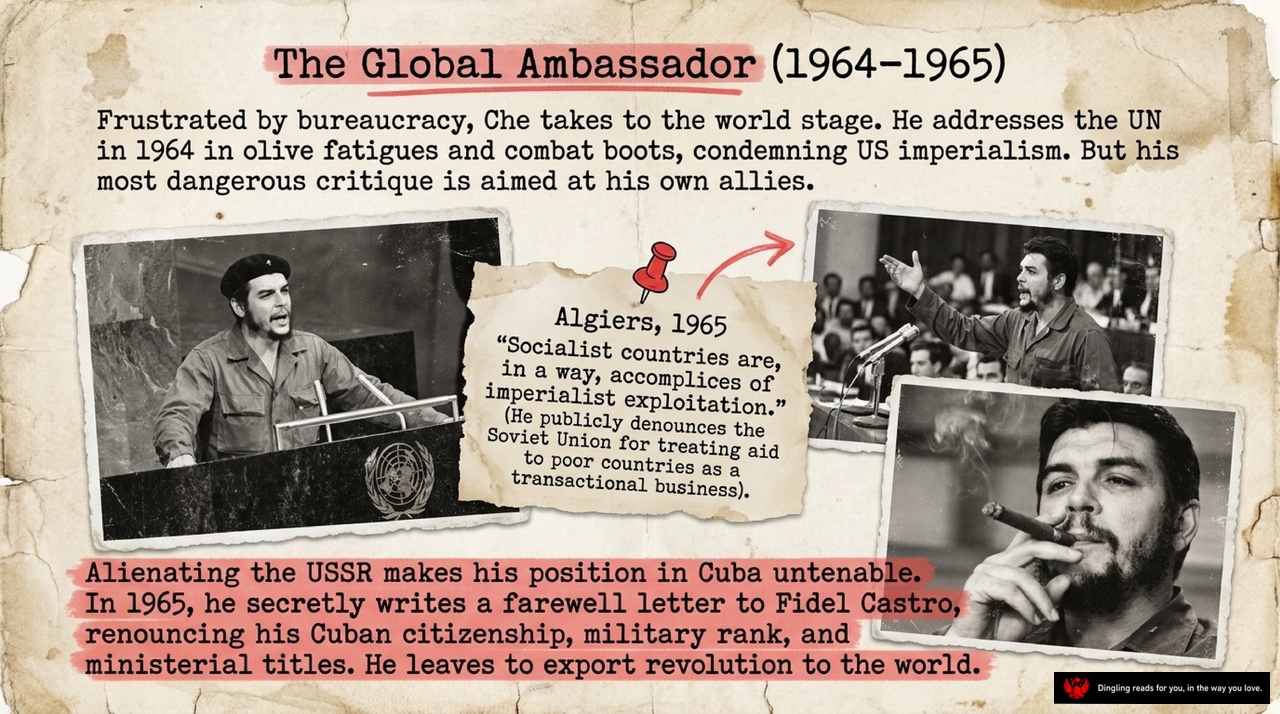
Che Guevara, the "Global Ambassador," took the stage in 1964 and 1965, frustrated by the bureaucracy of his own revolution. Dressed in olive fatigues and combat boots, he boldly addressed the UN in New York, condemning US imperialism. But his most dangerous critique wasn't aimed at his enemies—it was directed right at his own allies.
In Algiers in 1965, he publicly denounced the Soviet Union, calling socialist countries "accomplices of imperialist exploitation." He argued that Moscow treated aid to poor nations as a mere transactional business, prioritizing profit over genuine solidarity. This radical stance alienated the USSR, making his position in Cuba untenable.
Realizing he had lost the support of the very powers he once relied on, Che made a fateful decision. In 1965, he secretly wrote a farewell letter to Fidel Castro, renouncing his Cuban citizenship, military rank, and titles. He left the island to export the revolution to the world, seeking a new battlefield where he believed true change was still possible.
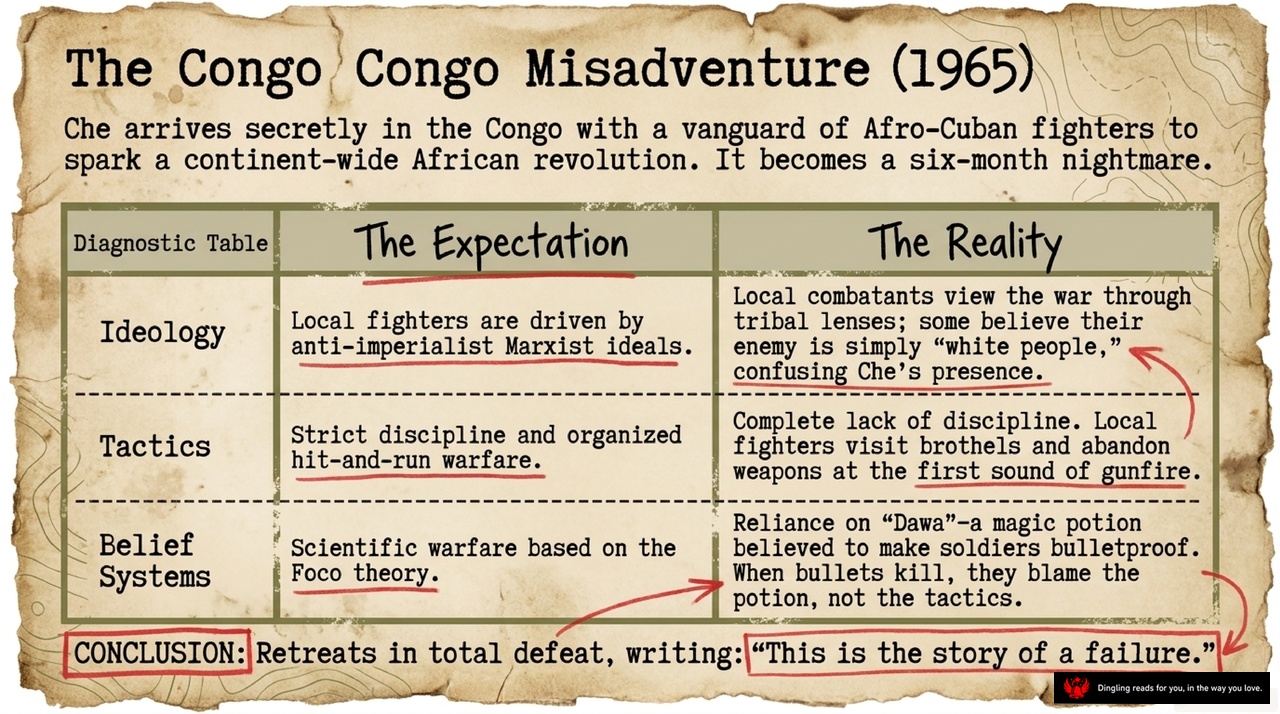
The slide we see here captures one of the most tragic and instructive chapters in revolutionary history: the "Congo Misadventure" of 1965. It wasn't just a military operation; it was a collision between idealism and reality, between what Che Guevara *expected* to happen and what the brutal truth of the Congo actually demanded.
Look at the diagnostic table on the screen. On the left, we have "The Expectation." Che arrived with a vanguard of Afro-Cuban fighters, driven by high-minded anti-imperialist Marxist ideals. He believed in strict discipline, organized hit-and-run warfare, and a belief system rooted in scientific theory. He thought he was bringing a finished product—a proven revolutionary model—to a place that needed it.
But look at the right side: "The Reality." This is where the nightmare began. The local combatants didn't see the war through a political lens; they saw it through tribal ones. To them, the enemy wasn't a complex imperialist structure; it was simply "white people." Che's presence, intended to be a beacon of liberation, was confusing and alienating.
The gap between these two columns was fatal. Where Che expected discipline, he found a complete lack of it. His fighters abandoned weapons at the first sound of gunfire and visited brothels instead of holding the line. Where he expected scientific warfare based on Foco theory, he encountered a reliance on "Dawa"—a magic potion believed to make soldiers bulletproof. When bullets killed, the soldiers blamed the potion, not the tactics or the strategy. This disconnect made any military success impossible.
The text above the table summarizes the outcome perfectly: a six-month nightmare that ended in total retreat. The conclusion at the bottom is stark and unyielding: "This is the story of a failure." Che retreated, not because of a lack of bravery, but because he fundamentally misunderstood the cultural and social landscape he was trying to conquer. He tried to export a revolution without understanding the soil it was planted in. This failure would haunt him for the rest of his life, ultimately leading him to his final, fatal mistake in Bolivia.
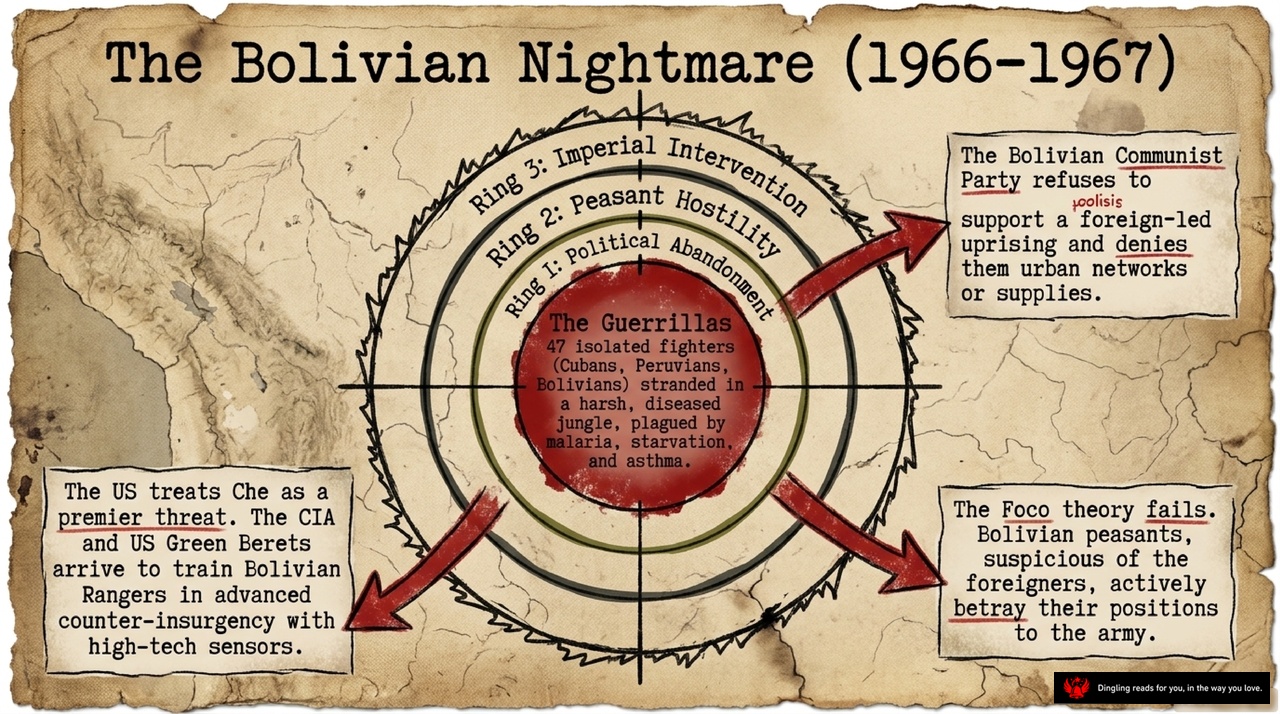
The Bolivian Nightmare of 1966 and 1967 wasn't just a battle; it was a perfect storm of isolation and betrayal that turned Che Guevara's revolutionary dream into a tragic reality.
At the center of this collapse were the guerrillas themselves—47 isolated fighters, a mix of Cubans, Peruvians, and Bolivians, stranded in a harsh, diseased jungle. They were plagued by malaria, starvation, and asthma, fighting a war they were never meant to win.
But the real tragedy wasn't just the terrain; it was the circles closing in around them. First, there was political abandonment. The very Bolivian Communist Party, which Che hoped would support the uprising, refused to back a foreign-led movement. They denied the guerrillas urban networks and supplies, leaving them utterly alone.
Then came peasant hostility. The Foco theory, which Che believed in, failed to account for local reality. The Bolivian peasants, suspicious of the foreigners, actively betrayed the guerrillas' positions to the army. Che's idealism couldn't bridge the gap between his vision and the local population's fear.
Finally, imperial intervention sealed their fate. The US treated Che as a premier threat. The CIA and US Green Berets arrived to train Bolivian Rangers in advanced counter-insurgency, equipped with high-tech sensors that made the jungle transparent.
The Bolivian Communist Party refuses to support a foreign-led uprising and denies them urban networks or supplies. The Foco theory fails. Bolivian peasants, suspicious of the foreigners, actively betray their positions to the army. The US treats Che as a premier threat. The CIA and US Green Berets arrive to train Bolivian Rangers in advanced counter-insurgency with high-tech sensors.
Trapped in the middle, the guerrillas had no allies, no supplies, and no escape. It was a nightmare where every path led to defeat, and the man who once dreamed of changing the world was crushed by the very forces he tried to liberate.
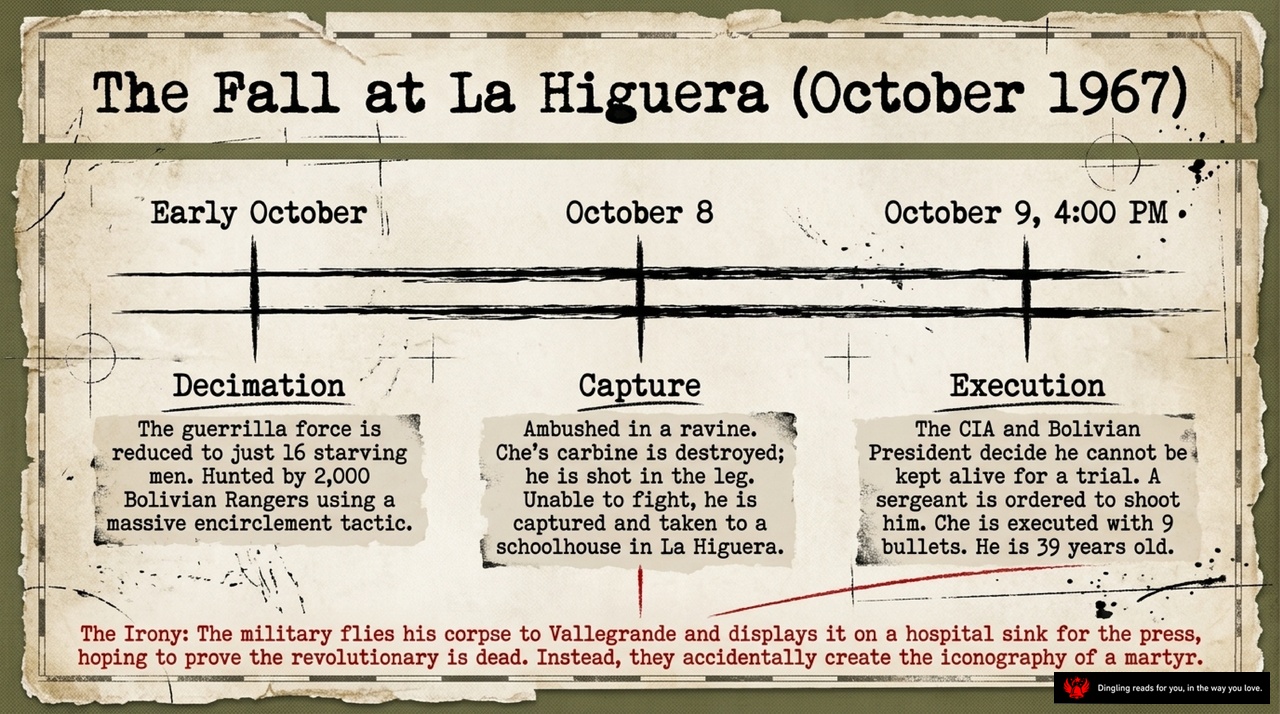
The Fall at La Higuera, October 1967. This timeline captures the final, brutal chapter of Che Guevara's life.
By early October, the guerrilla force had been decimated. Hunted by 2,000 Bolivian Rangers using a massive encirclement tactic, the fighters were reduced to just 16 starving men.
On October 8, the end came abruptly. Che was ambushed in a ravine. His carbine was destroyed, and he was shot in the leg. Unable to fight, he was captured and taken to a schoolhouse in La Higuera.
Then, on October 9 at 4:00 PM, the execution occurred. The CIA and the Bolivian President decided he could not be kept alive for a trial. A sergeant was ordered to shoot him. Che was executed with 9 bullets. He was 39 years old.
Here lies the ultimate irony: The military flew his corpse to Vallegrande and displayed it on a hospital sink for the press, hoping to prove the revolutionary was dead. Instead, they accidentally created the iconography of a martyr.

The Birth of a Myth. Look at this timeline. It traces the transformation of Che Guevara from a dying man into a global icon.
Phase one: The Crucified Demigod. On the left, you see the sketch of his emaciated corpse. Far from proving his defeat, these photos of his suffering body mirrored classical paintings of Jesus Christ. This visual narrative elevated his moral stature, turning him into a symbol of a man who died for his sins against imperialism.
Phase two: The Banner of Rebellion. By 1968, the image shifted. Korda's defiant portrait became the standard at student protests from Paris to Mexico City. He was idolized by thinkers like Sartre as the "most complete human being of our age," the ultimate symbol of resistance.
Phase three: The Ultimate Paradox. Here lies the twist. The fiercest enemy of capitalism was transformed into one of history's most commodified images. As you can see on the right, his face is now mass-marketed on a t-shirt, stripped of its violent reality to simply sell merchandise for $24.99. This is the paradox: the man who fought against exploitation has become the very symbol of the commercial machine he sought to destroy.
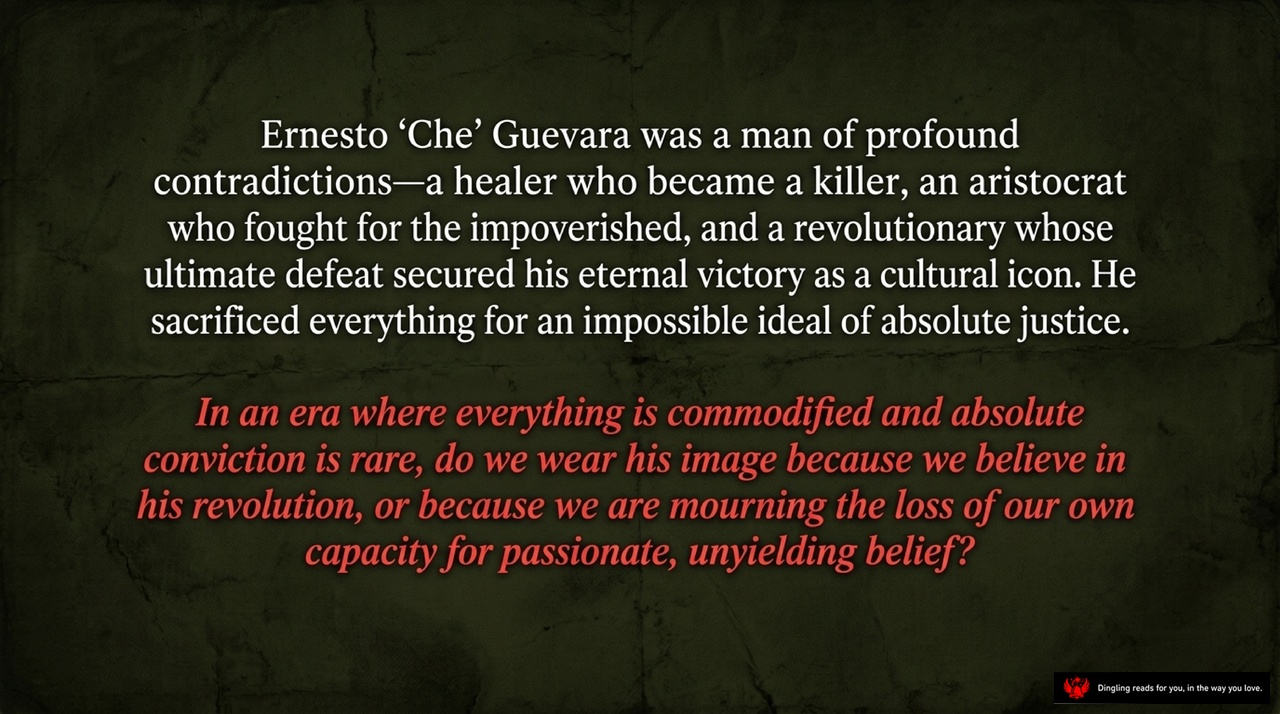
Ernesto 'Che' Guevara was a man of profound contradictions—a healer who became a killer, an aristocrat who fought for the impoverished, and a revolutionary whose ultimate defeat secured his eternal victory as a cultural icon. He sacrificed everything for an impossible ideal of absolute justice.
In an era where everything is commodified and absolute conviction is rare, do we wear his image because we believe in his revolution, or because we are mourning the loss of our own capacity for passionate, unyielding belief?
We see him today not just as a historical figure, but as a symbol of a time when people believed they could change the world with sheer will. The text on this slide captures his complex legacy: a man torn between compassion and violence, yet driven by a singular, unshakeable purpose. When we look at his face on a t-shirt or a poster, we are often reflecting on our own lives. We ask ourselves: Do we still have the courage to stand up for what is right, even when it costs us everything? Or have we become too comfortable in a world where everything has a price tag and true conviction is a rare commodity?
Guevara's story challenges us to look beyond the surface. Was his revolution real, or was it a mirror reflecting our own lost dreams? His life reminds us that while systems can be crushed, the human spirit's desire for justice remains unyielding. In a world that often tells us to compromise, Guevara's image stands as a reminder of the power of absolute belief.