


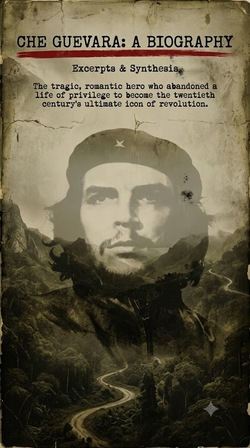
This book finally shows the real man behind the myth.
Your Review
This book finally shows the real man behind the myth.

Anderson brilliantly reconstructs Che as a complex human being rather than a flat icon, showing how his childhood asthma and medical background shaped his revolutionary path while honestly exposing his rigid failures in Congo and Bolivia.

Anderson brilliantly dissects Che's transformation from a privileged doctor to a ruthless revolutionary, revealing how his asthma-forged resilience and rigid idealism ultimately blinded him to local realities in Congo and Bolivia, making this biography a necessary corrective to the pop culture myth.


Anderson strips away the pop culture myth to reveal the complicated, contradictory man behind the world's most famous rebel face, making Che feel human again.

A nuanced biography that humanizes a famous icon beyond the T-shirt myth.

This biography strips away the myth to show the real, complex man behind the famous rebel image.

Anderson strips away the myth to show the real, flawed man behind the iconic rebel image.

Anderson strips away the myth to show how Che's rigid idealism failed when he refused to adapt his Cuban model to Congo and Bolivia.

This book strips away the myth to show the real, complicated Che Guevara behind the famous rebel face.

A definitive guide that finally humanizes the rebel.

Anderson brilliantly exposes how pop culture myth hid Che's complex, contradictory reality, revealing a privileged medical student whose lifelong asthma forced resilience, yet whose rigid refusal to adapt local realities in Congo and Bolivia ultimately caused catastrophic failure, showing how his humanitarian instincts as a doctor clashed with his uncompromising idealism that turned him into a divisive figure celebrated by some and condemned as a ruthless ideologue by others, making this biography a necessary mirror for us to confront tough questions about whether violence is ever justified in the name of justice and when uncompromising idealism becomes a liability that destroys the very cause it seeks to save.

Anderson masterfully uses private letters and interviews to reveal how Che's childhood asthma forged a resilience that later drove his rigid idealism and tragic failures in Congo and Bolivia. The book balances his humanitarian instincts as a doctor with his willingness to use violence, showing that his success in Cuba relied on aligning these traits with the right context while his downfall came from refusing to adapt his model to different cultures and realities. This nuanced portrait challenges the one-dimensional rebel image we see on merchandise, proving that Che's legacy is defined by both his unwavering commitment to justice and his fatal inability to compromise when local contexts demanded it, making his story a complex mirror for anyone navigating the tension between idealism and real-world change today.

Anderson brilliantly traces how Che transformed from a privileged doctor to a ruthless revolutionary. The detailed account of his motorcycle trip across Latin America reveals how systemic inequality shattered his initial faith in individual charity. Seeing his rigid idealism fail in Congo and Bolivia because he refused to adapt to local cultures is heartbreaking yet necessary. The book honestly explores this tension between his humanitarian instincts as a healer and his willingness to use violence to dismantle oppressive systems, showing that his asthma-forged resilience ultimately blinded him to the need for flexibility when context changed.

Anderson uses private letters and interviews to show how Che's childhood asthma forged the resilience that later made him an unyielding revolutionary.

Anderson provides excellent details on Che's asthma struggles and his shift from doctor to revolutionary, yet the book feels too focused on his failures in Congo and Bolivia without enough analysis of why his rigid ideology prevented adaptation to local cultures. The narrative is well-researched with private letters and interviews, making the portrait nuanced rather than one-dimensional, but I wish it explored more deeply how his refusal to compromise ultimately doomed his later missions despite his genuine empathy for the poor he met during his travels.

This biography strips away the T-shirt myth to reveal the complicated, contradictory man behind the famous rebel face. Anderson uses private letters and interviews to show how Che transformed from a privileged medical student dreaming of healing the sick into a revolutionary who believed violence was necessary to tear down unjust systems. The book doesn't shy away from his flaws, like his rigid idealism in Congo and Bolivia which led to disaster because he refused to adapt to local cultures. Instead, it highlights his profound empathy for the poor that drove his devastating choices. Reading this makes you question what we are willing to sacrifice for our ideals and why his story still matters today as we navigate our own era of social unrest and the tension between idealism and real-world change.

Anderson brilliantly traces how Che's childhood asthma forged his legendary resilience. Reading his journal entries from the motorcycle trip, I felt the moment he realized individual charity couldn't fix systemic poverty. The detailed account of his time in the Guatemalan leper colony, where he slept with patients without gloves, powerfully illustrates his shift from a healer to a revolutionary who believed violence was necessary to tear down unjust systems. This nuanced biography strips away the pop culture iconography to reveal a complicated, contradictory figure driven by profound empathy yet willing to make devastating choices for his ideals, making his ultimate failures in Congo and Bolivia feel tragically inevitable.

Anderson masterfully exposes the myth of Che, showing how his rigid idealism and refusal to adapt to local realities in Congo and Bolivia ultimately led to his catastrophic failures despite his noble intentions.

Anderson reveals the complex man behind the myth, making Che feel real rather than just a symbol.

Anderson brilliantly peels back the myth to show Che as a flawed, resilient man driven by empathy and rigid idealism.