
China 2049: Economic Challenges of a Rising Global Power: Complete Chapter-by-Chapter Summary

Welcome to "China 2049: Economic Transformation of a Global Power." This isn't just a prediction; it's a strategic blueprint for how China navigates the next century to achieve sustainable superpower status.
The vision is bold: by 2049, China aims to restore its economic share of the global economy to levels seen in 1820, with per capita income reaching double the world average. But the journey from a low-income agrarian society to a global powerhouse involves overcoming massive structural bottlenecks.
The book outlines four core drivers behind this transformation. First, the industrial foundation built during the planned economy era, which created a robust heavy industry backbone. Second, the massive demographic dividend that fueled labor-intensive growth and exports. Third, the critical shift away from an export-led model toward a domestic consumption-driven economy—a necessary rebalancing. And fourth, the transition to an innovation-led growth model to sustain momentum as the population ages and traditional advantages fade.
However, the path isn't without challenges. The authors highlight three major hurdles: slowing productivity growth as China approaches the global technology frontier, the unavoidable "gray rhino" of rapid population aging, and the shifting international landscape marked by trade tensions.
Ultimately, achieving this vision requires a fundamental shift. It demands deepening opening-up policies, reforming state-owned enterprises to ensure fair competition, and building a resilient financial system. The goal is clear: not just to grow larger, but to create prosperity for the world while securing China's own sustainable future.
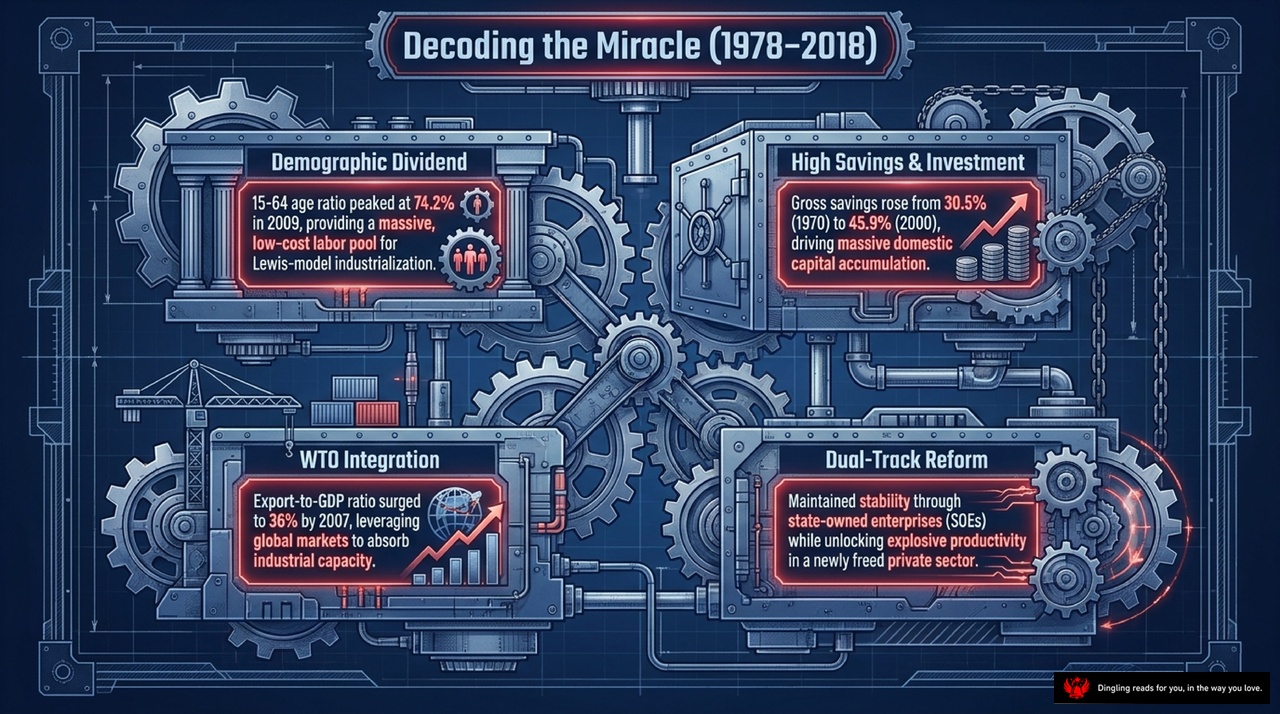
Let's pull back the curtain on the "Chinese Miracle" from 1978 to 2018. Think of this era not just as a story of GDP growth, but as a perfectly tuned machine where four distinct gears worked in harmony to drive an economic explosion.
First, the engine started with a massive **Demographic Dividend**. By peaking at 74.2% in 2009, the working-age population created a huge, low-cost labor pool. This abundance of workers was the fuel for what economists call Lewis-model industrialization, allowing factories to expand rapidly without labor costs skyrocketing.
Simultaneously, the machine was fueled by **High Savings & Investment**. While the West was spending, China was saving. Gross savings skyrocketed from 30.5% in 1970 to nearly 46% by 2000. This wasn't just hoarding; it was domestic capital accumulation. These savings were immediately reinvested into building the country's industrial backbone, creating a self-sustaining cycle of growth.
Then came the global connection through **WTO Integration**. Joining the World Trade Organization in 2001 was the turbocharger. China's export-to-GDP ratio surged to a peak of 36% by 2007. By leveraging global markets, China absorbed its massive industrial capacity, turning its factories into the world's most efficient production hubs and becoming the undisputed "world's factory."
Finally, the system remained stable through a clever **Dual-Track Reform**. China didn't choose between socialism and capitalism; it ran both. The government kept state-owned enterprises (SOEs) to maintain stability and control key resources, while simultaneously unlocking the explosive productivity of a newly freed private sector. This hybrid approach allowed the economy to grow fast without collapsing.
Together, these four mechanisms—labor abundance, capital accumulation, global market access, and a unique mixed economy—decoded the miracle, lifting hundreds of millions out of poverty and reshaping the global economic landscape in just four decades.

Look at this chart titled "The Post-2008 Turning Point: The Old Engine is Stalling." It visually captures a critical shift in China's economic story. On the left, you see the dark blue line representing Real GDP Growth. Before 2008, this engine was roaring at over 10%, but by 2019, it had slowed to around 6%. On the right, the red line shows the cost of doing business—specifically ICOR and SOE Debt. While efficiency was high before, this ratio has climbed from 3.5 to a staggering 6, with debt-to-equity hitting 163% by 2015.
The core message here is that the extensive growth model has simply reached its limits. As the text explains, Total Factor Productivity growth plummeted from an average of 6.1% pre-2005 to just 2.5% between 2006 and 2015. We are seeing the classic sign of an aging economy: output is slowing down while the cost of capital is skyrocketing. The era of rapid expansion fueled by massive investment and debt is over. Now, the challenge is clear: how do we grow with less capital and lower productivity gains? This is the new reality China must navigate to reach its 2049 goals.
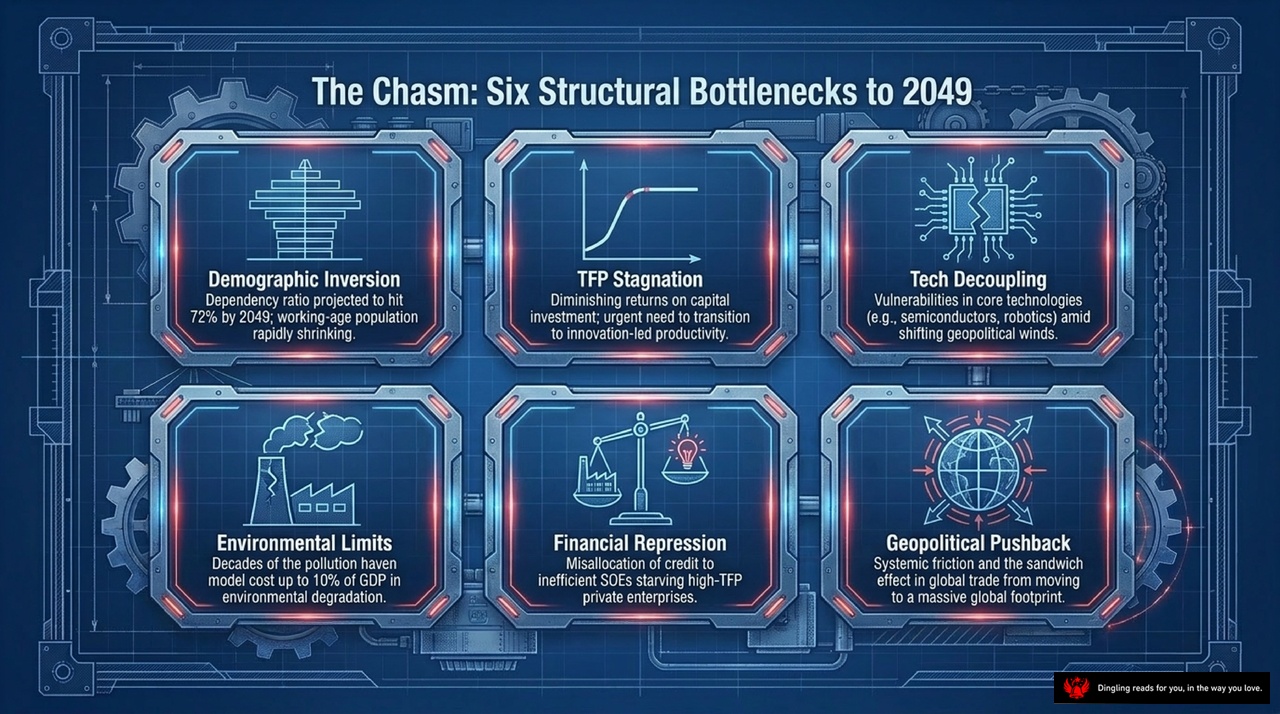
Look at this blueprint for China's future. We aren't just facing one obstacle; we are staring down six structural bottlenecks that will define the journey to 2049.
First, consider the demographic inversion. The working-age population is shrinking rapidly, and by 2049, the dependency ratio could hit 72%. That's a massive shift from the boom we enjoyed.
Next, we have TFP stagnation. As we approach the global technology frontier, the easy gains from capital investment are disappearing. We urgently need to pivot from capital-driven growth to innovation-led productivity, or we stall.
Then there's tech decoupling. We face vulnerabilities in core technologies like semiconductors and robotics. With shifting geopolitical winds, relying on a single supply chain is no longer an option.
We also hit environmental limits. Decades of unchecked pollution have already cost us up to 10% of our GDP. We cannot afford to ignore the physical constraints of a warming planet.
Financial repression is another major drag. Credit is misallocated to inefficient state-owned enterprises, starving the high-productivity private sector of the capital it needs to grow. This isn't just an economic issue; it's a growth killer.
Finally, geopolitical pushback. As we expand our global footprint, we face systemic friction and a "sandwich effect"—squeezed between rising costs in developed nations and competition from emerging markets.
These six forces create a chasm. To cross it, China must stop relying on old models and embrace a new era of innovation, balance, and genuine global integration.

Looking at this slide, we're diving into the heart of the labor market's future: a showdown between an aging workforce and the rising tide of automation. The visual clearly sets up a tension between two forces. On the left, we see the "Demographic Deficit," projecting a staggering drop of 170 to 200 million workers in China's working-age population by 2049. That's a massive contraction in human capital. But on the right, the slide pivots to "The AI Offset," suggesting that by 2049, AI and automation could substitute up to 278 million jobs—roughly 35.8% of total employment.
This isn't just about numbers; it's about a structural imperative. As the synthesis at the bottom notes, AI adoption isn't merely an industrial upgrade; it's the only way to offset a vanishing demographic dividend and sustain output. If fewer people are working, we need machines to do the heavy lifting. The data implies that automation might actually grow faster than the workforce shrinks, potentially filling the gap left by retiring generations. This shift forces a fundamental rethink of how we value labor and how we prepare our economy for a future where human hands are increasingly replaced by intelligent machines.

Look at this slide. On the left, we see China's impressive scale: a massive workforce of 3 million researchers driving R&D intensity up to nearly 3% of GDP by 2049, making the nation a global leader in patent volume. But on the right, the picture gets starkly different. This is the vulnerability. While China excels at applying technology in areas like consumer tech and smart manufacturing, its foundational layers are crumbling. Basic research, core semiconductors, and fundamental materials are fractured, accounting for only 5% of total R&D spending compared to roughly 20% in the US. Corporate basic research is under 3%. The synthesis here is clear: to truly overcome the middle-income trap and avoid supply chain weaponization, China must shift its focus from simply integrating applied tech to building a robust foundation in basic science. Without this bedrock, the entire innovation structure remains unstable.
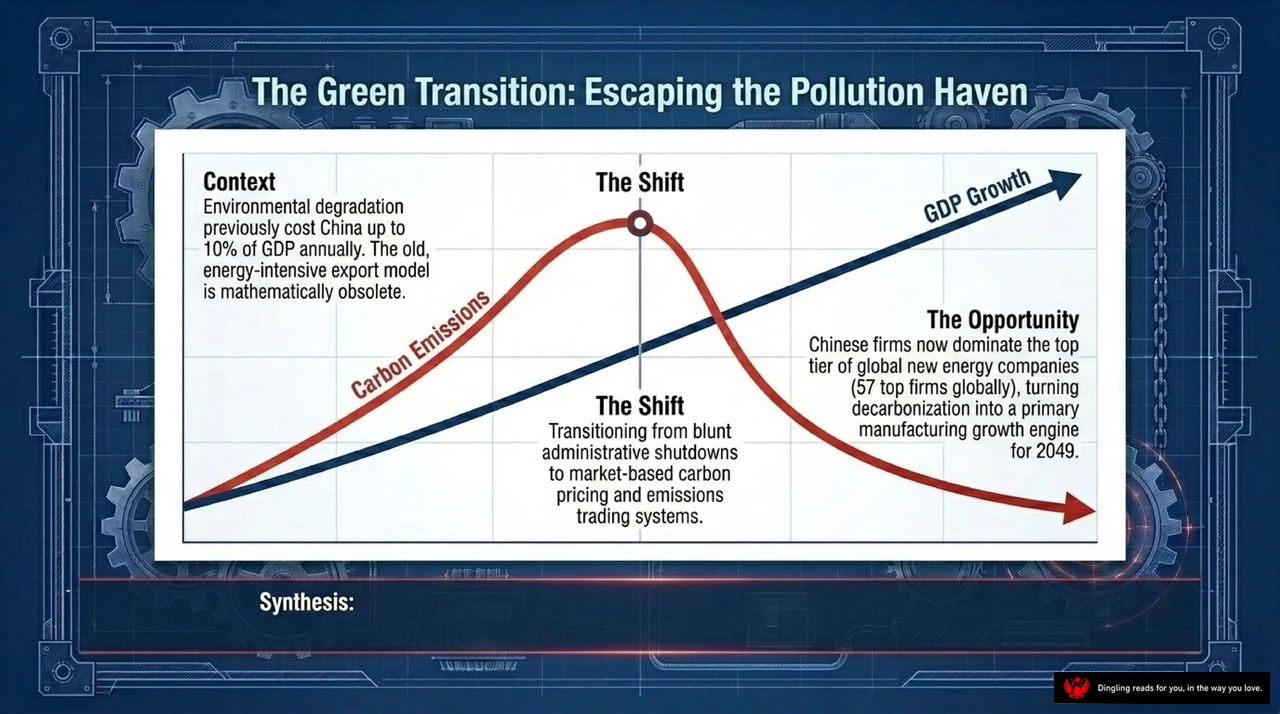
The slide outlines a critical pivot for China's future: escaping the "pollution haven" through a green transition. On the left, the context is stark—environmental degradation previously cost China up to 10% of its GDP annually, rendering the old, energy-intensive export model mathematically obsolete. The graph shows carbon emissions peaking and then declining, while GDP growth continues its upward trajectory. This shift marks a move from blunt administrative shutdowns to market-based carbon pricing and emissions trading systems. On the right, the opportunity is clear: Chinese firms now dominate the top tier of global new energy companies, with 57 top firms globally. This positions decarbonization as the primary engine for manufacturing growth by 2049. In short, China is trading short-term industrial efficiency for long-term global leadership in the green economy.

Imagine a roadmap that stretches from today all the way to 2049, outlining China's journey toward becoming a high-income nation. This isn't just a dream; it's a calculated trajectory based on mid-growth scenarios. The first major milestone is set for around 2025, marking the moment China officially crosses the World Bank's threshold to become a High-Income Economy.
But the journey doesn't stop there. By 2030, under these optimistic projections, China is forecasted to surpass the United States in total GDP scale, signaling a historic shift in global economic power. The final, most ambitious goal lies near 2050: reaching approximately 66% of the US GDP per capita. Achieving this would mean completing comprehensive modernization and reaching two-thirds of the American standard of living.
However, there is a crucial caveat to this vision. Achieving this convergence trajectory assumes successful structural reform. Without these deep changes, the path won't work. As we move toward 2049, long-term GDP growth will naturally decelerate to a sustainable range of 2.6% to 4.1%. This slowdown is not a failure, but a sign of maturation as the economy transitions from rapid expansion to high-quality, sustainable development.
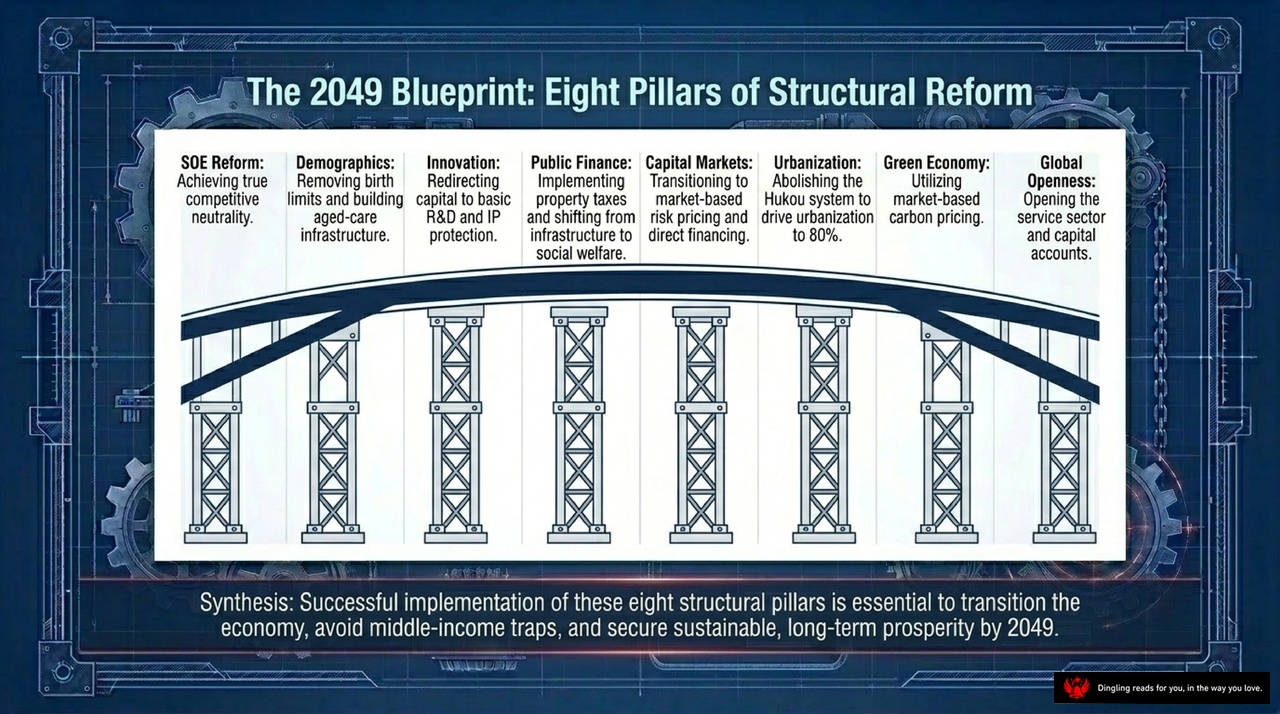
The 2049 Blueprint: Eight Pillars of Structural Reform isn't just a list of goals; it's the architectural foundation for China's next century of growth. Imagine this as a massive bridge, where each pillar supports the nation's transition from a high-speed economy to a sustainable, high-income powerhouse.
First, we need **SOE Reform** to ensure true competitive neutrality, leveling the playing field for everyone. **Demographics** requires us to remove birth limits and build robust aged-care infrastructure, directly tackling the coming aging crisis. **Innovation** demands redirecting capital to basic R&D and protecting intellectual property, shifting from copying to creating.
For **Public Finance**, we must implement property taxes and move spending from infrastructure to social welfare, making the system more equitable. **Capital Markets** need to transition to market-based risk pricing and direct financing, letting efficiency drive investment. **Urbanization** aims to abolish the *Hukou* system, driving urbanization to 80% to unleash human potential. **Green Economy** calls for utilizing market-based carbon pricing to fight climate change. Finally, **Global Openness** means opening the service sector and capital accounts to integrate fully with the world.
The synthesis is clear: successfully implementing these eight structural pillars is essential to transition the economy, avoid the middle-income trap, and secure sustainable, long-term prosperity by 2049. This blueprint transforms challenges into the very engines of China's future success.
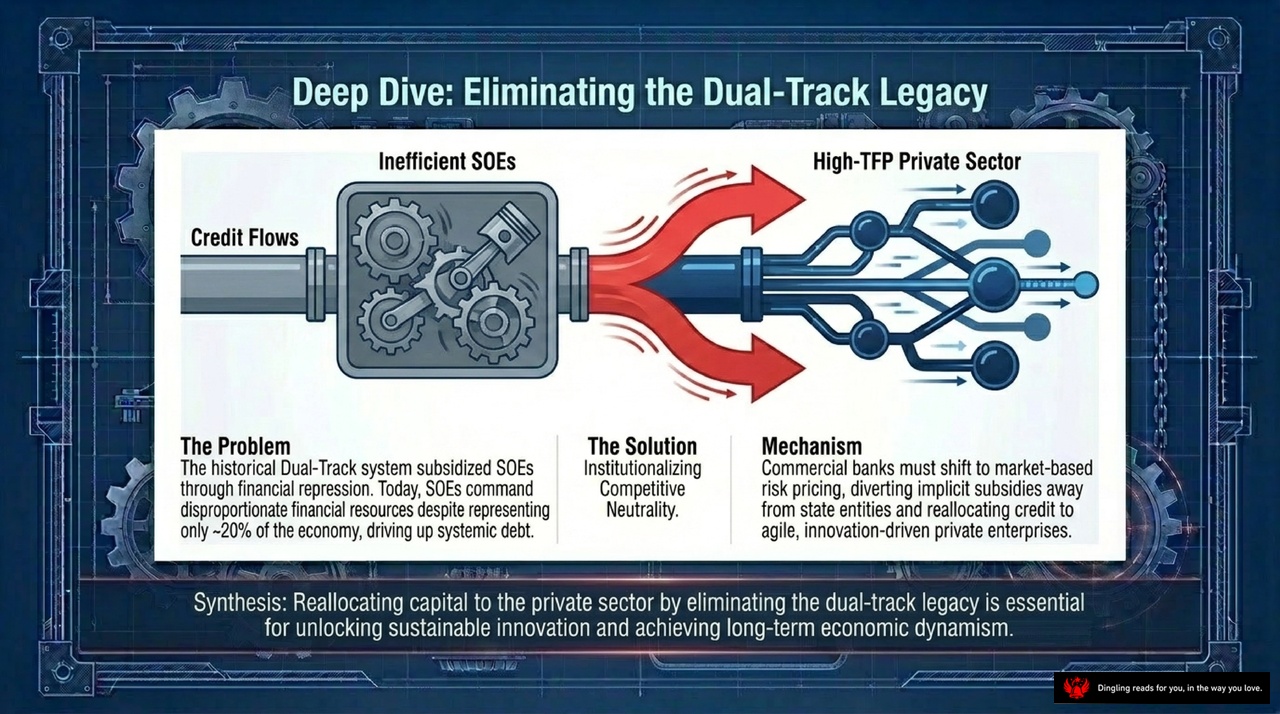
The dual-track legacy has long been a bottleneck for China's growth, creating a system where inefficient state-owned enterprises (SOEs) hoard resources while the dynamic private sector struggles. As the slide illustrates, this imbalance is driven by credit flows that are artificially diverted away from high-total-factor-productivity private firms and trapped in low-efficiency state entities.
To unlock sustainable innovation and achieve long-term economic dynamism, we must eliminate this legacy by institutionalizing competitive neutrality. This means shifting commercial banks from a policy-driven mindset to market-based risk pricing. By removing implicit subsidies from state entities, we can reallocate capital to agile, innovation-driven private enterprises. Only by reorienting these financial resources can China truly transition from an investment-driven model to one powered by genuine efficiency and creativity.
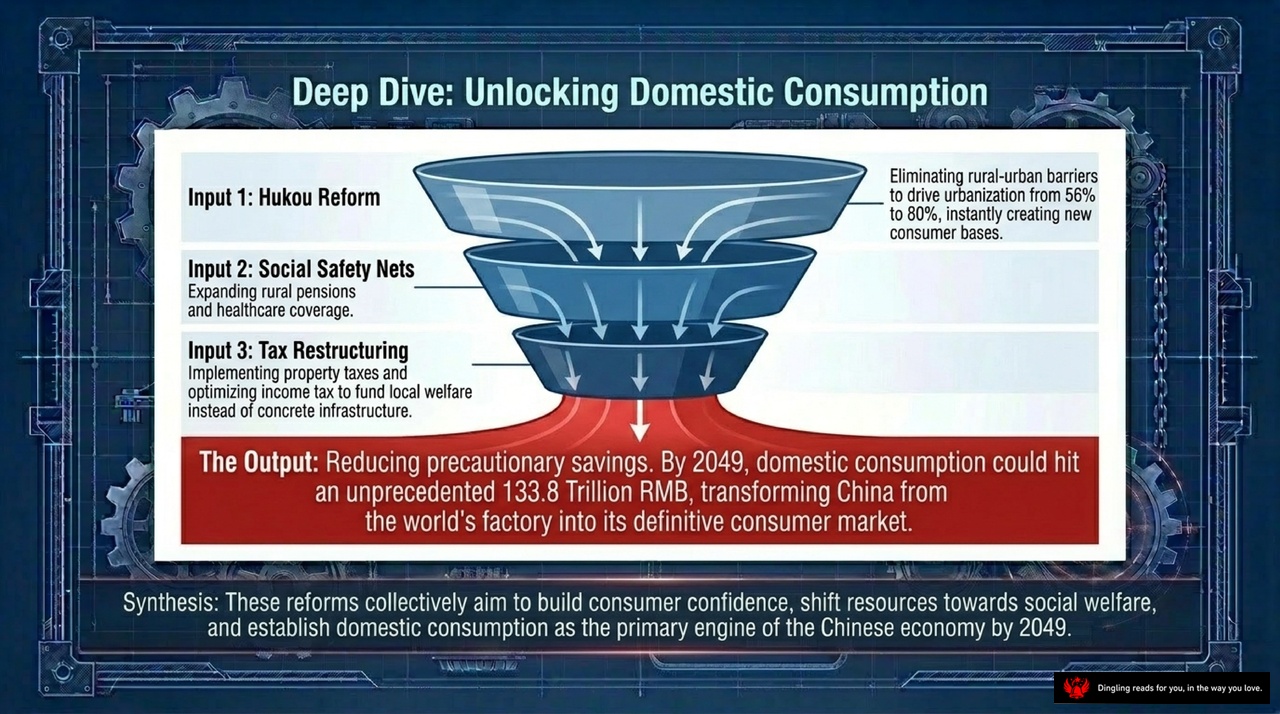
Today's slide breaks down the blueprint for unlocking China's domestic consumption by 2049. Think of it as a funnel where three critical inputs drive a massive economic transformation.
First, we tackle the **Hukou Reform**. By eliminating rural-urban barriers, we aim to boost urbanization from 56% to 80%. This instantly creates new consumer bases by integrating hundreds of millions of rural residents into the urban economy.
Second, we expand **Social Safety Nets**. This means rolling out rural pensions and healthcare coverage. When people feel secure, they stop hoarding money for emergencies and start spending on life.
Third, we implement **Tax Restructuring**. Instead of pouring money into concrete infrastructure, the focus shifts to property taxes and optimized income taxes to fund local welfare directly.
The output of this strategy is powerful: reducing precautionary savings. By 2049, domestic consumption could hit an unprecedented 133.8 trillion RMB. This shift would transform China from the world's factory into its definitive consumer market, making domestic demand the primary engine of the economy.

Look at this diagram. It's not just a chart; it's a blueprint for China's next 30 years. At the very center, we have "Domestic Markets." This is the anchor. The message is clear: China is moving beyond its old reliance on manufacturing exports and is now fully opening up its domestic service sector. The goal? To level the playing field for Foreign Direct Investment, creating a robust home base for growth.
Surrounding that core are three critical pillars. First, "Capital Liberalization." China is gradually opening its capital accounts. Why? To facilitate the internationalization of the RMB and, crucially, to shift the narrative from being a net exporter to becoming a global investor. It's about capital flowing out as freely as it flows in.
Second, we see "Global Governance." China is no longer just a passive participant in global institutions like the WTO, IMF, or AIIB. It is stepping up to become an architect. By reforming these bodies and taking proactive, rule-based leadership, China aims to mitigate the "sandwich effect" of global trade friction—getting squeezed between developed and developing economies.
Finally, the synthesis at the bottom ties it all together. This new paradigm moves beyond a defensive posture. It embraces full openness to leverage domestic growth, internationalize financial markets, and assume proactive global leadership. It's a strategic shift from protecting the home market to actively shaping the global economy.
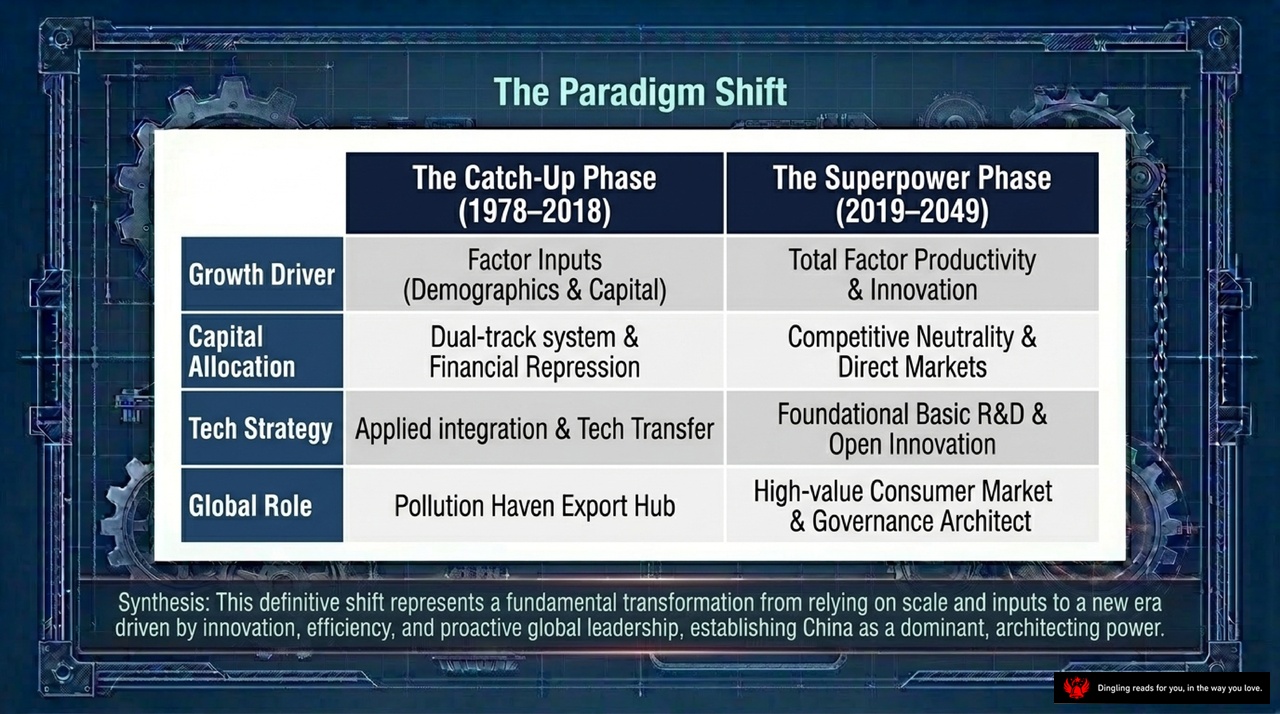
Today's slide, "The Paradigm Shift," maps out China's critical transition from a "Catch-Up Phase" (1978–2018) to a "Superpower Phase" (2019–2049). Think of it as moving from simply assembling parts to inventing the engine itself.
In the first phase, growth was driven by "factor inputs"—demographics and capital. China acted as a global export hub, leveraging its massive labor force and dual-track financial system to integrate technology and machinery. However, this era ended with China becoming a "pollution haven," exporting goods while absorbing the environmental costs.
The shift begins in 2019. The new era is defined by "Total Factor Productivity and Innovation." Instead of relying on cheap labor, the focus moves to foundational basic R&D and open innovation. The global role transforms dramatically: China moves from being a low-cost manufacturing base to a high-value consumer market and a key architect of global governance.
The synthesis at the bottom of the slide is crucial: this isn't just about making more things; it's a fundamental transformation from scale-driven growth to an era driven by efficiency and proactive leadership. For the next 30 years, China's success hinges on its ability to lead in innovation rather than just competing on cost. This shift establishes China not just as a participant in the global economy, but as a dominant power shaping its future.

China's journey to 2049 isn't just about continuing on the same path; it demands a definitive break from the past. We are at a critical inflection point where the old model of extensive, debt-fueled expansion can no longer sustain us. Instead, the nation must pivot toward an intensive, innovation-led, and institutionally neutral paradigm. This shift is urgent because the demographic dividend is vanishing and geopolitical winds are shifting. The core question we face is whether China's institutional reforms can outpace its structural headwinds.
To succeed, we must move away from relying on capital accumulation and embrace innovation as the true engine of growth. This means tackling the deep-seated inefficiencies in our state-owned enterprises, ensuring fair competition with private firms, and creating a level playing field that attracts global talent and investment. We also need to confront the reality of an aging population by investing heavily in human capital and digital technologies to boost productivity per worker.
Furthermore, opening up our markets further is non-negotiable. We must deepen our integration into the global economy, not just as a manufacturer of goods, but as a hub for ideas and services. By reducing barriers to entry, protecting intellectual property, and aligning with international standards, we can turn our vast domestic market into a magnet for global innovation. Ultimately, the path to 2049 requires a bold transformation of our institutions and a commitment to creating a prosperous future for all, proving that China can rise as a high-income, innovative nation.