
China's Motor: Complete Chapter-by-Chapter Summary

Ever wondered what fueled China’s social and economic evolution over a thousand years? Hill Gates’ *China’s Motor: A Thousand Years of Petty Capitalism (960-1949)* unpacks this through a unique lens: the dual-engine structural tension between state extraction (the tribute system) and family markets (petty capitalism). For centuries, these two forces clashed and coexisted—shaping how families ran businesses, how rulers maintained control, and how ordinary people navigated daily life. Gates’ work isn’t just a history lesson; it’s an analytical blueprint revealing the hidden dynamics behind China’s long-standing social fabric. It’s a fascinating look at how competing systems drove change from the Song Dynasty to the mid-20th century.

For centuries, Western observers looked at imperial China and saw a frozen, unchanging monolith—like a giant statue gathering dust, just waiting for modern capitalism to come along and wake it up. But that’s a total illusion.
The real story? From 960 to 1949, China was anything but static. It was a dynamic system driven by a thousand-year tug-of-war between two competing ways of producing and distributing goods. On one side, there’s the tributary system: the government’s top-down approach to collecting resources through taxes, tributes, and strict control over key industries like salt. On the other, there’s petty capitalism—small family businesses, local markets, and folks making goods like silk or rice to sell, often using family labor or close kin networks.
Take the silk industry in Guangdong’s Shunde region back in the day: women working from home with foot-powered looms produced twice as much silk as steam-powered factories. Shunde’s wealth even made up 80% of Guangdong’s total savings. That’s petty capitalism thriving, right? But the tributary system was always there, trying to keep it in check—using family and gender rules to limit how much people could accumulate wealth. Yet petty capitalism kept pushing back, finding ways to grow even under those constraints.
To really understand China, we can’t just fixate on emperors and dynasties. We have to look at the invisible gears of its political economy—the daily tussles between small business owners and government officials, the way family ties both fuel and restrict economic growth, and how these two systems have been pulling against each other for a millennium. That’s the engine that’s driven China’s history, not some static, waiting-for-Westerners myth.
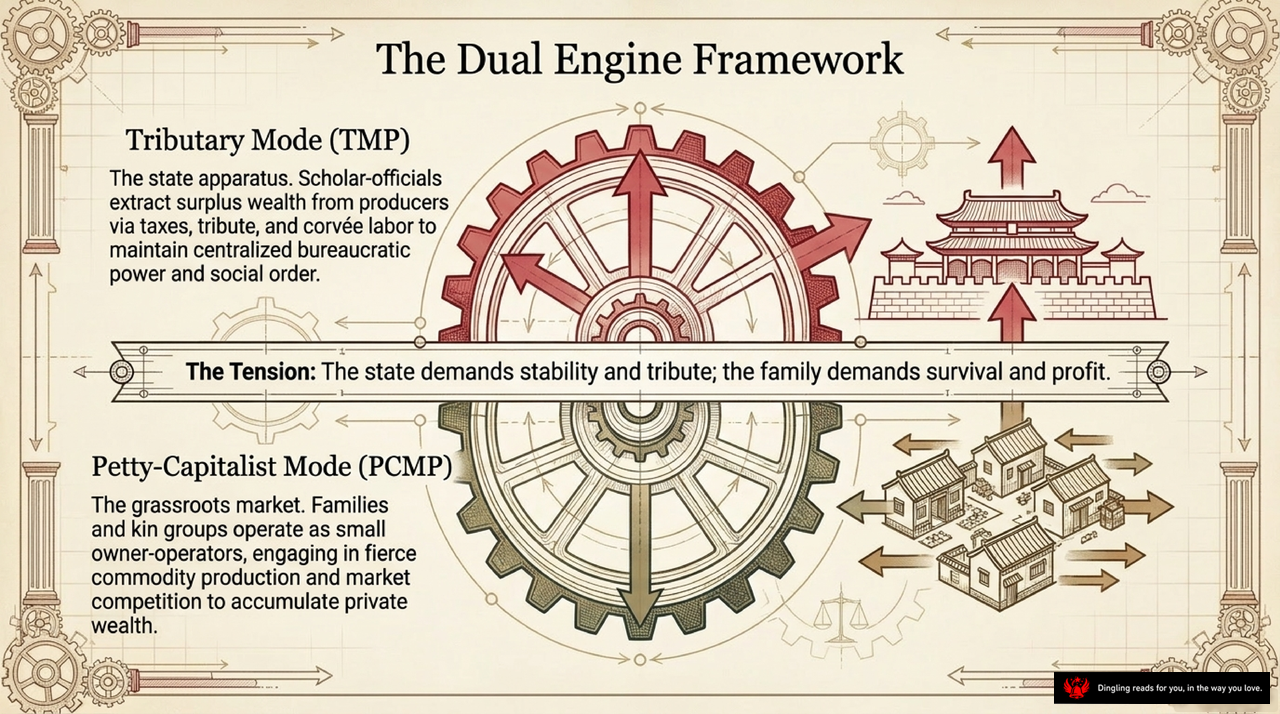
Imagine you’re a small café owner in your neighborhood. On one hand, the city asks for permits and taxes to keep the streets safe and clean—you get why that matters. On the other, you’ve got rent to pay, baristas to hire, and a family to feed, so you need to turn a profit to keep the lights on. That push-pull between collective needs and personal survival? It’s at the heart of the Dual Engine Framework we’re talking about today.
First up: the Tributary Mode, or TMP. Think of this as the state’s side of the equation. For centuries, governments (like imperial China) extracted surplus—through taxes, tribute, or even forced labor—to maintain centralized power and social order. Their top priority? Stability. A stable society meant they could keep collecting what they needed to run things smoothly.
Then there’s the Petty-Capitalist Mode, PCMP. This is the grassroots market: families and small groups running their own little operations—like a family farm selling extra veggies at the farmers’ market, or a tailor shop stitching clothes for neighbors. They’re not trying to build a corporate empire; they’re in it to survive and make a little profit, using local networks and their own resources.
The tension here is unavoidable. The state demands stability and tribute (your taxes), but your family needs to survive and turn a profit to get by. Let’s take an example from our book: when Western railways came to Taiwan, officials expected everyone to follow strict ticket rules. But locals used their own PCMP logic—some skipped fares, others paid with chickens or bags instead of cash. The state’s rigid TMP rules clashed with the family’s need to save money and make ends meet.
These two modes don’t just fight; they coexist and even shape each other. The state builds roads that help both collect taxes and let small businesses ship goods. But when PCMP gets too vibrant (like a market growing so fast it challenges state control), the government might step in to slow it down—like limiting how much a family can sell to keep prices stable.
This framework isn’t just about China. It’s about how every society balances the needs of the collective and the individual. Next time you see a small business owner haggling with a inspector, or a family deciding whether to sell extra homemade jam—remember: it’s the dual engines of TMP and PCMP at work, driving choices that have shaped our world for centuries.
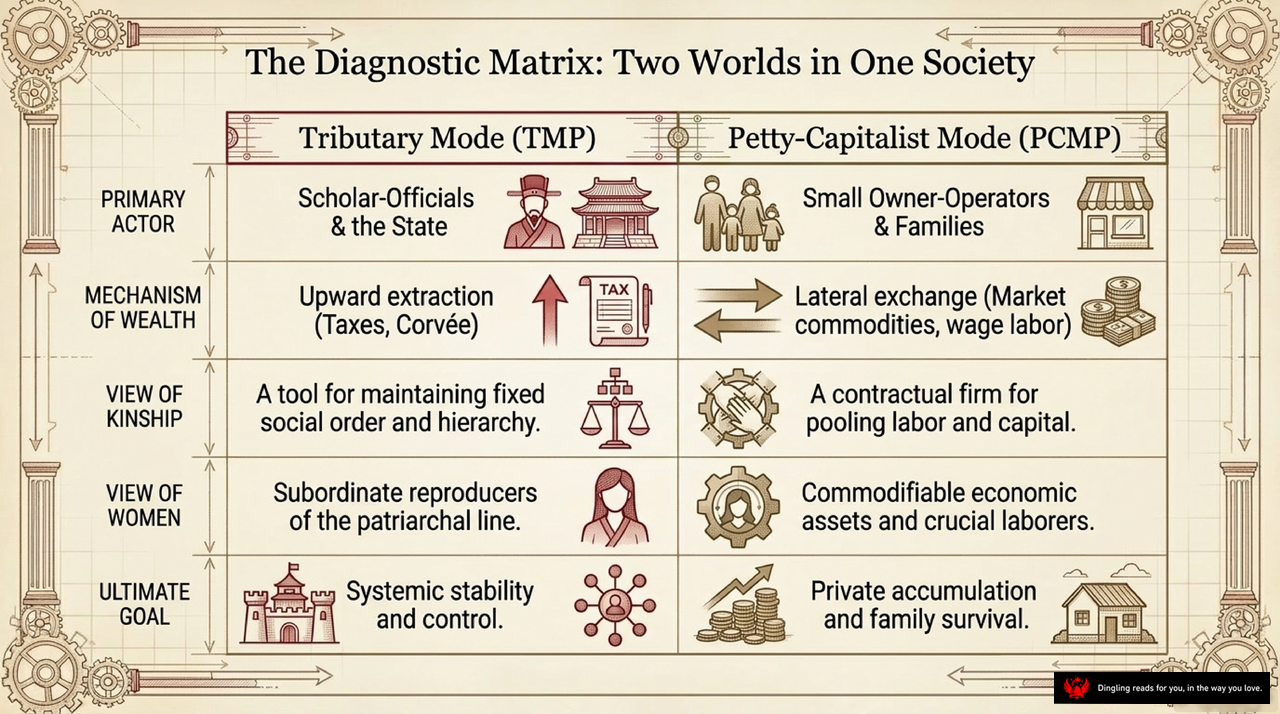
Let’s take a look at this Diagnostic Matrix—it’s a way to visualize two distinct systems coexisting in one society: the Tributary Mode (TMP) and the Petty-Capitalist Mode (PCMP).
First, who are the key players? In TMP, it’s the Scholar-Officials and the State—think of old imperial bureaucrats who held power and ran the government. In PCMP, it’s Small Owner-Operators and Families—like your neighborhood family bakery or local farmers selling crops at the market.
How do they handle wealth? TMP relies on upward extraction: taxes paid to the state, or corvée labor—unpaid work you’re forced to do for the government, like building canals or roads. PCMP uses lateral exchange: trading goods in the market, hiring wage labor, or selling services.
What about kinship? For TMP, kinship is a tool to keep social order and hierarchy fixed—family ties reinforced the rigid class system and the emperor’s authority. For PCMP, kinship acts like a contractual firm: family members pool labor and capital to run a business, working together to succeed.
How do they view women? In TMP, women are subordinate reproducers of the patriarchal line—their main job was to bear sons to continue the family name. In PCMP, women are economic assets and crucial laborers—they work in the family business, help with farming, or contribute directly to the family’s income.
And their ultimate goals? TMP prioritizes systemic stability and control—keeping the state or empire running smoothly. PCMP’s goal is private accumulation and family survival: earning enough to support loved ones and secure the family’s future.
These two modes don’t exist in isolation—they’ve interacted for centuries, shaping how people live, work, and connect in many societies.
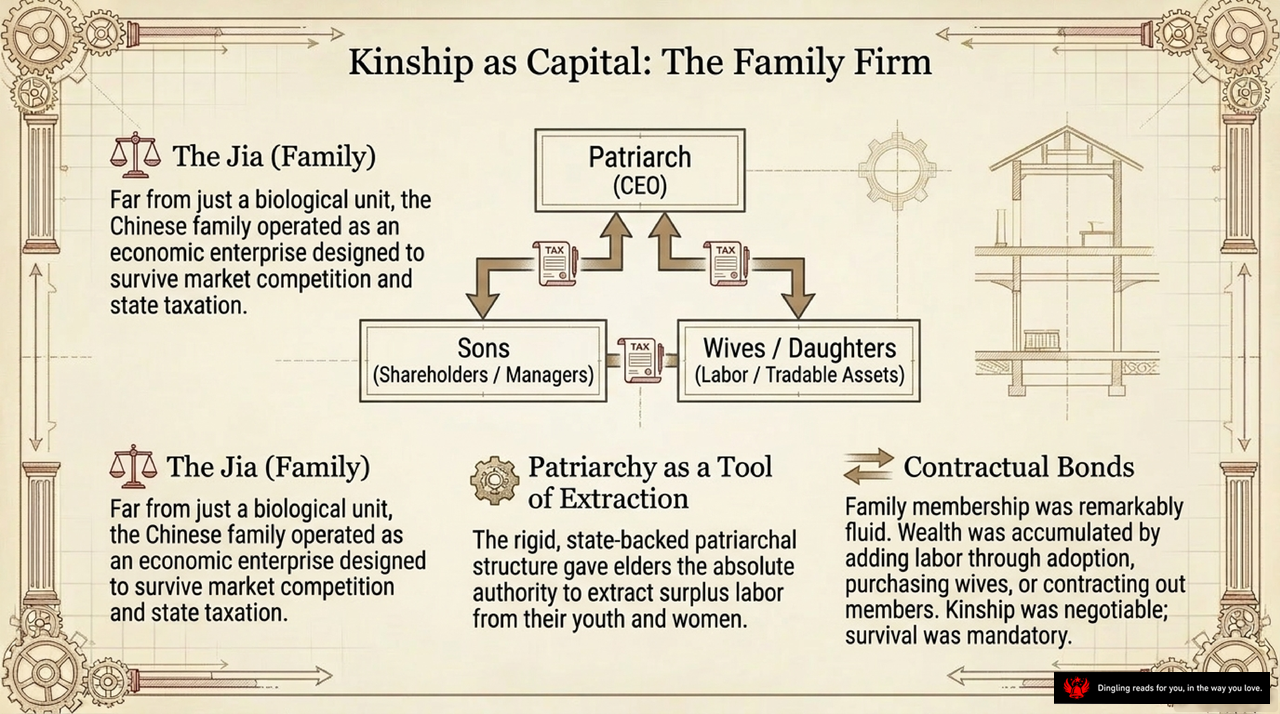
Let’s take a minute to wrap our heads around this idea: in traditional China, the family wasn’t just a group of people related by blood—it was a full-on economic enterprise, like a family firm. That’s exactly what the slide here is getting at with “Kinship as Capital: The Family Firm.”
Think about the roles: the patriarch was basically the CEO. He held all the power, made all the big decisions, and was the face of the family’s business. His sons? They were like shareholders or managers—they inherited stakes in the family’s assets and helped run the day-to-day operations. But what about the wives and daughters? They were often the backbone of the family’s labor—doing the work that kept the enterprise running—yet they were sometimes treated as tradable assets, like something you could buy or sell to benefit the family. That’s a harsh reality, but it’s key to understanding how this system functioned.
This family firm wasn’t just for fun—it was built to survive two big challenges: market competition and the heavy taxes the state imposed. And the patriarchal structure? It was a tool for extraction. The rigid, state-backed system gave elders absolute authority to take surplus labor from the younger generation and women. They could demand work without giving much in return, all in the name of family duty.
But here’s the surprising part: family ties weren’t set in stone. They were flexible, almost contractual. If a family needed more hands, they’d adopt someone. If they needed to make a strategic alliance or get more labor, they might buy a wife. Sometimes they’d even contract out family members to work elsewhere for extra income. Kinship was negotiable, and survival was always the top priority.
It’s a complex, often conflicting picture—one where love and duty mixed with cold economic calculations. The family was both a safe haven and a business, and every member had a role to play in keeping it afloat. This system wasn’t just about tradition; it was about staying alive in a tough world.

Let’s dive into the commodification of women under the PCMP. It’s a sharp contradiction: women’s labor—especially in textiles—was the backbone of grassroots wealth. Think about those women hunched over looms, their fingers flying to weave fabrics that sold far and wide, driving prosperity for their communities. But instead of being celebrated as contributors, they were reduced to transactional assets, passed between families like pieces of property.
Let’s walk through this lifecycle of female capital. First, the natal home. Daughters were seen as money-losing goods. All the time, energy, and resources spent raising them—teaching them to weave, cook, or care for others—would eventually benefit someone else’s patriarchal line when they married. It’s like pouring savings into a business you’ll never own.
Then comes the marriage market: not a romantic union, but a deal. Dowry from the bride’s family to the groom’s, brideprice from the groom’s to the bride’s—these are just ways to price a woman’s future labor and her ability to bear children. She’s not a person here; she’s an investment.
Once in the marital home, her only path to security is building a uterine family—her own children. In that hyper-competitive world, those biological ties are her safety net. Without kids, she has no standing, no voice. So even in this oppressive system, she finds a way to carve out a little power through the one thing she can control: her children.
It’s a cycle that turns women into commodities, but it also reveals their resilience—how they adapt, how they find strength in the only tools they have.
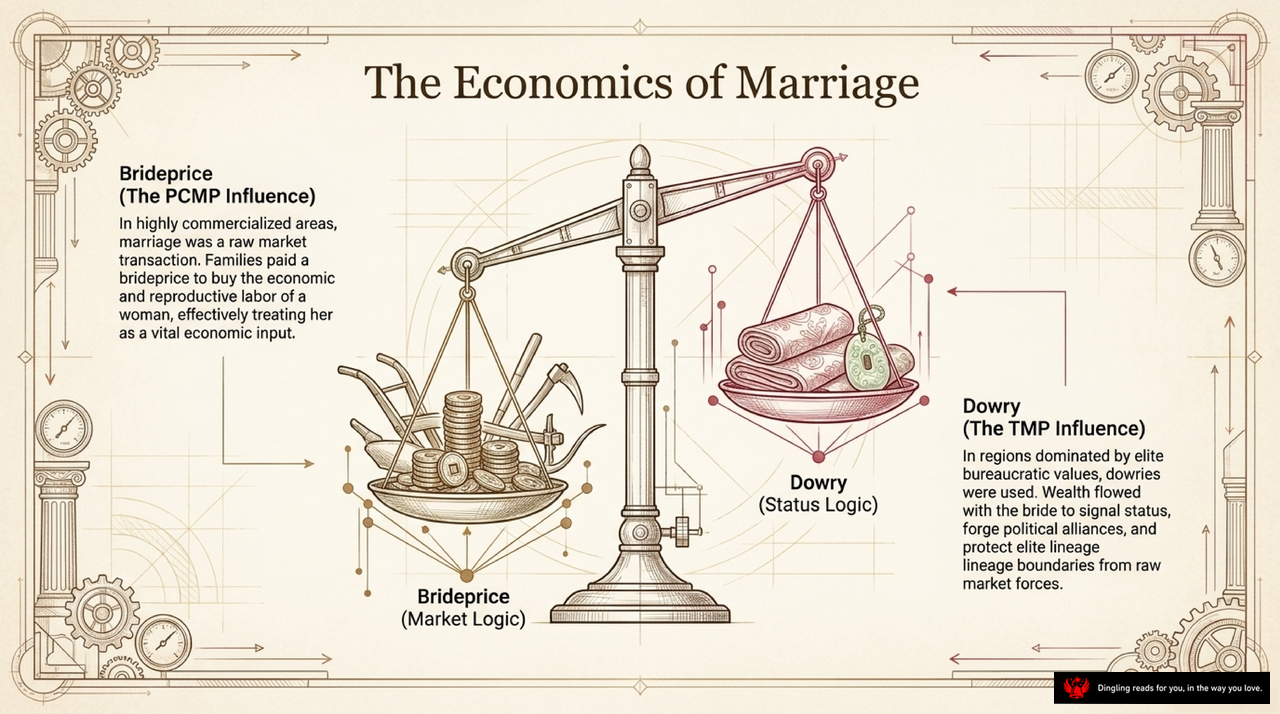
Let’s dive into the economics of marriage—because for way too long, saying “I do” wasn’t just about romance; it was a business deal. Take brideprice first: in super commercialized areas, this was straight market logic at work. Families paid up to get a woman’s economic and reproductive labor—essentially, she was a key economic input, like land or tools, that kept the household running and growing.
Then there’s dowry, which was all about status. In regions where elite bureaucratic values ruled, dowries weren’t just gifts—they were a way to show off your family’s standing, make political alliances, and keep elite lineages safe from messy market forces. Think of it as social currency to lock in power and keep the upper crust connected.
But let’s get concrete. In places like Taiwan, people used to call marriage a “pig brought to market.” Selling a daughter for brideprice was a major annual income for many families. Over in Shandong, farmers talked about buying wives or selling daughters like they were bargaining over wheat or pigs—no shame, just survival. Even in 1946, in areas where men outnumbered women, a teenage girl could cost twice as much as a 7-year-old because she could work more and have kids sooner.
Dowry had its own twists too. A good dowry wasn’t just for show—it secured a bride’s place in her husband’s home. Without one, she might be treated like an outsider until she had children. And sometimes, it was a way for the bride’s family to flex their wealth, making sure she was respected from day one.
These two systems—brideprice’s market-driven exchange and dowry’s status play—show how marriage was a tool to handle both money matters and social climbing. It’s a window into how even the most personal choices were tangled up in the economic and political pressures of the time.

Ever stopped to wonder why China’s population exploded over centuries, even when resources often felt scarce? The Demographic Paradox dives deep into this fascinating puzzle, revealing how economic pressures and survival instincts turned scarcity into a driver of growth.
At the heart of the story is the double squeeze families faced. On one side, the state demanded constant tribute—grain taxes, forced labor, or valuable goods—leaving little room for error. Miss a payment, and you might lose your land, face fines, or even be thrown into jail. On the other, they were thrown into ruthless market competition: neighbors sold surplus crops, artisans hawked handmade goods, and everyone fought to stay afloat. Fall behind, and your family could starve or be forced to sell off assets.
So what did they do? In a low-technology economy where machines were rare and productivity relied almost entirely on human effort, the only rational response was to have more children. More kids meant more hands to till the fields, weave cloth, tend to livestock, or peddle goods in the market. This extra labor didn’t just help meet tax obligations—it also let families expand their production, earn more money, and slowly build wealth to buffer against hard times.
But here’s the key insight: Children weren’t just a cultural desire or a way to carry on the family name. They were economic imperatives. Women were pushed to their maximum reproductive capacity because every new child was a potential worker who could help the family survive. It wasn’t about choice—it was about necessity. A family with more kids had a better chance of weathering a bad harvest, a sudden tax hike, or a market downturn. This pattern persisted for generations, as families passed down the unspoken rule that more children meant more security.
This paradox shows how deeply economic forces shaped China’s demographic history. It’s a reminder that sometimes the most unexpected outcomes come from the most practical, survival-driven choices people make when faced with limited resources.
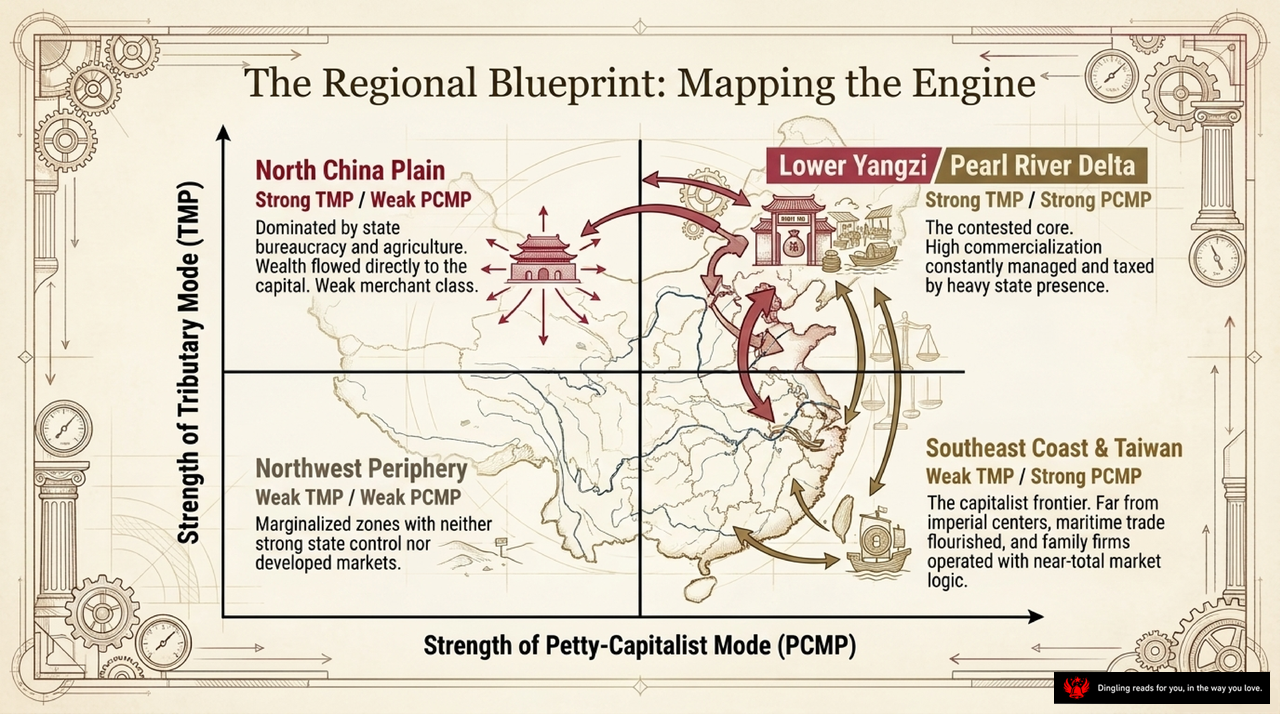
Let’s talk about the double bind women navigated in traditional China. On one hand, officials held up symbols like Widow Tang from Shandong—lauded for refusing to remarry, her “chastity” frozen into a moral statue. On the other? Folk tales poked holes in those rigid ideals, like the story that Confucian scholar Zhu Xi’s wisdom came from a fox fairy’s magic pearl.
You see, the idea that men and women were “naturally” different was a carefully crafted lie. Girls endured foot-binding’s agony; boys got beaten to memorize texts—gender roles were hammered into them, not born. But women found cracks in the system. Take rituals: in Shandong, women paraded in carts during festivals; in Fujian, they joked, “Men have their ancestral halls, women have their temples.” Goddesses like Guanyin and Mazu were their go-tos—figures of equal compassion, not the hierarchical love of Confucian fathers. Their offerings? Simple clay dolls or red eggs, a far cry from the whole pigs and golden plaques men gave to male deities.
Then there were the two extremes of female imagery: the “dangerous” woman (like fox spirits seducing men) vs the “pure” one (virgin mothers like Guanyin). Marriage was a paradox—for many, it was the only “job” available, but it felt like a cage. Hong Kong boatwomen sang wedding laments comparing marriage to death.
But some fought back. In 19th-century Guangdong, silk workers earned enough to go their own way. They formed sisterhoods, took vows never to marry—called “self-combed women.” They’d rather die than break their oaths. Even when the silk industry collapsed, their legacy lingered. These women lived in nunneries, worked as seamstresses, and some even learned to read—rare for women then.
The system tried to crush them: labeling them “immoral,” forcing marriage, or selling them. But they carved out space. Their resistance wasn’t loud—it was in the way they worshipped, the vows they kept, the lives they built on their own terms. Women in traditional China weren’t just victims. They were survivors, finding power in the margins.

Let’s dive into the big question: If China had such bustling markets, why didn’t it develop the kind of industrial capitalism we saw in Europe? This slide calls it the “Glass Ceiling on Capitalism,” and it breaks down the key barriers that kept things from evolving that way.
First up is the Tributary State Ceiling—think of that imperial crimson palace on the slide. The old Chinese state let markets grow, but only within strict limits: everything had to stay tied to family and kinship. No breaking free to build big, independent companies that could challenge state power.
Then there’s Capped Accumulation. Instead of growing vertically—scaling up into wage-labor corporations—wealth spread horizontally. Families would have more sons, start new branches, or expand into related businesses, but never into those large, modern firms we associate with Western capitalism. It’s like planting more saplings instead of nurturing one tall tree.
The Kinship Trap is another critical piece: To keep your wealth safe, you had to keep it in the family. Step outside that circle, and you risked losing it to the state or other powerful groups. So people stuck close to their kin networks—they were the only reliable safety net.
And finally, the Structural Synthesis. The tributary system (the old state) didn’t crush the petty-capitalist engine—those bronze gears on the slide, representing small family businesses. Instead, it harnessed their energy but made sure it never threatened the state’s control. No independent bourgeoisie allowed—because that would upend the state’s authority.
This mix of state control and kinship-bound markets isn’t just history. It still shapes how China’s economy works today. It’s a unique path, different from the West, and understanding this glass ceiling helps us see why China’s economic story is so one-of-a-kind.
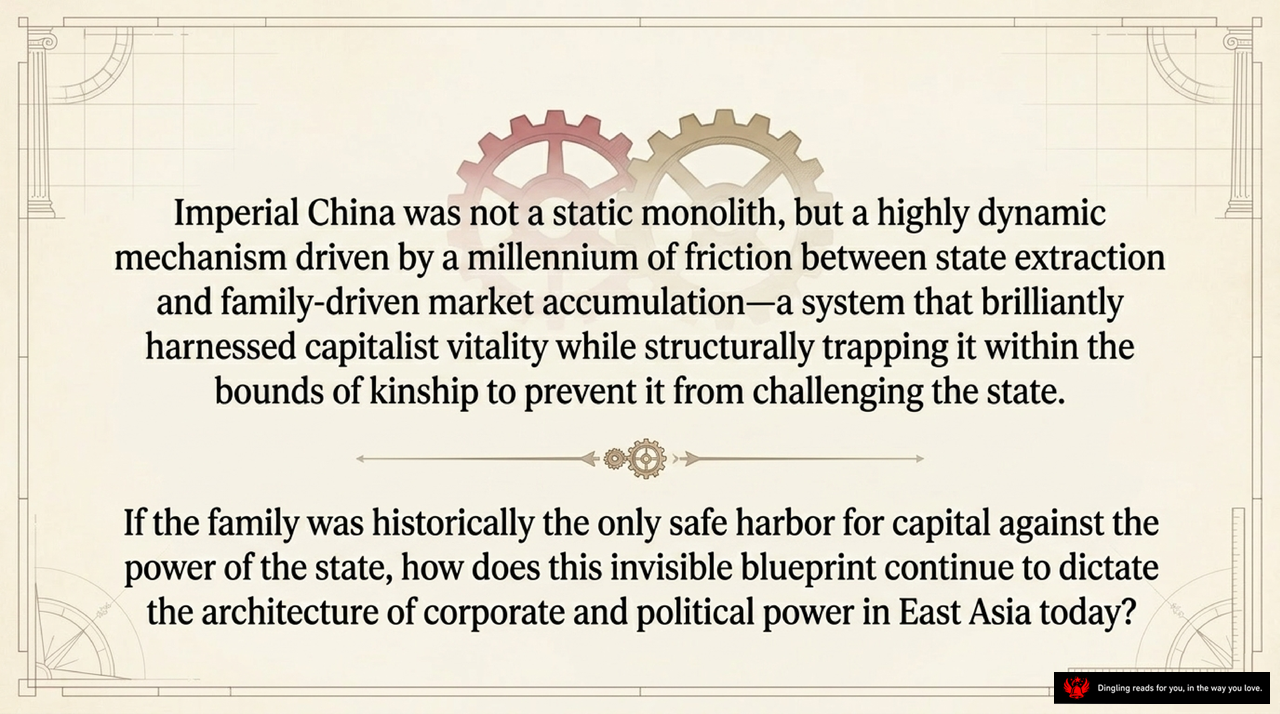
Let’s zero in on this slide—it’s the core of our discussion today. The first line hits it right: Imperial China wasn’t a static monolith. It was a dynamic machine, fueled for a thousand years by the friction between two forces: the state taking resources (tributary extraction) and family-driven market accumulation. And here’s the genius (or the trap) of that system: it harnessed capitalist energy, but kept it locked within kinship bounds to make sure it never threatened state power.
That’s not just history—it’s a blueprint that still shapes East Asia today. The slide asks: if the family was once the only safe harbor for capital against state power, how does that invisible structure still dictate corporate and political power in East Asia now?
Think about it. For centuries, Chinese families were the backbone of small-scale capitalism. They saved, invested, and grew wealth—but always within the family. Why? Because the state was a constant presence, ready to seize assets. The family was a shield. But this also meant that economic growth was tied to blood ties, not just market logic.
Fast forward to today: look at East Asian corporations. So many are family-owned, with leadership passing down through generations. Personal relationships (guanxi) still make or break deals. Political power often intersects with family networks. That’s the legacy of that old system. The state and family market forces have been in tension for a millennium, and that tension still defines how power works.
It’s a cycle: the state tried to control capital by keeping it in families, but those families kept the market alive. Now, those family-based patterns are what make East Asian economies unique—both their strength and their quirks. So this question isn’t just about the past; it’s about understanding the invisible rules that still guide our world today.
The system didn’t just trap capital in kinship—it created a way for market energy to coexist with state control. And that balance? It’s still playing out in boardrooms and political halls across East Asia, reminding us that history isn’t just something we leave behind—it’s something we carry forward in the way we do business, build power, and connect with each other.