
Civilization, Modernization, Value Investment and China: Complete Chapter-by-Chapter Summary
Welcome to today's session. We are diving into a grand unified theory that connects the evolutionary history of human civilization with the economic mechanics of modernization and the philosophy of capital allocation. This is the core of Li Lu's work: Civilization, Modernization, Value Investing, and China.
Imagine a single framework that ties together how humanity evolved over tens of thousands of years, how modern societies build their power, and how smart investors find value. It starts with a simple but profound idea: civilization is essentially about a society's ability to capture and use energy. Whether it is food, fuel, or information, the trajectory of human history is defined by how efficiently we harness these resources.
This perspective allows us to look beyond short-term political cycles and see the long-term forces shaping our world. From the agricultural revolutions that lifted populations out of the "Malthusian trap" to the industrial explosions of the last two centuries, every leap forward has been driven by better energy usage and smarter organization. And today, as we stand on the brink of a new era of technological convergence, understanding these deep historical currents is more critical than ever.
So, let's begin by exploring how we measure the rise of civilizations, and how that journey intersects with the path of China's modernization.

To predict where the stock market is heading, we have to stop staring at short-term charts and zoom out to look at the grand trajectory of human civilization. True visibility comes from understanding our 150,000-year evolutionary history.
Look at this diagram. It illustrates what I call "The Grand Unified Theory." It shows that to truly understand markets, you must integrate three distinct circles. The first is Human Evolutionary History—the long arc of how our species captures and compounds energy. The second is Macroeconomics, specifically looking at China's unique path within that history. And the third is Value Investing.
When you overlay these three, they intersect at a single, golden point. This is where the answer lies. Wealth creation isn't just about numbers; it's about how humanity evolves to harness energy more efficiently over millennia. Only by understanding this deep history can we make sense of modern wealth creation and predict the future.

Look at this curve. For the first 150,000 years, humanity's progress was barely perceptible. We were stuck in the 1.0 Hunter-Gatherer phase, slowly expanding across the globe but barely capturing any extra energy. Then came the 2.0 Agricultural revolution. For thousands of years, we hit a hard ceiling known as the Malthusian Trap. Every time our population grew, land constraints triggered famine and war, pushing us back down. We were running on a treadmill, unable to escape.
But then, everything changed. In 1776, we hit an unprecedented inflection point. This was the 3.0 Technological era, often called "The Rocket Ship." It wasn't just a slight bump; it was a vertical explosion that finally broke the agricultural ceiling. Suddenly, growth was no longer limited by how much land we could farm. Instead, it was driven by science, energy, and innovation. This single moment in 1776 marked the birth of modern civilization, launching us into a trajectory of exponential growth that we are still riding today.

Modernization isn't just about building factories or inventing new gadgets; it is the powerful fusion of two distinct forces: free markets and modern science. Think of it as a chemical reaction where the result is far greater than the sum of its parts.
Look at the diagram on your screen. On the left, you have "Economic Meritocracy" and Free Markets. This represents the system where opportunity is based on talent and effort rather than birthright, creating a self-correcting engine for wealth creation. On the right, you have "Modern Science & Tech." This is the engine of discovery, turning abstract ideas into tangible products that improve our lives.
The magic happens in the middle, labeled "The Spark," which occurred in 1776. That single year changed everything. Adam Smith published *The Wealth of Nations*, laying the theoretical groundwork for free markets. Simultaneously, the U.S. Declaration of Independence established the political framework for limited government, protecting individual rights. And right alongside these, James Watt perfected the steam engine, unleashing the power of modern technology.
When you combine these elements, you get what we call "The Output." This combination creates a unique system where abstract ideas are instantly converted into mass-produced goods. Unlike in the past, where progress was slow and fragile, this system generates sustainable, compounding economic growth. It is the only model in human history that has allowed for truly infinite, progressive growth. Without this specific blend of economic freedom and scientific advancement, we would still be stuck in the limitations of the agricultural age. This is the true secret of modernization.

Let's dive into the engine of modern prosperity. Today's slide contrasts two very different economic worlds: The Goods Economy and The Knowledge Economy.
On the left, we see the traditional model based on David Ricardo's Comparative Advantage. Here, the equation is simple: 1 plus 1 is greater than 2. When we trade physical goods, both parties benefit, yes, but the growth is linear. It's like swapping two blocks for three blocks; useful, but the math stays predictable.
Now, look at the right side. This is Li Lu's formulation for The Knowledge Economy. Notice how the equation shifts dramatically to 1 plus 1 greater than 4. Why? Because exchanging ideas doesn't just add value; it multiplies it. When you share knowledge, you don't lose your original idea. You keep your spark, you gain the other person's insight, and most importantly, you ignite entirely new innovations that neither of you could have created alone.
This is the magic of compounding. While physical resources are finite and trade yields linear gains, knowledge compounds infinitely. It's the difference between building a ladder and discovering a new way to climb. This exponential effect is the true engine behind modern economic growth, turning simple exchanges into boundless potential.
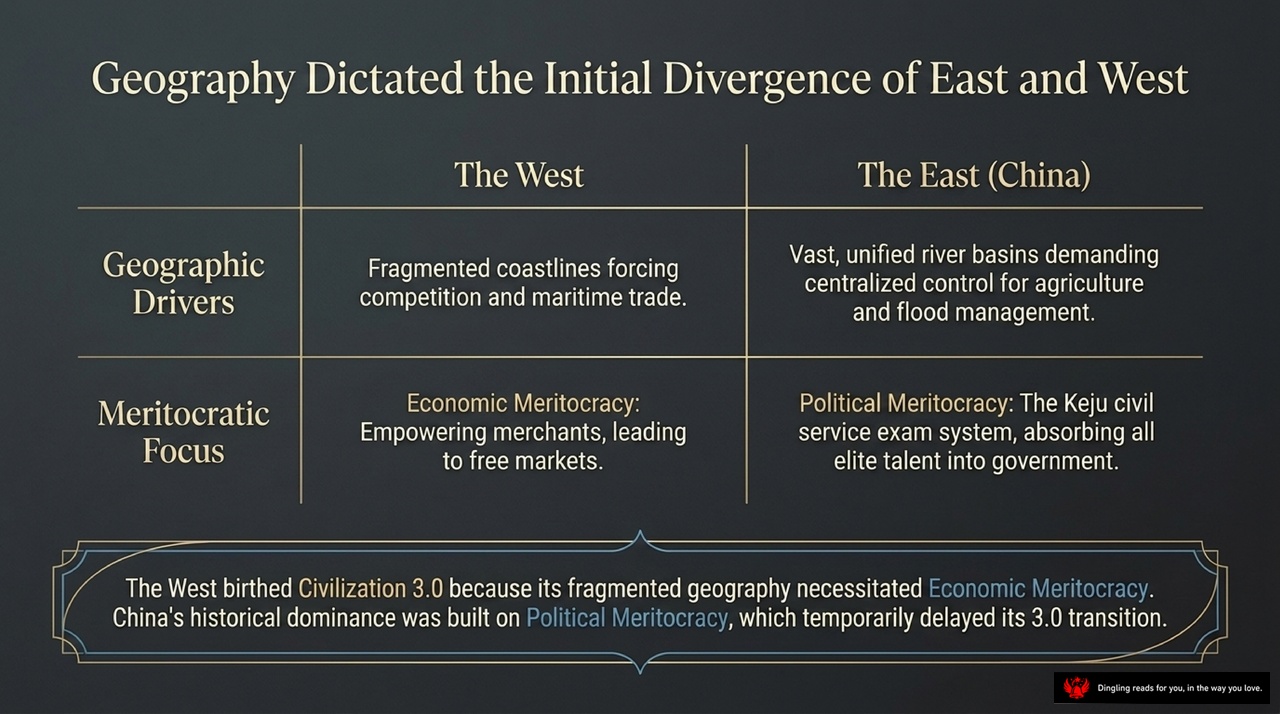
Good morning, everyone. Today, we are diving into a pivotal moment in human history: the birth of Civilization 3.0. This slide highlights the fundamental divergence between the West and the East, rooted not in culture, but in geography.
Look at the top row, "Geographic Drivers." The West's history was shaped by fragmented coastlines. These broken shores forced nations to compete fiercely and embrace maritime trade, pushing them toward innovation. In contrast, the East, specifically China, was defined by vast, unified river basins. This geography demanded centralized control to manage agriculture and floods, fostering a different kind of stability.
This geographic split created two distinct paths for talent. On the left, under "Meritocratic Focus," the West developed an Economic Meritocracy. By empowering merchants, they built free markets where individual drive fueled growth. On the right, the East established a Political Meritocracy. Through the ancient Keju civil service exam system, China absorbed all elite talent into the government, prioritizing state stability over market freedom.
As the bottom section explains, this is why the West birthed Civilization 3.0. Their fragmented geography necessitated Economic Meritocracy, which aligned perfectly with the needs of industrialization. China's historical dominance, however, was built on Political Meritocracy. While brilliant, this system temporarily delayed China's transition to the 3.0 era. Understanding this geographic and structural divergence is the key to unlocking the future of both civilizations.
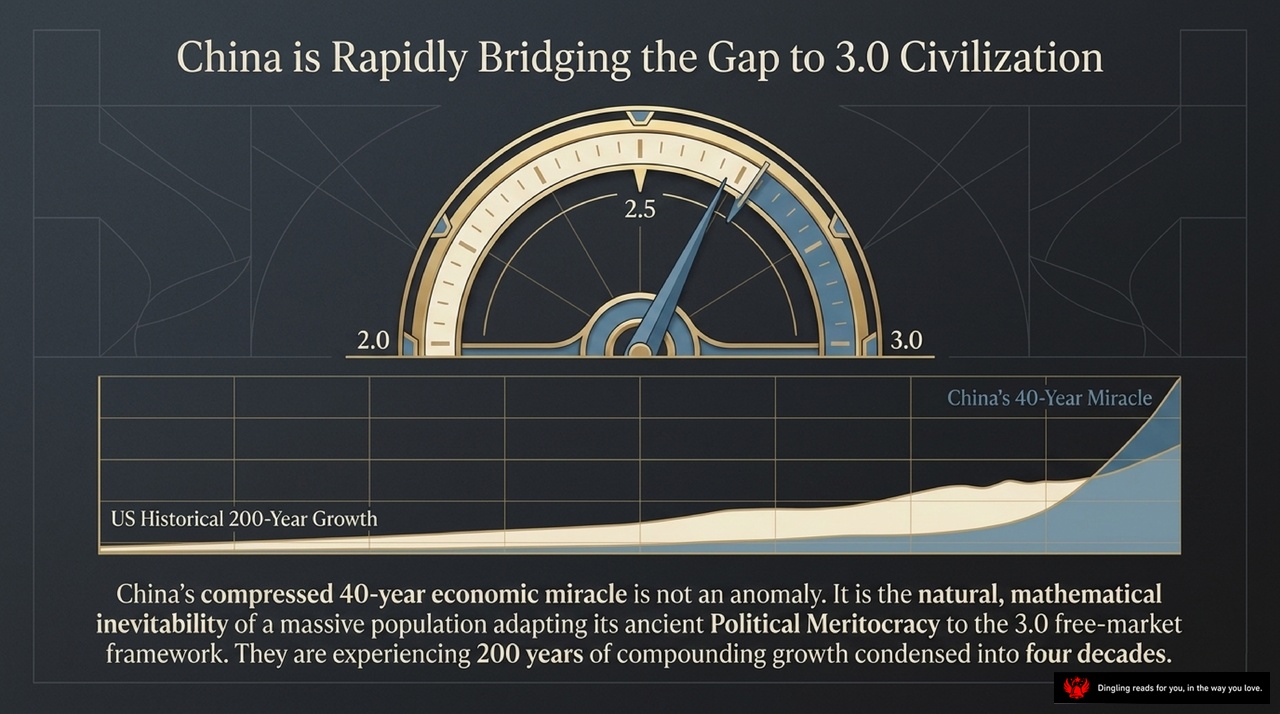
China is rapidly bridging the gap to 3.0 civilization. Look at this gauge: while the U.S. took two centuries to grow, China has compressed that same journey into just four decades. This isn't an anomaly; it's a mathematical inevitability. By adapting its ancient system of political meritocracy to the free-market framework, China is experiencing 200 years of compounding growth in a single generation. This "40-Year Miracle" proves that when a massive population leverages its historical strengths within a modern, open system, the results are nothing short of transformative. The path to 3.0 isn't about copying the West; it's about accelerating the universal laws of human progress at a speed the world has never seen before.

The largest interconnected market inevitably wins. This isn't just a catchy slogan; it's the iron law of our 3.0 Civilization. Look at the graphic: a massive, golden web of connections on the left, representing the global ecosystem, versus a small, isolated cluster on the right. The arrow points decisively toward the big network. Why? Because the largest market always wins. When you leave the global 3.0 ecosystem, you aren't just stepping aside; you are guaranteeing your own rapid obsolescence.
Think about the history of the last two centuries. The world didn't evolve in separate rooms. It evolved together. The United States, the EU, China, and the emerging markets are all part of one giant, self-reinforcing engine. When you disconnect from this engine, you stop participating in the innovation cycle, the scale effects, and the technological leaps that drive wealth creation. History shows us time and again that isolation leads to stagnation.
Yes, we see political tensions rising today. But we must remember a foundational truth: abandoning the global market economy contradicts the very law of modernization. It's like trying to build a skyscraper on a foundation that keeps sinking. For China, staying the course and integrating deeply into this global system isn't just a policy choice; it is the overwhelming historical probability. The future belongs to those who are connected, open, and part of the largest possible market. Isolation is the only path to decline.
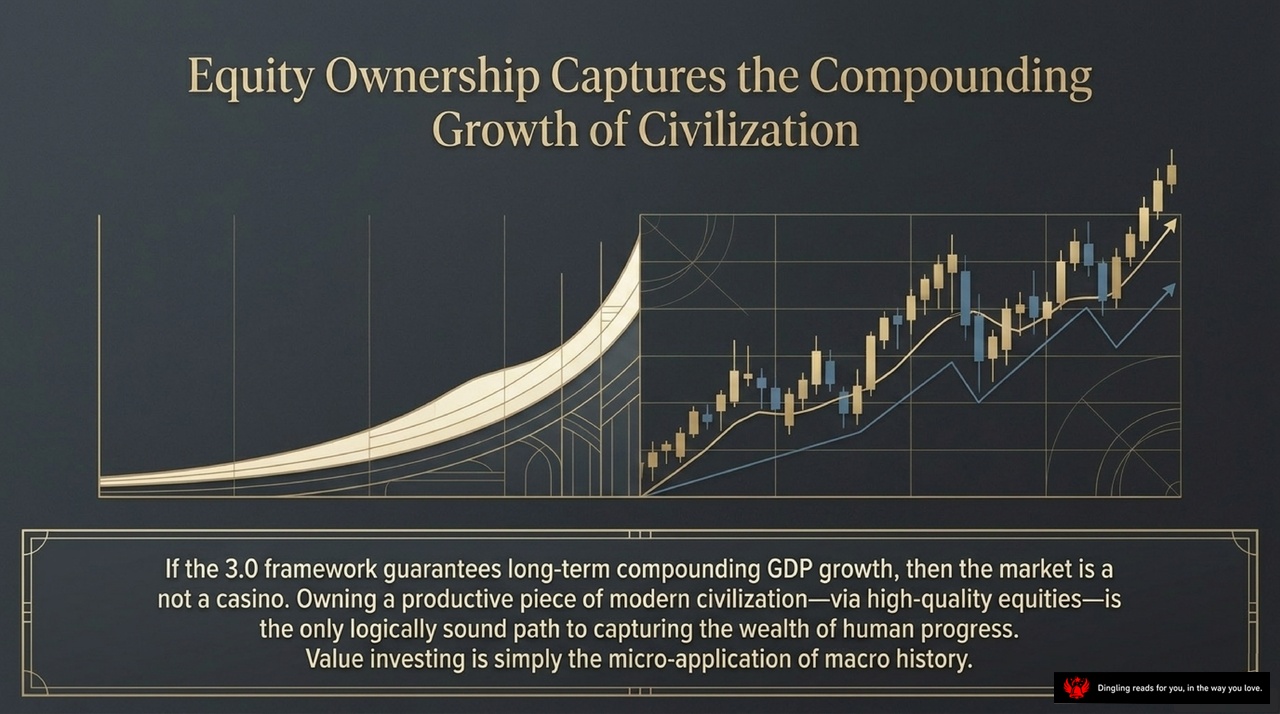
Equity Ownership Captures the Compounding Growth of Civilization. Look at this chart: on the left, we see the slow, steady rise of human progress over millennia; on the right, the explosive, jagged climb of the modern era. This visual perfectly illustrates a profound truth: if the 3.0 framework guarantees long-term compounding GDP growth, then the market is not a casino. Owning a productive piece of modern civilization—via high-quality equities—is the only logically sound path to capturing the wealth of human progress. Value investing is simply the micro-application of macro history. When you buy a great company, you aren't just buying a ticker symbol; you are buying a claim on the future. You are capturing the very engine that drives civilization forward: the relentless accumulation of knowledge, the explosion of technology, and the boundless expansion of the global market. While the past was defined by scarcity and limits, the present and future are defined by abundance and infinite growth. The stock market is the mechanism that channels this massive societal wealth into the hands of those who understand it. So, don't just watch the numbers fluctuate. Look at the underlying trajectory. The compounding growth of civilization is the greatest asset of all, and equity ownership is your ticket to ride it.

Four pillars form the foundation of sustainable investing, and today we're breaking down exactly what those pillars are. Think of this not as a rigid checklist, but as a cohesive framework that turns investing from a gamble into a disciplined art.
First, you must view **Stock as Partial Ownership**. This is the most critical mindset shift. Stop thinking of yourself as trading paper or betting on price movements. Instead, realize that when you buy a share, you are literally buying a slice of a real, compounding human enterprise. Your return doesn't come from the market's mood swings; it comes from the business itself growing and creating value over time.
Second, reframe your relationship with **Mr. Market**. The market is not your teacher; it is your servant. Market volatility is just an instrument to serve you, not a master instructing you on what to do. Volatility is not risk. Risk is something else entirely. When Mr. Market gets overly optimistic and offers you a bargain, you buy. When he gets depressed and dumps the market, you sell. You ignore the noise and focus on the underlying value.
Third, always maintain a **Margin of Safety**. Because we cannot predict the future with perfect accuracy, we need a mathematical buffer against the inevitable limits of human prediction. If a business is truly worth $100, you shouldn't pay $100. You might pay $70 or $80. This cushion protects you if your estimates are slightly off or if unexpected bad events occur. It's the difference between survival and ruin.
Finally, strictly define your **Circle of Competence**. You cannot know everything, so you must know exactly what you don't know. Knowing the exact perimeter of your own understanding is vital. Invest only in businesses and industries you truly understand. Don't just buy because the stock is going up; buy because you understand the business model, the management, and the competitive landscape.
When you combine these four concepts—owning real businesses, treating the market as a tool, keeping a safety buffer, and staying within your knowledge circle—you build a fortress against chaos. This is the essence of value investing: a rational, long-term approach that aligns your interests with the success of the companies you own.

True risk in investing isn't about the chaotic macroeconomy or the daily volatility you see on the news. It's far more dangerous than that. As the slide clearly illustrates, real peril lies outside your Circle of Competence.
Look at the center: that's "What you know." That is your solid ground. Surrounding that is the ring of "Intellectual Honesty"—the crucial zone where you admit, "I know what I don't know." This is where true safety lives. But step one ring further out, and you enter the zone of "Danger." This is operating outside your defined boundaries.
Many investors fail not because they are unlucky, but because they are intellectually dishonest. They pretend they understand complex markets or technologies they have never studied, simply because they want to be part of the action. They step outside their proven perimeter and gamble with money they don't understand.
The lesson here is simple but profound: your greatest risk is not the market crashing; it's you making a move because you feel confident, when in reality, you are just guessing. True risk is a failure of intellectual honesty. Stay within your circle, respect your limits, and you will avoid the trap that catches so many others.

Capital allocation isn't just about picking winning stocks; it's about honoring a deep moral responsibility. As Zheng Dao reminds us in *The Righteous Path*, we must treat every dollar as if it were the life savings of your hard-working parents. This mindset transforms investing from a zero-sum game of extraction into a true fiduciary duty.
When we support productive enterprises that advance our civilization, we aren't just seeking returns; we are fulfilling a moral obligation that benefits society as a whole. In an era where trust is fragile and markets are volatile, this ethical compass is what separates a responsible investor from a speculator. It's the difference between taking and giving, between exploiting a system and nurturing it. Let's invest not just for ourselves, but for the legacy we leave behind.

Are you merely trading within the noise of the market, or are you compounding your capital, character, and knowledge alongside the trajectory of human civilization?
This slide outlines your specific role in what we call the "Compounding Engine." Think of it as a massive, upward-sweeping curve representing the last 150,000 years of human history. For most of that time, our struggle was defined by the limitations of our biology and geography. But everything changed when humanity achieved a "3.0 fusion"—the powerful combination of free markets and modern science. This wasn't just an accident; it was the solution to our ancient struggle, allowing us to unlock the exponential growth that defines our species today.
You might ask, "Is this just a historical chart?" Not at all. Look at the next step: China's economic miracle. This wasn't magic; it was the inevitable result of finally joining this compounding engine. By embracing modern science and market mechanisms, China tapped into the same logic that drove Western growth for centuries.
But how do you actually participate in this engine? The answer lies in value investing. This isn't about guessing the next hot stock; it is the logical mechanism to capture this civilizational growth. When you invest in companies with real moats and long-term value, you aren't just buying paper; you are aligning your personal wealth with the broader progress of human civilization.
However, success in this game requires something more than just a strategy. It demands absolute intellectual honesty and a strict moral fiduciary anchor. You must be willing to admit when you are wrong, to think deeply, and to act with integrity. Without these traits, you risk becoming just another trader lost in the noise.
So, the final question is yours: Are you merely reacting to daily market fluctuations, or are you building something enduring? Are you compounding your capital, your character, and your knowledge, riding the wave of human advancement? That is the true essence of your role in this compounding engine.