
Cognitive-Driven: Complete Chapter-by-Chapter Summary
Welcome to today's session on "Cognitive Drive" by Zhou Ling. Imagine your life as a blueprint, where every decision is a line drawn in the sand. The core message here is simple yet profound: Do at least one thing in your life that is highly useful to others.
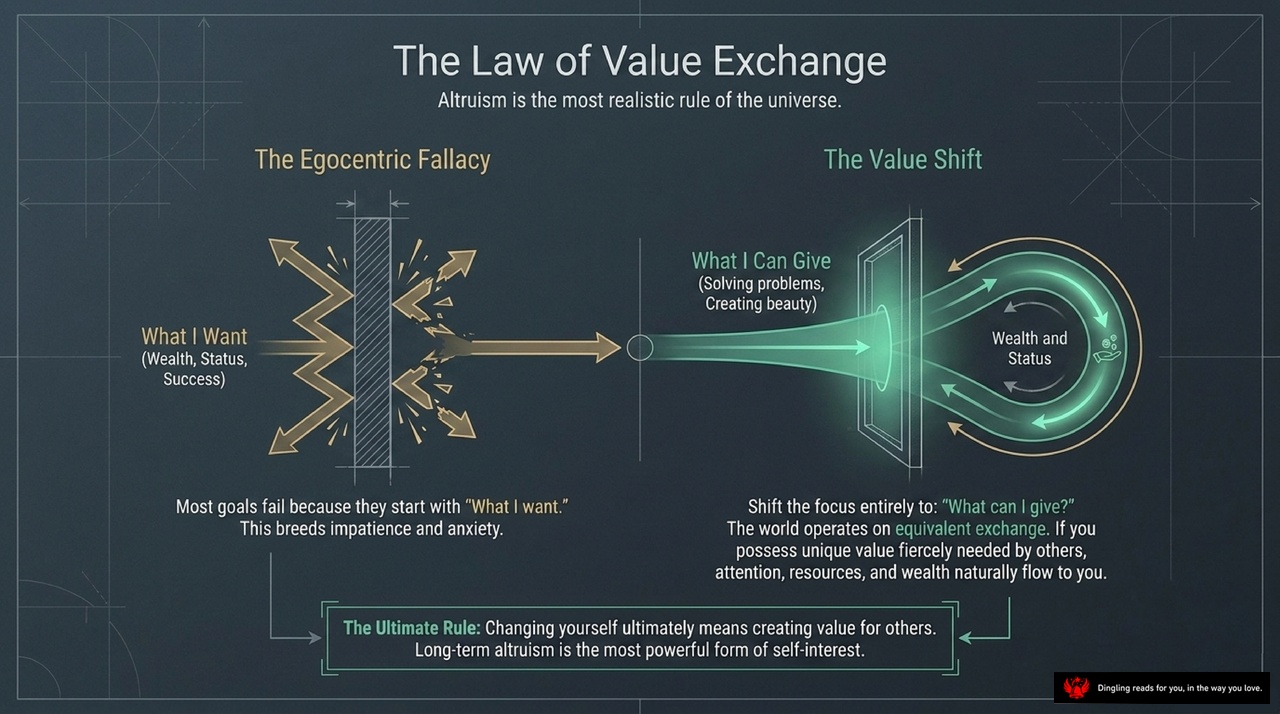
This isn't just a suggestion; it's the foundation of lasting success. In a world obsessed with personal gain, the most powerful strategy is actually to focus outward. When you create value for others, you inadvertently build an unshakeable foundation for your own life. This shift from "what I want" to "what I can give" transforms your mindset from a consumer of resources to a creator of opportunities.
Think about it: when you solve a real problem for someone, you aren't just being nice; you're building a reputation, a network, and a legacy that no algorithm can take away. This principle applies whether you're writing, coding, or simply listening. By committing to usefulness, you unlock a cycle where helping others becomes the very engine of your own growth. Let's dive deeper into how this cognitive shift can reshape your entire journey.
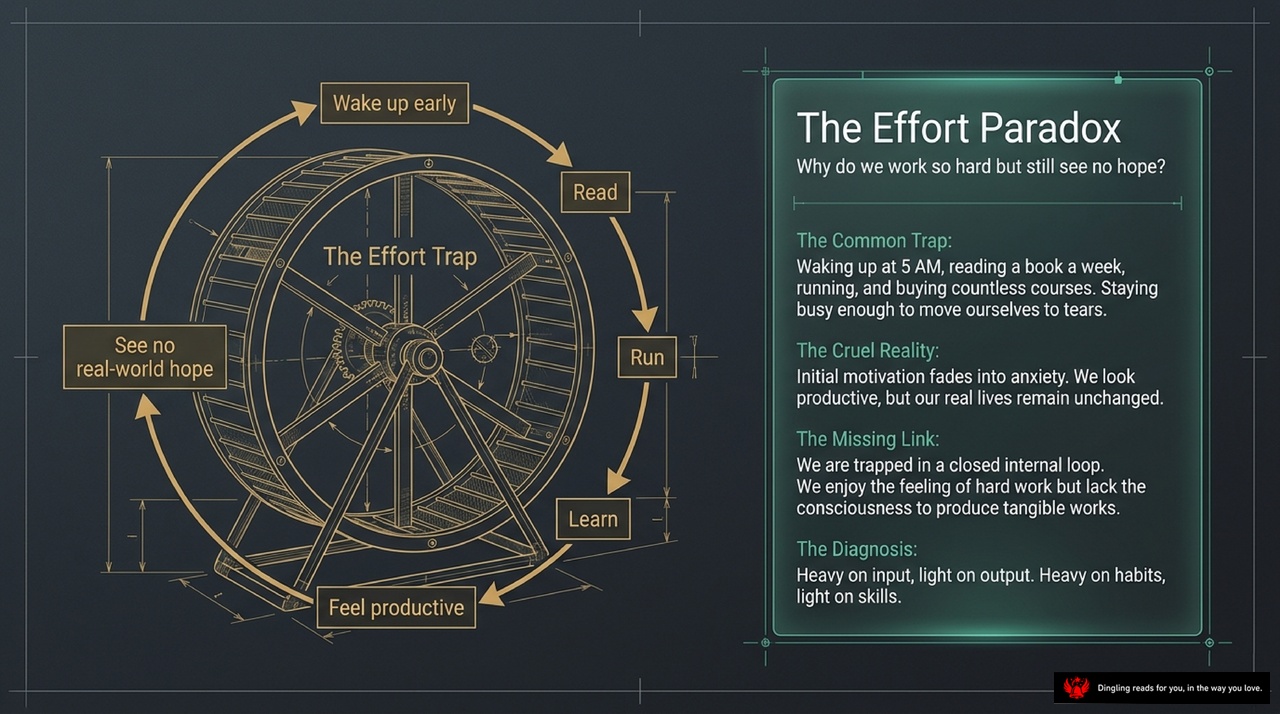
The Effort Trap is a modern curse. We wake up early, read books, run marathons, and binge-watch courses, yet feel no real-world hope. Why? Because we've built a hamster wheel of "pseudo-effort." We mistake busyness for progress, believing that if we just work harder, the results will magically appear. But here's the cruel reality: initial motivation often fades into anxiety. We look productive, but our actual lives remain unchanged.
The problem isn't a lack of effort; it's a lack of direction and output. We are trapped in a closed internal loop, enjoying the feeling of hard work while lacking the consciousness to produce tangible results. We are heavy on input and light on output, heavy on habits and light on skills. This is the effort paradox: we work so hard, but we see no hope because we're just spinning our wheels. To break free, we need to shift from merely consuming information to creating value that can be replicated, turning our efforts into a force that actually moves the needle in our lives.
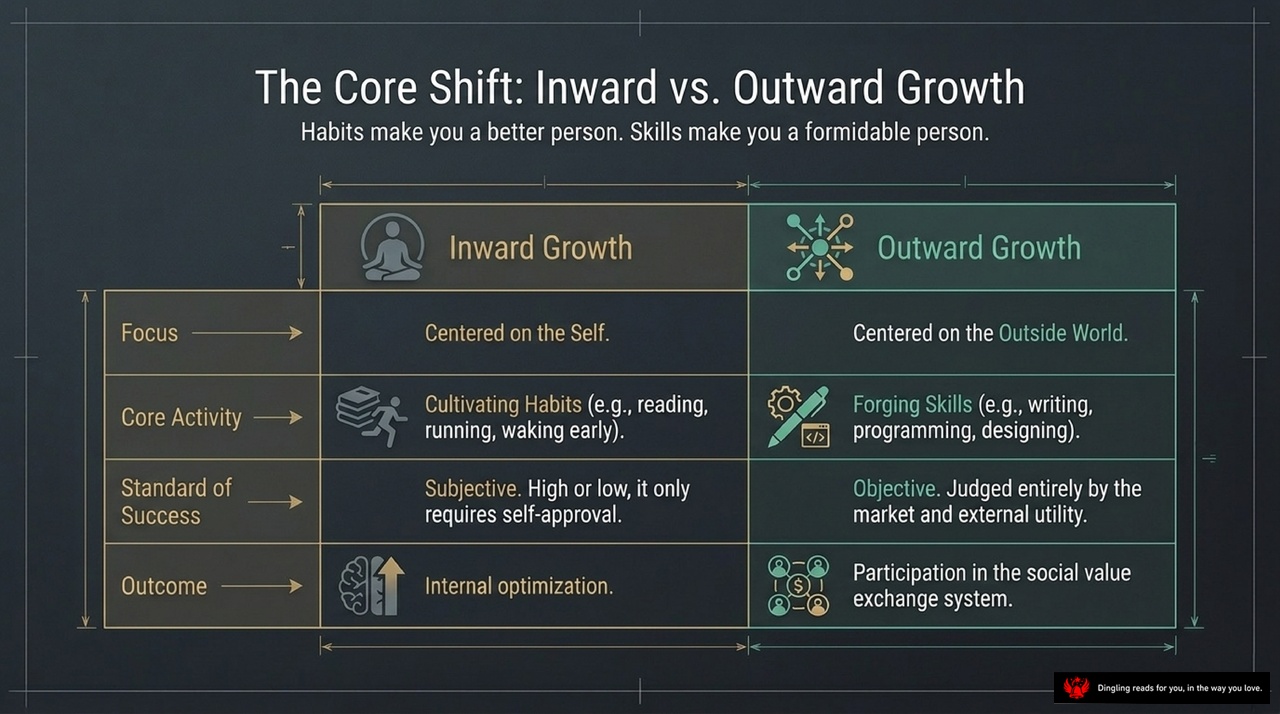
Today's slide breaks down the fundamental shift that separates a good person from a formidable one: the choice between Inward Growth and Outward Growth.
Think of it this way: habits make you a better person, while skills make you formidable. The chart on the left, **Inward Growth**, is entirely centered on the self. Its core activity is cultivating habits like reading, running, or waking up early. Success here is subjective; it only requires your own approval. The ultimate outcome is internal optimization. You're building a better version of yourself, regardless of what the outside world thinks.
On the right, we have **Outward Growth**. This is centered on the outside world. The core activity shifts from habits to forging tangible skills—things like writing, programming, and designing. Here, success is objective, judged entirely by market demand and external utility. The outcome isn't just about feeling good; it's about participating in the social value exchange system. You're creating something that has real-world impact.
The key takeaway? Don't just focus on optimizing your internal state. To truly thrive, you must pair that self-improvement with skills that solve real problems for others. That's how you move from being a "good person" to someone who is genuinely formidable.
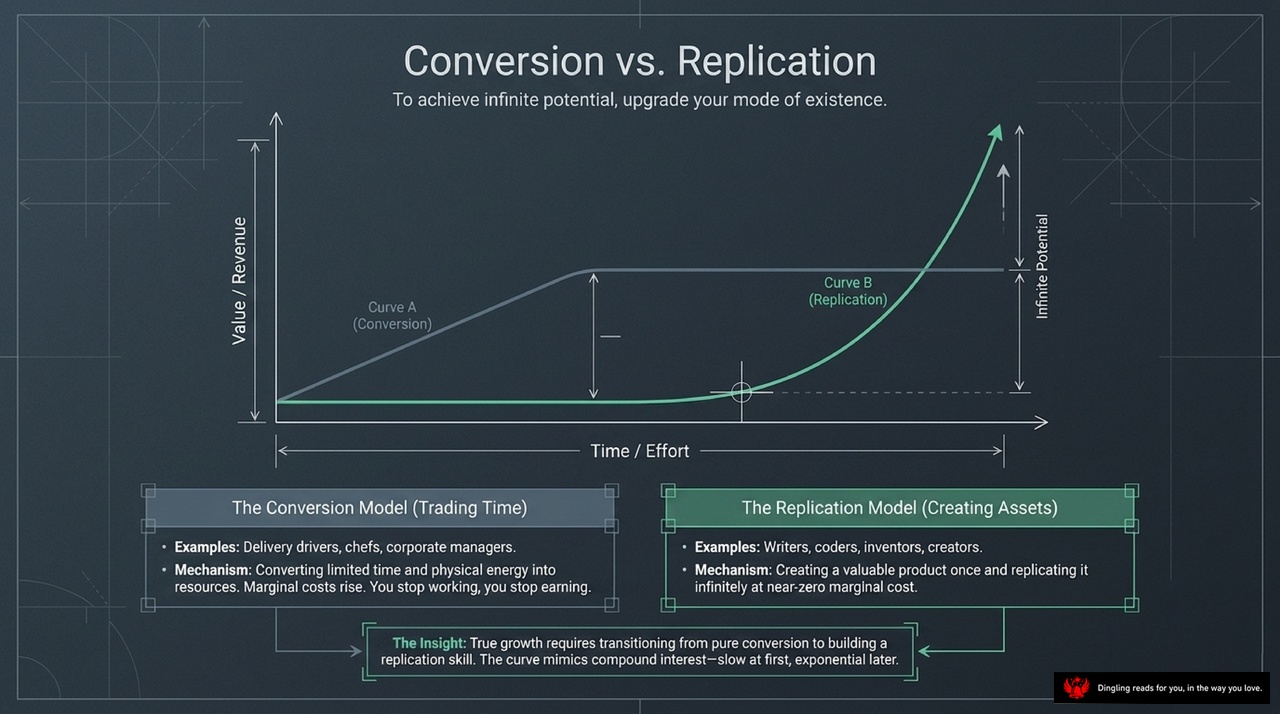
So, how do we actually become the kind of person who achieves infinite potential? The secret lies in shifting our mindset from a "conversion model" to a "replication model." Think about it: most of us are stuck trading our time for money. Delivery drivers, chefs, and even many corporate managers fall into this trap. We convert our limited physical energy directly into resources. The problem? The moment we stop working, the income stops. It's a linear game where marginal costs keep rising.
But look at the other curve. Writers, coders, inventors, and creators operate differently. They build assets once, and then they replicate that value infinitely at near-zero marginal cost. A book you write keeps selling years later; a song you compose continues to generate royalties even after you've stopped creating. This is the power of replication. It mimics compound interest. At first, the growth is slow, requiring patience and accumulation, but once you hit that inflection point, the curve explodes upward, offering true infinite potential.
The insight here is clear: true growth requires transitioning from pure conversion to building a replication skill. Don't just sell your time; create something valuable that can be copied. In today's digital age, the cost of replication has dropped to almost zero. You can write an article, record a video, or build a digital product, and let it work for you 24/7. But remember, replication is just the channel; value is the core. Without high-quality, valuable content, your replication strategy will fail. So, start by creating value that stands the test of time, and watch how your life expands beyond the limits of your working hours.
Have you ever noticed how your brain is wired to hunt for trouble? It's a survival mechanism baked into our DNA, but it's also the biggest thief of your happiness. Think about it: you might have twenty-three perfect hours in your day, yet one harsh comment from a boss or a single mistake can ruin your entire mood. This is what psychologists call "negative bias"—our brain treats a bad thing like a giant red flag and ignores a hundred good things just to stay safe.
To break free from this, you need to become the fish that sees the water. Instead of waiting for life to feel happy, you have to actively look for it. Try the "Success Journal" method: every day, write down at least five small wins, no matter how tiny. Maybe you woke up on time, or you finished a difficult task. By constantly recording these positives, you retrain your brain to spot the good stuff. You can also use imagination as a tool. When you feel overwhelmed, ask yourself: "What would I feel if I lost everything I have right now?" That sudden fear of loss will instantly remind you of the value of your current blessings.
But there's another mental trap we all fall into: binary thinking. We love black-and-white answers—good or bad, right or wrong, friend or enemy. This simple logic worked when we were kids, but the adult world is messy and gray. When you cling to binary thinking, you shrink your world. You might reject an entire group of people because of one bad trait, or you might ignore the good qualities in someone you dislike. True maturity means moving from this simple "0 or 1" mindset to a multi-dimensional one. It's about realizing that there are no absolute evils, only different perspectives. You can learn from people you don't like, and you can find opportunities even in difficult situations.
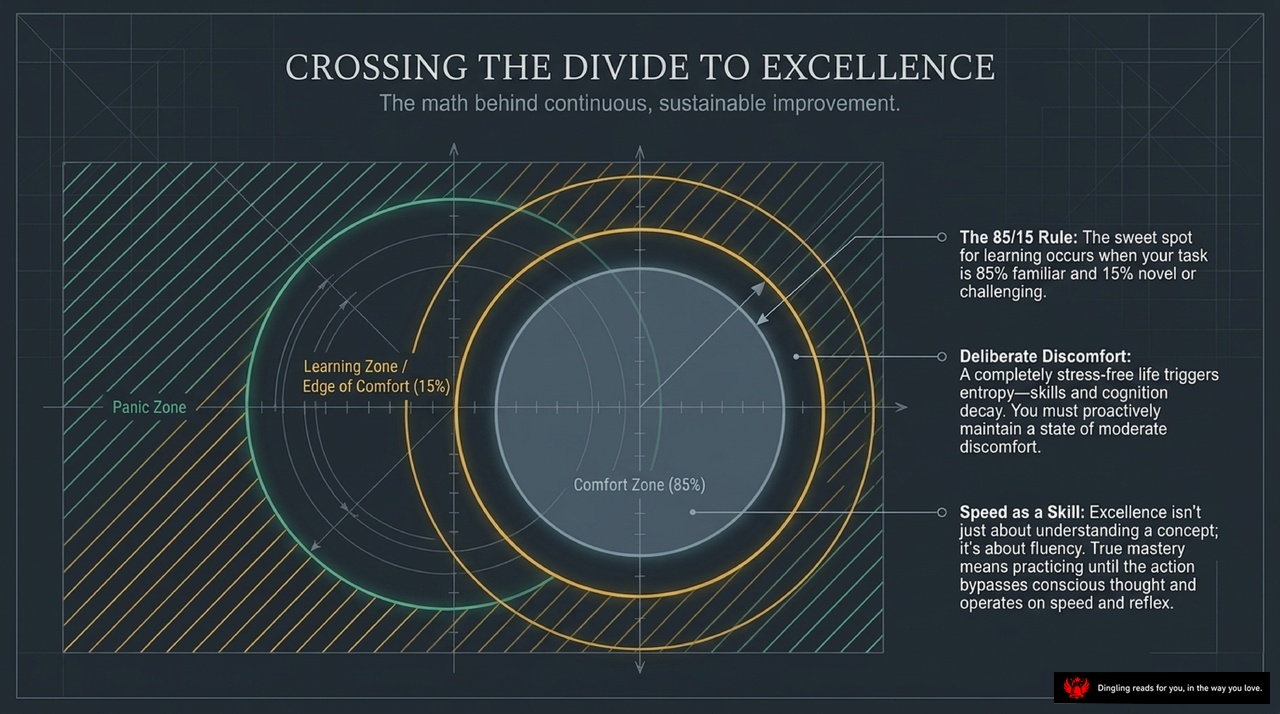
Finally, remember that stress isn't your enemy; it's your fuel. We often try to escape all pressure to find comfort, but that actually leads to stagnation. Think of it like a muscle: if you never lift weights, you get weaker. Similarly, if you never step out of your comfort zone, your mind and body atrophy. The goal isn't to eliminate stress, but to keep it at a "sweet spot"—right on the edge of your comfort zone. This is where growth happens. By embracing a little bit of discomfort, you force your brain to adapt and get stronger. So, stop running from the hard parts of life and start using them as the gym where you build your future.
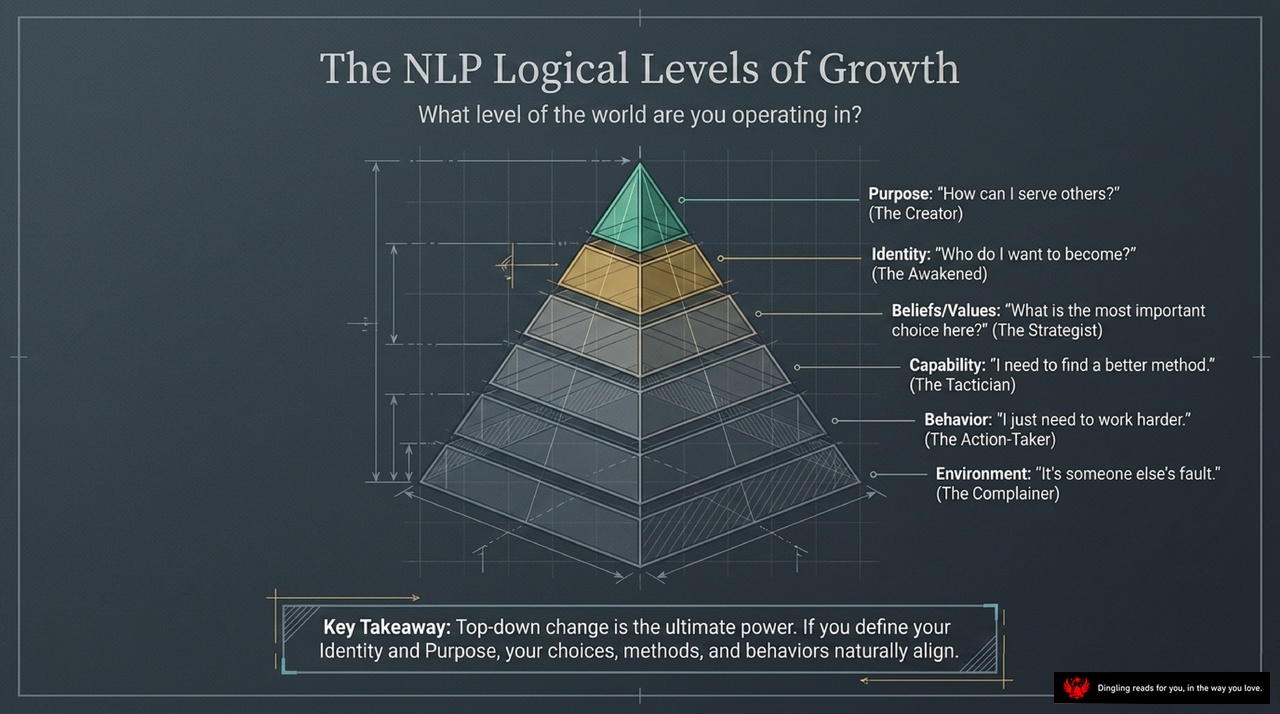
Today's slide introduces the NLP Logical Levels of Growth, a powerful framework that reveals exactly where you are operating in life. This pyramid, developed from the work of Richard Bandler and John Grinder, helps us understand that true transformation doesn't happen at the bottom; it starts from the top.
At the very peak sits **Purpose**, asking, "How can I serve others?" This is the realm of the Creator, where your life has meaning beyond yourself. Just below that is **Identity**: "Who do I want to become?" This is the Awakened state. As we've discussed, defining your identity is the ultimate driver for change. If you see yourself as a lifelong learner, reading and writing become natural habits, not a chore.
Moving down, we find **Beliefs and Values**. This is where the Strategist lives, constantly asking, "What is the most important choice here?" Your beliefs determine your strategy and filter your reality. Below that lies **Capability**, the Tactician's level, focused on methods and skills. Here, people think, "I need to find a better method." But often, fixing a method without fixing the belief above it is like changing the oil in a car with a broken engine.
Further down is **Behavior**, the Action-Taker's domain. This is where we say, "I just need to work harder." Many people get stuck here, believing that more effort equals more results. But if your identity or beliefs are misaligned, working harder often just leads to burnout without progress.
At the base is the **Environment**, the Complainant's level. Here, we blame others or circumstances: "It's someone else's fault." This is the lowest level of growth because you have no control over external factors.
The key takeaway is clear: Top-down change is the ultimate power. If you define your Identity and Purpose at the top, your choices, methods, and behaviors naturally align and follow suit. Don't just try to work harder at the bottom; climb the pyramid and redefine who you are and why you exist. That is how you unlock sustainable growth.

True long-termists don't rely on sheer grit to keep going; instead, they use cognitive drive to make quitting feel like a loss. As the slide illustrates, this shift happens through three interconnected gears.
First, see the mechanism. It's about understanding the underlying logic of your task. When you clearly grasp how something works, it stops being a burden and becomes your default choice. You move from passive persistence to active pursuit because you understand the "why" behind the action.
Second, find the meaning. Connect your daily actions to your ultimate identity. A goal without deep meaning simply cannot survive the friction of daily repetition. If you view your work as an investment in who you are becoming, the resistance fades.
Third, feel the benefits. This is the crucial pivot. Instead of focusing on the sacrifice—like losing sleep or skipping fun—shift your attention to the immediate harvest. Enjoy the absolute silence of a focused morning or the clarity of a finished thought. When you reframe the process as a series of small rewards, the long-term vision becomes tangible and achievable today.
By aligning logic, emotion, and focus, you transform your relationship with time and effort, turning the grind into a natural flow.

Success isn't just about working harder; it's about working with the right mindset. Today, we're diving into a powerful framework from Inamori Kazuo, often called the "Three Phases of Rationality," which is the secret to turning ambitious dreams into reality.
The first phase is **Optimistic Ideation**. This is where you dream wildly. It's crucial to turn off your rational brain during this stage. If you start listing reasons why you will fail right now, you'll never get started. You need to suspend doubt and let your imagination run free, focusing purely on what you want to achieve without constraints.
Once you have that clear vision, you move to **Phase 2: Pessimistic Planning**. Here, you flip the switch. Turn your rational brain to maximum power. Now is the time to anticipate every single risk, flaw, and obstacle you might face. You need to create airtight, cautious plans. By stress-testing your idea against every possible failure scenario, you prepare yourself so that when execution time comes, you aren't caught off guard by surprises.
Finally, we reach **Phase 3: Optimistic Execution**. This is where you put your plan into motion with absolute confidence. You focus on the joy of the present moment and deliberately ignore the doubts that might creep in. You trust the preparation you did in Phase 2 and move forward with momentum.
The magic happens when you balance these three states. You dream big, plan small and carefully, but act big and fearlessly. This rhythm allows you to break through the limitations of strict rationality and achieve extraordinary results.

Clear Your Mental RAM. We chronically underestimate the cognitive power of writing things down.
Imagine your brain as a computer with limited RAM. When it's full, everything gets messy and slow. That chaotic tangle on the left represents a mind overwhelmed by worries, schedules, and unprocessed emotions. It's exhausting. But look at the right side: a structured, organized tree. That's what happens when you clear your mental RAM.
Writing is the ultimate excavator for your thoughts. Think of it this way: thinking is one-dimensional, speaking is two-dimensional, but writing is three-dimensional. By putting your ideas on paper, you force your brain to shift from the primitive, emotional center to the logical prefrontal cortex. This instantly cools down anxiety and stops the mental chaos.
It also acts as an action engine. Your working memory is extremely limited—roughly seven units. When you write down worries or schedules, you close those open loops in your brain, freeing up massive mental bandwidth for deep focus. You stop holding onto everything in your head and start building a clear path forward.
So, don't just think about your goals. Write them down. Organize your thoughts. Clear the clutter. When your mental RAM is cleared, you aren't just less stressed; you're ready to think clearly, act decisively, and create the life you want.
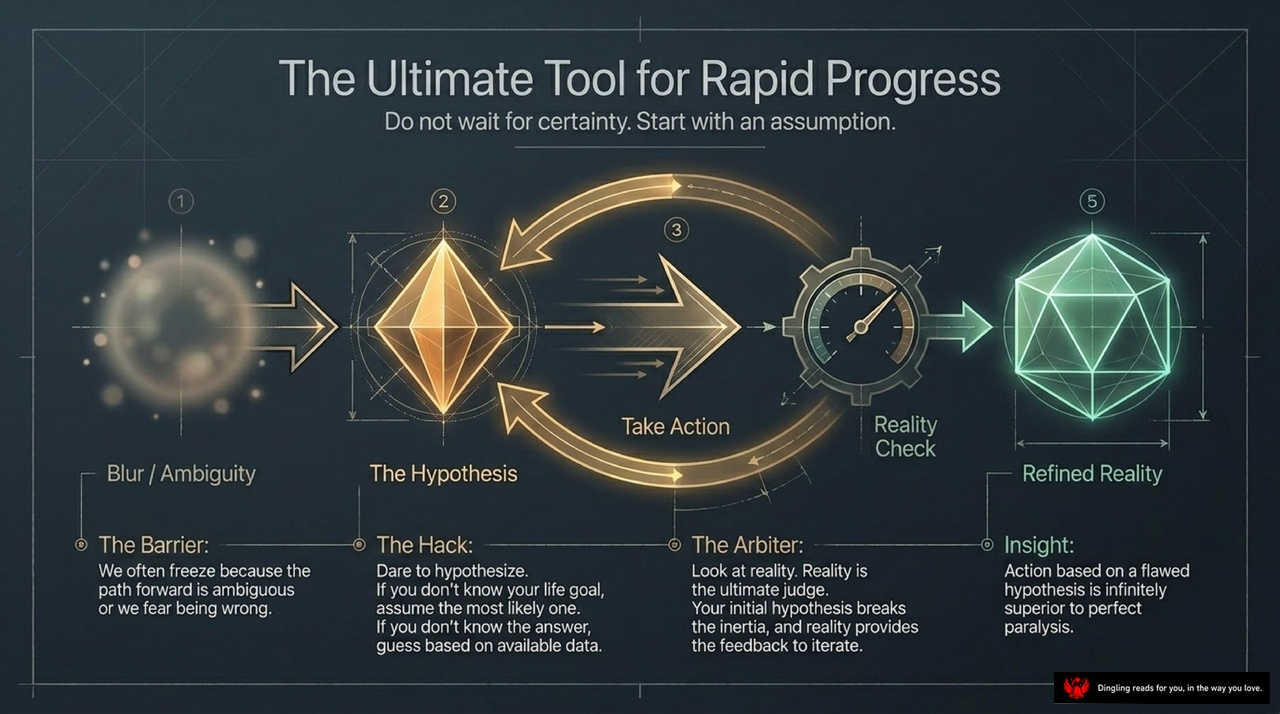
Today's slide maps out the ultimate tool for rapid progress: a five-step loop that transforms uncertainty into clarity. It starts with **Blur and Ambiguity**, the very state where most of us freeze. We hesitate because the path ahead isn't clear, or we're paralyzed by the fear of being wrong. This is the barrier holding us back.
But the hack to break through is simple: dare to hypothesize. If you don't know your life goal, assume the most likely one. If you don't have the answer, guess based on the data you have right now. You don't need certainty to start; you only need an assumption to move.
Once you take action, reality becomes your judge. This is the **Reality Check**. Look at what actually happens, not what you thought would happen. Your initial hypothesis might be flawed, and that's okay. In fact, a flawed hypothesis is infinitely superior to perfect paralysis because it breaks the inertia. Reality provides the feedback you need to iterate, refining your understanding until you reach **Refined Reality**.
The core insight here is powerful: action based on a flawed guess is better than waiting for perfection. Don't wait for certainty. Start with an assumption, take action, and let reality guide your next step.
We are all trapped in a "negative bias" that our genes wired into us for survival. It's why we obsess over a single bad grade while ignoring twenty-three hours of success, or why a harsh comment from a boss can ruin our entire day. To be happy, we have to consciously do the opposite: actively hunt for the good. Just like the character in *Rich Dad Poor Dad*, you need a "Success Journal." Write down five small wins every day, no matter how tiny. Over time, this simple habit rewires your brain to notice abundance instead of scarcity.
But there's another trap we fall into: the "hedonic treadmill." We think happiness comes from removing pain, but our brains are incredible adapters. Once we get used to a new pleasure—like a better phone or a fancy car—it quickly becomes the new normal, and we feel nothing. This is why static things are ignored; our brains are wired to notice change and danger, not stability.
So, how do we break free? We need to become the fish that can see the water. Instead of complaining about the current, shift your perspective. Ask yourself: "What would happen if I lost everything I have right now?" Suddenly, your current blessings feel precious. Or, zoom out. Look at your problems from the scale of a year or a lifetime. Most of the things keeping you up at night are actually trivial in the grand scheme.
Ultimately, the goal is to move from binary thinking—seeing the world as just black and white—to a multidimensional mindset. Life isn't about finding the one perfect answer; it's about navigating complexity with grace. By balancing our natural negativity with intentional gratitude and shifting our focus from what's missing to what we have, we stop living in a constant state of crisis and start building a life that feels genuinely rich.

The Power of Cross-Skilling: If you want to stand out, step out of your lane.
Let's be honest: most of us are stuck in a 1D lane. We compete purely on length or time—whether that's coding, writing, or just grinding out hours. The problem? You're competing against the absolute best in the world on the same single metric. It's a losing game from the start.
But look at what happens when you add a second, unrelated skill. Suddenly, you move from a flat line into a 2D plane. You aren't just the best coder anymore; you're the only person who combines deep coding expertise with, say, public speaking or storytelling. That's the multiplier effect. You don't have to be the top 1% at A or the top 1% at B. You just need to be the rare few who can combine A + B.
This is where the magic happens. By developing a secret Plan B in an entirely unrelated field, you create a multidimensional advantage. You stop competing on volume and start competing on uniqueness. This is what I call "Solo Navigation." Pursue your Plan B independently, distance yourself from the industry mainstream, and preserve your unique perspective.
The result? Exponential volume and a truly unique advantage. While everyone else is racing on the same crowded track, you've built your own 3D cube. You're no longer homogenized; you're irreplaceable. So, if you want to stand out, don't just run faster. Step out of your lane entirely.

Look at this diagram: "The Invisible Hand of Environment." It presents a harsh truth that changes everything: being lazy in the right environment beats grinding yourself to death in the wrong one.
Notice the concentric circles surrounding "The Individual." This visualizes how we are constantly shaped by layers of influence. At the outermost layer is the Macro Environment—your peers and culture. The text explains that we have "Mirror Neurons" which unconsciously mimic the behaviors and standards of those around us. Willpower simply cannot outlast a toxic or complacent environment. If you are surrounded by slackers, you will inevitably become one, no matter how hard you try.
Moving inward, we have the Micro Environment—your desk and your room. The slide introduces the concept of "Strategic Laziness." Instead of fighting against a chaotic world, the smart move is to move to an environment where excellence is the default. Imagine being surrounded by high-achievers; suddenly, coasting upward on their momentum becomes effortless. You don't have to push harder; you just have to be in the right room.
Finally, at the very center, we control our Information Environment through "Micro-Control." If you can't change the macro world, curate your micro world. Unfollow useless feeds, clear your cluttered desk, and use multi-sensory immersion to train your subconscious.
The core message is clear: stop blaming your lack of discipline. The real power lies in designing an environment that makes success the easiest choice you can make.

Imagine a toddler learning to walk. He stumbles, falls, and gets back up, completely unbothered by his clumsiness or the judgment of onlookers. Within a few weeks, he's on his way. Now, fast forward to adulthood. When we face a new skill or career path, we often freeze. We crave instant results, fear looking foolish, and quit before we've even taken a few steps. We've forgotten how to be like that child.
The secret to unlocking this potential lies in one simple, counterintuitive move: actively lower your expectations. It sounds risky, but it's the fastest way to get moving. When your expectations are too high—whether it's trying to do too many things at once or expecting perfection from day one—your brain triggers anxiety and paralysis. You're too busy worrying about the outcome to enjoy the process.
Think about learning a complex skill, like solving a Rubik's cube or mastering a new language. If you demand mastery in a week, you'll likely fail and feel defeated. But if you tell yourself, "I just need to learn one small piece today," the pressure vanishes. You focus on the immediate step, not the distant mountain. This shift from "I must succeed" to "I just need to try" removes the mental weight holding you back.
This isn't about giving up or settling for mediocrity. It's about removing the barrier to entry. By lowering the bar for what you expect today, you make it easy to start. And once you start, momentum takes over. The child doesn't worry about walking perfectly; he just focuses on putting one foot in front of the other. You don't need to see the whole staircase; you just need to take the first step with a lighter heart. So, stop waiting for the perfect moment or the perfect plan. Lower your expectations, embrace the stumble, and keep walking.

So, here's the bottom line: growth isn't about quietly hoarding knowledge to make yourself perfect. That's a trap. Real growth is about forging unique skills that actively serve the world. When you shift your focus from inward habits to outward value creation, you stop relying on fragile willpower and start leveraging the ultimate laws of exchange, environment, and purpose.
Think about it this way: if the true measure of a life well-lived is the enduring value you create for others, then the question isn't "What do I want?" but rather, "What original masterpiece will you begin building today?" The power to change your life doesn't come from how much you consume, but from how much you give back. So, what are you going to create that will outlast you?