
Cognitive Surplus: Complete Chapter-by-Chapter Summary
Welcome to today's session on *Cognitive Surplus* by Clay Shirky. Look at the world map behind us, crisscrossed with countless digital connections. This isn't just a map of geography; it's a map of human potential. The core idea we're exploring is simple yet profound: the unprecedented aggregation of human free time and digital connectivity is creating a new global resource capable of transforming society.
For decades, we've been told that our spare time is something to be consumed—watching TV, scrolling endlessly, or passively waiting. But Shirky challenges this view. He argues that this "free time" isn't a dead end; it's a surplus of raw cognitive energy. When combined with the tools that allow us to connect instantly across borders, this surplus becomes a powerful engine for innovation, collaboration, and social change. We aren't just users anymore; we are creators, coordinators, and architects of our own future. This book is your guide to unlocking that potential.
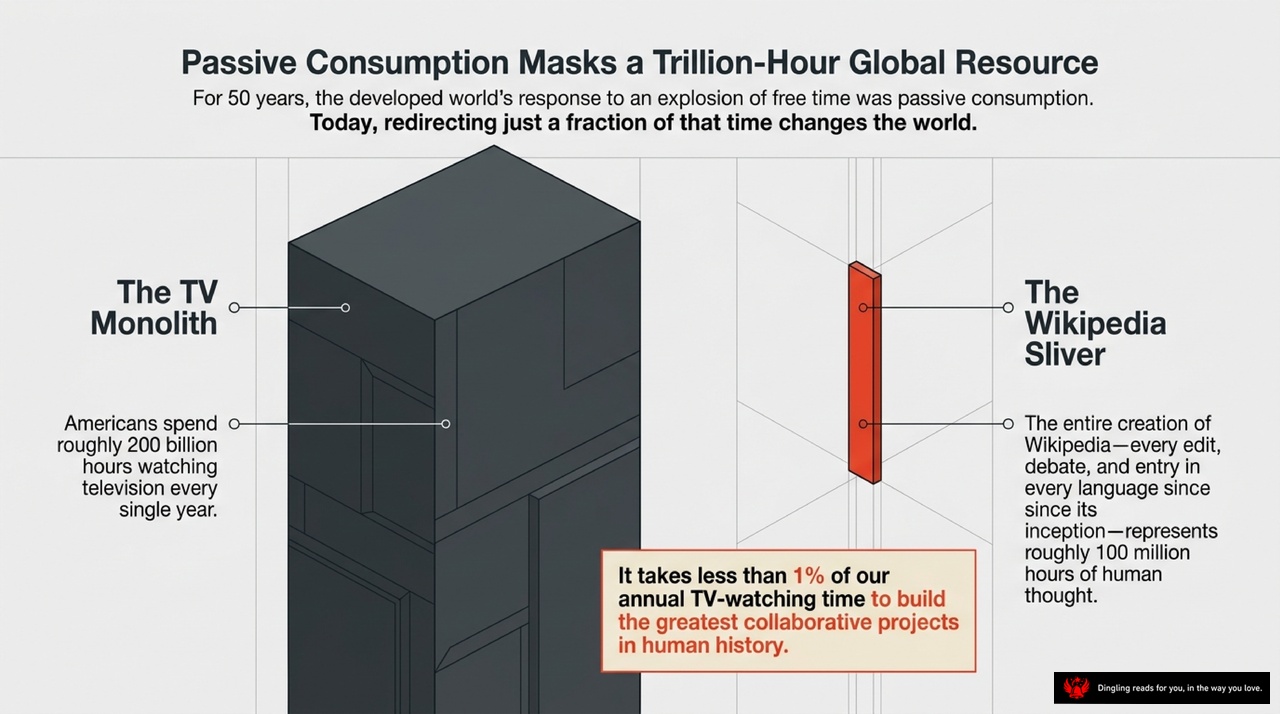
Imagine a massive, dark block labeled "The TV Monolith." On its side, the text reveals a staggering truth: Americans spend roughly 200 billion hours watching television every single year. Now, look to the right. There, a tiny, slender red sliver represents "The Wikipedia Sliver." This sliver contains the entire creation of Wikipedia—every edit, debate, and entry in every language since its inception—representing roughly 100 million hours of human thought.
The visual comparison is striking. It takes less than 1% of our annual TV-watching time to build the greatest collaborative projects in human history. Yet, for the past 50 years, the developed world's response to an explosion of free time was passive consumption. We built a giant monolith of entertainment, ignoring the fact that redirecting just a fraction of that time changes the world.
This isn't about technology; it's about opportunity. We have a trillion hours of global resources sitting idle, wasted on passive consumption. The shift from watching the same content over and over to actively creating and sharing it unlocks a transformative power. When we stop consuming and start participating, we transform our free time from a dead asset into a living engine for innovation and social change.
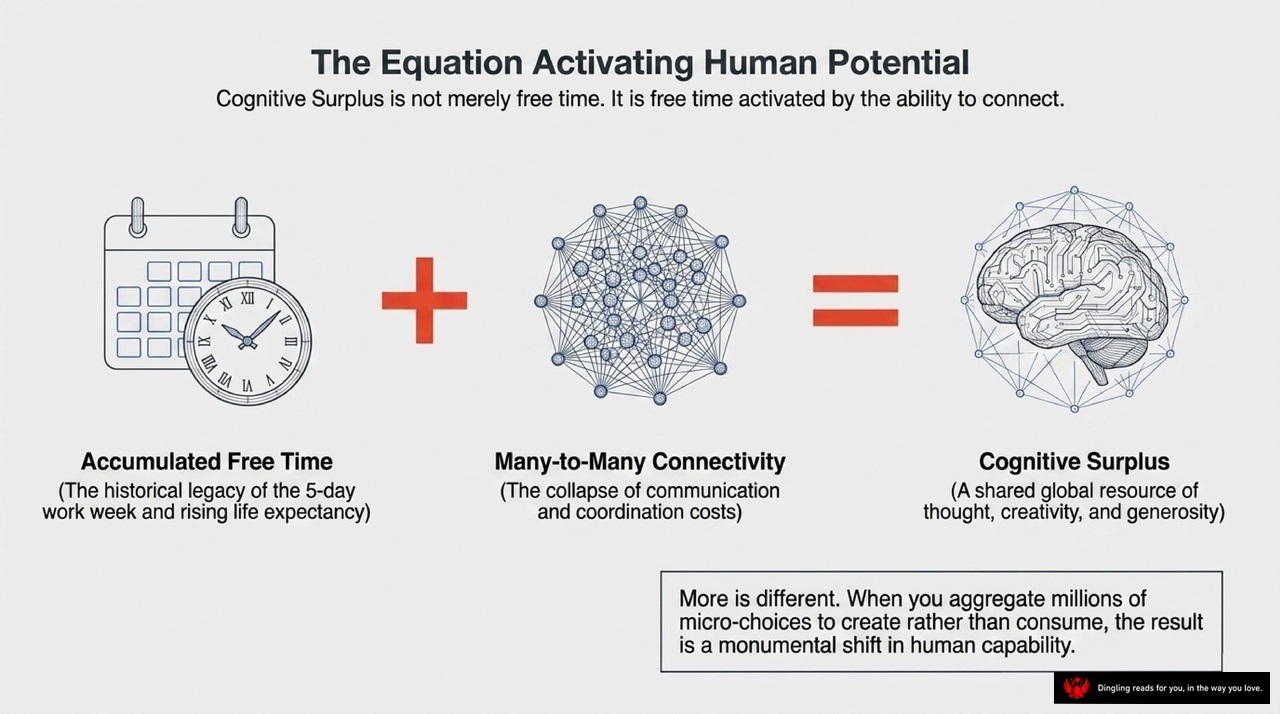
Imagine an equation that unlocks the full potential of the human mind. It starts with a simple but powerful concept: Cognitive Surplus. This isn't just about having free time; it's about free time activated by our ability to connect with others. Look at the first element on the left: Accumulated Free Time. This is the historical legacy of the five-day work week and rising life expectancy, giving us the raw material of spare hours. Now, add the second element: Many-to-Many Connectivity. This represents the collapse of communication and coordination costs, allowing us to link up effortlessly. When you combine these two—time plus connection—you get Cognitive Surplus.
This surplus transforms into a shared global resource of thought, creativity, and generosity. It changes everything. As the slide notes, "More is different." When you aggregate millions of micro-choices to create rather than consume, the result is a monumental shift in human capability. We move from being passive consumers of content to active participants in a global conversation. This equation proves that our greatest asset isn't what we own, but how we use our time together to build something bigger than ourselves.
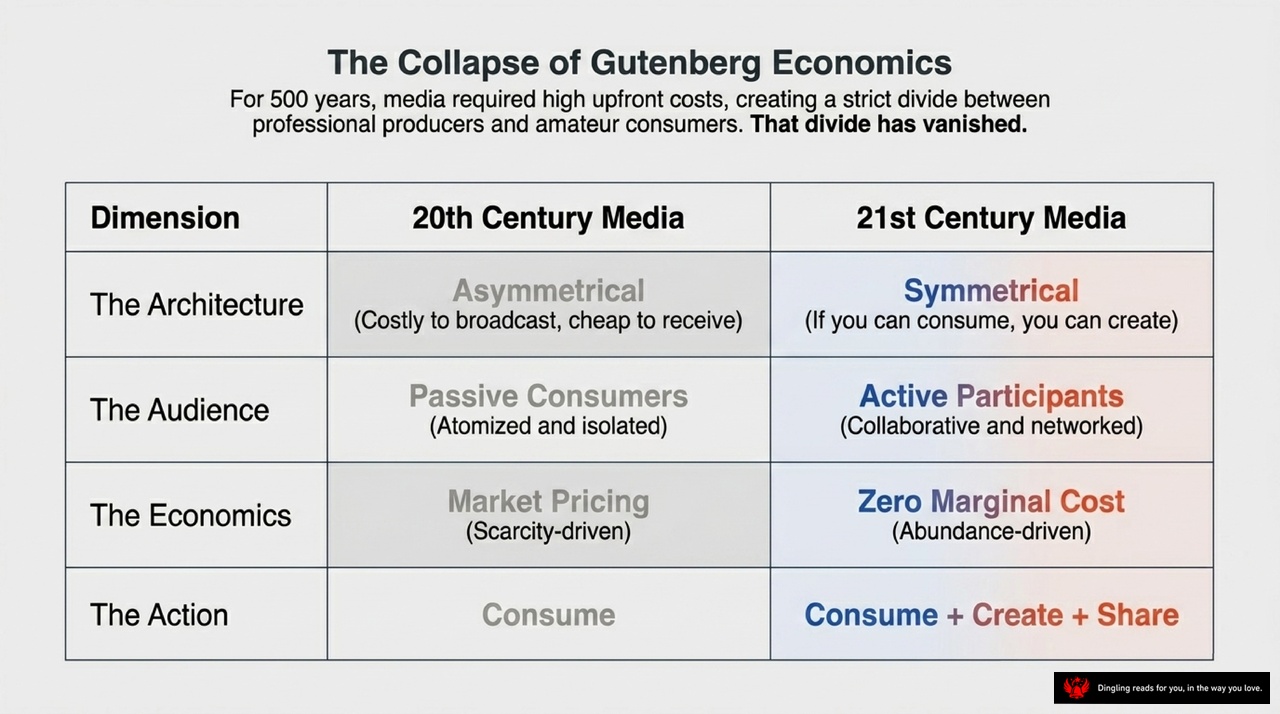
Look at this slide, "The Collapse of Gutenberg Economics." It captures a massive shift that has happened over the last 500 years. For centuries, media was built on high upfront costs, creating a strict wall between professional producers and amateur consumers. But that divide has vanished.
The table breaks this down into four key dimensions. First, the architecture. In the 20th century, it was asymmetrical—costly to broadcast, cheap to receive. Today, it's symmetrical. As the slide says, "If you can consume, you can create." The barrier to entry has disappeared.
Second, the audience. We moved from being "Passive Consumers," atomized and isolated, to becoming "Active Participants" who are collaborative and networked. You are no longer just watching; you are part of the conversation.
Third, the economics. We shifted from "Market Pricing," which was scarcity-driven, to a "Zero Marginal Cost" model driven by abundance. Once you create something digital, sharing it costs almost nothing.
Finally, the action. In the past, you simply consumed. Now, the action is a combination of "Consume + Create + Share." This isn't just about technology; it's about a fundamental change in how we live and connect. We have moved from a world where we only watched the show, to one where we help write the script.
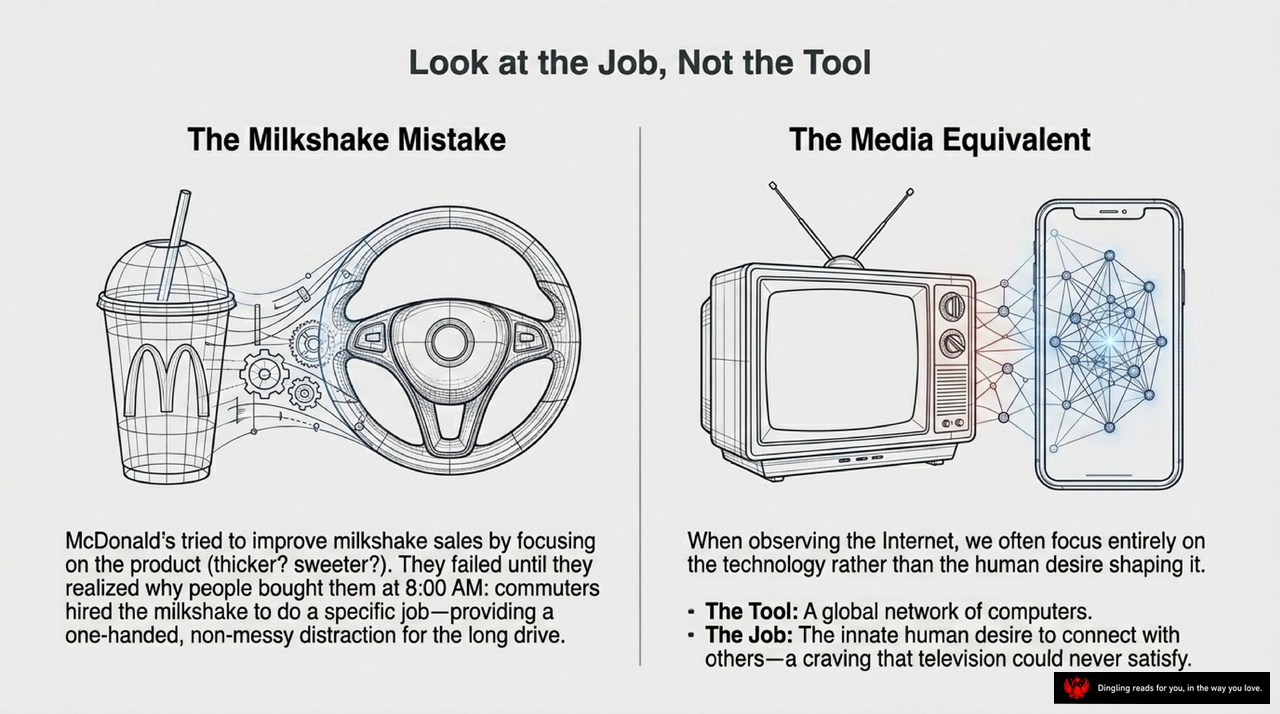
Look at the Job, Not the Tool. This slide perfectly captures a critical lesson from history: we often fixate on the wrong thing. On the left, we see the "Milkshake Mistake." For years, McDonald's researchers obsessed over the product itself—making milkshakes thicker, sweeter, or colder. They thought the job was to perfect the shake. But they were failing because they never asked, "What is the customer actually trying to do?" They finally figured it out by observing commuters at 8:00 AM. The real job wasn't to make a better dessert; it was to provide a one-handed, non-messy distraction for a long drive. The milkshake was just the tool to solve a specific problem.
On the right, we see the exact same trap happening in media. We are constantly looking at the technology—the computers, the bandwidth, the network—and assuming that's what drives us. But that's the mistake. The tool is just a global network of computers. The real job is the innate human desire to connect with others. Television, no matter how advanced its picture or sound, could never satisfy that craving for connection. Social media succeeded not because the tech was better, but because it finally allowed us to do the job we've always wanted to do: truly connect with each other. We need to stop focusing on the gadget and start solving the human need.
The slide highlights a crucial shift in how we create value, moving from private circles to the public good. It outlines four layers of value: personal, communal, public, and civic.
At the very base is **personal value**. Think of uploading a "Lolcat" image. Even if no one sees it, the act satisfies your creative urge. Digital tools let us freeze these moments, and with 2 billion potential viewers, even a tiny spark can gain public significance.
Above that is **communal value**, which serves only the group. A support group for new moms is a perfect example. Members share emotional support and coping strategies, creating a closed "circle of help." It's powerful internally but doesn't reach outside the group.
Next up is **public value**. This is open to anyone, and the results benefit everyone, even those who didn't participate. The Apache server project is the textbook example here. Developers from around the world contribute code not just for personal growth, but because they want the tool to be widely used. Their motivation is the expectation of public benefit, driving continuous sharing and iteration.
Finally, at the top, is **civic value**. Like public value, it's open, but its goal is to improve society itself. Consider India's "Pink Bra" movement. It didn't just help a specific group; it forced police intervention to protect the freedom of all Indian women. This requires stepping out of self-interest to tackle broader social issues.
While personal and communal groups will always exist to meet our immediate needs, creating public and civic value is harder but far more impactful. It's about using our cognitive surplus not just for entertainment, but to drive real societal progress.
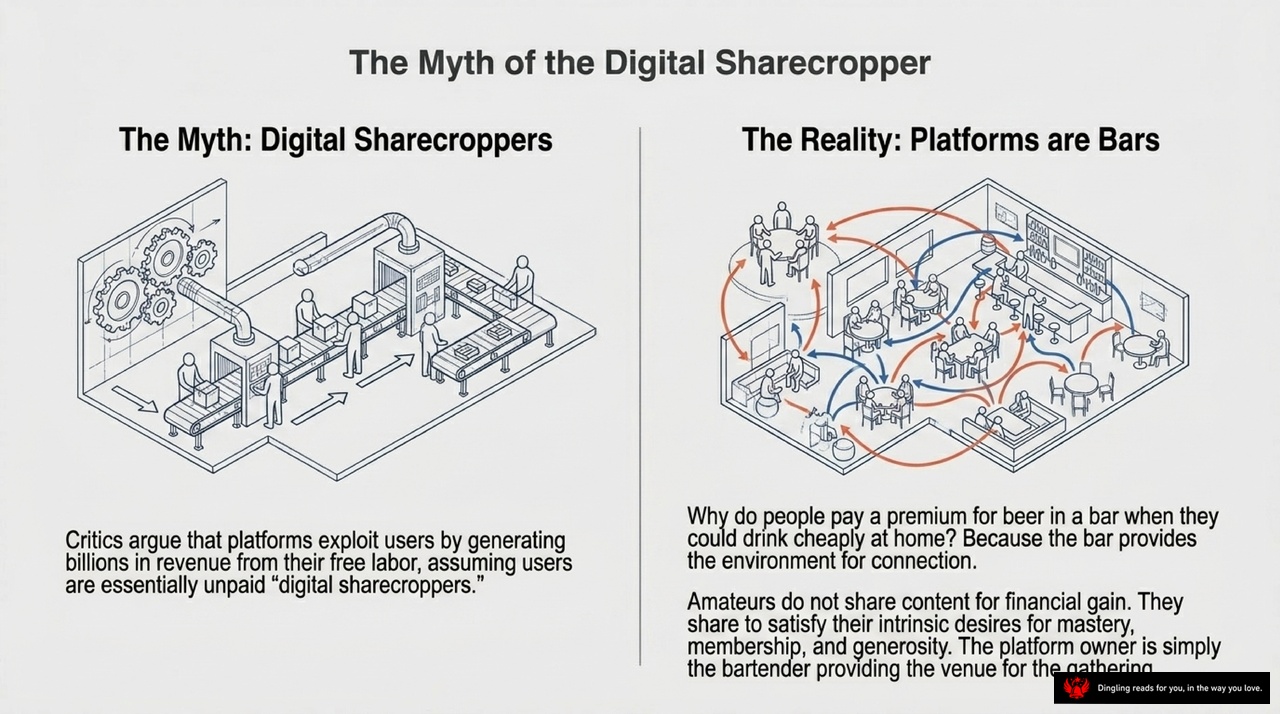
The slide you're seeing right now tackles a critical distinction: the difference between a "digital sharecropper" and a true "bar." Critics often argue that platforms exploit users, treating them like unpaid digital sharecroppers who generate billions in revenue through their free labor. The image on the left visualizes this myth—a rigid, factory-like assembly line where people are just cogs in a machine, passively feeding content into a system that extracts value without giving anything back.
But look at the reality on the right. This isn't a factory; it's a bar. Why do people pay a premium for a beer at a bar when they could drink cheaply at home? Because the bar provides an environment for connection. That's the core of the argument here. Amateur creators aren't sharing content for financial gain; they are sharing to satisfy intrinsic desires for mastery, membership, and generosity. The platform owner is simply the bartender, providing the venue for the gathering.
The value isn't in the content itself, but in the connection the platform facilitates. Just as people value the social atmosphere of a bar over the liquid alone, creators value the community and the opportunity to connect with others over the raw data they produce. This shift reframes the entire conversation from exploitation to empowerment, showing that when we design for human connection rather than extraction, we unlock a far more powerful and sustainable model for the digital age.

Zero discovery cost ignites latent motivation. The core idea here is simple yet profound: human motives haven't changed in centuries, but our ability to act on them has. Look at the graph. On the left, before the digital age, the "discovery cost" of finding people with niche interests was prohibitively high. Whether you were a model train enthusiast or someone with a rare disease, you remained isolated in your living room, unable to connect. This high cost kept your latent motivation dormant.
Then came the digital shift. As shown in the red curve, digital networks drive discovery costs to near zero. Suddenly, you can instantly locate your specific "tribe" globally. This isn't about tools creating new motives; tools unlock existing ones. They create opportunities to coordinate, experiment, and share entirely outside traditional institutional structures. That vertical jump in the graph represents the moment isolation turns into mass action. When the barrier to finding your community disappears, your hidden passions erupt into public life.

Look at this diagram. It flips the script on how we think about work. The title says "Organizing Without Organizations," and it makes a bold claim: we no longer need top-down management to handle complex, large-scale tasks.
On the left, we have the "Apache Server Proof." This is the ultimate evidence that big things don't always require big bosses. The software powering most of the world's websites wasn't built by a corporation. It was created by a decentralized, unpaid community of programmers collaborating in their free time. Think about that. Millions of people, no CEO, no strict hierarchy, yet they built the backbone of the internet.
Now, look at the center. It contrasts two worlds. The top shows the traditional pyramid: CEO, Management, Departments, Employees. It's rigid, top-down, and relies on control. But below that, we see the new reality. It's a web of connections. You have Peer Nodes, Contributors, Projects, and Modules all linked together. Instead of arrows pointing up to a boss, we see arrows flowing in every direction. This is how it functions without managers.
On the right, the slide breaks down the mechanics of this new system into three key pillars. First, Modular Tasks. This means anyone can fix a small bug independently. You don't need permission to contribute a piece of code; you just do it. Second, Shared Culture. This is the glue. It's a strict commitment to open collaboration and peer review. When everyone checks everyone else's work, trust replaces supervision. And third, Governance. This is about licensing that protects the commons from private enclosure, ensuring that what we build together stays open for everyone.
Finally, look at the quote at the bottom: "A good community with bad code is a good project." This is a profound insight. It tells us that the culture of the group dictates success far more than the initial quality of the tool. In a traditional organization, if you hire a bad person, the whole project suffers. But in a community like Apache, if a few people make mistakes, the rest of the community catches them, fixes them, and moves forward. The system is resilient because it's built on people, not just rules.
So, this slide isn't just about software. It's a blueprint for a new way of working. It suggests that if we can replicate this open, modular, and culturally driven model in other industries, we might finally unlock the full potential of human collaboration without the heavy cost of bureaucracy.
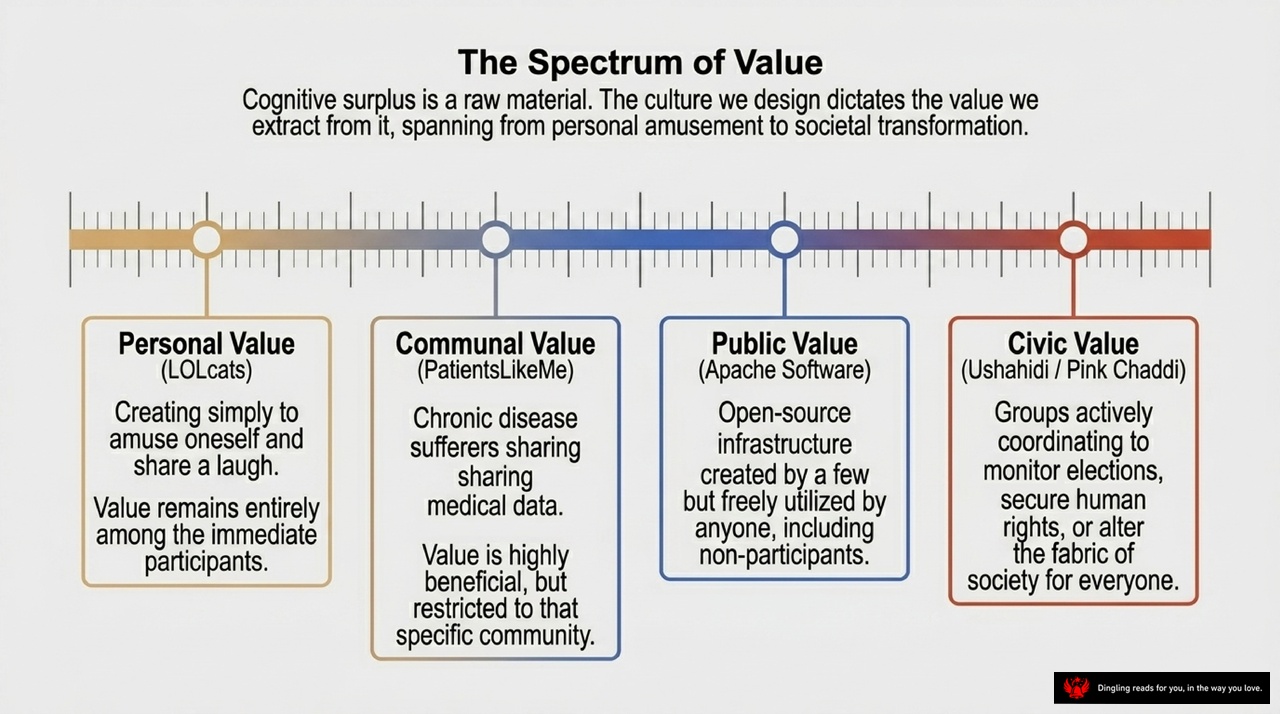
Imagine a spectrum of value stretching from personal joy to societal transformation. This slide maps exactly how we extract meaning from our cognitive surplus. On the far left, we have **Personal Value**, like sharing "LOLcats." It's simple: creating just to amuse ourselves and share a laugh, where the value stays entirely among the immediate participants. Moving right, we enter **Communal Value**, exemplified by platforms like PatientsLikeMe. Here, chronic disease sufferers share medical data. The value is highly beneficial, but it remains restricted to that specific community. Next is **Public Value**, represented by open-source infrastructure like Apache Software. A few people create it, but anyone, including non-participants, can freely utilize it. Finally, on the far right, lies **Civic Value**, seen in movements like Ushahidi or Pink Chaddi. Here, groups actively coordinate to monitor elections or secure human rights, altering the very fabric of society for everyone. As the text reminds us, cognitive surplus is just raw material; the culture we design dictates whether we use it for a private laugh or for a societal revolution.
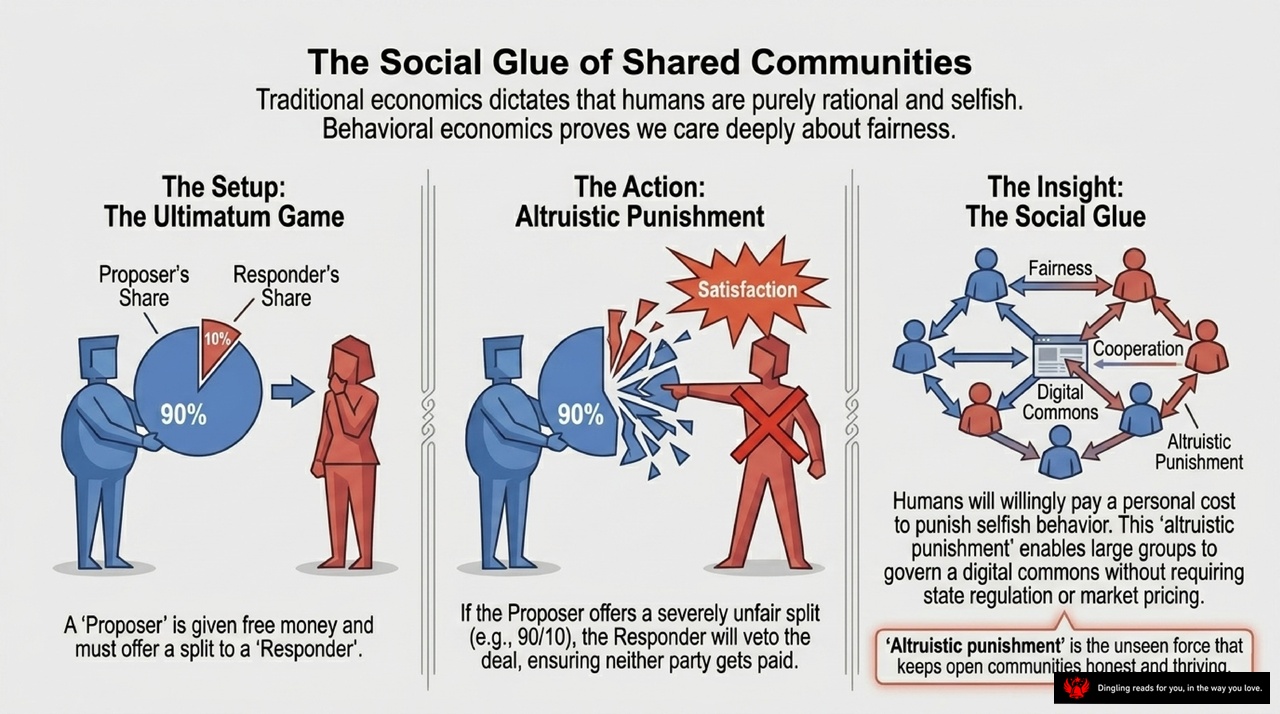
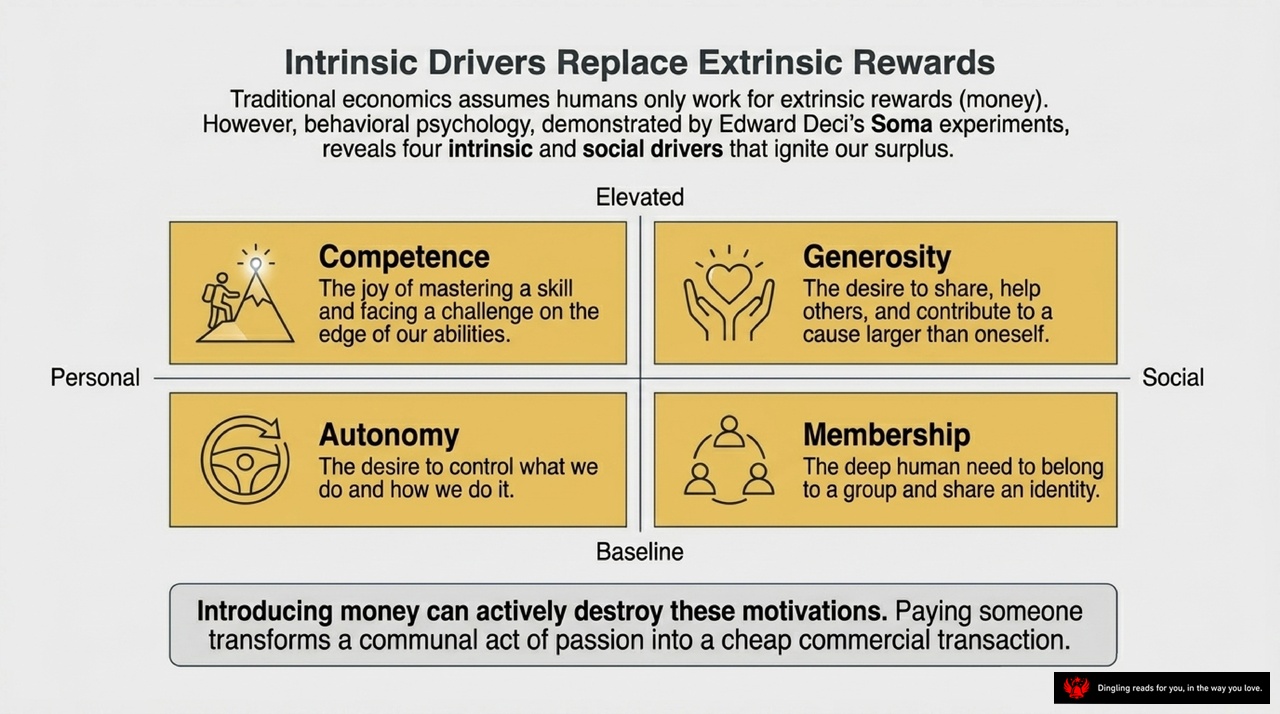
Traditional economics has long taught us to view humans as purely rational and selfish calculators, but behavioral economics tells a very different story. We care deeply about fairness, often more than we care about our own wallets. Look at this diagram: it illustrates the Ultimatum Game, where a proposer offers a split of money, say 90 percent to themselves and just 10 percent to a responder. If that offer seems too unfair, the responder has the power to veto it, meaning neither person gets paid. And guess what? Most people reject these stingy offers. They would rather lose money than let someone else get a free ride.
This behavior is known as altruistic punishment. We are willing to pay a personal cost simply to punish selfish behavior. It acts as an invisible social glue, keeping communities honest and cooperative without needing a police force or a strict boss. When we see unfairness, we feel a surge of satisfaction in rejecting it, and that feeling drives us to protect the group. This dynamic is what allows large groups to govern themselves, especially in digital commons where there are no traditional rules or market prices. It proves that our shared sense of fairness is the real foundation of trust and cooperation in any community.
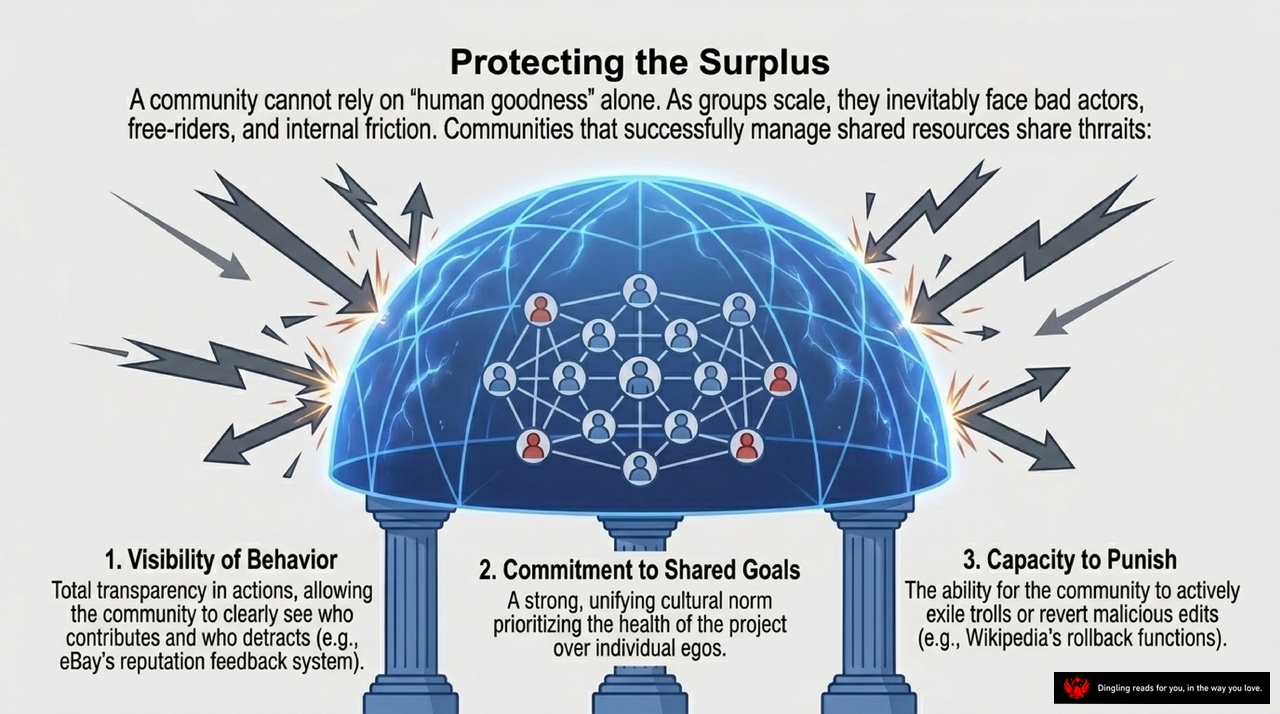
Protecting the Surplus is all about making sure a community doesn't just rely on "human goodness." As groups get bigger, bad actors, free-riders, and internal friction inevitably show up. Communities that successfully manage shared resources share three key traits: total visibility of behavior, a strong commitment to shared goals, and the capacity to punish.
Think about eBay's reputation feedback system. It creates total transparency, letting everyone clearly see who contributes and who detracts. Without this visibility, trust collapses. Similarly, consider Wikipedia's rollback functions. This is the capacity to punish—it gives the community the power to actively exile trolls or revert malicious edits. Without the ability to enforce norms, the project falls apart.
But it's not just about rules and penalties; it's about culture. This is the commitment to shared goals. It's a strong, unifying cultural norm that prioritizes the health of the project over individual egos. When a community internalizes these standards, they move from passive users to active guardians. This shift transforms free time from a personal distraction into a powerful social asset, allowing us to turn our scattered moments of idle time into a coordinated force for good.

Imagine a four-year-old girl crouching in the dark, tangled in a mess of cables behind a TV screen. When her father asks what she's doing, she simply replies, "Looking for the mouse." This isn't just a cute story about a child playing; it is the perfect metaphor for the new default of human expectation. To this next generation, a screen without a mouse—without the ability to talk back—is literally broken.
We are witnessing a massive paradigm shift. For decades, media was a one-way street where professionals spoke and we listened. But today, interactivity, creation, and sharing are no longer optional extras; they are the baseline state of existence. Young people don't just consume content; they comment, share, and even co-create stories. They expect to be part of the conversation, not just an audience member.
This shift is happening because our tools have changed. When a tool allows us to connect and express ourselves, we naturally use it that way. The "mouse" represents that power to participate. If we don't design systems that allow for this interaction, we aren't just missing a feature; we are ignoring a fundamental human need. The future belongs to those who understand that people don't want to be told what to watch or read; they want to be the ones who help write the story.

How to Harness the Surplus
Look at this diagram. It contrasts two very different ways of building the future. On the left, you see "Traditional Master Planning." It's a straight line, rigid and confident, heading straight for a wall. In our old world, we believed that if we just planned carefully enough, we could predict the future and build the perfect solution. But as the image shows, this approach inevitably crashes. The possibilities of networked groups are too unprecedented for a static master plan to handle.
Instead, the slide proposes the "Network Innovation Loop." This is a red, winding path that embraces failure. It's a cycle of Try, Fail, Learn, and Adapt. The text reminds us that value is no longer discovered through rigid planning, but through rapid, chaotic experimentation. We need to start small—don't build for a million users; build a system that is exceptional for just ten, and let it scale naturally. We must ask "Why?" by designing for intrinsic and social motivations, not just technical efficiency. And finally, we must adapt quickly by observing what users actually do and letting them design the culture.
The core message at the bottom is clear: the only way to find the next great civic innovation is to let groups try as many things as possible. We need to stop trying to control the outcome and start harnessing the surplus of human creativity by allowing the network to find its own path.
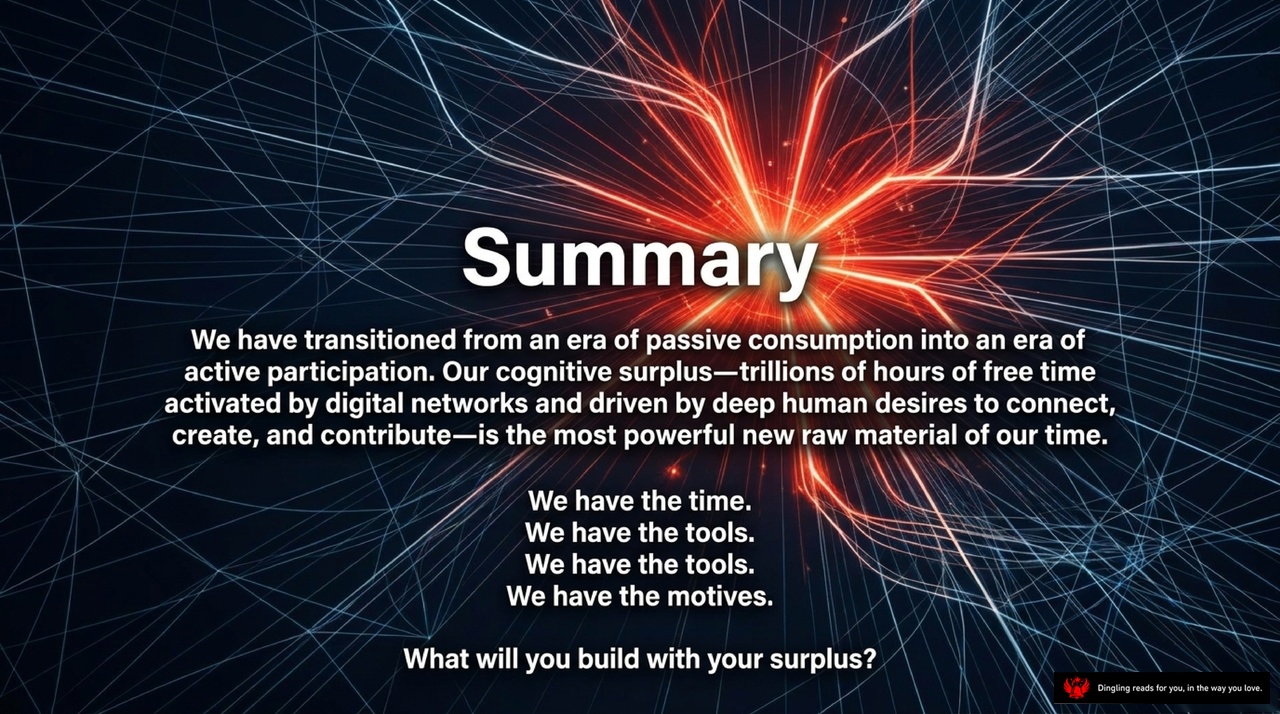
So, we've reached our summary slide. Let's tie everything together.
We've officially transitioned from an era of passive consumption into one of active participation. Think about it: we now have a "cognitive surplus"—trillions of hours of free time, activated by digital networks and driven by our deep human desires to connect, create, and contribute. This is the most powerful raw material of our time.
Look at the core equation we've built together: We have the time. We have the tools. And we have the motives.
The "cognitive surplus" isn't just about having spare hours; it's about the collective potential of those hours when we shift from watching to doing. Whether it's the collaborative power behind Wikipedia, the crisis mapping of Ushahidi, or even the cultural impact of something as simple as "Dancing Cat," the scale of what we can achieve is staggering.
But here's the real question hanging at the bottom of this slide: What will you build with your surplus?
The future doesn't belong to those who hoard their free time, but to those who use it to create, share, and connect. The tools are in your hands, the community is waiting, and the opportunity is right now. So, don't just consume the world. Build something new with it.