
Common Stocks and Uncommon Profits: Complete Chapter-by-Chapter Summary
Welcome to today's session on "Common Stocks and Uncommon Profits" by the legendary Philip A. Fisher. Think of this book not just as a manual, but as a timeless architectural blueprint for building profound wealth through rigorous qualitative business analysis.
In this presentation, we are looking at the core philosophy that separates ordinary investors from those who build generational fortunes. The central idea is simple yet powerful: true wealth comes from finding outstanding growth companies and holding them for the long term, ignoring market noise and short-term fluctuations.
Fisher teaches us that the most effective way to invest is to find a small number of exceptional companies with massive growth potential and hold them tightly. He contrasts this with the outdated strategy of trying to time the market or chase short-term trends, which often leads to losses. Instead, he emphasizes the importance of deep research into management quality, innovation, and sales capability.
By focusing on these high-quality growth stocks and holding them patiently, investors can achieve returns that far exceed the average market performance. This approach requires discipline, a willingness to go against the crowd when necessary, and a deep understanding of the businesses you own. Let's dive deeper into how to identify these uncommon opportunities and build a portfolio that stands the test of time.
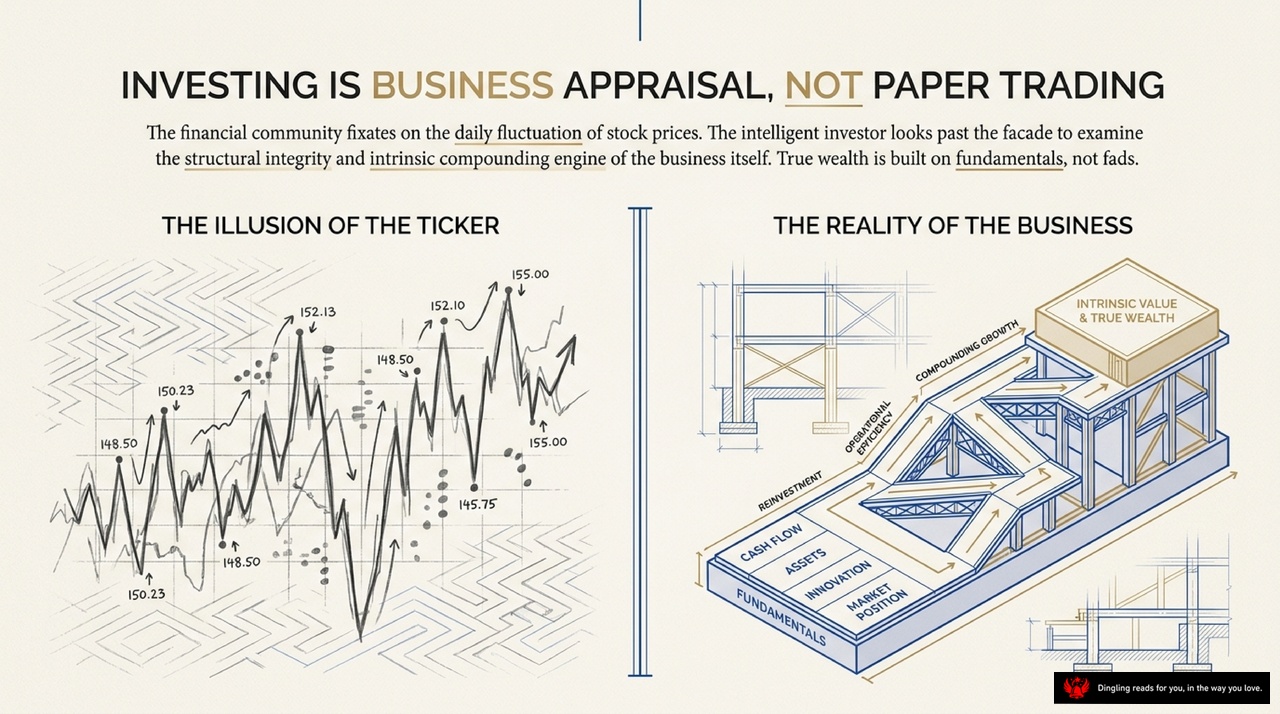
Most investors get it wrong from day one. They treat the stock market like a casino, obsessed with the daily jitter of the ticker tape, chasing every little spike and drop. But that is just the illusion of the ticker—a chaotic mess of noise that tells you nothing about reality.
True investing isn't about paper trading or guessing the next headline. It is about business appraisal. You have to look past the facade and examine the structural integrity of the company itself. Think of it like building a skyscraper. On the left, you have the shaky, unpredictable market swings. But on the right, you have the reality of the business. This is where true wealth is built.
Look at that foundation labeled "Fundamentals." That is your starting point. It's not about the stock price; it's about the bedrock: Cash Flow, Assets, Innovation, and Market Position. When you get these right, everything else follows. You reinvest those profits, which drives operational efficiency and compounding growth. And eventually, that structure supports the roof: Intrinsic Value and True Wealth.
The financial community fixates on the daily fluctuation, but the intelligent investor looks past the facade. They don't care if the stock price drops to 145.75 or spikes to 155.00; they care if the business underneath is getting stronger. True wealth is built on fundamentals, not fads. So, stop watching the chart and start building the building.
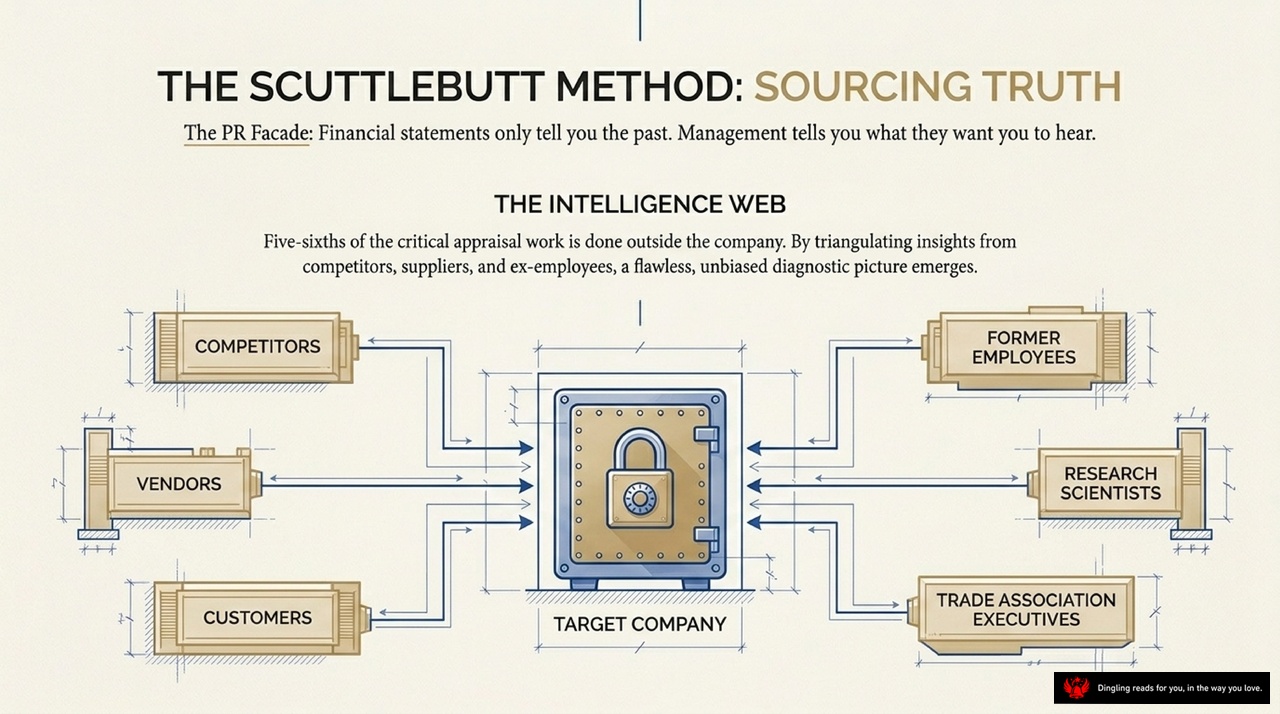
Let's dive into the "Scuttlebutt Method," a powerful strategy for uncovering the truth behind a company's financial facade. As the slide illustrates, relying solely on financial statements or what management tells you is often a trap; those numbers only reflect the past, not the future. To get a real, unbiased picture, you need to tap into "The Intelligence Web."
This method suggests that five-sixths of your critical appraisal work should happen outside the company walls. Instead of waiting for official reports, you triangulate insights from a diverse network of external sources. Think of it as building a 360-degree view of your target company by connecting with its competitors, vendors, customers, former employees, research scientists, and trade association executives.
The graphic shows how information flows from these six key groups into the center—the target company—to reveal its true potential. For example, asking a competitor about market share or talking to a former employee about internal culture can tell you more than any annual report ever could. However, there's a golden rule here: you must keep your sources anonymous. If they know you're digging, they won't speak the truth. By weaving together these independent threads of information, you create a flawless diagnostic picture that helps you see through the PR facade and find the real value hidden in the market.
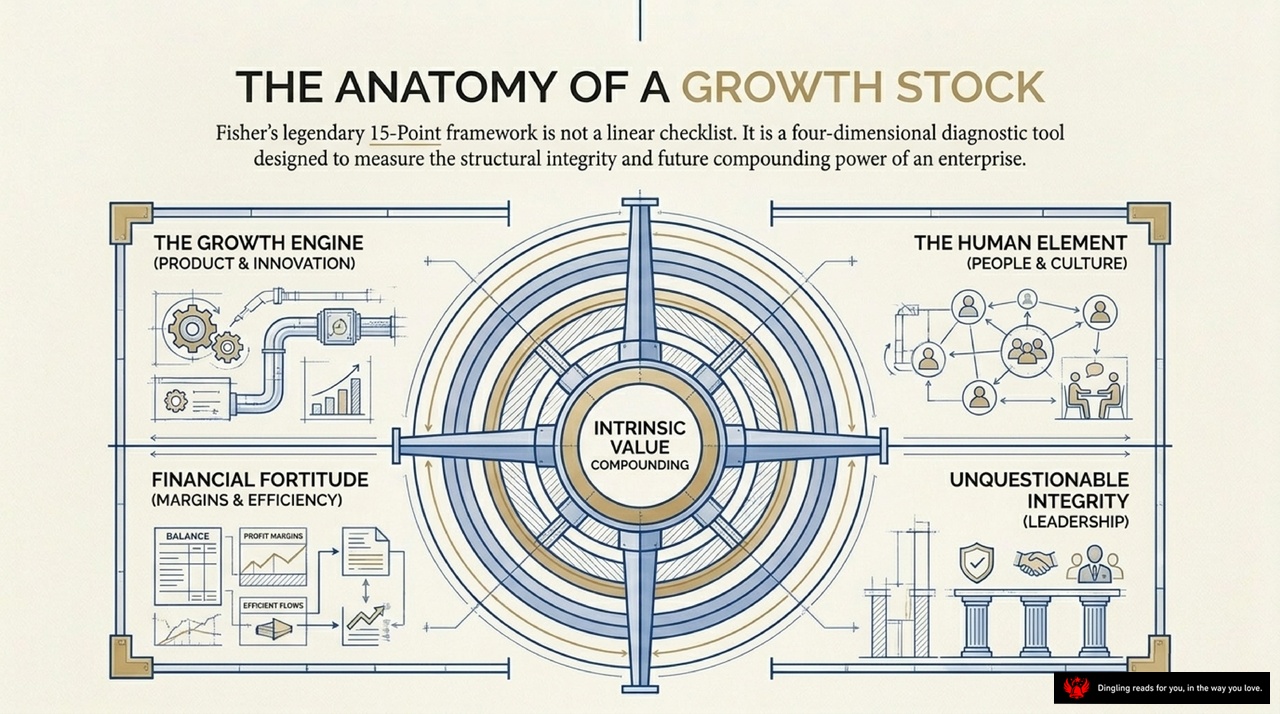
The Anatomy of a Growth Stock isn't just a simple checklist; it's a four-dimensional diagnostic tool designed to measure the structural integrity and future compounding power of an enterprise. Think of this framework as the blueprint for true value creation. At the very heart of this system lies Intrinsic Value and Compounding. This is the engine that drives everything else.
Surrounding this core are four critical pillars that must align for a company to succeed. First, you have The Growth Engine, driven by Product and Innovation. Without a compelling product that captures market share, nothing else matters. Second, you need Financial Fortitude, focusing on Margins and Efficiency. High profits aren't just about revenue; they are about how efficiently you operate and manage your costs.
But a great product and strong finances aren't enough if the people aren't right. That's where The Human Element comes in, encompassing People and Culture. A company's culture and its team's ability to execute are often the difference between a temporary trend and a lasting legacy. Finally, you must have Unquestionable Integrity, rooted in Leadership. Trust is the most valuable currency in investing. If management lacks integrity, the other three pillars don't matter.
In short, a growth stock is only as strong as its weakest link. You need a powerful growth engine, solid financials, a talented team, and ethical leadership, all working together to compound value over time.
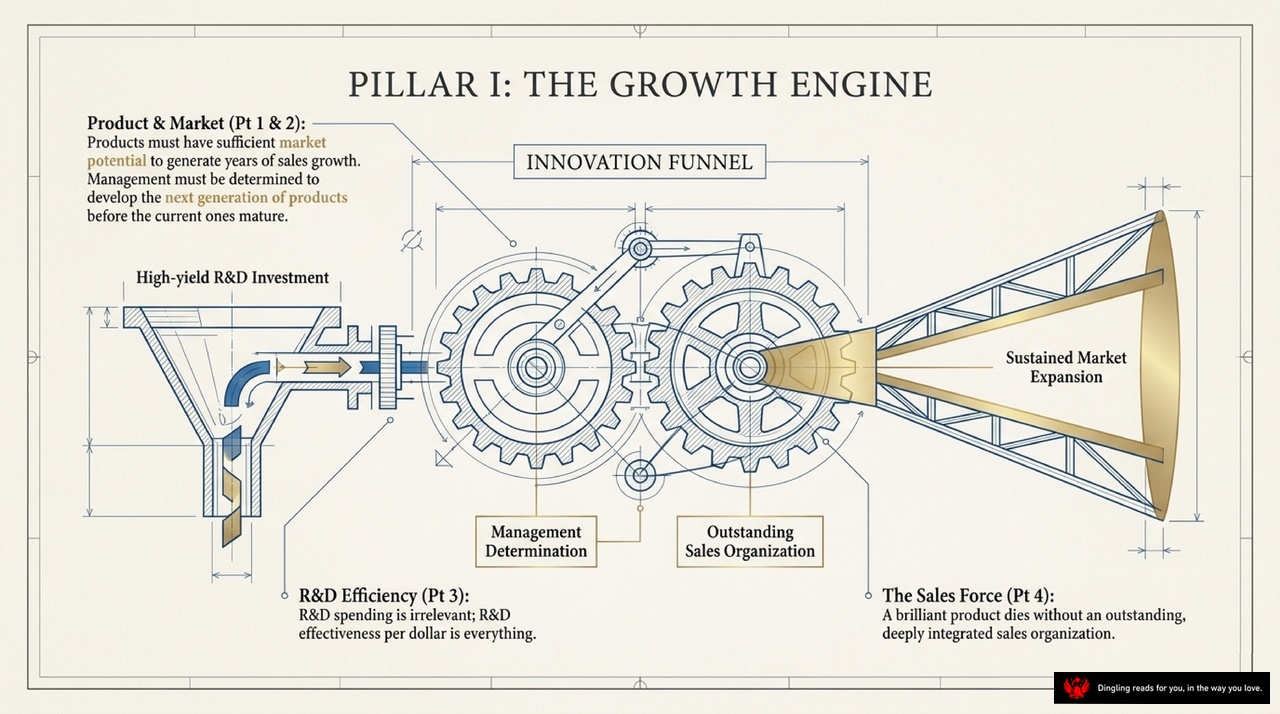
Think of your portfolio not as a scattered basket of eggs, but as a precision-engineered machine designed for sustained growth. As we dive into the fourth pillar of our discussion, remember that true diversification isn't about owning as many stocks as possible; it's about owning the right number of high-quality companies you truly understand.
The key is to categorize your investments into three distinct tiers. First, anchor your portfolio with a core of five or more large, established growth companies—think giants like DuPont, Dow, or IBM. These should make up the bulk of your investment, with no single holding exceeding 20% of your total capital. Their stability provides a safety net.
Second, layer in a few medium-sized growth stocks, perhaps two or three, that sit between the giants and risky startups. Allocate about 8% to 10% to each. These companies have strong management but carry slightly higher risk.
Finally, reserve a small portion for high-risk, small-cap opportunities. If you choose to invest here, limit each position to no more than 5% of your total funds, and only use money you can afford to lose entirely.
Crucially, do not over-diversify. Once you hit the minimum number of stocks needed to manage risk, adding more is counterproductive. It often signals a lack of conviction in your research and dilutes your returns. Instead of chasing quantity, focus on quality. As we've learned, the real power of investing comes from concentrating your capital on a few exceptional companies with proven long-term potential, rather than spreading yourself too thin across dozens of unknowns.

Pillar II: The Human Element. This pyramid illustrates the non-negotiable foundation for building a truly exceptional company. It all starts at the base with Exceptional Labor Relations. As we know from Chapter 8, high wages and excellent working conditions are far cheaper than the hidden costs of strikes, high turnover, and employee apathy. But a great workforce alone isn't enough; that stability must be built upon a Deep Bench of Management Talent. Companies cannot rely on a single "star" founder to survive decades. True growth requires a culture where authority is delegated and a robust pipeline of leaders is cultivated from within. This leads us to the upper tiers. We need Promotions from Within to ensure loyalty and institutional knowledge, culminating in an Executive Suite that is both Harmonious and Empowered. As Chapter 9 emphasizes, executives must be evaluated purely on performance, completely free from internal politics. Without this alignment, a company crumbles. Finally, Chapter 10 reminds us that management depth is critical; without it, even the best strategy fails. This entire structure proves that the human element is not just a department—it is the very engine of sustainable value.

Imagine your company as a fortress designed to withstand the inevitable storms of the economy. This slide outlines the third pillar of our strategy: Financial Fortitude. Think of this entire structure as a "Margin Moat"—a protective barrier that shields your profits from recessions and fierce competition.
At the very top sits **Profit Margins**. This is your ultimate buffer. A high profit margin isn't just a number; it's the shock absorber that keeps your business standing when the market crashes. But margins alone aren't enough. That's where **Margin Maintenance** comes in. It's not about looking back at past profits; it's about building structural advantages. Think of it as your scale economies and proprietary technology—these are the deep roots that protect your future earnings no matter what happens outside.
Beneath that, we have **Proprietary Processes**. These are your unique, hard-to-copy methods that give you an edge competitors simply cannot replicate. Finally, the foundation is built on precise **Cost Accounting**. Management must have a microscope to see exactly where every dollar goes, allowing them to identify profitable segments and ruthlessly eliminate waste.
Together, these four layers create a robust defense. When arrows representing recessions and competition strike, this fortified structure absorbs the impact, ensuring that your business doesn't just survive the downturn, but remains strong enough to thrive when the market recovers. This is the essence of financial resilience.
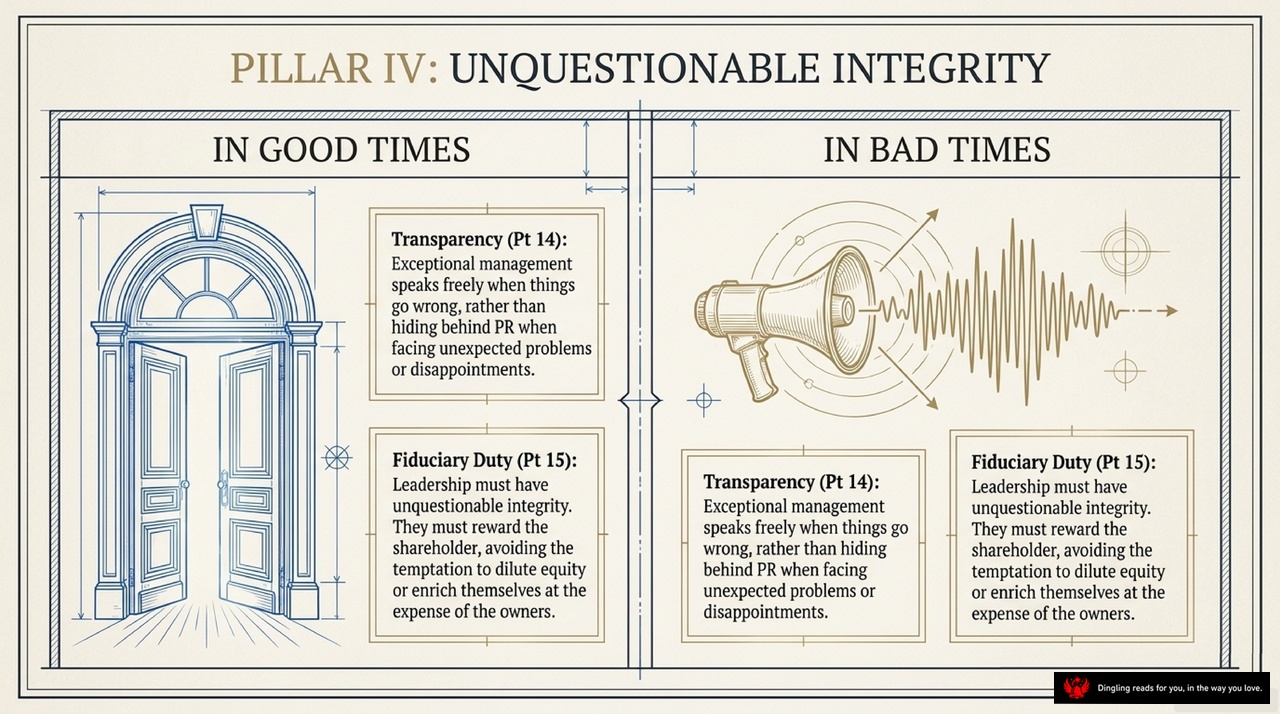
Pillar IV: Unquestionable Integrity. This is the bedrock of everything we've discussed. It's not just a nice-to-have trait; it's the single most critical filter for selecting a company.
Look at the slide. We've split this into two scenarios: Good Times and Bad Times. And the message is strikingly consistent across both.
First, Transparency. Whether the company is soaring or stumbling, exceptional management speaks freely when things go wrong. They don't hide behind PR spin or bury bad news. They own their mistakes and disappointments. This builds the trust required for long-term partnership.
Second, Fiduciary Duty. Leadership must have unquestionable integrity. They must reward the shareholder. This means avoiding the temptation to dilute equity or enrich themselves at the expense of the owners.
In good times, this integrity attracts capital and fuels growth. In bad times, it acts as an anchor, keeping shareholders onside when fear sets in. If you can't trust the people running the show, no amount of great product or market tailwinds will save your investment. Integrity isn't optional; it's the price of admission for any serious, long-term growth opportunity.

The chart before us illustrates a critical concept known as "The Dividend Fallacy." It highlights a fundamental flaw in how many investors approach wealth creation: the relentless pursuit of high dividends. As the graph shows, pulling capital out of a company as taxable dividends—represented by the flatter, gray line labeled A—destroys the exponential compounding curve. In contrast, allowing a company to retain earnings and forcefully reinvest them back into a high-return business engine—depicted by the steep, blue curve leading to point B—creates true exponential growth.
This isn't just about accounting; it's about the engine of wealth. When an exceptional management team has the opportunity to reinvest retained earnings at high rates of return, taking that cash out as dividends essentially wastes the company's most powerful asset: its ability to compound. The text emphasizes that this structural flaw means that for long-term wealth creation, especially for individuals who don't need the income stream today, holding onto companies that reinvest profit is far superior to chasing companies that pay it out.
The visual clearly distinguishes between "High Dividends," which lead to wealth lost to personal taxes and a lack of internal reinvestment, and "Retained Earnings," which fuel the business engine. The lesson is simple but counterintuitive: for the vast majority of investors, the path to massive wealth isn't found in the dividend check you receive today, but in the capital the company keeps to build tomorrow. You want a company that reinvests, not one that just pays.
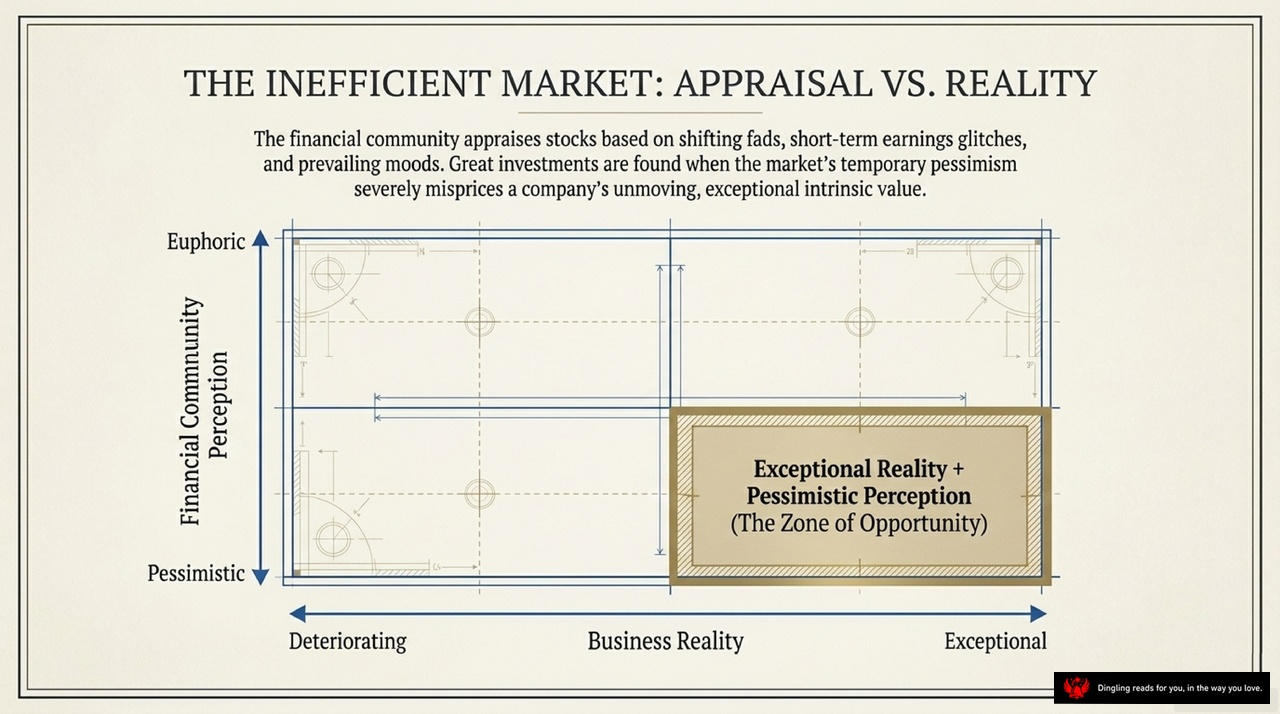
Imagine a world where the financial community is like a weather vane, constantly spinning with every shifting fad, short-term earnings glitch, and prevailing mood. This is the inefficient market. As we see on this slide, the gap between what the market thinks a company is worth—its appraisal—and what the company actually is—its reality—is where the real money is made.
Look at this grid. The vertical axis represents the "Financial Community Perception," swinging wildly between "Euphoric" and "Pessimistic." The horizontal axis shows the "Business Reality," ranging from "Deteriorating" to "Exceptional." Most investors chase the euphoric side or panic at the pessimistic side, but the true opportunity lies in that shaded box in the bottom right corner. This is the "Zone of Opportunity." It is defined by "Exceptional Reality plus Pessimistic Perception."
Think about it: Great investments are found precisely when the market's temporary pessimism severely misprices a company's unchanging, exceptional intrinsic value. The financial community might be freaking out because of a bad quarter or a negative headline, driving the stock price down into the "Pessimistic" zone. But if you look at the business reality, that company is actually operating at an "Exceptional" level. Its product has massive potential, its management is brilliant, and its long-term growth trajectory is solid.
The text above the chart explains it perfectly: "Great investments are found when the market's temporary pessimism severely misprices a company's unmoving, exceptional intrinsic value." In other words, you don't buy a stock because everyone is cheering for it. You buy it because everyone is ignoring it or panicking about it, while the underlying business is actually thriving. The slide reminds us that we must ignore the noise of the "shifting fads" and focus on the solid, unmovable value of the business itself. When reality is exceptional but perception is pessimistic, you have found your edge. That is the moment to buy.

The illusion of safety in numbers is a trap many investors fall into. As the slide illustrates, true safety doesn't come from blindly spreading capital across mediocre companies; ignorance simply cannot be diversified away. Instead of the amateur approach of owning fifty or more stocks with only a superficial understanding of operations, you need to embrace intelligent concentration.
Think of it like the visual contrast on this screen: amateur diversification is like firing a shotgun, scattering your money everywhere hoping for a hit, which often results in structurally average returns. Intelligent concentration, however, is like aiming a precise shot at a target. This means owning just ten to twelve exceptional companies where you possess deep, qualitative knowledge of their management and operations.
When you take this focused approach, you move from tracking businesses poorly to gaining an intimate understanding of how they work. This allows you to harness elite, exponential compounding rather than settling for mediocre growth. Remember, you can't diversify your way out of a lack of knowledge. By concentrating your resources on a few outstanding companies you truly understand, you create a far more robust and resilient portfolio than you ever could by spreading yourself too thin.

When it comes to buying, most people try to time the market, but that is a fool's errand. Instead of chasing cycles, you should wait for a structurally sound company to encounter a temporary, solvable glitch or face broad, unwarranted macro-economic pessimism. The golden rule is simple: buy the business when the noise drowns out the signal.
This slide perfectly illustrates that "Execution Trigger." You are looking for the intersection of three specific circles. First, you need **Exceptional Business Fundamentals**, often referred to as "The 15 Points"—a company with a durable moat, an honest management team, and a history of innovation. Second, you must identify a **Temporary Solvable Glitch**. This could be an operational delay, a minor product stumble, or simply a period of high spending that hasn't yet yielded returns. Third, you need **Macro-Market Panic & Institutional Apathy**. This is when the broader economy is fearful, and smart money is fleeing, causing the stock price to drop significantly.
The magic happens in the center where these three overlap. When a great company faces a temporary problem, and the entire market is panicking, the price disconnects from the intrinsic value. This is your moment to buy. As the text reminds us, attempting to predict the future is impossible, but recognizing when a brilliant business is being sold cheap due to temporary confusion is a skill you can master. Don't wait for the market to cheer; wait for it to panic, and that is when you step in.
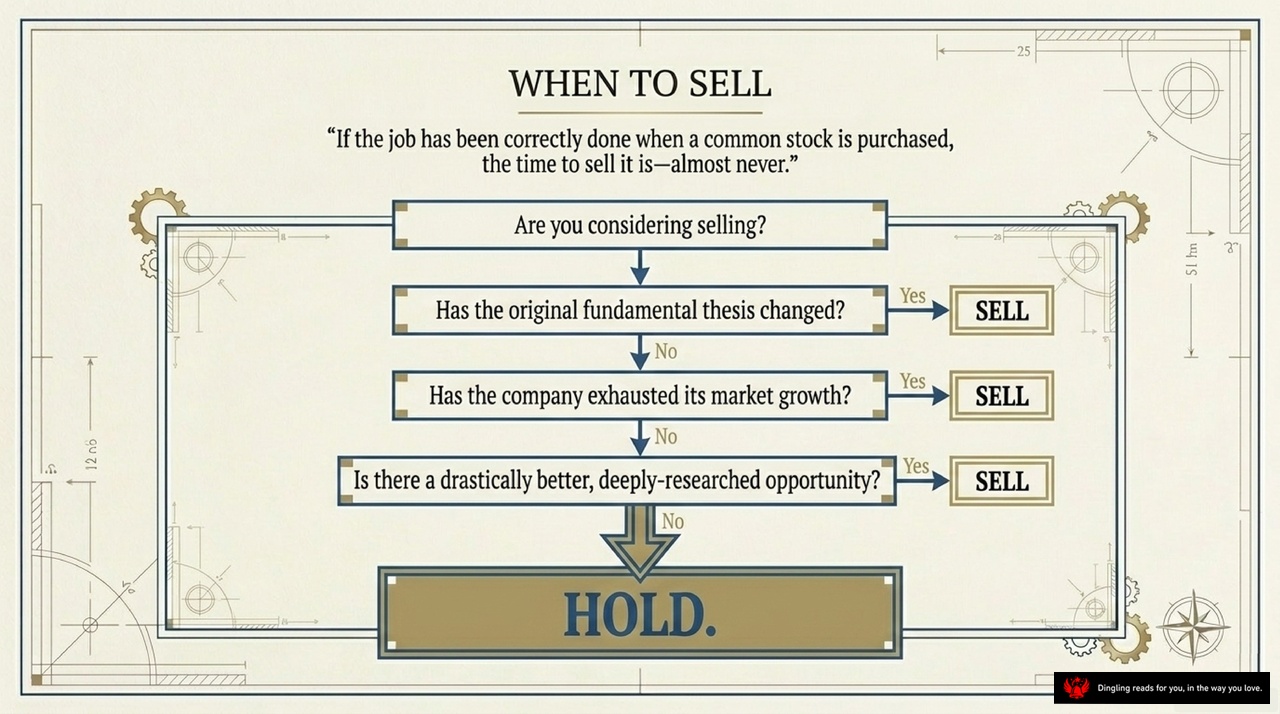
Imagine a blueprint for your portfolio, one that cuts through the noise of market panic and tells you exactly when to sell. As you look at this flowchart, notice the first critical question: "Has the original fundamental thesis changed?" If your reason for buying that company—perhaps its unique technology or dominant market position—is no longer true, then it's time to sell. Don't hold onto a sinking ship just because you bought it cheap.
But what if the core reason you invested remains solid? The chart then asks, "Has the company exhausted its market growth?" If the industry is flat and the company can no longer grow faster than the average, selling is the logical move. However, if growth potential is still alive, we move to the final, most common trigger: "Is there a drastically better, deeply-researched opportunity?" Only if you find a superior investment that clearly outshines your current holding should you switch.
Here is the golden rule that anchors this entire strategy: "If the job has been correctly done when a common stock is purchased, the time to sell it is—almost never." This means if the company is still executing its vision, the market is still rewarding its growth, and no better alternative exists, you simply hold. The market's short-term fluctuations, the fear of a crash, or the temptation to chase hot tips are not valid reasons to sell a quality compounder. True wealth comes from patience and conviction, letting your best ideas run their course until the fundamental story truly changes.

So, we've reached the final chapter of our journey: The Culmination. Building a Masterpiece.
Look at the blueprint on your screen. It's not just about throwing darts at a board or chasing the latest market trend. True wealth isn't built by trading fluctuations or trying to outsmart the crowd. It is constructed like this building we see here—using qualitative intelligence to identify exceptional compounding engines, buying them when the market is ignoring them, and having the sheer discipline to let them run.
Think about your own life. Are you spending your days trading pieces of paper, hoping for a quick flip? Or are you actually building the discipline to own a masterpiece?
The answer lies in the companies you choose. We need businesses with durable competitive advantages, managed by leaders who prioritize long-term growth over short-term earnings. When you find those few true outliers, you don't sell just because the stock price goes up. You hold on. You let the compound interest do its work.
Remember, the market will be wrong about these companies more often than it will be right. That's actually your opportunity. If you have the patience to hold through the noise, the results will speak for themselves. So, ask yourself today: Are you building a portfolio of masterpieces, or just a collection of temporary gains?