
Company of One: Complete Chapter-by-Chapter Summary

Welcome to “Company of One” by Paul Jarvis. Today, we’re diving into a bold idea: why staying small is actually the next big thing for business. In a world obsessed with scaling up, going viral, and chasing massive growth, this book flips the script. It’s not about how big you can get—it’s about how well you can stay focused, lean, and truly effective as a one-person business. This isn’t just theory; it’s a practical guide for entrepreneurs who want to build something meaningful without getting lost in the noise of corporate expansion. Let’s explore what it means to thrive as a company of one.

Let’s be honest: we’ve all been sold the same script. From school to boardrooms, the message is clear—success means more. More people, more products, more scale. We’re told that growth is the only path to value, that adding “more” is always the answer. But here’s the uncomfortable truth: that narrative might be lying to us.
This slide calls it “The Growth Trap.” And it’s not just a catchy title—it’s a warning. Look at the data: 74% of high-growth tech startups fail because they scaled too early, too fast. That’s not a failure of product or market. It’s a failure of timing and discipline. Meanwhile, two out of three of the fastest-growing companies end up folding, downsizing, or selling for far less than they could have. Why? Because they chased growth instead of solving real problems.
So what’s the alternative? Slowing down. Choosing quality over quantity. Sometimes, the smartest move isn’t to grow—but to prune, to focus, to do less but better. This isn’t about rejecting ambition. It’s about rejecting the idea that growth is always good. In fact, sometimes, adding more just adds friction. And in today’s market, that friction can kill your business before it ever gets started.
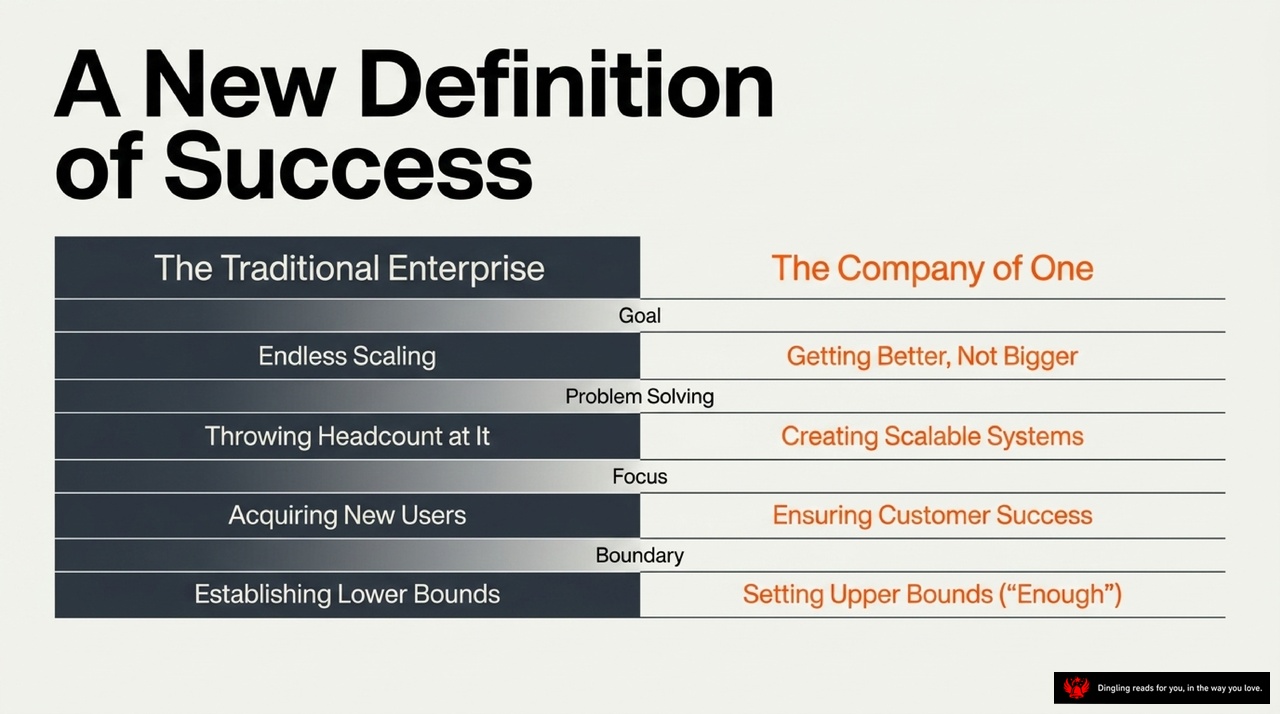
We’re not just redefining success—we’re redefining what it means to run a business.
In the old model, success meant endless scaling: grow your team, expand your market, keep hiring. But in “The Company of One,” success is about getting better—not bigger. It’s not about how many people you have, but how well your systems work.
Instead of throwing headcount at every problem, the modern entrepreneur builds scalable systems that solve issues without needing more people. And instead of chasing new users, you focus on making sure your current customers are thriving.
Finally, instead of setting a lower bound—“how much do we need to survive?”—you set an upper bound: “How much is enough?” That’s the new definition of success. It’s not about growth for growth’s sake. It’s about impact, sustainability, and knowing when you’ve done enough.
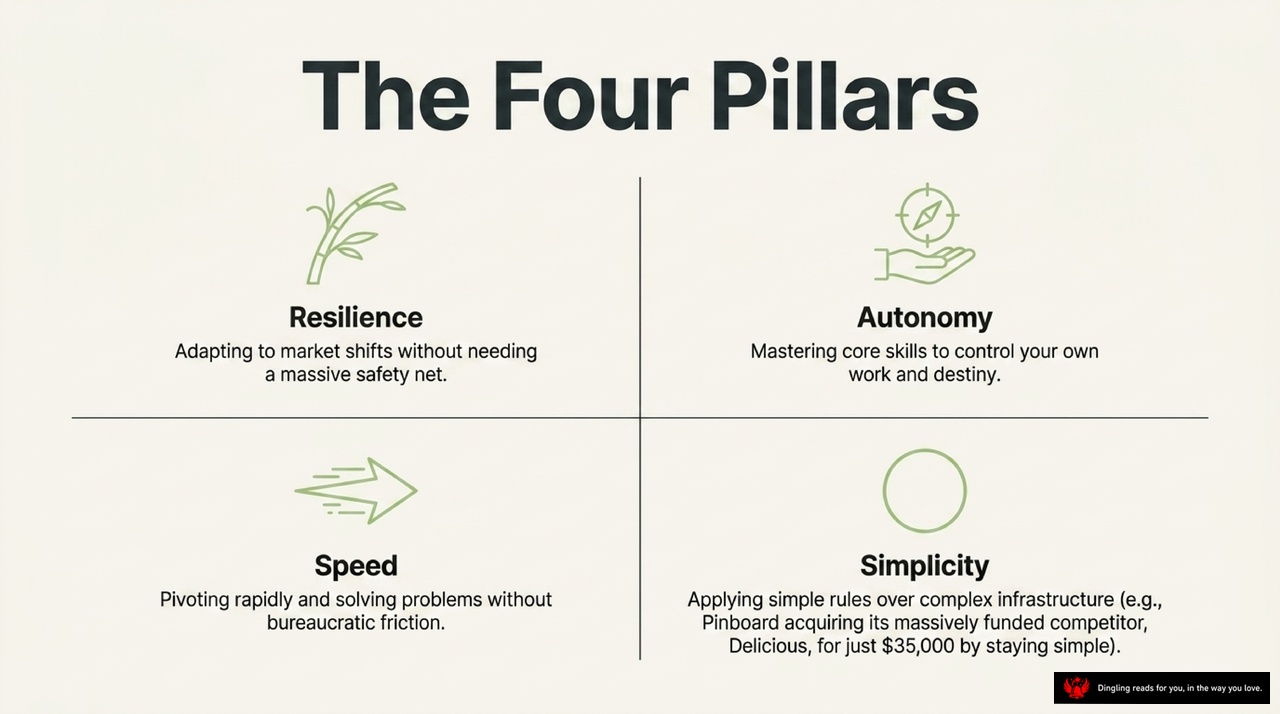
So, here we are with the four pillars that make up the entire framework: Resilience, Autonomy, Speed, and Simplicity.
First, let's talk about Resilience. It’s not just about being tough when things go wrong—it’s about adapting to market shifts without needing a massive safety net. That means staying flexible, so you can keep moving forward even when the landscape changes.
Next is Autonomy. This is about mastering core skills so you can control your own work and destiny. When you’re skilled and self-reliant, you’re not dependent on external forces—you’re the driver of your own success.
Then there’s Speed. In today’s fast-paced world, the ability to pivot quickly and solve problems without getting bogged down by bureaucracy is crucial. It’s about efficiency and agility—making decisions fast and acting on them without delay.
Finally, Simplicity. Sometimes, the best strategy is to keep things simple. Instead of building complex systems or relying on heavy infrastructure, you can achieve big results with minimal resources. For example, Pinboard acquired its well-funded competitor, Delicious, for just $35,000—because they stayed simple and focused on what really mattered.
These four pillars—Resilience, Autonomy, Speed, and Simplicity—are the foundation of a lean, adaptable, and effective approach to work and life.
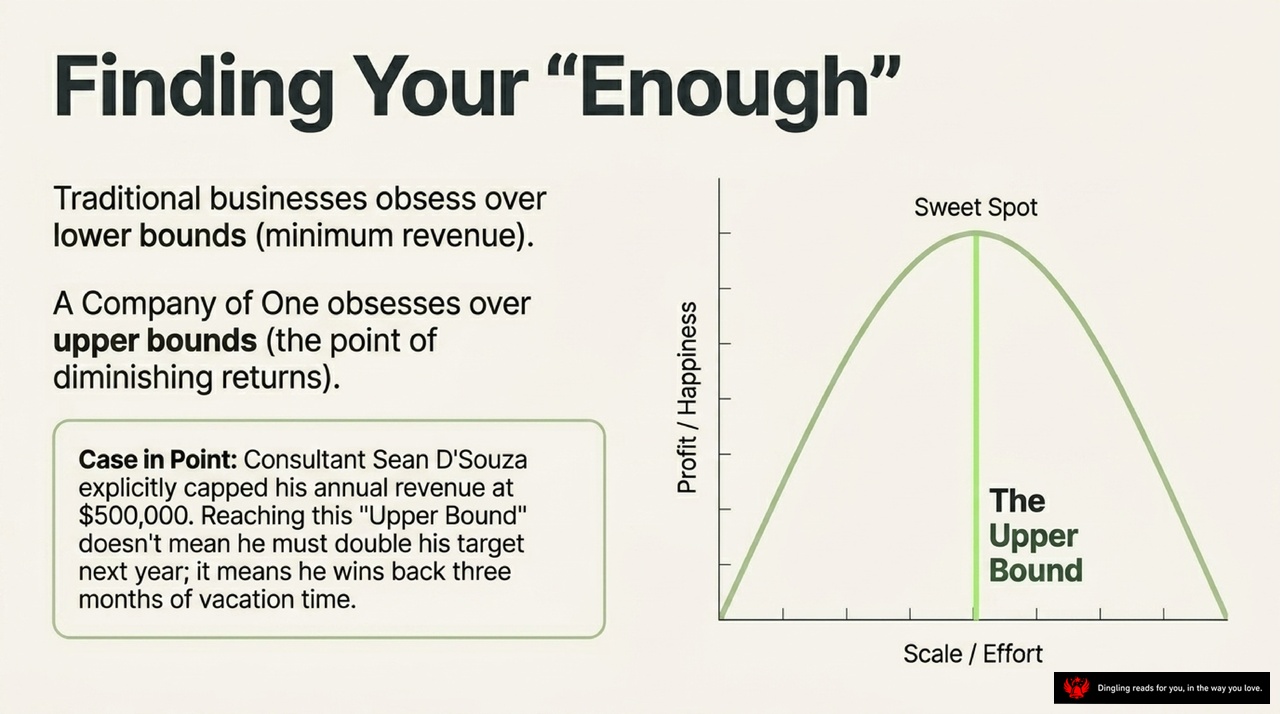
Slide 4: Finding Your "Enough"
Most traditional businesses are obsessed with the bottom line—chasing minimum revenue, setting targets, and pushing for growth no matter the cost. But for a Company of One, the game is completely different. Instead of focusing on the lower bound, we obsess over the upper bound. That’s the point where diminishing returns kick in—where more effort actually means less happiness or profit.
As you can see in the chart, there’s a sweet spot. It’s the peak of the curve, where your scale, effort, and happiness intersect. Beyond that point, adding more work doesn’t bring more reward—it brings burnout.
Take Sean D’Souza, a consultant who set a hard cap on his annual revenue at $500,000. Why? Because once he hit that number, he knew the extra hours wouldn’t be worth it. Instead of chasing more, he chose to win back three months of vacation time. That’s the power of defining “enough.”
So ask yourself: what’s your upper bound? Where does the extra work stop adding value? And more importantly—what will you do with the time you reclaim once you hit that limit?
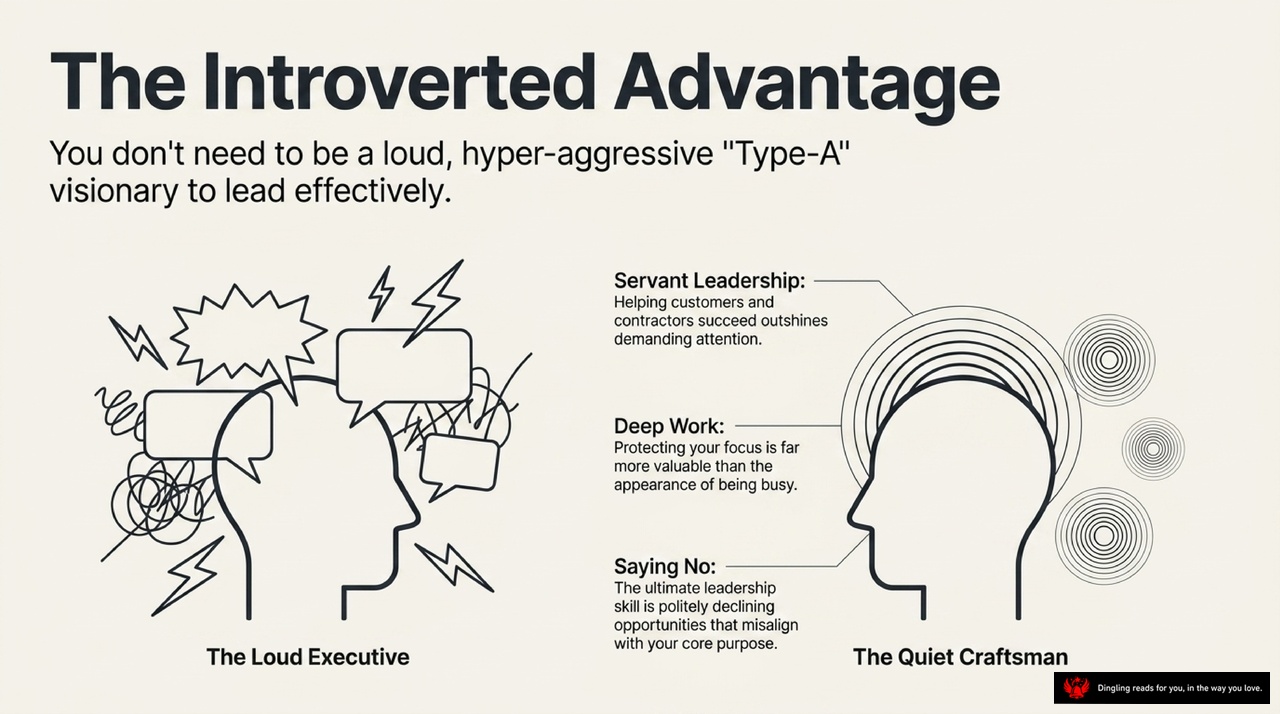
Let’s talk about the introverted advantage—because if you’ve ever felt pressured to be loud, assertive, and constantly “on,” this slide is for you. On the left, we see “The Loud Executive”: a Type-A leader who leads through volume, interruptions, and the illusion of urgency. But on the right? “The Quiet Craftsman.” This isn’t about being passive—it’s about being intentional.
Servant leadership means helping others succeed, not demanding attention. Deep work means protecting your focus—not pretending you’re busy. And saying no? That’s not rejection; it’s alignment. It’s choosing what truly matters over what just looks impressive.
You don’t need to be the loudest person in the room to lead effectively. In fact, the quietest leaders often create the most impact—because they listen, they reflect, and they act with purpose. The advantage isn’t in the noise. It’s in the silence.
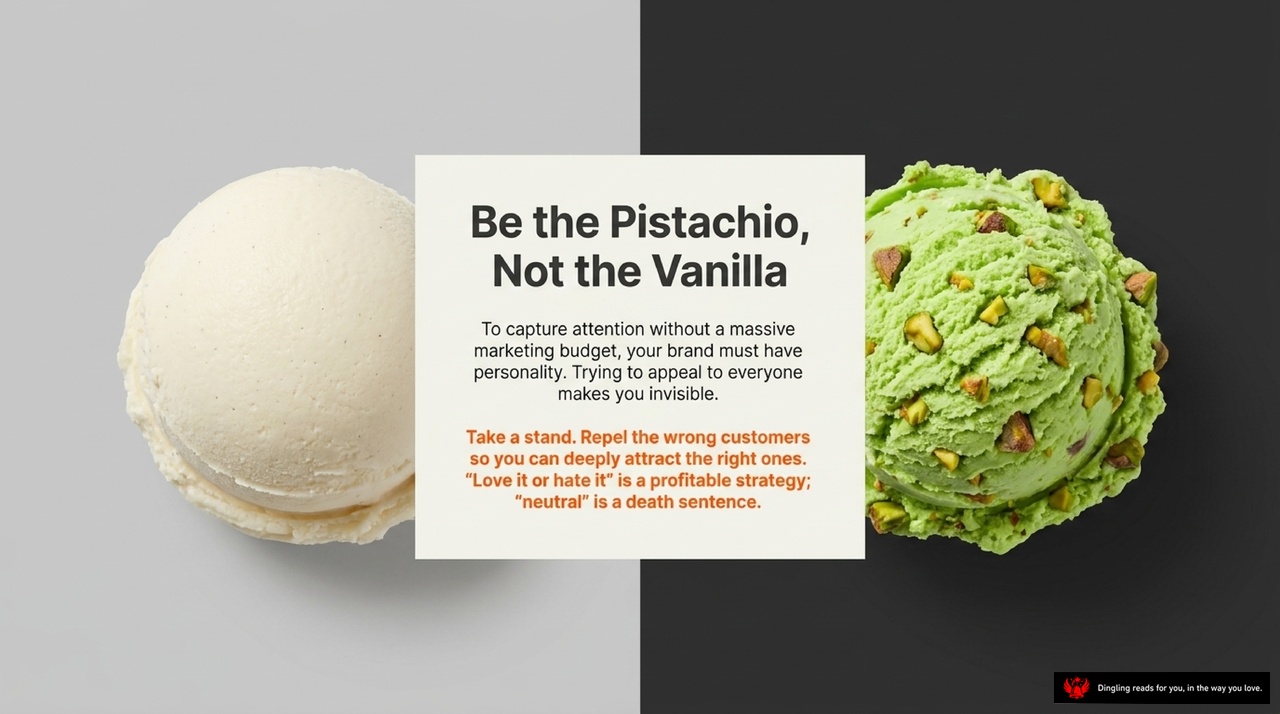
Imagine you’re at an ice cream shop. You see two scoops: one plain vanilla, safe and predictable, and one vibrant pistachio—bold, distinctive, unmistakable. Now, which one do you remember? Which one makes you stop and say, “I want that”?
This slide is all about that choice. It’s saying: Be the pistachio, not the vanilla. In a crowded market, trying to be everything to everyone is a recipe for invisibility. If your brand doesn’t have a point of view, it won’t be remembered.
The text on the slide makes it clear: “To capture attention without a massive marketing budget, your brand must have personality.” That’s the key. Without personality, you’re just noise. But when you take a stand—when you say, “This is who we are, and this is who we’re for”—you become magnetic.
And here’s the bold truth: “Love it or hate it is a profitable strategy; ‘neutral’ is a death sentence.” Being neutral is dangerous. It’s like walking through life without a direction. But when you embrace your uniqueness, even if it polarizes some, you attract the people who truly get you.
So, are you vanilla or pistachio? Are you blending in or standing out? Because in today’s world, standing out isn’t just an option—it’s survival.
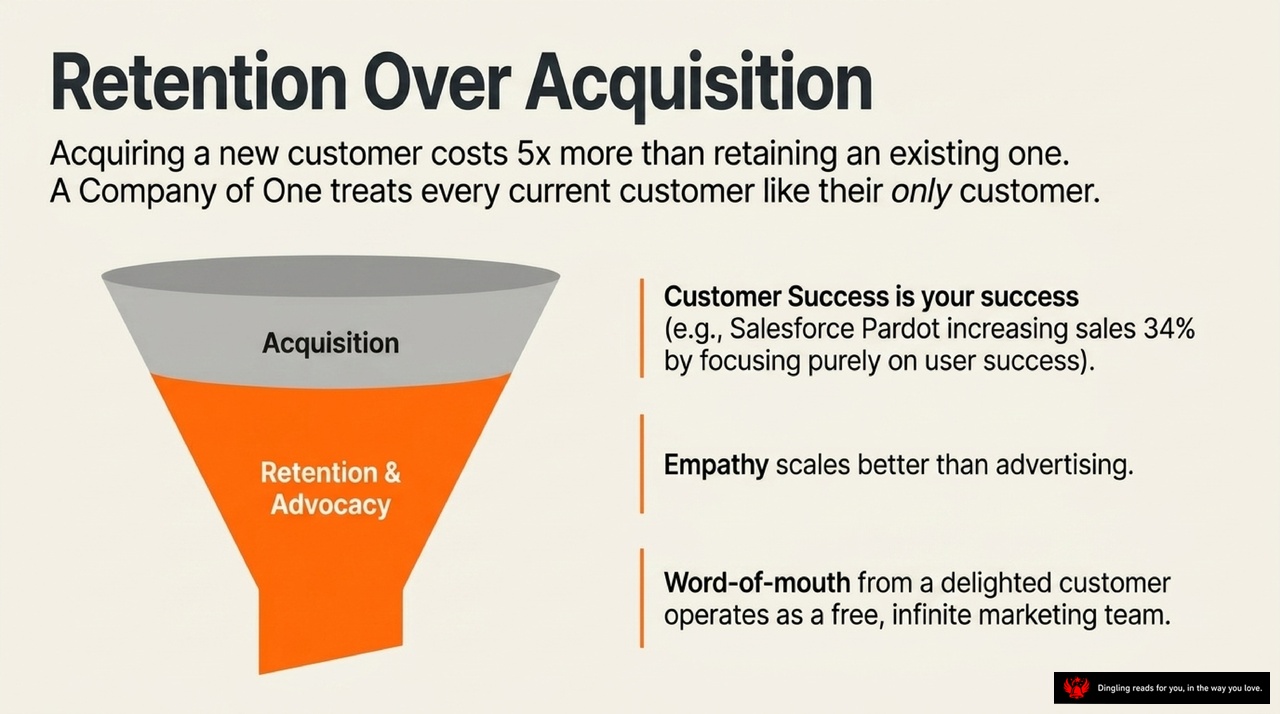
Hey everyone, today we’re diving into one of the most powerful shifts in modern business thinking: Retention Over Acquisition.
Let’s be real—chasing new customers is expensive. In fact, it costs five times more to bring in a new customer than to keep the one you already have. That’s not just a number; it’s a wake-up call. And that’s exactly what “A Company of One” teaches us: treat every current customer like they’re your only customer. When you do that, everything changes.
Look at this funnel. At the top, you’ve got Acquisition—the traditional marketing play. But below that? That’s where the real magic happens: Retention and Advocacy. This isn’t just about keeping people around; it’s about turning them into loyal fans who speak up for you without you even asking.
Here’s the kicker: Customer Success isn’t just a department—it’s your success. Take Salesforce Pardot, for example. By focusing purely on helping users succeed, they boosted sales by 34%. No ads, no gimmicks—just real value.
And here’s something most companies overlook: empathy scales better than advertising. When you truly care about your customer’s experience, that feeling spreads. It becomes word-of-mouth, which is basically a free, infinite marketing team.
So let’s stop obsessing over acquisition and start investing in retention. Because when you get this right, growth doesn’t just happen—it compounds.
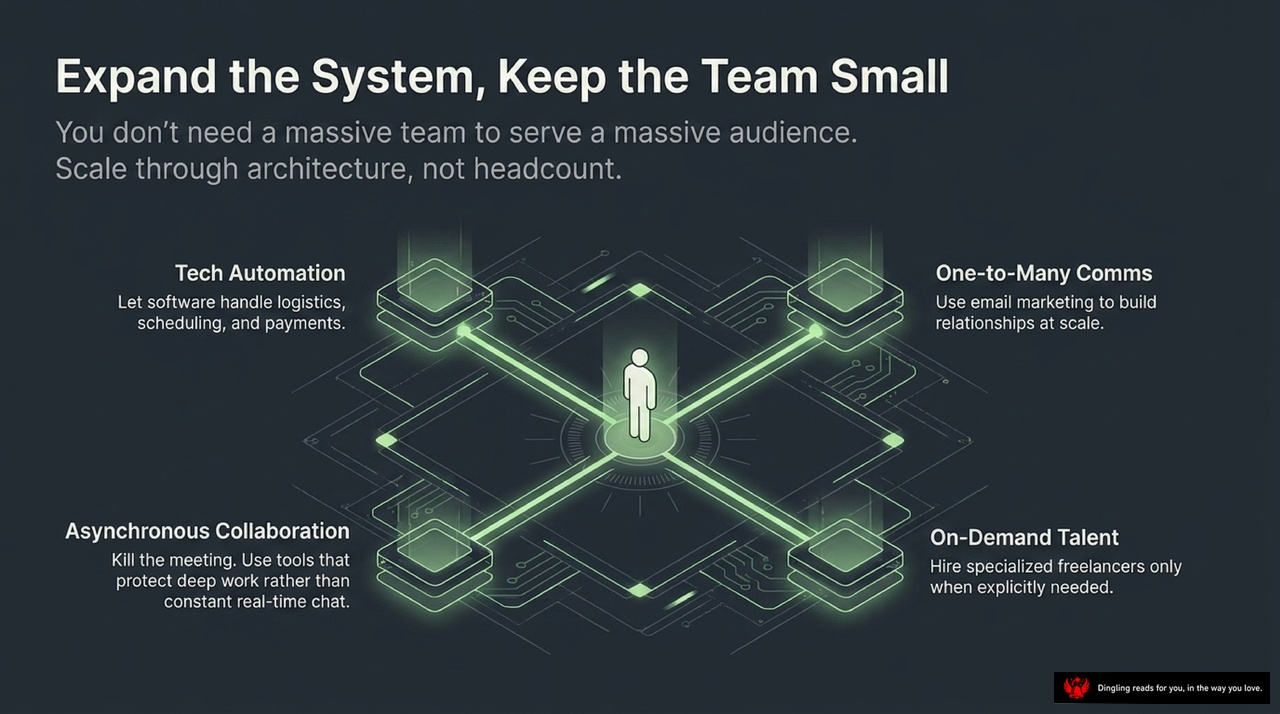
Hey, here’s the thing most founders get wrong: they think scaling means hiring more people. But what if you could grow your audience without growing your team? That’s the power of smart architecture.
This slide breaks it down into four key levers. First, Tech Automation—let software handle the heavy lifting on logistics, scheduling, and payments. No more manual grind. Second, One-to-Many Comms—use email marketing to build relationships with thousands of people at once. Third, Asynchronous Collaboration—kill the endless meetings and protect deep work time with tools that don’t demand constant real-time chat. Finally, On-Demand Talent—hire specialized freelancers only when you actually need them, not to fill permanent roles.
The message is clear: scale through systems, not headcount. You don’t need a massive team to serve a massive audience. Build the right architecture, and you’ll grow faster, leaner, and smarter.
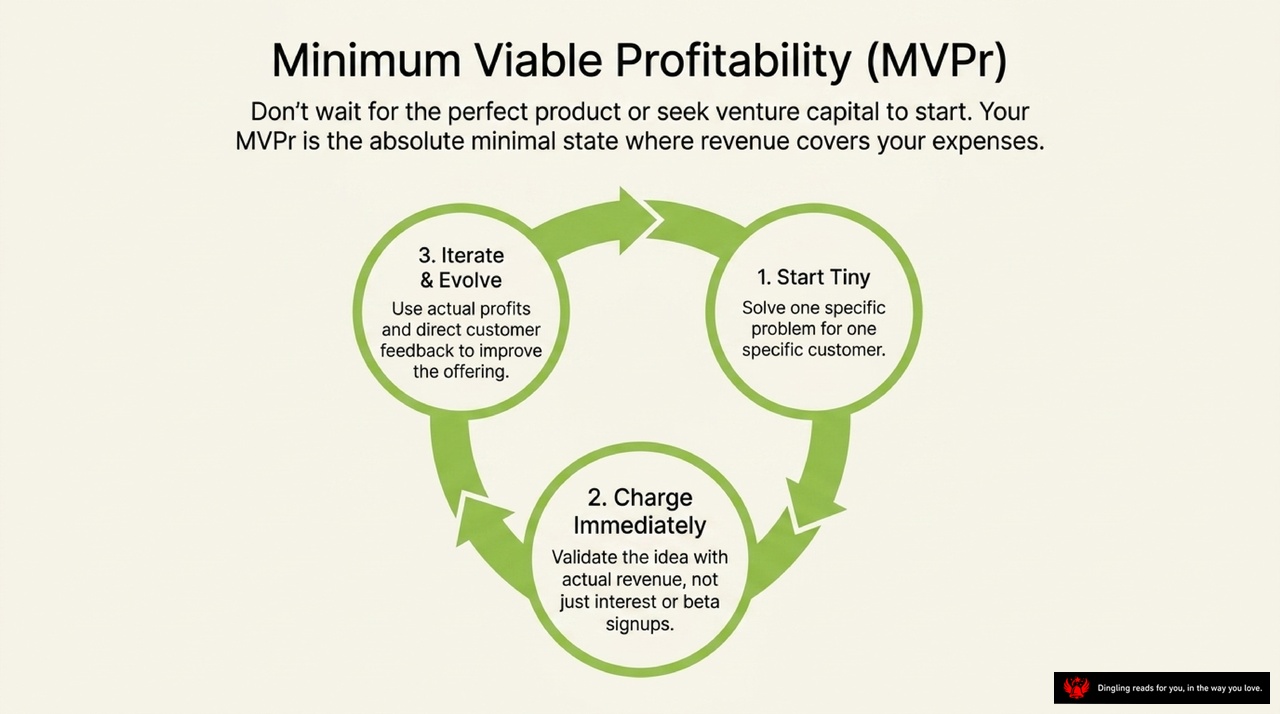
So, let’s talk about something that changes the game for founders and entrepreneurs: Minimum Viable Profitability—or MVPr.
You’ve probably heard of MVP, right? The Minimum Viable Product. But here’s the twist: what if you don’t need a perfect product to start? What if you just need to make money—just enough to cover your costs?
That’s exactly what MVPr is. It’s not about building the best product first. It’s about starting small, solving one real problem for one real customer, and charging for it immediately.
Think about it: instead of waiting months or even years to launch something “perfect,” you test your idea in the real world. You get actual revenue, not just empty promises or beta signups. That’s step two: Charge Immediately.
And once you’re making money—even a little—you can use that to improve. Use real customer feedback and real profits to evolve your offer. That’s step three: Iterate & Evolve.
But it all starts with step one: Start Tiny. Don’t try to solve every problem for everyone. Pick one specific customer and solve one specific problem for them. Keep it simple. Keep it focused.
This isn’t about rushing. It’s about moving forward with confidence, knowing that every dollar you earn brings you closer to a sustainable business.
So, forget the perfect product. Forget the endless fundraising. Start with MVPr. Start small. Start charging. Start growing.

Here is the spoken script for Slide 10.
**Slide 10: Teach Everything You Know**
Let's talk about the biggest myth in the business world: the fear that giving away your knowledge for free will kill your ability to make money. Today, we are going to flip that script completely. The truth is, sharing your expertise is the very engine that builds your business.
Look at this pyramid. It breaks down exactly how that works, starting from the bottom.
At the **Base**, the strategy is to **Share Ideas Widely**. Here’s the hard truth: ideas are cheap, but execution is everything. If you keep your best insights locked up, you’re just a competitor to yourself. You need to give the ideas away for free. Why? Because when you share your ideas, you lower the buyer’s defense mechanisms. You stop them from thinking, "Who is this person?" and start thinking, "Wow, this person gets it." This establishes you as the undeniable expert.
Once you’ve done that, you move to the **Middle**, where you **Build Authority**. This is the bridge between a casual reader and a paying client. When you teach people how to do things, you are essentially training them. And here is the psychology: when someone learns something from you, they naturally trust you. They feel a sense of ownership over your methods.
This leads us to the **Top** of the pyramid: **Earn Trust & Revenue**. This is the payoff. When people have learned from you, when they have internalized your ideas, and when they have seen your authority in action, they are no longer shopping around. When they eventually need the work done perfectly, they won't hire a stranger. They will hire the expert who taught them how to do it.
So, don't hold back. Teach everything you know. It doesn't cannibalize your business; it builds it.

Today’s slide is all about the Bank Account of Trust—a powerful metaphor for how your business actually grows over time. You see three pillars here: Financial Capital, Human Capital, and Social Capital. While money and talent are essential, the real game-changer is Social Capital. That glowing orange column? That’s trust. And trust doesn’t just sit there—it compounds.
Here’s the truth: “Growth hacking” often burns through trust to get quick wins. But a Company of One plays the long game by investing heavily in Social Capital. The secret? Give before you ask. Provide immense value, solve problems, and connect people—without expecting anything back. When your social capital account is full, your business will never lack clients. Trust is the only currency that compounds automatically. So stop chasing shortcuts. Start building trust. That’s how you build a business that lasts.
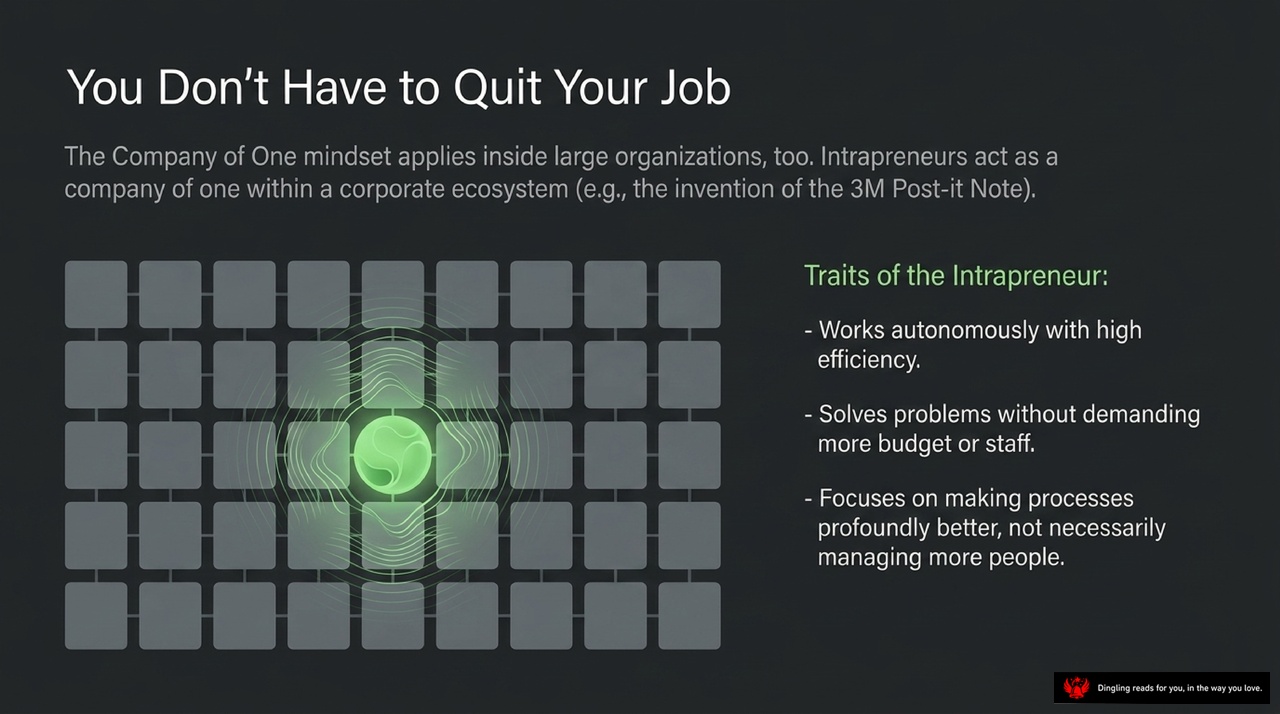
You don’t have to quit your job to act like a boss. In fact, some of the most impactful change-makers in big companies never leave—they just operate like a “Company of One” from within. Think of it this way: you’re not building a new business from scratch; you’re building a personal brand and a unique value proposition inside an existing organization.
The slide shows how intrapreneurs—those who innovate within a company—function like independent operators. They work autonomously, deliver results efficiently, and solve real problems without constantly asking for more budget or headcount. Look at that glowing center in the grid: that’s you, taking initiative, making things better without needing permission or extra resources.
Intrapreneurs don’t manage more people—they improve processes. They focus on doing things smarter, not bigger. Take the 3M Post-it Note, for example. It wasn’t invented by a startup, but by someone inside 3M who believed in the power of a sticky idea. That’s the mindset we’re talking about: be the driver of change, even when you’re still on the payroll.
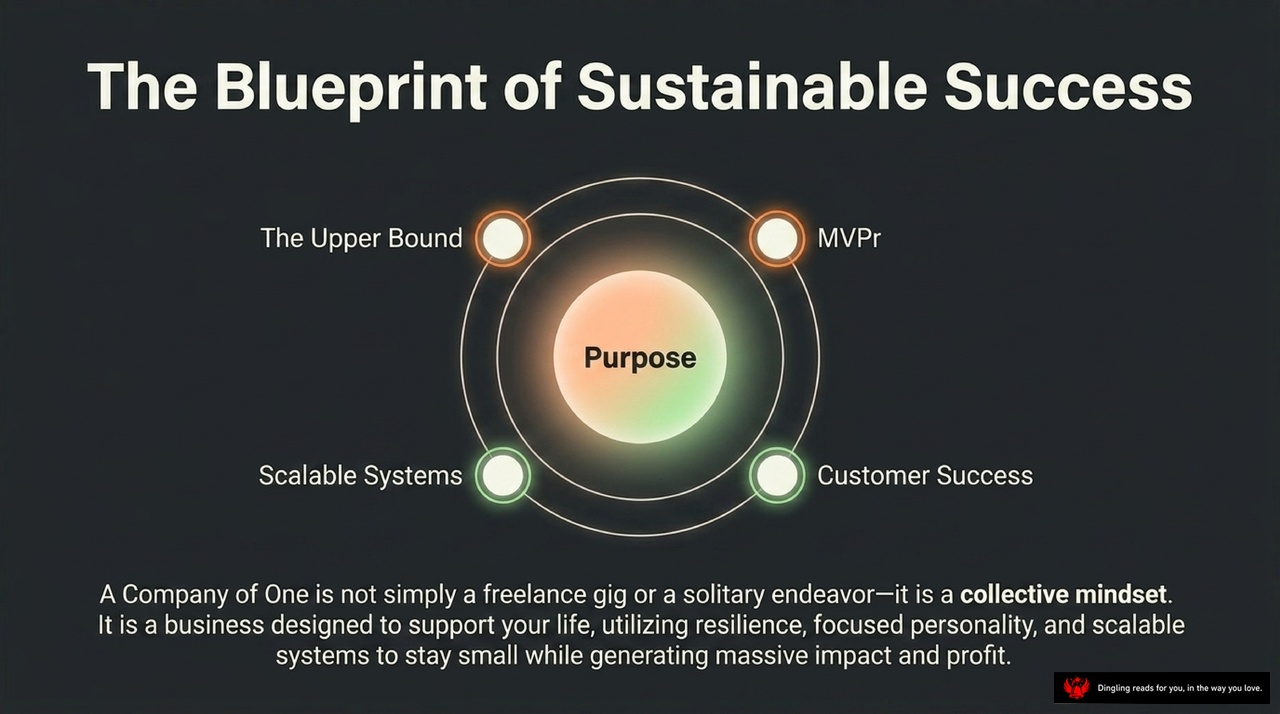
Let’s talk about what it really takes to build a business that lasts—not just one that starts strong, but one that keeps growing without burning out.
At the heart of it all is purpose. Not the kind you write on a vision board, but the kind that drives your daily decisions, shapes your culture, and pulls you forward even when things get tough. That’s the core. Around that center, four key elements form the blueprint for sustainable success:
First, MVPr—your Minimum Viable Product, but not just a test. It’s your first real version of something people actually want. Get this right, and you don’t need to guess anymore.
Next, customer success. If your product doesn’t genuinely improve someone’s life or work, it won’t stick. Make their win your win.
Then, scalable systems. You want to stay lean, but not fragile. Build processes that let you grow without adding chaos.
And finally, the upper bound—the ceiling of what you can achieve. This isn’t about hitting a target and stopping. It’s about pushing boundaries while staying grounded in your purpose.
This isn’t just for big teams or funded startups. A Company of One isn’t about working alone—it’s about thinking collectively. It’s about designing a business that supports your life, uses your strengths, and scales smartly. You don’t have to be huge to make an impact. You just have to be intentional.

Here is the script for slide 14.
**Script:**
"Let's look at the core philosophy of a 'Company of One.' It starts with a radical premise: 'better is better,' and growth is actually not a requirement for success. Most companies chase scale, but here, we define our own upper limits. We prioritize 'customer trust' and scale our 'systems' instead of our 'headcount.' The result? You gain the ultimate business advantage: 'freedom.'
But I want you to pause and ask yourself this: 'Are you building a business to support the life you want, or are you living your life to support a business that never stops demanding more?' This is the ultimate test. If you are chasing growth for the sake of growth, you will end up sacrificing your life. But if you build a business that serves your life, you win. Choose the path that gives you freedom, not just revenue."