
Competing Against Luck: Complete Chapter-by-Chapter Summary

Welcome to today's session on "Competing Against Luck." As you see the title on this slide, the core message is simple yet revolutionary: we need to transform innovation from a game of chance into a predictable engine of growth.
This vision belongs to Clayton M. Christensen and his team. They argue that the key to unlocking this potential lies in uncovering the "Jobs to Be Done." This concept shifts our entire perspective. Instead of asking what features a product has, we ask why a customer is "hiring" a product to do a specific job in their life. When we focus on these jobs, we stop guessing and start building solutions that truly matter, turning the unpredictable nature of market success into a strategy we can actually control.
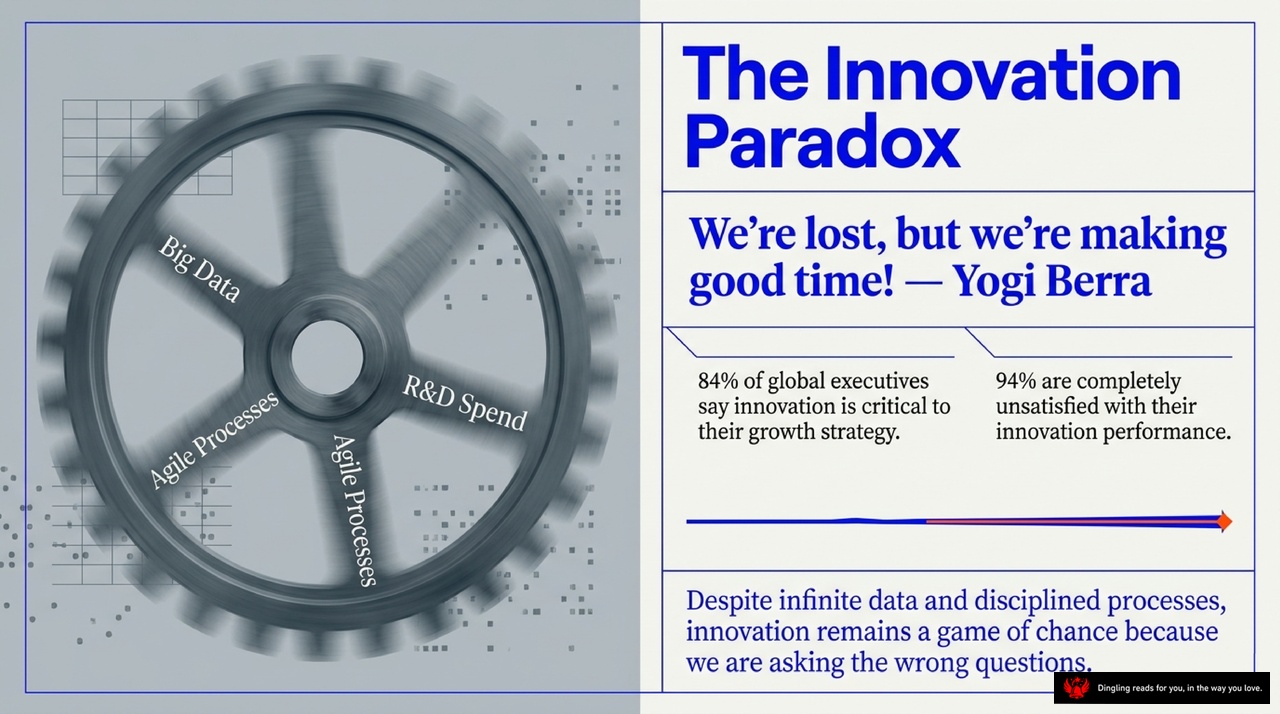
Look at this spinning gear. It represents the modern obsession with innovation: Big Data, Agile Processes, massive R&D spend. We are all trying to turn this wheel, convinced that more data and faster processes equal better results. But here's the hard truth: despite having infinite data and disciplined workflows, innovation remains a game of pure chance. Why? Because we are asking the wrong questions.
The slide highlights a painful paradox. 84% of global executives admit innovation is critical to their growth strategy, yet 94% are completely unsatisfied with their actual performance. It's a classic Yogi Berra moment: "We're lost, but we're making good time!" We are running fast in the wrong direction.
The core problem isn't a lack of effort; it's a lack of direction. Traditional theories like disruptive innovation tell us how to respond when we are already being disrupted, but they fail to answer the most critical question: where do we actually find new opportunities? How do we stop shooting in the dark? The answer lies in shifting our focus from the product itself to the specific task the user is trying to complete. Only by understanding the real job the user is hiring our product to do can we stop guessing and start creating meaningful value.
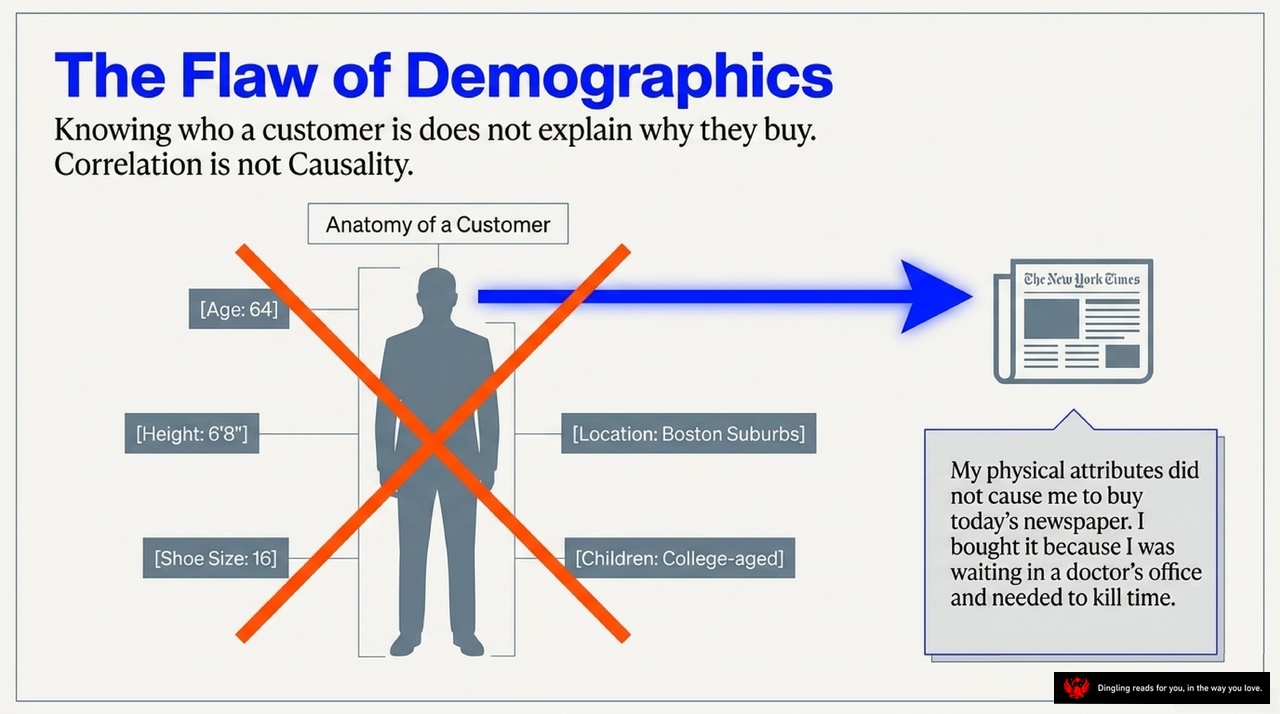
The slide title, "The Flaw of Demographics," hits home immediately. It challenges a common mistake: thinking that knowing *who* a customer is explains *why* they buy. As the text reminds us, correlation is not causality.
Look at this "Anatomy of a Customer." We have a 64-year-old, 6'8" man living in the Boston suburbs with college-aged kids. The blue arrow suggests these physical traits cause him to buy *The New York Times*. But the red X clearly shows that's wrong. His height, age, or shoe size didn't make him buy that newspaper.
The real reason, as the quote explains, is simple: he was waiting in a doctor's office and needed to kill time. His physical attributes didn't cause the purchase; the specific situation and the task he needed to accomplish did.
This is the core insight of the User Goal Theory. For decades, companies have been obsessed with demographics—chasing age, income, and location. They build profiles and assume that's enough. But this slide proves that's a trap. If you only market to "men over 60," you miss the real story. You might sell a newspaper to a 64-year-old man in Boston, but you'd also sell it to a 20-year-old woman in Tokyo if she was stuck in an airport lounge waiting for a flight.
The lesson is clear: stop focusing on who your customer is, and start focusing on what they are trying to get done. In the business world, this means shifting from selling products to solving tasks. Whether it's buying a newspaper to pass time, a car to get from A to B, or software to manage finances, the user isn't buying the object itself; they are "hiring" it to complete a specific job in their life.
So, before you design your next campaign or product, ask yourself: Am I targeting a demographic, or am I solving a task? Because understanding the task is the only way to truly understand the customer.
Think about the last time you bought something. Was it because you loved the object itself? Or was it because that object helped you move your life forward in a specific direction? That's the heart of the "Jobs to Be Done" framework.
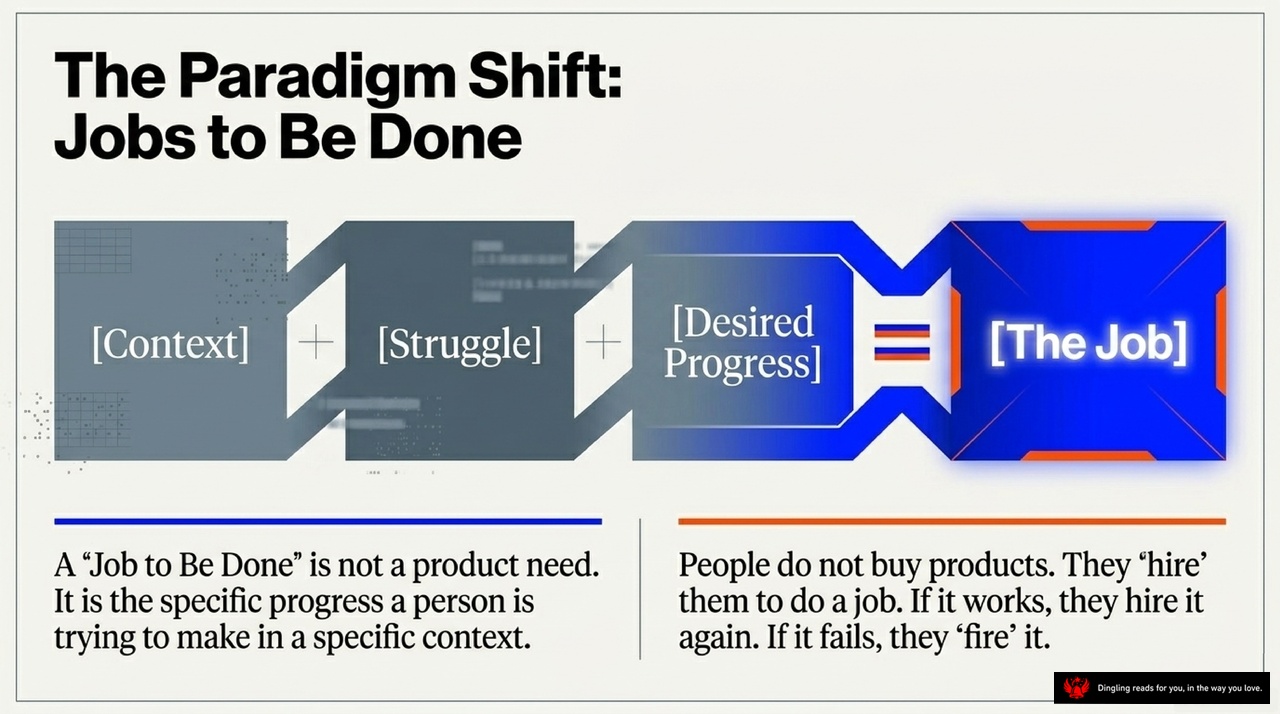
This slide breaks down exactly how that decision happens. It's not magic; it's a simple equation: Context plus Struggle equals Desired Progress, and that combination creates The Job.
First, look at the **Context**. This is the specific situation you are in. Maybe it's your morning commute, a messy kitchen, or a stressful workday. You aren't just standing there; you are somewhere, with someone, at a specific time.
Next, there is the **Struggle**. Something is blocking you. You are hungry, you are tired, you are overwhelmed, or you are just bored. You feel stuck.
Then comes the **Desired Progress**. You want to move from that stuck state to a better one. You want to feel full, rested, or in control.
When you combine your situation, your struggle, and what you want to achieve, you get **The Job**.
Here is the crucial insight written at the bottom: People do not buy products. They "hire" them to do a job. If the product successfully helps you make that progress, you hire it again. If it fails, you fire it.
So, a "Job to Be Done" is not about product features or specs. It is the specific progress a person is trying to make in a specific context. When you shift your thinking from "selling a product" to "helping a user complete a job," you unlock entirely new opportunities that you couldn't see before.
Have you ever wondered why a simple milkshake could sell so well to two completely different groups of people? The answer lies not in the recipe, but in the specific job each customer is trying to get done.
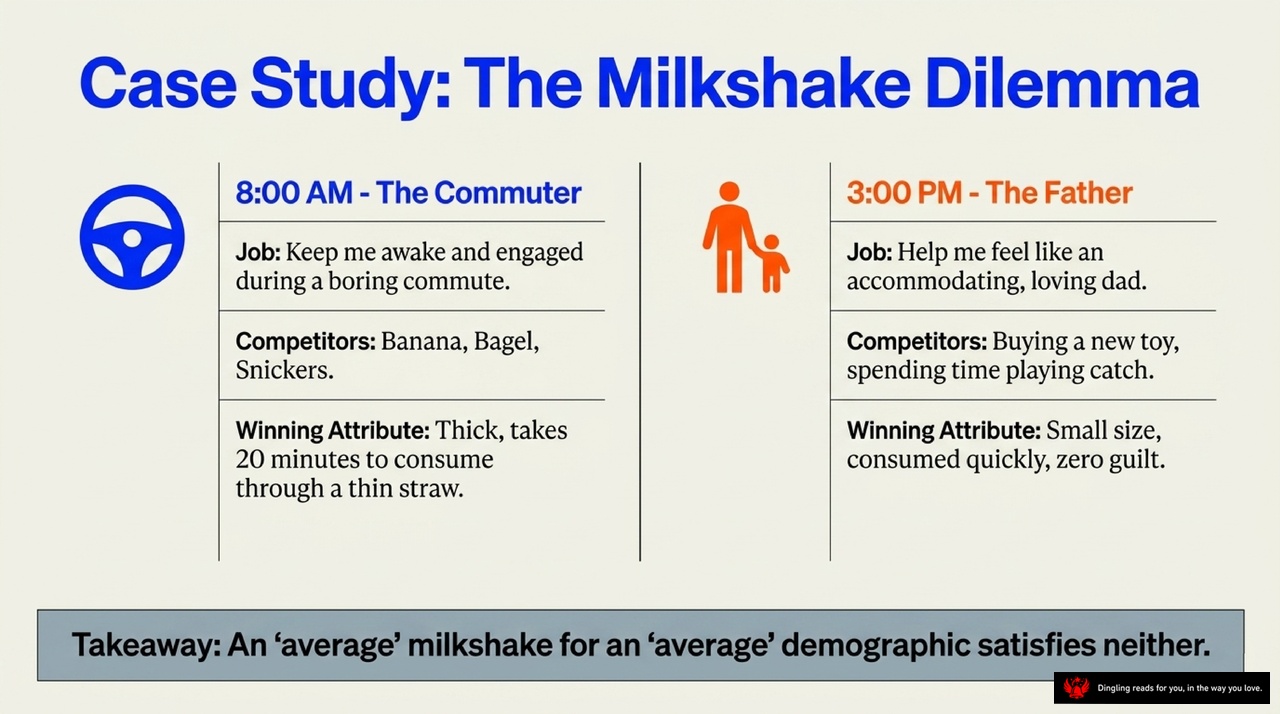
Look at this slide. On the left, we have the commuter at 8:00 AM. His job is simple: he needs to stay awake and engaged during a boring drive. A banana, a bagel, or a Snickers bar are his competitors. But a thick milkshake, sipped slowly through a thin straw for twenty minutes, is the perfect tool to keep him occupied and full.
Now, shift to the right side. It's 3:00 PM, and we have a father. His job isn't about staying awake; it's about feeling like a loving, accommodating dad. His competitors aren't other snacks, but buying a new toy or playing catch with his child. For him, the winning attribute is a small milkshake that can be consumed quickly, offering a quick fix with zero guilt.
The takeaway here is powerful: an average milkshake for an average demographic satisfies neither group. True innovation happens when you stop selling the product itself and start selling the solution to a specific task. By understanding the unique job each user needs to get done, you unlock growth that a one-size-fits-all approach simply cannot reach.

Today's slide breaks down a job into three distinct layers: Functional, Emotional, and Social. Think of the job not just as a task, but as a complete experience. The Functional layer is the practical work—like keeping an exam table sanitary. But look deeper. The Emotional layer is about how the user wants to feel. In that same medical room, crinkly paper might create severe anxiety, while a warm greeting builds trust. Finally, the Social layer covers how the user wants to be perceived. A doctor turning away to type on a PC breaks that connection, whereas drawing on a scrap of paper builds a genuine human bond.
The key insight here is clear: never over-engineer the functional at the expense of the emotional. We often obsess over the practical task, but users are actually "hiring" a product or service to achieve a specific progress in their lives. They aren't just buying features; they are buying a solution to a task that satisfies their functional, emotional, and social needs all at once. If you ignore the emotional and social layers, you might solve the practical problem, but you'll fail to win the user's heart. True innovation happens when you design the entire experience to help them succeed in that specific moment.
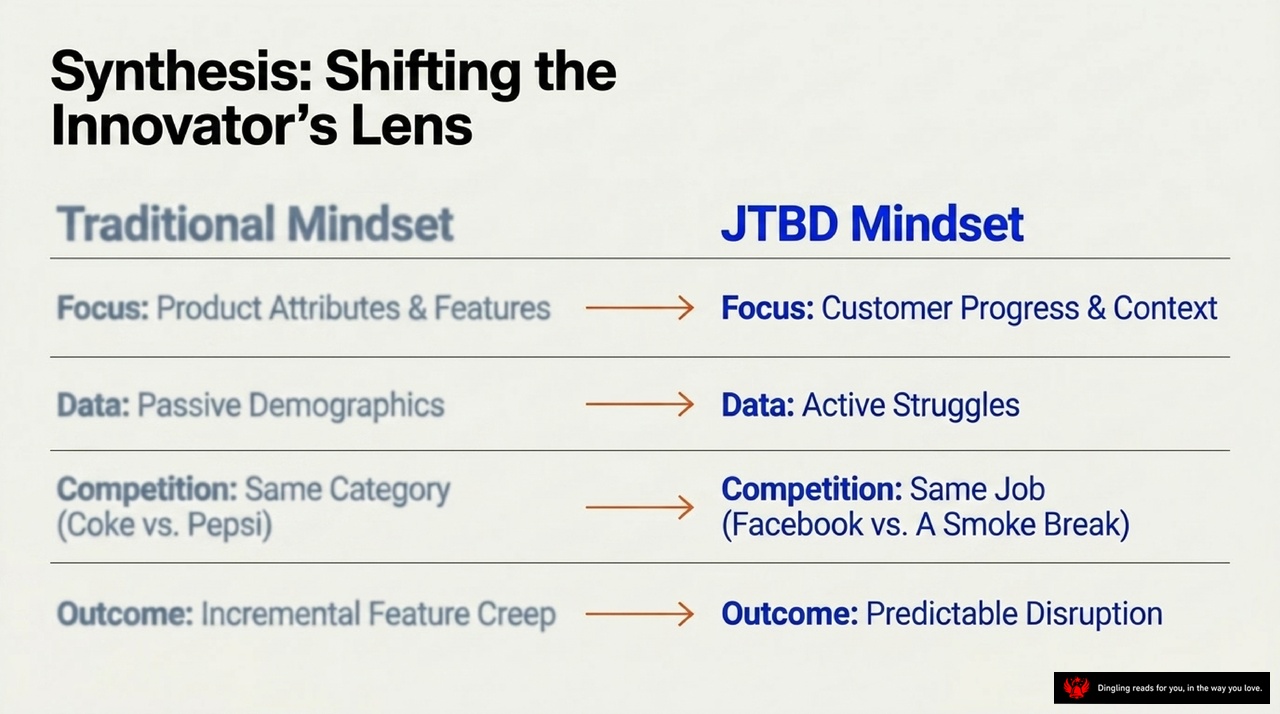
Most organizations build their entire structure around functions, departments, or geography. But the companies that achieve sustainable growth do something completely different: they rebuild their internal logic around the customer's job. Think about Mayo Clinic. When I was there for a week-long diagnosis, they didn't make me hop from department to department. Instead, they looked at my specific goal—getting an accurate diagnosis quickly—and designed a workflow where all the necessary experts were ready for a single, concentrated session. That seamless experience is their true competitive advantage, something no one can copy just by hiring better doctors.
The same principle applies to giants like Toyota, Pixar, and even consumer protection agencies. Toyota doesn't protect its secret by hiding its machines; they protect it by hiding their complex, integrated workflow. Pixar shares their creative process openly, yet competitors still can't replicate their magic because they lack the underlying cultural integration. When you align your internal processes with the user's goal, you stop wasting resources on internal efficiency and start creating real value. Your workflow becomes a machine that converts resources directly into the user's desired progress.
But here's the trap: once a company succeeds, it often drifts away from this focus. Look at V8 juice. They initially won by solving a specific job—helping busy people eat their vegetables. But later, they got distracted by data and started launching a chaotic array of flavors, losing their clear purpose. To avoid this, you must guard against three deadly data traps. First, don't let passive data from sales reports drown out the active struggles of your users. Second, resist the urge to dilute your core job just to chase surface-level growth. And third, never let your own biases confirm what you already believe; always let the user's true goal be the final judge. When you keep your processes and your goals tightly aligned, you build a fortress that is nearly impossible for competitors to breach.

The Innovator's Radar is your cheat sheet for spotting hidden opportunities. Instead of staring at a crowded market, you simply look where the pain is.
First, look at **Your Own Life**. The best ideas often start by scratching your own itch. Remember how Khan Academy began? It wasn't a grand corporate plan; it was just math videos made for a cousin.
Next, watch for **Non-Consumption**. These are the people who have stopped trying because the current solutions just don't work. When people realized renting a hotel room was too expensive or impersonal, Airbnb stepped in to fill that gap.
Then, keep your eyes open for **Workarounds**. These are the duct-tape solutions people invent when they're frustrated. OpenTable, for example, was born out of the sheer annoyance of trying to book a restaurant table.
Don't ignore **Negative Jobs** either. Notice what people are actively avoiding doing. ZzzQuil didn't just treat a cold; it solved the problem of needing to sleep while sick.
Finally, observe **Unusual Uses**. What happens when people take a product and use it in a way you never intended? Arm & Hammer baking soda, originally for baking, became a go-to deodorizer because people found it worked.
By scanning these five areas, you stop guessing and start finding the exact jobs that need solving.
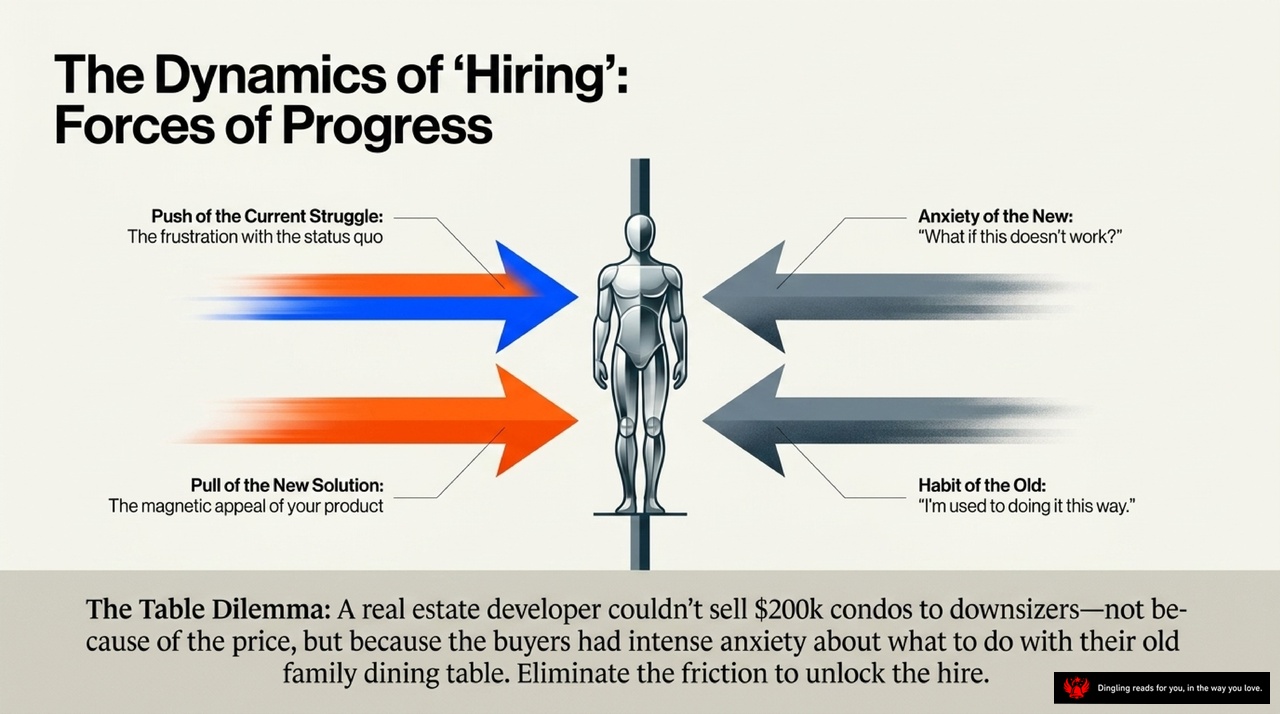
Look at this diagram. It perfectly captures the invisible tug-of-war every hiring decision faces. On the left, you have the "Push of the Current Struggle"—that frustration with the status quo, the feeling that things just aren't working anymore. Then there's the "Pull of the New Solution," the magnetic appeal of your product promising a better way. But on the right? That's where most deals die. You have the "Anxiety of the New"—the terrifying thought, "What if this doesn't work?"—and the stubborn "Habit of the Old," the voice saying, "I'm used to doing it this way."
This friction is exactly what we call the "Table Dilemma." Think about it: why couldn't a real estate developer sell $200k condos to downsizers? Was it the price? No. The buyers were paralyzed by anxiety about what to do with their old family dining table. That emotional friction blocked the transaction. To unlock the hire, you have to eliminate that friction. You can't just push harder; you have to help the buyer overcome the fear of the unknown and the weight of their habits. When you remove those barriers, progress becomes inevitable.

Designing the Perfect Experience isn't just about making things look good; it's about proving your product can actually get the job done. Think of your product as a resume—it has to demonstrate its capability at every single touchpoint, from the initial purchase all the way through daily use.
This slide highlights a critical shift in how we view competition. We often focus on "The Big Hire"—the moment of purchase. But true success happens in "The Little Hires," those repeated daily interactions where your product must consistently solve the user's problem.
Take Southern New Hampshire University as a prime example. They realized their students weren't just buying a degree; they were trying to complete a specific task: getting a transcript quickly to advance their careers. Instead of just selling the course, SNHU took on the burden of acquiring transcripts themselves and guaranteed a 10-minute callback response time. By solving this specific friction point, they didn't just sell a class; they perfectly executed the student's job. When you design an experience that aligns so tightly with the user's daily tasks, you stop competing on features and start competing on results.
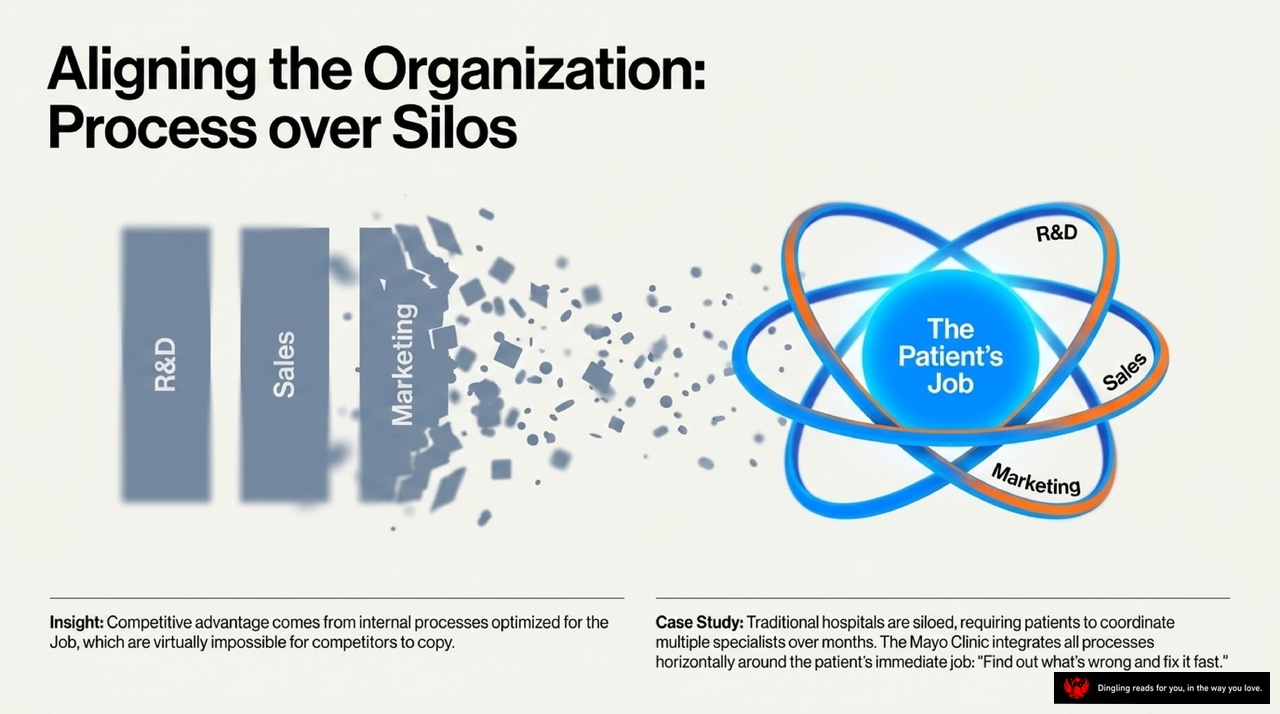
So, here's the reality check that every leader needs to hear: your organization's biggest competitive advantage isn't your products, your technology, or even your brand name. It's your internal process. Specifically, it's how well your entire organization aligns around a single, clear user goal.
Look at the slide. On the left, we see the traditional model: rigid silos. R&D, Sales, and Marketing are locked in separate boxes, passing the buck and creating friction. This is the "siloed" hospital where a patient spends months hopping between specialists, just to get a diagnosis. It's inefficient, frustrating, and impossible for customers to navigate.
But look at what happens when we break those walls down. On the right, we see the transformation. Those same departments—R&D, Sales, and Marketing—don't disappear. Instead, they dissolve into a unified orbit around "The Patient's Job." Suddenly, every part of the company is working horizontally to help the customer solve one specific problem: "Find out what's wrong and fix it fast."
This is the core insight: competitive advantage comes from internal processes optimized for the job, which are virtually impossible for competitors to copy. As we saw with the Mayo Clinic, when you integrate all processes around the user's immediate task, you create a seamless experience that no one else can replicate. Traditional hospitals are stuck in the old way, but innovators who restructure their organization to prioritize the user's goal over departmental turf will always win. It's not about having better tools; it's about having a better flow.

The V8 Juice Story is a classic cautionary tale about the "Fallacy of Surface Growth." As the slide illustrates, what started as a clear "Original Job"—helping busy people eat their vegetables without the hassle of cooking—eventually spiraled into a chaotic mess of "Surface Growth," "Feature Creep," and "Data Confirmation Bias."
Instead of optimizing for that specific task, V8 chased the wrong metrics. They launched V8 Splash, V-Fusion teas, and random fruit flavors, trying to compete in the crowded fruit juice aisle rather than solving the vegetable problem. The result? They lost their clear identity and abandoned their unique value to compete meaninglessly against everyone else.
This visual perfectly captures the danger of ignoring the user's true goal. When you stop focusing on the specific task the customer is trying to accomplish, you don't grow; you just drift. You end up adding features that nobody asked for, chasing data that confirms your biases, and ultimately diluting the very brand equity that made you successful in the first place. True growth comes from deepening your ability to solve the core problem, not just expanding the product line.

Imagine a compass at the center of your business, with Product, Sales, Marketing, and Support all pointing in the same direction. That's exactly what Intuit TurboTax did by shifting its entire culture. Instead of obsessing over "building better tax questions," they aligned thousands of engineers around a single, user-centric North Star: "Zero questions." By auto-filling W-2 data, they turned a complex task into a seamless experience. This is the power of a job-centric culture. When you clearly define the user's job, it acts as "Commander's Intent," allowing your team to make distributed decisions without micromanagement. Every department, from sales to support, naturally pulls in the same direction because they are all focused on helping the user complete their specific task. This approach transforms chaos into a unified mission, proving that when everyone fights for the same user goal, you don't just build a better product—you build a better experience that users can't ignore.

True success isn't about building a genius product in isolation; it's about creating a seamless alignment between the job the user needs to get done, the experience they expect, and the internal processes that deliver it. Think of innovation as a three-layer architecture. At the foundation, we must uncover the job itself—understanding the specific context and progress the user is seeking, not just the product features. Moving up, we design the experience by overcoming the forces that stand in the user's way, ensuring the solution feels effortless. Finally, at the peak, we integrate the process by aligning our culture and metrics to support that entire journey. This pyramid reminds us that when the job, the customer experience, and the internal process lock together perfectly, you don't just have a product; you have a predictable path to innovation.
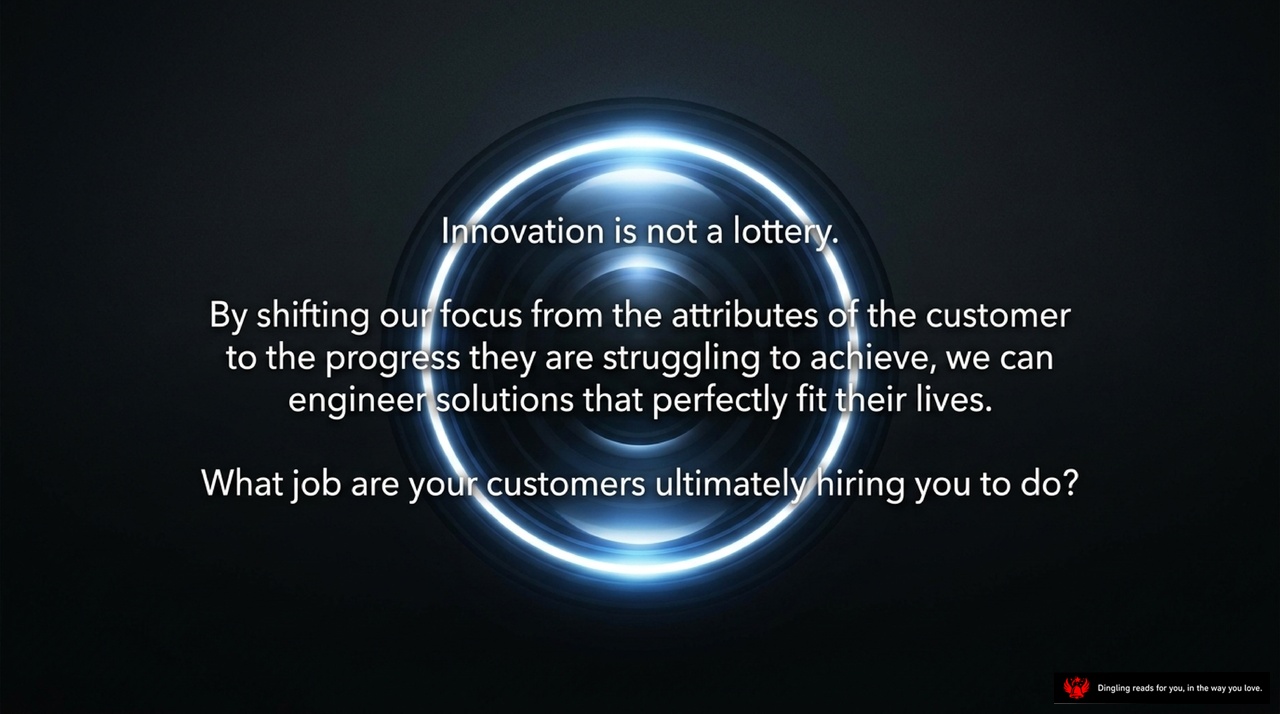
Innovation isn't a game of chance; it's a matter of engineering the right solution for the right moment. The slide reminds us that we must stop obsessing over customer attributes and start focusing on the progress they are desperately trying to achieve. When we shift our lens from "what the product is" to "what job the customer is hiring us to do," we unlock the ability to design solutions that truly fit their lives.
Think about it: a customer isn't just buying a product; they are hiring it to solve a specific problem in a specific context. By asking, "What job are your customers ultimately hiring you to do?" you stop competing in a crowded red ocean of similar features and start creating a unique value proposition. Whether it's helping a commuter kill time and stay full, or helping a parent soothe a child, the magic happens when your product perfectly aligns with that specific task. This shift transforms innovation from a risky gamble into a predictable, strategic process where you engineer success by understanding the user's true mission.