
Competitive Strategy: Complete Chapter-by-Chapter Summary
Welcome to the opening chapter of Michael E. Porter's classic, *Competitive Strategy*. Think of business not as a series of random battles, but as a structured game of chess. On the board, the pieces are your competitors, and the rules are defined by the very industry you operate in.
This framework is all about analyzing industries and competitors to achieve superior performance. The core idea is simple yet powerful: industry structure determines the rules of the game. It's not luck that decides who wins; it's the five forces at play. These forces—the threat of new entrants, the power of buyers and suppliers, the threat of substitutes, and the intensity of rivalry—collectively dictate an industry's profitability.
For example, why do tire manufacturers struggle while cosmetic brands thrive? It comes down to these forces. If barriers to entry are low, new players flood in, driving prices down. If buyers have too much power, they squeeze margins. Your strategic goal is to find a position where you can best withstand these pressures. By understanding these dynamics, you stop reacting blindly and start shaping the game to your advantage, whether that means defending a weak spot or proactively changing the rules before your rivals do.
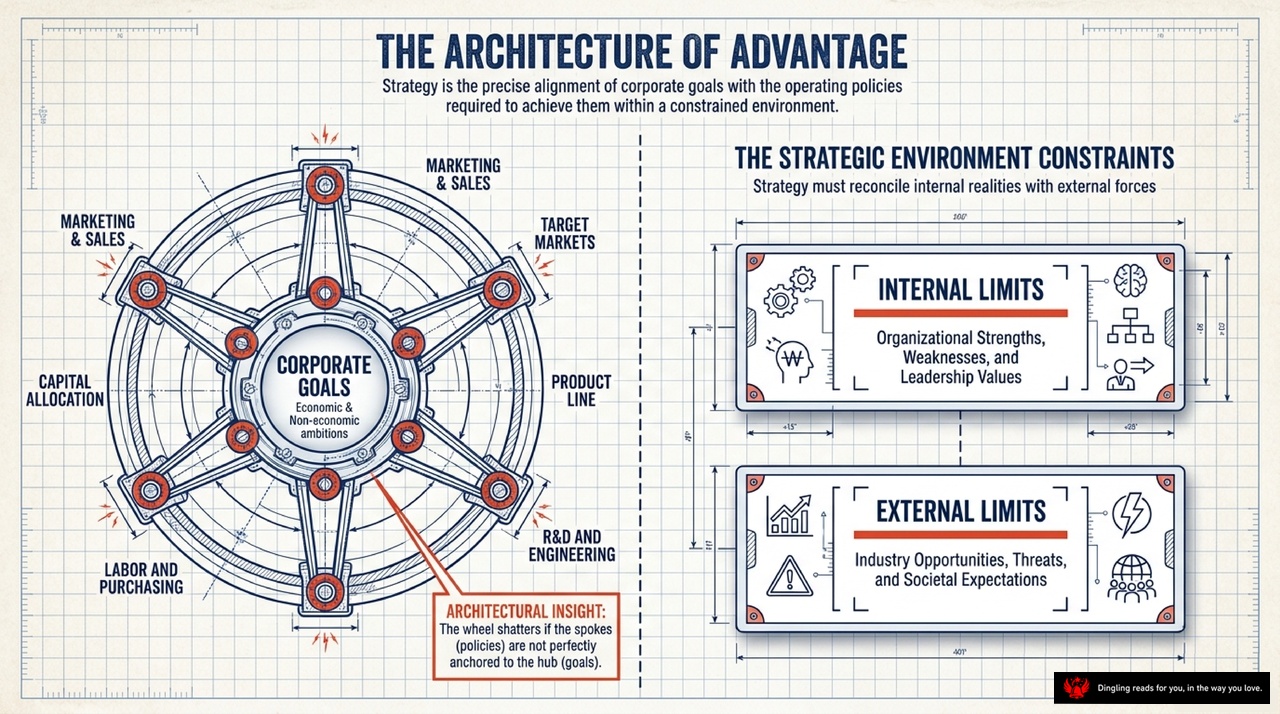
Strategy is often misunderstood as just a high-level vision, but in reality, it's the precise alignment of corporate goals with the operating policies required to achieve them within a constrained environment. Think of your organization as a complex machine, where every gear must turn in perfect harmony. If one part jams or spins too fast, the whole system fails. That's exactly what the "Architecture of Advantage" illustrates: the central hub represents your Corporate Goals, while the spokes—Marketing, Sales, R&D, Capital Allocation, and more—must be perfectly anchored to that core. If the spokes drift away from the hub, the wheel shatters, and your strategy collapses.
But building this machine isn't enough; you have to design it within specific boundaries. Every strategy must reconcile internal realities with external forces. On the right side of our diagram, we see these constraints clearly divided. First, there are your Internal Limits: your organizational strengths, weaknesses, and leadership values. These are the hard truths about who you are and what you can actually execute. Second, there are External Limits: the industry opportunities and threats you face, plus the shifting expectations of society. You can't ignore these forces.
The most critical insight here is that strategy isn't about ignoring these constraints or pretending they don't exist. It's about navigating the tension between them. If your internal capabilities don't match the external demands, or if your goals aren't firmly anchored to your operational reality, your advantage evaporates. True competitive edge comes from building an architecture where your goals, your policies, and your environment all speak the same language.

Imagine your industry not as a chaotic battlefield, but as a complex machine with five distinct control levers. This structural analysis reveals that profitability isn't luck; it's strictly dictated by the collective strength of these five fundamental forces. At the very center sits the "Rivalry Among Existing Competitors," the central battlefield where the intensity of the fight is dictated by growth rates, fixed costs, and exit barriers. But this central conflict is constantly squeezed from all sides.
On the left and right, you have the "Bargaining Power of Suppliers" and the "Bargaining Power of Buyers." When suppliers are concentrated or offer critical inputs, they erode your margins. Conversely, when buyers purchase in high volume or face low switching costs, they push down your prices. Above and below, two external threats loom: the "Threat of New Entrants" and the "Threat of Substitutes." New entrants flood the market if barriers like economies of scale are low, while substitutes set an absolute ceiling on your pricing power.
The key takeaway here is that the industry's long-term capital return is determined by how strong these five forces are. For example, industries like tires or steel suffer from fierce competition and low profits, while sectors like cosmetics enjoy gentler rivalry and higher returns. Your strategic goal is to find a position that allows you to better withstand these pressures, turning this structural map into your blueprint for success.
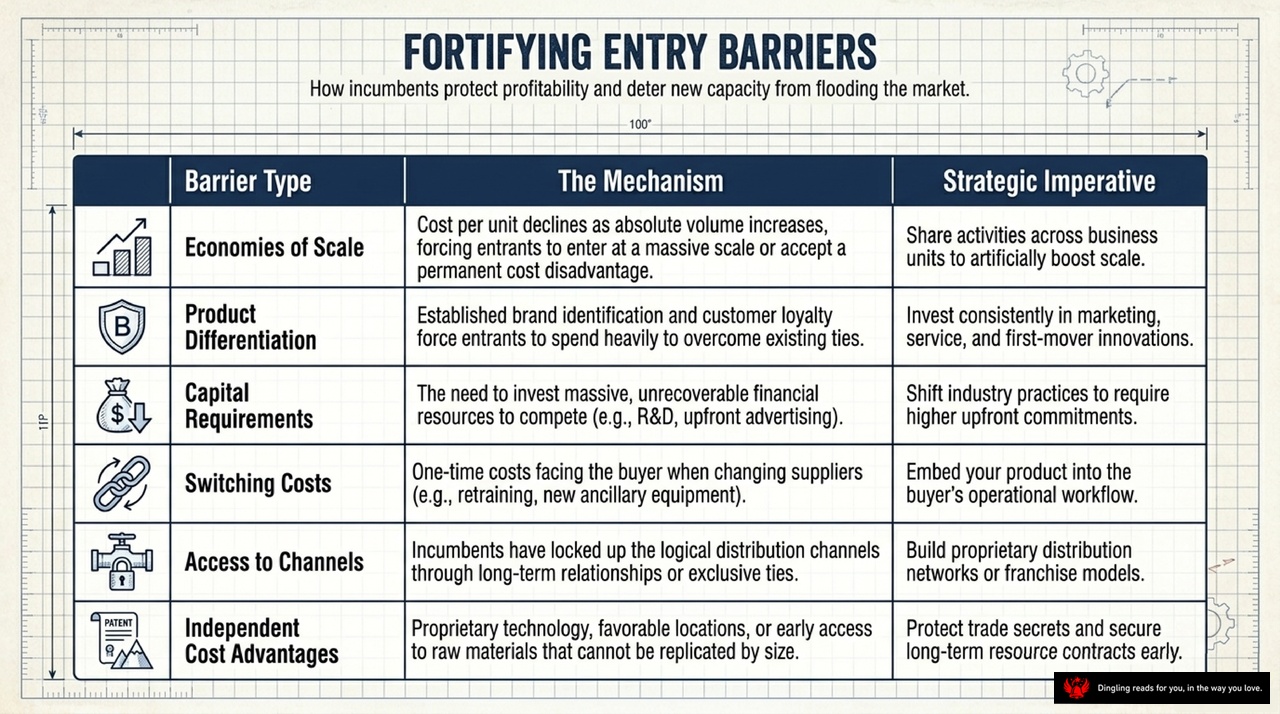
Welcome back. Today we're diving into how established companies build walls to keep new competitors out. This slide, "Fortifying Entry Barriers," breaks down the six main mechanisms incumbents use to protect their profits and stop the market from getting flooded.
Let's start with **Economies of Scale**. As you can see, the mechanism here is simple: volume drives down the cost per unit. This forces any new entrant to either come in massive or accept a permanent cost disadvantage. The strategic move? Share activities across different business units to artificially boost that scale.
Next is **Product Differentiation**. Existing brands have loyal customers, so new players must spend heavily just to break through. The imperative here is consistent investment in marketing, service, and first-mover innovations to stay ahead.
Then we have **Capital Requirements**. Some industries demand massive, unrecoverable financial investments upfront—think R&D or heavy advertising. Companies need to shift industry practices to require even higher upfront commitments to raise the bar.
**Switching Costs** are another huge hurdle. When buyers change suppliers, they face one-time costs like retraining or buying new equipment. To counter this, embed your product deeply into the buyer's daily workflow so leaving becomes painful.
**Access to Channels** is about locking up distribution. Incumbents secure these logical routes through long-term ties or exclusive deals. Your strategy should be building proprietary distribution networks or using franchise models to control the flow.
Finally, there are **Independent Cost Advantages**. This includes proprietary technology, prime locations, or early access to raw materials that simply can't be replicated by size. Protect your trade secrets and secure long-term resource contracts early to maintain this edge.
By mastering these six barriers, incumbents don't just defend their turf; they actively reshape the rules of the game to make entry nearly impossible for the competition.
When we talk about vertical integration, we're essentially asking: should we keep everything in-house, or should we rely on the open market? Think of it as deciding whether to build your own supply chain or outsource it. On paper, it often looks like a simple math problem—doing it yourself seems cheaper and easier to coordinate. But the reality is far more complex. It's not just about cutting costs; it's a strategic choice that requires balancing the benefits of control against the heavy price of flexibility.
Let's look at why companies do this. The biggest payoff is control. By integrating forward or backward, you stop relying on external suppliers or distributors who might have their own agenda. You can smooth out supply chain volatility, lock in critical technologies, and even use that control to raise barriers for competitors. Imagine a computer company buying its own chip manufacturer; suddenly, you aren't just a customer; you're the master of your destiny. You can also protect your margins by neutralizing the bargaining power of tough suppliers or customers.
However, there's a catch. Integration comes with hidden costs and risks. First, you have to overcome the barriers that exist in those new industries—maybe it's a steep learning curve or massive capital requirements. Second, you're locking yourself in. Once you integrate, it's incredibly hard to back out. You're stuck with higher fixed costs and less agility. If the market turns, you can't just fire your internal sales team as easily as you could switch suppliers. There's also the risk of the "rotten apple" problem. If one part of your integrated business struggles, the rest of the company often feels pressured to bail it out, dragging down the performance of your healthy divisions.
So, how do you decide? You don't just integrate blindly. Sometimes, a partial approach works best. Think of "conical integration," where you do part of the process yourself and outsource the rest, or "quasi-integration" through strategic partnerships. This lets you enjoy some of the benefits without taking on all the risks. The key is to avoid common traps: don't assume you can simply copy your current management style into a new industry, and don't integrate just to save money on a single transaction. Remember, the goal isn't just to own more steps in the value chain; it's to create a competitive advantage that the market simply can't replicate.
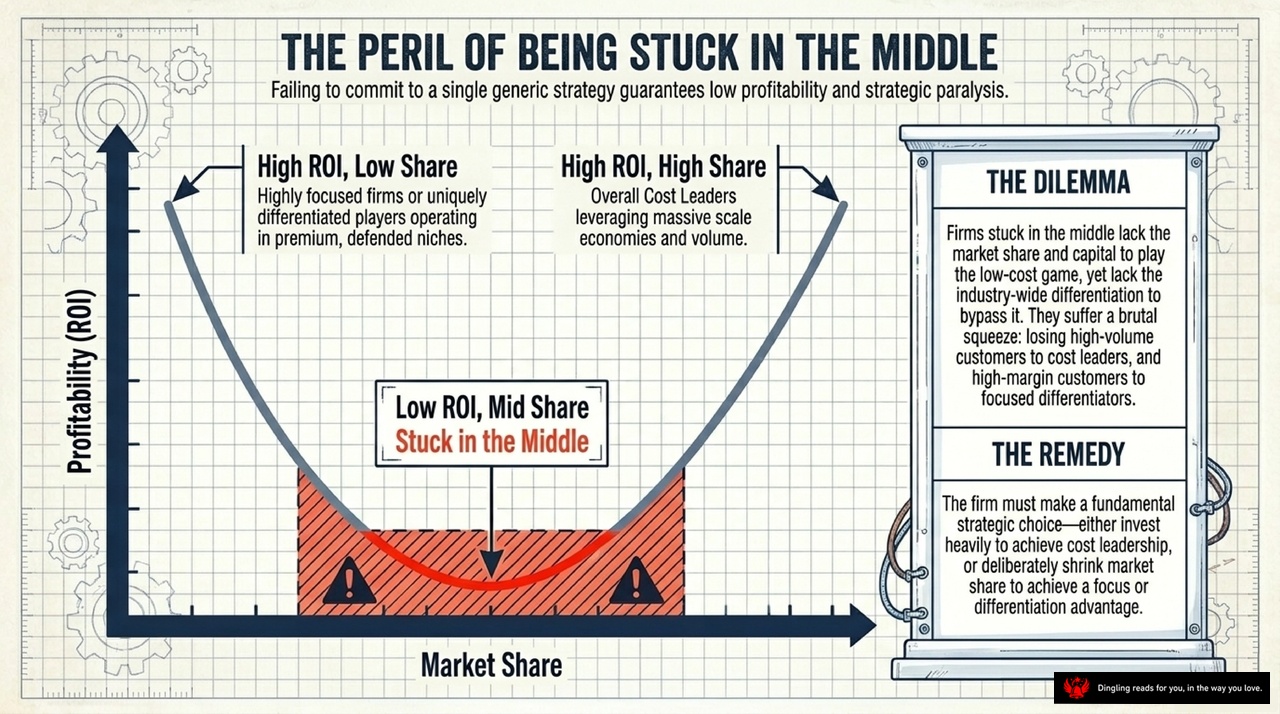
Imagine a graph where the vertical axis is profitability and the horizontal axis is market share. You'll notice a distinct U-shape curve. At the top left, you have highly focused firms operating in premium, defended niches, achieving high ROI with low share. At the top right, you see overall cost leaders leveraging massive scale economies, securing high ROI with high share. But look at the bottom center—the red shaded zone labeled "Low ROI, Mid Share." This is the dangerous trap of being "Stuck in the Middle."
The dilemma is clear: firms trapped here lack the market share to compete on low costs, yet they lack the differentiation to bypass the low-cost game. They suffer a brutal squeeze, losing high-volume customers to cost leaders while high-margin customers flee to focused differentiators. There is no safe middle ground.
The remedy is a fundamental strategic choice. You must either invest heavily to achieve cost leadership or deliberately shrink your market share to achieve a focus or differentiation advantage. Failing to commit to a single generic strategy guarantees low profitability and strategic paralysis. As the chart warns, you must pick a lane and run, because the middle is where profits disappear.

Mapping Strategic Groups isn't just about drawing circles on a chart; it's about understanding where the real money is hidden in an industry. As the slide illustrates, competition is rarely uniform. Industries are actually composed of clusters of firms pursuing similar strategic postures, which we call strategic groups. Think of these groups as distinct territories on a map, defined by dimensions like product line breadth, vertical integration, or pricing levels.
Crucially, these territories are protected by what we call "Mobility Barriers." Just as entire industries have entry barriers, these internal barriers—be they specific costs, technological leaps, or structural hurdles—make it incredibly difficult for a firm to shift its strategy and jump from one group to a more profitable one. This creates a powerful dynamic: competition is always fiercest within a specific strategic group, while it remains secondary between adjacent groups.
Furthermore, these barriers lead to "Asymmetrical Pressures." The Five Forces don't apply evenly across the map. Some strategic groups might be shielded from buyers or substitutes far better than others based on their specific posture. This means that if you can identify a group with high mobility barriers and low external pressures, you've found a fortress. In fact, the profitability of an entire industry often hinges on the average profitability of its dominant strategic groups. If you're trapped in a low-profit group with low barriers, you're fighting a losing battle. The smartest strategy is to either build your own high-barrier group or find a way to cross over into one that offers a sustainable advantage.
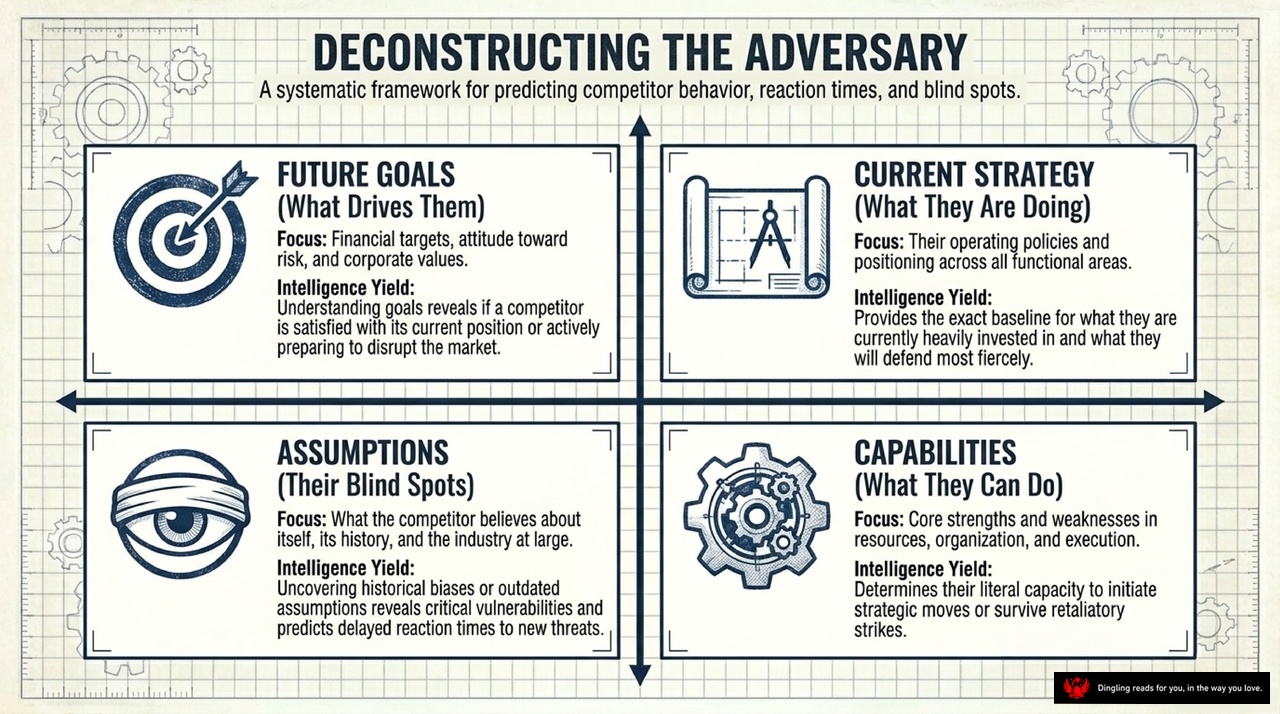
Deconstructing the Adversary: A Blueprint for Predicting Competitor Moves.
Imagine your competitor not as an enemy, but as a machine with predictable gears. To outmaneuver them, you need to see inside their engine. This slide breaks down that systematic framework into four critical quadrants.
First, look at **Future Goals**. What drives them? Are they chasing financial targets or driven by a specific corporate attitude toward risk? Understanding their goals tells you if they are content with the status quo or actively preparing to disrupt the market.
Second, examine their **Current Strategy**. What are they actually doing right now? By analyzing their operating policies and positioning across all functional areas, you get the exact baseline of what they are heavily invested in—and, crucially, what they will defend most fiercely.
Third, dig into their **Assumptions**. These are their blind spots. What do they believe about themselves, their history, and the industry? Uncovering outdated beliefs or historical biases reveals critical vulnerabilities and predicts why they might react slowly to new threats.
Finally, assess their **Capabilities**. What can they actually do? This isn't just about resources; it's about their core strengths in organization and execution. Determining their literal capacity to initiate strategic moves or survive a retaliatory strike is the key to knowing if you can actually win.
By connecting these four dots—Goals, Strategy, Assumptions, and Capabilities—you stop guessing and start predicting your competitor's next move with precision.
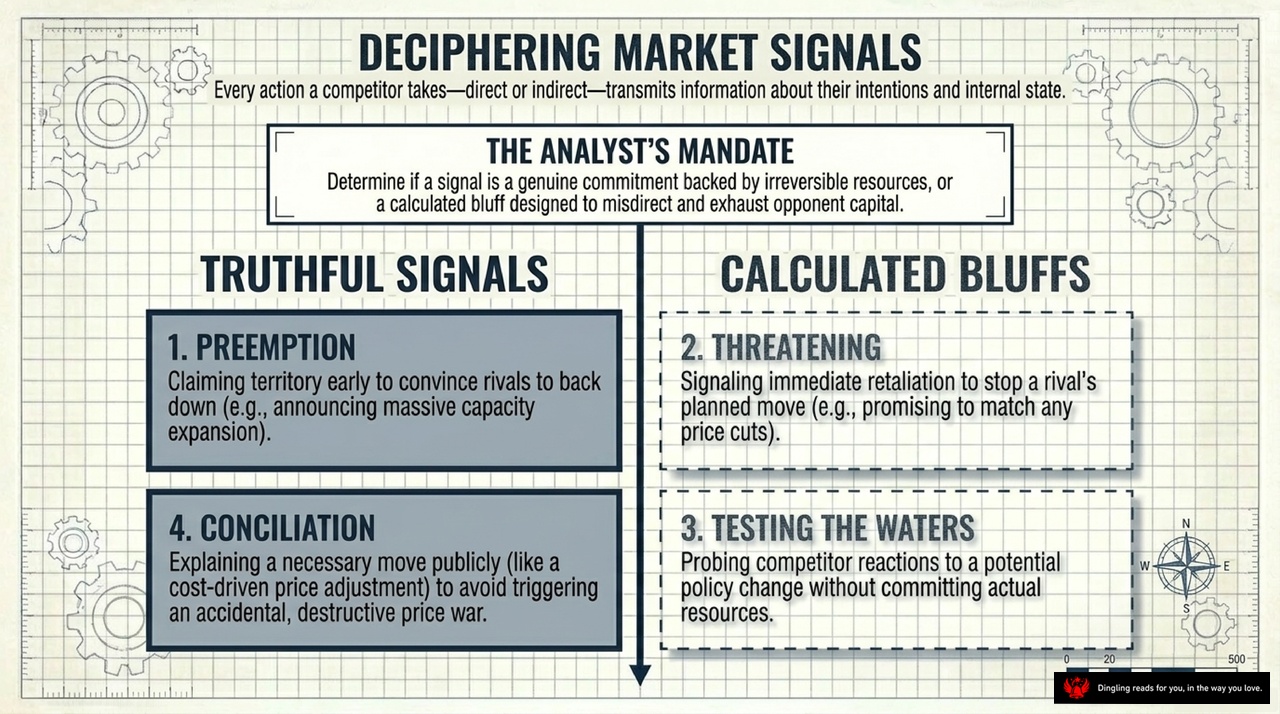
When we look at the chessboard of competition, every move a rival makes is a signal. It's not just an action; it's a message about their true intentions and internal state. As analysts, our mandate is clear: we must distinguish between a genuine commitment backed by irreversible resources and a calculated bluff designed to misdirect and exhaust our capital.
On the left side of the board, you see truthful signals. Take preemption, where a company claims territory early—like announcing massive capacity expansion—to convince rivals to back down. Or consider conciliation, where a firm explains a necessary move, perhaps a cost-driven price adjustment, publicly to avoid triggering a destructive price war. These are real commitments.
On the right, we have calculated bluffs. A threatening signal might look like promising to match any price cut to stop a rival's planned move, yet the company has no intention of following through. Or a firm might be testing the waters, probing our reactions to a potential policy change without actually committing any resources. By decoding these signals—understanding whether they are warnings or mere noise—we gain the precision needed to outmaneuver our competition and protect our market position.
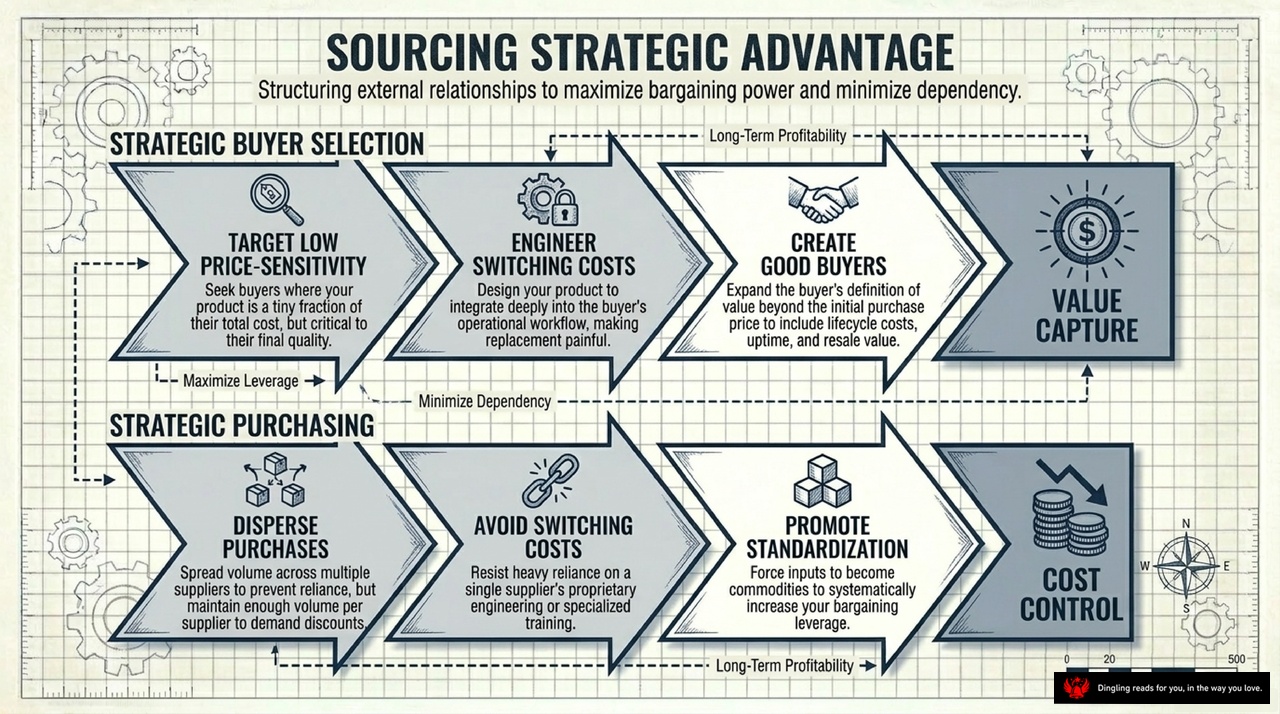
Strategic sourcing isn't just about buying low; it's about architecting your relationships to maximize leverage while minimizing dependency. Think of it as a dual-track system. On one side, you want to become a "Strategic Buyer." This means targeting customers where your product is a tiny fraction of their total cost but critical to their quality. By making your product so integral to their workflow that switching becomes painful, you engineer high switching costs. You also create "good buyers" by expanding their definition of value beyond the initial price to include things like uptime and resale value. The result? You capture long-term profit and value.
On the other track, you focus on "Strategic Purchasing" to control costs. Instead of relying on a single supplier, you disperse your purchases across multiple vendors to prevent reliance while still demanding volume discounts. You actively avoid switching costs by resisting over-reliance on proprietary tech or specialized training. Furthermore, you promote standardization, forcing inputs to become commoditized so you can systematically increase your bargaining leverage. This approach leads to strict cost control. By balancing these two approaches, you structure your external relationships to ensure long-term profitability without being held hostage by suppliers or buyers.

The Dynamics of Industry Evolution isn't just a chart; it's a map for survival. As shown on this slide, every industry follows a predictable life cycle, but the rules of the game change completely at each stage. If you try to play the game of an emerging startup using the playbook of a mature giant, you're doomed to fail.
Let's look at **Phase 1: Emerging Industries**. This is the high-risk, high-reward zone. There's no established order, and technology is uncertain. The strategic imperative here is aggressive: you must shape the industry structure itself. You need to lock in the dominant technology standard and secure those vital distribution channels before rivals can even catch their breath. It's about being the architect, not just the player.
Then, as the curve peaks and growth slows, we hit **Phase 2: Transition to Mature**. This is where the environment shifts dramatically. Buyers become experienced and hyper-sensitive to price; capacity starts to outstrip demand. The strategic imperative flips completely. Instead of expanding the market, you must fiercely defend your slice of it. Cost efficiency and precise buyer segmentation become paramount. It's no longer about building the house; it's about protecting the walls from intruders.
Finally, the inevitable decline leads us to **Phase 3: Declining Industries**. Here, absolute sales volume shrinks due to substitutes or demographic shifts. But the danger isn't just the shrinking pie; it's the trap. High exit barriers—specialized assets and emotional attachments—trap firms in the industry. This triggers brutal, profit-destroying price wars as everyone fights for scraps. The lesson is clear: strategy must adapt to the curve. You can't use yesterday's winning moves to fight today's battles.

Navigating an industry's twilight isn't about blind optimism; it requires deliberate, objective action. As we look at the "End-Game Strategies for Decline," the path forward depends entirely on two factors: your firm's competitive strength against the remaining demand and the favorability of the industry's structural position.
If you have strong competitive advantages but face an unfavorable industry structure, your best move is **Leadership**. Here, you invest heavily to force rivals to exit quickly, capturing the remaining market share to operate as a highly profitable monopoly during the industry's final years. Conversely, if you are strong but the industry structure is favorable, you should **Harvest**. This means halting all new investment, drastically minimizing maintenance, and aggressively milking the business for maximum cash flow before a final liquidation.
However, if you lack competitive strength in an unfavorable industry, the answer is to **Divest Quickly**. You must exit immediately, selling assets before their values plummet and before brutal price wars entirely erode your capital. Finally, if you are weak but the industry structure is favorable, you retreat to a **Niche**. You immediately move to a specific, highly defensible demand pocket that will resist the decline the longest, heavily defending that specific boundary to survive. Choosing the right quadrant in this matrix is the difference between a dignified exit and a catastrophic collapse.
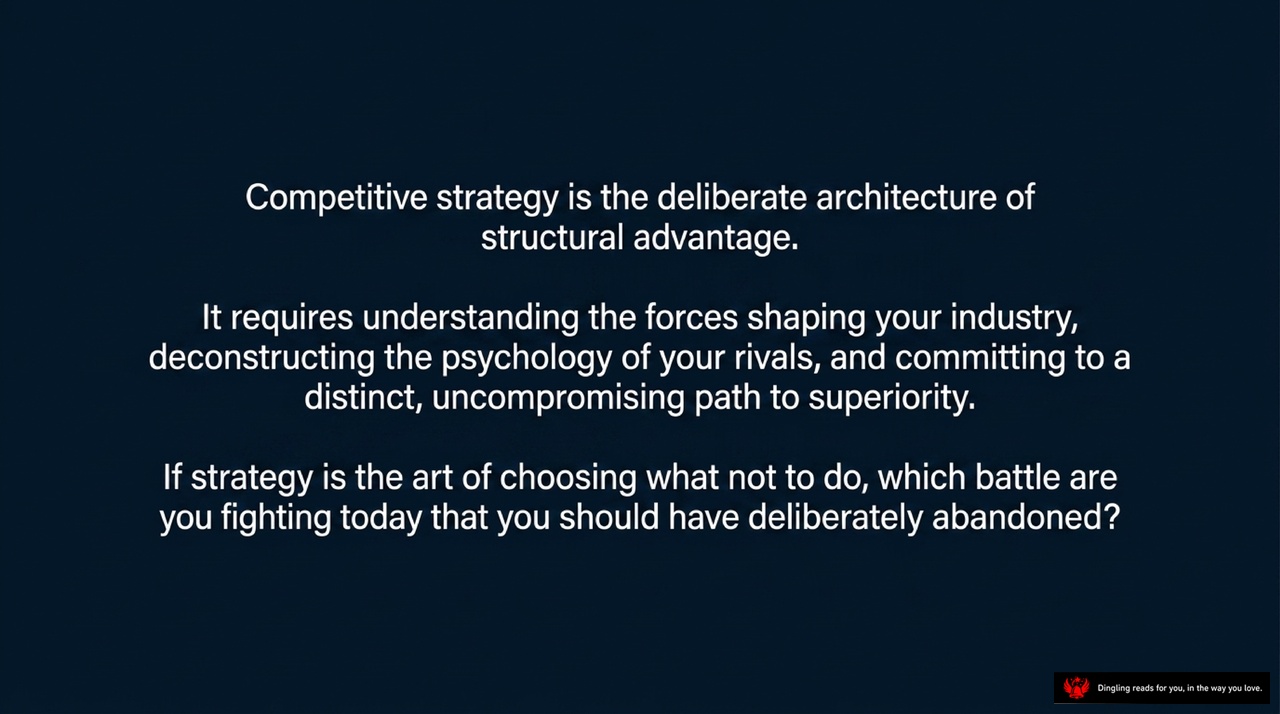
Strategy isn't just about fighting harder; it's about building a deliberate architecture for structural advantage. As the slide highlights, true competitive strategy requires understanding the forces shaping your industry, deconstructing your rivals' psychology, and committing to a distinct path to superiority.
Think of it this way: if strategy is the art of choosing what *not* to do, then the critical question is, which battle are you fighting today that you should have deliberately abandoned?
Many companies fail because they lack this clarity. They try to compete in every segment, offering everything to everyone, which ultimately dilutes their resources and weakens their position. The most successful firms know that by defining a clear, uncompromising path—whether that's through cost leadership, differentiation, or focus—they can create barriers that protect their profitability. They understand that their goal isn't to be the biggest, but to be the most structurally advantaged.
So, before you make your next move, pause and ask yourself: Are you fighting a battle that aligns with your core strengths, or are you just reacting to noise? The winners are the ones who have the courage to say no, to stop fighting battles that don't matter, and to focus entirely on the path that leads to their specific kind of dominance.