
Complexity: Complete Chapter-by-Chapter Summary

Welcome to the world of Complexity. Today, we're stepping away from the clockwork universe of the past and into a realm where order emerges from chaos.
The image before you captures the very heart of this shift. We see a tangled web of lines, a visual metaphor for the book *Complexity* by M. Mitchell Waldrop. It illustrates the profound transition from linear reductionism to the science of emergence at the edge of chaos.
For decades, science operated on the belief that if you broke the world down into its smallest parts, you could perfectly predict the whole. But this book argues that the universe is far messier and more creative than that. True life and intelligence don't live in rigid order or total randomness; they thrive right on the boundary between the two. It is in this dynamic tension, at the edge of chaos, that complex systems like economies, ecosystems, and even our own brains find their power to adapt and evolve. This isn't just a change in theory; it is a complete revolution in how we understand reality itself.

Look at this split screen. On the left, we see the "Illusion of the Machine"—a clock disassembled into its individual gears and springs. For three centuries, science operated on the belief that if you just break a system down into its smallest parts, like atoms or quarks, you automatically understand the whole. It was the era of reductionism, treating the world like a predictable clockwork machine.
But look at the right side. That's "The Reality of the Network." Instead of separate, isolated parts, we see billions of elements flowing together, intertwining, and creating something entirely new. This visual shift captures the core question driving modern complexity science: The parts cannot explain the whole.
Think about it. How do billions of individual neurons create the single experience of consciousness? How can lifeless molecules self-organize into a living cell? Or, how do individual traders, each acting on their own, suddenly cause a massive, coordinated stock market crash? In a traditional machine, pulling one gear doesn't stop the whole clock. But in a network, a tiny ripple can cascade into a massive wave.
This is the fundamental shift we're exploring today. We are moving away from the idea of a static, balanced machine toward understanding dynamic, evolving networks where the interactions between parts create emergent behaviors that no single part could ever predict on its own.

Look at this slide titled "The Paradigm Shift." It visually contrasts two very different ways of understanding the world: Classical Science versus Complexity Science.
On the left, under Classical Science, we see a grid. This represents a worldview built on 19th-century thermodynamics, where the underlying physics is defined by decay and entropy. The system dynamics are all about equilibrium and stability—a resting state where things just sit there. The actors are identical, rational units acting uniformly, like billiard balls on a table. The core law here is diminishing returns and negative feedback; the system pushes back against change to maintain order.
Now, look at the right side under Complexity Science, represented by that branching tree. Here, the underlying physics shifts to biology and evolution, focusing on structure, pattern, and life cycles. The system is never resting; it's in a state of perpetual innovation and expansion. The actors aren't identical clones; they are diverse, dispersed individuals adapting uniquely to their environment. The core law flips completely to increasing returns and positive feedback. Instead of pushing back, the system amplifies success, leading to runaway growth or market lock-ins.
This shift isn't just academic; it changes everything. It moves us from a universe of predictable machines to one of evolving, self-organizing life. It explains why some ideas or companies dominate while others fade, and why stability is often just an illusion in a dynamic world.

The slide presents a powerful contrast between two worlds: the "Classical View" and "The Reality." On the left, we see the traditional economic machine—a perfect, stable system where supply and demand always meet at a single equilibrium point. It assumes markets are predictable machines that instantly correct any disruption. But look at the right side. That swirling blue spiral represents the truth: markets are actually unstable, living ecologies. They aren't driven by perfect logic, but by historical accidents, unpredictability, and compounding advantages.
As the text reminds us, the economy isn't a machine; it's an evolving organism. Unlike the classical model where every deviation is quickly corrected, reality shows us that initial small advantages can lock in market dominance through positive feedback loops. Whether it's the VHS format beating Betamax or Silicon Valley's cluster effect, history matters more than we thought. This shift from a static equilibrium to a dynamic, chaotic evolution is the core insight that changed how we understand everything from financial bubbles to biological evolution.

The engine of lock-in is a powerful force, and it all starts with something as random as a historical accident. Think about the QWERTY keyboard or the early VHS tapes; they weren't necessarily the best technology, but they got a slight head start. That tiny early advantage triggers a network effect. As more people adopt the standard, others build infrastructure around it, making the choice even more obvious. This creates a compounding advantage where the product becomes the default not because it's superior, but because it's ubiquitous. Eventually, the market freezes in a sub-optimal equilibrium, blocking out any better competitors. History matters because these small, random fluctuations get amplified by positive feedback into permanent, irreversible structures. It's a cycle where the past dictates the future, often locking us into paths that aren't the most efficient, but are simply the ones we got stuck on.

Imagine a pile of sand. As you slowly drop grains onto it, nothing happens at first. But once the slope hits a critical tipping point, the system shifts into a state of self-organized criticality. Suddenly, a single grain of sand can trigger a tiny slide or a massive avalanche, with the frequency of these events following a strict power law. This isn't just about sand; it's the hidden rhythm of our world. Think about earthquakes, where small tremors happen daily but massive quakes are rare yet devastating. Or stock markets, where daily fluctuations are normal, but a financial crash is a rare, high-impact event. Even species extinction follows this pattern.
This concept, pioneered by Per Bak, reveals that complex systems naturally evolve to this critical edge without any external control. They aren't rigid machines waiting for a push; they are dynamic networks constantly balancing order and chaos. At this edge, systems are stable enough to hold information but flexible enough to adapt instantly to change. It’s the sweet spot where life and evolution thrive.
Now, connect this to the other side of our slide: "Order for Free." This is Stuart Kauffman's revelation. He argues that order isn't something engineers must build or evolution must painstakingly engineer over billions of years. Instead, order is a natural, unavoidable property of these complex networks. Just like the sandpile finds its own critical state, biological systems, economies, and immune networks spontaneously organize themselves at this chaotic edge. Life isn't a lottery of random mutations waiting for a perfect hand of spades; it is a self-organizing process that constantly generates new complexity from simple rules. The universe, it turns out, knows how to order itself for free.

Look at this funnel. At the top, we have a chaotic mess—10 to the power of 30 possible states. It's pure noise. But watch what happens as it flows down. Instead of getting lost forever, this loosely connected genetic network quickly settles into just 10 distinct, repeating states. This is the magic of auto-catalytic sets and state cycles.
The text at the bottom explains the secret: a loosely connected network doesn't wander randomly. It self-organizes into stable, ordered cycles. This emergent order is the raw material upon which natural selection actually operates. Without this initial drop from chaos to order, evolution couldn't get started. It's a beautiful reminder that complexity doesn't require a top-down designer; sometimes, the right connections simply allow the system to find its own rhythm.

Imagine a world where intelligence isn't about a single boss giving orders, but about a bustling crowd of competing rules figuring things out on their own. This is the heart of a Complex Adaptive System, or CAS. Think of it as a self-driving loop. It starts with **Detectors**—the system's eyes, like sensors or market data, constantly scanning the environment. These observations get posted on **The Notice Board**, converted into simple binary strings, like a digital bulletin board for everyone to see.
Next come the **Classifiers**, which are the system's internal brain. They aren't a central computer, but a population of "If/Then" rules. Each rule competes to see if the current data matches its condition. If it does, that rule fires and triggers an action. These actions are taken by **Effectors**, which move the system in the real world. Finally, the results feed back through **Environmental Feedback**. Did the system succeed or fail? That outcome loops back to the start, telling the detectors what's happening and letting the rules evolve.
The magic here is that there is no central controller. Intelligence emerges from this constant loop of sensing, matching, acting, and learning. As the slide perfectly captures: the secret to intelligence isn't a top-down command, but a dynamic population of competing rules working together to adapt and survive.

The Bucket Brigade and Genetic Algorithms are the twin engines driving a Complex Adaptive System. On the left, you see the Bucket Brigade: a successful outcome isn't just a result; it's a reward that travels backward through the chain of activated rules. This feedback loop strengthens the useful rules while starving the useless ones, creating a self-correcting mechanism. On the right, we see Genetic Algorithms in action. Just like nature, digital chromosomes break apart and cross over to form offspring. This isn't about finding a single perfect answer; it's about letting internal models compete, mate, and evolve. As the slide reminds us, optimization is often an illusion. In a complex world, the only real strategy is constant adaptation.

Imagine a grid of simple black and white squares, seemingly chaotic on its own. But watch closely as these squares transform into geometric shapes, and then into a fluid, swirling flock of birds. This visual journey illustrates a profound truth about life: complex, hyper-realistic behavior can emerge from incredibly simple, local rules.
There is no top-down command telling these birds to flock. Instead, each individual follows just three basic instructions: avoid crowding, match the speed of neighbors, and move toward the center. When thousands of individuals follow these simple guidelines simultaneously, the result is a sophisticated, unpredictable group dynamic.
This is the essence of emergent behavior. The underlying code, or genotype, is remarkably simple, yet the resulting behavior, or phenotype, is rich and complex. It demonstrates that we don't need a central controller to create order; sometimes, the right local interactions are enough to simulate the very essence of life itself.

Look at this chart titled "Langton's 4 Classes of Systems." It maps out the spectrum of how complex systems behave, ranging from frozen to chaotic. On the far left, we have Class I, the "Frozen" zone. Imagine a rigid crystal structure; information freezes immediately, and the system essentially dies because it can't change. On the other side, we have Class III, the "Chaotic" zone. Here, total randomness reigns. Information is instantly destroyed in the noise, leaving nothing but static.
Then we have the predictable middle. Class II represents "Periodic" systems. Think of a simple pendulum swinging back and forth. These systems fall into endless, boring loops. They are stable, but they lack the ability to adapt or evolve.
But right in the center, highlighted in that warm brown box, is the most critical part: Class IV. This is the mysterious zone where complex computation and life actually occur. As the slide notes, this is "Zone 4." It sits perfectly on the edge between order and chaos. If a system is too ordered, like the frozen crystal, it stops learning. If it's too chaotic, like the random noise, it collapses. But in this sweet spot, the system is stable enough to store information yet flexible enough to process it quickly. It's the only state where true adaptation and evolution can happen. This is the "edge of chaos," the exact condition required for life and intelligence to emerge.

Imagine a world that is either so rigid it cannot change, or so chaotic it falls apart completely. Nowhere is this tension more visible than in the concept of "The Edge of Chaos." As the slide illustrates, we live on a spectrum between Rigid Order and Pure Chaos. On the left, rigid order is too static to innovate; it's a frozen system where nothing new can happen. On the right, pure chaos is too turbulent to sustain any structure; it's a noise-filled void where no information can be stored.
But life, and indeed all complex systems, thrive right in the middle. This is the Edge of Chaos—the exact balance point where a system has just enough stability to hold onto information, yet enough fluidity to transmit it. It is here that mutations thrive, where empires rise and fall, and where life itself exists.
Think of it like a mountain ridge. If you slide too far toward order, you get stuck. If you slide too far toward chaos, you tumble off. But standing right on that peak, you are perfectly poised to adapt and evolve. This is the secret to complexity: the magic doesn't happen in the center of safety or the center of disorder, but right on the edge where the two forces meet. It is in this delicate, dynamic balance that true innovation and survival become possible.
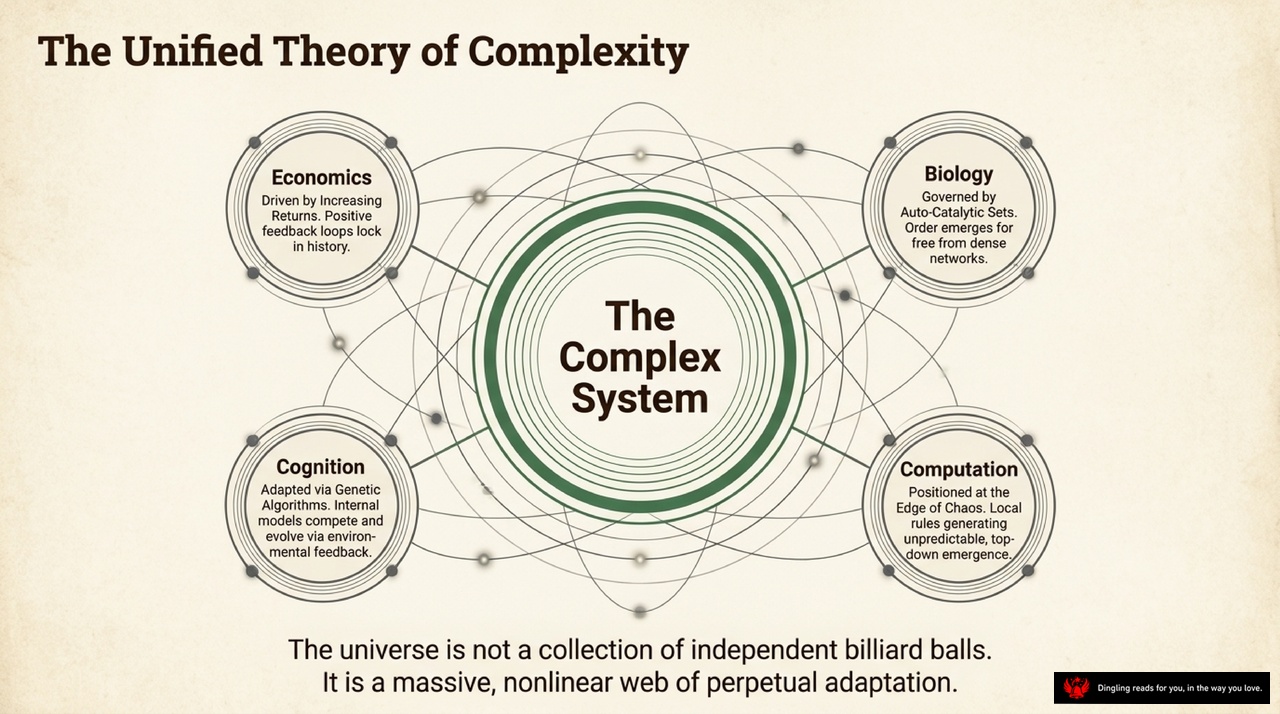
The universe isn't a collection of independent billiard balls; it's a massive, nonlinear web of perpetual adaptation. This is the heart of the Unified Theory of Complexity. At the center lies the Complex System, acting as the hub where four distinct but deeply interconnected domains converge: Economics, Biology, Cognition, and Computation.
Look at the top right: Biology. It's governed by auto-catalytic sets, where order emerges freely from dense networks rather than being imposed from the top down. Move to the bottom right for Computation. This domain sits right at the edge of chaos, where local rules generate unpredictable, top-down emergence—exactly the kind of behavior we see in life and markets.
On the left, we see Economics and Cognition. Economics is driven by increasing returns, where positive feedback loops lock in history, meaning early advantages can permanently shape the future. Similarly, Cognition adapts via genetic algorithms, with internal models competing and evolving through environmental feedback.
All these circles are connected by a web of lines, illustrating that these aren't separate silos. They are parts of one unified system. As the text at the bottom reminds us, we must stop thinking of the world as a predictable machine and start seeing it as a dynamic, adaptive network where complexity is the only constant.

Navigating the Edge of Chaos isn't about finding a single perfect answer; it's about choosing the right strategy for the world we actually live in. Look at the slide: on the left, we have the "Illusion of Control," the old Newtonian way. For centuries, we've tried to act like the universe is a clockwork machine. We assume everyone is perfectly rational, that markets always find a stable equilibrium, and that if we just isolate variables and issue top-down commands, we can predict and control everything. It's the comfort of certainty, but it's built on a lie.
Now, look at the right side: "The Reality of Cultivation." This is the Complexity Strategy. It asks us to accept a harder truth: bounded rationality and fundamental unpredictability. The world isn't a machine waiting to be fixed; it's an ecosystem waiting to be guided. Instead of seeking a permanent equilibrium, we should maximize options and resilience. Instead of rigid, top-down commands, we design simple local rules that let order emerge from the bottom up. We stop trying to solve problems in a vacuum and start observing the interconnected feedback loops that drive real change.
The shift from control to cultivation is the difference between fighting the current and learning to surf it. It means trading the false security of perfect prediction for the dynamic power of adaptability. In a complex world, the smartest move isn't to lock everything down; it's to stay flexible enough to evolve when the unexpected happens.

We've stopped seeing the universe as a predictable, mechanical clockwork and started recognizing it as a living, self-organizing network—a perpetual cycle of adaptation, emergence, and evolution balanced precariously at the edge of chaos.
So, if the systems that govern our economies, our societies, and even our minds are alive and constantly adapting, are you still exhausting yourself trying to control them? Or will you finally learn how to evolve with them?