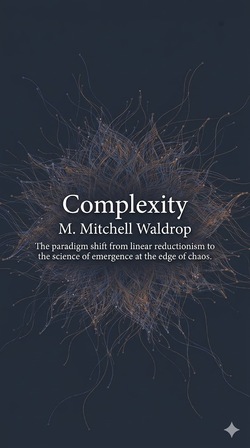
This book shows why traditional economics failed to predict the 2008 crash. Mainstream models assumed markets would always reach a stable equilibrium where supply and demand balance perfectly, ignoring how real systems actually work. They treated economies like simple machines with predictable parts, but the 2008 crisis proved markets are messy, interconnected networks where small changes trigger massive, unpredictable cascades. Traditional theories couldn't account for how panic spreads or how risky loans bundled into opaque derivatives create self-reinforcing loops that no single equation could solve. Instead of fixing these broken models, complexity science suggests we need to study dynamic, adaptive systems where agents learn and evolve together. The book details how scientists at the Santa Fe Institute rejected the old reductionist approach to build new tools for understanding chaos. They realized that order and disorder balance at a fragile edge, where systems thrive through constant adaptation rather than static stability. This shift helps us understand everything from financial crashes to tech monopolies without blaming irrational humans or seeking false certainty. It is a necessary read for anyone wanting to make sense of a volatile world. Understanding the edge of chaos means accepting that unpredictability is a feature, not a bug, of life itself.