
Confessions of a Mask: Complete Chapter-by-Chapter Summary

Welcome everyone. Today we are diving into a masterpiece that changed how I see myself: Confessions of a Mask by Yukio Mishima.
Look at the cover. It is not just a book; it is a cracked surface. Mishima wrote this as a coming-of-age story, but it is really about the struggle between who we pretend to be and who we actually are.
The subtitle on the slide says it is a psychological deconstruction of the chasm between societal facade and visceral truth. In the book, the protagonist feels like he is wearing a mask all the time. Society expects him to be normal, successful, and polite. But inside, he is obsessed with death, beauty, and things that break the rules.
It is a raw look at the human condition. How do we hide our true selves to fit in? And at what cost? This book is not just about growing up; it is about the pain of realizing the gap between the mask we wear and the person underneath. Let us start our journey.

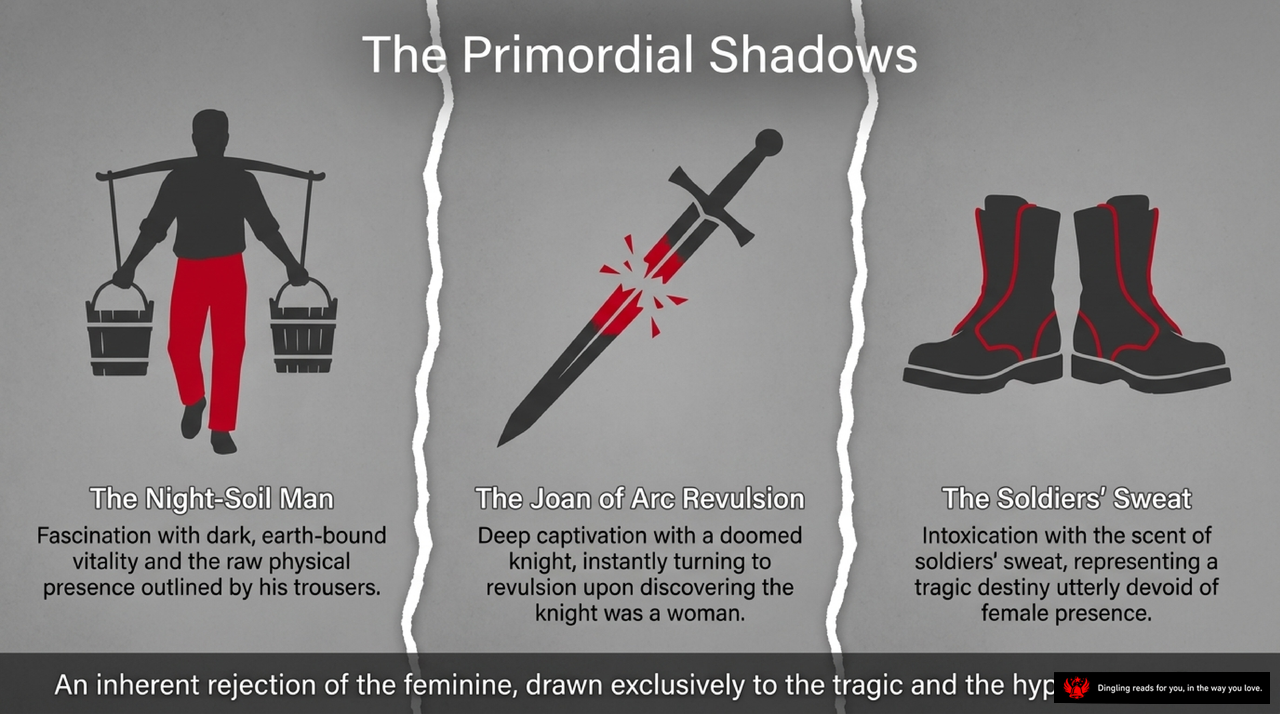
Let's talk about the first shadows that cast themselves over my life, the ones that defined who I wanted to be before I even knew I had a name. I call them the Primordial Shadows.
First, there was the Night-Soil Man. I remember being five years old, climbing a hill with a woman, when this man walked by carrying buckets on a pole. He wore dark trousers that outlined his physical presence. I didn't just see him; I was fascinated by him. I felt a deep desire to become him. It wasn't about wealth or status; it was about that dark, earth-bound vitality. I wanted the raw physicality, the sense of a life lived close to the ground, even if it meant embracing a kind of tragic, self-destructive existence.
Then came the Joan of Arc Revulsion. I was obsessed with a picture of a knight on a horse, brandishing a sword. I thought it was a man, a hero. But a nurse later told me the truth—that the knight was a woman, Joan of Arc. The moment I realized the hero was female, I felt a deep revulsion. It wasn't just disappointment; it was a crushing blow. That image became a symbol of everything I wanted to reject. I was captivated by the doomed knight, but the moment the feminine element was revealed, I turned away.
Finally, there was the Soldiers' Sweat. I remember the army marching past my house. I would ask for bullet casings, but the real attraction was the smell. The scent of soldiers' sweat, that damp, salty smell of the battlefield. It intoxicated me. It represented a tragic destiny, a life utterly devoid of female presence. I found that smell more alluring than anything else, because it promised a kind of pure, masculine sacrifice.
These three moments—the man with the buckets, the female knight, and the smell of sweat—formed the foundation of my early psychology. They were an inherent rejection of the feminine, drawn exclusively to the tragic and the hyper-masculine. It wasn't a choice I made; it was a destiny I was born into, a shadow that would follow me for the rest of my life.
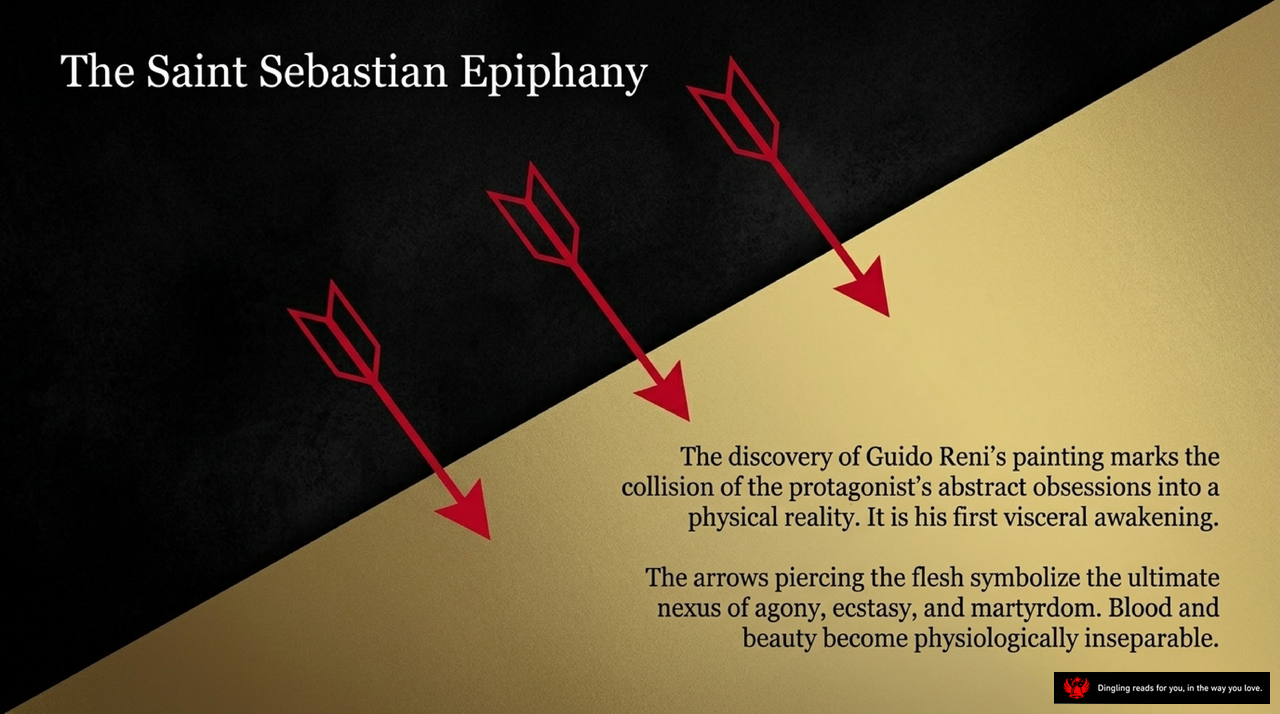
Welcome to this pivotal chapter of the book. This slide captures a defining moment in the narrator's life: The Saint Sebastian Epiphany. It represents the exact collision where his abstract obsessions crash into physical reality. Before this, his desires were hidden thoughts, but finding Guido Reni's painting triggers his first visceral awakening.
Look closely at the arrows pointing down. They symbolize the arrows piercing the flesh in the painting. In the text, the narrator describes his blood boiling instantly upon seeing the image. He feels a pagan joy that shakes his entire existence. The arrows represent the ultimate nexus of agony, ecstasy, and martyrdom. For the protagonist, blood and beauty become physiologically inseparable. He realizes that the pain depicted is a form of beauty he deeply craves.
This discovery changes everything. He starts unconsciously imitating the saint's posture, even mimicking the pose of the martyr under the blue sky later in life. It is the moment he accepts that his desire is tied to this specific kind of suffering and sacrifice. He connects his identity to this image of wounded grace, realizing that his 'bad habit' isn't just a secret act, but a profound connection to this ancient figure. The text mentions that this image awakens a 'toy' within him, making it stronger than before. It's the first time he experiences a sudden 'bad habit' without being taught. This epiphany sets the stage for the rest of his journey, binding him to the aesthetic of pain and beauty forever. It transforms his internal struggle into a tangible, physical experience that he can no longer ignore. The painting becomes a mirror, reflecting a dark, beautiful truth about his own soul that he had previously avoided. This moment defines his understanding of desire as something that requires a physical manifestation to be truly felt. He no longer sees the saint as a distant religious icon, but as a reflection of his own inner turmoil and intense longing for something that hurts and heals at the same time.
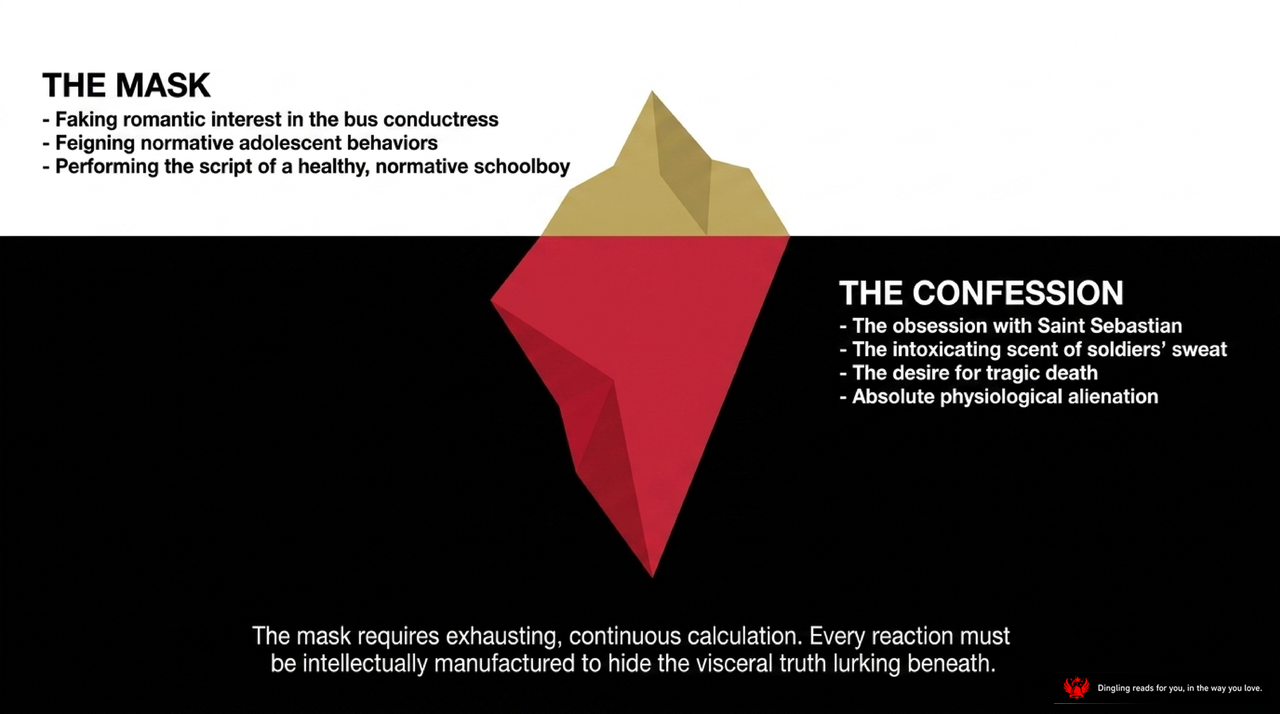
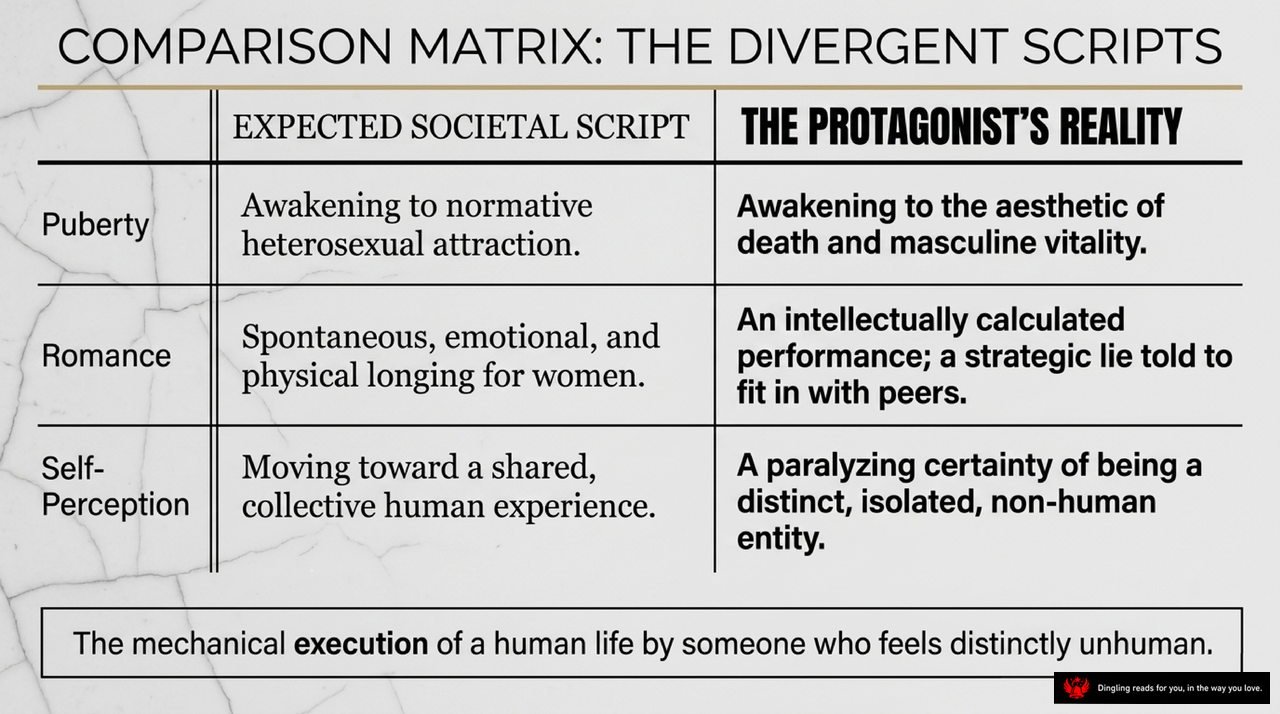
So, look at this iceberg. We see 'The Mask' above the water. For the narrator, this isn't just a costume; it's a survival strategy. He describes faking romantic interest, pretending to be a normal schoolboy, constantly calculating how to act so he doesn't stand out. He says, 'The mask requires exhausting, continuous calculation.' Every smile, every reaction, is intellectually manufactured to hide who he really is. He's terrified of being seen as different, so he builds a perfect, healthy facade. He even admits to 'feigning normative adolescent behaviors' just to fit in with his peers. He was performing a script, pretending to be a healthy boy when he felt completely broken inside. He had to constantly monitor himself, like an actor on stage, to ensure he never slipped up.
But what about 'The Confession'? What's hiding underwater? This is where the real, raw truth lives. It's not about being a normal guy. It's an obsession with Saint Sebastian, a beautiful martyr. It's the intoxicating scent of soldiers' sweat, the idea of tragic death. He admits to a desire for death, a feeling of absolute physiological alienation. He feels disconnected from his own body and from normal life. He remembers the smell of sweat on soldiers' bodies, not as something gross, but as something intoxicating, linked to their tragic fate. It's a desire for the end, for the pain that normal life denies him. He finds beauty in the destruction of the body, which is the opposite of what society teaches.
The book makes it clear: the mask is just a shield. Behind it lies a dark desire for suffering and a complete rejection of the happy, normal life everyone expects. It's a tragedy of hiding the self. The narrator admits that every reaction is manufactured to hide the visceral truth lurking beneath. It's a constant, tiring performance to keep the world at bay, while inside, he's screaming for a death that feels like a release. He realizes that the 'normal' life he's performing is actually a lie, and the truth is far darker, filled with a longing for pain that normal people can't understand. That's the cost of wearing the mask. He's trapped between the world he pretends to be and the dark desires he can't escape. This is the core of his struggle, and it's a warning to anyone who tries to hide who they really are behind a smile.
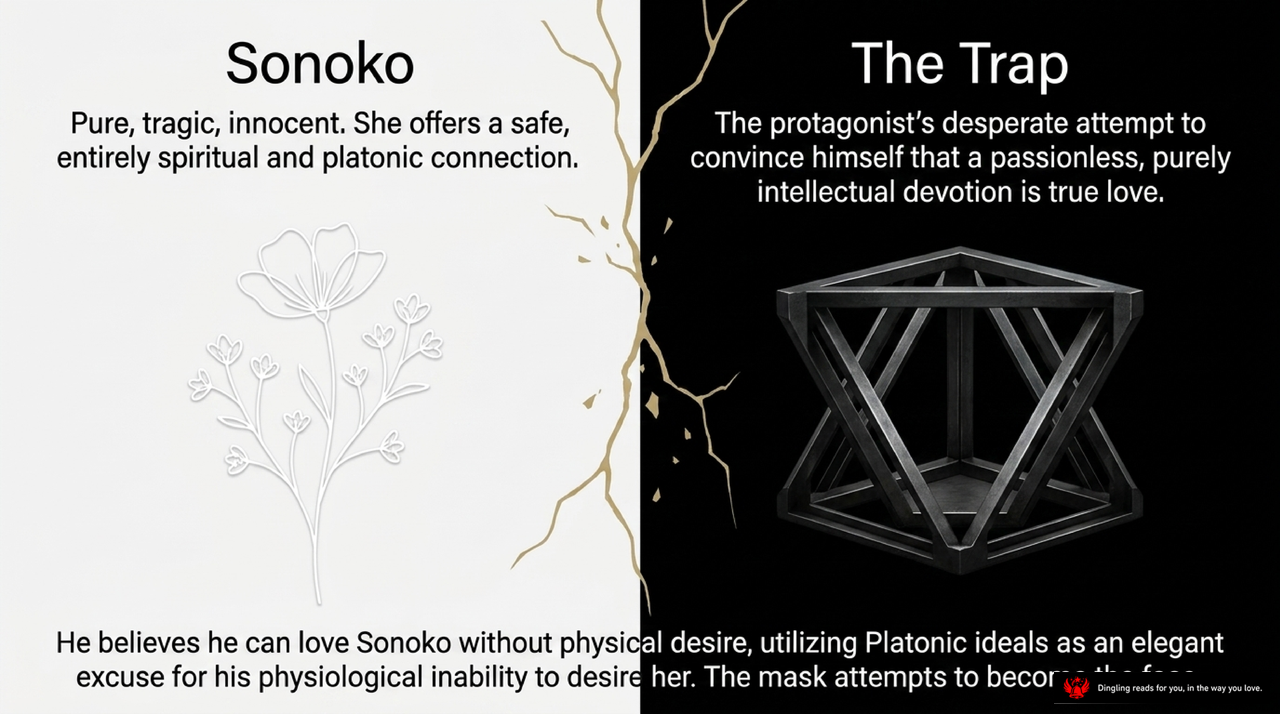
On this slide, we're looking at the two halves of the narrator's psyche. On the left, we have Sonoko. She's pure, tragic, and innocent. To him, she represents a safe, entirely spiritual connection. It's a fantasy where love exists without the messiness of the physical world. She's the ideal he's built to protect himself.
But on the right, we see The Trap. This is the protagonist's desperate attempt to convince himself that this passionless, purely intellectual devotion is actually true love. It's a lie he tells himself to feel safe.
The text reveals the core conflict: He believes he can love Sonoko without physical desire. He uses these Platonic ideals as an elegant excuse for his physiological inability to desire her. He can't feel the normal attraction that comes with real intimacy, so he builds this wall around her. He pretends to be a noble lover, hiding his vulnerability.
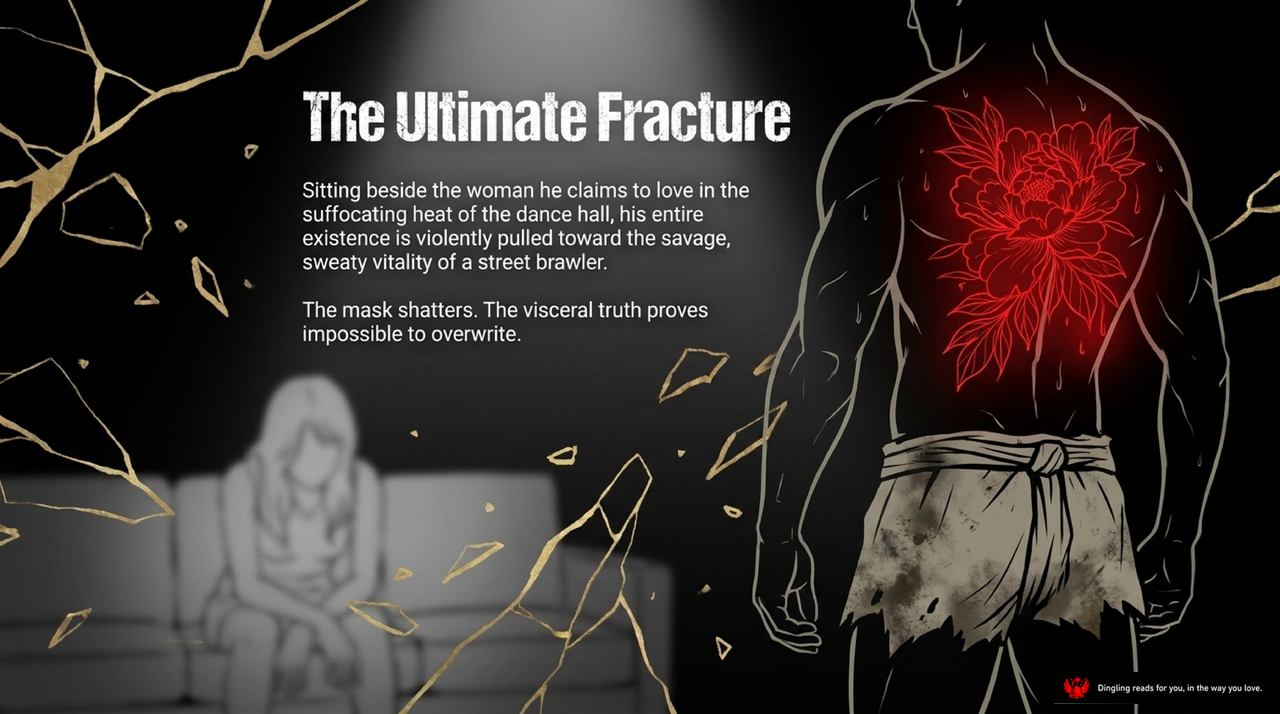
Think about it. In the story, he tries to kiss her, but he feels nothing. No pleasure, no spark. He realizes he's a fraud. He's pretending to be a normal man, but he's just using this 'pure' relationship to avoid the vulnerability of real intimacy. He's trapped in this version of himself where he's a noble lover, but he's actually just avoiding the real thing.
The bottom text sums it up perfectly: 'The mask attempts to become the face.' He isn't just wearing a mask anymore; he's become the mask. He's trapped in this beautiful, tragic illusion. He chooses the safe, spiritual Sonoko over the messy, physical reality of human connection. And that's the trap. He loves the idea of love, not the person.
This is a profound commentary on modern relationships. We often do this too. We look for the perfect, painless connection to avoid the risk of being truly known. We build these walls of 'intellectual love' to keep the physical distance. But it's a prison. It's a trap that keeps us from ever truly living. The narrator realizes this too late, watching his own life dissolve into this beautiful, empty performance. It's a warning to all of us about the danger of loving an idea instead of a person. We think we're protecting ourselves, but we're actually just isolating ourselves. That's the ultimate cost of this 'pure' love.
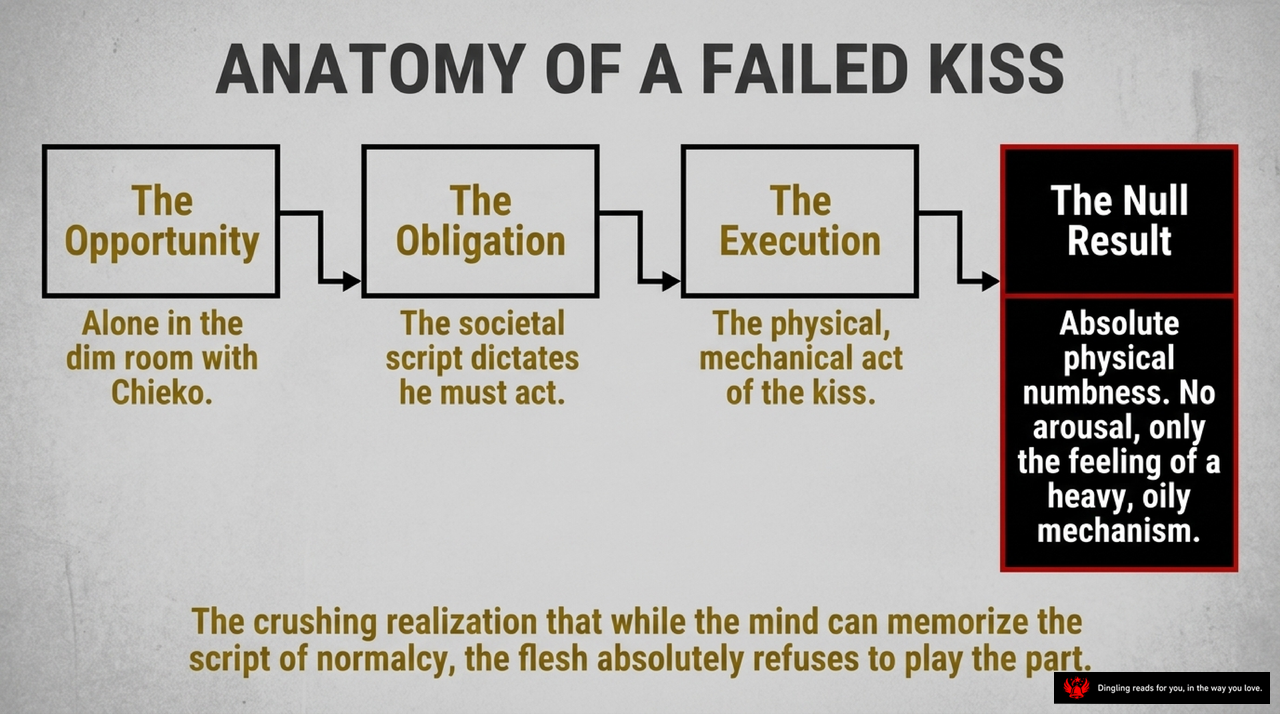
Welcome back to our deep dive. Today we're looking at a pivotal moment in the book, specifically this slide titled "Anatomy of a Failed Kiss." It maps out a psychological breakdown that the protagonist experiences during a critical encounter with Sonoko. It's not just about a kiss; it's about the failure of an identity.
Let's look at the first box: "The Opportunity." In the text, he and Sonoko are alone in the woods near an abandoned golf course. The setting is intimate, almost like a private stage. The light is fading, creating that dim room atmosphere. He's waiting for the moment to happen. He's planning the steps in his head like a script. He's alone, but not really alone, because his mind is racing with expectations. He needs this moment to be perfect. He wants to feel something.
Then we move to "The Obligation." This is where it gets heavy. He doesn't just want to kiss her; he feels he *must*. The societal script dictates it. He believes that if he kisses her, he becomes a real man. It's a performance. He's trying to fit into a mold of masculinity that he doesn't actually understand. He's acting out a role he was told to play. The pressure is on him to perform a normalcy that he feels he lacks. He feels like he's failing at being human.
Next is "The Execution." He finally does it. He holds her, he kisses her lips. He's done the physical act. But here's the twist. It wasn't romantic. It wasn't passionate. It was cold.
And finally, "The Null Result." This is the punchline. He expected arousal, he expected a connection, he expected to feel like a man. But instead, he feels absolute physical numbness. No arousal, just the feeling of a heavy, oily mechanism. It was mechanical, not human. It felt like he was operating a machine rather than feeling a connection. It was a dead weight.
The text at the bottom sums it up perfectly: "The crushing realization that while the mind can memorize the script of normalcy, the flesh absolutely refuses to play the part." His brain knew exactly what a kiss was supposed to feel like, but his body refused to cooperate. That disconnect is where the real tragedy lies. It wasn't just a failed kiss; it was a failed identity. He realized he couldn't become the man he thought he needed to be. That moment of numbness stays with him, defining his relationship with intimacy for the rest of the book. It's a haunting reminder that you can't force feelings, no matter how hard you try to follow the script. The mind can learn the lines, but the body can't always feel the scene.

Look at that structure. It looks like a building, but really, it's a cage. That's the core idea of this slide: The Paradox of the Facade.
In the book, the narrator realizes something early on. He sees that life is like a stage. He says, "Everyone says life is a stage," but for him, it becomes a prison. He tries to wear a mask. Why? To protect himself from society. He thinks, "I need to look normal. I need to fit in."
But here's the catch. By wearing this mask so perfectly, he actually protects society from him. Society gets a "normal" person, but the real him is locked away. He becomes untouchable. He performs normalcy so well that he becomes utterly unloved for who he truly is. He ends up exiled to an absolute, permanent solitude.
He tries to act like everyone else. He tries to be a normal student, a normal man. But underneath, he's screaming. The book describes this as a "flawless performance." And that performance? It's his ultimate prison. He builds the cage himself. He thinks he's safe inside it, but he's just trapped.
So, the mask was meant to be a shield. But it turned into a wall. And that's the tragedy.

Look at this cracked paper. It feels like the human condition itself, doesn't it? We’re told that to exist in the light, to fit into society, we have to live as ghosts. We hide behind a mask. But the book tells us a different, darker story. The protagonist spent his whole life trying to be 'normal,' to act like everyone else, believing life was just a performance on a stage. He even joked that life was a play that could end early. But that performance cost him his soul. He realized that to feel the truth of his flesh, to actually feel alive, he had to embrace the shadows of destruction. He had to touch the darkness inside himself.
Think about it. If wearing a mask is the only way to survive society, but feeling the raw truth of your body is the only way to feel alive, which one is the true self? This isn't just about him. It's about all of us. We wear masks every day. We smile when we want to cry. We pretend we're fine when we're falling apart. But the question remains: when you take that mask off, who is left underneath? Is the person who survives the social game the real you, or is the person who dares to feel the pain, the fear, and the destruction the real you?
In this book, the author explores this conflict from childhood to adulthood. He admits he was a coward, a liar, someone who hid behind a 'normal' persona. He felt like a ghost in his own life, watching others live while he performed. He realized that his 'virtue' was just a mask to hide his 'monsters.' He obsessed over the bodies of others, the war, the death, because those were the only things that felt real to him. He wanted to be a hero, but he was a ghost. He wanted to be alive, but he was dead inside. He was obsessed with the physical sensation of others, the smell of sweat, the sight of wounds, because that was the only way he felt connected to reality.
Look at the text again. It says, 'To exist in the light, he must live as a ghost.' That's exactly what he did. He lived a double life. He pretended to be a law student, a normal citizen, but inside, he was consumed by a desire for destruction. He was terrified of being ordinary, so he chose to be monstrous. He was terrified of death, so he embraced it. He was terrified of being seen, so he hid. He even had an 'early death hypothesis,' thinking that if he died young, he wouldn't have to face the burden of being a fake. But he couldn't escape. So, here we have the tragedy distilled into a single question. Are we defined by how well we hide, or how well we feel? The slide asks us to choose. But the book suggests that the tragedy lies in the fact that we can't really choose. We are torn between the safety of the mask and the pain of the flesh. So, what do you think? Which side is the true self? We spend our lives building walls, but the real question is whether we ever dare to break through them.