
Confessions of an Advertising Man: Complete Chapter-by-Chapter Summary
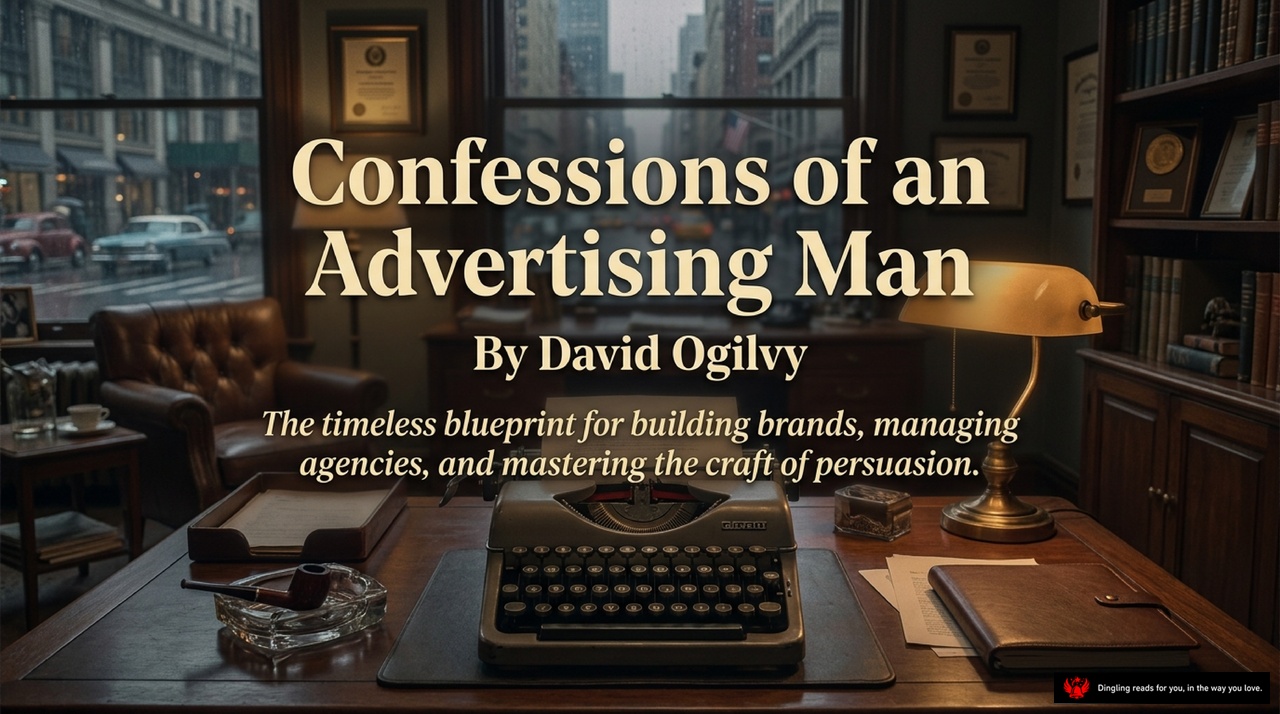
Welcome to "Confessions of an Advertising Man" by the legendary David Ogilvy. Set against a backdrop of a classic, rain-swept New York office, this image captures the very essence of the craft: a vintage typewriter, a pipe, and the quiet determination of a writer who believes that great advertising is not just about selling, but about building something lasting.
This book is the timeless blueprint for building brands, managing agencies, and mastering the art of persuasion. Ogilvy's story begins in 1948 when he launched his agency with a simple yet bold mission statement: "We are a new company, trying to survive." He started with just $6,000 and a borrowed name, driven by a vision to break the cycle of mediocrity that plagued the industry. He refused to hire sycophants, seeking instead people with brains and education who could create work that truly mattered.
The image before you represents the core philosophy that Ogilvy championed: that advertising is a serious profession, a craft that requires dedication, intellect, and a refusal to compromise on quality. It is a reminder that behind every successful brand is a team of dedicated professionals who believe in the power of truth and creativity to change the world. Whether you are building a startup or leading a global agency, the principles laid out in these pages offer a clear path forward, proving that with the right mindset and unwavering commitment, you can turn a small idea into a giant success.

Let's talk about how the father of modern advertising, David Ogilvy, built his legendary agency, Ogilvy & Mather, from scratch. In 1948, with just $6,000 and a borrowed name, he launched his company not for quick riches, but to break the industry's cycle of mediocrity. He knew that new agencies often fail because they rely on old styles once the founders get comfortable. So, he set a bold goal: to become a major company within 12 years by hiring "intelligent, well-educated" young people and demanding rigorous discipline, clean workspaces, and a deeply involved leadership style.
Ogilvy believed that advertising wasn't just about selling; it was a behavioral science applied to sales. To prove this, he drew lessons from three distinct sources. First, he learned from a chef in Paris that discipline and cleanliness are non-negotiable for success. Second, he studied a salesman in Scotland who taught him that every pitch must be grounded in hard facts and a deep understanding of human nature, avoiding fluff. Third, he looked to a researcher from Gallup, who discovered that intuition is fatally flawed and that relentless testing and data are what truly dictate success.
These three influences converged to form what Ogilvy called "The Advertising Mastermind." He famously admitted, "I have almost no capacity for logical thought, but I have a pipeline to my unconscious... combined with a habit of research." This was his secret formula: using research to feed his intuition. He believed that advertising is a behavioral science applied to sales, and by combining the chef's discipline, the salesman's focus on facts, and the researcher's reliance on data, he created a system that would revolutionize the industry and turn a small startup into a global powerhouse.

Welcome to the heart of our creative philosophy. Today, we're diving into "The Talent Mandate," a concept that isn't just about hiring people, but about building giants. As the slide beautifully illustrates with that nesting doll, if you only hire those smaller than you, your company shrinks into a collection of dwarfs. But if you relentlessly seek talent that is bigger, smarter, and more capable than yourself, you build a legacy of giants.
This mindset drives three core pillars on the right side of our screen. First, we operate as a "Teaching Hospital." Think of our agency not as a factory, but as a medical institution where young talent is relentlessly cultivated and trained. We don't just want bodies; we want minds to grow. Second, we are fiercely "Anti-Bureaucracy." We believe in eliminating layers of approval. Look around any city park, and you'll find statues of individuals, but never statues of committees. We reject the slow, stifling approval process because creativity dies under bureaucracy.
Finally, we live by "The Rule of Truth." Integrity is our ultimate business strategy. We never write an advertisement we wouldn't want our own family to read. This isn't just a slogan; it's a filter for everything we do. It means rejecting anything that feels dishonest or manipulative. By combining these principles—hiring the best, removing red tape, and staying truthful—we create an environment where great work isn't just possible, it's inevitable.

Let's talk about the actual craft of writing an ad that sells. Forget the pretentious talk about "creativity" for a moment; in our world, there's no such thing. There are only good ads and bad ads. We have a strict set of rules, often called the "Lamp," derived from decades of hard data from mail-order catalogs and department store receipts. These aren't suggestions; they are the law.
First, remember that content always beats form. The promise you make to the consumer is what drives the sale, not how fancy the layout looks. Second, your copy must be factual. We don't want to flatter the reader; we want to inform them. If your product is complex, give them the full story. Don't be afraid of long copy; in fact, the more detail you provide, the more trust you build. Think of it like a dinner party: if your neighbor asks, "Which car should I buy?" you wouldn't give a vague, flowery speech. You'd be direct, honest, and specific.
Now, let's look at the visuals. The picture is just as important as the words. In fact, the image often does the heavy lifting. A photo is better than a painting because it feels real. And here is a golden rule: never create an ad you wouldn't want your own family to see. If you can't look at it without feeling embarrassed, don't put it in the paper. We also need to avoid being annoying. With thousands of ads competing for attention every day, you have to be polite, modern, and interesting without being pushy.
Finally, the headline is your most valuable asset. It carries 80% of the ad's value. It needs to be direct, like a price tag, and it must grab attention immediately. Use words that offer new information or spark curiosity, but avoid clever tricks or double entendres that might confuse a reader scanning quickly. Your headline should promise a benefit, and your body copy should deliver on that promise with facts and a clear call to action. If you follow these principles, you stop guessing and start selling.

The Magic Lantern Framework isn't just a catchy title; it's the exact four-step engine that built Ogilvy into a global powerhouse. Let's walk through how this logic transforms a raw idea into a market-moving campaign.
It all starts with Phase 1: The Dig. You can't skip this. Before writing a single word, you must study the product and the research. No creative work begins without a foundation of hard facts. You need to know your stuff inside and out.
Once you have those facts, move to Phase 2: The Core Promise. This is where you select the single most persuasive benefit. You test it relentlessly. Remember, the promise—the large promise—is the soul of an advertisement. It's the anchor that holds everything together.
Next comes Phase 3: The Big Idea. Here is the hard truth: unless your advertising contains a big idea, it will pass like a ship in the night. It won't be seen. Your idea must be instantly arresting, cutting through the noise to grab attention immediately.
Finally, Phase 4: The Execution. This is where many agencies fail. You must subordinate the cleverness to the product. A good advertisement does not draw attention to itself; it draws attention to the product. The trick isn't to make the ad look smart; it's to make the product look irresistible.
By following these four phases, you stop guessing and start building campaigns that actually sell.

Let's talk about the art of the billboard. You might think these roadside signs are just eyesores, but when done right, they are the most efficient sales tools in the entire world. Unlike a magazine ad where you have time to read, a driver sees a billboard for less than five seconds. That means every single element must work instantly.
The design philosophy here is simple: be bold, be clear, and be direct. We aren't trying to win an art competition; we are trying to stop a car. The text needs to be large, using a strong serif font, and the brand name must be impossible to miss. If a driver can't understand your promise in five seconds, they will drive right past you.
We also rely heavily on imagery. Research shows that realistic photos or illustrations convey the message much faster than abstract art. Think of a simple silhouette or a clear product shot against a dark background. Avoid clutter; limit your materials to three or fewer. The goal isn't to be beautiful in the traditional sense, but to be effective.
While modern art critics might scoff at a billboard that looks too commercial, remember that your only job is to sell. A billboard is a "short, flat, and fast" medium. It can't tell a complex story, but it can deliver a powerful, memorable promise that sticks in the driver's mind long after they've passed it.

The trap of the mundane is real. When you show a generic, beautiful photograph, it just blends into the wallpaper of media. It feels safe, but it sells nothing. To truly capture attention, you need the hook of curiosity. Instead of showing reality, try illustrating imagination. Insert a single, unexplained element of intrigue that forces the reader to stop, engage, and hunt for answers. Look at the difference: a standard photo gets ignored, but a sketch with a mysterious detail—like an eyepatch—creates an immediate question that demands to be answered.
But there's another critical rule. Photographs represent reality, which consumers buy, but illustrations represent imagination, which sparks the mind. Always match your visual subject to your target buyer; men look at men, women look at women, and everyone looks at babies. Finally, never let the image speak alone. The true power lies in the story appeal. Use the image to create a gap in knowledge, then use your copy to fill it. When you combine a compelling visual hook with a narrative that explains the "why," you transform a simple ad into an experience that people can't look away from.

Here are the five key principles for writing copy that actually sells, as if you were chatting with a friend at a dinner party. First, write for one person. Imagine you are answering a question from the person sitting next to you; keep your tone personal, direct, and conversational. Second, banish the myth that long copy is bad. If your facts are interesting, people will read them—more facts equal more sales. Third, eliminate all abstract fluff and vague generalizations. Use plain talk and specific metrics to prove your point. Fourth, leverage the power of testimonials. Consumers trust other customers far more than they trust an anonymous copywriter. Finally, offer a genuine service. Tell the reader exactly how to remove a stain or cook a meal; service-oriented copy drastically increases readership.

On this slide, we see a sharp divide between two worlds: the quiet, thoughtful mind of the reader and the fast-paced, visual eye of the viewer.
On the left, we have the era of Print. It appeals to the reader's mind, driven by static curiosity and factual depth. Success here relies entirely on the headline's promise and the weight of the evidence in the body copy. It's a game of logic and patience, where you have to earn the reader's attention with facts.
On the right, we have Television, which speaks directly to the viewer's eye. Here, the rules are completely different. It's driven by demonstration, speed, and raw emotion. You can't just tell a story; you must show it. That's why Rule 1 is so critical: Show, don't just tell. You need to visually demonstrate both the problem and the product's solution instantly.
Furthermore, in TV, picture dominance is everything. If you turn off the sound, the viewer should still fully understand the promise. The visual must carry the entire message. Finally, consider the pacing. With an average of 200 words per minute, pitchmen talk fast because speed moves product. In the world of print, you take your time to explain; in the world of TV, you have to grab attention in a split second and keep it moving.

When we talk about advertising, we often think of a one-size-fits-all approach, but the reality is that every category demands a completely different playbook. You can't sell a vacation the same way you sell medicine, and you certainly can't sell food using the tactics you'd use for a patent drug.
Take **Food** first. Here, appetite appeal is king. Your strategy shouldn't focus on the people eating the meal; instead, use large, vibrant, high-quality photographs of the food itself. The goal is to make them hungry instantly. Furthermore, include prominent recipes. This isn't just about inspiration; it provides immediate, actionable utility, giving the consumer a clear reason to buy right now.
Now, shift gears to **Travel**. The core objective here is to sell the dream, but you must also justify the cost. Travel is an investment, so your job is to highlight unique cultural identifiers—those experiences and details that people literally cannot see or get back home. To address the primary barrier, which is expense, be factual and specific about price points. Don't hide the cost; explain the value behind it so the customer feels the trip is worth every penny.
Finally, consider **Patent Medicine**. This is a high-stakes category where you must establish absolute authority and seriousness immediately. The tone cannot be playful. You need to highlight the unique difference of the drug, proving why it is superior to alternatives. Crucially, you must acknowledge the patient's discomfort and offer a factual, reassuring solution. You are not just selling a pill; you are offering relief and trust in a moment of vulnerability.
By tailoring your message to these specific category dynamics, you stop shouting into the void and start speaking directly to the consumer's actual needs and mindset.

Here is the spoken-word script for the current slide, tailored for an American audience:
"Look at this chart. It perfectly illustrates the trap many companies fall into. The jagged black line represents 'Temporary Promotional Sales Spikes.' It shows the rollercoaster effect of constant discounts and price cuts. Sure, you get a quick rush of sales, but every time you cut the price, you are eroding your long-term brand equity. You are training customers to wait for the deal, rather than buying because they value the product.
Now, look at the smooth red line climbing steadily upward. This is 'The Brand Image Investment.' This is where the real money is made. Instead of chasing short-term spikes, you treat every advertisement as a contribution to a complex symbol—the brand itself. This is the power of consistency. The greatest brands don't change their core positioning because of internal boredom or the urge to be trendy. They hold their ground for decades.
The lesson here is clear: Stop chasing the illusion of the discount. That is a fool's game. Instead, focus on building an asset that grows over time. Consistency isn't just a boring strategy; it is genius. When you invest in a strong, unshakeable brand image, you create a value that no temporary sale can ever destroy. That is how you build a company that lasts."

Welcome to the final step of our career blueprint. As we climb these last rungs, the focus shifts from raw output to strategic wisdom.
Step one was about outworking the room, and step two was about becoming an undisputed specialist. Now, at step three, you must master the presentation. This isn't just about speaking confidently; it's about the delicate art of blending cold, hard logic with theatrical confidence. You need to write memos that are lucid and brilliant, and deliver pitches that command attention without losing substance. Your ideas must be sharp, but your delivery must be captivating.
Finally, reach step four: maintain objectivity. This is where true leadership is forged. You must be willing to concede on minor points to win the major strategic battles. It's about knowing when to let go of a small detail to secure the bigger picture. But there is a non-negotiable rule here: never lose your intellectual honesty. You can compromise on tactics, but you can never compromise on the truth. Keeping your integrity intact while navigating complex negotiations is what separates a great ad man from the rest.

Look at this scale. On one side, we have the economic engine: advertising driving mass production, lowering prices, and fueling innovation. On the other, the moral boundary. Here, the text reminds us that the consumer is not a moron; she is your wife. Never insult her intelligence.
This balance isn't just about money; it's about the truth mandate. Facts sell better than hype. Good business and good ethics are perfectly aligned. If you wouldn't want your own family exposed to an ad, it has no right to exist. That is the ultimate filter.
In a world full of noise, this framework is your compass. It tells us that real advertising respects the consumer's judgment, treats her with dignity, and prioritizes honest information over manipulation. When we align profit with principle, we don't just sell products; we build trust. And in the long run, that trust is the only currency that truly matters.

Synthesis: The Ecosystem of Respect. This isn't just a buzzword; it's the operating system for a top-tier agency. Look at the Venn diagram: where The Consumer, The Client, and The Craft intersect, we find one non-negotiable core: Respect.
First, respect the consumer. Stop treating them like targets. Give them facts, not fluff. Speak to them as intelligent equals and reward their attention with utility or intrigue. When you banish committees and rely on research and the discipline of the Magic Lantern, you stop selling smoke and mirrors. Advertising is a serious medium of salesmanship, and it demands honesty.
Second, respect the client. Treat their money as if it were your own. This means telling them the hard truths, even if it risks the account. If a strategy isn't working, you have the courage to say so. You aren't just a vendor; you are a partner invested in their success.
Finally, respect the craft. Banish the committee mentality. Rely on relentless testing and data. When you honor the craft, you naturally earn the respect of both the consumer and the client. It's a simple circle, but it's the only way to build a legacy that lasts.

True advertising mastery isn't about manipulating minds; it's about the disciplined alignment of factual research, compelling promises, and relentless respect for the consumer. If your advertising cannot sell the product without sacrificing the truth, is it the product that is flawed, or the advertiser?
Think about the modern marketplace we live in today. We are bombarded with thousands of messages every single day. In this noisy environment, the only way to cut through the clutter isn't by being louder or more aggressive, but by being more honest. When you strip away the manipulation and focus on the actual value your product offers, you build something far more powerful than a short-term sale: you build trust.
This slide challenges us to look inward. Before we launch a campaign, ask yourself: Can I sell this without lying? If the answer is no, then the problem might not be the product itself, but perhaps our approach to marketing it. True persuasion comes from clarity and integrity, not tricks. When you respect the consumer enough to tell them the truth, they respect you back. That is the foundation of lasting success in any business.