
Connected: Complete Chapter-by-Chapter Summary

Welcome to our deep dive into the invisible architecture of human life. Today, we are exploring the groundbreaking book *Connected* by Nicholas A. Christakis and James H. Fowler. As you see on the screen, the cover features an intricate web of nodes and lines, perfectly symbolizing the book's central thesis: our social networks possess a surprising power that invisibly shapes every single aspect of our existence.
From the health of our loved ones to the economic stability of our communities, and even the way we vote or feel happiness, we are far more connected than we ever imagined. This book moves beyond simple statistics to reveal how these hidden connections act as a powerful force, turning a collection of individuals into a single, functioning "superorganism." We are about to uncover how these invisible threads dictate our reality, proving that in a world of billions, we are all inextricably linked.

We often think of ourselves as lone travelers, making choices in a vacuum. But the slide you see right now shatters that illusion. It contrasts the myth of the "isolated individual"—the old idea of *Homo economicus* acting alone—with the reality: we are cells within a much larger organism. Look at that web on the right; it shows how our thoughts, feelings, and actions ripple outward through invisible connections, fundamentally altering the collective whole.
This isn't just abstract theory; it's the biological reality of being human. From an evolutionary standpoint, emotions didn't develop just for us; they evolved to synchronize our group. Imagine early humans hunting or defending themselves; they needed to feel the same urgency at the exact same moment. A smile or a look of fear travels faster than words. This is the "contagion" of emotion, driven by our mirror neurons. When you see someone else's face, your brain literally simulates their experience. That's why a joke in one part of the room can make everyone laugh, or why a sudden panic can freeze a crowd.
But this ripple effect doesn't stop at your friends. It travels through the "three degrees of separation." Research shows that if someone you know is happy, your odds of feeling happy jump by 15%. If it's your friend's friend, that's a 10% boost. Even your friend's friend's friend still adds 6% to your happiness. In fact, the emotional lift from a happy person three degrees away is far more powerful than earning an extra $10,000.
However, this same network can spread negativity with terrifying speed. We've seen this with "mass psychogenic illness," where fear or a phantom smell triggers real physical symptoms across an entire school or town, all because the anxiety itself became contagious. We've also seen it with loneliness. If someone close to you is lonely, you are 52% more likely to feel lonely yourself. If that lonely person is two degrees away, your risk still jumps by 25%.
So, when we look at that complex web on the slide, remember: you are not an island. Your mood, your health, and even your decisions are constantly being shaped by the invisible currents flowing through this network. We are not solitary actors; we are a single, breathing, feeling superorganism, and every single one of us plays a vital role in its heartbeat.

Imagine your social world not as a random scatter of acquaintances, but as a living, breathing machine built on just two invisible pillars: Ties and Contagions. Think of the lines connecting us as the structural skeleton—these are our Ties, defining exactly who connects to whom. But what travels along those lines? That's where Contagions come in. Whether it's a virus, a dollar bill, a piece of gossip, or even happiness, these are the Contagions that flow through our network, turning static connections into dynamic action.
Now, look at how these connections shape our reality through two powerful structural forces. First, we have Centrality. Picture the hub-and-spoke model: being in the middle gives you high exposure and immense influence. You are the first to hear the news, the first to get the job offer, and the first to catch a cold. It's about your position in the network. Second, we have Transitivity. This is the magic of the triangle: when your friends know each other, trust skyrockets. When your friend's friend is happy, you feel it too. This creates a web of high trust and reinforcement that no single person could build alone.
Here is the profound takeaway: your life isn't just shaped by who you know directly, but by the structure of your entire web. Being central or having tightly knit friends determines your access to resources, your health, and even your happiness. We are not isolated individuals; we are nodes in a vast, self-organizing system where our position dictates our destiny.

Imagine a world where your happiness isn't just your own—it's a currency you pass around. Today's slide reveals the invisible architecture of our interactions, showing that the shape of a network dictates its ultimate function. We see four distinct models: the linear "Bucket Brigade" for heavy lifting, the branching "Telephone Tree" for rapid information cascades, the tightly knit "Military Squad" for high-trust coordination, and finally, the complex, mixed "Organic Social Web," which is actually the natural state of human connection.
While we might think our choices are entirely ours, the reality is far more interconnected. As the book explains, we are part of a "super-organism" where emotions, behaviors, and even health ripple through a "three-degree network." This means your happiness can be boosted by 15% simply by being directly connected to someone who is happy, and that positive energy travels even further to your friends' friends. Conversely, loneliness follows the same path, spreading from a close friend to your entire social circle with startling speed.
The data is striking: the emotional value of these social connections far outweighs money. Research shows that being connected to happy people increases your joy more than earning an extra $10,000 would. Furthermore, physical proximity matters immensely; if a happy friend lives less than 1.6 kilometers away, their positive influence jumps to 25%. We are constantly wired to mimic and sync with our network, whether it's through the "mirror neuron" system in our brains or the silent pressure of social norms. From the spread of obesity and smoking to the rise of suicide rates, our health and behaviors are deeply embedded in these invisible webs. Understanding this "organic social web" isn't just academic; it's the key to unlocking better health, stronger relationships, and a more resilient society.

Imagine a world where your health isn't just a personal choice, but a shared reality shaped by the people around you. Today, we explore how social networks act as invisible architects of our well-being, proving that we are never truly alone in our health journey.
The first rule is simple yet profound: obesity is contagious. Data from the Framingham study reveals a startling truth—if your friend gains weight, your risk of doing the same skyrockets by nearly three times. This isn't about willpower; it's about shifting norms. When people around you normalize a larger body size, your own standards for "healthy weight" quietly adjust, making it easier to relax on diet and exercise. Even friends who live far away can influence you, not by mimicking your actions, but by reshaping the cultural script you follow.
But it's not just about weight. Smoking rates have dropped dramatically over the last few decades, not because everyone suddenly became rational, but because quitting became a social norm within connected groups. When one person stops, it ripples outward to friends, friends' friends, and beyond, following that powerful "three-degree rule." The same dynamic drives alcohol consumption, where peer pressure plays a massive role, especially among young women.
However, the network doesn't always push us toward the same behaviors. When it comes to sexually transmitted infections, the structure of the network matters immensely. In some communities, connections spread risk rapidly across the entire group, while in others, the network stays tight, containing the threat. Similarly, suicide acts as a tragic signal in tightly knit communities, showing how grief and despair can spread through emotional bonds just as quickly as happiness.
The good news is that we can use these network rules to our advantage. Public health experts have discovered that targeting the "hubs" of a network—the most connected individuals—is far more effective than random campaigns. If you help just 30% of the most influential people in a group, you can protect nearly everyone else. Studies show that when four people try to lose weight together, their success rate jumps by 33%. Even better, if you ask your friends to help their friends, the effect travels further than if you only worked with your direct circle.
So, your next step isn't just to focus on your own plate or gym routine. It's to look at your network. Who are the influencers in your life? How can you introduce healthy habits that others will want to adopt? By understanding that our health is a collective project, we realize that every small change we make has the power to heal an entire community.

Imagine your influence spreading like a ripple in a pond. It's reliable, but here's the hard truth: it vanishes completely by the fourth degree. That's the Golden Rule of Social Networks.
Look at this diagram. Right in the center is "You." Your direct friends, or Degree 1, feel a strong 15% impact from you. Move out one more ring to your friends' friends, and that impact drops to 10%. By the time you reach your friends' friends' friends—Degree 3—the influence is still significant at 6%. But once you hit Degree 4, the ripple hits a barrier. The impact drops to zero.
Why does this happen? It's not just about distance; it's about intrinsic decay, network instability, and evolutionary limits. Even though technology lets us connect with anyone on Earth, our actual ability to influence someone is capped at these three degrees. This means your actions can indirectly affect thousands of people, but beyond that third ring, your direct power stops. Understanding this boundary is crucial because it shows that we are never truly isolated; we are all part of a dynamic web where our choices ripple out, but only so far.

Happiness isn't a solitary feeling; it's a networked resource that flows through our social connections. Think of your social circle not just as a list of names, but as a living ecosystem where emotions travel like a virus. Research shows that a happy friend can boost your own happiness by 9%, while an unhappy friend can drag it down by 7%. But here's the mind-blowing part: even a stranger you've never met, as long as they are within three degrees of separation from you, can impact your joy more than your own bank account. If they are wealthy and happy, your joy rises.
However, there is a catch. Proximity is mandatory. Emotions require close physical or temporal connection to spread effectively. The data reveals that if your friend lives less than 1.6 kilometers away, their happiness can increase your own by a staggering 25%. Beyond that distance, the effect fades significantly. This explains why living with a happy spouse or having happy neighbors near you is so powerful, while distant relatives, no matter how loving, have a much weaker direct impact on your daily mood.
So, remember this: your happiness is contagious, but it travels best within a tight, local network. To truly thrive, you need to cultivate a cluster of happy people around you, because in this connected world, your well-being is literally dependent on the emotional health of those closest to you.

Love isn't just a feeling; it's a structural reality. Look at this diagram: it shows how our social networks create invisible walls around our romantic lives. We often think we have total freedom in choosing partners, but the data tells a different story. About 68% of us actually meet our spouses through mutual acquaintances. Your network acts as a "reference pool," defining exactly who you can date and giving you a competitive advantage.
But these networks also enforce strict geometric boundaries. Notice the red "X" at the bottom? That represents "Structural Avoidance." We instinctively avoid dating a friend's ex's new partner's ex. It's a rule our brains enforce to protect our social harmony.
This slide highlights that intimacy has limits. Our connections are not random; they are shaped by the topology of our relationships. Even if we try to break free, the structure of who we know dictates who we can love. We are bound by the geometry of our own social world.

Health interventions often fail when they focus on individuals in isolation, but they succeed when they target dense network clusters to rewrite shared biological norms. This concept is perfectly illustrated by the idea of "Inheriting Norms Over Genes." As the slide shows, targeting a single individual leads to a high failure rate, whereas intervening within a connected network results in a high success rate.
Consider the impact of obesity: if your friend becomes obese, your own risk triples. Why? Because the network physically resets the collective standard of what is acceptable. When you are surrounded by people who view larger body sizes as normal, your own behavior and self-perception shift to align with that new reality. This isn't just about willpower; it's about the environment your social circle creates.
Similarly, smoking rates have dropped not because individuals suddenly decided to quit alone, but because non-smokers formed tight clusters that made smoking socially unacceptable. In these dense groups, the norm of "not smoking" became the default, pushing smokers to the edges of the network.
The lesson is clear: to change behavior on a large scale, we must stop treating people as isolated units and start working with the groups they belong to. By shifting the shared norms within a community, we can create lasting change that individuals alone could never achieve.

The image you see here perfectly captures a core secret to success: the "Bridging Power of Weak Ties." Look closely at those dense clusters labeled "Execution." These are our strong ties—tight-knit groups where everyone knows everyone else. They are incredible at getting things done. They drive action, ensure reliability, and allow a team to execute seamlessly. Think of a Broadway production crew or a lab team; they need these strong bonds to function as one unit.
However, notice the thin, golden lines connecting these clusters. These are the "Weak Ties," and they are the engines of innovation. While strong ties keep us in our comfort zones, repeating what we already know, weak ties act as bridges to the outside world. They are the only way radical new ideas, fresh perspectives, and vital information can enter your network. Without these bridges, your group becomes an isolated island, brilliant at execution but blind to new possibilities.
The text at the bottom confirms this dynamic, noting that success in fields like science and entertainment relies on this specific "Small World" structure. You need the dense clusters of strong ties to execute, but you absolutely need those just-enough weak ties to import the next big idea. In a world obsessed with deep connections, don't forget to nurture the casual acquaintances. They aren't just background noise; they are the critical link between your current reality and your future breakthrough.

The Political Domino Effect is one of the most powerful yet invisible forces shaping our modern world. As the slide illustrates, voting isn't just an isolated act of casting a ballot; it's a highly contagious behavior amplified by network polarization. Think of the network on the left as a group of like-minded people, and the one on the right as a polarized echo chamber. When you decide to vote, you don't just add one voice to the count. Because we surround ourselves with politically aligned nodes, your decision triggers a localized chain reaction among your friends, who then influence their friends.
Research shows that a single person's decision to vote can reliably deliver three or more additional votes to your candidate. This is the "Political Domino Effect." In a polarized environment where everyone shares your ideology, your action becomes a catalyst. You convince your neighbor, who convinces their friend, creating a ripple effect that extends far beyond your immediate circle. It's a multiplier effect that transforms individual choices into collective momentum. This is why political campaigns focus so heavily on mobilizing specific communities rather than just targeting individuals in isolation. Your vote matters not only for the ballot it represents but for the entire network it activates.

The Physics of Contagion reveals a profound truth: different forces require entirely different network architectures to travel. It's not enough to just connect people; we must understand *how* those connections are structured to move specific types of influence.
Look at the table. For **Information**, the optimal topology is **Weak Ties** or **Bridges**. Information doesn't need proximity or reinforcement. It flows effortlessly across the gaps between different social circles, traveling without needing to stop and be explained. Think of a job opportunity or a breaking news story; it jumps from one group to another precisely because of these weak links.
However, **Emotions** behave differently. They thrive in **Dense Clusters**. To catch a cold or feel a surge of joy, you need close physical or temporal distance. You need to be surrounded by others feeling the same way. The spread requires **Moderate** reinforcement because emotions are fragile; they need a supportive environment to take root and spread through a tight-knit group.
Finally, consider **Behaviors & Norms**, which we often call **Health** or lifestyle choices. These require **Strong Ties** found in **Triangles**. If your best friend starts a new diet, you are more likely to follow because you trust them deeply. But this transmission needs **Low** proximity and, crucially, **Yes**, it requires **Complex Contagion**. You need multiple sources to validate the behavior before you adopt it. You need to hear it from your spouse and your close friend to feel safe changing your habits.
Understanding these three distinct architectures—bridges for information, clusters for emotions, and triangles for complex behaviors—helps us see why some trends go viral while others fade away. It's the physics of how we connect that dictates what we catch.
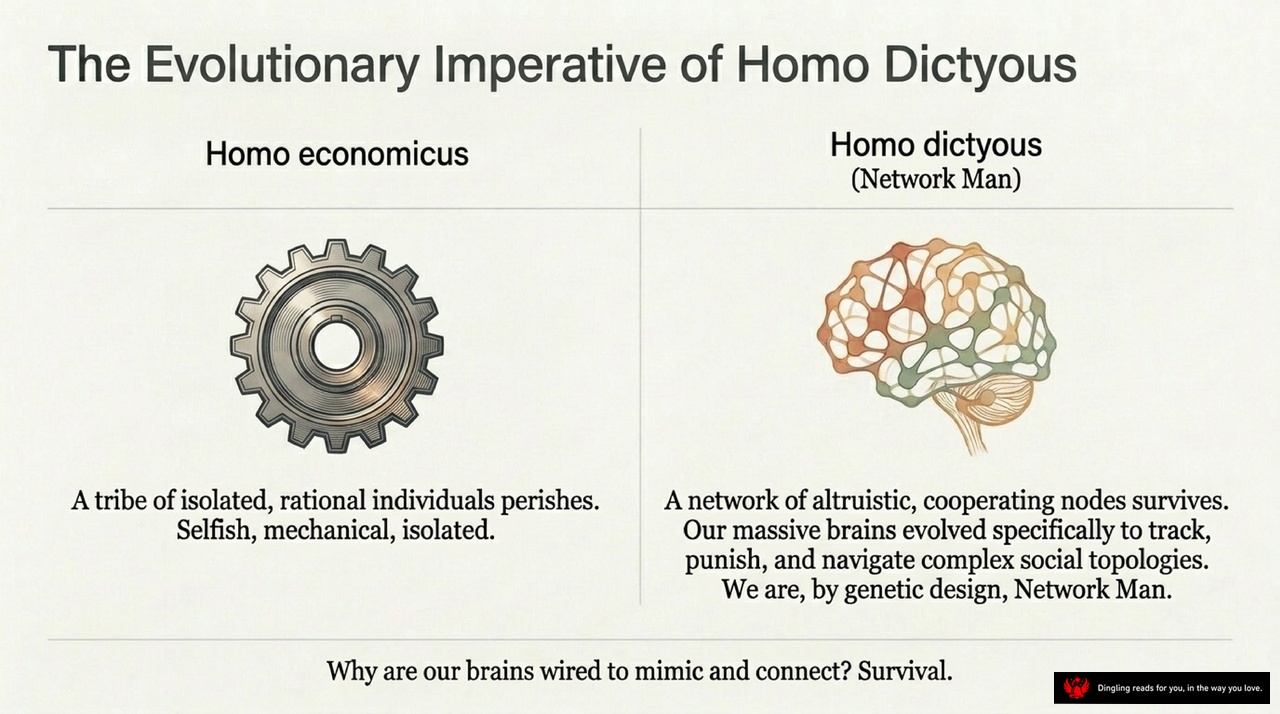
Imagine you are a single, isolated gear in a machine. If you break, the whole line stops. That is the old story of *Homo economicus*: a world of selfish, rational individuals who survive only by cutting off the rest. But look at the other side. We are not gears; we are *Homo dictyous*, or "Network Man." Our brains didn't evolve to calculate profit margins; they evolved to map complex social maps.
As the slide shows, while a tribe of isolated, mechanical individuals inevitably perishes, a network of altruistic, cooperating nodes survives. Our massive brains are specifically wired to track, punish, and navigate these intricate social topologies. We are, by genetic design, built to connect.
Why are our brains hardwired to mimic and link up? It is the ultimate survival strategy. In a world where a single person is fragile, a connected network is invincible. We are not just individuals; we are a single, breathing super-organism where the whole is far greater than the sum of its parts.
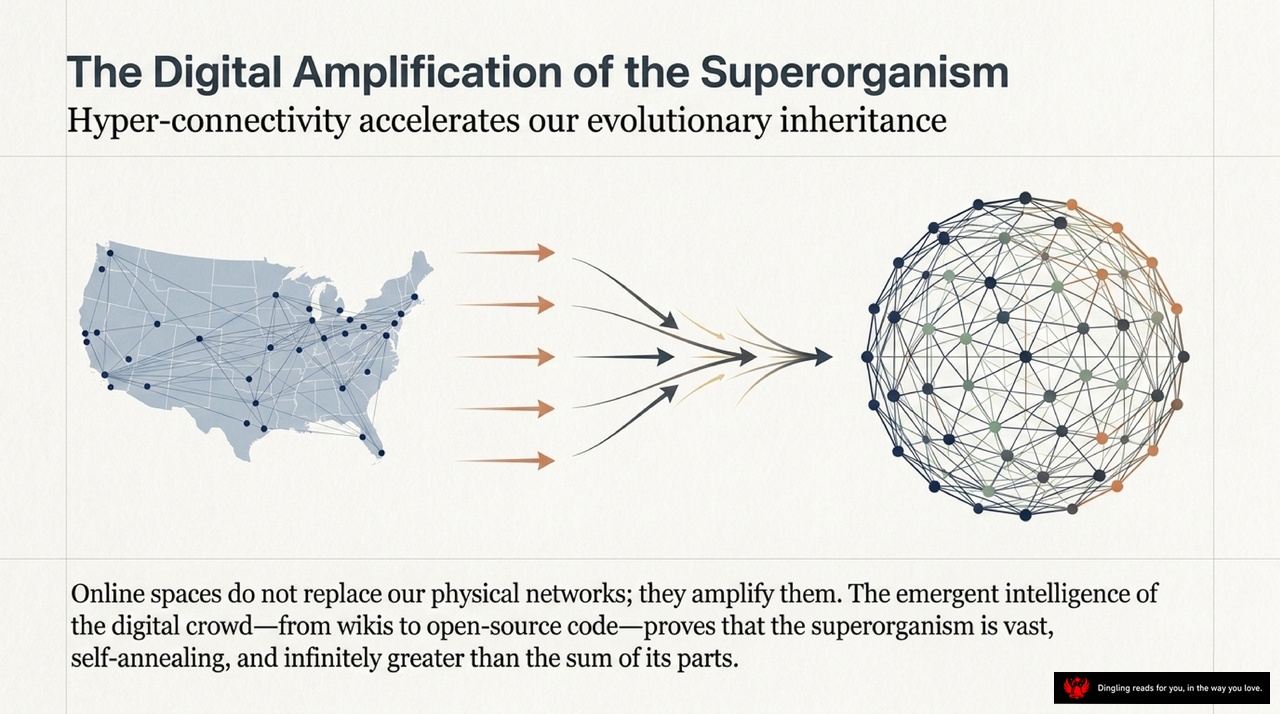
Look at this visualization: we start with a connected map of the United States, and through hyper-connectivity, all those individual nodes converge into a single, dense sphere. This image perfectly illustrates the core idea of today's slide: "The Digital Amplification of the Superorganism."
The text reminds us that online spaces don't replace our physical networks; they amplify them. Think of the internet not as a substitute for your friends, but as a force multiplier for the collective intelligence we already possess. From wikis to open-source code, the emergent intelligence of the digital crowd proves that our superorganism is vast, self-annealing, and infinitely greater than the sum of its parts.
Just like a bucket brigade where the group works faster than any individual could alone, or a telephone tree that spreads information instantly, our digital networks allow us to solve problems no single person could tackle alone. The arrows in the diagram show that hyper-connectivity accelerates our evolutionary inheritance. We are no longer isolated individuals; we are cells in a living, breathing, self-repairing organism that adapts and grows faster than ever before.

Imagine the ripples in a pond. When you drop a stone, the energy doesn't just stay there; it travels outward, touching thousands of unseen shores. This slide captures that exact idea: we are not solitary architects building our own destinies in isolation. Instead, we are living nodes woven into a vast, self-healing superorganism.
Look at that text here: our emotions, health, wealth, and choices are continuously shaped by invisible threads of connection. Even our smallest actions ripple outward to shape the lives of thousands we may never meet. Think about it. If your everyday choices automatically reprogram the reality of the network around you, what kind of world will you choose to broadcast today?
This concept of the superorganism challenges the old belief that we act alone. It reveals that we are part of a larger, breathing system where one person's shift in mood or behavior can trigger a chain reaction across the entire network. You are both the sender and the receiver in this endless loop, and understanding your place in this web is the first step to choosing the kind of future you want to help create.