
Contagious: Complete Chapter-by-Chapter Summary

Welcome to the world of Contagious, by Jonah Berger. Imagine a world where ideas, products, and behaviors spread through human networks just like viruses do. That's the core promise of this book: it's a blueprint for engineering things that catch on.
Look at the intricate web of connections surrounding us. This visual represents the very idea of contagion—how a single spark can ignite a massive fire across a network. In our daily lives, we are constantly sharing stories, recommending products, and discussing trends. But why do some things go viral while others fade into silence?
The answer lies in understanding the psychology behind sharing. It's not just about luck or timing; it's about social currency, triggers, emotion, public visibility, practical value, and stories. When we share something, we are often trying to enhance our own image, save time, or connect with others. By mastering these six principles, we can design products and messages that naturally motivate people to talk about them.
This isn't just theory; it's a practical guide for anyone looking to make their ideas stick. Whether you're launching a new product, promoting a cause, or simply trying to share a great story, understanding how contagion works gives you the power to influence the world around you. Let's dive into the mechanics of why things catch on and how we can harness that power.

Traditional marketing relies on a top-down broadcast model—think of a megaphone shouting at a crowd. It assumes that massive ad spend, price drops, and incremental quality improvements are the keys to success. But as the slide clearly shows, this old way fails to explain virality. Why did a $100 cheesecake suddenly become a cultural phenomenon without a single ad dollar? Why did a hidden speakeasy in New York fill up without a marketing team? The answer lies in the shift from broadcasting to word-of-mouth reality.
Look at the network diagram on the right. This is how modern virality actually works. It's not about pushing a message from the center out; it's about organic spread, viral loops, and social transmission. When something becomes a story people inherently have to share—like eating that incredible cheesecake—it generates exponential growth through social networks. This word-of-mouth reality is far more persuasive and deeply targeted than traditional advertising.
The core lesson here is simple: people don't talk about brands; they talk about things that help them build their own identity. When a product or experience becomes a piece of social currency that makes the sharer look smart, cool, or in-the-know, it spreads like wildfire. Traditional marketing tries to force attention, but true virality happens when you give people a reason to talk about you because talking about you makes them feel good about themselves. That's the only way to break through the noise.

The Architecture of Contagion isn't just a buzzword; it's the blueprint for why things go viral. Think of it as a six-sided puzzle where every piece must fit perfectly for an idea to spread.
First, you need **Social Currency**. We share things that make us look good—like a cool gadget or a secret spot. It's about status and remarkability. If you talk about something impressive, you're boosting your own image.
But what triggers that sharing? You need **Triggers**. These are the cues in our environment—like a specific time of day or a familiar object—that remind us to talk about a brand. Without these triggers, even the best product gets forgotten.
Next, tap into **Emotion**. People share what makes them feel something intense. Whether it's the awe of a breathtaking view or the anger of a injustice, high-arousal emotions drive us to hit that share button. Low-key feelings, like mild sadness, don't do it.
Then, there's **Public**. If a behavior is visible, it becomes contagious. Think of the "Movember" movement or a long line outside a restaurant. When others see us doing something, we're more likely to join in. Visibility fuels imitation.
You also need **Practical Value**. People love sharing tips that save them time or money. It's that helpful "how-to" story that solves a real problem. If your content offers a useful takeaway, it naturally finds an audience.
Finally, wrap it all in **Stories**. Facts are boring; stories are memorable. A good story acts like a Trojan Horse, hiding your core message inside an engaging narrative. When people share the story, they're unknowingly spreading your brand.
Master these six elements, and you stop chasing trends—you start building a system that spreads itself.

Social currency doesn't just rely on the product itself; it fundamentally depends on elevating the messenger. When we share something, we aren't just passing information—we are broadcasting our own identity, our taste, and our status. That is why the mechanisms of social currency are so powerful.
First, we have **Inner Remarkability**. The concept here is simple: does this break expected patterns? If you can share something surprising, you instantly become the center of attention. Think about Snapple printing obscure, surprising facts under their bottle caps. Even if the facts aren't entirely accurate, the sheer novelty makes them irresistible. We crave these moments because they make us look curious and culturally aware.
Next, we look at **Game Mechanics**. Does this allow people to broadcast their achievements? This is all about turning everyday actions into a scoreboard. Consider airline frequent flyer tiers or Foursquare check-in badges. These tools give us a clear metric for success. When you see someone has reached "Premier Executive" status or unlocked a rare badge, you aren't just seeing data; you are witnessing a win. This taps into our deep desire for social comparison and status, turning passive users into active promoters who want to show off their progress.
Finally, there is **Scarcity & Exclusivity**. Does restricted access make the user feel like an insider? Nothing creates desire quite like the feeling of being part of a secret club. Take "Please Don't Tell," a secret bar hidden behind a vintage phone booth in New York. No advertising, just pure mystery. Or think about Rue La La's flash sales. When access is limited, owning the product becomes a badge of honor. People talk about these exclusive experiences not just because they are cool, but because sharing them proves they have access to something others don't.
In short, to make something viral, you have to design experiences that let the sharer look good. Whether it's breaking patterns, leveling up in a game, or holding a secret key, these three mechanisms transform a simple product into a powerful tool for personal branding.

Triggers link behaviors to everyday environments by creating engineered, organic, and strategic anchors that turn routine moments into powerful marketing opportunities. Think about it: when a coffee break becomes the trigger for a Kit Kat craving, you're not just snacking; you're activating a $300 million brand strategy that scaled to $500 million. That's the power of an engineered association—embedding a product into a specific daily context so it feels inevitable.
But it's not always about design. Sometimes, the magic happens naturally. Take the Rebecca Black phenomenon. The trigger wasn't a paid campaign; it was the simple, recurring context of "Friday." That organic association turned a single song into a viral cultural moment, proving that timing and environment can do the heavy lifting without a single dollar spent on ads.
Then there's the strategic anchor. When you're thinking about dinner, seeing a Boston Market turkey doesn't just satisfy hunger; it triggers a 20% increase in word-of-mouth. By anchoring a product to a specific daily routine, brands can outperform generic messaging entirely. Whether it's a coffee break, a Friday afternoon, or dinner time, the key is finding that precise intersection where a user's life meets your brand. When you successfully link behavior to environment, you stop chasing attention and start owning the moments that matter most.

So, here is the "Emotion Arousal Matrix." Think of this as the ultimate cheat code for going viral. It's all about understanding that not every feeling gets shared.
Look at the top half: "High Arousal." Whether it's negative, like anger and anxiety, or positive, like awe and excitement, these emotions drive sharing. That's why outrage over Wall Street bonuses during a recession spreads like wildfire, or why a viral video of a cough mapped through Schlieren photography captures the world's attention. These high-energy states make us feel activated and compel us to talk.
Now, look at the bottom half: "Low Arousal." This is where sharing dies. Sadness and contentment both kill the spread. When we are sad, our physiological activation drops, and we just want to retreat. When we are content and relaxed, that comfort actually reduces the physical impulse to share information. We don't need to tell people about something when we are just happy and chill.
So, the lesson is simple: if you want your content to go viral, don't aim for comfort or sadness. You need to push people into a state of high arousal—make them feel something intensely, whether it's shock, fear, or pure awe. That energy is the fuel that drives the conversation.

Today's slide reveals a fascinating psychological trick: how we turn private, hidden actions into public signals through something called "behavioral residue."
Look at the first example. Listening to music on generic black headphones is a quiet, hidden behavior. But when you switch to Apple's iconic white earbuds, that private act instantly becomes a public broadcast. Those white buds act as a badge, signaling to everyone around you that you own an iPod.
The second row shows a similar shift. You might quietly donate to prostate cancer research without anyone knowing. But by growing a mustache in November—what we call Movember—you transform that private generosity into a visible symbol. Suddenly, your friends know you care.
Finally, supporting cancer survivors privately is one thing, but wearing a bright yellow Livestrong wristband changes everything. That simple accessory turns your personal commitment into a public statement, inviting others to join the cause.
The core idea here is simple: we don't just share our thoughts; we share the visible traces of our actions. By designing behaviors that leave a residue—like a specific style, a seasonal mustache, or a colored bracelet—we can broadcast our values and identity without saying a word. It's about making the invisible visible so the world can see who we really are.

Have you ever wondered why a 20% discount on a $25 shirt feels so much bigger than saving $5, while a 10% discount on a $2,000 laptop barely registers? The answer lies in the Rule of 100, a simple yet powerful principle that dictates how we perceive value. When the price is under $100, people respond better to percentage discounts because the relative savings feel psychologically larger. But once the price crosses that $100 threshold, our brains switch gears. Suddenly, an absolute dollar amount becomes the dominant factor. A flat $200 off a $2,000 laptop feels significantly more impactful than a percentage cut, simply because the tangible cash savings are now the star of the show. This isn't just about math; it's about how practical value drives our sharing behavior. We love sharing deals that make us look like smart shoppers, whether it's spotting a massive percentage drop on a trendy shirt or locking in a huge dollar saving on a big-ticket item. By aligning your pricing strategy with this psychological rule, you don't just trigger a sale; you create a story worth telling, turning every customer into a brand ambassador who can't wait to spread the word.

The Trojan Horse Narrative Model is all about wrapping your brand message in an irresistible story. Think of it like this: the outer shell is the narrative itself—an engaging, highly arousing story that people naturally want to consume and share. It's the hook that grabs attention, like Dove's "Evolution" video, which exposed the beauty industry's manipulation, or those viral Panda Cheese commercials where a giant panda wreaks havoc in a supermarket. These stories are so compelling that people talk about them without even realizing they're promoting a brand.
But here's the critical part: inside that wooden horse lies the hidden compartment, which is your core product benefit. This is where the magic happens, but it requires precision. The brand message must be integral to the plot. If you remove the brand, the story must fall apart. That was the fatal flaw with Evian's "roller-skating babies" video; the water was completely irrelevant to the entertainment, so the product got lost in the noise.
In short, your story needs to be so good that people share it for fun, but the brand needs to be so essential to that story that sharing it feels like sharing the brand. When you get the shell and the compartment aligned perfectly, you don't just tell a story; you create a vehicle for your message to travel far and wide.

Contagion isn't a lottery; it's an engineered formula. Today, we're looking at the Viral Coefficient Multiplier, specifically the STEPPS Synthesis Wheel. This model shows us that while a product doesn't need all six principles to go viral, combining them multiplies the viral coefficient exponentially.
Let's break down these gears. First, we have **Social Currency**. People share things that help them look good. Talking about a cool blender or a secret speakeasy makes us feel smart and fashionable. Then, there are **Triggers**. These are environmental cues that keep a product top-of-mind. Think of how hearing the word "Mars" spikes chocolate sales, or how a song gets stuck in your head because it's tied to a specific day of the week.
Next, we have **Public**. This is about making behavior visible. When actions are hidden, they don't spread. Movember turned a private health issue into a public movement just by growing beards. Similarly, adding a "Sent from my iPhone" signature turns a private email into a public badge of status.
Then comes **Emotion**. High-arousal emotions like awe, anger, or excitement are the fuel for sharing. Sadness or calm satisfaction don't trigger the same viral response. We share what makes us feel something intensely.
Finally, we have **Stories**. Stories are the Trojan horses of communication. They wrap useful information in an entertaining package, making the data impossible to ignore.
And remember, **Practical Value** gets you noticed. Whether it's saving money, saving time, or helping someone solve a problem, useful content is always shared. When you combine these elements—making something shareable, triggering it constantly, making it visible, tapping into emotion, wrapping it in a story, and ensuring it's useful—you don't just create a product; you create a movement.
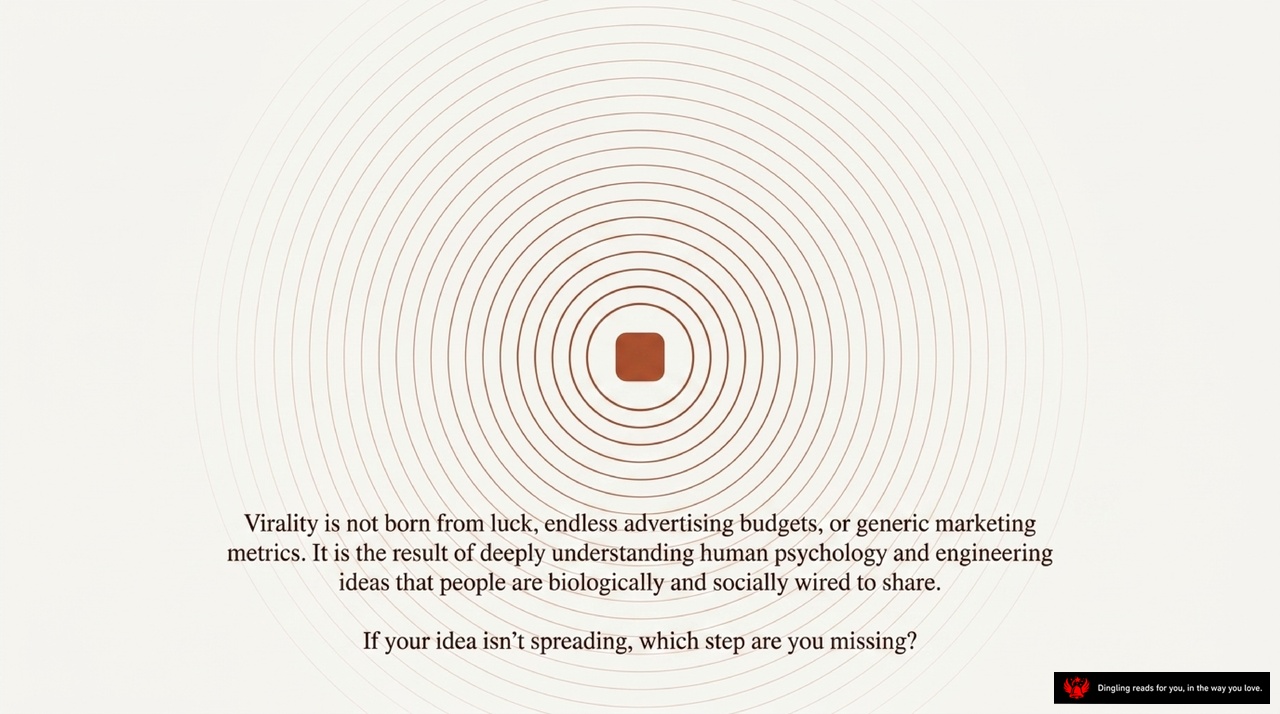
Viral spread isn't magic; it's math. The image on this slide perfectly captures the core truth: virality isn't born from luck or endless ad budgets. It happens when you deeply understand human psychology and engineer ideas that people are biologically wired to share.
Think about it. When we share something, we aren't just passing along information; we are curating our own image. We talk about a cool gadget or a secret spot not because we have to, but because it makes us look smart, trendy, or "in the know." That's social currency in action.
But there's a catch. Just being interesting isn't enough. The content needs to hit that sweet spot where it feels both useful and surprising. It has to offer value—maybe it saves someone time, or solves a problem—while also triggering that spark of curiosity or even a bit of shock. When you combine that practical utility with a touch of the extraordinary, you create a message that feels impossible to ignore.
So, if your idea isn't spreading, ask yourself: Are you missing the step that bridges the gap between "interesting" and "must-share"? You need to ensure your message offers enough value to be useful, and enough novelty to be memorable. That's the formula for true virality.