
Content is Brand: Complete Chapter-by-Chapter Summary
Welcome to today's session. We're diving into *Content as Brand* by Liu Fei. Think of your content not just as information, but as a long-term asset that compounds your personal equity. This book is a playbook for long-termists who want to transform everyday knowledge into something valuable and enduring.
The core idea is simple yet powerful: treat your content like a brand. Just like a great company builds trust over years, your content needs to do the same. It's about shifting from chasing quick viral hits to building a library of value that users return to again and again. Whether you are sharing insights, stories, or analysis, the goal is to create a connection that lasts beyond the moment of consumption.
In the chapters ahead, we will explore how to find your unique angle, craft content that truly resonates, and navigate the journey from a solo creator to a trusted voice. We'll look at real examples of successful creators and break down the principles that allow them to thrive in a noisy digital landscape. Get ready to rethink your approach to content creation and start building something that truly matters.
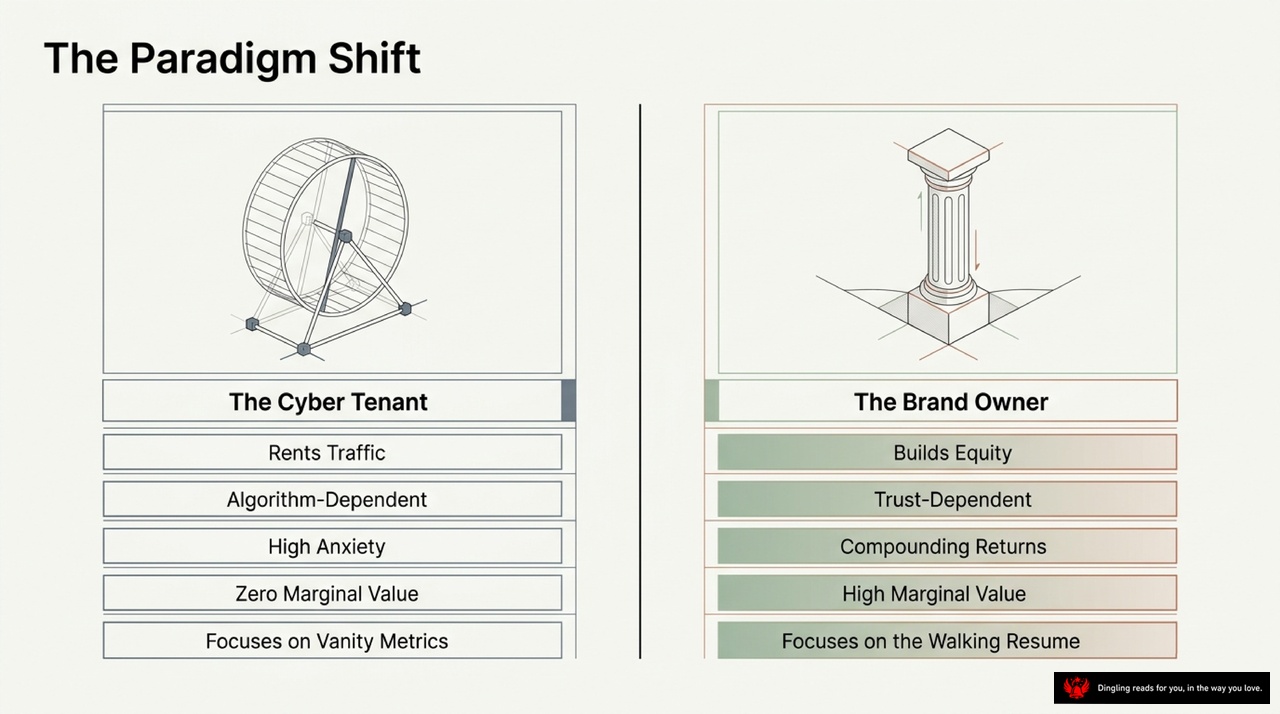
Imagine you are running a business, but instead of building a sturdy foundation, you are just running on a hamster wheel. This is the reality for "The Cyber Tenant"—the modern creator who rents traffic from platforms, lives entirely dependent on algorithms, and suffers from constant high anxiety. Because their content has zero marginal value, every click feels like a fleeting victory, and they end up obsessing over vanity metrics that mean nothing in the long run.
But there is another way. Look at the pillar on the right: "The Brand Owner." This is the mindset we need to shift toward. Instead of renting traffic, you build equity. Instead of relying on the fickle algorithm, you become trust-dependent. Your work generates compounding returns with high marginal value, meaning every piece of content you create adds lasting worth. Most importantly, you stop chasing empty numbers and start focusing on your "walking resume"—a tangible portfolio of value that grows with you, regardless of the platform. The shift is simple: stop being a tenant in someone else's house and start building the foundation of your own.
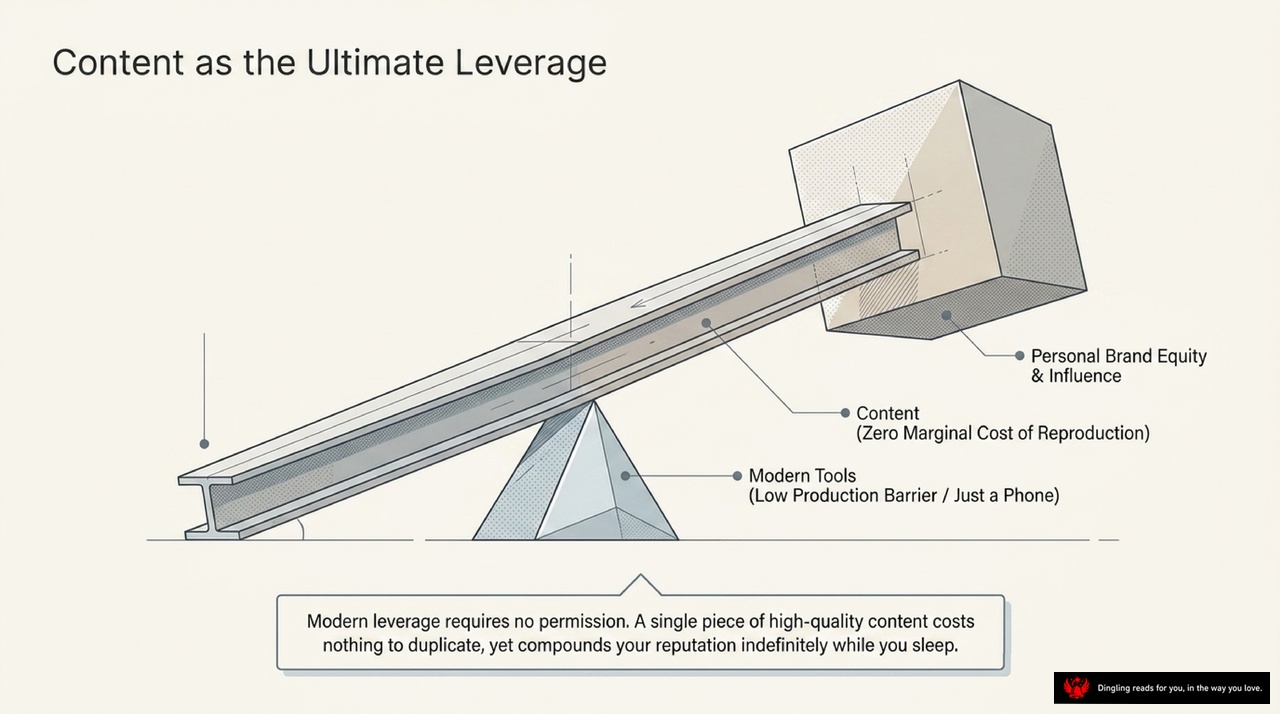
Content is the ultimate leverage, and this isn't just a catchy title—it's the fundamental shift of our era. Imagine a seesaw. On one end, you have modern tools like a smartphone, which lowers the barrier to entry to almost zero. On the other end, you have your personal brand equity and influence. But what sits right in the middle, acting as the fulcrum that amplifies everything? That's high-quality content.
The magic here is the concept of "zero marginal cost of reproduction." Unlike physical products, once you create a piece of great content, duplicating it costs nothing. Yet, unlike a fleeting trend, good content compounds your reputation indefinitely, even while you sleep. Think of it as digital assets that work for you 24/7 without needing your constant permission or presence.
This is why modern leverage requires no gatekeepers. A single video, article, or podcast episode can travel across the globe, building trust and authority over time. It's not about how fast you post, but about creating something valuable enough that people want to keep it, share it, and return to it. When you master this, you stop trading time for money and start building an asset that grows exponentially. That is the true power of content as leverage.

Today's slide introduces what I call "The Master Equation" for building a brand. Look closely at this formula: Brand equals Good Content multiplied by the sum of Sustainability and Opportunity. This isn't just math; it's the blueprint for long-term success in the content game.
Let's break down the first term: Good Content. This is your baseline requirement. The slide warns us clearly: "Zero quality multiplied by time is still zero." No matter how much you post or how long you stick around, if your content lacks value, your brand will never take off. You have to start with substance.
Next, we have Sustainability. The text describes this as "the ability to stay at the table." It's about having a scrappy, consistent survival strategy. In a noisy digital landscape, the brands that survive aren't necessarily the ones with the biggest budgets, but those that can endure. They are the ones who keep showing up, delivering value day after day, refusing to quit even when growth feels slow.
Finally, there is Opportunity. The slide calls this "the stroke of market luck." It's unpredictable, yet the text notes it becomes inevitable "if you survive long enough." Think of it as timing. You might have the best content and the grit to keep going, but you also need to catch the right wave at the right time. However, remember this: luck favors the prepared. By mastering the first two elements—quality and consistency—you significantly increase your chances of catching that lucky break.
So, to build a brand, don't just chase viral moments. Focus on creating high-quality content, stay consistent through the tough times, and trust that your persistence will eventually align with the right opportunity.
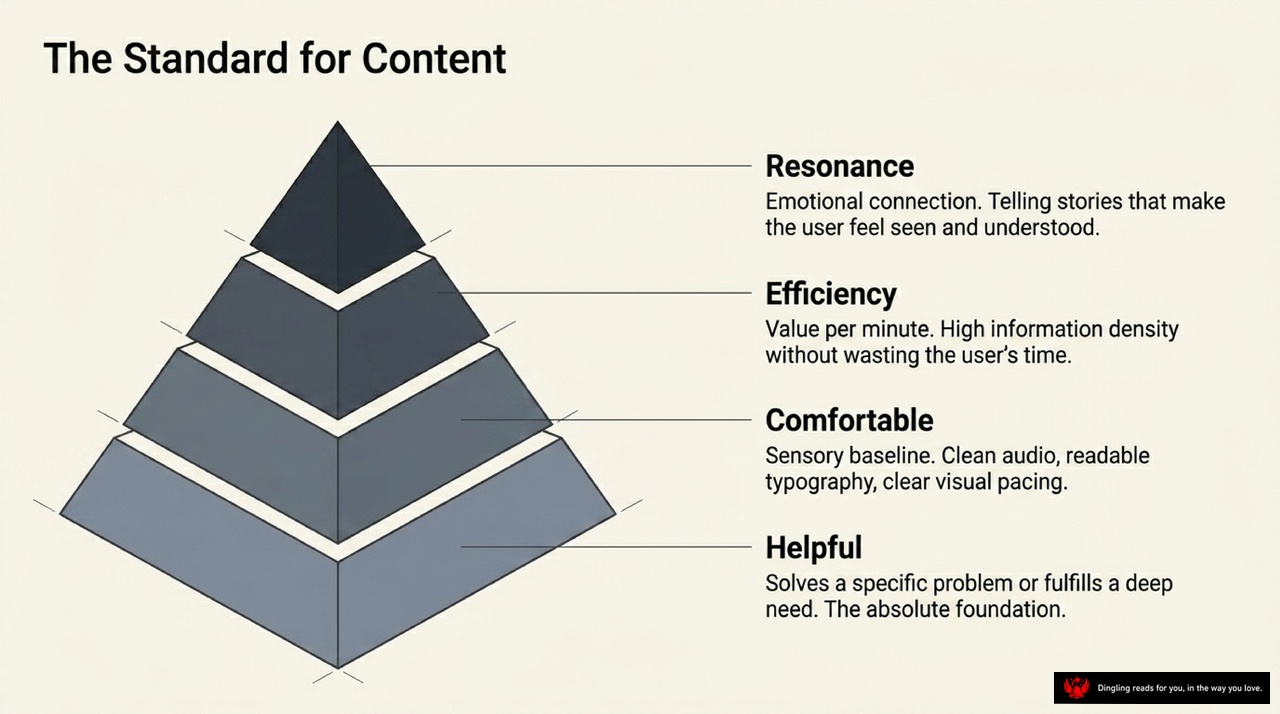
Welcome to the final layer of our content pyramid: Resonance. Think of this as the emotional heartbeat of your content. It's the difference between a user feeling "seen and understood" versus just being informed.
True resonance isn't about grand speeches; it's about connection. It comes in three flavors: companionship, comfort, and inspiration. Companion content creates a sense of presence, like that warm feeling of having a family member talking to you while you work alone in a new city. Comforting content hits that sweet spot where you realize, "I'm not the only one struggling," effectively neutralizing anxiety and self-doubt. And then there's inspiration—stories that show a user they can actually achieve what they dream of, turning content from a mere tool into a loyal partner.
But building this connection is a slow process, like braiding a rope. It starts with knowing your audience and deepens through consistent, meaningful interactions. It's about making the people who love you love you even more. When you deliver on your promise again and again, brand trust isn't just built; it becomes a durable asset that survives the long haul.

Helpful: Content vs. Material. This slide breaks down the critical difference between creating something that truly helps versus something that just tries to sell.
When a user consumes your content, they are on a journey that splits into two paths. If you prioritize solving their problem or making them feel understood, the mission is complete. You've delivered value, and trust gets deposited. It's a win-win where the user feels accomplished.
But take the other path. If you reveal a hidden agenda and demand a conversion immediately after consumption, trust gets eroded. That's when content turns into mere material. As the slide notes, content prioritizes the user's perspective and ends its mission upon consumption. Material, however, prioritizes the creator's agenda, demanding a transaction that burns goodwill.
Think about your own experience. Have you ever clicked a link expecting a helpful guide, only to be hit with a hard sell? That's the "material" trap. Conversely, think of resources like Patagonia's product manuals—they educate you on climbing techniques while subtly promoting their gear. That's content. It builds trust because it respects the user's needs first. Don't force the sale; let the value do the work.

Today's slide breaks down the "Resonance Audience Model," a powerful framework for understanding how we connect with our listeners. Think of your audience not as a flat crowd, but as concentric rings radiating outward from your core.
The outermost ring represents "Passersby." These are people who see your content because an algorithm pushed it to them. They get a fleeting moment of awareness, but the value is low. They scroll past without stopping.
Moving inward, we find the "Regular Consumers." These listeners recognize your unique style and voice. They might not listen every single day, but they consume your content occasionally because they enjoy what you have to say. They are the bridge between the casual observer and the devoted fan.
At the very center are your "True Fans." These are the people who actively seek you out. They don't just wait for content to appear in their feed; they go looking for it. They share your work, defend your ideas, and form a deep emotional connection with you. This is where the real magic happens.
Notice the large arrow pointing straight to the center. This is the critical insight on this slide: The goal of content creation isn't to endlessly expand the outermost ring to chase viral traffic. Chasing the Passersby is a race you often lose and a trust you rarely build. Instead, your true objective is to deepen the gravity of these inner rings. You want to pull Regular Consumers closer and nurture them into True Fans. By building a resilient private domain of trust in the center, you create a sustainable foundation that lasts far longer than any fleeting viral moment ever could.

Imagine a compass designed specifically for creators, guiding you toward sustainable creation. This is the Creator's Compass, and it rests on four distinct quadrants that must align to find your true north.
First, look at the top left: Skill. This represents your relative advantage. Ask yourself, what comes naturally to you? What costs you less effort than it does for everyone else? It's not about being the best in the world, but rather being the best for a specific audience with a unique set of tools or experiences.
Move to the top right: Passion. This is the fuel that keeps you going when the rewards aren't immediate. It's the patience to endure the early days without needing external validation. Without this, even the most skilled creator will burn out.
Now, look at the bottom right: Platform Match. This is about aligning your weapon with the right battlefield. It's not just about making great content; it's about choosing the specific channel and audience where your message resonates most powerfully. If you're in the wrong arena, even a master strike falls flat.
Finally, the bottom left quadrant: Differentiation. This is where you win by being different, not just better. In a saturated market, doing things differently creates a heterogeneous victory. Whether it's your unique voice, a specific niche, or a fresh format, this is what makes you memorable.
When these four elements—Skill, Passion, Platform Match, and Differentiation—intersect, they create the center: Sustainable Creation. This isn't a fleeting trend; it's a long-term asset. It's the moment your unique strengths meet the world's needs in the right place, allowing you to build a brand that endures.

So, here is the key insight we need to lock in today: stop trying to win in the bloodiest arena. Look at the slide. On the left, you have "Survival of the Fittest"—a chaotic crowd of generic circles competing to be the number one General Product Manager. That is a losing strategy. When you compete directly on broad terms, you are just another drop in the ocean, fighting for scraps against giants who already own the category.
Instead, we need to pivot to the right side of this diagram: "Survival of the Different." Notice that single, glowing blue dot? That represents "Heterogeneous Victory." The example given is becoming the number one B2B SaaS Product Manager specifically focusing on Growth. By adding highly specific adjectives to your identity, you stop being a generic competitor and become a niche curator. You aren't just a "Product Manager"; you are the expert on Growth for B2B SaaS.
The text at the bottom drives this home perfectly: You do not need to fight in the bloodiest arena. Add highly specific adjectives to your identity until you become a category of one. Be a niche curator, not a generic competitor. In a crowded market, being the best at everything is impossible, but being the absolute best at one very specific thing is a guaranteed path to survival. So, don't try to be the best product manager ever. Instead, ask yourself: what is the most specific slice of this market I can own? Define your niche so precisely that you become the only logical choice for that specific problem. That is how you turn competition into your own unique advantage.
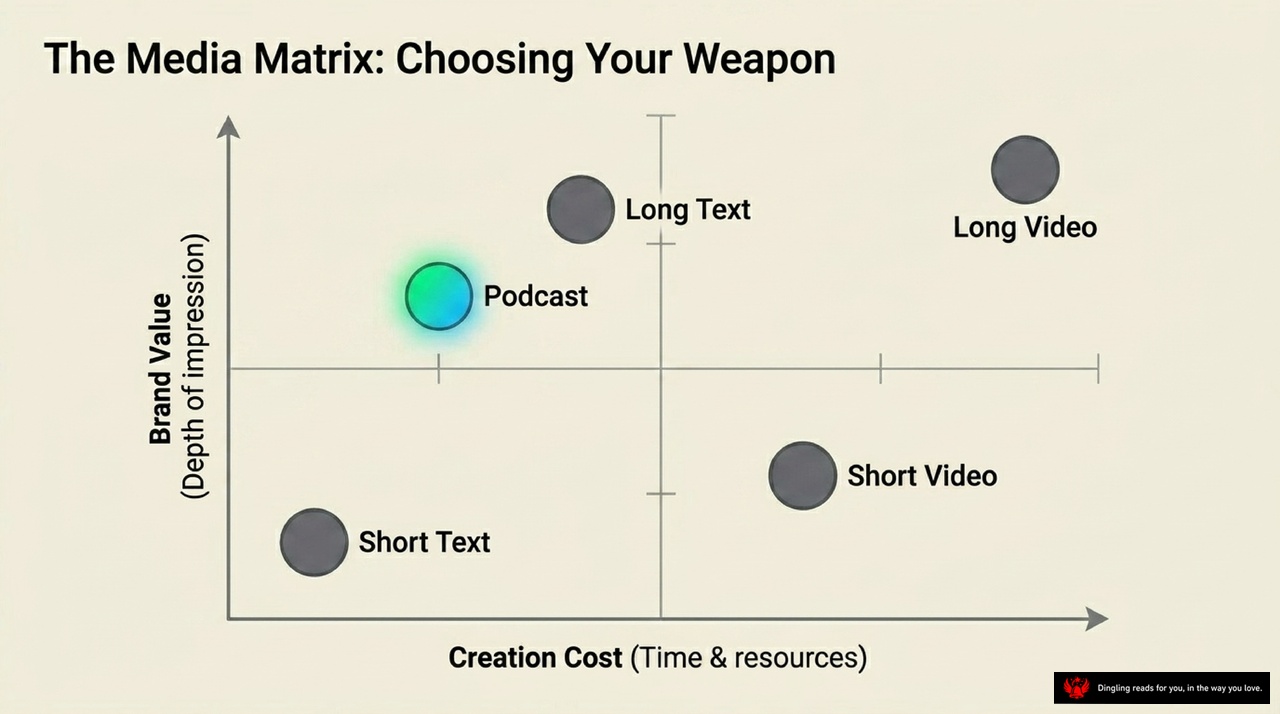
Imagine you are an entrepreneur standing in front of a giant map, tasked with choosing the perfect weapon for your brand. This is exactly what the "Media Matrix" helps us visualize. On this chart, the horizontal axis represents your "Creation Cost"—the time and resources you must invest—while the vertical axis measures "Brand Value," or the depth of the impression you leave on your audience.
Look at the bottom left: "Short Text." It's low cost and low brand value. It's great for quick tips, but it rarely builds deep trust. Now, look at the bottom right: "Short Video." It requires significant production effort to grab attention, yet it often struggles to create lasting, deep impressions because users scroll past quickly.
Then there's the top right: "Long Video" and "Long Text." These are your heavy artillery. They demand massive resources—think of the meticulous editing of a documentary or the deep research behind a long-form essay. But the payoff? They offer the highest brand value. They allow users to immerse themselves, creating that crucial "comfort zone" where trust is built. As the text reminds us, a 2,000-word deep dive creates far more emotional connection than ten scattered 200-word posts.
But here is the strategic choice the matrix presents: The "Sweet Spot." In the middle-left, we see "Podcast" and "Long Text." Notice how the podcast is highlighted. Why? Because it sits in the sweet spot between reasonable creation cost and high brand value. It doesn't require the expensive cameras and crews of long video, yet through the power of voice and storytelling, it delivers a profound, intimate experience that feels like a conversation with a friend.
The key takeaway isn't just about picking a format; it's about matching your resources to your goal. If you have limited time but want to build a strong brand, don't chase the high-cost long video trap. Instead, lean into formats that maximize the "depth of impression" per dollar spent. Whether you choose the intimacy of a podcast or the authority of a long essay, the goal remains the same: create content that doesn't just inform, but truly resonates, making your brand unforgettable without burning out your resources.
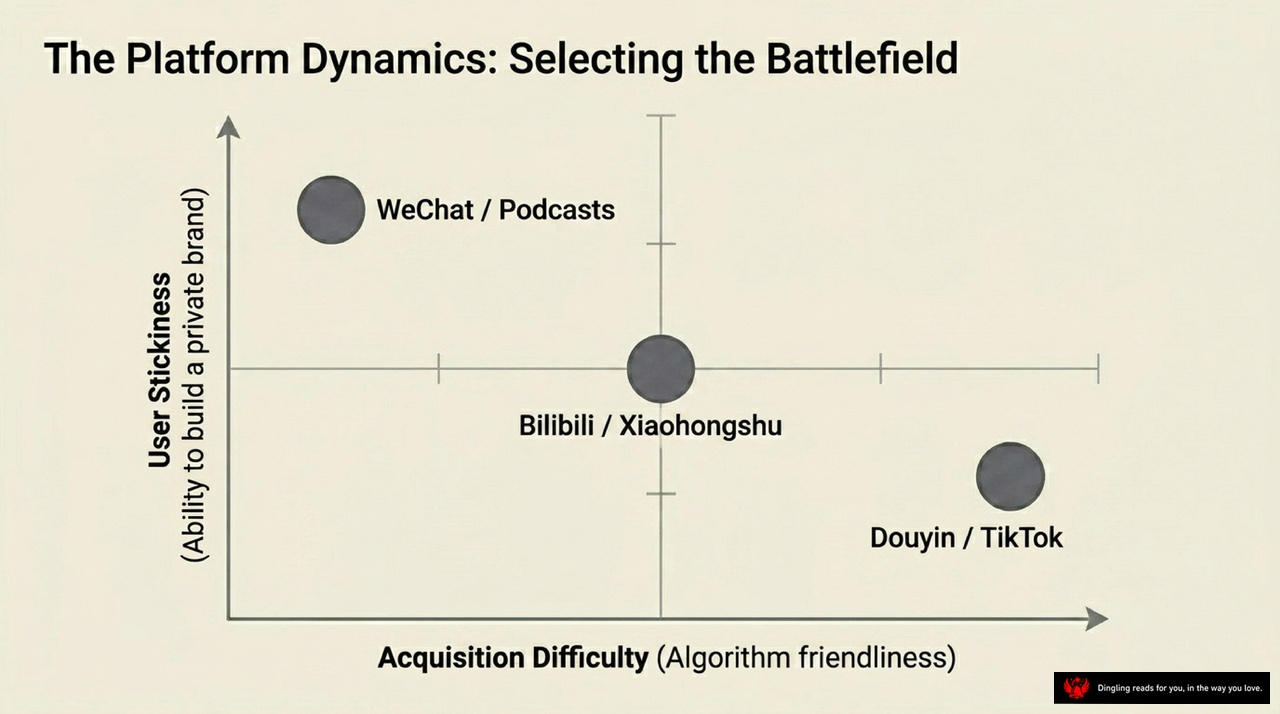
Look at this chart: "The Platform Dynamics: Selecting the Battlefield." It maps out where creators actually win or lose based on two critical forces.
On the vertical axis, we have "User Stickiness"—your ability to build a private brand. On the horizontal axis, we see "Acquisition Difficulty," or how friendly the algorithm is to your growth.
Notice where WeChat and Podcasts sit? High stickiness, but hard to acquire new users. Think about it: once you're in the WeChat ecosystem or a podcast subscriber list, you're locked in. But getting that first subscriber is a real grind. You're building a fortress, but the gate is narrow.
Then look at Douyin and TikTok. They sit low on stickiness but high on acquisition. The algorithm is a god here, pushing content to strangers instantly. It's easy to go viral, but hard to keep them. Once the trend fades, they're gone. You're renting attention, not owning an audience.
Right in the middle, you have Bilibili and Xiaohongshu. This is the sweet spot for many creators. The algorithm helps you grow, but users stay because they value your content and community. It's a balanced battlefield where you can build a brand without fighting a losing war on either front.
So, the lesson is clear: don't just chase the easy traffic of short-video algorithms. Ask yourself, where can I build real stickiness? Where can I create a community that stays, even when the algorithm changes? That's where the real brand power lies.

Look at this "Scrappy MVP Loop." It's a roadmap for execution, and honestly, it's the antidote to the paralysis that so many of us feel before hitting "publish."
Step one is the "Scrappy Start." Don't wait for perfection. Launch with a zero production budget. Think about it: a polished studio is useless if no one cares about your script. A messy start beats deep, thoughtful hibernation every time. You don't need a perfect camera or a fancy studio; you just need to start.
Once you're live, step two is to "Test the Core." Don't worry about the aesthetics yet. Validate the helpfulness and resonance of your message first. Does your content actually solve a problem or make someone feel understood? If the value isn't there, no amount of visual polish will save it.
Step three is to "Gather Feedback." Listen closely to your initial audience. Those early listeners are your best coaches. They'll tell you what's working and what's falling flat. Use their real reactions to guide your next move, not your own assumptions.
Finally, step four is the "Iterative Upgrade." This is where you invest in audio and visual polish—but only after you've proven your value. Once you know people care about your ideas, then you can make it look and sound professional.
The whole point of this loop is to keep moving. Don't get stuck trying to build a flawless product from day one. Start rough, test the core, listen to the crowd, and then upgrade. That's how you build something that actually sticks.
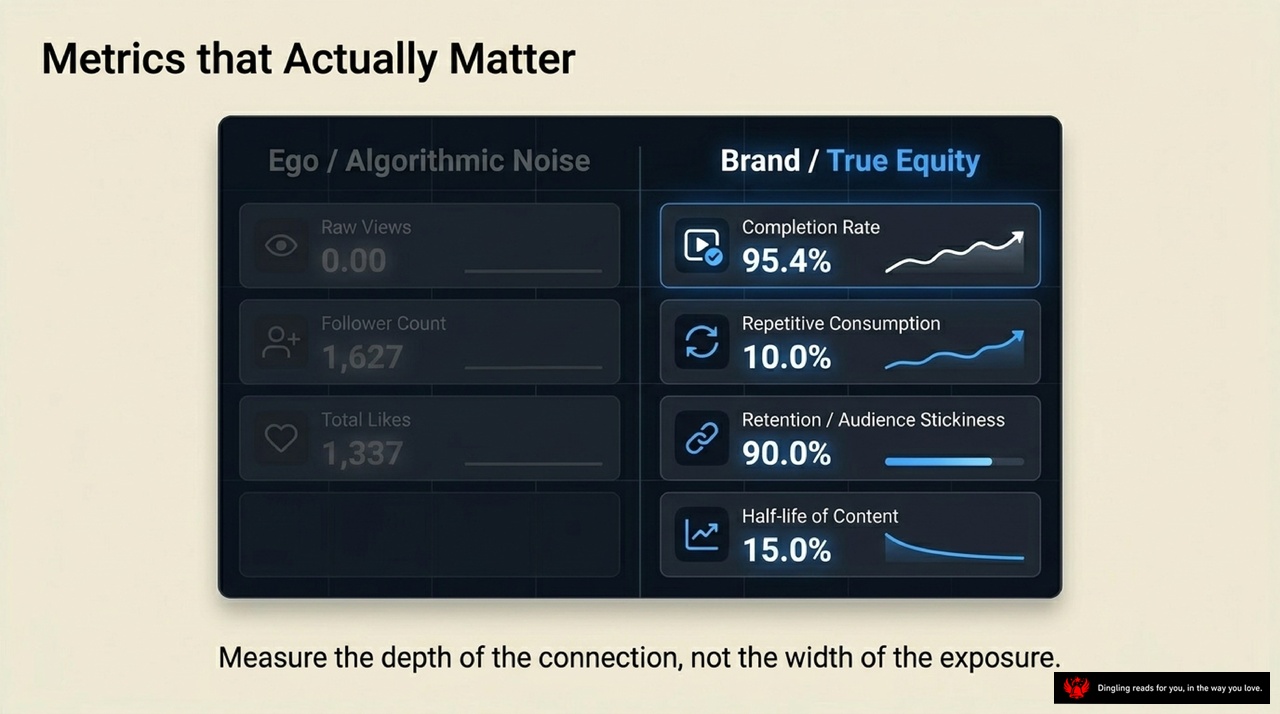
Look at this dashboard. On the left, you see the vanity metrics we all obsess over: raw views, follower counts, and total likes. These are what I call "Ego" or "Algorithmic Noise." They measure the width of your exposure, but they tell you almost nothing about whether you actually matter to your audience.
But look at the right side. This is where the real work happens. This is "Brand" and "True Equity." Notice the completion rate at 95.4%? That tells us if people are actually sticking with us. The repetitive consumption at 10.0% shows if our content has enough staying power to be re-watched. And that retention metric at 90.0%? That is the ultimate sign of a deep, loyal connection.
The lesson here is simple but often ignored: don't measure the width of your exposure. Measure the depth of your connection. In a noisy digital world, it's not about how many people see your content for a split second. It's about how many people feel seen by you, understand your message, and keep coming back. That is the only metric that actually matters.
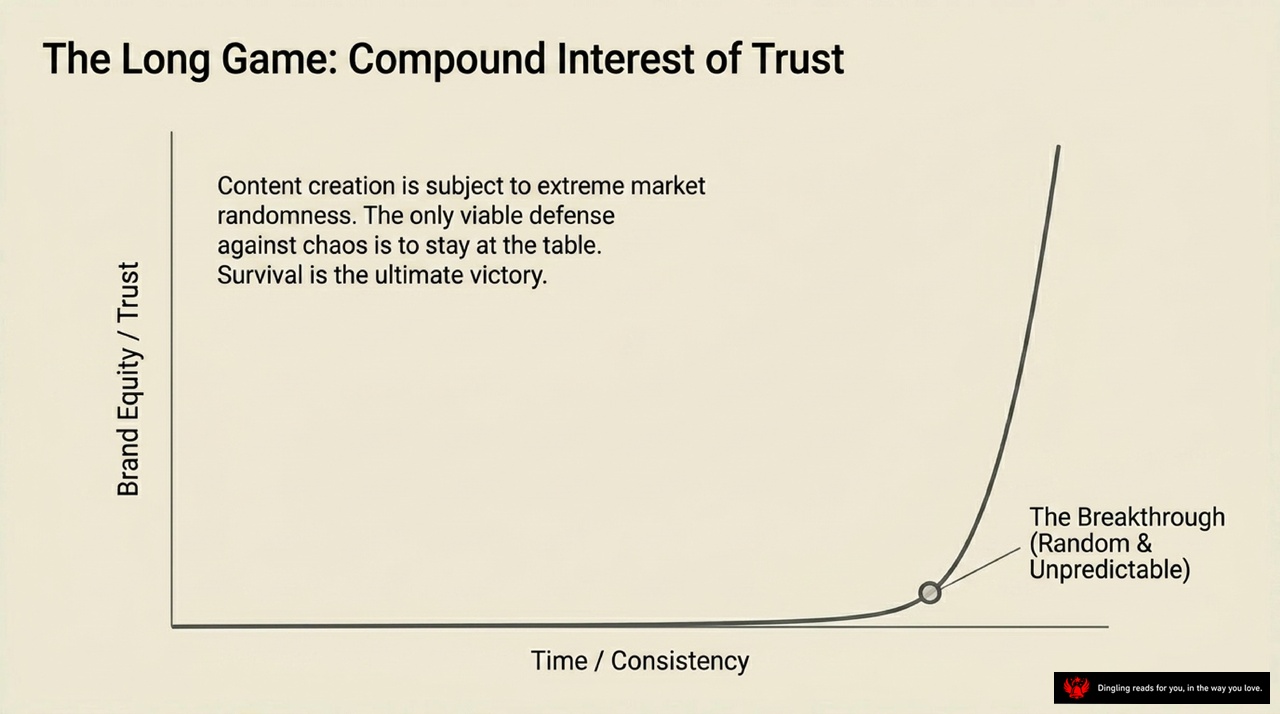
Think of content creation not as a sprint for a quick viral hit, but as the ultimate long game. The market is chaotic and unpredictable; your only real defense against that noise is simply staying at the table. As the slide illustrates, brand equity and trust don't grow in a straight line. For a long time, they might feel flat, but if you keep showing up consistently over time, you eventually hit that tipping point—the breakthrough moment where growth becomes exponential and random.
This is the power of the compound interest of trust. While many creators chase fleeting trends, the ones who win are the ones who prioritize survival as their ultimate victory. They understand that true value isn't built overnight; it's woven through hundreds of small, consistent interactions. Whether it's a podcast host sharing a genuine story or a brand delivering on a promise, every single piece of content adds another strand to that rope. Over years, these tiny investments compound into a fortress of trust that algorithms can't break and competitors can't replicate. So, don't worry if your first few videos or episodes don't go viral. Just keep creating with integrity. The curve will eventually turn upward, and your consistent presence will become your greatest asset.
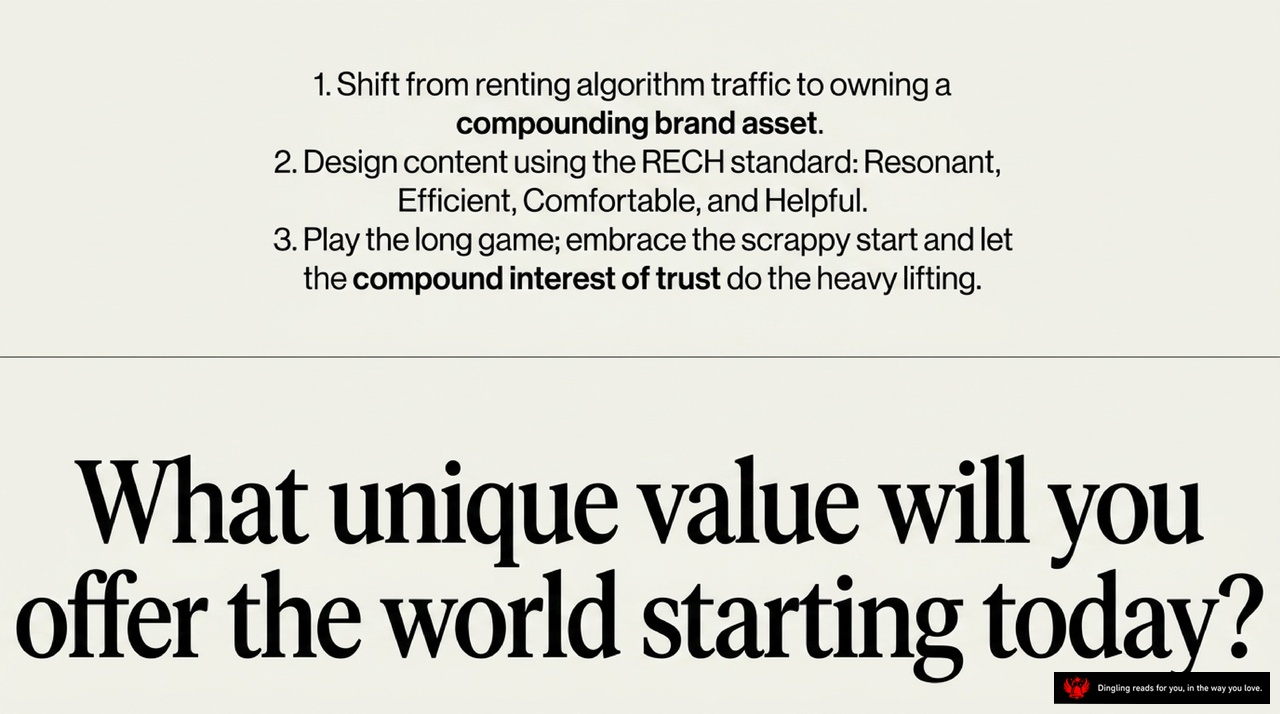
So, what unique value will you offer the world starting today? It's not about renting algorithm traffic that disappears overnight; it's about owning a compounding brand asset that grows stronger with time. To build that asset, you need to design your content using the RECH standard: make it Resonant, Efficient, Comfortable, and Helpful. But remember, the real magic happens when you play the long game. Embrace that scrappy start, don't fear the rough edges. Let the compound interest of trust do the heavy lifting. Because in a noisy world, the only sustainable advantage is the deep, unshakeable connection you build with your audience, one piece of honest, valuable content at a time.