
Cosmologies and the Modern World: Complete Chapter-by-Chapter Summary

Welcome to "Cosmologies and the Modern World," an anthropological journey through the shifting paradigms of time, power, and Western civilization over the past five hundred years. This book is built on lectures I delivered at Cambridge in 1982, a course titled "The Cosmology of Capitalism." For decades, these ideas shaped my thinking, and today, we are revisiting them to understand how our understanding of the world has fundamentally transformed.
We are standing at the beginning of a story about how human societies moved from seeing history as a repeating cycle to viewing it as a straight line of progress. For centuries, people believed that history was just a wheel spinning in place—societies would rise, fall, and eventually return to where they started. The Renaissance itself was literally a "re-birth," a return to the glory of the ancients. But something shifted around the 1400s. The invention of the printing press, the rise of mechanical clocks, and the discovery of the New World by Columbus shattered the idea of a closed, static world. Suddenly, the past was no longer a mirror of the present; it was a distant, fixed point. Time became linear, like a river flowing toward an unknown future.
This shift wasn't just about calendars; it was a complete rewiring of how we think. It gave birth to the belief that society could be improved, that we could actively shape our destiny rather than just waiting for the next cycle to begin. This new linear worldview, driven by the Enlightenment and later solidified by the theory of evolution, became the foundation of modern science and the drive for global expansion. We stopped asking, "Where are we in the eternal cycle?" and started asking, "How far have we come, and where are we going?" This change in perspective is what allowed the modern world to emerge, transforming our understanding of everything from religion to economics.
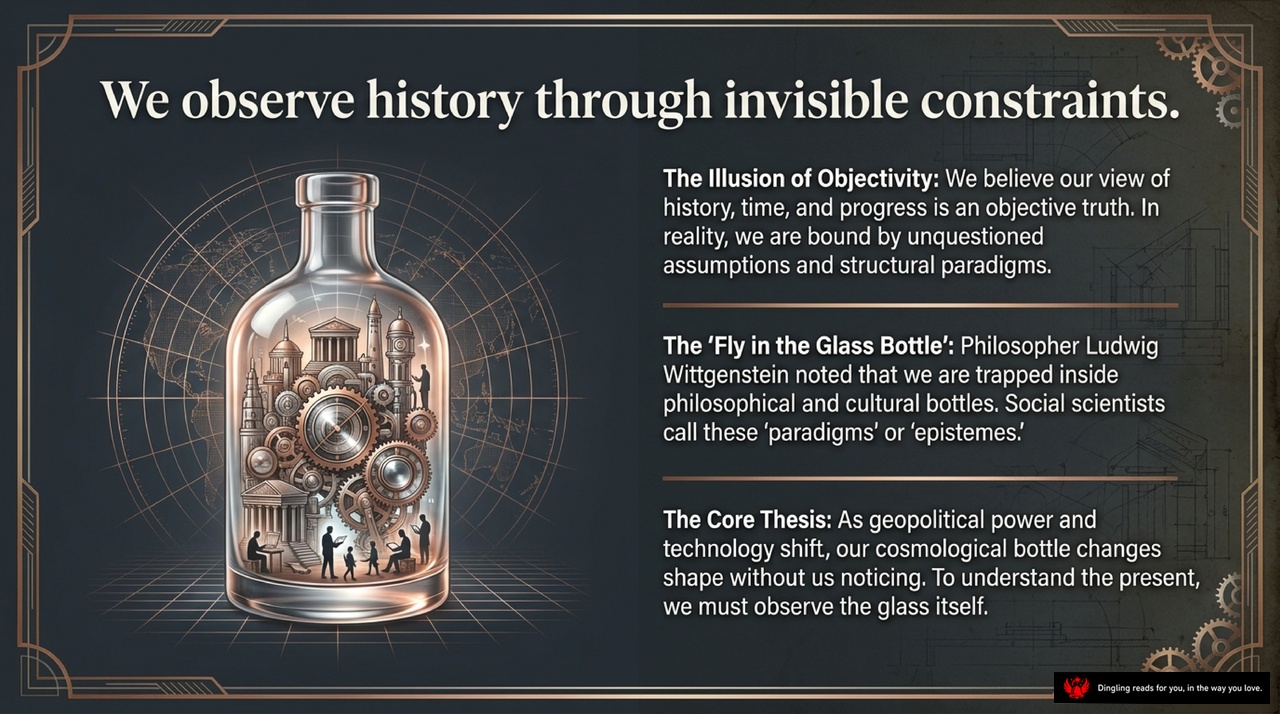
We observe history through invisible constraints. Look at this image: a complex world of gears, cities, and people trapped inside a glass bottle. This is a powerful metaphor for our condition. We often believe we are watching history objectively, as if we are standing outside the flow of time. But the truth is, we are all "flies in a glass bottle." As the philosopher Ludwig Wittgenstein noted, we are trapped inside our own philosophical and cultural frameworks. Social scientists call these invisible boundaries "paradigms" or "epistemes."
These paradigms act like the glass walls of our bottle. They shape how we see progress, time, and even human nature. For centuries, Western thought operated under a specific set of assumptions—a linear view where history is a straight line moving from simple to complex, from primitive to civilized. We believed we were the vanguard of human evolution, destined to bring order and technology to the rest of the world. But here is the critical insight: as geopolitical power shifts and technology evolves, the shape of our "cosmological bottle" changes without us even noticing.
We are constantly moving, but we rarely see the walls around us. To truly understand the present, we must stop just looking at the scenery inside the bottle and start observing the glass itself. We need to question the very assumptions that define our reality, because those invisible constraints are what ultimately limit our vision of history and our future.
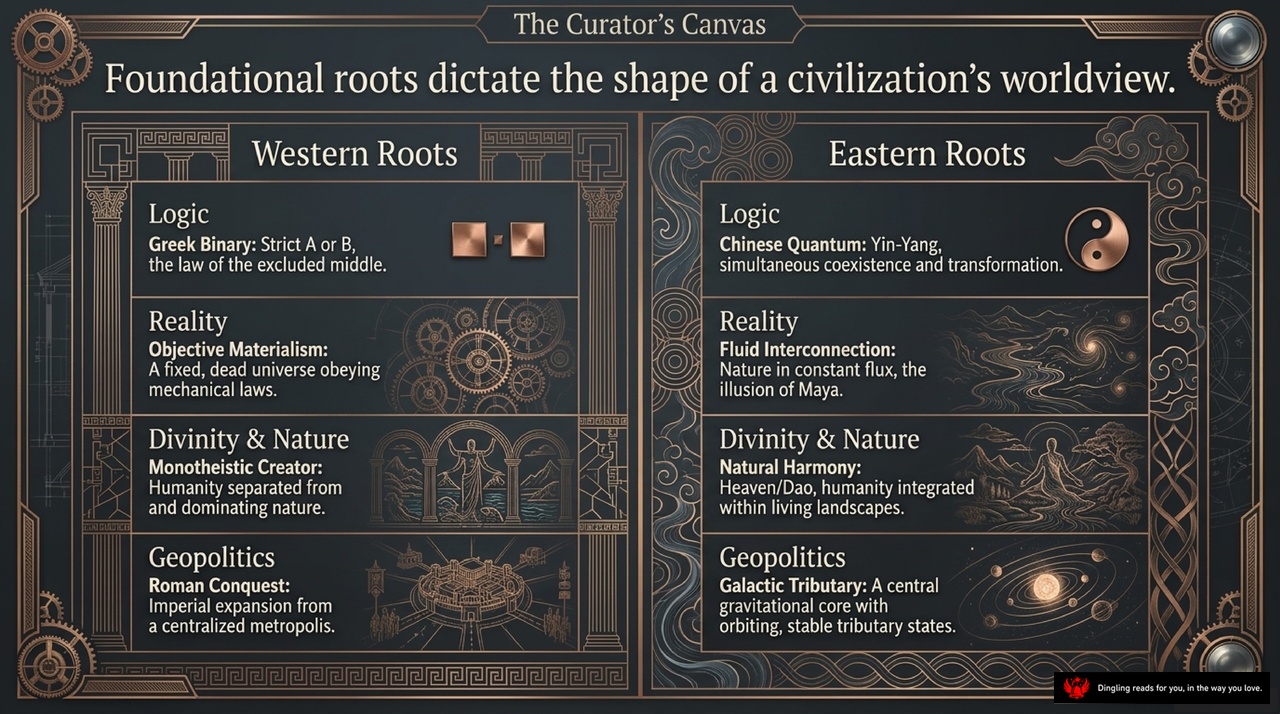
Let's dive into the profound shift that reshaped how we see time itself, moving from the comforting loops of the past to the relentless forward march of the future. For centuries, from ancient Greece through the Middle Ages, the dominant worldview was cyclical. History wasn't a straight line of progress; it was a wheel. Think of the Roman Empire rising and falling, or the Arab scholar Ibn Khaldun's theory of dynastic cycles where nomads conquer cities, only to be conquered by new nomads after generations of decadence. The phrase "there is nothing new under the sun" perfectly captures this pessimistic but stable reality. If you fell off a cliff, you just rolled back to the bottom; the world was a closed system, destined to return to its starting point.
But around the 1400s, something radical happened in Europe. The cycle broke. Why? It wasn't just a philosophical whim; it was driven by tangible changes. The invention of the printing press in the mid-15th century was a game-changer. Suddenly, knowledge wasn't fluid like oral tradition or architecture that could adapt quietly over time. Books were fixed, dated, and immutable. You could now clearly see the difference between the past and the present. Imagine reading a book printed in 1500 and comparing it to one from today; the gap is undeniable. This created a linear, continuous view of truth.
Then came the mechanical clock. Before this, time was tied to nature—sunrise, sunset, seasons. But the clock detached time from nature, giving it a constant, ticking rhythm that could be sliced into minutes and seconds. You could literally hear time slipping away. This made time feel like a commodity, something you could run out of, rather than an eternal cycle.
The final, most explosive catalyst was the Age of Discovery. When Columbus set sail, he didn't just find new land; he shattered the idea of a closed world. He encountered cultures, species, and technologies that didn't fit the old script. The world expanded, and with it, our imagination. Suddenly, the future wasn't just a return to the past; it was a blank canvas waiting for something new. This shift from a closed, circular universe to an open, linear one didn't just change how we measure hours; it birthed the very idea of "progress." It allowed us to believe that we could actively shape our destiny, paving the way for the Enlightenment and the modern scientific age. We stopped waiting for history to repeat itself and started racing toward a better tomorrow.

Time is a reflection of social interaction, not a law of nature. This profound idea challenges our Western obsession with time as a constant, ticking clock. On the left, we see "Ecological Time," where activity defines the calendar. As the slide reminds us, a man does not build a fishing dam because it is November; rather, it is November because he builds a fishing dam. In this view, the seasons and work rhythms dictate time, not the other way around.
On the right, we explore "Structural Time," which the Nuer people of Sudan experience differently. Anthropologist E.E. Evans-Pritchard observed that they do not coordinate activities to an abstract ticking clock. For them, historical time has shallow depth, stretching back only about 50 years. Beyond that, time isn't a river flowing forward; it's simply a tool to map the structural distance between living social groups. This contrasts sharply with our linear, progressive view of history. Ultimately, this suggests that our perception of time isn't universal; it is shaped by the power dynamics and social structures of the society we live in.
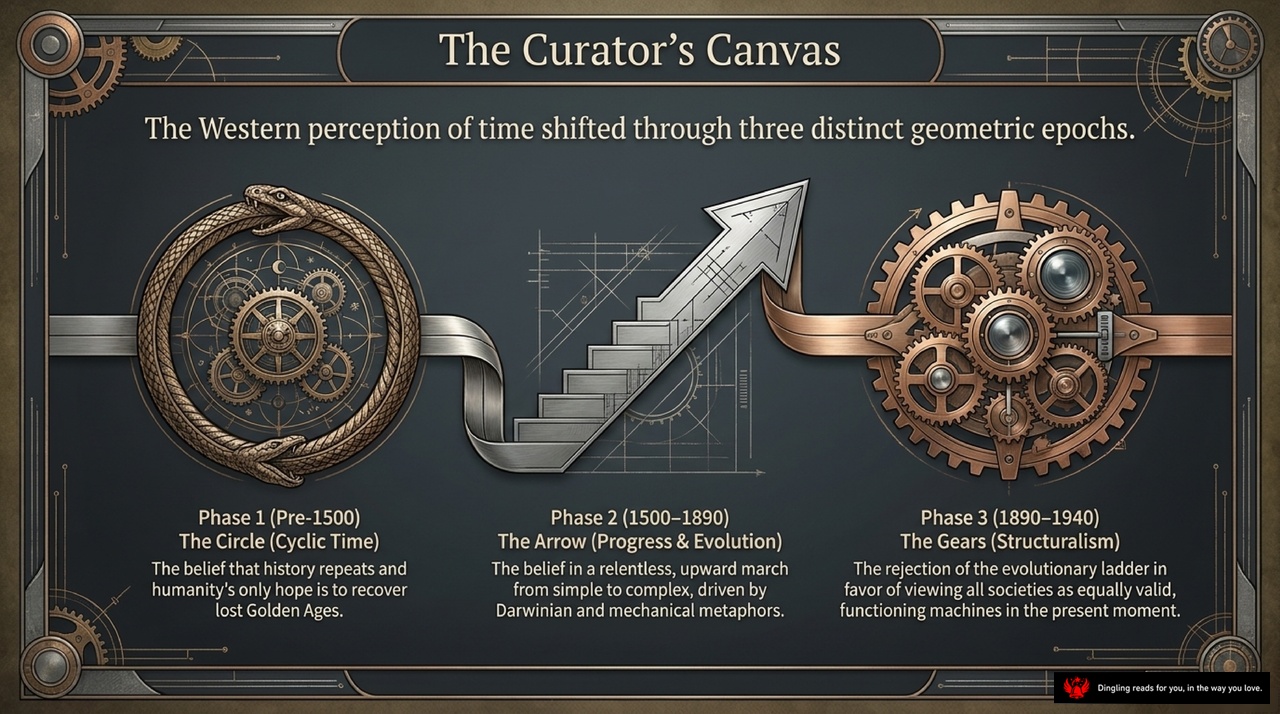
The slide before us outlines the three distinct geometric epochs that have shaped the Western perception of time. It's a powerful visual of how our understanding of history has shifted from a circle to an arrow, and finally to a complex system of gears.
Let's break this down. Phase one, before 1500, is represented by the Ouroboros—the snake eating its own tail. This is the era of the Circle, or Cyclic Time. For centuries, the dominant belief was that history merely repeats itself. There was no true progress, only a pendulum swinging between rise and fall. The hope for humanity wasn't a better future, but the recovery of a lost Golden Age from the past.
Then, in the second phase, from 1500 to 1890, the image shifts dramatically to an upward-pointing arrow rising over a staircase. This is the Arrow, the age of Progress and Evolution. Driven by the Enlightenment, Darwin, and the Industrial Revolution, the narrative changed entirely. Society was no longer a cycle; it was a relentless march upward. We believed we were evolving from simple to complex, moving from savagery to civilization. This era was fueled by a deep-seated optimism that the future would always be better than the past.
Finally, we arrive at Phase three, from 1890 to 1940, depicted by the intricate machinery of interlocking gears. This is the era of Structuralism. Here, the idea of a linear ladder of progress was rejected. Instead, scholars began to view all societies as equally valid, functioning like machines in the present moment. The focus shifted away from where we came from or where we were going, and instead, we started analyzing the complex structures holding our current society together.
This visual journey from the circle to the arrow to the gears perfectly captures the intellectual evolution of the West, setting the stage for the deep dive into how these shifting time views actually transformed our social sciences.

When global power was balanced, time was perceived as a closed loop. This concept, "There is nothing new under the sun," dominated human thought prior to 1500. Both Western and Eastern empires viewed history not as a straight line of progress, but as a cyclical rise and fall. Thinkers like Ibn Khaldun famously noted that empires reliably cycle through birth, maturity, and decay across three generations—a pattern known as the 120-Year Cycle. It describes how nomadic vigor eventually leads to urban maturity, and ultimately to decadent collapse, only to be conquered by a new wave of nomads.
But here is the crucial shift: societies during this era did not look forward to a technological utopia. Instead, they looked backward. They hoped only to resurrect the lost glory of Rome, Greece, or ancient sages. They believed the present was a decline from a golden age, and the future would merely repeat the past. This closed-loop view of time wasn't just a philosophical preference; it was a reflection of the world's power balance. When no single civilization held absolute dominance, the world felt stable and static. It was only when the balance tipped—when Europe began its ascent—that time suddenly opened up into a linear river, rushing toward an unknown and exciting future.

Expanding borders shattered the cyclical loop of ancient history. For centuries, humanity lived in a closed circle, believing that "there is nothing new under the sun." Societies rose and fell in endless repetition, much like the seasons or the rise and fall of empires described by historians like Gibbon. But between 1450 and 1700, everything changed. This was the catalyst: the known geographical world doubled in size. Explorers pushed beyond the edges of the old map and encountered flora, fauna, and entire civilizations completely absent from Biblical texts and ancient Greek philosophy. This discovery shattered the old dogma that the world was a finite, closed system. Suddenly, ancient texts could no longer explain reality. Time unspooled from a closed loop into an open, linear road. The concept of the 'Future' as a space of infinite, conquerable possibility was born. It was no longer about returning to a golden past, but about moving toward an unknown tomorrow. This shift didn't just change maps; it rewired human consciousness, transforming our understanding of time itself from a repetitive cycle into a straight line of progress.

Imagine a rough, unpolished stone sitting in the center of a mechanical workshop. Now, watch as gears and drills engage with it, grinding away its jagged edges until it transforms into a brilliant, sparkling diamond. This visual perfectly captures how early thinkers like Voltaire and Condorcet envisioned progress: not as a sudden revolution, but as a rational, mechanical process of refining society. They believed that ignorance, intolerance, and social roughness were simply flaws waiting to be smoothed away by the power of reason, much like polishing a gem.
This mindset was deeply rooted in the "Mechanical Universe" of Newton's physics. Just as the cosmos was seen as a giant clockwork mechanism that humanity could understand and optimize, society was viewed as a machine that could be engineered for perfection. Thinkers of the Enlightenment didn't see humans evolving into a new species; they saw society being upgraded, layer by layer, until it reached a state of pure logic and efficiency. It was a confident era where the belief in human reason acted as the ultimate tool to fix everything, turning the chaotic world into a polished masterpiece.

The image before us paints a striking picture of human history as a grand staircase, a relentless climb from the "primitive" to the "advanced." At the very bottom, we see the raw tools of our ancestors—the stone axe, the bone needle, the simple shelter—representing the earliest stages of human existence. As we ascend this evolutionary ladder, the imagery shifts dramatically. We move from simple farming tools and mud-brick houses to the towering smokestacks of the Industrial Revolution, and finally, to the pinnacle of the Western world: the gleaming columns of classical democracy and the complex machinery of modern civilization.
This visual metaphor is not just artistic; it reflects a profound shift in how we thought about history itself. In the 19th century, thinkers like Herbert Spencer took the biological theory of evolution and applied it directly to human societies. They argued that history was no longer just a cycle of events, but a biological mutation—a linear progression from "primitive" to "advanced." This created a moral hierarchy of civilizations. The West placed itself at the absolute top of the staircase, viewing all other cultures as "children" who needed to be guided up the steps toward their own enlightenment.
This mindset turned evolution into a kind of secular religion. It was a faith that demanded progress, a belief that society was moving toward a perfect future, much like an organism striving for perfection. This evolutionary ladder became the dominant worldview for centuries, justifying everything from colonial expansion to the belief that certain races or cultures were inherently superior. It suggested that if you were not at the top, you were simply stuck at the bottom, waiting to be pulled up. But as we will see, this confident climb eventually led to a crisis, challenging the very idea that history is a straight line upward.
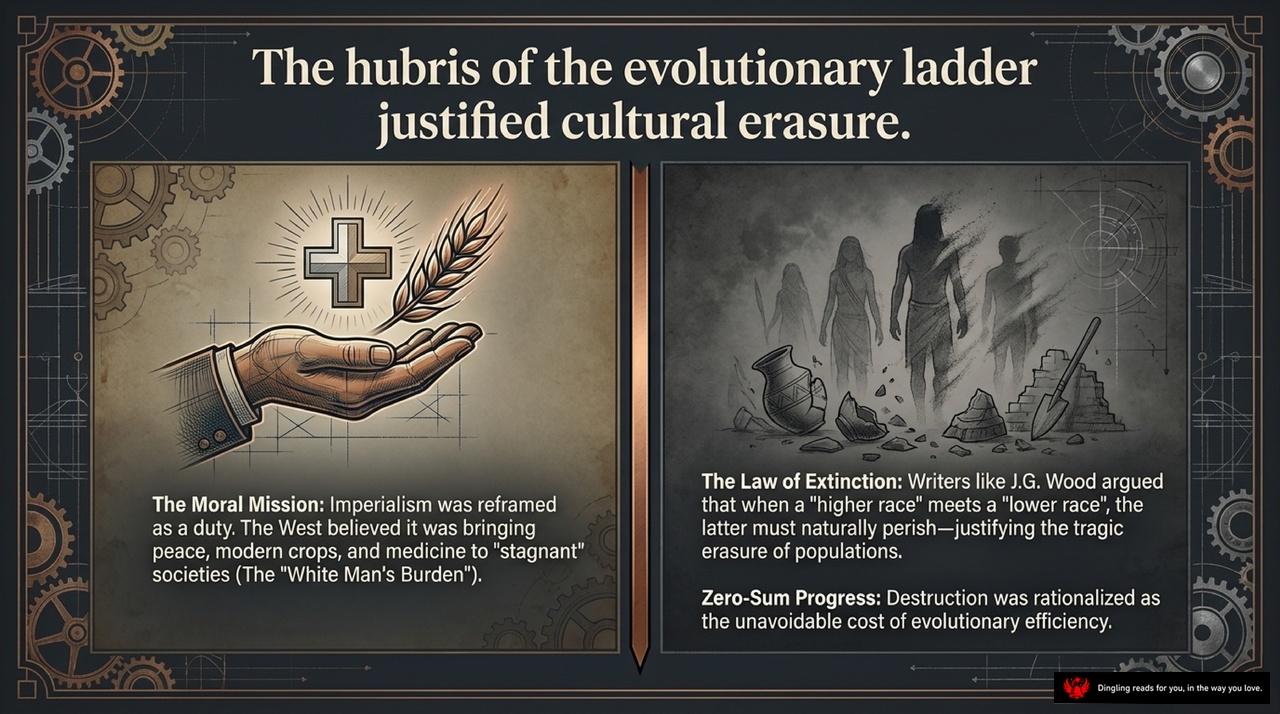
The hubris of the evolutionary ladder justified cultural erasure. On the left, we see the "Moral Mission": imperialism was reimagined as a noble duty. The West convinced itself that it was bringing peace, modern crops, and medicine to "stagnant" societies, framing this domination as the "White Man's Burden." But on the right, the reality was far darker. This was the Law of Extinction, where writers like J.G. Wood argued that when a "higher race" meets a "lower one," the latter must naturally perish. This logic tragically justified the erasure of entire populations. Furthermore, progress was viewed as a zero-sum game; destruction was rationalized as the unavoidable cost of evolutionary efficiency. In this worldview, the rise of the West was inextricably linked to the fall of others, turning cultural diversity into an obstacle that had to be cleared away for the sake of a single, linear future.

Structuralism halted the evolutionary arrow to examine the present. Think of society not as a ladder climbing toward perfection, but as a complex machine where every gear fits perfectly to keep the whole thing running. This shift, known as the Anthropological Revolution, began in the early 20th century when scholars like Malinowski and Radcliffe-Brown rejected the arrogant evolutionary ladder. They argued that all societies—from remote islands to industrial cities—are equally valid, perfectly functioning mechanisms adapted to their specific environments. Instead of asking, "What historical stage is this?" the academic focus shifted to "How does this system function right now?" This new perspective treated culture as a stable structure rather than a messy, linear progression. It was a radical move that stopped looking back at origins or forward to a promised future, and instead focused entirely on the intricate logic of the present moment.
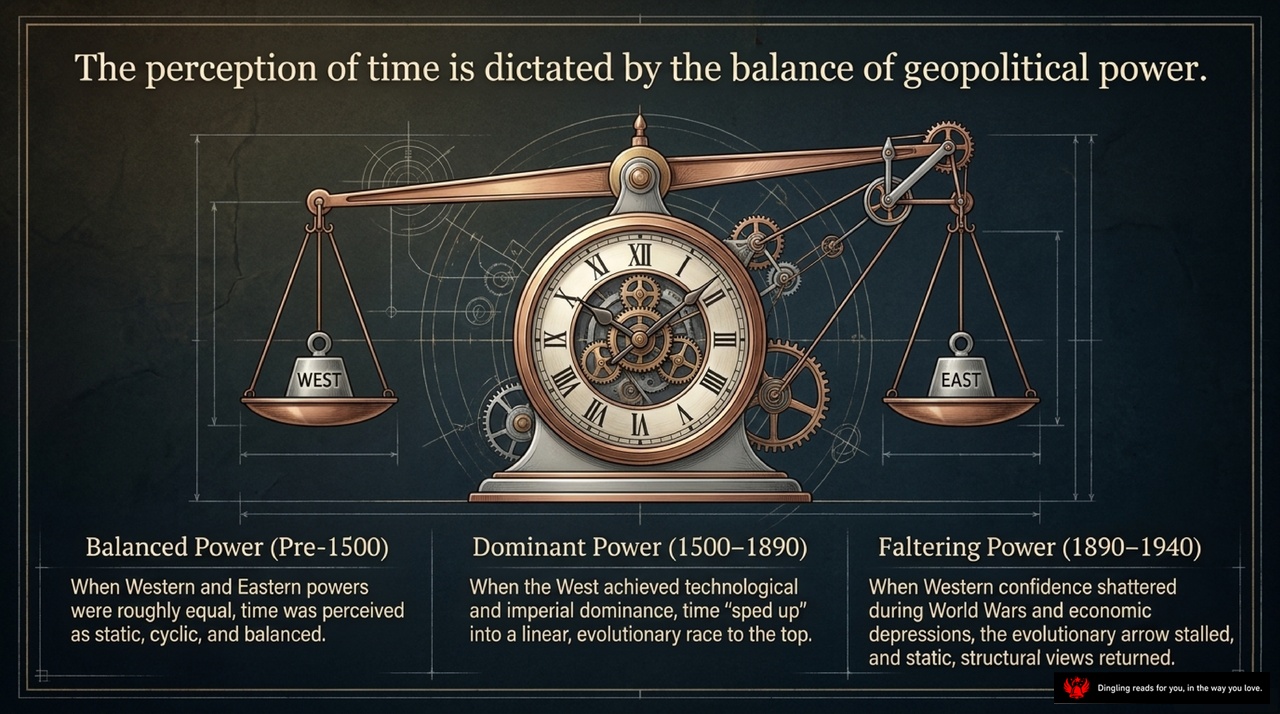
The slide we see right now captures a profound truth about how we experience time: it is not a universal constant, but a reflection of geopolitical power. Look at that scale in the center, balancing the "West" and the "East." When these powers are roughly equal, as they were before 1500, time feels static, cyclic, and balanced. There is no rush, no linear race to the top; history is just a wheel turning over and over.
But as soon as one side dominates, the entire rhythm of human life changes. From 1500 to 1890, the West achieved technological and imperial dominance. Suddenly, time "sped up." It transformed from a slow cycle into a frantic, linear evolutionary race. We started believing that history was a straight arrow pointing toward a perfect future, that we were constantly improving and conquering. This was the era of the "evolutionary race to the top," where every moment felt like a step forward in a grand competition.
However, that dominance didn't last forever. By the time we reach the period between 1890 and 1940, we see the West faltering. The confidence shattered during the World Wars and economic depressions. The evolutionary arrow stalled. When the dominant power struggles or declines, the frantic pace slows down again. The linear rush gives way to static, structural views once more. So, the speed of our time perception isn't just about clocks; it's about who holds the power. When the balance shifts, our entire understanding of history and the future shifts with it.
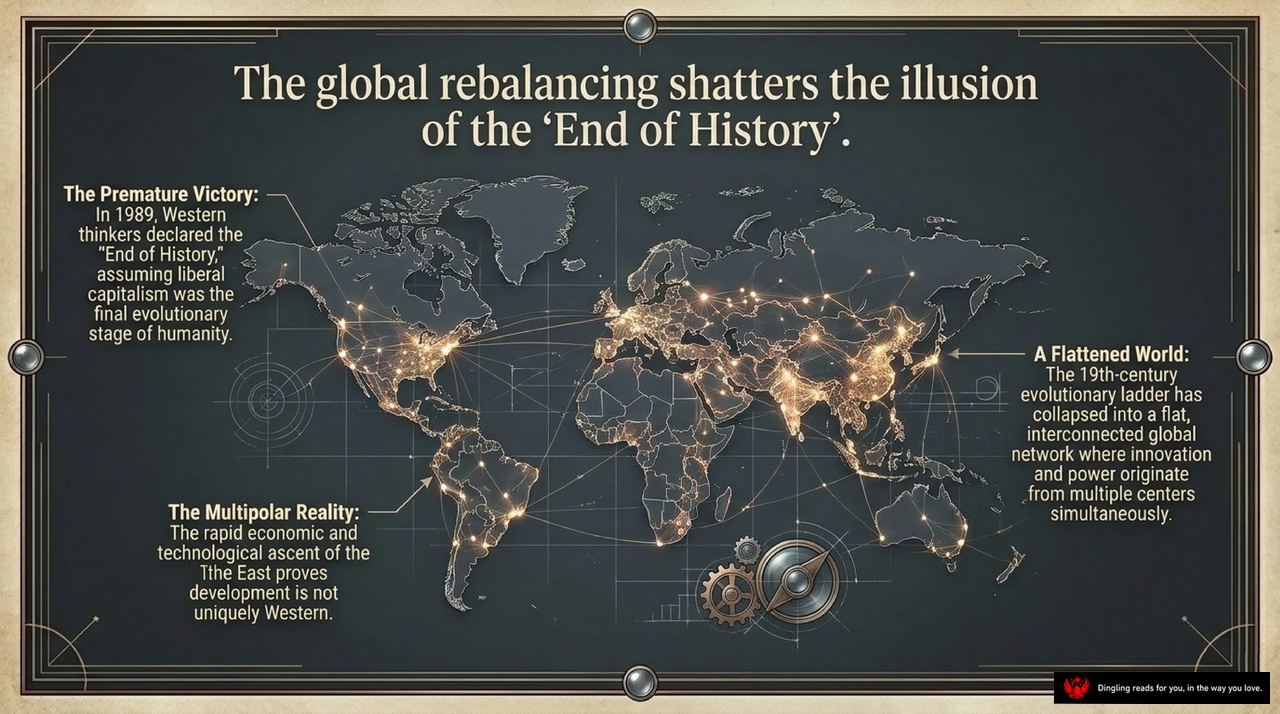
Look at this map. It depicts a world that is no longer a ladder, but a flat, interconnected network. The title on this slide makes a bold claim: "The global rebalancing shatters the illusion of the 'End of History'." This isn't just a geopolitical statement; it's a direct challenge to a specific intellectual era that dominated our thinking for decades.
In 1989, Western thinkers confidently declared that liberal capitalism was the final evolutionary stage of humanity. They believed history had reached its peak, and no other system could surpass it. This was the "End of History"—a belief that the 19th-century evolutionary ladder had finally collapsed into a single, finished line. We thought innovation and power would originate from one center, the West, forever.
But this slide shows us the "Multipolar Reality." The rapid economic and technological ascent of the East proves that development is not uniquely Western. The 19th-century ladder has indeed collapsed, replaced by a "Flattened World." Here, innovation and power originate from multiple centers simultaneously. This shift destroys the illusion that Western history is the only valid narrative for humanity.
We are moving away from the idea that history has a final destination. Instead, we are entering a new phase where the global rebalancing forces a rethinking of our entire worldview. The old paradigm of Western triumph is shattering, making space for a future where multiple civilizations coexist and evolve together, rather than one dominating the rest.

We must transition from a cosmology of conquest to one of collaboration. This isn't just a hopeful wish; it's a necessary evolution for our species. For two millennia, Western philosophy has been built on a zero-sum game—a mindset of aggressive individualism where nature is something to be dominated and conquered. But we have hit a wall. This old way of thinking has reached its ecological and political limits. It simply cannot sustain the future.
As global power shifts, the world urgently requires a different approach. We need to look toward Eastern cosmological principles, where the focus is on coexistence, mutual survival, and deep integration with natural forces. Instead of viewing the world as a resource to be extracted, we must see it as a partner to be worked with.
The path forward lies in a new synthesis. This means abandoning the arrogance of the "evolutionary ladder"—the idea that some civilizations are inherently superior and others are just waiting to be upgraded. The future belongs to a collaborative, multi-civilizational worldview. We are no longer climbing a ladder; we are building a web. Only by embracing this shift from domination to partnership can we ensure a stable and thriving future for all.
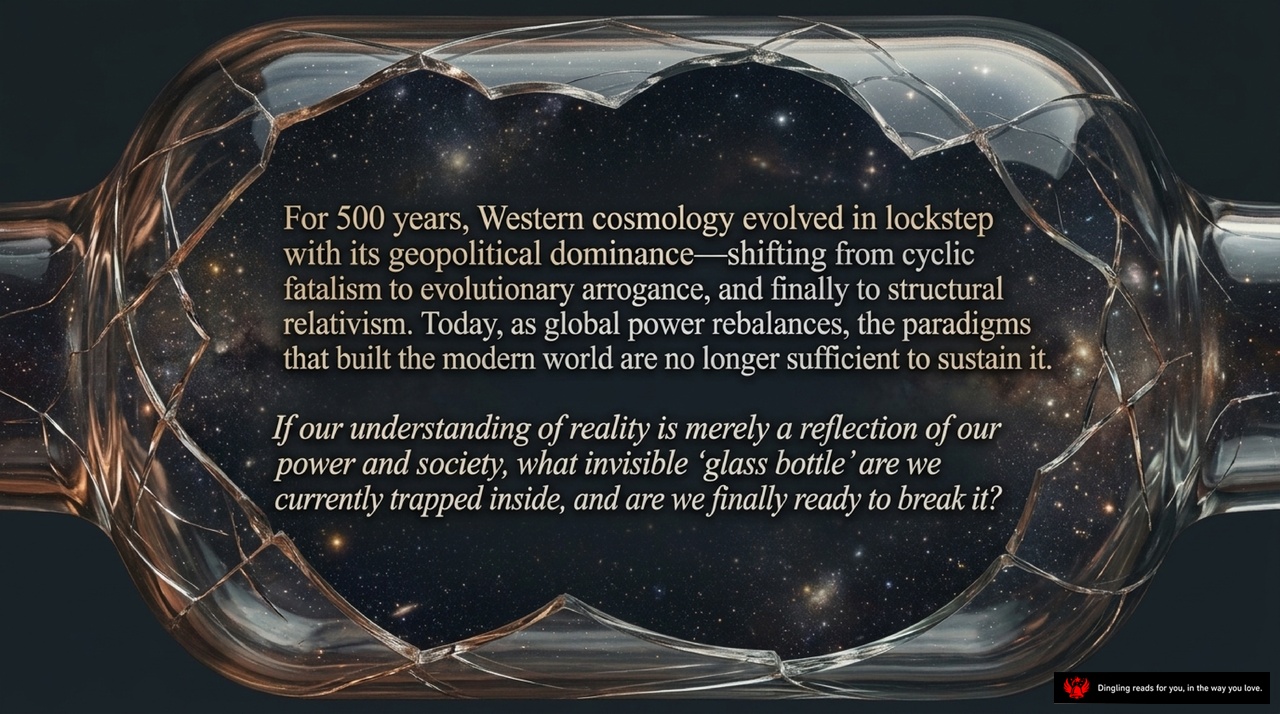
Look at this image. It depicts a shattered glass bottle filled with the cosmos, symbolizing a world on the brink of breaking free from its constraints. The text inside asks a profound question: if our understanding of reality is merely a reflection of our power, what invisible "glass bottle" are we currently trapped inside, and are we finally ready to shatter it?
This image perfectly captures the book's central thesis regarding the evolution of Western thought over the last 500 years. For centuries, Western cosmology evolved in lockstep with its geopolitical dominance. We shifted from a mindset of cyclic fatalism—believing history was just a repeating wheel—to one of evolutionary arrogance, where we thought we were destined to conquer and perfect the world. Finally, we arrived at structural relativism, where we stopped looking for grand narratives and started analyzing how systems function.
But today, as global power rebalances, the paradigms that built the modern world are no longer sufficient to sustain it. We are facing a crisis of the "glass bottle" itself. The old models of linear progress and Western superiority are cracking under the weight of a changing reality.
So, what is this invisible bottle we are trapped in? Is it the belief that our social structures are the only valid way to organize life? Or is it the arrogance of thinking we have the final answer to human existence? The book challenges us to look beyond these inherited frameworks. It asks us to consider whether we are ready to break the bottle, to reject the old scripts of history and politics, and to imagine a new reality where power is not the sole determinant of truth. The shattering glass in the image isn't just destruction; it's the necessary first step toward a new, uncharted future. Are you ready to take that leap?