
Crime and Punishment: Complete Chapter-by-Chapter Summary
Welcome to *Crime and Punishment* by Fyodor Dostoevsky. Set against the grim, cobblestone streets of St. Petersburg, this is a psychological descent into the fractured mind of a murderer and his agonizing path toward spiritual resurrection. It is not just a story about a crime, but a brutal exploration of what happens when a man tries to prove he is above the law. Follow Raskolnikov as he moves from the shadows of poverty and arrogance into the depths of guilt, and ultimately, toward the only true freedom he can find: the courage to be human again.
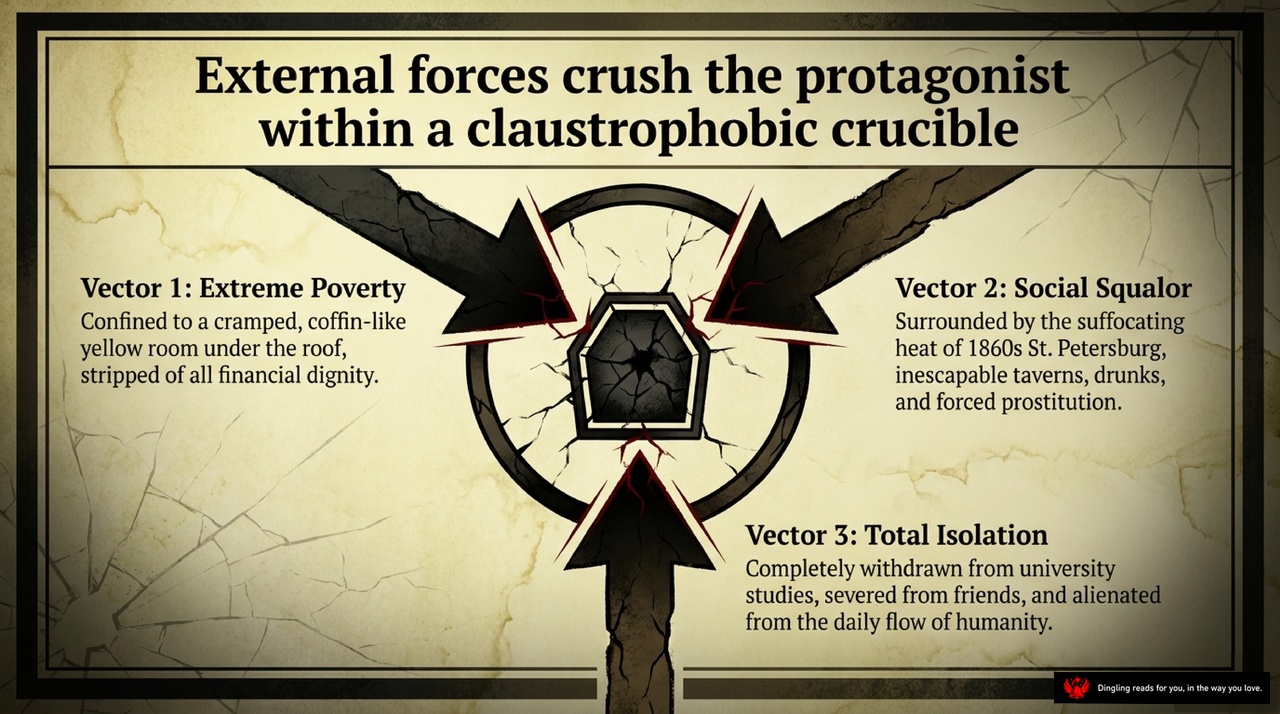
External forces crush the protagonist within a claustrophobic crucible. Imagine being squeezed from every angle, with no room to breathe and no escape in sight. That is exactly the trap Raskolnikov finds himself in.
First, look at Vector 1: Extreme Poverty. He is confined to a cramped, coffin-like yellow room under the roof, stripped of all financial dignity. It's not just about money; it's about the crushing weight of debt and the constant humiliation of a landlady who cuts off his food.
Then, there is Vector 2: Social Squalor. He is surrounded by the suffocating heat of 1860s St. Petersburg, inescapable taverns, drunks, and the terrifying reality of forced prostitution. The city itself feels like an enemy, pressing down on him.
Finally, Vector 3: Total Isolation. He is completely withdrawn from university, severed from friends, and alienated from the daily flow of humanity. He is alone with his thoughts, and those thoughts are dangerous ones.
These three vectors converge on a single point, cracking him open. Stripped of his status as a student and his moral compass, he begins to concoct a theory to justify his suffering. He convinces himself that he is not a "ordinary" person, but a "superman" with the right to break the law if he believes it serves a higher purpose. But this logic, born of desperation, is about to lead him down a path from which there is no turning back.
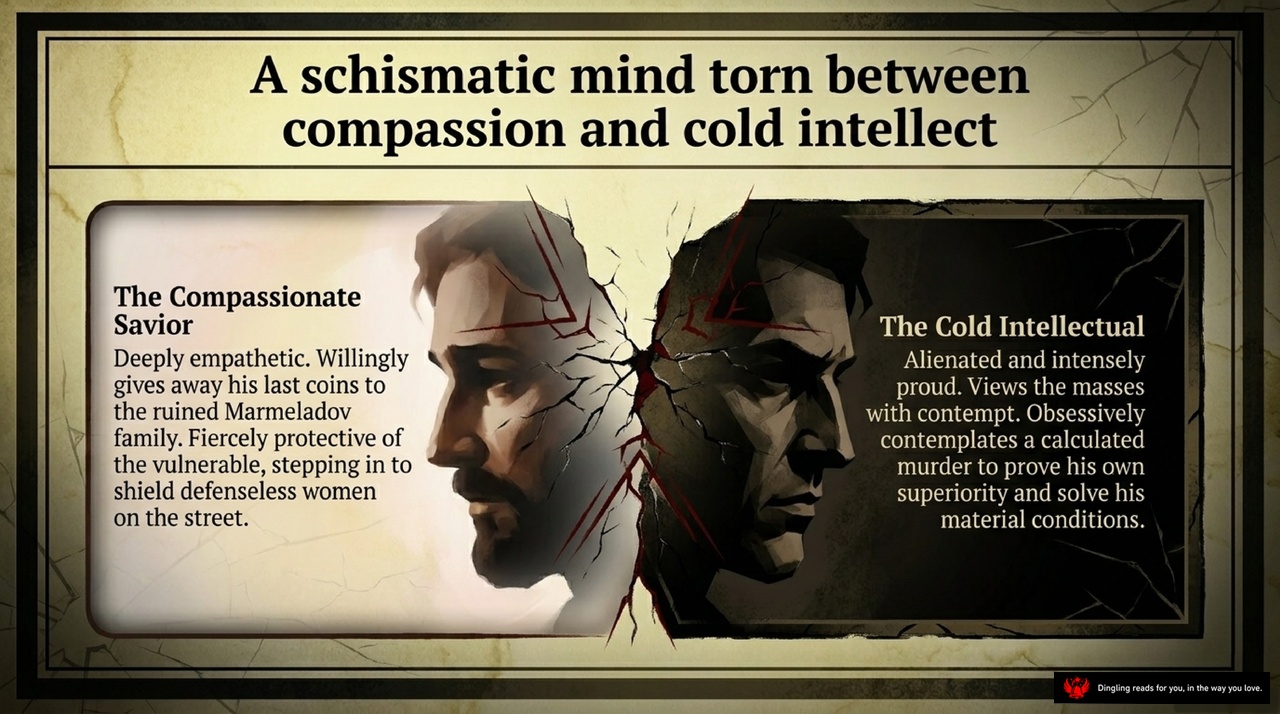
Picture shows a split face, one side glowing with the warmth of a "Compassionate Savior" who gives his last coins to the Marmeladov family, while the other side sinks into the shadows of a "Cold Intellectual" who views the masses with contempt. This visual perfectly captures Raskolnikov's internal war: torn between deep empathy and a dangerous, calculated intellect.
Look at the left side. He is deeply empathetic, fiercely protective of the vulnerable, and willing to step in to shield defenseless women. Yet, look at the right side. He is alienated, intensely proud, and obsessively contemplates a calculated murder to prove his own superiority. He believes the masses are merely "useless louses," while he is a special being who has the right to transgress moral laws for a "great purpose."
This slide isn't just about a character; it's about the terrifying moment a man decides to test the very fabric of humanity. He isn't just struggling with poverty; he is struggling with a theory that tells him he is above it all. He is trying to kill a part of himself to see if the rest can survive. The cracks running through his face symbolize that this isn't a clean choice—it's a schism, a tearing apart of his own soul. He is standing on the edge, ready to prove if he is a Napoleon or just another ordinary man, unaware that the cost of this experiment will be far greater than he ever imagined.

Look at this pyramid. It visualizes the terrifying intellectual framework that justifies crossing the moral line. At the very peak, we have "Extraordinary Men"—the masters of the future like Napoleon. The slide argues they possess an inherent, intellectual right to step over moral boundaries and shed blood if it serves a greater purpose or a "New Word." But at the base, we have "Ordinary Men," the reproductive masses bound by laws, tradition, and morality, whose sole job is to maintain the present order.
The red jagged line cutting through the middle is labeled "Prestuplenie"—the stepping over, the crime. This is the moment a man decides he is a Napoleon rather than a peasant. In Dostoevsky's *Crime and Punishment*, Raskolnikov is trapped in this exact trap. He is an ordinary man, crushed by poverty, yet he convinces himself he is extraordinary. He believes that because he has a "great idea," he has the right to kill an innocent pawn woman, Alyona Ivanovna, to prove his theory and use her money to help others. He tries to rationalize the murder as a scientific experiment, believing he is simply bypassing the rules that bind the weak. He tells himself that killing the "useless fly" is a necessary sacrifice for a higher good. But this slide exposes the brutal reality: this isn't about justice or greatness. It is a fragile, arrogant delusion. When Raskolnikov pulls the axe, he isn't a conqueror; he is just a murderer who convinced himself he was above the law. The moment he crosses that red line, the pyramid collapses, and he realizes there is no such thing as an "extraordinary" right to commit evil.
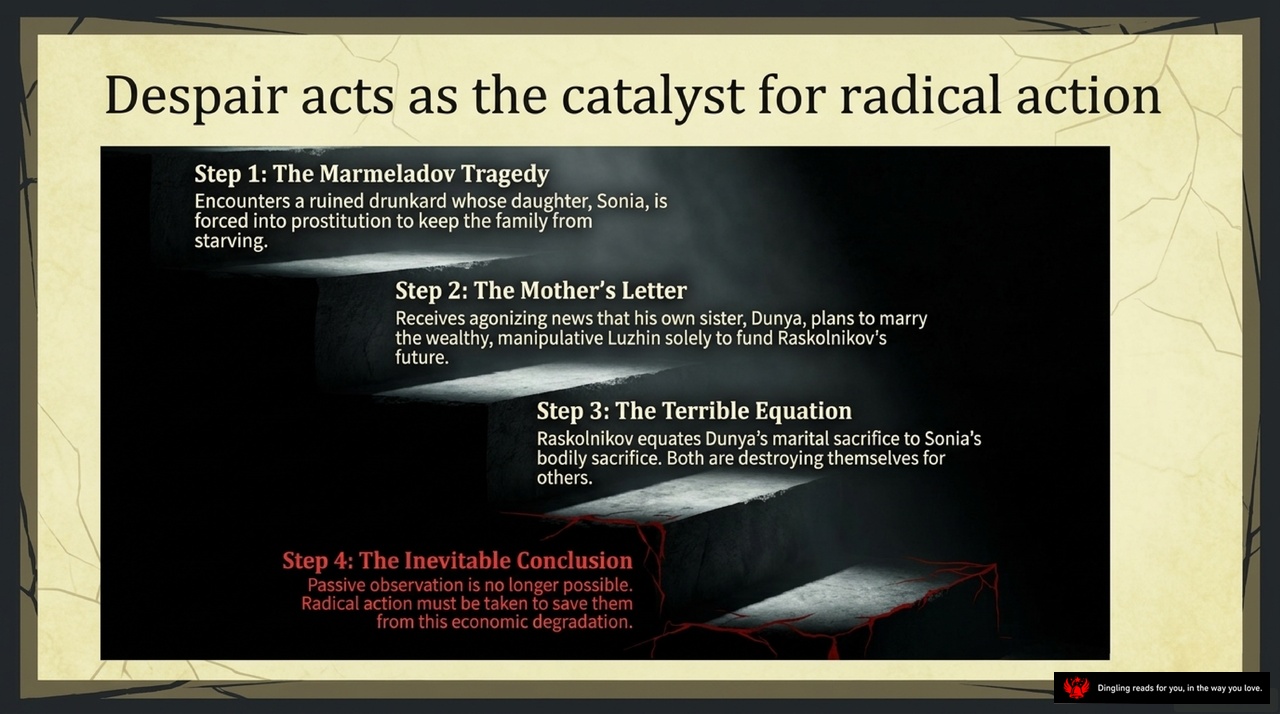
Despair acts as the catalyst for radical action. Look at these four steps that drive Raskolnikov toward his crime.
Step one is the Marmeladov Tragedy. He encounters a ruined drunkard whose daughter, Sonya, is forced into prostitution to keep the family from starving. This isn't just a story; it's a brutal reality check that shatters his theory of the "extraordinary man."
Step two is The Mother's Letter. He receives agonizing news that his own sister, Dunya, plans to marry the wealthy, manipulative Luzhin solely to fund Raskolnikov's future. He sees this not as love, but as a transaction where his sister's happiness is the price for his survival.
Step three is The Terrible Equation. Raskolnikov equates Dunya's marital sacrifice to Sonya's bodily sacrifice. Both are destroying themselves for others. The realization hits him: he is not the only one suffering, and his theoretical superiority is a lie when compared to their silent, selfless endurance.
Finally, Step four is The Inevitable Conclusion. Passive observation is no longer possible. Radical action must be taken to save them from this economic degradation. In his twisted logic, killing the "useless parasite" becomes the only way to stop the cycle of suffering. Despair has finally pushed him over the edge.
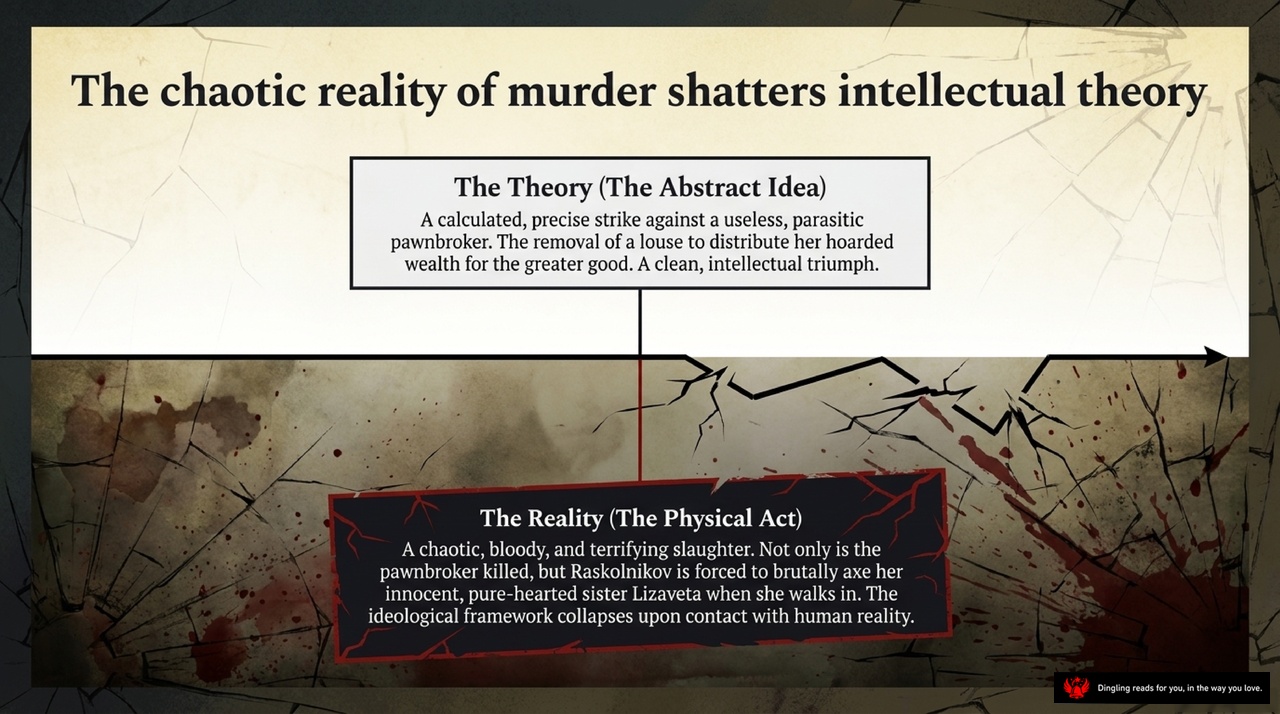
The slide you see right now captures a brutal truth about human nature: our grandest theories crumble the moment they touch real life. On the top, we have "The Theory"—the abstract idea. It's a cold, calculated plan to kill a "useless, parasitic pawnbroker" and redistribute her wealth for the greater good. In this intellectual bubble, it feels like a clean triumph, a logical solution to poverty.
But look at what happens when that theory hits "The Reality." The moment Raskolnikov swings the axe, the sterile theory shatters into chaos. It's no longer a philosophical experiment; it's a bloody, terrifying slaughter. He doesn't just kill the pawnbroker; in a panic, he brutally kills her innocent, pure-hearted sister, Lizaveta, who just walked in. That single, unintended act destroys his entire ideological framework. The moment he confronts actual human suffering and innocence, his "superman" theory collapses. You can't kill a louse without accidentally killing the child next to it. This slide reminds us that no amount of intellectualizing can prepare us for the weight of real violence.

Look at this concentric circle diagram. It illustrates the true cost of Raskolnikov's crime—not the legal penalty, but a psychological alienation that acts as immediate and true punishment.
Let's break down these rings. The outer ring represents society. Overcome by fever, paranoia, and delirium, Raskolnikov can no longer interact with the city without suspecting everyone. He is cut off from the world around him.
Moving inward to the middle ring, we see his loved ones. He realizes his bloody hands have permanently severed him from his devoted mother and his loyal friend Razumikhin. The bonds that once held him are broken.
But the inner core is where the ultimate realization happens. This is the Self. He hasn't just killed an old woman; he has murdered his own soul. The true punishment begins the very second the axe falls, long before the law catches him. He is trapped inside his own guilt, isolated from humanity, and spiritually dead.

Secondary characters act as dark ideological mirrors. In Dostoevsky's masterpiece, the villains aren't just obstacles; they are the twisted reflections of the protagonist's own philosophy. Look at Pyotr Luzhin: he represents utilitarian evil, using cold capitalist logic to disguise his selfishness as virtue. He treats marriage as a business deal, believing he can leverage poverty to gain power over others. Then there is Arkady Svidrigailov, the embodiment of nihilistic evil. He is the logical endpoint of Raskolnikov's theory—a man who has discarded God and all boundaries, driven purely by sensual gratification and crushing boredom. Finally, we have Raskolnikov himself, the divided man. He is caught between his innate moral conscience and his theoretical ruthlessness. He is horrified by the actions of Luzhin and Svidrigailov, failing to realize that their behavior is merely the practical application of his own theories. These characters force us to ask: where does the line between a revolutionary and a monster truly lie?
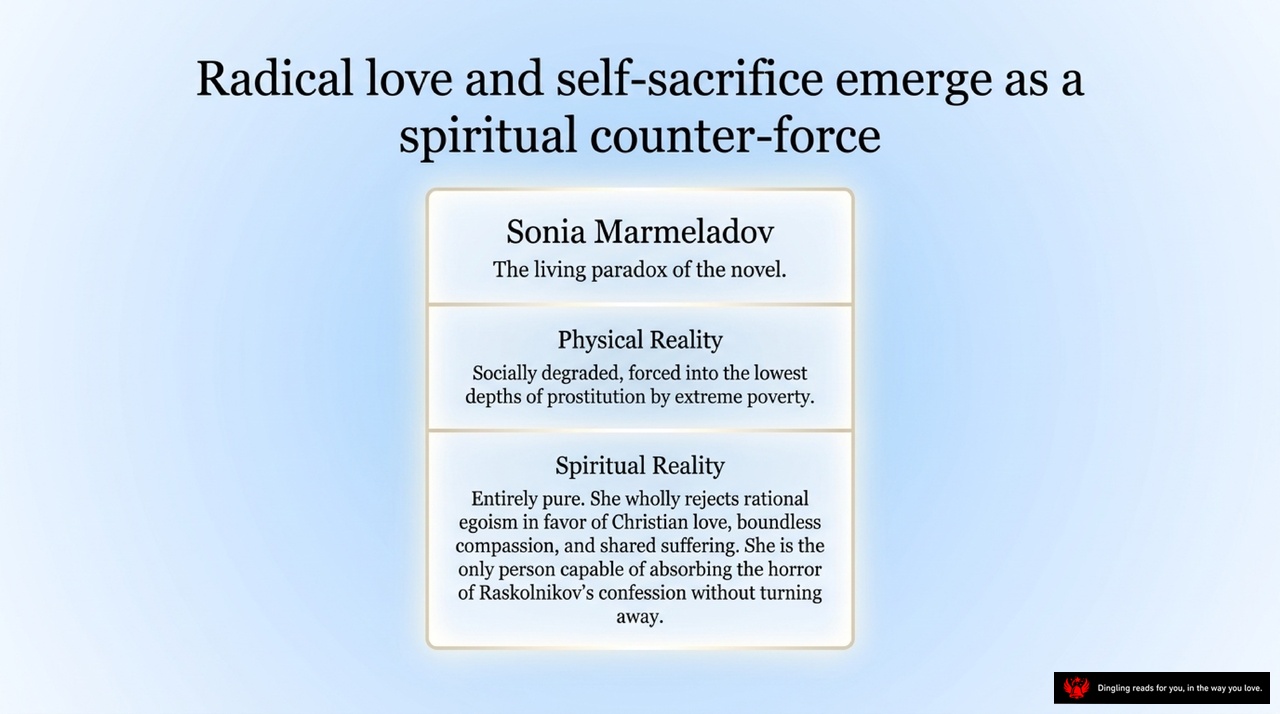
Radical love and self-sacrifice emerge as a spiritual counter-force, a powerful rebuttal to the cold logic of the world. This slide highlights Sonia Marmeladov, described as the living paradox of the novel. She embodies a stark duality. In her physical reality, she is socially degraded, forced by extreme poverty into the lowest depths of prostitution to feed her family. Yet, in her spiritual reality, she remains entirely pure. She wholly rejects rational egoism in favor of Christian love, boundless compassion, and shared suffering. She is the only person capable of absorbing the horror of Raskolnikov's confession without turning away. While others flee from sin and shame, she stands as a testament to the idea that true strength lies not in breaking rules, but in sacrificing oneself for others. Her existence challenges the very notion of the "extraordinary man," proving that radical love is the most powerful force of all.
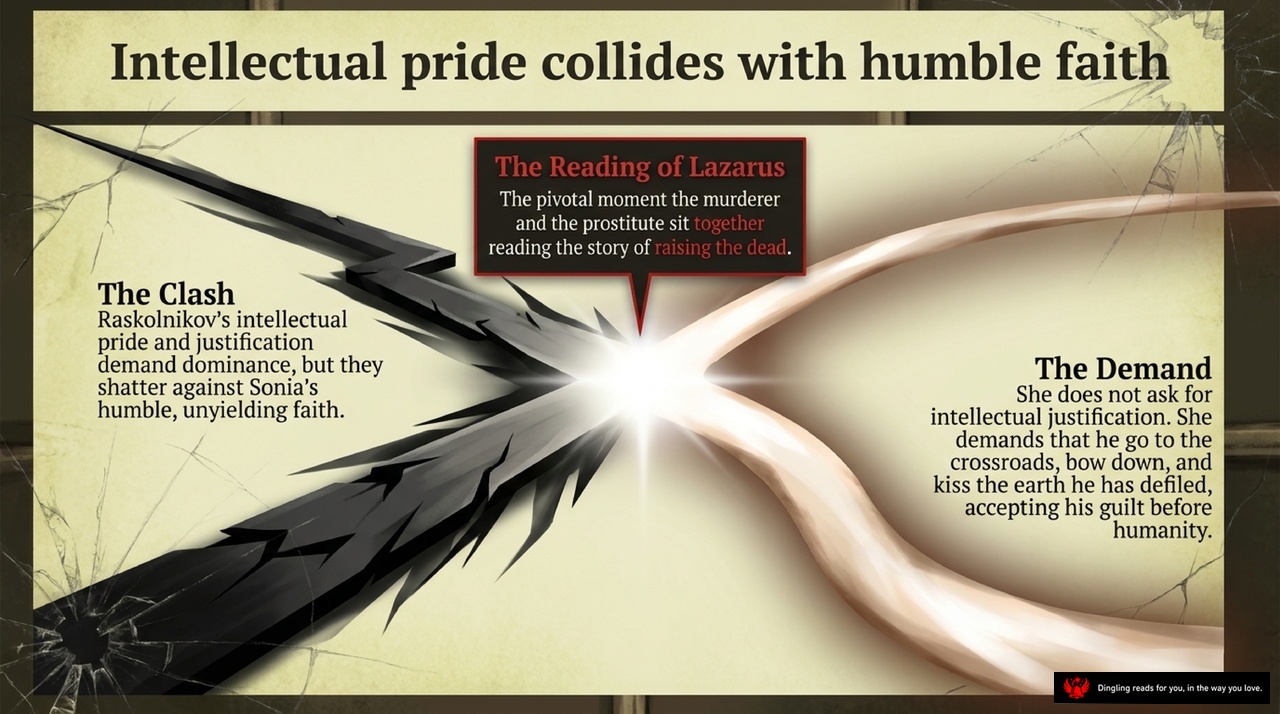
This slide captures the explosive clash at the heart of the novel: the collision between Raskolnikov's intellectual pride and Sonya's humble, unyielding faith. You see here, "The Clash"—Raskolnikov's theory that some "extraordinary" men have the right to break moral laws for a greater good shatters against Sonya's simple, humanistic belief in suffering and redemption.
Look at "The Demand." Sonya doesn't ask for excuses or intellectual justification. She demands he go to the crossroads, bow down, and kiss the earth he has defiled. She forces him to accept his guilt before humanity, stripping away his arrogant theories. This confrontation happens during "The Reading of Lazarus," the pivotal moment when the murderer and the prostitute sit together reading the story of raising the dead. It is in this shared space of suffering that his rigid logic finally breaks, proving that true strength isn't found in breaking rules, but in the courage to humble oneself and love.
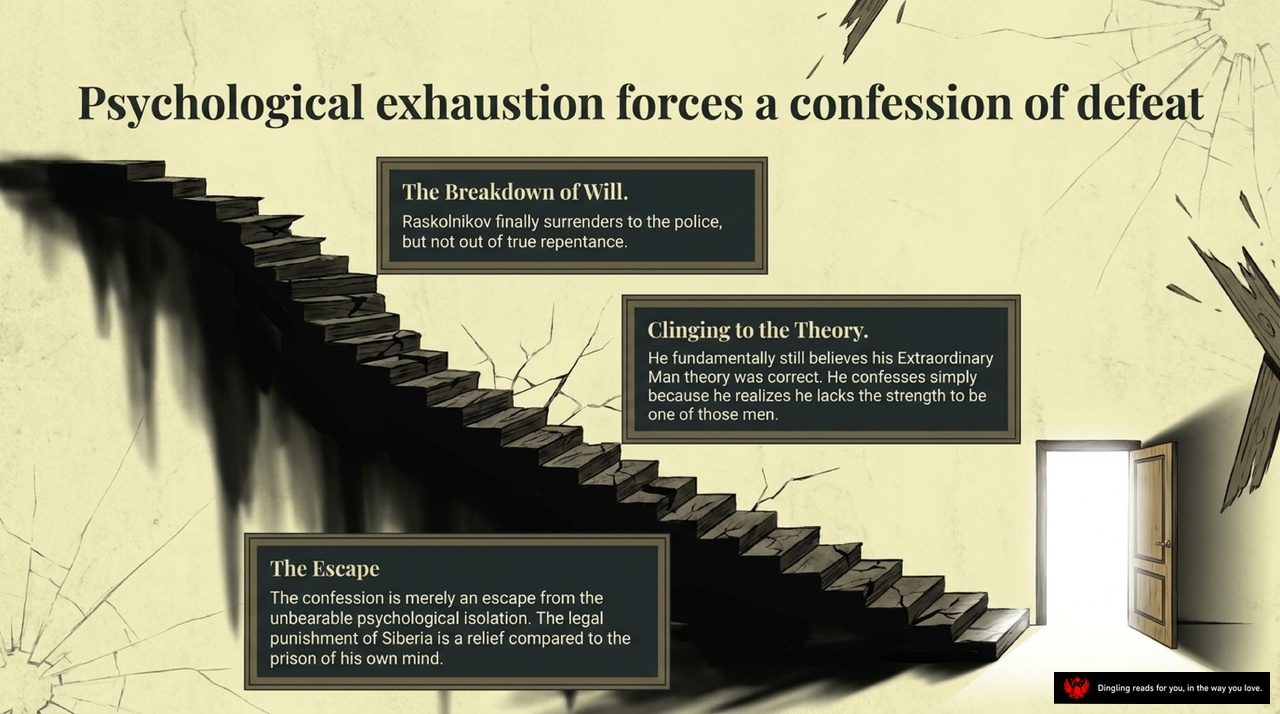
Psychological exhaustion forces a confession of defeat. This isn't about sudden remorse; it's the ultimate collapse of the will. Raskolnikov didn't surrender because he realized he was wrong; he surrendered because the pressure of his own guilt became too heavy to carry. He still clings to his theory that "extraordinary men" have the right to break the law, but the confession is simply an admission that he lacks the strength to live up to that ideal. He realizes that being a Napoleon is not about doing evil, but about having the fortitude to face the consequences. Instead, he is drowning in isolation. His confession is merely an escape from the unbearable prison of his own mind. The legal punishment of Siberia, with its harsh but structured reality, feels like a relief compared to the chaotic, self-imposed hell he was already living in. He trades his freedom for a chance at redemption, because the only way out of his own head is to let the law take him.

Spiritual resurrection requires the death of rational pride. This isn't just a philosophical concept; it's the brutal, necessary price Raskolnikov pays to save his soul. Look at the three stages laid out here: The Fever Dream, The Awakening, and The Ascent.
First, we see The Fever Dream. Locked in the prison hospital, Raskolnikov doesn't just suffer physically; he hallucinates a virus of pride and intellect that infects humanity. In this nightmare, men destroy each other because they cling to the absolute certainty of their own rational truths. He believes his cold logic is superior, that he is an "extraordinary man" who can rewrite the rules. But this intellectual arrogance is actually a poison, isolating him from every other human being.
Then comes The Awakening. The fever breaks, but so does his pride. He finally realizes the hard truth: cold intellect leads only to destruction. He sees that his theory was a lie, a shield he used to hide his own cowardice and fear. The logic he built to justify murder collapses when he faces the reality of his own guilt.
Finally, we reach The Ascent. This is where true change happens. Through Sonia's enduring love and her unwavering faith, Raskolnikov begins to submit to the irrationality of shared human suffering. He stops trying to be a god and starts being human again. By letting go of his rational pride and accepting the pain he caused, his spiritual resurrection finally begins. He learns that life isn't about proving you're special; it's about connecting with others and finding grace in the messiness of being alive.
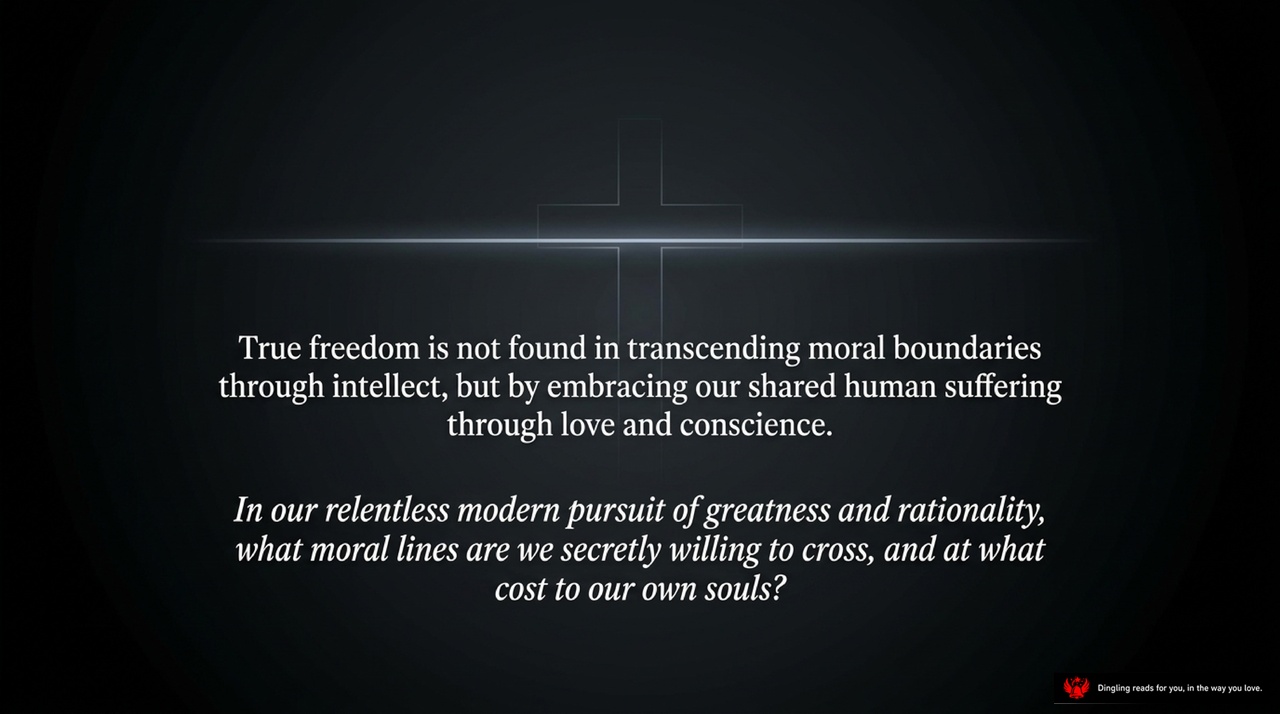
True freedom isn't about using your brain to break the rules; it's about connecting with the pain we all share through love and a clear conscience. In our modern race to be great and logical, what moral lines are we secretly willing to cross, and what price are we willing to pay for our own souls?
Look at the story of Sonya. She was forced into the darkest corners of society, selling her dignity just to keep her family alive. Yet, she never lost her faith or her humanity. She chose to suffer in silence rather than let her family starve. Her sacrifice wasn't a weakness; it was the ultimate act of strength and love.
Contrast this with Raskolnikov's twisted theory. He believed that some "extraordinary" people had the right to break the law for the greater good. He thought he could become a Napoleon, rewriting the world by stepping over others. But his experiment ended in blood and ruin. He tried to prove he was special by destroying innocent lives, only to find that he was nothing more than a prisoner of his own arrogance.
The cross in the background reminds us of the path back to humanity. It's not about transcending our limits, but embracing our shared suffering. True greatness isn't found in how many rules you can break, but in how deeply you care for the people around you. When we lose our empathy, we lose our freedom. The cost of ignoring our conscience is far too high.