
Crisis in the Red Zone: Complete Chapter-by-Chapter Summary
Welcome to today's session on *The Hot Zone*, based on the gripping work of Richard Preston. We are starting at the very beginning, right here in the "Red Zone."
Imagine a dark, tangled world where a virus hides in plain sight, waiting for the perfect moment to strike. This isn't science fiction; it's a chronicle of the deadliest viral outbreak in modern history. The story follows the frontline heroes who fought it and the terrifying warning it leaves for our future.
As you see on this slide, we are diving into "Crisis in the Red Zone." This is where the narrative begins, setting the stage for a battle against an invisible enemy that knows no borders. We are about to explore how a single, unknown pathogen could change the world forever.

Look at this map. It tells a story of thirty-eight years, but the virus itself hasn't changed. What has changed is the world around it.
On the left, we see 1976. The Yambuku Catholic Mission in Zaire. The data readout shows an "Unknown" index case, and the status is a "rapid burn-out in an isolated low-land rainforest." The red circle is small, contained, and fading. It was a tragedy, but it was contained by the very isolation of the jungle.
Fast forward to the right. That is 2014. The Makona Delta, straddling Guinea, Liberia, and Sierra Leone. Now, look at the red lines. They are everywhere. This is an "exponential explosion across hyper-connected regional transit routes." The index case here was a two-year-old boy named Emile Ouamoundo.
The insight note at the bottom captures the entire tragedy: "The virus had not changed its geography; human geography had changed around the virus, turning isolated ecosystems into highways."
In 1976, the dense rainforest acted as a barrier. The virus burned out because it couldn't jump easily from animal to human, and there were no roads for humans to carry it to new villages.
But by 2014, that barrier was gone. Decades of deforestation had pushed people deeper into the forest. Hunters, fishermen, and children were interacting daily with bats and primates that carried the virus. When Emile got sick, he wasn't alone. He was connected to a network of families, markets, and transit routes that stretched across three countries. The virus didn't need to evolve to become more dangerous; it just needed the roads to get there.
This map is a stark reminder that the greatest risk factor for the next pandemic isn't necessarily a new mutation in the lab or the wild. It is our own expansion. By erasing the boundaries between the human world and the natural world, we have turned a quiet, isolated outbreak into a global highway for disaster. The virus was waiting all along; we just finally built the road for it to drive down.
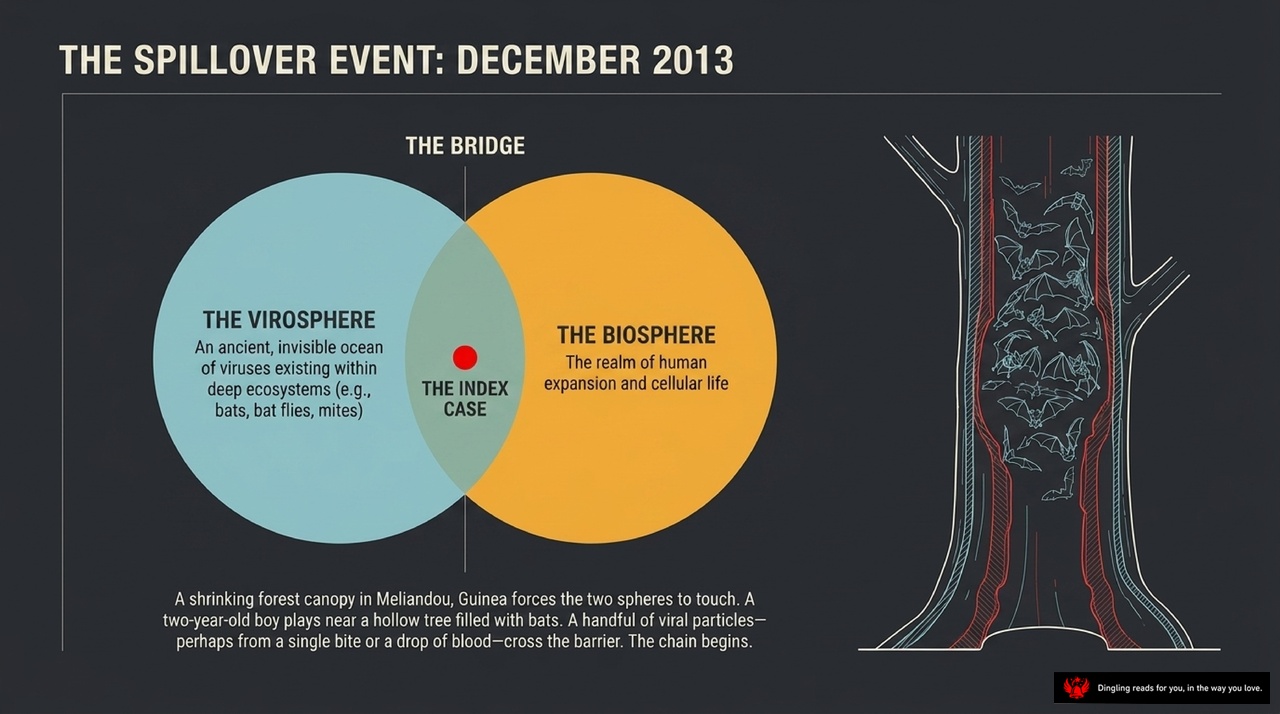
In December 2013, a quiet moment in Meliandou, Guinea, shattered the fragile boundary between the wild and the human world. This was the exact moment of the "spillover event," where two invisible realms finally collided. On the left, we see the virosphere—an ancient, invisible ocean of viruses hiding deep within ecosystems like bats, flies, and mites. On the right lies the biosphere, the realm of human expansion and cellular life. For centuries, these spheres remained separate, but that changed here.
The image shows a hollow tree filled with bats, acting as the bridge. As the forest canopy shrank due to deforestation, humans and their livestock pushed deeper into the jungle, forcing these two worlds to touch. A two-year-old boy named Emery played near this tree, unknowingly becoming the index case. Perhaps from a single bite or a drop of blood, a handful of viral particles crossed the barrier. The chain began. This single point of contact, marked by the red dot in the center, triggered a cascade of events that would soon engulf West Africa. It wasn't just a biological accident; it was the direct result of human activity eroding the natural buffers that once kept us safe. The virus, long dormant in the virosphere, found a new host in the biosphere, setting the stage for a global crisis.

The slide we see here captures a terrifying truth about how Ebola truly spreads: it doesn't just jump from person to person like a cold; it travels through the very bonds of love and care. The diagram illustrates what the book calls "The Chain of Love and Death," highlighting a specific mechanism that turned a local outbreak into a regional catastrophe.
Look at the center of this network: Menindor, a traditional healer in the village of Kpondu. When she died, her funeral became what the slide calls "The Amplification Node." Because of local customs, mourners physically washed her body, hugged her, and touched her with bare hands. This single event acted as a massive hub, sparking at least 365 new infections across the Makona Delta.
The slide breaks down exactly how this happened through "The Network Effect." The virus exploited our deepest human instincts—washing the dead, hugging the sick, and treating patients. In the book, we learn that Menindor's five sisters and a doctor all fell ill after caring for her, and the virus then jumped to the doctor's patients, creating a chain reaction that overwhelmed the entire region. This graphic reminds us that in an outbreak like this, the act of caring for someone can become the very thing that spreads the disease, turning a community's love into a deadly vector.
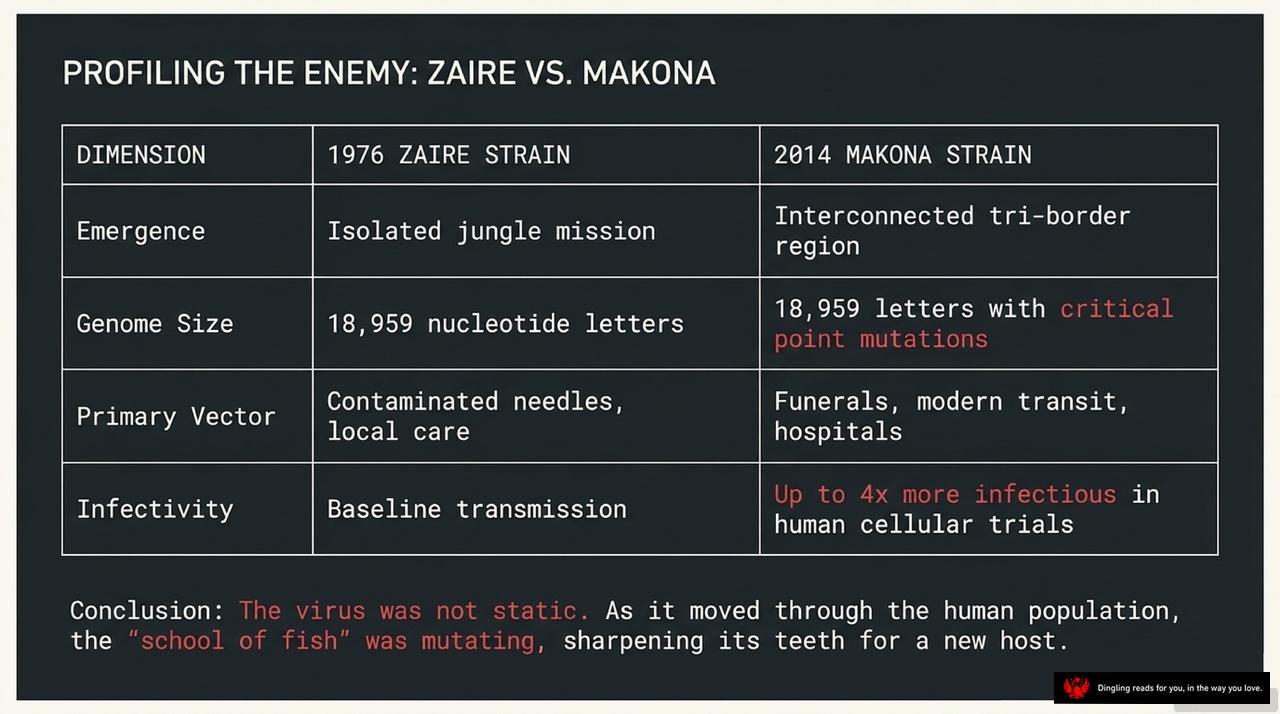
Look at this comparison: the 1976 Zaire strain versus the 2014 Makona strain. While the genome size remained identical at 18,959 nucleotides, the Makona version carried critical point mutations that fundamentally changed its nature. The virus wasn't static; it was evolving like a "school of fish" sharpening its teeth for a new host.
In 1976, the outbreak emerged from an isolated jungle mission, spreading via contaminated needles and local care. It was a baseline transmission. But by 2014, the Makona strain emerged from interconnected tri-border regions, utilizing funerals, modern transit, and hospitals as its primary vectors. This shift made it up to four times more infectious in human cellular trials.
This evolution explains why the 2014 crisis was so devastating. A tiny mutation allowed the Makona strain to bind much more tightly to human cells, making it far more efficient at spreading through our population. The virus had learned how to be a better human virus.
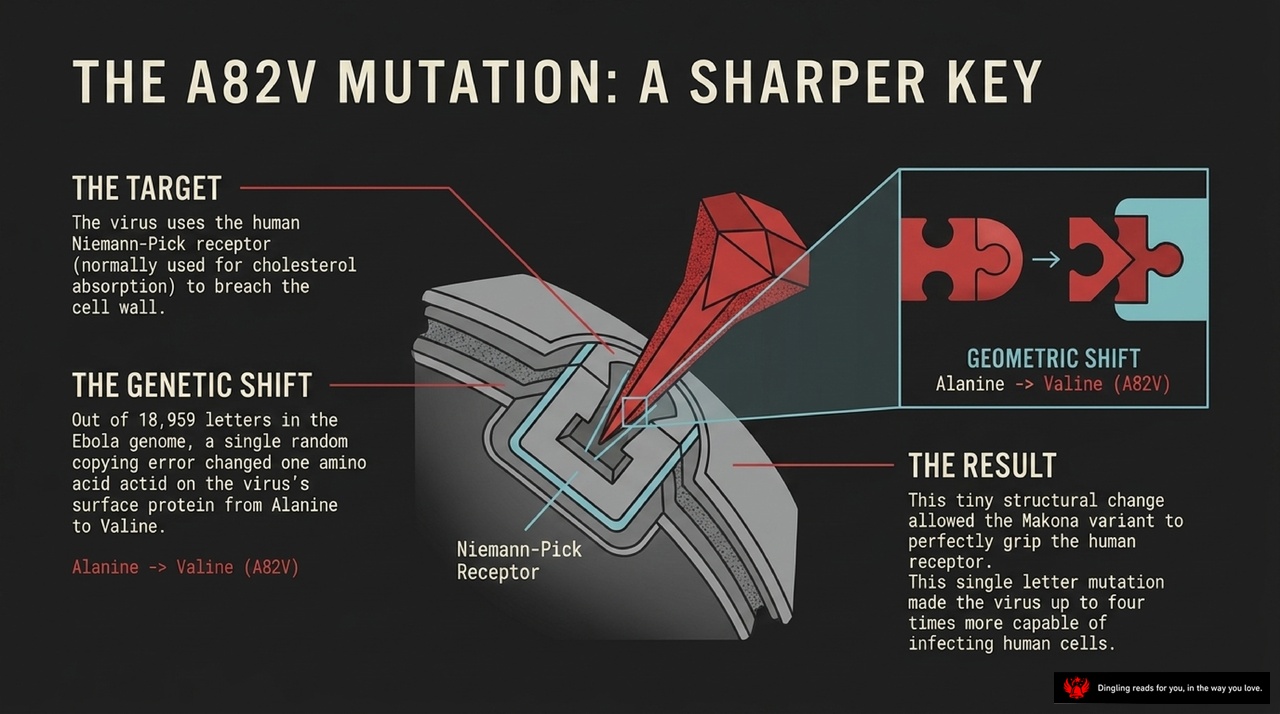
Imagine a lock and a key, but instead of metal, we're talking about biology. In 1976, the original Ebola virus had a specific shape that fit perfectly into a human receptor, like a key in a lock. But nature is always tinkering. Through random mutations, the virus changed just one tiny letter in its genetic code, swapping an amino acid called Alanine for Valine. This specific change, known as the A82V mutation, created a "sharper key." It allowed the virus to grip the human cell wall with four times more strength than before. This single geometric shift transformed the virus from a quiet threat into a highly efficient killer, making it up to four times more capable of infecting human cells. It's a stark reminder that in the world of viruses, a single letter change can rewrite the rules of survival.

Imagine a single drop of blood as a microscopic library, holding billions of genetic books—human, bacterial, and viral—all at once. This is the power of deep sequencing, the methodology Dr. Pardis Sabeti's team used to unlock the secrets of a deadly virus. By breaking that liquid into six trillion barcoded DNA fragments and running them through supercomputers, scientists could read the exact genetic code of the virus in real time. For the first time, humanity watched a Level 4 virus mutate and adapt across four dimensions, tracking its real-time evolution as it hopped from person to person. The result? An evolutionary tree that maps every jump, turning a chaotic outbreak into a solvable puzzle.

Imagine stepping into a sealed box where the air itself is a weapon. This is the Red Zone, the absolute front line in the battle against Ebola. As the infographic illustrates, this isn't just a room; it's a high-tech prison designed to trap the virus. Inside, medical staff are encased in impermeable Tyvek suits and battery-powered PAPR respirators, maintaining positive air pressure to keep the deadly pathogen outside. But this armor comes at a terrible cost. The heat inside soars rapidly, risking fatal heatstroke within just an hour.
Yet, even with this heavy protection, the margin for error is razor-thin. A single microscopic pinprick in a double-layered glove can transform a healer into a patient, instantly. Modern medicine here is stripped down to nothing but IV fluids and raw human endurance. The entire setup relies on a strict one-way flow, moving patients from the infection zone through decontamination showers to safety. It is a system built on friction and fear, where every movement is calculated, and every second counts against the relentless virus.
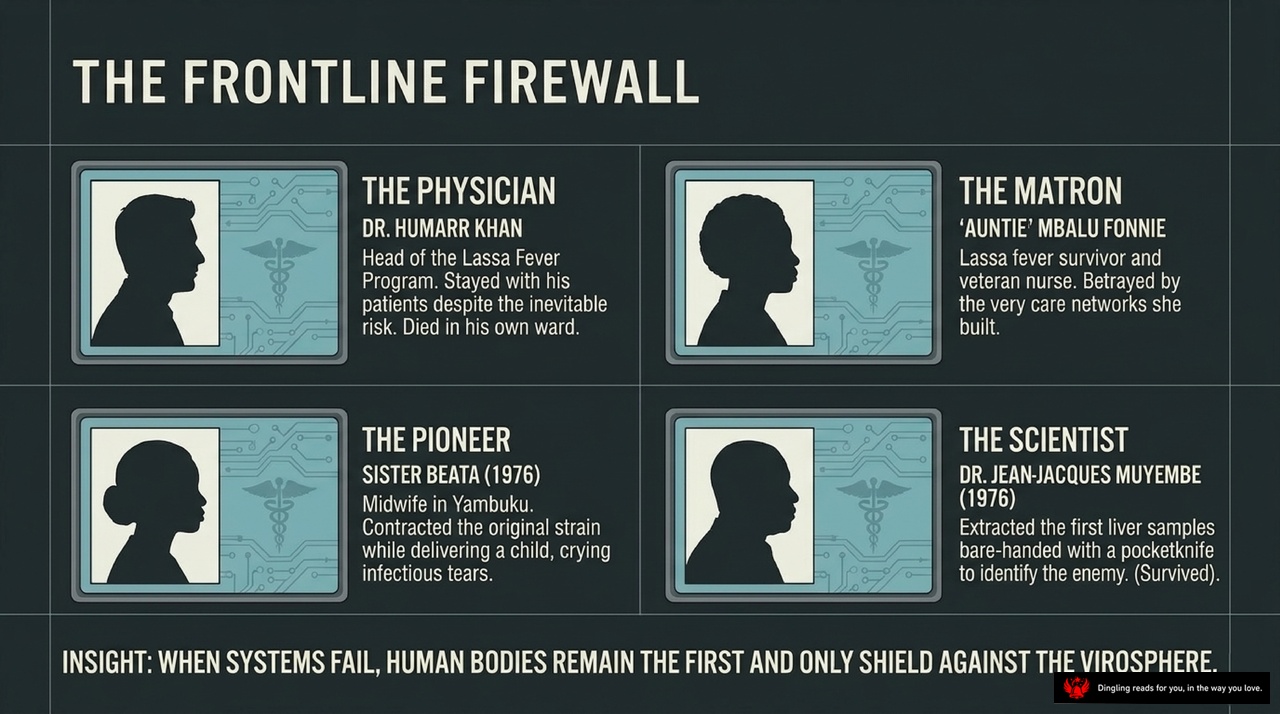
The Frontline Firewall isn't just a metaphor; it's the brutal reality we faced when systems collapsed and human bodies became our only defense. This slide honors four unsung heroes who stood between us and the virosphere when everything else failed.
First, Dr. Humarr Khan, the physician. As the head of the Lassa Fever Program, he didn't run away when the risk became inevitable. He stayed right there in his own ward, caring for his patients until his life ended in the very hospital he tried to protect. Then there is 'Auntie' Mbalu Fannie, the matron. A veteran nurse and a Lassa fever survivor herself, she built a care network that should have saved lives, yet she was betrayed by the very system she dedicated her life to building. She died because she cared too much.
We also remember Sister Beata, the pioneer. In 1976, while delivering a child in Yambuku, she contracted the original strain of the virus. The horror was so extreme that she cried infectious tears—blood and tears mixing together—which tragically killed the priest who administered her last rites. Finally, we have Dr. Jean-Jacques Muyembe, the scientist. In 1976, with no proper equipment, he extracted the first liver samples bare-handed, using just a pocketknife to identify the enemy. He survived, but at a terrifying cost.
These four stories drive home a chilling insight: When systems fail, human bodies remain the first and only shield against the virosphere. They weren't just workers; they were the final line of defense, paying the ultimate price so we could learn the truth about the virus.
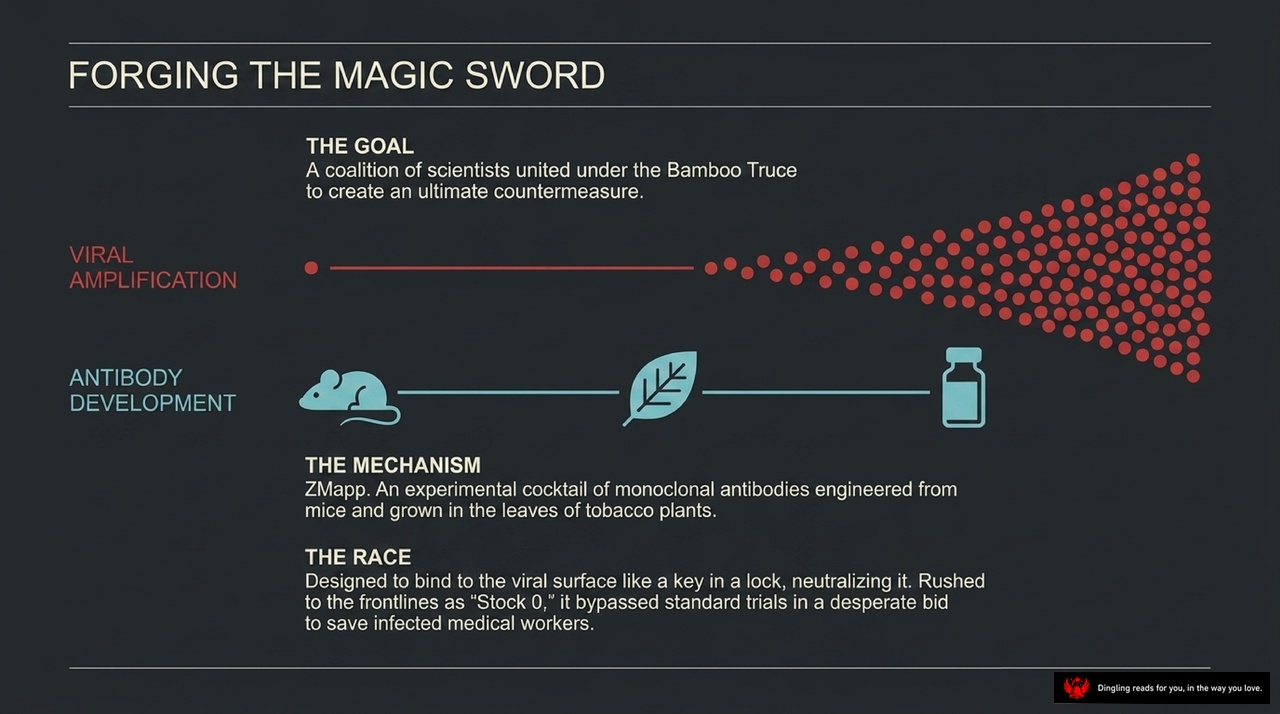
Forging the Magic Sword. Imagine a coalition of scientists united under the Bamboo Truce, driven by a single, desperate goal: to create an ultimate countermeasure against a lethal enemy. This was the birth of ZMapp, an experimental cocktail of monoclonal antibodies. But how did they build it? The process began with viral amplification, followed by a unique path of antibody development. Scientists engineered these antibodies from mice, then surprisingly, grew them within the leaves of tobacco plants. This unconventional method allowed for rapid, large-scale production of the very tools needed for survival. The mechanism was precise: designed to bind to the viral surface like a key in a lock, ZMapp neutralized the virus before it could destroy the host. In a race against time, this "Stock 0" bypassed standard trials and rushed to the frontlines. It was a gamble, a desperate bid to save infected medical workers and halt the spread of a virus that had already claimed countless lives. This was the forging of a magic sword, born from ingenuity and urgency, ready to face the deadliest threat of our time.
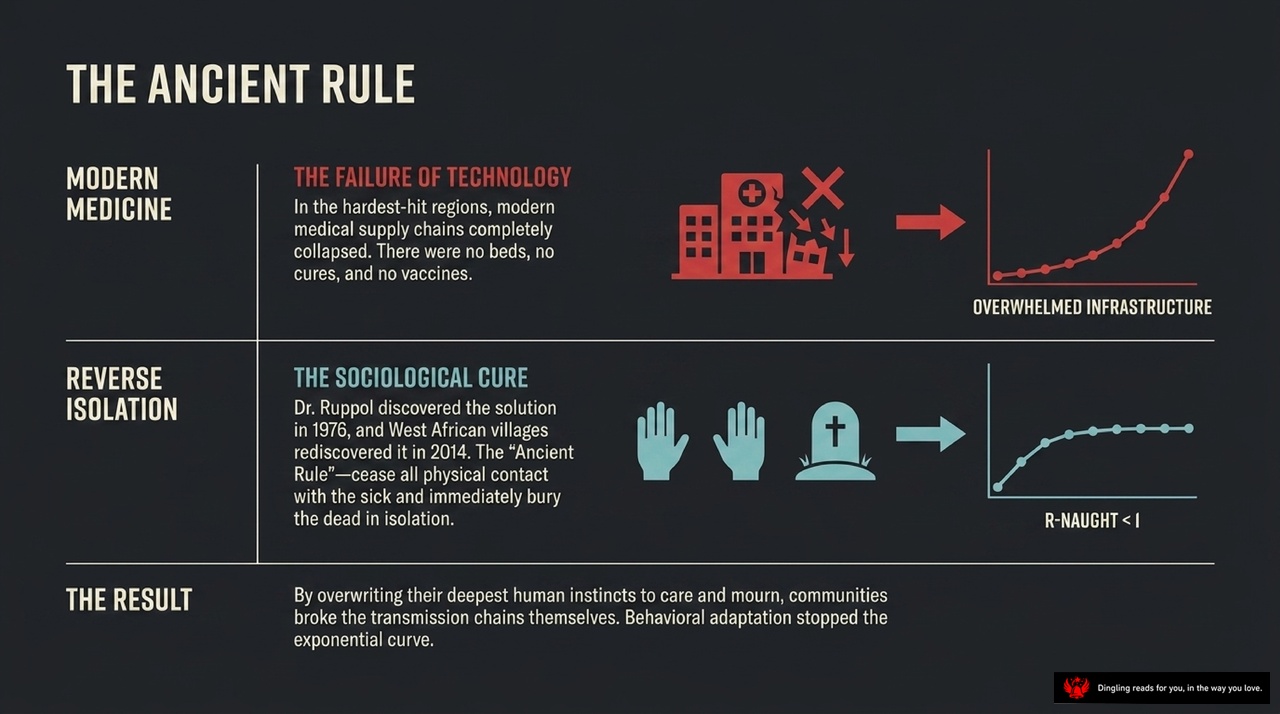
The ancient rule is a harsh lesson in survival, born from the failure of modern medicine when technology collapses. As we see in the slide, when supply chains break down—no beds, no cures, no vaccines—infrastructure becomes overwhelmed, and the infection curve spikes vertically. But there is another path. In 1976, Dr. Ruppol discovered that the sociological cure was to cease all physical contact with the sick and immediately bury the dead in isolation. This "reverse isolation" forced communities to overwrite their deepest instincts to care and mourn. By stopping the transmission chain themselves, they broke the exponential curve, keeping R-naught below one. The result wasn't a miracle drug, but a behavioral shift that stopped the spread. This ancient wisdom, rediscovered in 2014, proved that sometimes the most powerful weapon against a virus is simply stepping back.
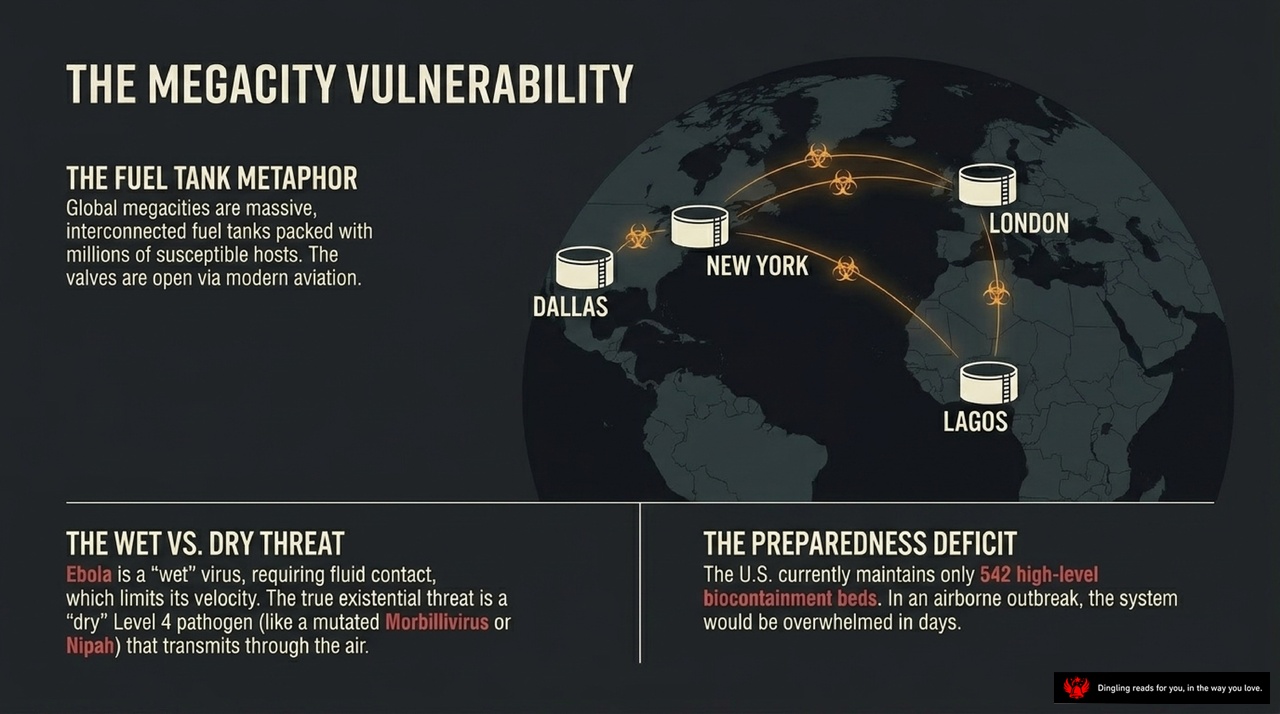
Global megacities are no longer just cities; they are massive, interconnected fuel tanks packed with millions of susceptible hosts. As the slide illustrates, modern aviation has effectively opened the valves between these tanks, creating a system where a spark in one location can ignite the entire globe. Look at the map: Dallas, New York, London, and Lagos are all linked. If a pathogen enters one of these hubs, the speed of global travel ensures it reaches the next within hours.
But the real danger lies in what kind of threat we are facing. We often think of Ebola as a "wet" virus, requiring fluid contact and limited by its speed. However, the true existential threat is a "dry" Level 4 pathogen—like a mutated Morbillivirus or Nipah—that transmits through the air. Unlike the wet virus, an airborne threat doesn't need close contact or specific fluids to spread; it can jump across continents instantly, turning our connected world into a tinderbox.
Finally, consider our preparedness deficit. The U.S. currently maintains only 542 high-level biocontainment beds. In an airborne outbreak, this system would be overwhelmed in days. We are building our cities as fuel tanks, arming ourselves with a "wet" virus in mind, and expecting to survive a "dry" one. The gap between our infrastructure and the reality of an airborne pandemic is a gap we cannot afford to leave open.
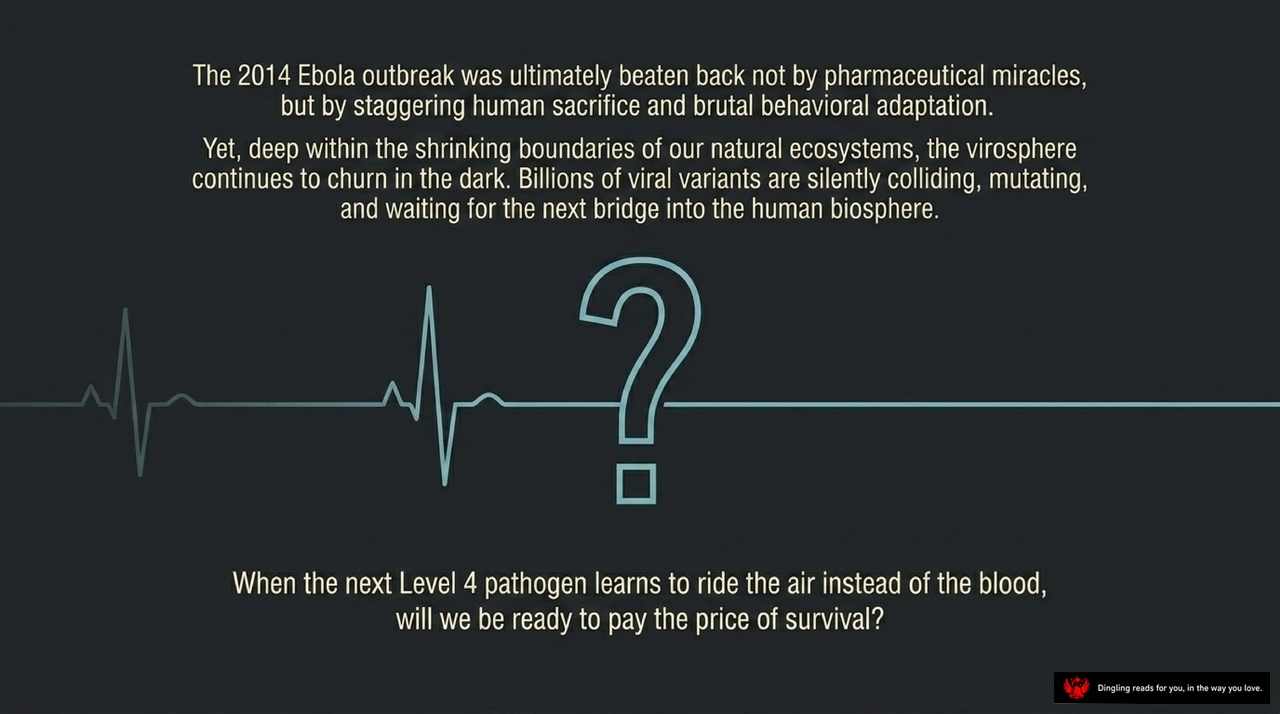
Look at this heartbeat line ending in a question mark. It captures the terrifying uncertainty we face today. The slide reminds us that the 2014 Ebola outbreak wasn't stopped by medical miracles, but by staggering human sacrifice and brutal behavioral adaptation. Yet, deep within our shrinking natural ecosystems, the virosphere continues to churn in the dark. Billions of viral variants are silently colliding, mutating, and waiting for the next bridge into the human biosphere.
We must ask ourselves: When the next Level 4 pathogen learns to ride the air instead of the blood, will we be ready to pay the price of survival? The history of Ebola teaches us that survival often depends not on the technology we have, but on the choices we make to protect each other. But as we encroach deeper into the wild, the risks are evolving, and the stakes have never been higher.