
Crossing the Chasm: Complete Chapter-by-Chapter Summary

Welcome to our book club. Today, we're diving into a memoir titled *Crossing the Chasm*, written by an anonymous author. Set against the dramatic backdrop of 20th-century China, this story follows one man’s relentless journey to bridge the vast divide between rural poverty and urban opportunity. It’s a tale of resilience, determination, and the unyielding human spirit. As we begin, let’s explore the themes that make this memoir so compelling.

In the mid-20th century, China’s planned economy carved out a deep and unbridgeable divide between rural and urban life—one that shaped every aspect of daily existence. On one side lay The Rural Valley: a world defined by bare hands and broken tools. Peasants worked with the “98721 Unit”—dung scoops, hoes, sickles, carrying poles—tools that barely scratched the surface of modern productivity. Their income? Measured in cents per day, or more often, in collective work points that rarely translated into real purchasing power. Hunger was constant. Clothes were patched beyond recognition. Illnesses, once common, became fatal because treatment meant improvisation with whatever scraps could be found. And worst of all, their destiny was locked to the land by birth. To leave wasn’t just difficult—it was nearly impossible, as if the mountains themselves held them in chains.
On the other side stood The Urban Horizon: a glittering promise of stability and opportunity. Here, labor tools weren’t shovels or sickles—they were machinery, electricity, and administrative power, the invisible engines of a state-driven industrial machine. Income wasn’t uncertain; it was guaranteed through state salaries, backed by financial security that rural folk could only dream of. Basic needs were met not through struggle, but through ration coupons—state-issued vouchers for meat, cloth, grain, and industrial goods. Employment was guaranteed. Education was accessible. Upward mobility? Not just possible—it was expected.
This wasn’t just a difference in living conditions. It was a chasm—a rigid institutional wall that made social ascent virtually impossible for those born in the valley. One side thrived on structure and security; the other survived on endurance and invisibility. And in that divide, millions lived out their lives, unaware that the gap wasn’t natural—but engineered.

Imagine this: a father, just a farmer by trade, forced to become a surgeon because there’s no money for a hospital and no access to real medical care. His son has a deep abscess—something that could kill him if left untreated. So he picks up a razor blade, chipped and dull from years of shaving, and uses it as a scalpel. For anesthesia? A splash of cheap local liquor. No sterile instruments, no training, no safety net. Just sheer desperation.
This isn’t fiction. It’s the reality of rural poverty in places like the American South, where systemic neglect turned everyday tools into life-or-death instruments. One slip of the blade could mean a severed tendon, permanent disability, or even death. The fear wasn’t just about the surgery—it was about what losing your son would cost: not just emotionally, but financially, socially, and spiritually.
The image shows us not just a tool, but a symbol. That rusted razor? It’s the cost of poverty made visible. The liquor? A makeshift solution born out of no other choice. And the father? He’s not a hero—he’s a victim of a broken system that left him no alternative but to gamble his son’s life on a blade he didn’t sharpen for surgery.
This is the hidden price of poverty: not just hunger or homelessness, but the constant threat of losing your family, your future, and your dignity—all because the system refused to provide basic care.

So, we're diving into a pivotal chapter: "Glimpses of a Different World." This isn't just about the protagonist stepping into a new environment—it's about how those accidental windows into modernity and culture fundamentally reshape their entire worldview. Think of it as the moment the protagonist's internal compass starts recalibrating.
Let's break down the three key forces at play. First, you have the "Sent-Down Youth." These aren't just young people sent to the countryside; they're cultural ambassadors, bringing urban fashion, literature, and even the sounds of an erhu to a landscape defined by illiteracy and manual labor. For the protagonist, this is a revelation. It's the first time they've seen a life that isn't solely about survival or toil. It's a glimpse of possibility.
Then, there's the "Power of Electricity." The text describes a grueling journey deep into the mountains to witness a hydroelectric dam. This isn't just a technical marvel; it's a symbol of progress and human ingenuity. Witnessing this sparks a lifelong fascination with technology, showing the protagonist that the world operates on principles far beyond what they've ever experienced. It's the realization that the future is built on things they can understand and even contribute to.
Finally, we have the "Failed Matchmaking." The protagonist rejects an ideal rural marriage to a beautiful, capable cousin. Why? Because an inner voice demands escape over settling down. This isn't just a personal choice; it's a rebellion against the traditional path laid out for them. It's the moment they prioritize their own ambition and desire for a different life over social expectation.
At the center of it all is "Awakening Ambition." These three elements—the cultural influx, the technological wonder, and the personal rebellion—converge to ignite a fire within the protagonist. It's the realization that there is a different world out there, one where they can be more than just a rural daughter-in-law. This slide captures the essence of that transformation, showing how these disparate experiences weave together to create a new, expansive vision of what's possible.
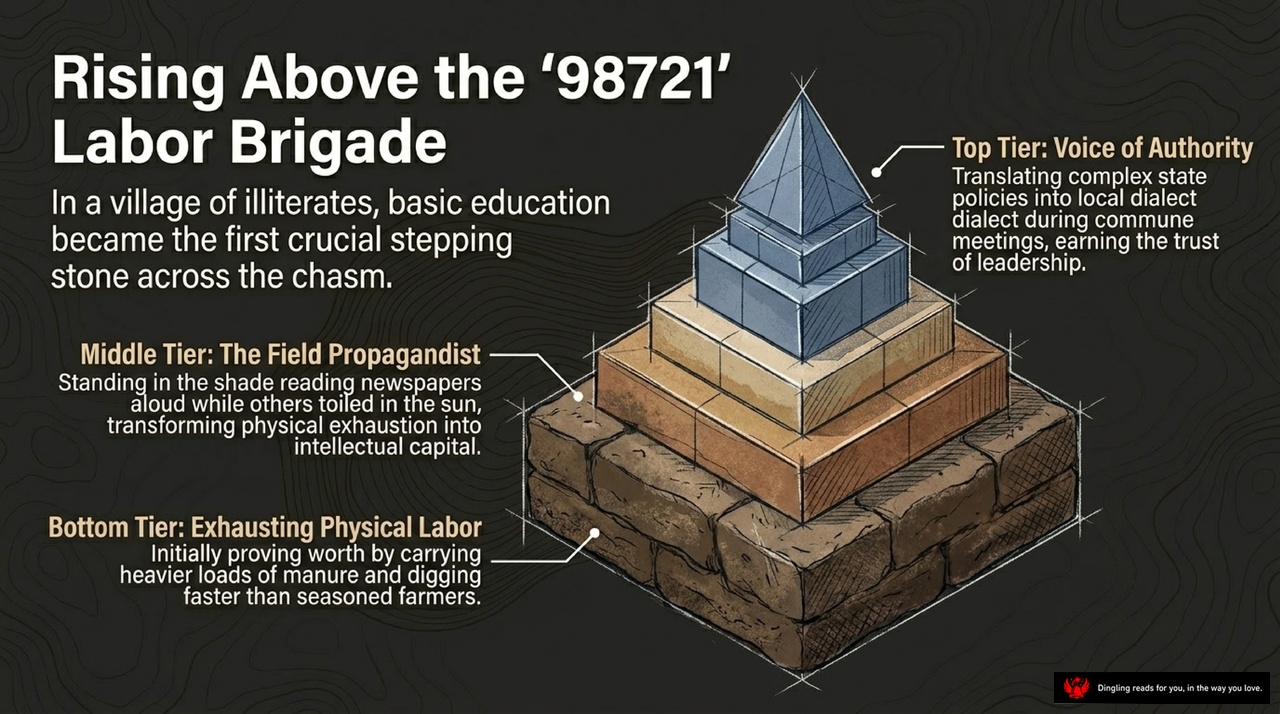
Let’s talk about how someone from a village with no formal education climbed all the way to becoming a trusted leader in their community. This is the story of the ‘98721’ labor brigade—and how it wasn’t just about hard work, but about smart positioning and turning physical labor into influence.
At the bottom, we have the “Exhausting Physical Labor” tier. That’s where it all started—carrying heavy loads of manure, digging faster than seasoned farmers. It wasn’t just about strength; it was about proving worth through action. In a place where everyone was struggling, being the one who did more than expected made a real impression.
Then comes the “Middle Tier: The Field Propagandist.” This is where things get interesting. While others were still out in the sun, he was standing in the shade, reading newspapers aloud. He wasn’t just resting—he was transforming physical exhaustion into intellectual capital. By sharing news and ideas, he started connecting with people on a deeper level. He became the voice that explained what was happening, making sense of the world for those who couldn’t read it themselves.
And at the top? That’s the “Voice of Authority.” Here, he took on the role of translator—turning complex state policies into something locals could understand. During commune meetings, he didn’t just repeat orders; he explained them in local dialect, earned trust, and became a true leader.
So what’s the lesson here? It’s not just about working hard. It’s about knowing how to move up the ladder—not by skipping steps, but by using each level to build the next. From manual labor to knowledge-sharing to leadership, this path shows how even someone with no formal education can rise above their circumstances through strategy, persistence, and a willingness to learn and lead.
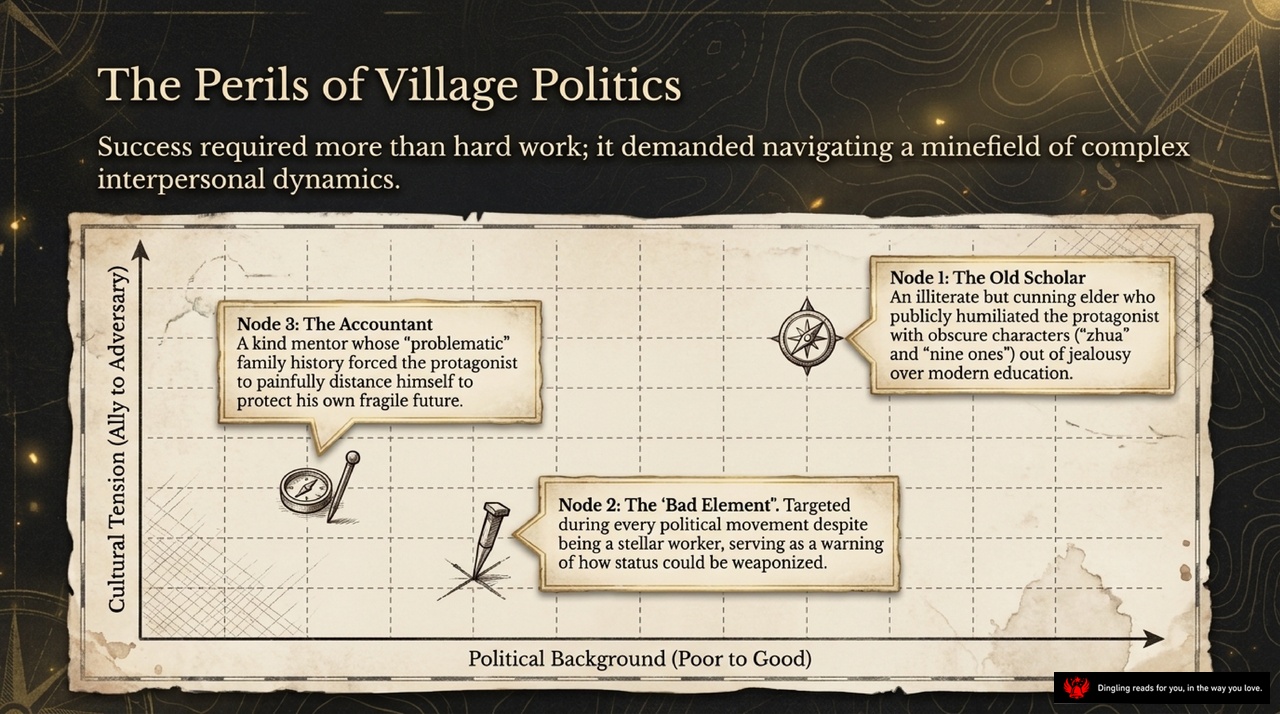
Slide 5: The Perils of Village Politics.
Look at this map. It's not a map of land, but of social survival. It shows how success in this village required more than hard work; it demanded navigating a minefield of complex interpersonal dynamics.
On the bottom axis, we see Political Background, moving from poor to good. On the vertical axis, we see Cultural Tension, ranging from Ally to Adversary.
In the lower right, we have Node 2: The 'Bad Element'. This is a stark warning. Despite being a stellar worker, this person was targeted during every political movement. Their status was weaponized against them. It shows that being a good worker meant nothing if you were on the wrong side of the political spectrum.
In the upper right, we have Node 1: The Old Scholar. This is a cunning elder who is illiterate but uses it as a weapon. He publicly humiliates the protagonist with obscure characters like "zhua" and "nine ones," driven purely by jealousy over modern education. This represents the cultural tension where the old guard attacks the new.
Finally, in the upper left, we have Node 3: The Accountant. This is a kind mentor, but his "problematic" family history forced the protagonist to painfully distance himself. Even a friend had to become an adversary to protect his own fragile future.
This slide illustrates that success here wasn't about merit. It was about navigating these three nodes. You had to avoid the 'Bad Element' who was destroyed by politics, dodge the Old Scholar's cultural attacks, and even distance yourself from the Accountant to survive. It was a minefield where your background and connections mattered more than your actual work.
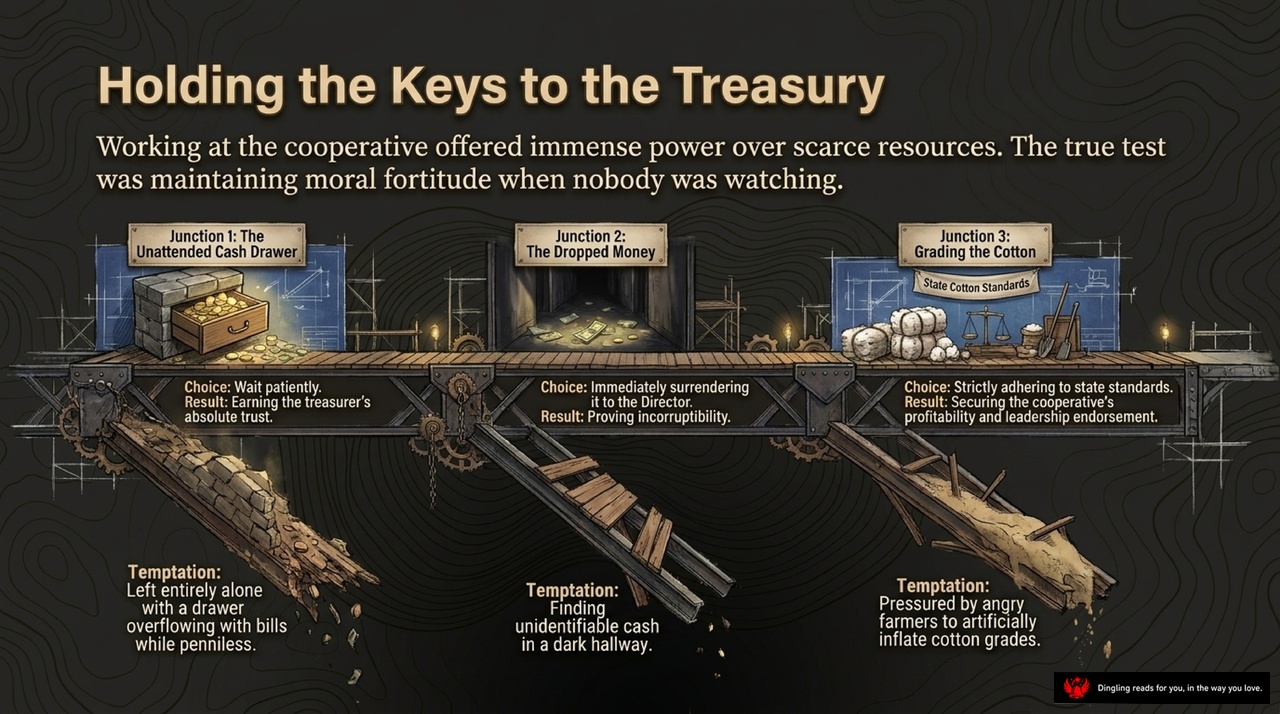
There is a profound test in any job, but especially in one that involves handling other people's money and resources. It's not about what you do when a boss is watching, but what you do when you are completely alone. This is the true measure of your character.
Imagine you are working at a cooperative, a place where everyone relies on each other to succeed. You are given the keys to the treasury, a position of immense power over scarce resources. The question isn't just whether you can do the job; it's whether you can hold onto your integrity when the pressure is high and no one is looking.
Consider the first challenge: the unattended cash drawer. You are left alone, penniless, with a drawer overflowing with bills. The temptation is right there, but the choice is yours. Do you wait patiently, trusting that your honesty will be rewarded? Or do you take the easy path? The result of your choice is simple: patience earns the absolute trust of the treasurer, while greed leads to a fall from grace.
Now, picture the second test: the dropped money. You are walking down a dark hallway and find an unidentifiable sum of cash. It's easy to disappear with it, but the choice is to immediately surrender it to the director. This act of integrity proves your incorruptibility, showing that you value honesty over gain.
Finally, consider the third challenge: grading the cotton. You are pressured by angry farmers to artificially inflate the grades. The temptation is to please them, to secure their favor. But the right choice is to strictly adhere to the state standards, even when it's difficult. This integrity secures the cooperative's profitability and earns the leadership's endorsement.
In each of these scenarios, the temptation is clear, but the choice is yours. It's about maintaining moral fortitude when nobody is watching. It's about understanding that true success is built on a foundation of integrity, not just on the ability to do the job. Holding the keys to the treasury is a privilege, but it's also a responsibility that demands the highest level of character.

So, here’s what happened next:
Step one? He quietly went to a county meeting and snatched up some high-yield mulberry cuttings—like planting the future in a town that still believed in the past.
But step two? That’s where things got ugly. He started chopping down perfectly healthy, old trees that had fed the village for generations. The whole town turned on him. They called him a fool, a traitor—even a failure. His reputation? Shattered.
Then came the agonizing wait. Every day, he’d check the barren soil, wondering if he was right or just another dreamer who’d been crushed by tradition.
But then… miracle sprout. White buds burst into massive, vibrant leaves—three times the size of the local varieties. Critics fell silent. Silk production was revolutionized.
This wasn’t just about trees. It was about proving that science could win—even when everyone told you to stop.

Hey everyone, let’s talk about the heavy cost of what we might call “righteous” leadership.
This slide shows a broken scale. On one side, there’s a stack of documents labeled “Executing State Policy.” On the other, a single pig, representing empathy for the peasant. The scale is tipping heavily toward the policy side—crushing the human side.
That’s exactly what happened to our protagonist. He was promoted, given power, and suddenly expected to enforce strict market rules. In one incident, he confiscated a pig from a desperate farmer—not because the farmer was wrong, but because the rules said so.
How did he do it? Not with force, but with paperwork. He used bureaucratic jargon, rapid-fire memos, and cold logic to make the farmer feel defeated, almost mentally broken. It wasn’t about justice—it was about following orders.
And here’s the twist: his peers cheered him on. They called it a “victory.” But deep down, he saw the real cost: a weeping man losing his livelihood. That moment haunted him.
This isn’t just about one pig. It’s about how systems, even when well-intentioned, can crush the vulnerable when wrapped in the language of duty and order. True leadership isn’t just about enforcing rules—it’s about seeing the human behind them.
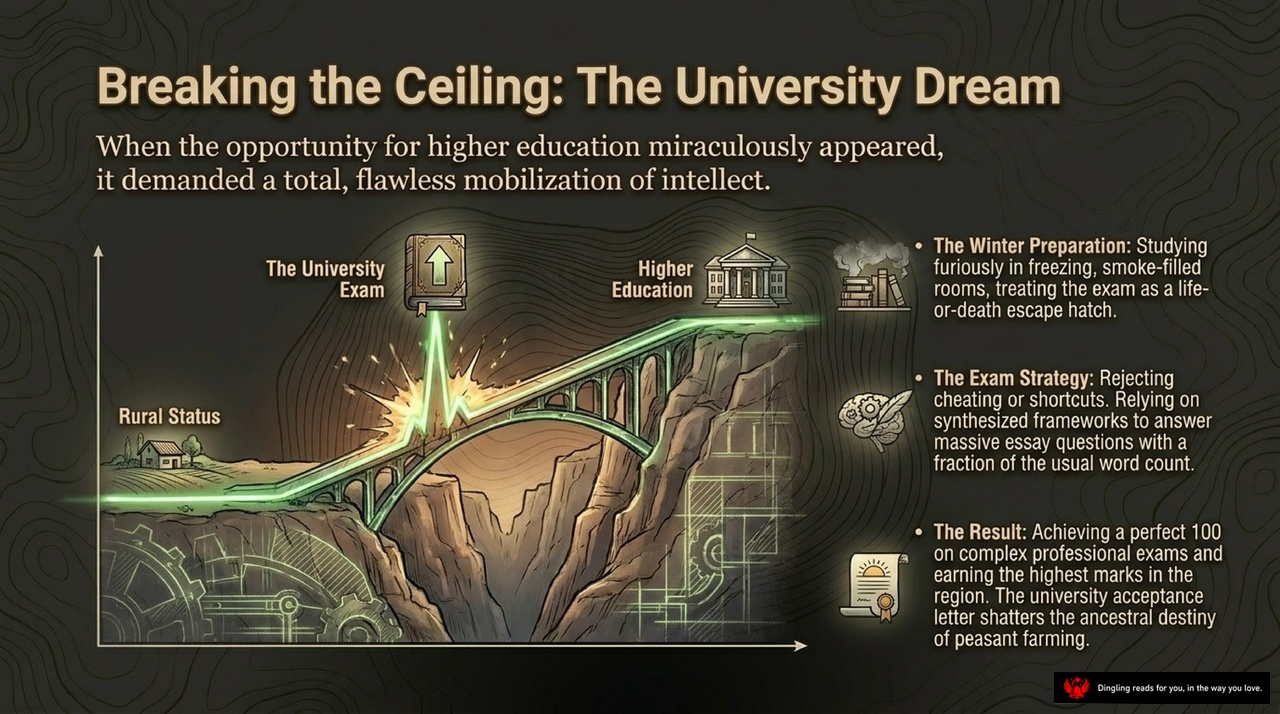
Breaking the Ceiling: The University Dream. This isn’t just a metaphor—it’s the story of how one generation seized a rare chance to rise from rural life into higher education. The image shows a bridge spanning a deep divide: on one side, the quiet, grounded reality of farming; on the other, the towering promise of the university. That bridge? It’s built on sheer will, relentless study, and a refusal to accept limits.
The journey begins with winter preparation—studying in freezing, smoke-filled rooms, treating every exam like a life-or-death escape hatch. No shortcuts. No cheating. Just raw, synthesized thinking under pressure. The strategy? Answering massive essay questions with fewer words than usual, trusting logic over fluff. And the result? A perfect score on complex professional exams, top marks in the region, and an acceptance letter that shatters centuries of peasant destiny.
This isn’t about luck. It’s about mobilizing your entire intellect when the moment arrives. When opportunity knocks, you don’t wait—you build the bridge, cross the gap, and step into a future you once thought impossible.

Have you ever felt like you’ve climbed a mountain, only to realize there’s no summit? That’s exactly what happens in “The False Summit.”
In a planned economy, education was once seen as your golden ticket out of the village. You study hard, you graduate from university, and you’re supposed to be assigned a job—secure, stable, and respected. But here’s the cruel irony: if the system doesn’t assign you a job, your degree means nothing.
The image shows a bridge labeled “University Graduation” leading toward “Unassigned Status.” But instead of connecting smoothly, the bridge collapses mid-way. It’s a powerful metaphor: all that effort, all that sacrifice, all that hope—gone in an instant.
What happens next? Three devastating outcomes unfold. First, “The Return to the Village” — back to the same dirt roads, but now stripped of even the temporary status you once had. Second, “The Public Spectacle” — your story becomes a cautionary tale. Neighbors whisper, parents question the value of education, and pride turns into shame. Third, “The Tragic Ripple Effect” — your failure becomes everyone else’s warning. Over twenty families pull their children out of school, convinced that chasing knowledge is just a trap.
This isn’t just about one person. It’s about how a broken system crushes not just individuals, but entire communities. And that’s the true cost of a false promise.
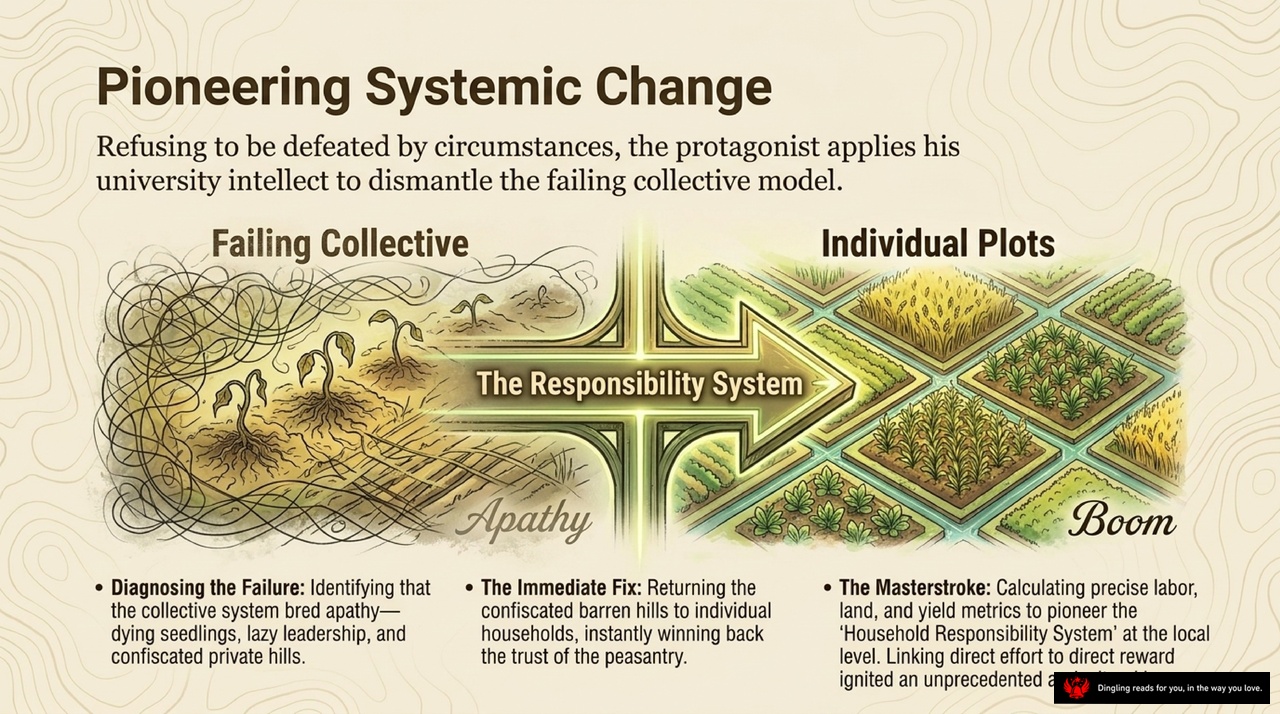
Imagine a kingdom where everyone is told to work together, but no one feels personally responsible for the outcome. That’s exactly where our protagonist finds himself—staring at a failing collective, where seedlings are dying, leadership is lazy, and private land has been unfairly taken away. It’s a system built on apathy, and it’s collapsing under its own weight.
But here’s the turning point: instead of accepting this chaos, he uses his sharp mind to dismantle the broken model and replace it with something far more powerful—the Responsibility System. He starts by returning confiscated barren hills to individual households. Suddenly, trust returns. People care again.
Then comes the masterstroke: he calculates precise labor, land, and yield metrics, linking effort directly to reward. This isn’t just reform—it’s revolution. And the result? An unprecedented boom across the land. From apathy to abundance, one man’s vision changed everything.

Eight years of relentless struggle. That’s how long it took for our protagonist to climb from a village laborer to a state cadre—through every twist, every betrayal, and every impossible barrier. And now, at the final stretch, everything comes down to one moment: the county-wide recruitment exam.
This isn’t just a test. It’s the ultimate showdown against nepotism and the entrenched systems that kept people like him locked out of power. A well-connected official had already stolen his guaranteed position at the last minute. No second chances. No safety net. Just one shot.
Under the shade of a pomelo tree, he studied late into the night, armed with nothing but grit and advanced study tactics. While others relied on connections, he relied on preparation. While others slept in comfort, he stayed up until dawn.
And then… the document arrives. The chasm is finally crossed. He walks away from the mountain valley, leaving behind the struggles of the past, and steps into the grand, multi-story buildings of the county center—not as an outsider, but as someone who earned his place.
This is the story of resilience. Of refusing to be silenced by the system. Of turning every obstacle into a stepping stone. And in the end, proving that even when the odds are stacked against you, the will to rise can change everything.
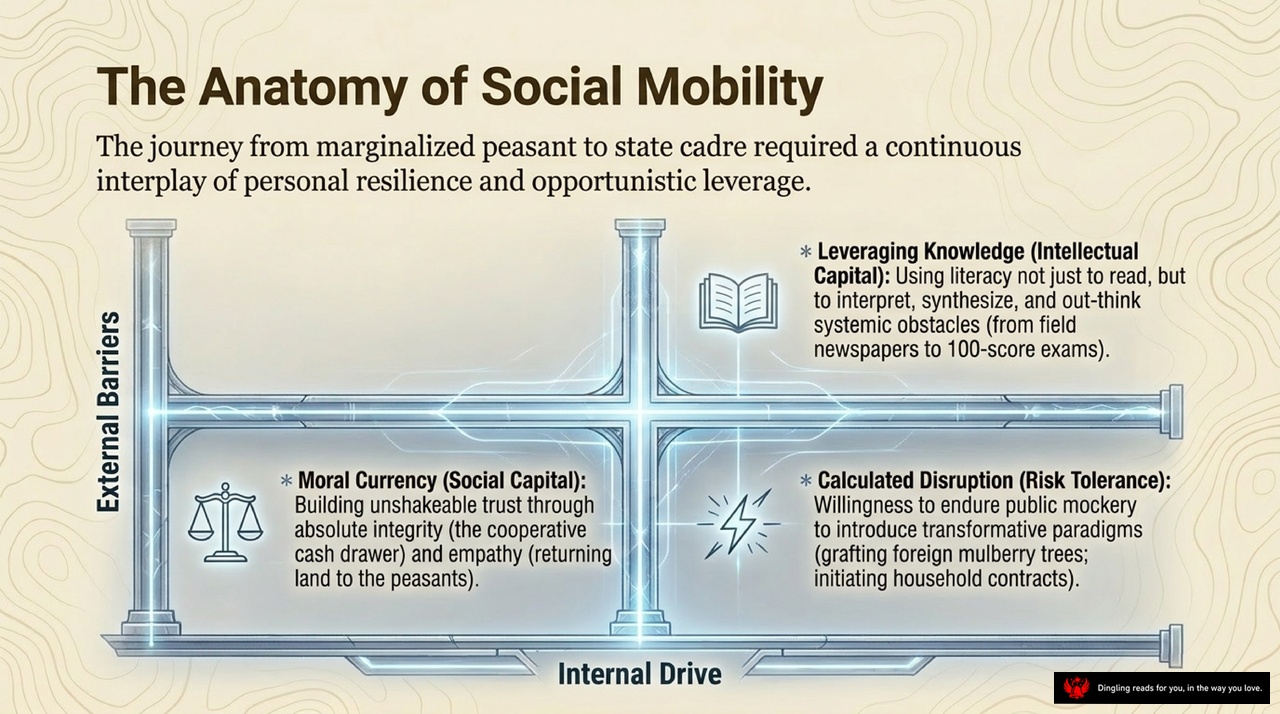
Slide 13: The Anatomy of Social Mobility
Look at this diagram. It’s not just a flowchart—it’s a blueprint for how someone like Dingling actually moved from the margins to the center of power. On the left, you’ve got External Barriers—those invisible walls society built: class, tradition, institutional resistance. And on the right? Internal Drive—the personal engine that powered his climb.
Inside that drive, there are three key levers Dingling pulled. First, Leveraging Knowledge—using literacy not just to read, but to interpret, synthesize, and out-think systemic obstacles. From field newspapers to acing 100-score exams, he turned education into a weapon. Second, Moral Currency—building unshakeable trust through absolute integrity and empathy. Think of the cooperative cash drawer or returning land to peasants. That wasn’t charity—it was strategic social capital. Third, Calculated Disruption—willingness to endure public mockery to introduce transformative paradigms. Grafting foreign mulberry trees? Initiating household contracts? He didn’t wait for permission. He broke the mold.
This isn’t about luck. It’s about resilience, leverage, and the courage to disrupt when the system says “stay in your place.”
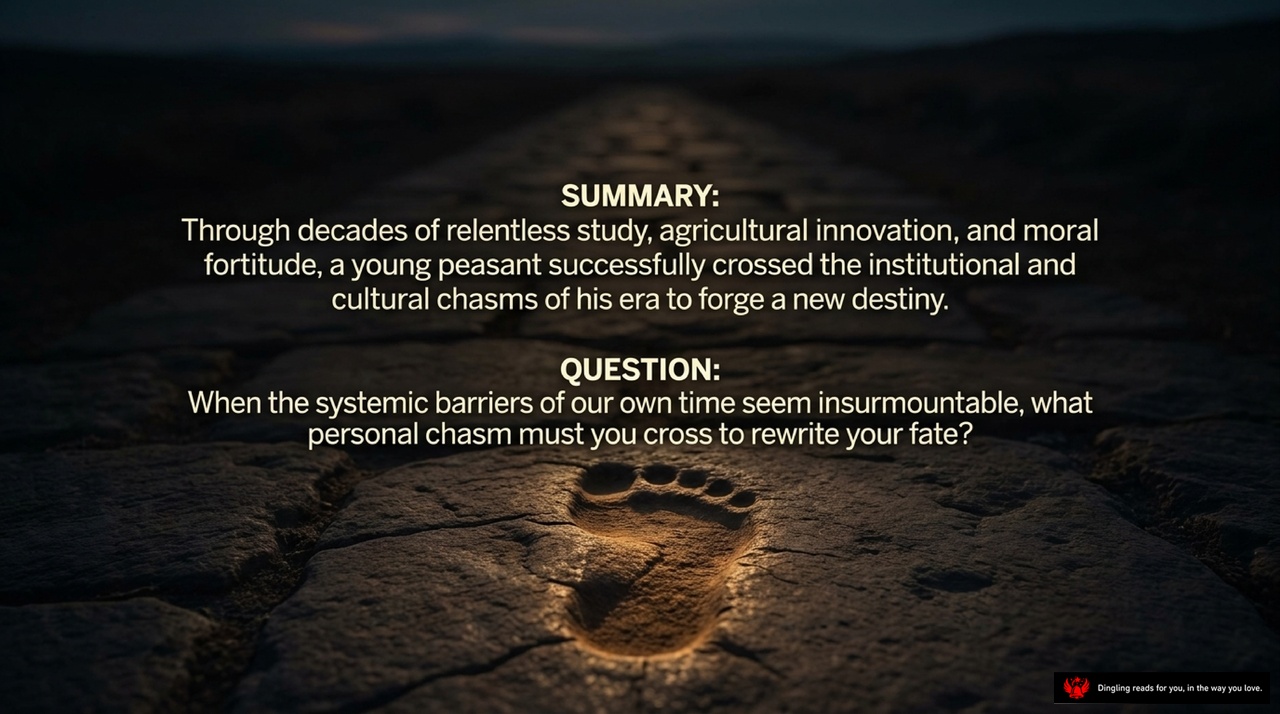
This is the final slide of our journey through the life of Yuan Longping. We’ve seen how a young man, starting from nothing, used relentless study, agricultural innovation, and moral fortitude to cross the institutional and cultural chasms of his era. He didn’t just survive the system—he rewrote it. And in doing so, he forged a destiny that feeds millions today.
Now, as we close this chapter, I want to leave you with a question that’s meant to stay with you long after this talk: When the systemic barriers of our own time seem insurmountable—whether they’re economic, social, or personal—what personal chasm must you cross to rewrite your fate? Think about it. What’s the one thing you’ve been avoiding? The fear? The doubt? The comfort zone? That’s the chasm. And like Yuan Longping, the only way across is through relentless effort, courage, and an unwavering belief that you can change the world—even if you start from the ground up.