
Crossing the Chasm: Complete Chapter-by-Chapter Summary

Welcome to today's session. We are diving into a classic that changed how the world thinks about innovation: *Crossing the Chasm* by Geoffrey A. Moore. As you see on this cover, the book is more than just a title; it's a strategic blueprint for navigating one of the most dangerous transitions in business. It guides disruptive high-tech products from the early adopters to the lucrative mainstream market.
Think of this as the ultimate map for any entrepreneur or product leader trying to scale. The core insight here is that there is a massive gap between the early market and the mass market. Early adopters are tech-savvy and willing to take risks, but the mainstream market is risk-averse and demands reliability. Without a specific strategy to bridge this divide, even the best products can fail spectacularly.
Moore's work provides the exact framework to make that jump. It's about understanding the different buyer personas, the changing product requirements, and the organizational shifts needed to succeed. Whether you are launching a new SaaS platform, a hardware device, or any innovative service, mastering the art of crossing the chasm is the difference between becoming a household name or fading into obscurity. This book is essential reading for anyone serious about turning a great idea into a dominant business.

On this slide, we see a clear divide between two types of innovation: Continuous and Discontinuous. Continuous innovation is the steady, predictable path we all know—like upgrading to a faster PC or using better whitening toothpaste. These changes demand zero shift in consumer behavior; they are easy to market because they fit right into existing habits.
But look at the right side: Discontinuous Innovation. This is where things get disruptive. Think of early electric cars that required entirely new charging stations, or HDTVs that forced us to adopt new broadcast standards. These technologies don't just improve what we have; they force us to abandon old habits and infrastructure. That creates extremely high friction. While continuous innovation slides smoothly along the arrow, discontinuous innovation is a jagged climb that demands we change who we are and how we live.
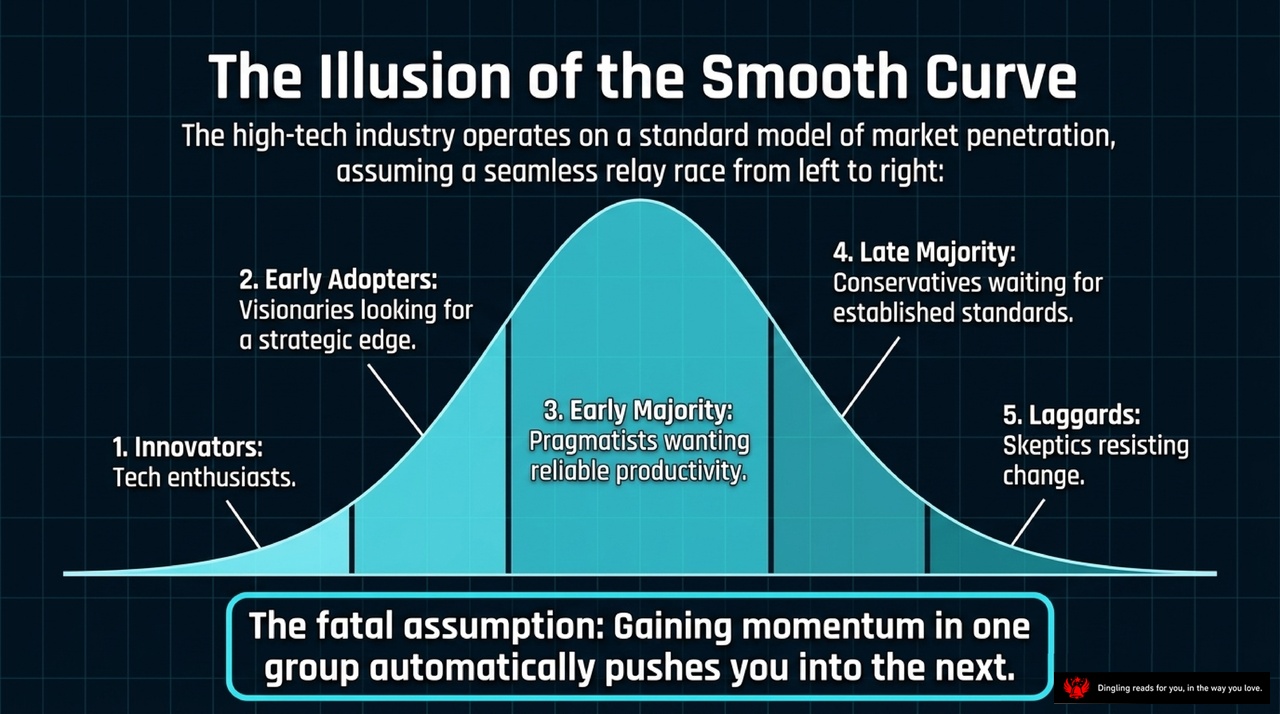
The illusion of the smooth curve suggests that market adoption follows a predictable, seamless relay race: from Innovators to Early Adopters, then Early Majority, Late Majority, and finally Laggards. Many assume that gaining momentum in one group automatically pushes you into the next. But this is a fatal assumption. In reality, the transition isn't automatic. You can stall between groups, or worse, get trapped in a specific segment without ever reaching the mainstream. Just like the narrator's journey from a struggling rural village to a coveted government job, progress wasn't a straight line. He faced rejection, saw opportunities stolen by connections, and struggled with complex social dynamics that no simple chart could predict. Success required navigating these gaps, understanding the real human friction behind the curve, and persisting when the momentum seemed to stop. The smooth curve is a beautiful lie; the real path is messy, unpredictable, and demands resilience.

In the early days of my collective farming life, I found myself surrounded by a tight-knit community, yet a strange sense of loneliness began to settle in. While the political atmosphere was intense and everyone was eager to advance, I realized I desperately needed a space to express my own thoughts—a true "small world" of my own. That need drove me to actively join the Communist Youth League. I wrote my application with care, found mentors among my peers, and worked harder than anyone else, eventually earning that small but precious badge on my chest. It wasn't just an honor; it was a responsibility that pushed me to lead by example.
But soon, a harsh reality check came. One day, while weeding in the fields, a fellow farmer sighed over his dead pig, worried about his livelihood. Instead of offering comfort, I foolishly said, "Just lose it and buy another one later." My father immediately hit me, teaching me a lesson that stuck: "When others suffer, don't just stand there and make snide remarks." I learned that words carry weight, and empathy matters more than being right.
This lesson in human connection led to a life-changing opportunity. The county sent a notice for me to study water conservancy technology—a field I knew nothing about. It was my first time traveling far from home, heading sixty miles to a training camp. I was fascinated by the electricity I had only seen in flashlights, eager to learn from experts who could turn the mountain's rivers into power. It was a rare chance for a rural youth to step out of the shadows, and I knew I had to seize it.
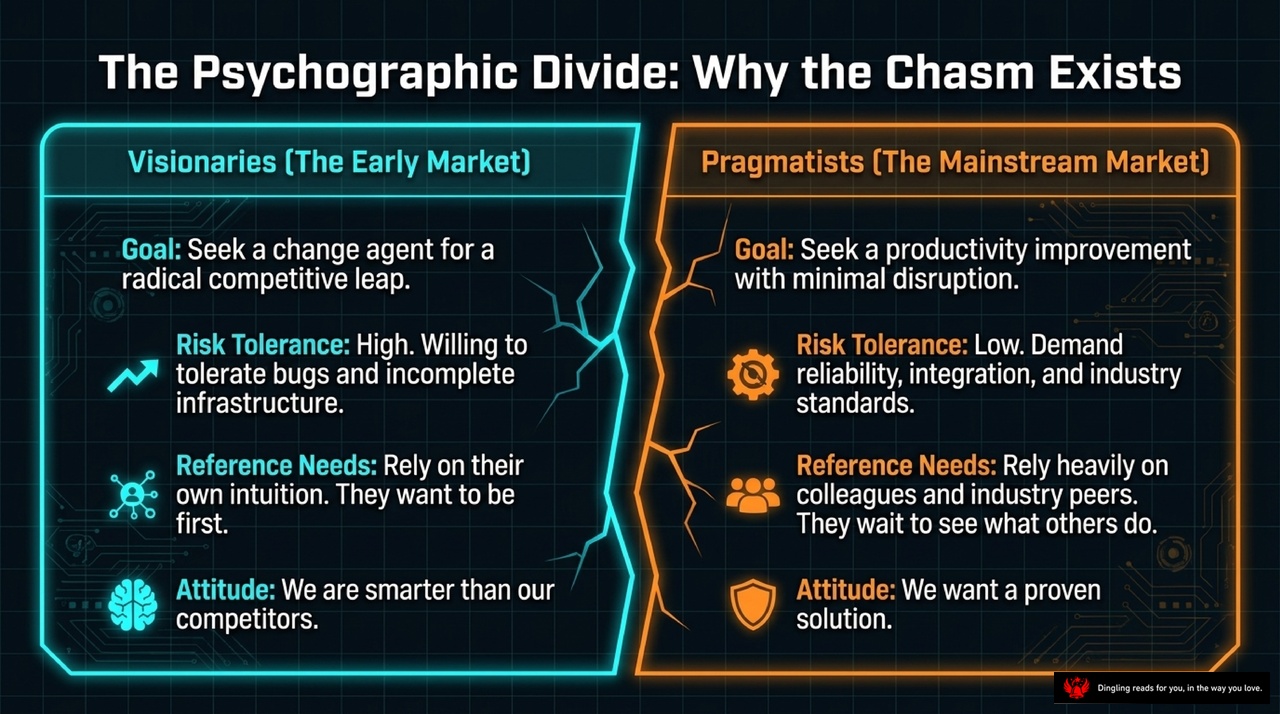
The chasm between early adopters and the mainstream market isn't just about technology; it's a fundamental clash of psychographics. On the left, you have the Visionaries. They are the early market, driven by a desire for radical competitive leaps. They seek change agents, not because they need them, but because they want to be first. Their risk tolerance is incredibly high; they don't mind bugs or incomplete infrastructure. Their attitude is bold and arrogant: "We are smarter than our competitors." They rely on their own intuition, trusting their gut over data or peers.
On the right, you have the Pragmatists, representing the mainstream market. Their goal is completely different: they seek productivity improvements with minimal disruption. They have low risk tolerance; they demand reliability, seamless integration, and established industry standards. They don't trust their own intuition; they rely heavily on colleagues and industry peers, waiting to see what others do before they commit. Their attitude is conservative and pragmatic: "We want a proven solution."
This divide creates the chasm. Visionaries are willing to take risks for potential breakthroughs, while Pragmatists are risk-averse, prioritizing safety and stability. Understanding this difference is crucial because trying to sell to one group using the messaging of the other will always fail.

The mainstream market often traps startups in a vicious cycle known as "Catch-22." As the slide illustrates, this trap begins with a fundamental disconnect: Pragmatists won't invest without references from other trusted Pragmatists, yet startups only have credibility from Visionaries—leaders whom Pragmatists view as reckless and unreliable. This creates an impossible loop where the startup is trapped, unable to use early success to unlock mainstream growth.
On one side, Pragmatists wait for an industry standard to emerge before they commit, while on the other, Visionaries push for innovation without established proof. The result is a deadlock where sales stall, cash flow dwindles, and venture capital burns out. Startups find themselves caught between a rock and a hard place, unable to bridge the gap between radical innovation and conservative trust. To break free, founders must find a way to translate their visionary ideas into language and metrics that Pragmatists can understand and trust, effectively building a bridge where none seemed to exist.

Welcome back. Today, we're diving into the final chapter of our journey: the leap from the village to the university. The slide before you captures the essence of this transition—crossing the chasm. It reminds us that to succeed, you can't try to conquer the entire mainstream market at once; instead, you must execute a highly concentrated invasion. Just like the D-Day strategy, targeting a single, specific beachhead is key.
For the protagonist in our story, that beachhead was knowledge itself. Growing up in a remote mountain village where life was defined by survival and tradition, he harbored a secret dream: to leave the soil and enter the city. The gap between his rural reality and the urban world was a vast abyss. But he refused to stay on the shore. He made a strategic decision to focus all his energy on one target: getting into college.
This wasn't a passive hope; it was a calculated move. He spent his days working in the fields and his nights studying under the dim light of a charcoal fire, treating every minute as a critical investment. He realized that while others were distracted by the immediate struggles of life, he needed to build a "whole product" for his future self—a strong foundation of theoretical knowledge that he could carry into the modern world.
The result was a decisive breakthrough. When the admission results came out, he didn't just get accepted; he excelled. He wasn't just a student; he was a top performer, often scoring perfect marks and earning the highest scores in his class. His success proved that by focusing overwhelming force on a single, highly specific target—his education—he could cross the abyss.
This story teaches us a powerful rule of engagement: don't scatter your efforts. Whether you're launching a product or changing your life, identify your one critical target, assemble your resources around it, and invade that specific territory with total focus. That's how you turn an impossible dream into a reality.
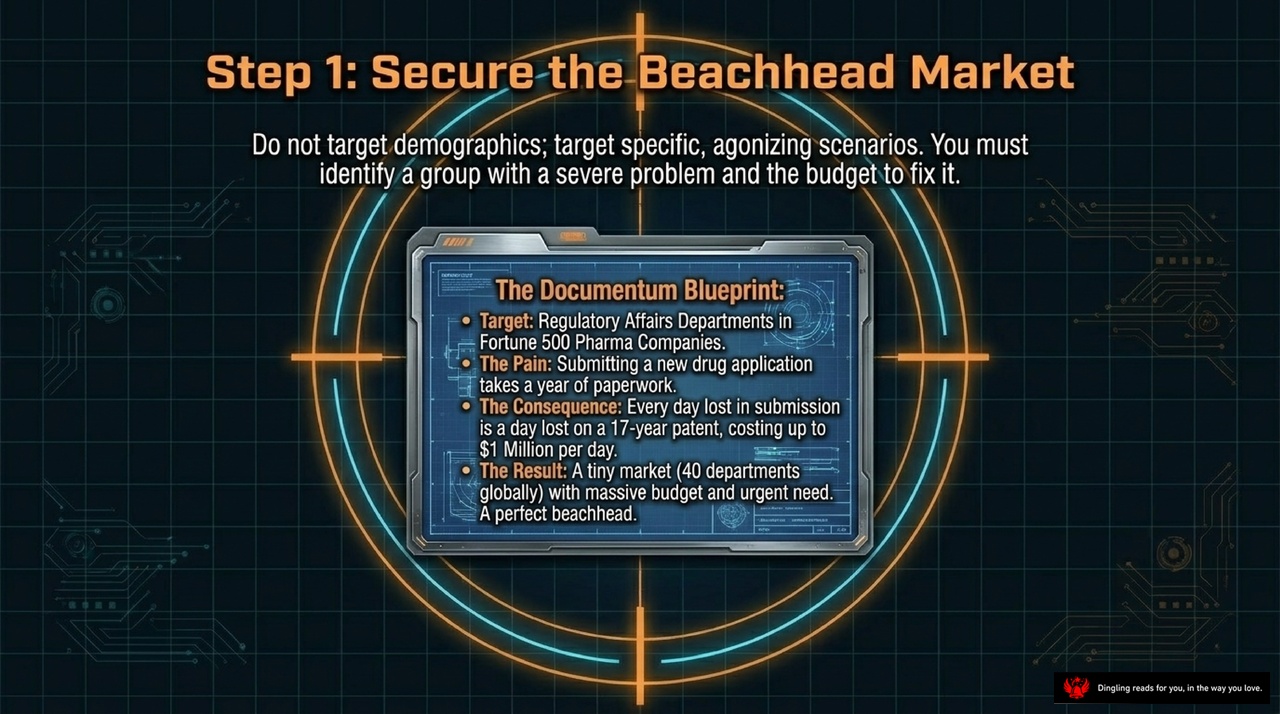
Step 1: Secure the Beachhead Market. The core principle here is simple but powerful: don't target demographics; target agonizing scenarios. You must identify a group with a severe problem and the budget to fix it.
Let's look at "The Documentumum Blueprint" as a concrete example. Instead of casting a wide net, the target was specifically the Regulatory Affairs Departments in Fortune 500 Pharma Companies. Why? Because the pain was acute. Submitting a new drug application takes a year of paperwork, and every day lost in submission is a day lost on a 17-year patent. The consequence is staggering: costing up to $1 Million per day.
This creates a tiny market—only 40 departments globally—but it has a massive budget and an urgent need. That is a perfect beachhead. By focusing on a specific, high-stakes problem rather than a broad demographic, you ensure that your solution isn't just wanted, but desperately needed and fully funded.
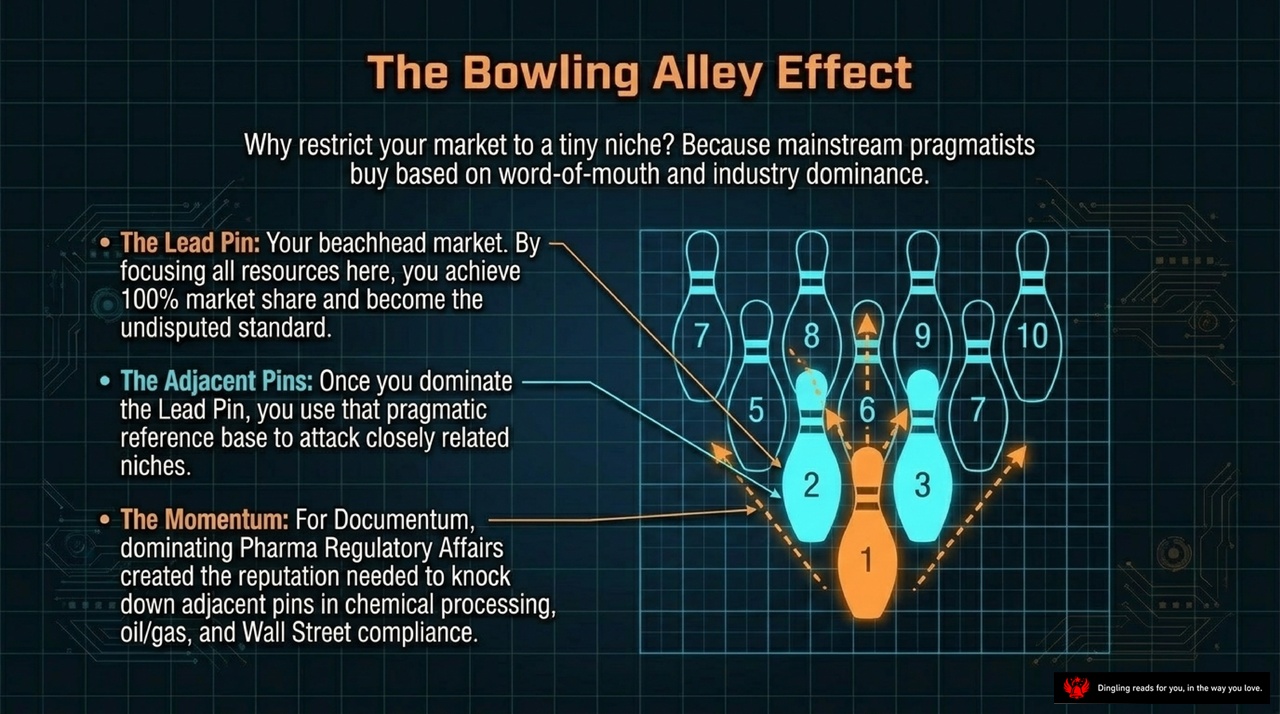
Why settle for a tiny niche when you can dominate the entire field? The "Bowling Alley Effect" teaches us that mainstream pragmatists rely on word-of-mouth and industry dominance, but true growth comes from strategic focus. Think of your market like a bowling lane: you don't try to knock down all the pins at once. Instead, you identify "The Lead Pin"—your beachhead market—and pour all your resources there to achieve 100% market share, becoming the undisputed standard. Once you've mastered that first pin, you use that momentum to attack the "Adjacent Pins," the closely related niches right next to you. As the story of Documentum shows, dominating Pharma Regulatory Affairs created the reputation needed to knock down adjacent pins in chemical processing, oil and gas, and Wall Street compliance. By focusing on one area until you win, you create a chain reaction that clears the entire lane, turning a small start into total industry dominance.
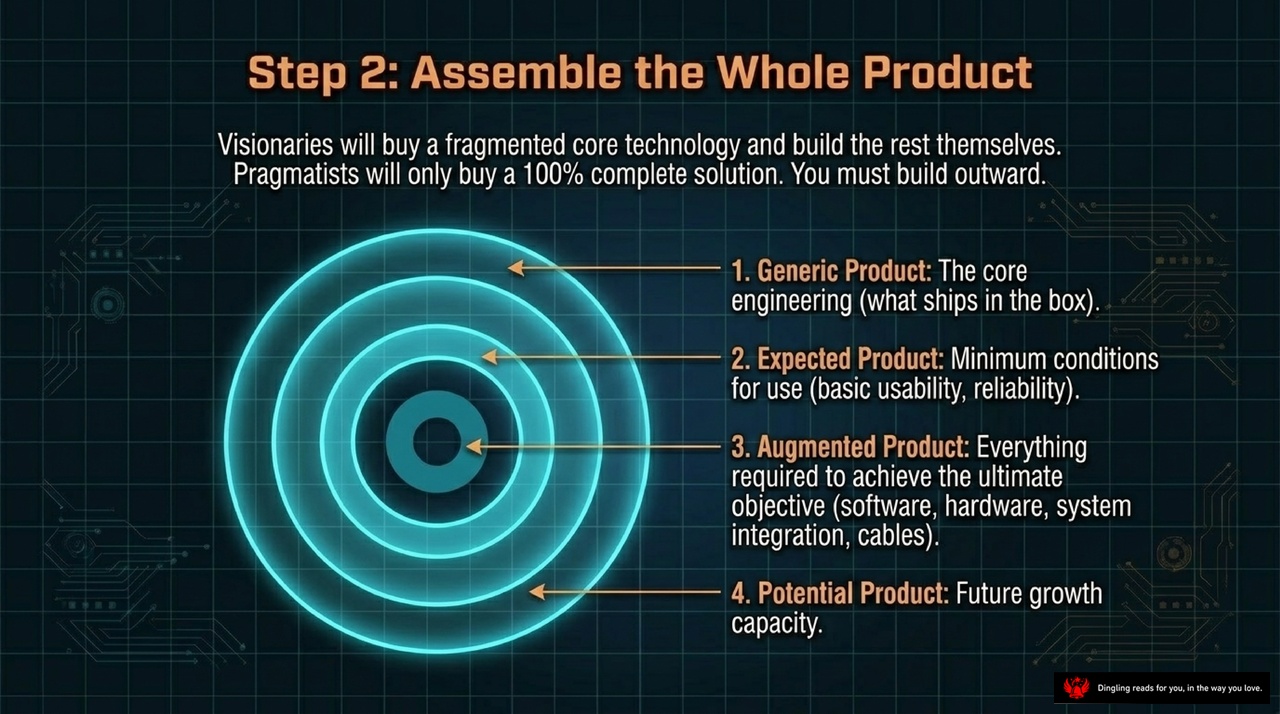
Step 2: Assemble the Whole Product. Imagine your product not as a single item, but as a set of concentric circles expanding outward from the core. At the very center lies the Generic Product—the raw engineering, the bare minimum that actually ships in the box. Moving outward, you hit the Expected Product: the basic usability and reliability that a customer simply assumes will be there. The next ring is the Augmented Product. This is where the magic happens. It includes everything required to achieve the ultimate objective—software, hardware, system integration, and even the cables that connect it all. Finally, the outermost layer is the Potential Product, representing your future growth capacity.
The slide highlights a crucial divide between visionaries and pragmatists. Visionaries buy fragmented core technology and build the rest themselves because they see the potential. Pragmatists, however, only want a 100% complete solution. To succeed, you must build outward. You cannot just sell the core; you must deliver the expected experience, augment it with necessary services and integrations, and finally, sell the promise of future growth. If you stop at the generic product, you've only sold a tool. If you build all four layers, you've created a product that people love and can't live without.
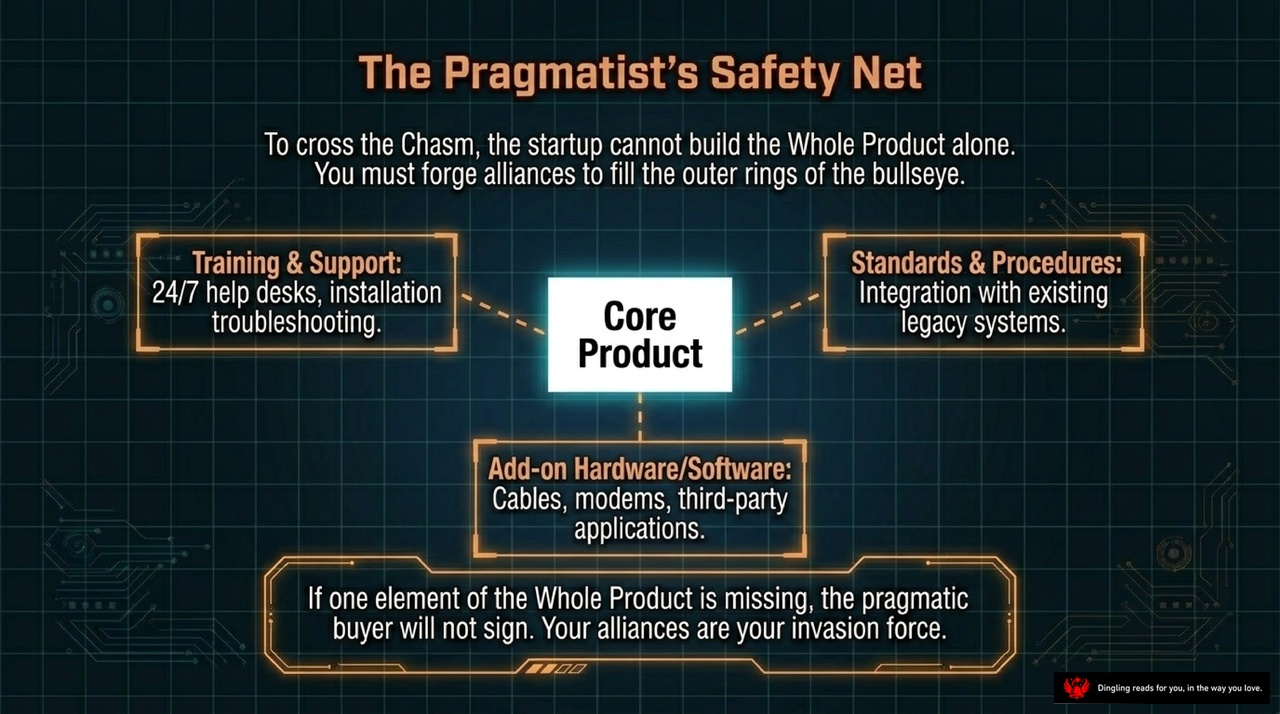
The Pragmatist's Safety Net
Look at this diagram. To cross the chasm, a startup can't build the whole product alone. You must forge alliances to fill the outer rings of the bullseye. At the center sits your Core Product, but it's useless without the surrounding ecosystem. Think of it like this: you need Training & Support, like 24/7 help desks and troubleshooting, so customers don't get stuck. You need Standards & Procedures to integrate with their existing legacy systems, removing friction. And you need Add-on Hardware or Software, like cables or third-party apps, to make the solution complete. If one element of the Whole Product is missing, the pragmatic buyer simply won't sign. Your alliances are your invasion force. Don't just sell a tool; sell a complete, supported, and integrated solution.
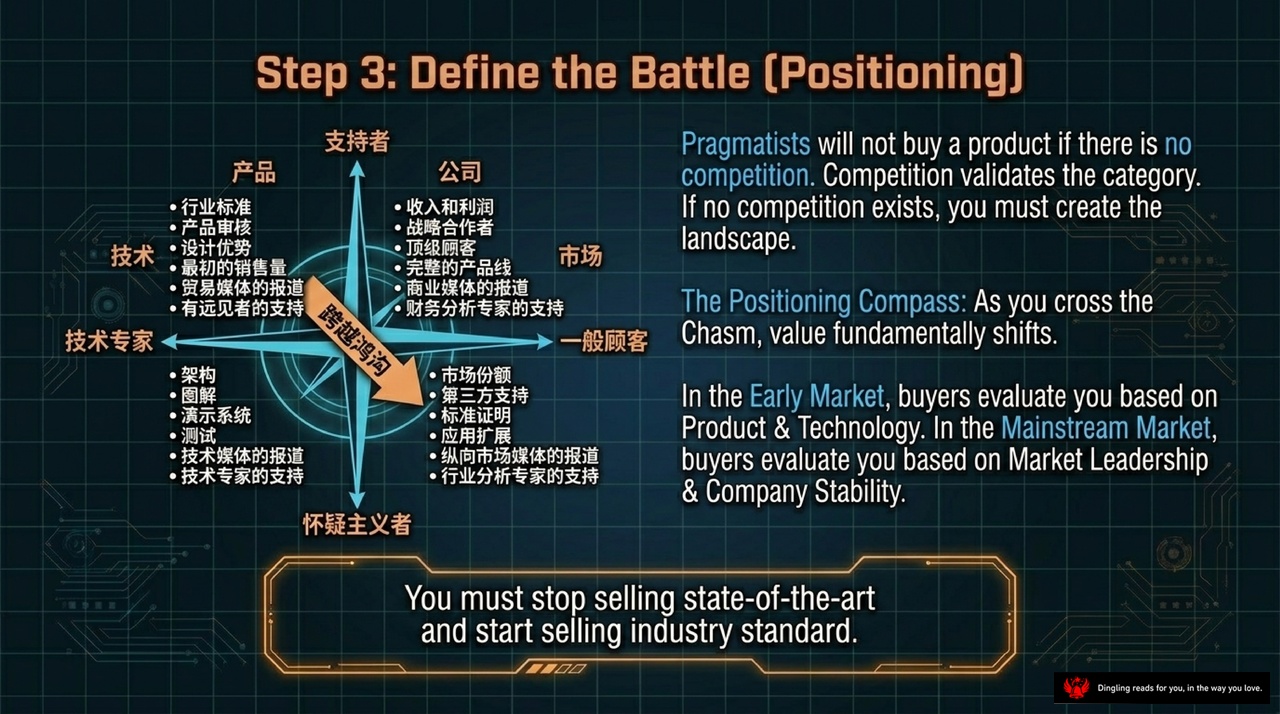
Step 3: Define the Battle. In the early market, you're selling technology and product specs to visionaries who don't care about the competition yet. But as you cross the chasm into the mainstream market, the game changes completely. Buyers stop buying state-of-the-art and start buying industry standards. They need to see market leadership, revenue, and company stability before they take a risk. If you can't show you're the leader, pragmatists simply won't buy. You must stop selling the future and start selling the present.
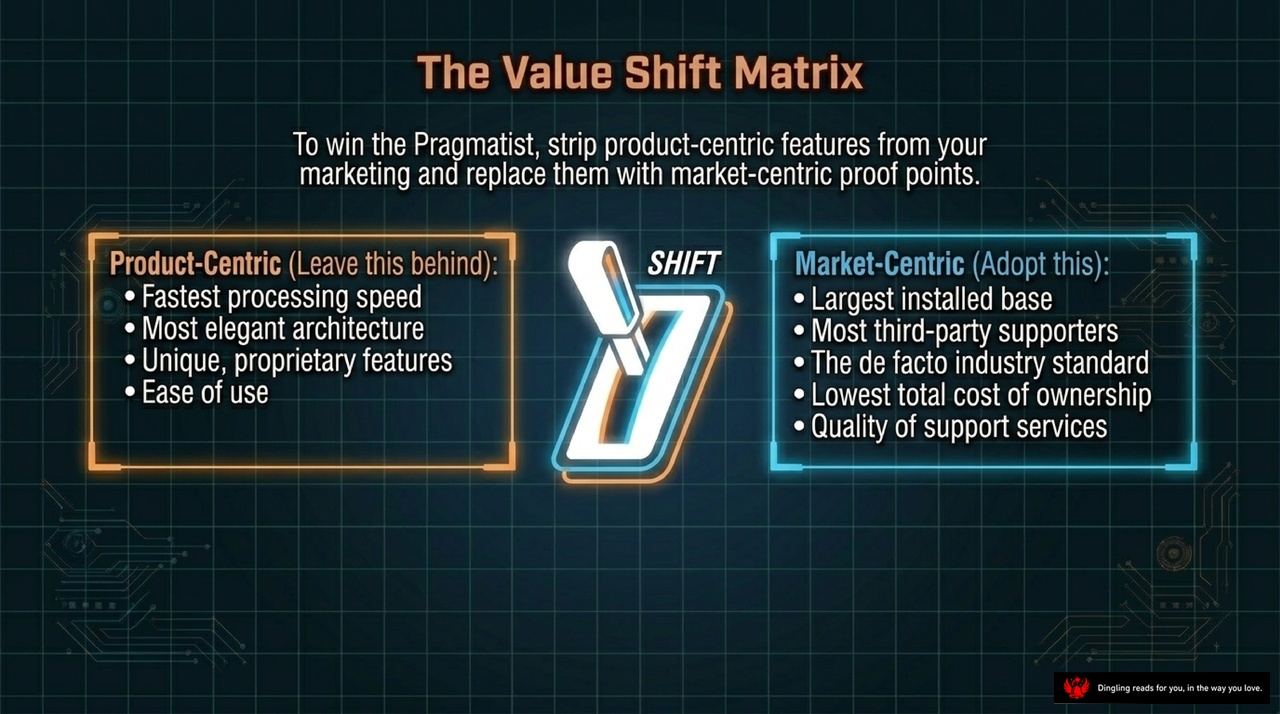
Let's talk about the "Value Shift Matrix." This slide captures a critical lesson for winning over the pragmatic buyer: stop selling features and start proving value.
On the left, we see what to leave behind. These are product-centric attributes like processing speed, elegant architecture, or unique proprietary features. While impressive on paper, they often fail to convince a customer who cares about results, not specs.
The shift is to the right, toward market-centric proof points. Here, the focus moves to tangible business outcomes. Instead of bragging about the fastest processor, you highlight the largest installed base and the most third-party supporters. You aren't just selling a tool; you're selling safety in numbers and industry standards.
This matrix teaches us to replace abstract technical claims with concrete market validation. By prioritizing total cost of ownership and the quality of support services, you align your message with what the customer actually needs to succeed. This isn't just a marketing tweak; it's a fundamental shift from talking about the product to proving its worth in the real world.
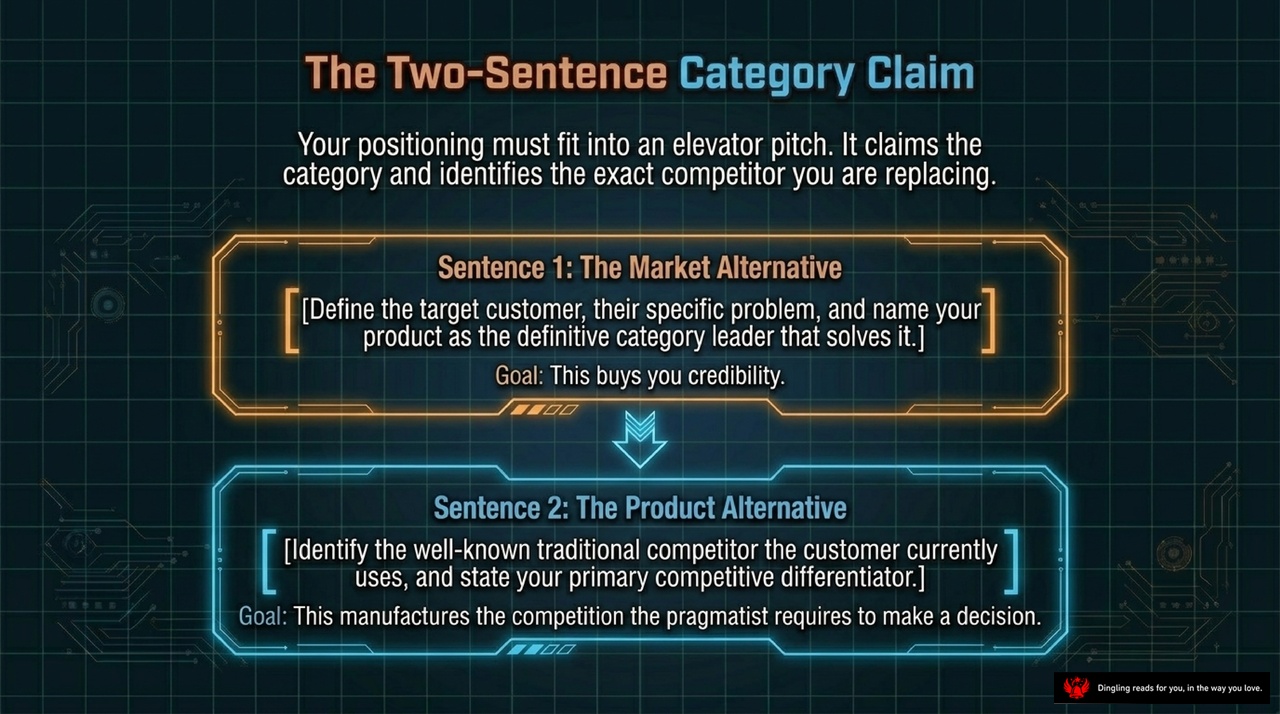
The Two-Sentence Category Claim is your ultimate positioning tool. Think of it as the perfect elevator pitch: a concise statement that instantly tells the market exactly who you are, who you replace, and why you win.
The first sentence defines the Market Alternative. You must clearly identify your target customer, the specific problem they face, and position your product as the definitive category leader that solves it. The goal here is simple but powerful: this buys you immediate credibility. If you can't define the problem and claim leadership in that moment, you haven't earned the right to be heard.
The second sentence introduces the Product Alternative. Here, you identify the well-known traditional competitor the customer currently uses and state your primary competitive differentiator. This is where you manufacture the competition the pragmatist requires to make a decision. You aren't just describing features; you are showing the customer exactly what they are giving up by staying with the status quo and what they gain by switching to you.
When you combine these two sentences, you create an unshakeable position. You stop being a generic option and become the only logical choice for a specific group of people facing a specific problem. This structure forces clarity on both your end and the customer's, turning a complex value proposition into a single, undeniable truth.
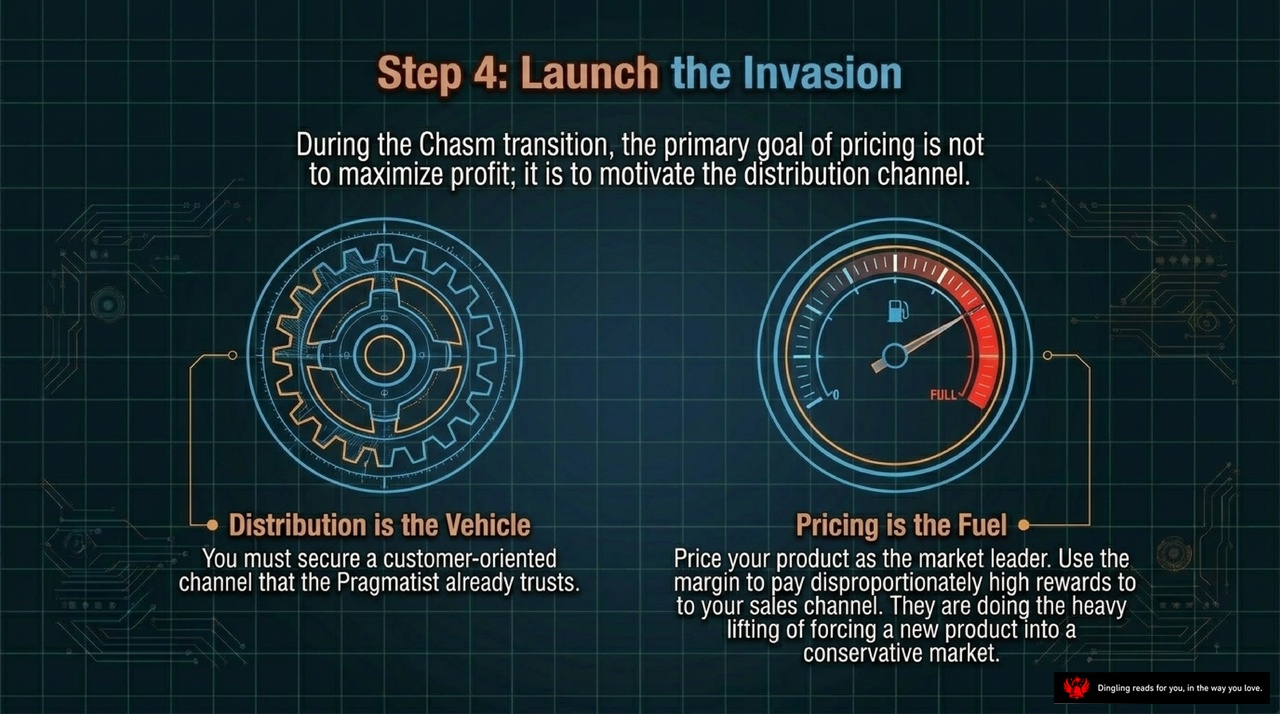
Step 4: Launch the Invasion. Think of your distribution channel as the vehicle and your pricing strategy as the fuel. During this critical transition, your primary goal isn't to maximize profit; it's to motivate your sales channel. You must secure a customer-oriented channel that your pragmatist customers already trust. But here's the key: price your product as the market leader. Why? Because you need to use those margins to pay disproportionately high rewards to your sales team. They are doing the heavy lifting of forcing a new product into a conservative market. Don't skimp on their incentives. If you want them to push your product hard, you have to fuel their engine generously. This is how you turn a hesitant market into a launching pad.
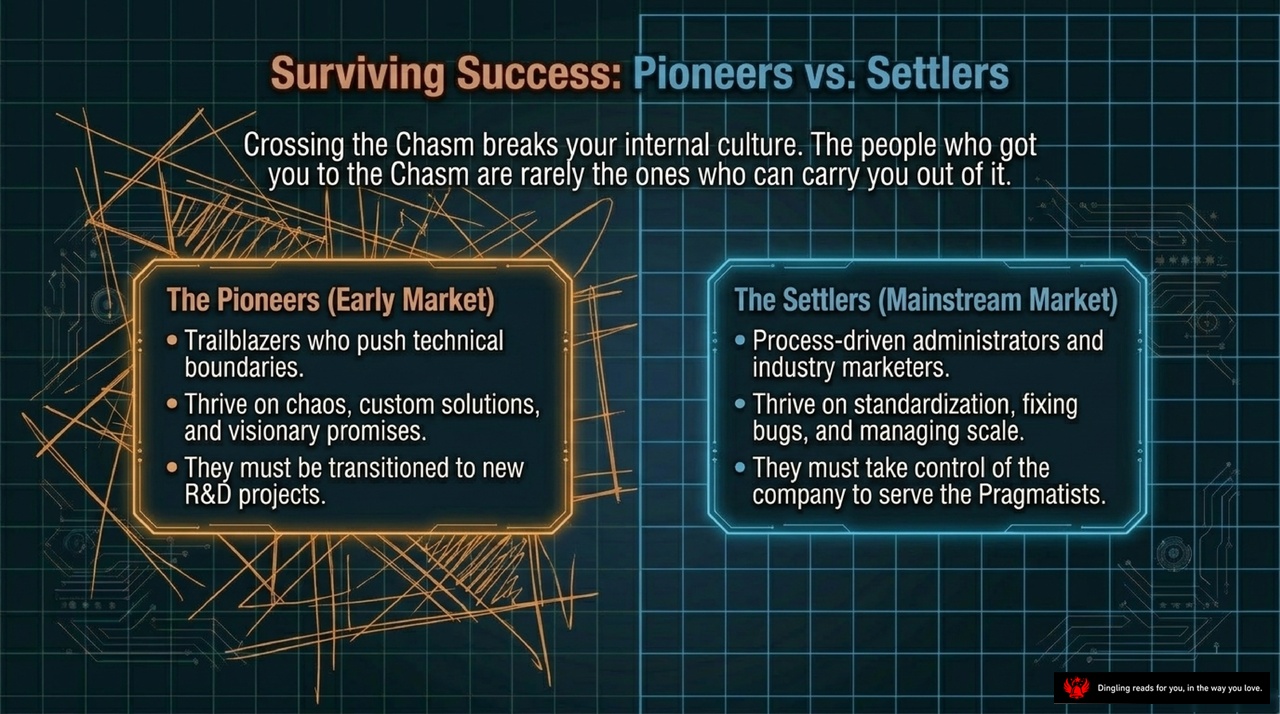
Surviving Success: Pioneers vs. Settlers. When your company crosses the chasm, it doesn't just change your customers—it shatters your internal culture. The very people who drove you to the edge of the mainstream are rarely the ones who can pull you back across to safety.
On the left, we have the Pioneers, the Early Market. These are the trailblazers who pushed technical boundaries, thriving on chaos, custom solutions, and visionary promises. They built the foundation, but once the market matures, they must transition to new R&D projects to stay relevant.
On the right, we have the Settlers, the Mainstream Market. These are process-driven administrators and industry marketers who thrive on standardization, fixing bugs, and managing scale. To survive, the pioneers must hand over the reins to these pragmatists who can take control and serve the growing customer base.
The lesson is clear: success in the early days is a trap for the late game. You need a different mindset, a different team, and a completely different strategy to move from being a pioneer to becoming a settler.
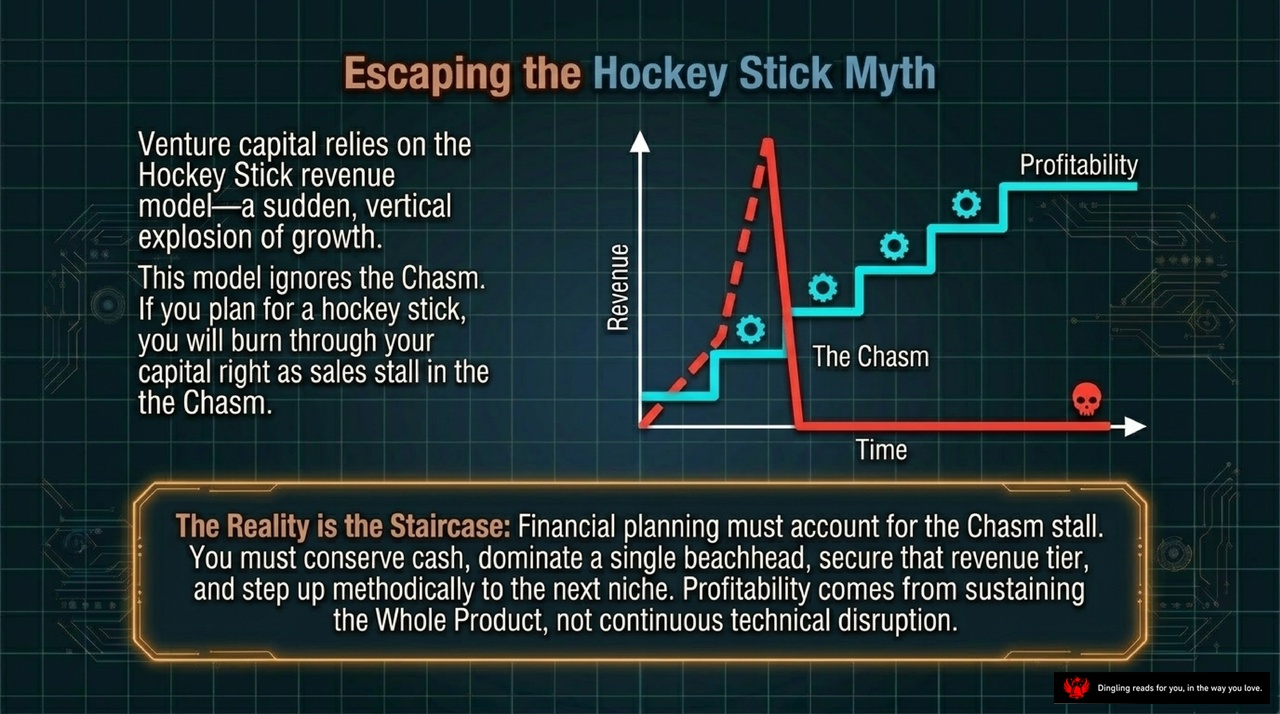
Escaping the Hockey Stick Myth
Look at this graph. On the left, you see the "Hockey Stick" model that venture capital loves—a sudden, vertical explosion of growth. But here's the trap: this model ignores "The Chasm." If you plan for a hockey stick, you'll burn through your capital right as sales stall in that gap, leading to failure.
The reality, as shown on the right, is the Staircase. Financial planning must account for the Chasm stall. You can't just jump; you must conserve cash, dominate a single beachhead, secure that revenue tier, and step up methodically to the next niche. Profitability comes from sustaining the Whole Product, not relying on continuous technical disruption. This staircase approach is the only way to survive and thrive.
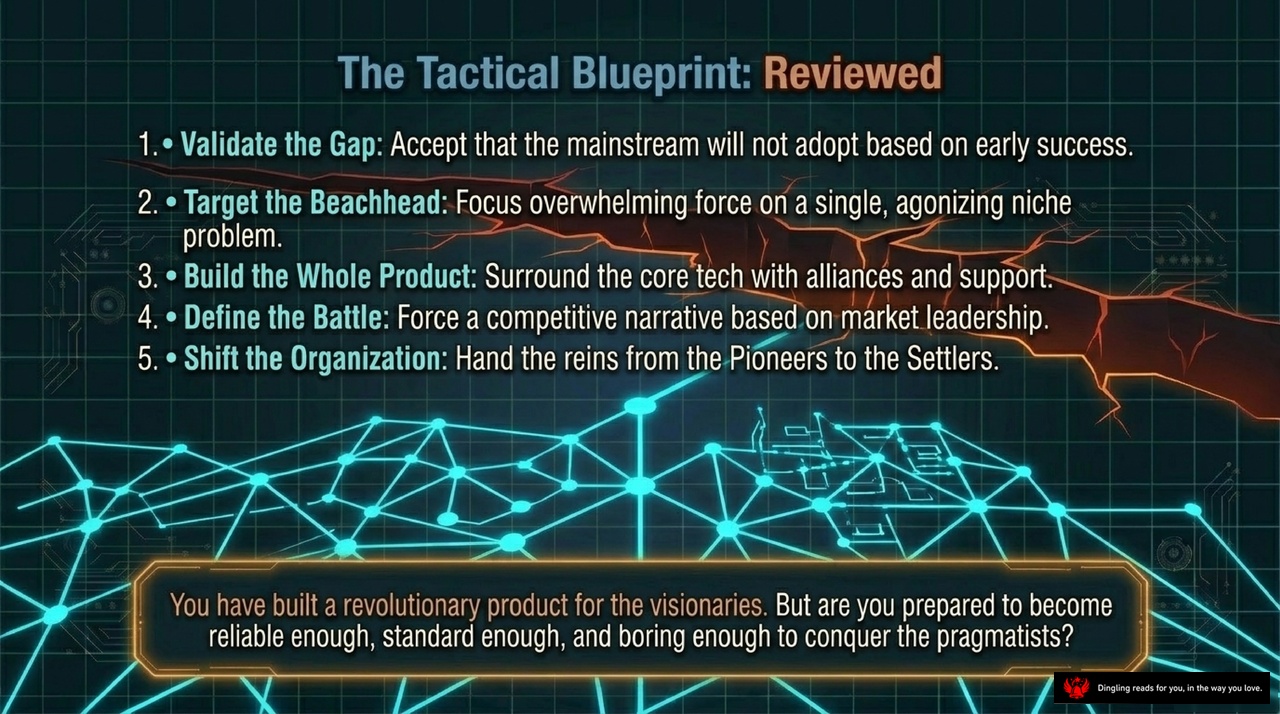
Look at this blueprint we've reviewed: validating the gap, targeting a beachhead, building the whole product, defining the battle, and shifting the organization. This isn't just a list of tactics; it's a hard truth about how revolutions actually win. You see, most startups fail because they try to please everyone too early. The first step is accepting that the mainstream won't care about your early success. You have to be willing to operate in the shadows, away from the noise.
Once you've accepted that isolation, you need to pick your fight. Don't try to solve every problem. Focus your overwhelming force on a single, agonizing niche problem. That's your beachhead. Solve that one thing perfectly, and you build a fortress. But a fortress is useless without allies. That's why you must build the whole product by surrounding your core tech with partnerships and support. You can't do it alone.
Then, you have to force a narrative. Stop waiting for people to understand your value; define the battle yourself based on market leadership. Make them see the competition in a way that favors you. Finally, the hardest shift: move the reins from the pioneers who built the dream to the settlers who will scale it. This is the transition from vision to reality.
So here is the ultimate question staring us all in the face: You have built a revolutionary product for the visionaries. But are you prepared to become reliable enough, standard enough, and boring enough to conquer the pragmatists? Because that's where the real world lives.