
Cybernetics: Complete Chapter-by-Chapter Summary
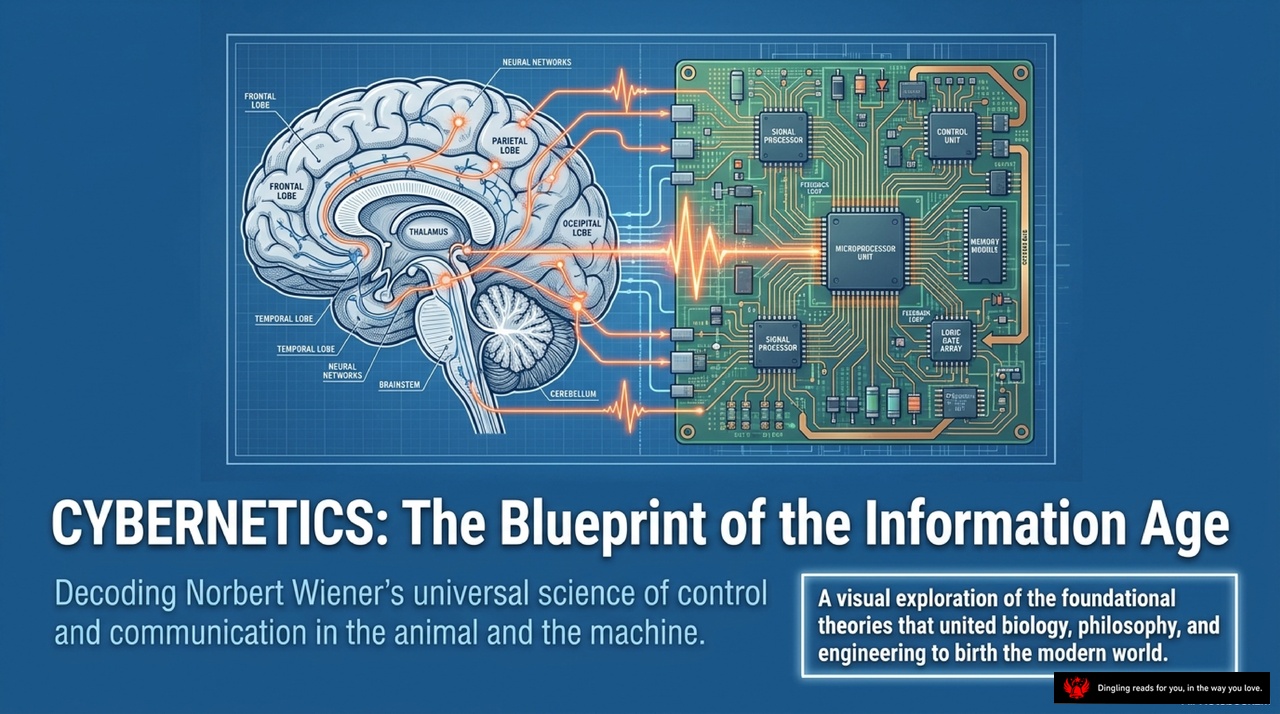
Welcome to the beginning of our journey into the mind and the machine. Today, we're decoding the blueprint of the Information Age: Cybernetics.
Look at this image. On the left, you see the human brain, with its frontal, parietal, and temporal lobes working in concert. On the right, you see a complex circuit board with microprocessors and signal processors. The glowing lines connecting them represent a profound truth: there is no fundamental difference between how a living organism thinks and how a machine calculates.
This is the core idea of Cybernetics, a term coined by Norbert Wiener. It comes from the Greek word for "steersman," honoring the ancient art of steering a ship using feedback. Wiener realized that whether it's a biological nervous system or an engineered control loop, the underlying principles of communication and control are identical.
In the 1940s, Wiener and his colleagues proved that the same logic used to aim anti-aircraft guns could explain how the human brain processes information. They showed that life, in a sense, is a machine that fights against disorder. By understanding these universal laws of feedback and information, we unlocked the future. From artificial intelligence to modern robotics, the vision born in this blue era continues to shape our world today.
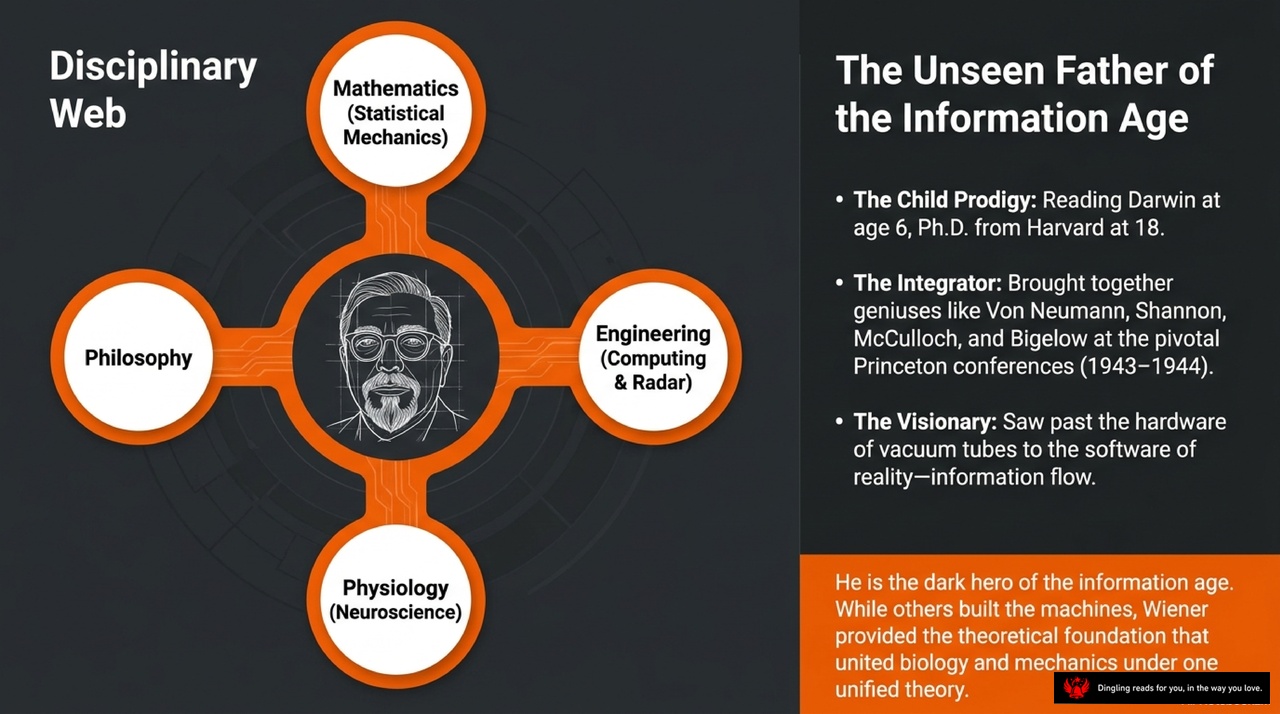
Welcome to the "Disciplinary Web" of Norbert Wiener, the unseen father of the Information Age. Imagine a single mind weaving together the threads of Mathematics, Philosophy, Engineering, and Physiology. That was Wiener's genius. He wasn't just a mathematician; he was an integrator who brought together giants like Von Neumann, Shannon, and McCulloch during pivotal conferences in the 1940s.
Look at the diagram: it shows how Wiener connected statistical mechanics with neuroscience, and radar technology with deep philosophy. He was a true visionary. While others were busy building machines with vacuum tubes, Wiener saw past the hardware to the software of reality itself—the flow of information. He realized that whether it's a machine, a human brain, or even a society, they all operate on the same principles of control and communication.
From being a child prodigy who read Darwin at age six to earning his Ph.D. from Harvard at just 18, Wiener provided the theoretical foundation that united biology and mechanics under one unified theory. He is the dark hero of the information age. While the world built the computers, Wiener gave us the language to understand how they think, how they learn, and how they control the complex systems that define our modern world.
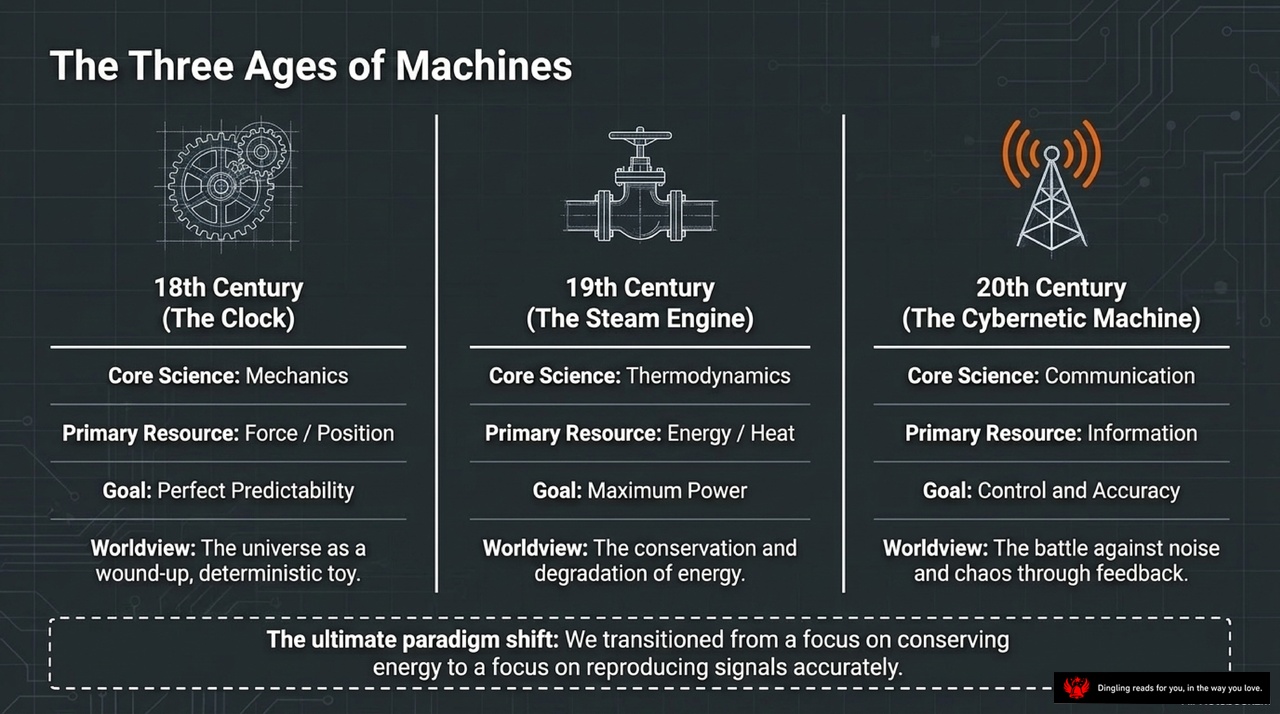
Imagine the universe not as a simple clockwork mechanism, but as a complex system constantly fighting against chaos. This slide outlines the three distinct eras of human engineering, showing how our fundamental goals have shifted over time.
In the 18th century, we were in the Age of the Clock. Our core science was mechanics, and we believed the universe was a predictable, deterministic toy. Our primary resource was force and position, and our goal was perfect predictability. We thought if we knew the starting position, we could know the future with absolute certainty.
Then came the 19th century, the Age of the Steam Engine. Here, thermodynamics took the lead. We realized energy could be conserved but also degraded. Our primary resource shifted to energy and heat, and our goal became maximizing power. We were focused on how to get the most work out of a system, understanding that while total energy stays the same, its usefulness fades over time.
Finally, we are living in the 20th century, the Age of the Cybernetic Machine. This is where things get fascinating. Our core science is now communication, and our primary resource is information, not energy or force. Our goal has changed to control and accuracy. We are no longer just trying to predict a fixed future; we are building systems that can sense disturbances and correct them in real-time.
Look at the worldview shift at the bottom. We moved from seeing the universe as a wound-up toy to understanding it as a battle against noise and chaos. The ultimate paradigm shift here is profound: we transitioned from a focus on conserving energy to a focus on reproducing signals accurately. In a world full of noise, the ability to send a clear message and get a precise response is far more powerful than just having raw power. This is the essence of the cybernetic age—using feedback loops to maintain order in a chaotic world.
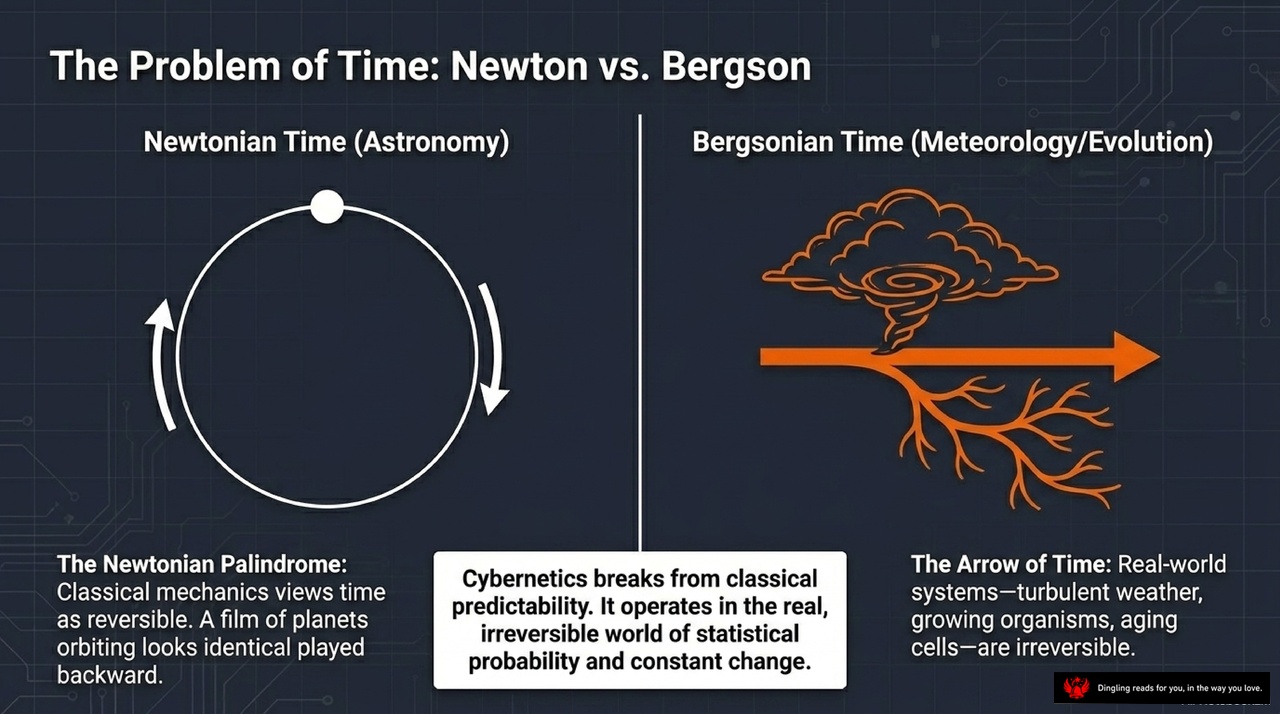
Have you ever wondered why the stars move in perfect loops while the weather seems to spiral out of control? This slide contrasts two fundamental views of time: Newton's and Bergson's.
On the left, we see Newtonian Time, rooted in astronomy. Imagine a planet orbiting a star. If you played a film of this orbit backward, it would look exactly the same. This is what the slide calls the "Newtonian Palindrome." In classical mechanics, time is reversible. The laws of physics work just as well forward as they do backward. It's like a perfect, symmetrical circle where nothing truly changes direction.
Now, look at the right side: Bergsonian Time, which applies to meteorology and evolution. Here, time is an arrow pointing forward. Think of a storm cloud or a growing tree. If you tried to play a video of a hurricane or an aging cell backward, it would look absurd and impossible. The cloud wouldn't un-form, and the tree wouldn't un-grow. This is the "Arrow of Time." Real-world systems like turbulent weather, living organisms, and aging cells are irreversible. They constantly move toward a new state, creating history that cannot be undone.
So, what does this mean for us? Classical mechanics assumes a predictable, reversible universe. But cybernetics breaks from this classical predictability. As the center box highlights, we live in a real, irreversible world of statistical probability and constant change. We don't live in a perfect loop; we live in a branching, evolving system where the past shapes the future, and nothing ever truly repeats itself.

Defining Cybernetics: The Art of the Steersman. Look at this image—it perfectly captures the core idea that steering is never a one-time command, but a continuous, dynamic dance of course-correction based on real-time data from the environment.
This concept comes from the Greek word *Kybernetes*, meaning "steersman" or "helmsman." It was inspired by James Clerk Maxwell's 1868 paper on the mechanical "governor" of a steam engine. Think about it: just like a ship's rudder constantly adjusts to the wind and waves, a control system doesn't just follow orders blindly; it listens to feedback.
As the slide states, cybernetics is the science of control and communication in both animals and machines. Whether it's your brain adjusting your grip on a coffee cup or a computer filtering noise from a signal, the principle is the same. We are constantly receiving information, processing it, and making tiny corrections to stay on course. It's the universal language of how systems—living or artificial—learn to adapt and survive in a changing world.

Welcome to the final chapter of our journey into Cybernetics. Today, we're moving beyond the classic feedback loops we've discussed and diving into the future: self-organizing systems and the potential for machines to truly learn.
Look at the diagram. On the left, we have the concept of a "Learning Machine." This isn't just about following pre-programmed rules. Think of a chess-playing computer. Early versions played the same game every time because they followed a fixed set of instructions. But a true learning machine, like the one Samuel and Watkins built, actually plays, loses, analyzes its mistakes, and then adjusts its own internal strategy. It's a direct simulation of how humans and animals learn from experience. It takes the "feedback" we talked about earlier and turns it into a tool for evolution.
On the right side of the screen, we see the concept of "Self-Reproducing Machines" and "Self-Organization." This is where things get fascinating. For a long time, we thought reproduction was the exclusive domain of life. But Norbert Wiener and John von Neumann proved mathematically that a machine could be designed to build a copy of itself. How? By using non-linear transformers. Unlike linear systems where the output is just a simple multiple of the input, non-linear systems can create complex, new patterns from their interactions.
This leads us to the idea of self-organization. Look at the brain waves shown in the lower section. They aren't chaotic noise; they exhibit a phenomenon called "frequency locking." Imagine thousands of tiny oscillators in your brain, all vibrating at slightly different speeds. Through non-linear interaction, they naturally synchronize into a unified rhythm, like a choir finding the same pitch without a conductor. This same principle applies to fireflies flashing in unison or even viruses reproducing.
The big takeaway here is profound: order doesn't always need a central commander telling every part what to do. Through non-linear interactions and feedback, complex systems can spontaneously generate their own structure. This shifts our view from machines as passive tools to potential partners in discovery—systems that can learn, adapt, and even organize themselves, blurring the line between the biological and the mechanical.
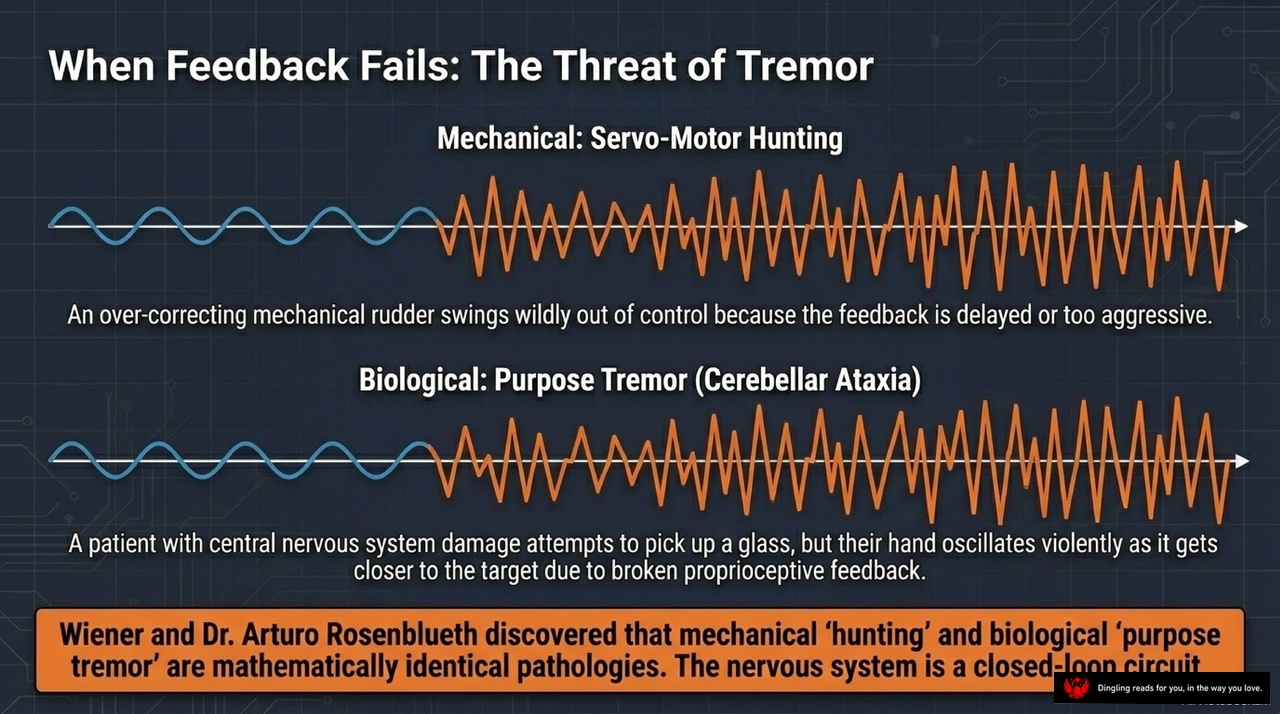
When feedback loops go wrong, they don't just fail—they go into a violent, uncontrollable oscillation known as "tremor." This slide brilliantly illustrates how this same mathematical pathology appears in both machines and human biology.
On the top, we see a mechanical system, specifically a servo-motor, experiencing what engineers call "hunting." Imagine a ship's rudder trying to steer; if the feedback is delayed or too aggressive, the rudder over-corrects. It swings wildly left, then right, then left again, swinging further out of control with each cycle. The system is essentially fighting itself, unable to settle on a steady course.
Below that, we see the exact same pattern in a human body, labeled as "Purpose Tremor" or Cerebellar Ataxia. Picture a patient trying to pick up a simple glass of water. As their hand gets closer to the target, instead of stabilizing, their hand begins to oscillate violently. Why? Because the nervous system relies on proprioceptive feedback—sensing where the limb is in space. When that feedback loop is broken or damaged, the brain sends conflicting signals, and the hand overshoots, then undershoots, creating that jagged, chaotic wave you see on the graph.
The profound insight here, discovered by Norbert Wiener and Dr. Arturo Rosenblueth, is that these two seemingly different problems are mathematically identical. Whether it's a metal rudder struggling with a laggy signal or a human brain struggling with damaged nerves, the underlying mechanism is the same: a closed-loop circuit that has lost its balance. This realization unified the study of machines and life, showing that the nervous system operates on the same fundamental principles of control and communication as the most complex engineering systems.
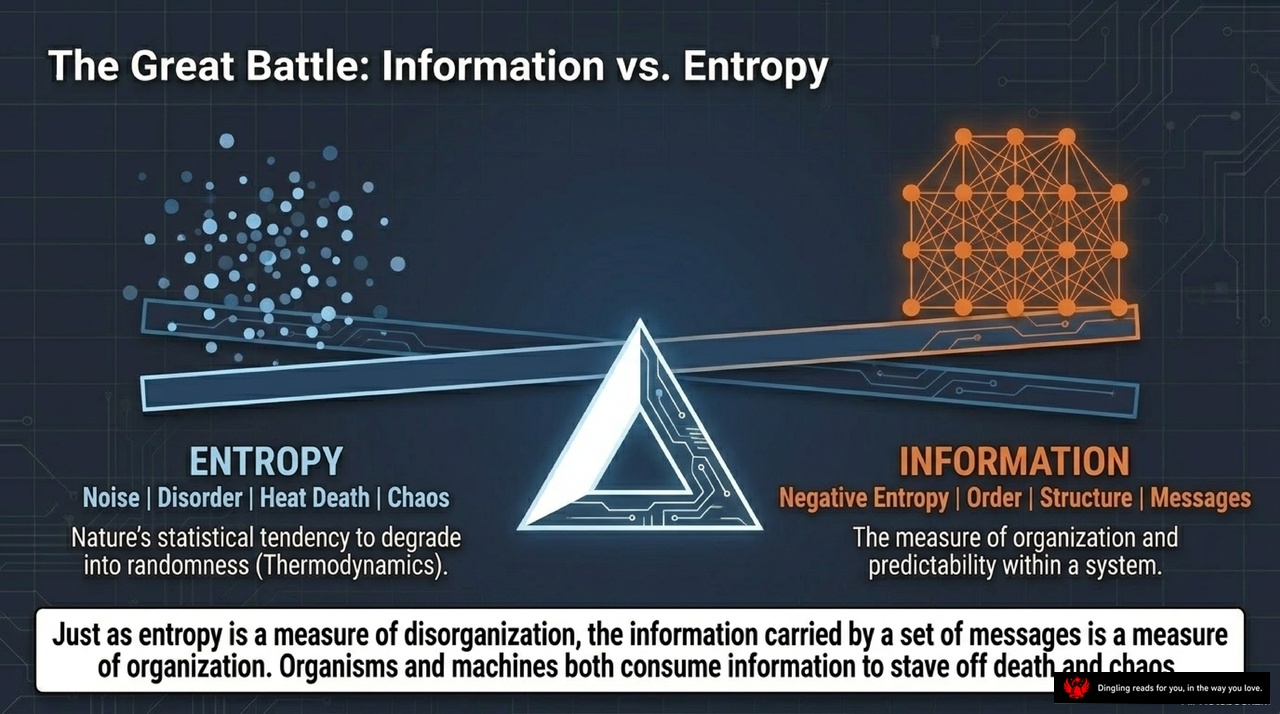
Imagine a seesaw balancing the forces that shape our universe. On one side sits Entropy, the relentless push toward chaos, disorder, and what scientists call "heat death"—nature's statistical tendency to degrade into randomness. On the other side is Information, acting as negative entropy, representing order, structure, and the predictability within a system.
Just as the slide illustrates, entropy measures disorganization, while information measures the organization carried by messages. Think of it this way: organisms and machines are essentially fighting against this natural drift into chaos. They do this by consuming information to stave off death and disorder. Whether it's a biological cell repairing itself or a computer running complex algorithms, both are constantly battling the arrow of time that entropy dictates.
This fundamental battle isn't just theoretical; it's the engine of life itself. By gathering information and creating structure, we resist the slide into randomness. As we move deeper into the control theory framework, remember this core tension: every system we study, from the human brain to global economies, is engaged in this same great struggle to maintain order against the overwhelming force of entropy.

Today's slide introduces what we call the "Black Box Approach," a cornerstone of behaviorism. Instead of trying to open the box and dissect its internal gears or neurons—like functionalism does—behaviorism asks a much simpler question: What does it do? It focuses entirely on the relationship between what goes in and what comes out.
Think of inputs as stimuli, radar data, or any external trigger. Now, look at the outputs: these are the resulting behaviors, motor actions, or predictions. The core idea here is that the internal makeup of the box—whether it's biological grey matter or mechanical copper wire—becomes irrelevant. Cybernetics analyzes complex systems by their behavior alone. By focusing on the math of the input/output relationship, we can understand the system without needing to know exactly how it's built inside. This shift allows us to study everything from living organisms to machines using the same universal principles of feedback and control.
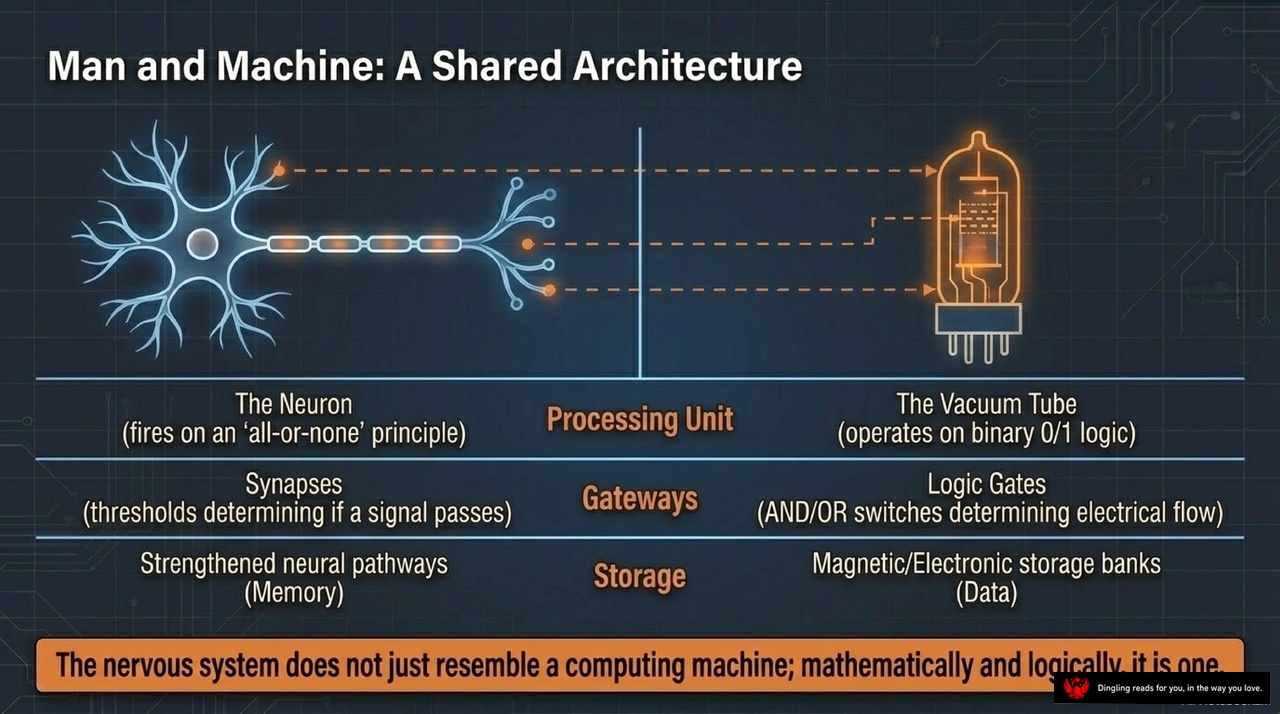
Look at this slide: "Man and Machine: A Shared Architecture." It's not just a metaphor; it's a mathematical reality. Notice the diagram on the left: the neuron. It fires on an "all-or-none" principle. Now look at the right: the vacuum tube. It operates on binary 0/1 logic. The parallel is striking.
Think about the connections. In our brains, synapses act as gateways, using thresholds to decide if a signal passes. In machines, logic gates—ANDs and ORs—determine electrical flow in the exact same way. Even our memory isn't so different; strengthened neural pathways store data just like magnetic or electronic storage banks do.
The bottom line here is profound. The nervous system doesn't just resemble a computing machine; mathematically and logically, it *is* one. This realization was the spark that launched the information age, proving that the principles governing life and the principles governing technology are fundamentally the same.

Welcome back. Today, we're diving into one of the most mind-bending concepts in physics and biology: the subversion of Maxwell's Demon.
Look at this diagram. You see a box divided into two sides. On the left, we have hot particles; on the right, cold ones. In the middle stands a robot—the "Maxwell's Demon." Its job is simple but impossible: sort the fast particles to one side and the slow ones to the other. If it succeeds, it creates order out of chaos, lowering entropy without doing any work. It seems like a violation of the Second Law of Thermodynamics, right? That's the physics paradox.
But here is the twist, as Wiener explains. The demon isn't magic; it's an information processor. To sort those particles, the demon must actually *see* them. It needs to measure their speed and position. And in physics, information isn't free. The act of gathering that data requires energy and creates disorder elsewhere. So, while the demon decreases entropy inside the box, it increases the total entropy of the universe by the cost of processing that information. The law holds, but only if you count the demon's own energy bill.
This leads us to the third point on the slide: the biological reality. Life itself acts as a metastable Maxwell's Demon. Enzymes and biological catalysts constantly use information to locally organize matter, temporarily reversing entropy to sustain life. They don't break the laws of physics; they just pay the thermodynamic price through metabolism and energy consumption. So, life isn't a violation of nature; it's a sophisticated, energy-consuming information processor that keeps our world from falling into total chaos.
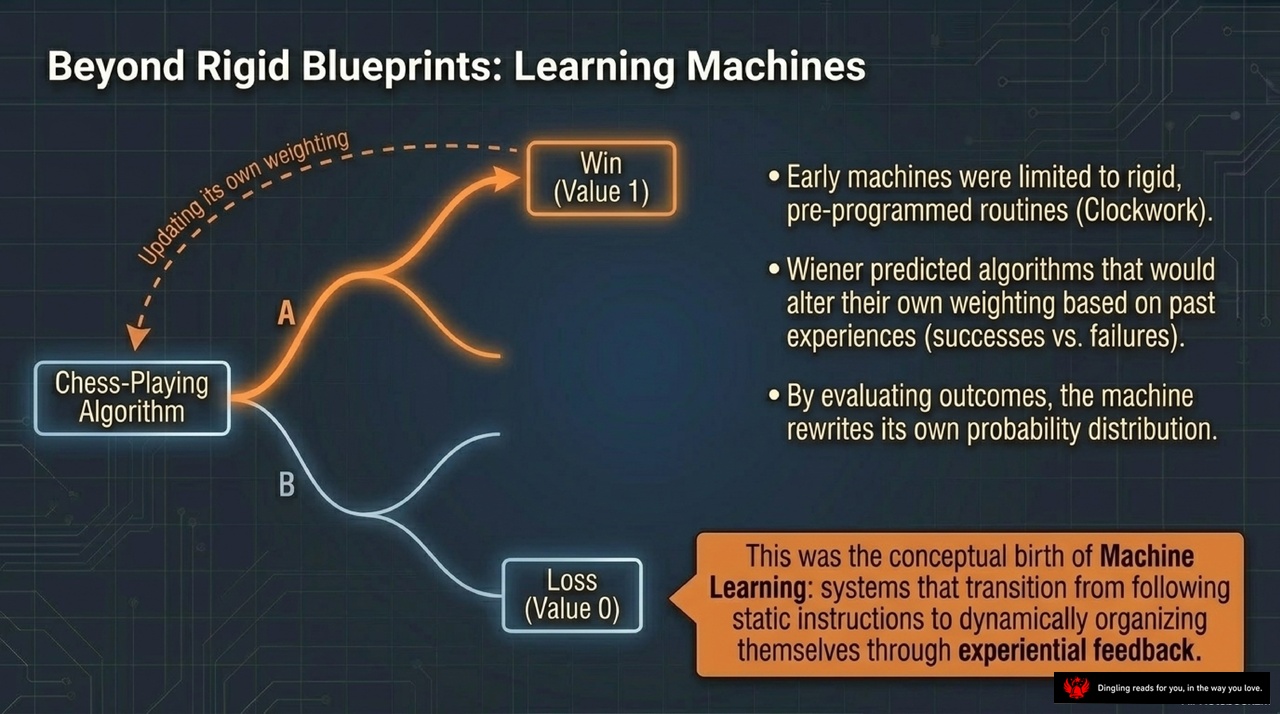
Imagine a chess-playing algorithm facing a fork in the road: path A leads to a win, while path B leads to a loss. In early machines, this was a dead end—a rigid, pre-programmed routine like clockwork that could never change. But what if the machine could learn?
This is exactly what happens when we move beyond static blueprints into the realm of learning machines. As the diagram shows, the system doesn't just execute a fixed script; it actively updates its own weighting based on past experiences. When the algorithm chooses path A and achieves a "Win," it assigns a value of 1. When it takes path B and suffers a "Loss," it assigns a value of 0. By constantly evaluating these outcomes, the machine rewrites its own probability distribution, favoring successful paths and avoiding failures.
This dynamic process marks the conceptual birth of Machine Learning. It represents a fundamental shift from systems that merely follow instructions to those that dynamically organize themselves through experiential feedback. Instead of being told how to play, the machine learns how to play by winning and losing, effectively teaching itself the rules of the game.

Synthesis: The Universal Language of Systems. Look at this diagram. It illustrates a profound truth that cuts across biology, engineering, and sociology: they are no longer isolated disciplines. Whether it's a firing neuron, a steering ship, a ringing telephone, or a functioning economy, they are all governed by the same statistical mechanics of communication.
At the center lies "Information and Feedback." This is the heartbeat of complex systems. The ultimate insight here is clear: all complex systems survive by fighting chaos, or entropy, through the continuous processing of information.
Think about it. In biology, your body fights entropy by constantly processing sensory data to keep you alive. In engineering, a ship's autopilot uses feedback to correct its course against the wind. In our social economy, we rely on information flow to coordinate millions of people. Without this continuous loop of feedback, systems dissolve into disorder. As we move forward, remember that information isn't just data; it's the fuel that keeps the universe from falling apart.
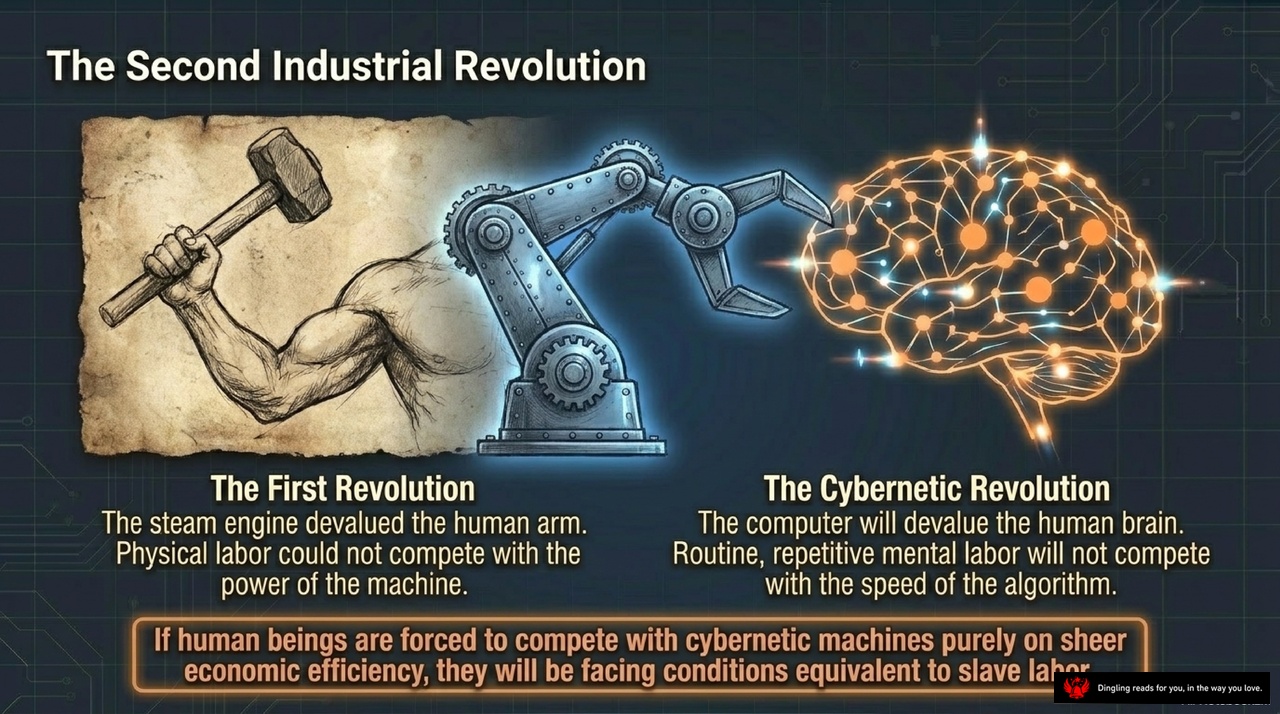
The Second Industrial Revolution isn't just about building better machines; it's about a fundamental shift in what it means to be human. Look at this timeline: we started with the steam engine, which devalued the human arm. Physical labor simply couldn't compete with the raw power of a machine. But now, we are facing a new frontier. This is the Cybernetic Revolution.
Just as the steam engine replaced muscle, the computer is poised to devalue the human brain. Routine, repetitive mental labor will no longer compete with the speed of an algorithm. The image on the right shows that neural networks are no longer biological; they are digital, faster, and infinitely scalable.
But here is the critical warning at the bottom: if human beings are forced to compete with these cybernetic machines purely on sheer economic efficiency, we are facing conditions equivalent to slave labor. We cannot simply race against the machine in the same arena. The challenge isn't about working harder or smarter in the old way; it's about finding value that machines cannot replicate. The future belongs not to those who try to outcompute the algorithm, but to those who understand how to collaborate with it.
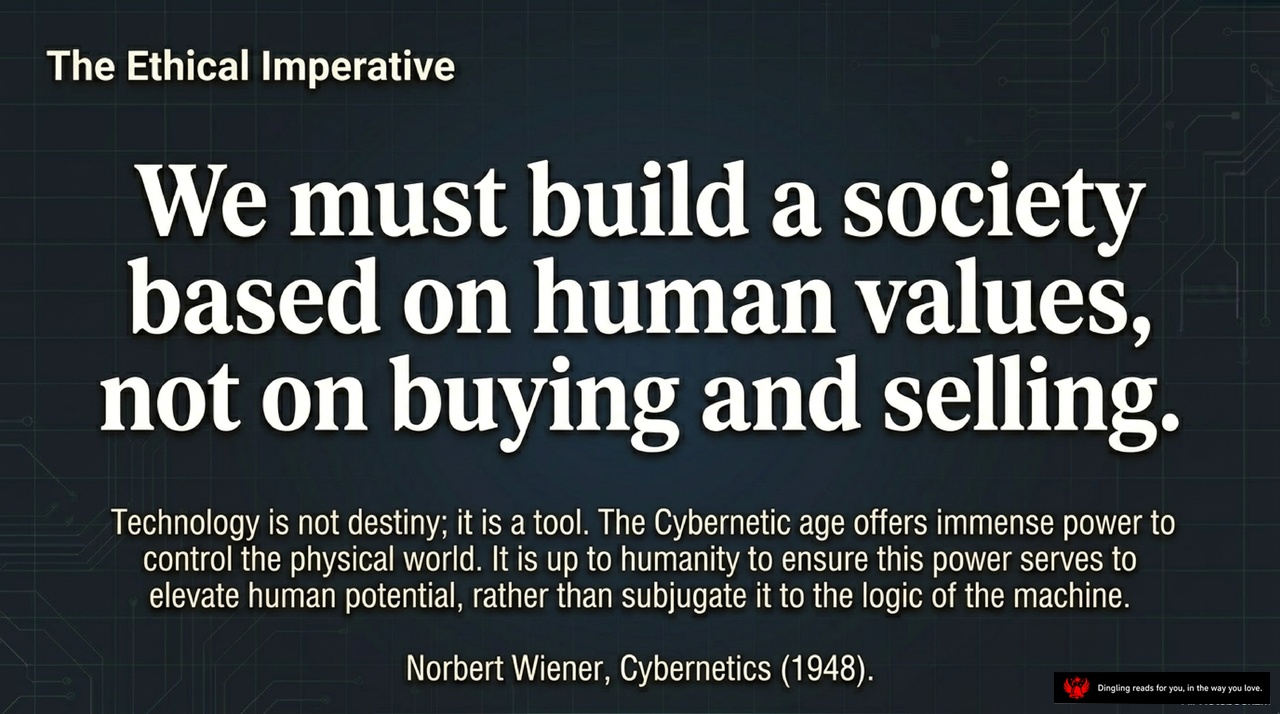
We must build a society based on human values, not on buying and selling. This isn't just a slogan; it's a critical warning from Norbert Wiener, the father of cybernetics. In his groundbreaking 1948 book, *Cybernetics*, he argued that technology is not destiny—it is merely a tool. The cybernetic age offers immense power to control the physical world, but it is up to humanity to ensure this power elevates our potential rather than subjugating us to the logic of the machine.
Wiener realized that when we let the logic of efficiency and automation drive our social structures, we risk turning human beings into mere cogs in a machine. He saw that as communication tools became more advanced, they could actually destabilize society if not guided by ethical principles. When information flows are controlled by commercial or political interests, the collective wisdom of the public gets drowned out, and we lose our ability to self-correct.
So, the ethical imperative is clear: we must take back control. We need to design our systems and our societies to serve human needs, dignity, and freedom, rather than optimizing them for profit or power. As Wiener famously noted, the most important thing about the atomic age isn't winning a war with few casualties, but facing the new possibilities of a better world. We have the tools to build that future, but only if we choose to prioritize human values over the cold, unfeeling logic of the machine.