
Danshari: Complete Chapter-by-Chapter Summary

Welcome to today's session on "Dan-Sha-Li," a transformative philosophy by Hideko Yamashita. Imagine a philosophy where decluttering your soul is achieved through mastering your physical space. It's not just about cleaning your room; it's about creating a sanctuary that reflects your true self.
In a world overflowing with endless goods, we often find ourselves trapped in a cycle of accumulation, holding onto things that no longer serve us. Dan-Sha-Li invites you to break free from this cycle. It teaches us to filter out the unnecessary, keeping only what is truly needed, suitable, and comfortable for the present moment. By doing so, we transform our living spaces into environments that not only feel spacious and serene but also empower our minds and spirits.
Let's embark on this journey together, exploring how a simple shift in perspective can lead to profound changes in our lives.
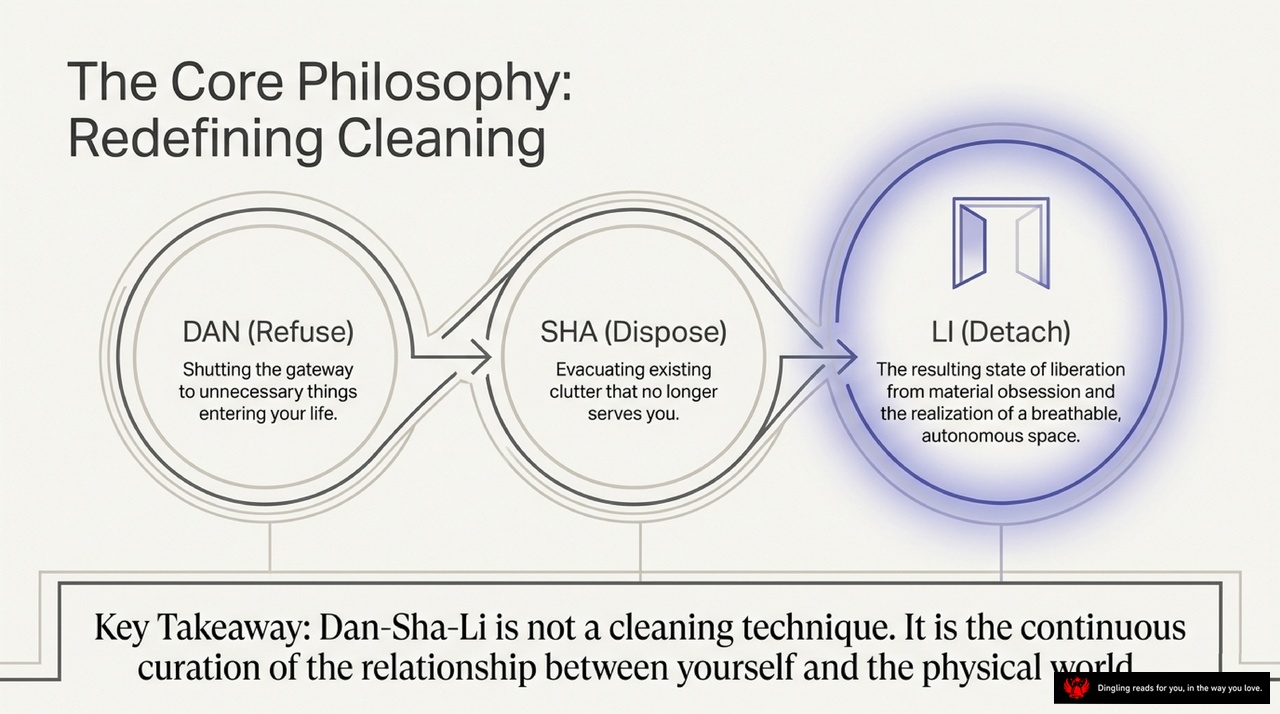
Welcome to the core philosophy of Dan-Sha-Li: redefining what it truly means to clean. Most people think cleaning is just about scrubbing surfaces, but today we're going to shift that mindset entirely.
Look at this flow: it starts with **DAN**, which means "Refuse." Think of this as shutting the gate. You stop letting unnecessary things enter your life in the first place. It's about making a conscious choice before you even bring something home.
Next, we move to **SHA**, or "Dispose." This is the act of evacuating the clutter that has already accumulated but no longer serves you. It's not just tidying up; it's making space for what matters.
And finally, we arrive at **LI**, or "Detach." This is the beautiful result: a state of liberation from material obsession. When you've cleared out the noise, you realize a breathable, autonomous space. You own your environment again.
Here is the key takeaway: Dan-Sha-Li is not just a cleaning technique. It is the continuous curation of the relationship between yourself and the physical world. It's about choosing what deserves a place in your life and letting go of the rest.

Imagine your home as a massive, stagnant pond. On the left, you have an overwhelming inlet—societal pressure, constant discounts, and a culture of hyper-consumption flooding your life like an uncontrolled torrent. This is what the diagram calls the "broken Dan valve," where the entry is wide open to everything. On the right, you have a blocked outlet. Guilt, a "waste-not" mentality, and the fear of making the wrong decision rust the exit shut. This is the "broken Sha valve."
When the intake far exceeds the outflow, your home doesn't just get messy; it becomes a stagnant pond of material sludge. Just like a clogged pipe or a backed-up sewer, this accumulation suffocates your energy and mobility. You feel heavy, trapped, and unable to move forward. The text explains that this isn't just about clutter; it's about a broken cycle where we keep taking in without ever letting go.
But here is the good news: you can fix this system. The solution is to repair both valves. You need to tighten the "Dan valve" by consciously stopping the inflow of things you don't truly need, and you must clear the "Sha valve" by courageously discarding the excess. Once you restart this flow, the stagnant water drains away, and your home—and your life—begins to circulate again, bringing back clarity, freedom, and a sense of lightness.

Today's slide reveals the core diagnostic tool of decluttering: the Self & Now Axis. Think of this grid as a filter for your life. The vertical axis asks, "Is this about me?" while the horizontal axis asks, "Is this for the present moment?"
Look at the top-left quadrant, labeled the "Nostalgia Trap." This is where we keep things just because they remind us of who we used to be. But here's the hard truth: if an item doesn't serve your current self, it's holding you back.
Now, look at the bottom-left area, the "Clutter Zone." This is where we store items thinking, "I might need this someday." But that "someday" is a fantasy. If it's not useful right now, it's just taking up space and energy.
The only zone that matters is the top-right box: "The Target Zone." This is where the magic happens. It's the intersection of Self and Now. The question you must ask yourself for every single item is simple but powerful: "Do I use this now?"
The slide reminds us that the only valid criterion for keeping an object is this exact intersection. If you can't answer "yes" to using it in the present, it doesn't belong in your life. By clearing out the nostalgia trap and the clutter zone, you stop living for the past or a fake future, and finally start living your actual, vibrant present.
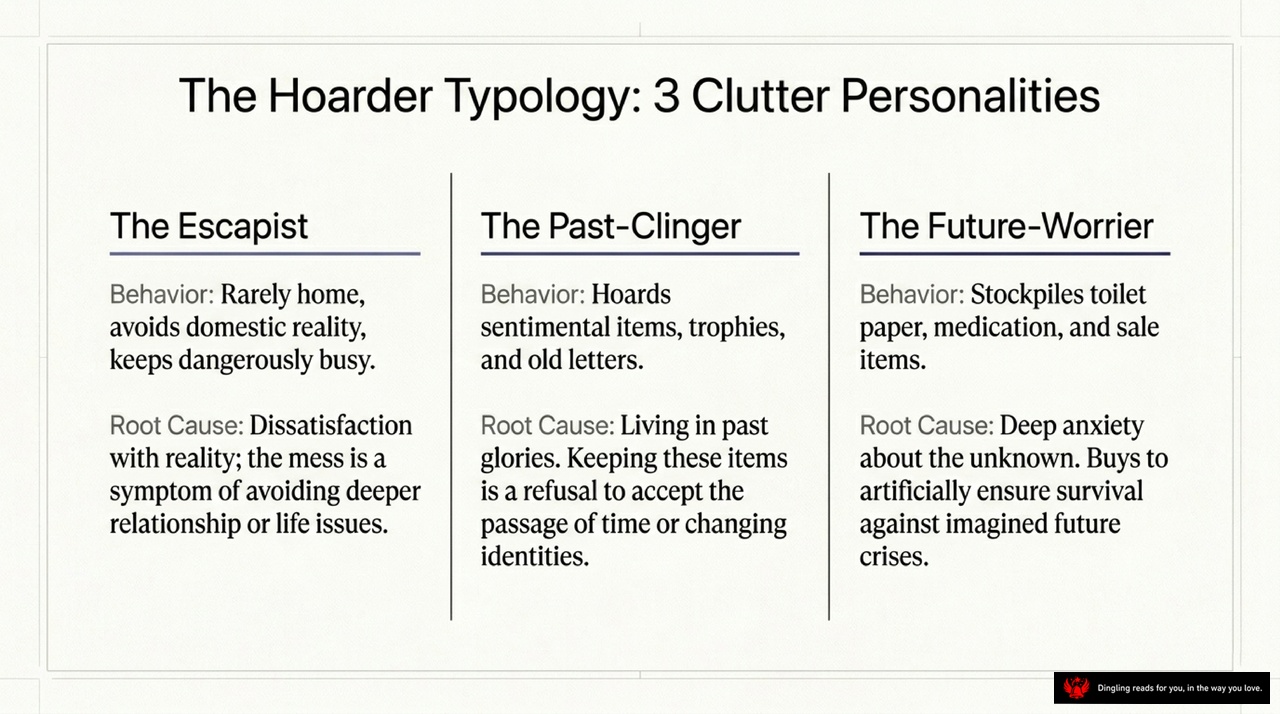
Today's slide breaks down the Hoarder Typology into three distinct clutter personalities: The Escapist, The Past-Clinger, and The Future-Worrier. Let's dive into how these behaviors actually play out in real life.
First, we have The Escapist. These individuals rarely stay home because they actively avoid domestic reality. They keep dangerously busy with work, social events, or hobbies, using that busyness as a shield. The root cause here is deep dissatisfaction with reality; the mess isn't just about things, it's a symptom of avoiding deeper relationship issues or life problems.
Next is The Past-Clinger. This personality hoards sentimental items like old letters, trophies, and photos. Their behavior stems from living in past glories. Keeping these objects is a refusal to accept the passage of time or changing identities. They are stuck, unable to let go of who they used to be.
Finally, there is The Future-Worrier, which is actually the most common type. These people stockpile toilet paper, medication, and sale items. Their behavior is driven by deep anxiety about the unknown. They buy things to artificially ensure survival against imagined future crises, constantly trying to prepare for a disaster that hasn't happened yet.
Understanding which of these three you are isn't just about labeling yourself; it's the first step toward unlocking the root cause of your clutter and finally reclaiming your space and your peace.

The Typology of Junk reveals exactly why your home feels heavy, even when it looks "clean." It's not about the mess you see; it's about the invisible energy trapped in three distinct layers.
At the top, you have Layer 1: Unused or Forgotten items. These are things you've ignored because you forgot what they were for. By neglecting them, you break a silent promise to yourself, creating a background hum of guilt and blocked energy.
Below that sits Layer 2: Used but Unloved. These are the cheap, mismatched, or simply disliked items you grab every day. Every time you use them, your subconscious whispers a damaging message: "This low-quality item is good enough for you." They slowly erode your self-worth just by being there.
And at the bottom, the heaviest layer, is Layer 3: Sentimental objects. These carry the weight of the past. They anchor your mind to outdated versions of yourself, preventing new opportunities from flowing in.
True decluttering isn't just cleaning; it's removing these layers. When you clear the resentful, the self-deprecating, and the outdated, you stop being a slave to your belongings and finally become the master of your life.

The true cost of holding onto things isn't just about the space they take up; it's about the invisible rent we pay every single day. As this slide illustrates, a staggering 80% of our possessions are essentially unused, acting as a heavy burden of spatial rent, visual noise, and cognitive load. In contrast, only 20% of our items form the vibrant core of our daily lives. This imbalance perfectly mirrors the Pareto Principle of clutter: we use just 20% of our things for 80% of our time, while the remaining 80% sits dormant, draining our energy without adding value.
Here is the hard truth: keeping unused items out of guilt doesn't save them; it actually disrespects them. When we hoard things we never use, we are trapping them in a stagnant state, denying them their true purpose. The real honor we can give an object is to release it to someone who will actually use it. By letting go of that 80% of unused mass, we don't just free up physical space; we liberate our minds. We stop paying the daily tax of managing clutter and start living in the 20% that truly matters, creating a life that is lighter, clearer, and genuinely alive.

The Action Protocol: The 3-Category Rule. Here's how to stop feeling paralyzed by endless choices and actually get things done. The core principle is simple: never try to sort an entire room at once. That's too overwhelming. Instead, break your total space down into exactly three large categories. Think of your kitchen as Ingredients, Cookware, and Tableware. Once you've defined those three buckets, move to the next step. Take one of those macro categories, like Cookware, and divide it into three sub-categories. Maybe that's Sink items, Stove items, and Appliances. Keep drilling down. If you're still feeling unsure, take one of those sub-categories and split it into three micro groups until the decision becomes binary and immediate. This method keeps your cognitive load minimal. By forcing yourself to choose between just three options at any given time, you bypass the brain's tendency to freeze when faced with too many variables. It's not about perfection; it's about creating a clear, manageable path forward so you can act without hesitation.

Let's talk about how we actually organize our homes. Most people think they need more storage space, but the real secret lies in the "Spatial Blueprint: The 7-5-1 Rule." It's not about buying bigger closets; it's about how you fill the ones you already have.
First, look at your invisible storage—drawers and closets. The golden rule here is the 70% limit. Your drawers should only be filled to 70%, leaving the remaining 30% empty. Why? Because that empty space is the channel that allows items to flow in and out without friction. If you pack them tight, you'll end up digging through piles just to find one thing.
Next, consider your visible storage, like glass cabinets or open shelves. These should be filled only halfway, or 50%. When you see a shelf that's completely packed, it feels like a cluttered warehouse. But when it's filled only half, curated to look like a high-end boutique, your everyday items suddenly feel like deliberate, high-quality choices. It turns a messy room into a stylish space.
Finally, there's your display storage in areas like the gallery or entryway. This is the most critical part: keep it to just 10%. You need maximum negative space. By drastically limiting what you show, you highlight the profound beauty of the single object. It's the difference between a crowded gift shop and a sophisticated art gallery.
When you follow this 70-50-10 ratio, you stop fighting against your clutter and start designing a home that works for you.

Have you ever stopped to think about why you can't seem to find that specific item, even though it's right there in your closet? The answer lies in something called "friction."
Look at this diagram. The "Before" scenario shows a process full of friction: you have to open the closet door, pull out a box, remove the lid, and then finally take the item out. That's four separate motions. When the brain perceives this much effort, it creates resistance. We call this "high friction." And what does high friction lead to? It leads to clutter. Because the brain wants to avoid that effort, you end up leaving the item sitting on the counter instead of putting it back. It's too much work to go through all those steps again.
Now, look at the "After" scenario. We've redesigned the space to achieve "zero friction." You simply open the door and take the item. It takes one motion. When the process is this smooth, it becomes "flow." You don't need to summon any willpower to retrieve or store things because the design does the work for you.
This is the core of the "One-Touch Principle." If an item requires more than one motion to retrieve, it will eventually become clutter. So, here is your actionable rule: eliminate lids, rubber bands, and nested boxes. Design your life so that everything is accessible with a single touch. When you remove the friction, you stop the clutter before it even starts.

Let's talk about how we actually store things to make them work for us, not just to hide them away. The slide highlights three key principles for physical orientation: Stand, Free, and Flexible.
First, look at the "Stand" concept. Instead of stacking towels or shirts flat where you can't see the bottom ones, we should store them vertically. Think of it like a file cabinet or a bookshelf. When items stand up, nothing gets buried. Everything is equal, visible, and ready to grab instantly. This verticality makes selection effortless.
Next is "Free," which is all about visibility. Arrange your items so they are as easy to pick as drinks in a convenience store. If you can see everything at a glance without digging through piles, you are less likely to grab the wrong thing or forget what you have. Unobstructed access breeds use; if you can't see it, you won't use it.
Finally, we have "Flexible." This is about control. For soft items like linens or clothing, roll or fold them tightly so they hold their shape. By obeying your spatial constraints with these compact rolls, you maximize your autonomy. You aren't fighting gravity or messy folds; you are in charge of the space.
When you combine standing, visibility, and flexibility, you stop fighting your environment and start living in a space that supports your daily flow effortlessly.

Today's slide reveals a powerful truth: the things we touch daily actually program our subconscious. Look at this curve, which maps the relationship between the quality of the objects in your life and your internal self-esteem.
On the left, we see "The Guest Paradox." Many of us save fine crystal for guests while drinking from cheap plastic ourselves. This sends a subconscious message to our own brain that we are not worthy of quality. We are essentially lowering our standards by what we choose to keep.
But look at the other side: "The Elevation." When we actively use high-quality items daily—like choosing a Baccarat glass over a plastic cup—we raise our internal standard. The physical environment pulls our self-worth upward.
This isn't about vanity; it's about alignment. By surrounding ourselves with things we respect, we train our minds to respect ourselves. The objects we touch every day are mirrors of our self-image. If you want to elevate your life, start by elevating the things you hold.

Synthesis: The Automation of Well-being. Imagine your life as a river. Right now, you might feel like a fish trapped in a stagnant pool, overwhelmed by a flood of stuff pouring in from the "past" and the "future," while the gates letting things out are rusted shut. But what if you could unlock the flow?
The journey starts with **Physical Declutter**—letting go of the past and future. When you remove the clutter that doesn't serve your "present self," you instantly gain **Mental Clarity**. You wash away the ambient stress and guilt that have been weighing you down. This creates a foundation for **Elevated Self-Worth**, where you surround yourself only with the loved and necessary, aligning your environment with your true identity.
As you refine your space, you naturally make **Better Choices**. Your intuition sharpens, and your standards rise. You stop hoarding "just in case" and start curating a life that feels right. This isn't just about cleaning a room; it's about organizing your subconscious mind. When your environment is perfectly curated, life shifts from exhausting manual effort to an **automated flow**. You move from relying on your own power to harnessing the effortless power of a well-ordered world. This is the ultimate synthesis: transforming your home into a machine that supports your well-being automatically.

Dan-Sha-Li isn't just about throwing things away; it's a powerful act of reclaiming your life. Think of those unwanted physical objects as anchors dragging you down. By cutting those anchors loose, you unblock the flow of energy, elevate your self-worth, and align your environment perfectly with who you are today.
So, take a moment to look around your space right now. Be honest with yourself: What are you holding onto that is actually holding you back? Those items aren't just clutter; they are barriers to the life you deserve.