
Dealing with Darwin: Complete Chapter-by-Chapter Summary

Welcome to "Dealing with Darwin," by Geoffrey A. Moore. This isn't just another business book; it's a strategic blueprint for navigating the chaotic evolution of the corporate world. Think of your organization not as a static machine, but as a living entity that must constantly adapt to survive.
The core idea is simple yet powerful: innovation is the engine that gives your company pricing power. Without it, you're stuck in a race to the bottom, competing on price until profits vanish. But with innovation, you create unique value, allowing you to charge premium prices and build a sustainable moat.
However, innovation doesn't always lead to success. It can result in differentiation, which is the gold standard; assimilation, where you just catch up to the leader; productivity gains, which lower costs; or, worse, waste. Often, companies fail because they try to be too safe, avoiding risky breakthroughs, or because their departments work in silos, canceling each other out instead of creating momentum.
Moore also introduces a crucial framework: the product life cycle. Every category moves through stages—from the early adopters in the "chasm" to the mass market mainstream. Your strategy must shift as you move from growth to maturity to decline.
Finally, we look at two distinct business architectures: the Complex System, tailored for high-value, customized solutions for enterprise clients, and the Scale Operation, built for low-cost, standardized products for the masses. Understanding which model you are in—and when to switch—is the key to mastering Darwin's relentless selection process.

Look at this blueprint. It lays out the Darwinian Mandate, which is the single most important rule for any innovator: innovation has only one true economic purpose, and that is to create a decisive competitive gap that yields pricing power.
The chart breaks down the economic effects of innovation into four distinct quadrants. The top right orange section represents your goal: **Pricing Power**. This is achieved through **Differentiation**. When you create a unique competitive gap, you command premium customer preference. You stop competing on price and start commanding value.
But not all innovation leads here. Look at the top left quadrant labeled **Assimilation**. This is the trap many companies fall into. It neutralizes competitor advantages and seeks "good enough," not "best in class." By simply following the herd, you erase your own advantage and end up fighting on price.
Then there's the bottom left: **Productivity**. This is about re-engineering processes to lower costs and free trapped capital. While essential for efficiency, it doesn't create a pricing gap on its own. It just makes you cheaper, not better.
Finally, the bottom right quadrant is **Waste**. This includes failed projects or over-engineering that fails to create a pricing gap. It's the result of trying to be unique without actually being different in a way the market values.
The core message here is simple. If your innovation doesn't move you into that orange zone of differentiation and pricing power, you are either wasting resources or just playing a game of catch-up. True economic value comes from being the only choice, not the cheapest option.

In today's market, growth isn't just about selling more; it's about finding the one feature that makes customers say, "I need this." This is the power of the "Killer Application"—the specific function that solves a critical pain point so well that it becomes the product's entire reason for existing. Think of Medtronic's pacemakers for heart patients or Xerox's photocopiers for document efficiency. If you don't hit this mark, your product is just another option in a crowded field.
But finding the killer app is only step one. Step two is laser-focused execution. Too many companies fail because they try to do everything at once, diluting their impact. Successful innovators like Medtronic and EMC refuse to chase every trend. They stick to their core value—whether it's heart rhythm management or platform-independent storage—and ignore the noise. This focus allows them to pour resources into perfecting what matters, making their value unmistakable to the customer.
Finally, you must master "Total Product Management." A great feature is useless if the delivery fails. It's not just about engineering; it's about the entire journey from development to support. Xerox succeeded not just because of the copier, but because they built a robust sales and service network to support it. Medtronic aligned doctors, hospitals, and patients around their product. EMC ensured their storage systems worked seamlessly across different platforms. By eliminating friction in every link of the chain, you turn a good idea into an unbreakable competitive advantage.

In the mature phase of a market, the game changes completely. Growth flattens, commoditization begins, and the battle shifts from stealing new customers to defending your share. This is where most companies fail because they keep trying to be disruptive in a market that demands efficiency.
Look at the slide. We are now in the **Mature Market**. The curve peaks, but the slope is flat. Here, your innovation strategy must pivot from "breaking the rules" to "perfecting the system."
There are two powerful levers you can pull here. First is **Product Line Extension**. Think of Tylenol. They didn't invent pain relief; they took their trusted brand and extended it into allergies, flu, and specific demographics like kids or women. Or look at American Express, moving from travel checks to credit cards, mortgages, and insurance. By leveraging your existing brand trust and distribution channels, you expand your footprint without the massive risk of starting from scratch.
Second is **Augmented Innovation**. This is about the details that matter. It's not about changing the core architecture; it's about making the experience slightly better. Take Pampers vs. Huggies. Both do the exact same job, but one has a Z-shaped slot for better absorption, while the other has an elastic mesh to prevent leaks. Or look at Boeing's 737. They didn't invent the plane; they added winglets for fuel savings, silent takeoffs, and GPS landing systems. These small, incremental improvements create a moat that competitors can't easily cross.
But what happens when product features become identical? That's when **Marketing** and **Experience** take over. Marketing isn't just ads; it's about capturing the customer's mind. Nike didn't just sell shoes; they sold a lifestyle through Michael Jordan and immersive store experiences. In the B2B world, McKinsey built an unassailable reputation through their journal and exclusive alumni network. Meanwhile, experience is about the emotional journey. Disney creates immersion; Cirque du Soleil creates art; IBM built trust by training executives decades ago. When products are commodities, the experience is the only thing that justifies a premium.
Finally, there is **Value Engineering** and **Integration**. In a mature market, cost is king. Bic's pen is a masterpiece of value engineering—simple, durable, and cheap to produce at scale. Southwest Airlines applies this to service, cutting costs by using one plane model and skipping meals. On the other side, integration creates value by reducing complexity. SAP and Microsoft Office succeed not because their individual tools are the best, but because they work together seamlessly.
So, if you are in this mature stage, stop looking for the next big disruption. Instead, extend your lines, refine the details, own the experience, and optimize your cost structure. That is how you survive and thrive when the market stops growing.

When the market is expanding, your job isn't just to improve what you have; it's to seize the future. This slide maps out the "Product Leadership Zone," where growth markets demand aggressive innovation to capture new customers and dominate the landscape.
Look at these four pillars. First, **Disruptive** innovation. This is about introducing a non-continuous technology or business model that creates an entirely new category. Think of the companies that didn't just tweak the status quo but built a new one from scratch.
Next is **Application** innovation. Here, you aren't reinventing the wheel; you're finding new, specialized uses for existing technologies to capture specific, unserved niches. It's about solving unique problems with proven tools.
Then, you have **Product** innovation. This is where you focus on engineering significant improvements to existing products to trigger mass upgrades and solidify market share. Speed and differentiation are key here.
Finally, the **Platform**. This is the ultimate leadership move: establishing a foundational architecture that forces third-party partners to build upon your ecosystem. You stop selling just products and start selling the rules of the game.
In a growth market, your strategy must flow through these stages. Start by disrupting the old ways, find niche applications for your tech, scale those products through significant improvements, and ultimately, build a platform that locks in your dominance. That is how you turn a growing market into a fortress.

When a market matures, the game changes. The core product becomes a commodity, and innovation shifts from building new technology to mastering the customer experience. This is where the "Fractal Effect" kicks in: as the main market gets crowded, it splits into highly specific niches, each with its own unique rules.
Think of this strategy as a blueprint for survival and growth in a saturated landscape. The slide outlines four distinct levers you can pull to differentiate yourself when features alone aren't enough.
First, look at **Line-Extension**. Instead of reinventing the wheel, you create sub-categories to capture specific customer preferences without altering your core technology. It's about expanding your reach within your existing world.
Second, consider **Enhancement**. This is about adding "delight" features to refresh an old product. You don't need a breakthrough; you just need to stimulate replacement buying by making the familiar feel new and exciting.
Third, there's **Marketing**. When the product itself is identical to your competitor's, you win by repositioning the brand. You use novel campaigns or storytelling to make an otherwise commoditized offering feel unique and desirable.
Finally, and perhaps most powerfully, is **Experiential** innovation. This is about redesigning the entire customer journey. It's not just about what the product does, but how the customer feels interacting with it. By creating a premium, differentiated brand experience, you build loyalty that competitors simply cannot copy.
In a mature market, success isn't about being the first to invent; it's about being the best at connecting. Whether you choose to extend your line, enhance your features, reframe your message, or elevate the experience, the goal remains the same: transform a commodity into a cherished relationship.

In a mature market, growth often stalls, and the real battle shifts from price wars to squeezing every last dollar out of your operations. This is where "Operational Excellence" becomes your lifeline. When you can't raise prices, you must violently cut the cost of your product's foundation—the substrate—to protect your margins.
Think of this as a four-pronged attack. First, apply **Value-Engineering**. Ruthlessly strip out over-engineered features and standardize components. If a feature doesn't drive revenue, cut it. This isn't about quality; it's about manufacturing efficiency. Second, pursue **Integration**. Instead of selling a bundle of discrete, commoditized parts, bundle them into a single, seamless solution. Customers will pay a premium for simplicity, even if the individual pieces are cheap.
Third, radically re-engineer your **Process**. Look at your entire supply chain, manufacturing, and delivery. Can you do it faster? Cheaper? Think of how companies like Dell or Toyota revolutionized their workflows to outpace competitors without changing a single product feature. Finally, execute **Value-Migration**. This is the ultimate move: abandon the commoditized layer entirely and shift your business operations to a higher-margin layer of the value chain. Don't compete on the cheap hardware everyone sells; compete on the high-value service or software only you can offer.
As we saw with Cisco, even in mature markets, you can drive massive margins by integrating these strategies. By moving from selling individual boxes to providing integrated systems, and by relentlessly optimizing the backend, you turn a stagnant market into a profitable fortress. The key is to stop fighting on price and start fighting on how efficiently you deliver value.

When the entire market starts to decline, playing the old game faster doesn't save you. You have to fundamentally change the game. As the blueprint illustrates, when category economics collapse, execution speed is useless; you must either pivot the franchise or harvest and exit.
You have three distinct paths forward. First, Organic Renewal. This is about repositioning your internal capabilities to serve an entirely new, growing category. Instead of fighting a losing battle, you leverage what you already know to win in a fresh arena.
Second, Acquisition Renewal. If internal pivots are too slow or risky, solve the decline externally by purchasing a high-growth company and integrating it. This allows you to instantly access new technologies and markets without waiting for organic growth.
Finally, there is the alternative: The Harvest. When neither renewal is viable, you extract the maximum remaining cash flow, slash R&D to zero, and prepare for a graceful exit. This isn't failure; it's a strategic decision to preserve value for stakeholders while acknowledging the end of an era.
The key is recognizing which lane you are in and moving decisively before the decline becomes irreversible.

So, where do we actually go to build our "Complete Innovation Arsenal"? The answer lies in diagnosing exactly where your category sits in its life cycle. As the slide illustrates, we aren't trying to use every tool in the box at once; instead, we must commit aggressively to a single primary vector that matches our market's maturity.
Look at the "Innovation Ecosystem Map." On the left, in the Growth phase, we are in the Product Leadership zone. Here, the goal is to seize market share. We have four powerful weapons: Disruptive innovation to create entirely new markets, Application innovation to find new uses for existing tech, Product innovation to speed up feature rollouts, and Platform innovation to build ecosystems. Think of Cisco or Apple in their early days—they weren't just tweaking products; they were building the very platforms that defined their industries.
As we move to the center, into the Mature phase, the game changes. We shift from Product Leadership to Customer Intimacy and Operational Excellence. The market is stable, and the real battle is about optimization and loyalty. Here, we rely on Line-Extension to cover new niches without high risk, Enhancement to polish specific features like that extra ice dispenser on your fridge, and Marketing or Experiential innovation to make the brand feel personal. But if products become commoditized, we turn to Operational Excellence. This is where Value-Engineering cuts costs without sacrificing core function, Integration bundles our services into a seamless system like SAP or Microsoft Office, and Process innovation rewrites our playbook entirely, as Dell did with its direct sales model.
Finally, on the right, we enter the Decline phase. The market is shrinking, and the old ways don't work. Here, we look to Category Renewal through Organic innovation or Acquisition. We might pivot internally, like Intel did when they abandoned memory chips for microprocessors, or we might buy a competitor to jump into a growing category instantly.
The key takeaway is simple: Diagnose your category's maturity first. If you're growing, build the platform. If you're mature, optimize the experience and the cost. If you're declining, reinvent or acquire. Don't mix the strategies. Pick the vector that fits your stage, and that's how you build a sustainable competitive advantage.

The Enemy Within: Corporate Inertia. This slide reveals the hidden trap killing innovation in mature organizations. The problem isn't a lack of resources; it's that our best talent gets trapped managing yesterday's success.
Look at the diagram. On the left, we have "The Core"—the activities that create a real competitive gap and win customer preference. This is where resources *should* live. But on the right, we see "The Trap." When a Core activity becomes too successful, it turns into "Context." It becomes mission-critical, essential for survival, but it yields zero competitive advantage. Management hoards top talent here to manage risk and keep the lights on, effectively starving the future Core of the innovation it needs to survive.
Below that is "The Context"—the work we must do perfectly just to avoid punishment. It's non-mission-critical in terms of winning the market, but it consumes massive amounts of energy. The result? Organizations fail to innovate because their best resources are busy maintaining the status quo instead of building the next big thing. We are busy managing yesterday's innovations while the future slips away.

Freeing Trapped Resources: The Five Levers. Think of your company as a mine. Too often, we leave valuable capital and talent buried in our "Mission-Critical Context"—the very areas we think are most important. But if those resources are trapped in routine, low-value work, they can't fund the evolution we actually need. That's why management must forcefully extract them.
Here is how we do it, step by step. First, **Centralize**. Stop letting every department reinvent the wheel. Consolidate redundant processes into a single control point to kill duplication. Second, **Standardize**. Once centralized, eliminate variations. Enforce one single, repeatable method. Yes, this might feel rigid, but it's the foundation for efficiency. Third, **Modularize**. Break those standardized processes into discrete, interchangeable components. Think of it like Lego bricks; you can swap them out quickly without rebuilding the whole structure.
Fourth, **Optimize**. Now that we have clean, modular pieces, apply quality controls to squeeze out every bit of friction and human error. Finally, the fifth lever: **Outsource**. Once a process is standardized, modular, and optimized, it's low-risk. Move it to a third-party vendor. This doesn't just cut costs; it frees up your internal team to focus on what truly matters.
The result? We move from "Trapped Context" at the top of the funnel to "Refined Capital & Talent" at the bottom. That extracted energy flows directly into "The Core," fueling the innovation and growth that keeps your business ahead of the curve. Don't let your best people get stuck doing average work. Use these five levers to unlock your true potential.

Outsourcing isn't about cutting jobs; it's about recycling talent to higher-value zones. Think of your company as a three-gear engine: Invent, Deploy, and Optimize. At the top, your entrepreneurs operate in the core, creating unprecedented solutions while embracing ambiguity. They invent the future. Below them, project managers take those prototypes and deploy them at a mission-critical scale, bringing order, specs, and deadlines to make innovation stick. Finally, process engineers apply the five levers to optimize the rest. They take the scaled processes, de-risk them, and systematically recycle that talent back to the inventors. This continuous loop ensures you're not just managing work, but constantly reinvesting your best people into the next big thing.
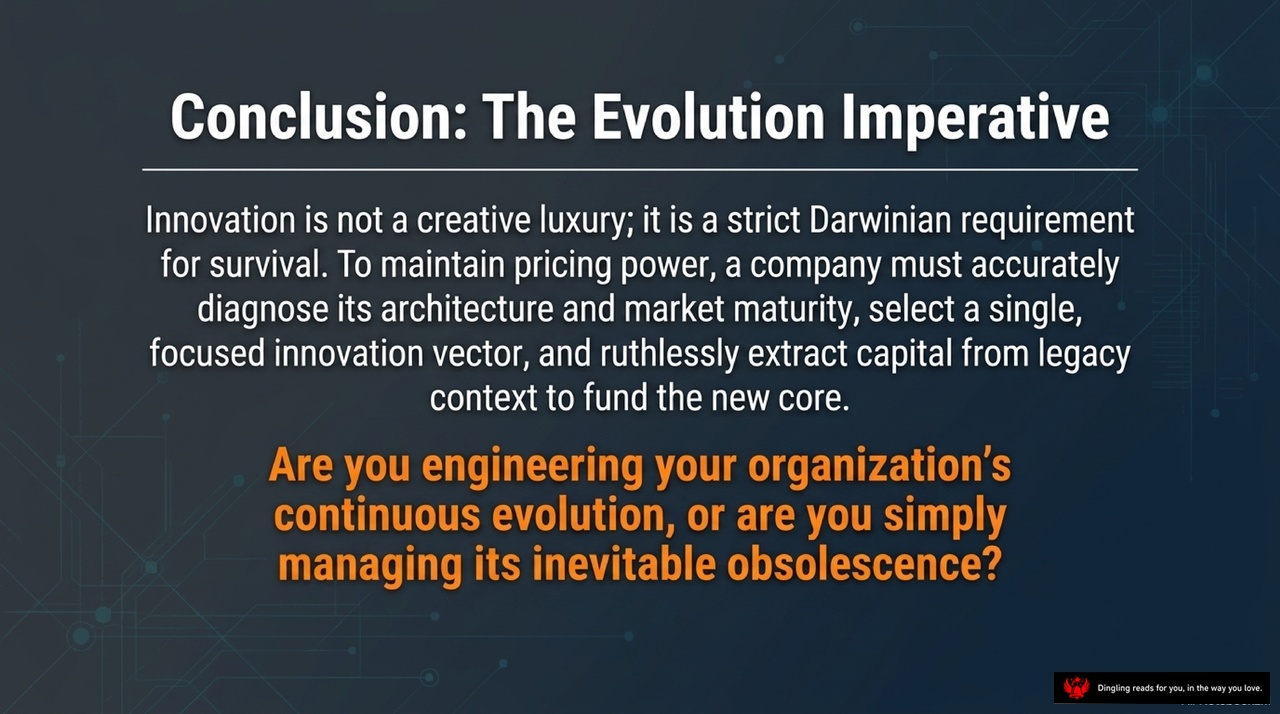
Innovation isn't a creative luxury; it is a strict Darwinian requirement for survival. To maintain pricing power, a company must accurately diagnose its architecture and market maturity, select a single, focused innovation vector, and ruthlessly extract capital from legacy contexts to fund the new core.
But here is the critical question: Are you engineering your organization's continuous evolution, or are you simply managing its inevitable obsolescence? The difference between thriving and fading often comes down to whether you are actively shifting resources from dying products to emerging ones, or if you are stuck maintaining the status quo while the market moves on.