
The History of the Decline and Fall of the Roman Empire: Complete Chapter-by-Chapter Summary
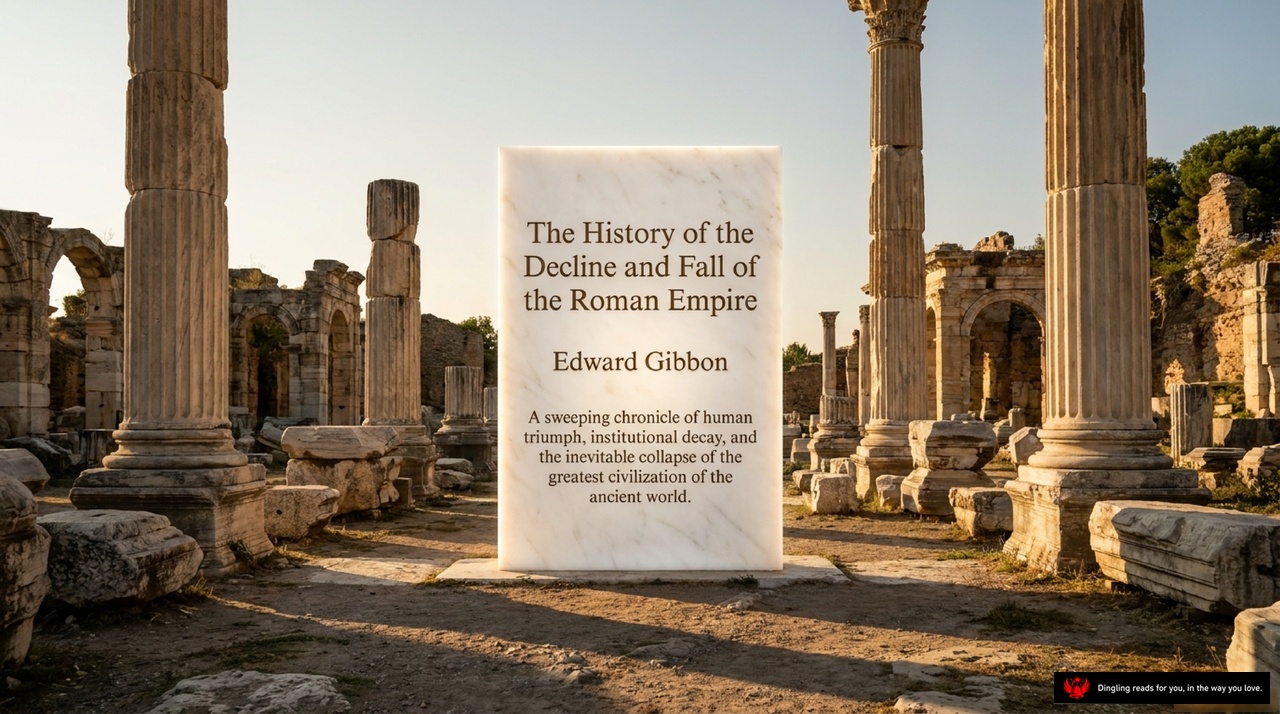
Welcome to the story of the greatest civilization the ancient world ever knew. Imagine a sweeping chronicle of human triumph, institutional decay, and the inevitable collapse of an empire that once ruled the known world.
This is Edward Gibbon's masterpiece, *The History of the Decline and Fall of the Roman Empire*. Set against the backdrop of crumbling ancient ruins, this book captures the full arc of Rome's rise and fall. Gibbon describes it as a massive narrative spanning nearly 1,400 years, from the reign of Trajan to the final disappearance of the Eastern Empire.
He reminds us that Rome once covered the best lands on earth, home to the most civilized people, with an army of under 450,000 defending a population of over 120 million. Yet, as he famously wrote, history is often just a record of human vice, folly, and disaster.
This book isn't just a dry textbook; it is a literary masterpiece that has captivated generations. From Winston Churchill to Mahatma Gandhi, countless leaders have found inspiration in its pages. As one critic noted, as long as language exists, this book will continue to live on. It stands as an enduring testament to how empires are built, how they thrive, and ultimately, why they fall.
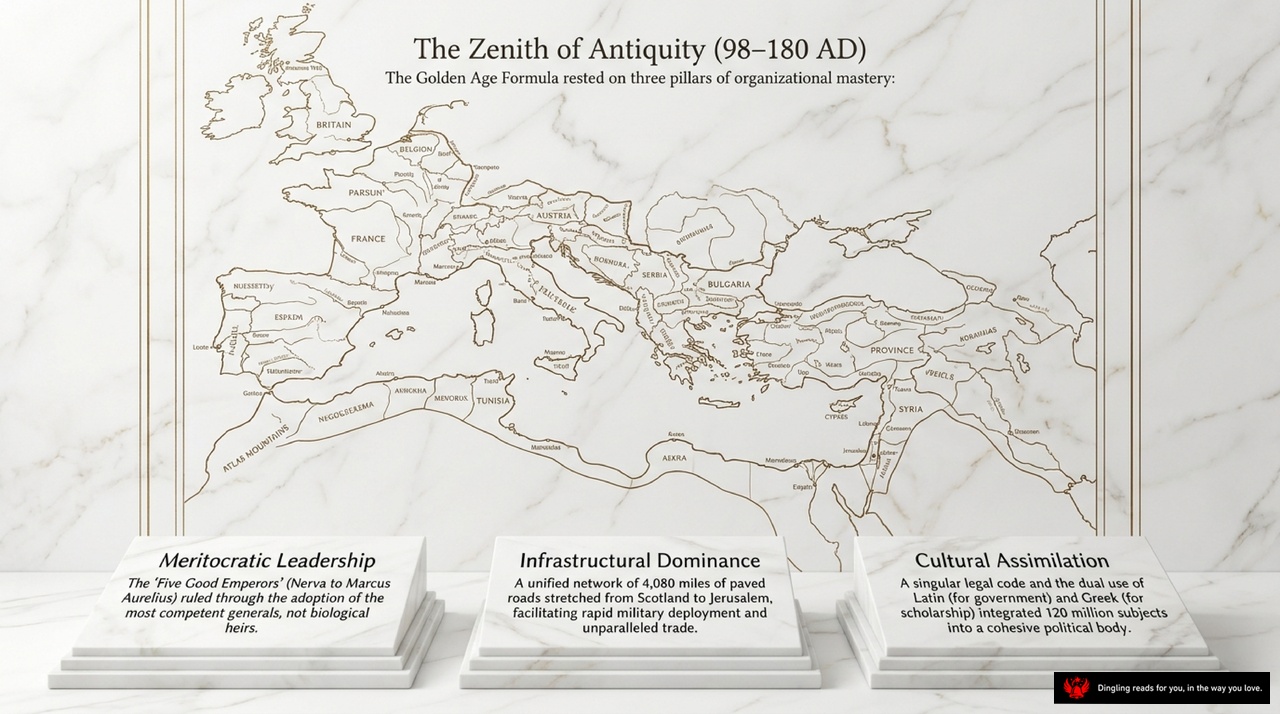
Welcome to the golden age of antiquity, roughly spanning from 98 to 180 AD. If you look at this map, you're seeing the Roman Empire at its absolute zenith. This wasn't just luck; it was the result of a perfect "Golden Age Formula" built on three specific pillars of organizational mastery.
First, we have Meritocratic Leadership. Instead of relying on biological heirs, who often turned out to be incompetent, the emperors like Nerva and Marcus Aurelius chose their successors based on ability. This "Five Good Emperors" era ensured that the most competent generals were running the show, creating a stable and capable government.
Second, look at the sheer scale of this infrastructure. A unified network of over 4,000 miles of paved roads stretched all the way from Scotland down to Jerusalem. This wasn't just for show; it facilitated rapid military deployment and unprecedented trade, effectively binding the entire empire together.
Finally, there was Cultural Assimilation. Rome didn't just conquer land; it conquered minds. By enforcing a singular legal code and using a dual-language system—Latin for government and Greek for scholarship—they successfully integrated 120 million subjects into one cohesive political body. This is why, for nearly two centuries, the empire enjoyed an unprecedented peace and prosperity.

The image before us captures a pivotal moment in history: the moment the Roman Empire's golden age shattered into chaos. We see a crumbling marble structure split into two distinct paths. On the left, under the banner of "Meritocratic Adoption," we see stability. This was the era of the "Five Good Emperors," where leaders like Trajan and Antoninus Pius chose successors based on proven military and administrative competence. This wise tradition gifted the world nearly 80 years of unprecedented global peace.
But look at the right side: "Biological Nepotism." This is where the fatal flaw of absolute power exposed itself. Marcus Aurelius, the last of the great philosophers, broke the tradition of meritocracy. Instead of choosing the most capable heir, he named his biological son, Commodus, as his successor. The result, as the image starkly illustrates, was total collapse.
Commodus abandoned statecraft entirely, preferring to fight as a gladiator in the Colosseum—730 times, no less. His assassination didn't just end his life; it triggered the infamous "Crisis of the Third Century." A brutal 69-year period of civil war ensued, where 30 different military usurpers fought to claim the throne, fracturing the very foundation of the empire.
This slide teaches us a timeless lesson: an empire built on the wisdom of choosing the best leader can endure, but one built on the whim of bloodline is destined for the ruins we see today.

The image illustrates a grim, self-perpetuating loop known as the "Vicious Cycle of Prosperity." It shows how immense wealth, once a sign of strength, ultimately eroded the very civic virtues that built the Roman Empire. At the top, we see "Unprecedented Wealth." The Roman elite consolidated land and capital, with senators earning staggering annual incomes of 4,000 pounds of gold. This surplus drained 800,000 pounds of silver yearly just to import Asian silks and spices, creating a bubble of excess.
This wealth led directly to "Social Apathy." As citizens grew comfortable with idle urban lives, they abandoned military service for the pleasures of chariot races and free bread distributions. The result was a critical shift toward "Outsourcing Defense." To protect their borders without fighting, Romans hired foreign mercenaries—often the very "barbarians" they were supposed to be fighting—to man their legions. Finally, this reliance created "Vulnerability." The military transformed from a tool of loyal citizens into a weapon of foreign mercenaries, turning the state's greatest defenders into its greatest internal threat. This cycle broke the empire from within, leaving it exposed to the very forces it had invited in.
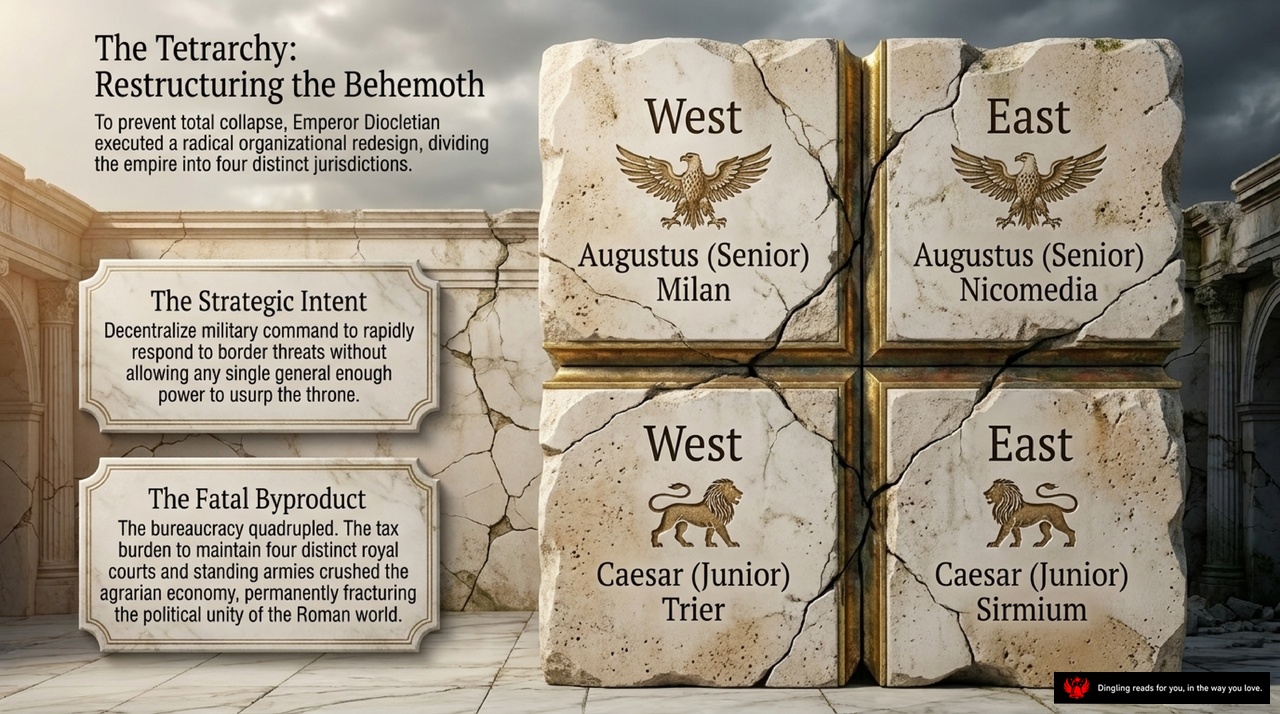
The image on your screen captures a pivotal moment in Roman history: the Tetrarchy, or the "Four-Rulers" system, engineered by Emperor Diocletian to save an empire on the brink of total collapse. As the slide explains, this was a radical organizational redesign that split the massive Roman world into four distinct jurisdictions. On the right, you see the four stone blocks representing these new power centers. The top two blocks show the two senior emperors, or *Augusti*, stationed in Milan and Nicomedia, while the bottom two represent their junior counterparts, the *Caesars*, based in Trier and Sirmium. This structure wasn't just about geography; it was a strategic move to decentralize military command. By dividing the empire, Diocletian ensured that no single general could ever accumulate enough power to usurp the throne, allowing for a rapid response to threats along the empire's vast borders.
However, as the slide notes under "The Fatal Byproduct," this solution created a new, complex problem. To maintain this four-part system, the bureaucracy quadrupled. The tax burden skyrocketed as the state now had to fund four distinct royal courts and standing armies. This crushing financial weight devastated the agrarian economy, permanently fracturing the political unity of the Roman world. While Diocletian's plan successfully stabilized the empire for nearly twenty years, it also set the stage for future fragmentation, proving that while the beast could be restructured, the strain on its resources was immense.

When we look at the transition from the ancient pagan world to the Christian empire, we see a profound cultural paradigm shift that fundamentally altered the psychological gravity of the Roman world. Under Constantine, a previously persecuted sect was elevated to the state religion, creating a divide between earthly glory and heavenly salvation. The ultimate goal of the Roman elite shifted from serving the state and achieving civic honor to securing eternal salvation in the afterlife. This change wasn't just religious; it had a tangible cost on the empire's military might. We see the drain of talent, where brilliant administrative minds and potential military leaders abandoned public office for monastic isolation in the deserts of Egypt, leaving the front lines vulnerable. Furthermore, this shift led to the erosion of the martial spirit. The pacifist doctrines of the early church clashed directly with the aggressive, militaristic ethos that had previously driven Roman expansion and defense. As the empire embraced these new values, the very spirit that had conquered the world began to fade, setting the stage for the challenges that would eventually bring the ancient order to its knees.

When the Western Roman Empire crumbled under the weight of internal decay and barbarian invasions, the Eastern Empire, or Byzantium, stood as the last bastion of Roman civilization. But this survival wasn't just luck—it was the result of a masterstroke by Constantine the Great. Recognizing the vulnerability of the old capital, he relocated the seat of power to the ancient Greek colony of Byzantium, creating a fortress city built specifically for survival.
Look at this map. This new center of gravity wasn't just a random choice; it was a strategic masterpiece. First, consider this ultimate chokepoint. Situated precisely between Europe and Asia, the city controlled the vital maritime trade routes connecting the Black Sea to the Mediterranean. This meant that every ship passing through the Bosporus paid a toll, generating vast wealth that far surpassed the decaying agricultural economy of Rome.
But wealth alone isn't enough for a fortress; you need defenses. As you can see, the new capital was practically invulnerable. Surrounded by water on three sides and protected by massive land walls on the fourth, it stood as an impenerable barrier against the land-based barbarian armies ravaging the West. While the West fell into chaos, this city generated economic independence and security, allowing the Roman legacy to continue for another thousand years. Constantine didn't just move a capital; he engineered a shield that time itself couldn easily break.

The fatal compromise of 376 AD didn't just change history; it shattered the myth of Roman invincibility. Imagine a desperate crisis: 200,000 Gothic refugees, fleeing the terrifying Huns, begging for asylum across the Danube. They weren't just asking for safety; they were starving, forced to trade their own children into slavery just to buy dog meat. But instead of offering mercy, Roman border officials chose corruption. They accepted the refugees only to extort them brutally, turning a humanitarian plea into a trap.
Driven by absolute desperation, these armed refugees didn't wait for rescue; they rebelled. By 378 AD, the rebellion culminated in the catastrophic Battle of Adrianople. It was a disaster of epic proportions. The Gothic horde annihilated the Roman army and killed Emperor Valens himself. In that single moment, the dream of an unbreakable Roman military empire was permanently shattered. This wasn't just a battle loss; it was the beginning of the end, proving that the empire's internal decay had finally caught up with its external might.
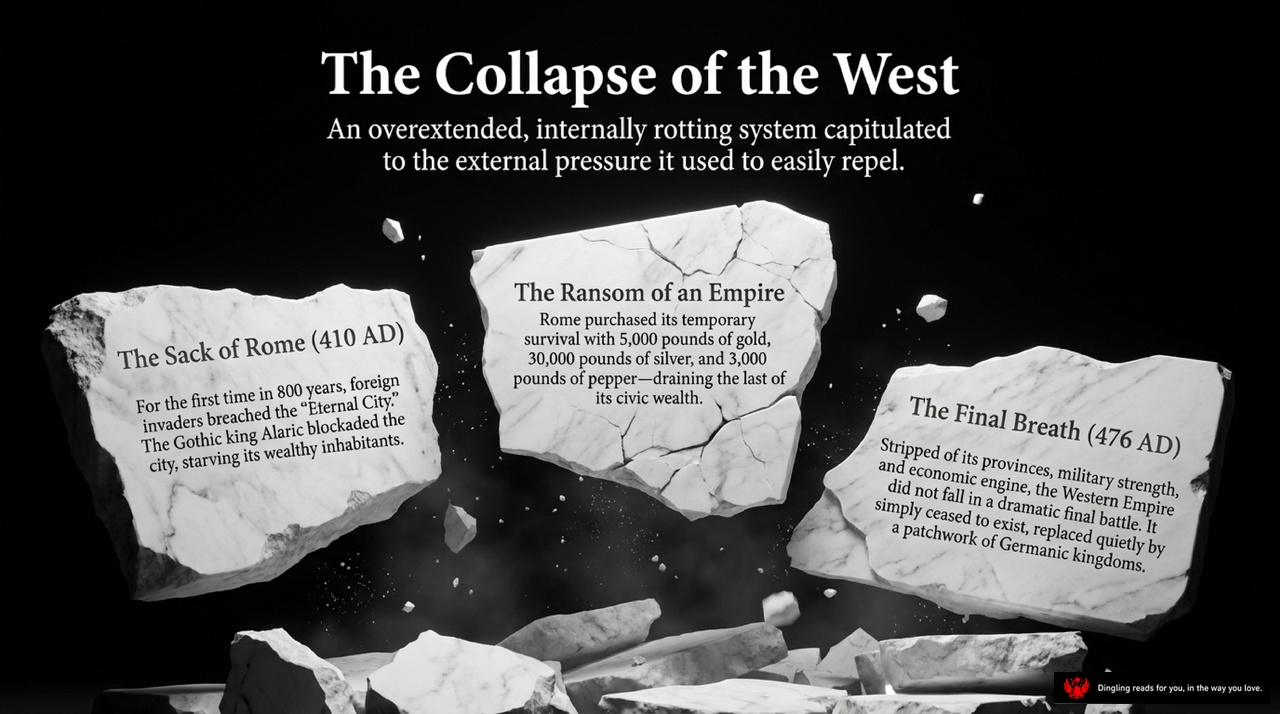
The Fall of Rome wasn't a sudden explosion, but a slow, agonizing collapse from the inside out. Think of it as a massive, overextended system that had already been rotting away long before the final enemy showed up. As the slide vividly illustrates, this wasn't just about battles; it was about an empire that capitulated to external pressures it once easily repelled, because its internal foundation had crumbled.
Look at the first fragment: The Sack of Rome in 410 AD. For the first time in eight hundred years, foreign invaders breached the "Eternal City." The Gothic king Alaric blockaded the city, starving its wealthy inhabitants until they had no choice but to surrender. This wasn't a victory of conquest; it was a desperate transaction. In the middle stone, we see "The Ransom of an Empire." Rome purchased its temporary survival with 5,000 pounds of gold, 30,000 pounds of silver, and even 3,000 pounds of pepper. This wasn't just paying a price; it was draining the last of its civic wealth, trading its future for a few more years of peace.
Finally, we reach the last breath in 476 AD. By this point, stripped of its provinces, military strength, and economic engine, the Western Empire didn't fall in a dramatic final battle. It simply ceased to exist, replaced quietly by a patchwork of Germanic kingdoms. The system had no heart left to pump blood through it. The West had collapsed not because it was conquered by a superior force, but because it had exhausted itself, leaving nothing to hold onto when the inevitable pressure finally arrived.
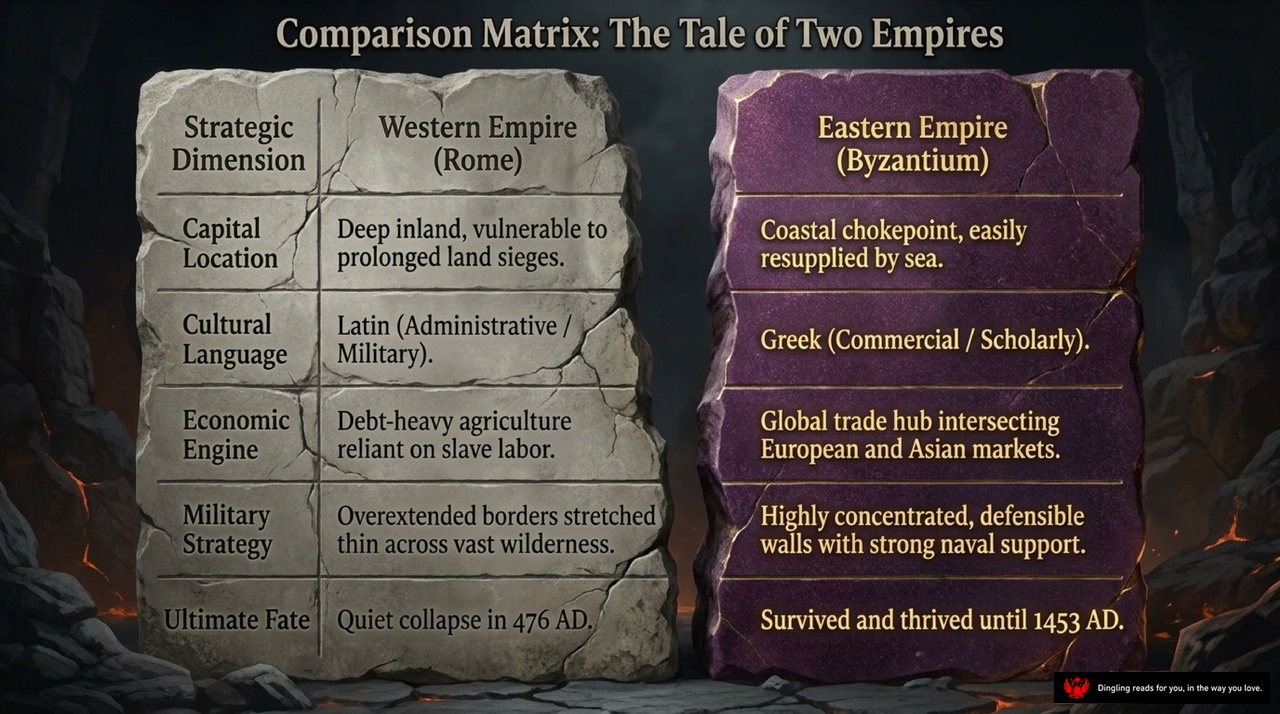
Comparison Matrix: The Tale of Two Empires. Let's look at how Rome and Byzantium played completely different games.
On the left, the Western Empire. Its capital was deep inland, making it a sitting duck for land sieges. It spoke Latin for administration and military, running on a debt-heavy agricultural engine that relied on slave labor. Its borders were stretched too thin across vast wilderness, leading to a quiet collapse in 476 AD.
Now, look at the Eastern Empire. Its capital sat on a coastal chokepoint, easily resupplied by sea. They spoke Greek for commerce and scholarship, turning into a global trade hub connecting Europe and Asia. Their military strategy was highly concentrated, relying on defensible walls and strong naval support. This resilience allowed them to survive and thrive until 1453 AD.
The contrast is stark: one empire was built on land and slaves, destined to fall. The other was built on the sea, trade, and adaptability, ensuring its survival for over a thousand years.
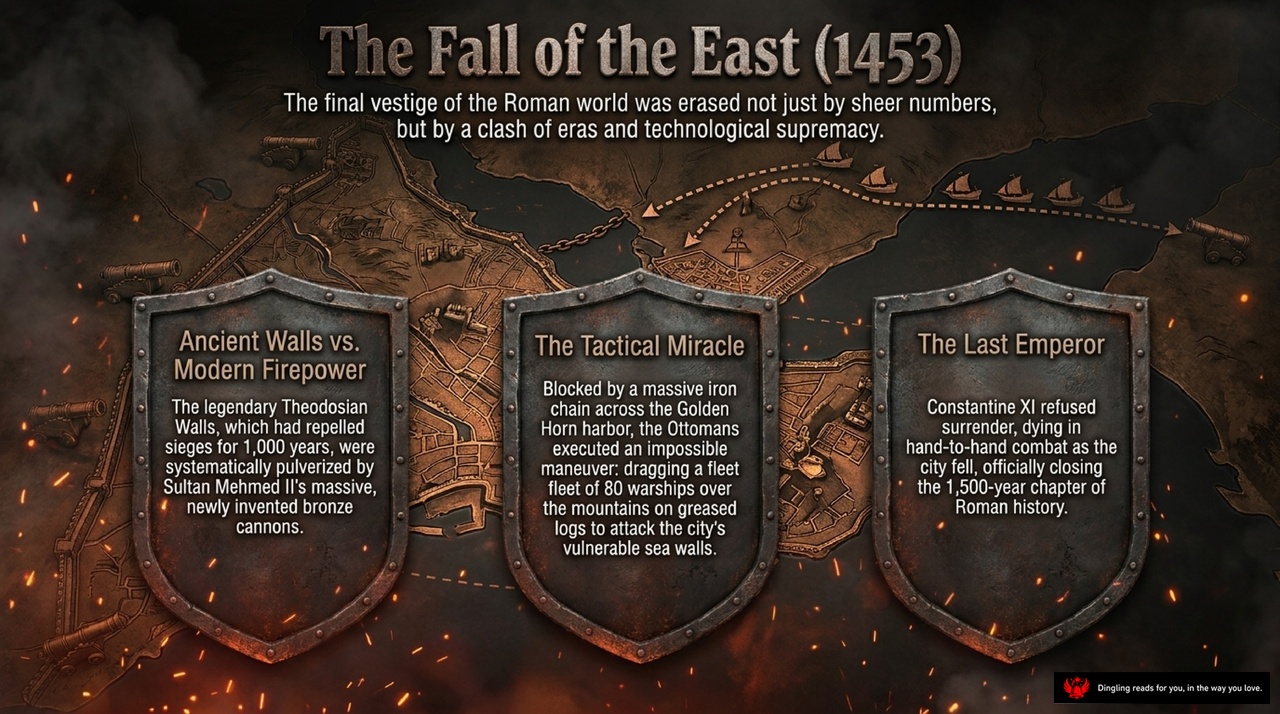
The Fall of the East in 1453 wasn't just a battle of numbers; it was a collision of two different worlds. The final chapter of the Roman story ended not because they ran out of men, but because they ran out of the right tools. Look at the left: for a thousand years, the legendary Theodosian Walls stood as an impenetrable shield, stopping every siege imaginable. But now, Sultan Mehmed II's newly invented bronze cannons systematically pulverized that ancient defense. It was the moment when modern firepower finally broke the back of the ancient world.
But it wasn't just about guns. The Ottomans executed a tactical miracle that defied logic. Blocked by a massive iron chain across the Golden Horn, they dragged a fleet of 80 warships over mountains on greased logs to attack the city's vulnerable sea walls. It was an impossible maneuver that turned the empire's greatest strength into its fatal weakness.
Inside the crumbling city, Constantine XI refused to surrender. As the walls fell, he chose to die in hand-to-hand combat rather than become a prisoner, officially closing the 1,500-year chapter of Roman history. The fall of Constantinople in 1453 erased the last vestige of the Roman world, marking the end of an era and the dawn of a new one.
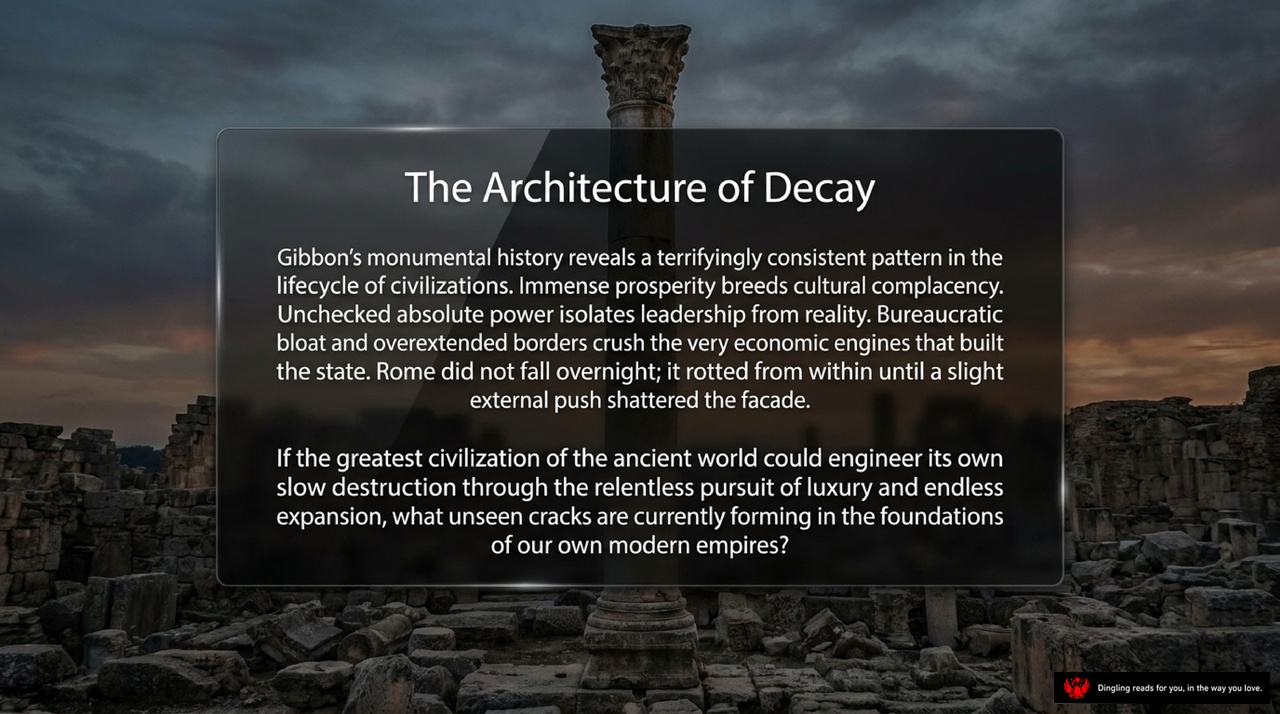
The Architecture of Decay. Look at these ruins. This isn't just ancient stone; it's the physical manifestation of a terrifyingly consistent pattern in the lifecycle of civilizations, a pattern Edward Gibbon revealed in his monumental history.
Gibbon teaches us that immense prosperity often breeds cultural complacency. When a state becomes too powerful, unchecked absolute power isolates leadership from reality. Bureaucratic bloat and overextended borders eventually crush the very economic engines that built the state. Rome didn't fall overnight; it rotted from within until a slight external push shattered the facade.
The slide asks a haunting question: If the greatest civilization of the ancient world could engineer its own slow destruction through the relentless pursuit of luxury and endless expansion, what unseen cracks are currently forming in the foundations of our own modern empires? We are still watching the same drama unfold.