
Deep: Complete Chapter-by-Chapter Summary

Welcome to the deep end. Imagine diving into the ocean's final uncharted frontier, where the secrets of our hidden capabilities and the very origins of life are waiting to be found. Today, we're exploring *Deep* by James Nestor.
As you can see on this slide, we're starting right at the surface—the zero-foot mark. This is where the story begins. It's not just about how far down you can go, but about what happens when you finally let go of the air and embrace the water. The ocean holds mysteries that have shaped us for millions of years, from the ancient instincts in our DNA to the incredible creatures living in the eternal dark below.
We're about to dive into a journey that challenges everything we think we know about human limits, marine life, and our place in this blue world. So, take a deep breath, and let's go deeper together.

Welcome to the final frontier of our planet. While we often think of wilderness as forests or mountains, the true last great wild place is actually beneath our feet, in the vast, dark ocean.
Look at these numbers: a staggering 71% of Earth's surface is covered by the ocean. And here is the most mind-blowing fact: an estimated 50% of all known species on the planet call this blue realm their home.
While we have mapped and tamed the land, the deep ocean remains a pristine, unmapped void. It is the ultimate escape from the noise of our modern world, a place where life has evolved in ways we are only just beginning to understand. From the mysterious middle depths where sharks navigate using Earth's magnetic field, to the crushing pressure of the hadal zone where giant tube worms thrive in total darkness, the ocean is teeming with life that defies our imagination.
This deep blue isn't just empty space; it is the cradle of life itself. Scientists now believe that life didn't start in the sunlit surface, but in the boiling, toxic waters of deep-sea hydrothermal vents. It is time to stop looking up at the sky and start looking down into the depths, where the greatest adventure on Earth is waiting.

The Master Switch of Life isn't just a title; it's a biological reality that wakes up the moment your face touches cold water. As we dive deeper into this ancient instinct, we unlock a survival mechanism that has protected mammals for millions of years.
It all starts with the trigger. The moment you submerge your face in cold water, the Mammalian Dive Reflex is instantly activated. This is your body's emergency brake, designed to conserve oxygen in a hostile environment. The first effect is a dramatic drop in heart rate, known as bradycardia. Your heart rate can immediately drop to 50% of its normal speed, and in extreme depths, it can slow down to just 25%. This isn't a sign of failure; it's a strategic shift to keep your brain and heart oxygenated while the rest of the body slows down.
Simultaneously, your blood begins a critical migration. Through peripheral vasoconstriction, blood is shunted away from your limbs and extremities. This protects your vital organs and your brain from the pressure and lack of oxygen. You might feel your hands and feet go numb, but that's the system working exactly as designed. Finally, we see a major blood shift. Your blood engorges the lung vessels, creating a cushion that prevents them from collapsing under the crushing weight of extreme pressure.
Together, these four mechanisms—trigger, bradycardia, vasoconstriction, and blood shift—allow us to hold our breath far longer than we could on land. It's a powerful reminder that our bodies are built for the ocean, and with the right understanding, we can tap into this master switch to explore the depths.

Descent to 60 feet takes us into the Photic Zone, where the ocean shifts from a familiar world to something truly alien. On the left, we see the harsh reality of the Human Approach: imagine living at 60 feet under, like researchers in the Aquarius Reef Base. Down there, the water pressure is 2.5 times what we face at the surface, and 112 tons of water are pressing down on every inch of your body. If you were to ascend without a grueling 17-hour decompression, the nitrogen in your blood would literally boil, a fatal reminder of the physics governing our limits.
But look to the right. This is The Natural Rhythm. While we struggle against the pressure, corals are thriving. They lack eyes and brains entirely, yet they possess a light-sensitive gene called CRY2. This tiny genetic tool allows them to perfectly synchronize mass spawning events across hundreds of miles, coordinating with the moon's light in a way that remains a critical puzzle for marine survival.
The contrast is striking: humans must fight the ocean's weight to survive, while nature has evolved to dance with it. At 60 feet, we are just beginning to understand that the ocean isn't just a place we visit—it's a system we are still learning to read.

At three hundred feet, we hit the absolute edge of what the human body can endure. The pressure here is ten times what we feel on the surface—strong enough to instantly crush a soda can flat. That's the reality facing competitive freedivers like William Trubridge, who reach these depths completely unassisted.
But the most terrifying part isn't just the external pressure; it's what happens inside. This is "The Lung Squeeze." At this depth, the immense pressure compresses your lungs down to the size of just two baseballs. Your breathing instinct completely fails. Gravity effectively reverses, and instead of kicking to control your descent, you enter a state of free-fall, plunging passively into the abyss.
The physiological toll is staggering. Your heart rate drops to just one-quarter of its normal pace, and your brain enters a low-power state similar to sleep. While this sounds extreme, for elite athletes, it's a profound, Zen-like connection to the deep. They risk blackouts and nitrogen narcosis, yet they push forward, risking organ collapse to experience a moment of pure unity with the ocean. This slide captures the brutal truth: at 300 feet, you aren't just diving; you are testing the very limits of human life.

Imagine diving to 650 feet, a depth where the ocean transforms from a familiar blue into a realm of shifting senses. At this extreme pressure, our human senses dull, but for creatures like sharks, it's where their true superpowers ignite. The slide highlights a fascinating biological shift: the descent to 650 feet triggers a complete reorganization of how life perceives the world.
First, look at the Ampullae of Lorenzini. These aren't just skin pores; they are a network of 1,500 tiny holes filled with conductive gel, acting as an ultra-sensitive electromagnetic antenna. This allows sharks to detect muscle twitches emitting just one-billionth of a volt. It's like having a built-in radar that picks up the faintest electrical signals in the water, letting them hunt even in total darkness.
Then there is magnetoreception. Sharks navigate global migratory routes using the electromagnetic pulses generated by Earth's molten core. They essentially have a GPS system that reads the planet's magnetic field. Interestingly, the slide notes a chilling connection to us: research on human CRY2 proteins suggests we possess a dormant version of this exact sense. We are wired to see the magnetic field, but we've lost the ability to use it.
This slide isn't just about shark biology; it's a mirror reflecting our own lost connection to the ocean. While we struggle with the pressure and darkness at 650 feet, these ancient creatures thrive, using senses we've forgotten. It reminds us that the ocean is not just a place to visit, but a world with its own rules and intelligence, waiting for us to finally understand and respect them.

Imagine you're holding a map to the deep ocean, but instead of just showing locations, this map tells a story about how we touch, feel, and survive down there. Today's slide, our "Exploration Matrix," breaks down the four main ways we access the deep, comparing them across depth, risk, and most importantly, our sensory connection to the world below.
At the top of our scale, we have Freediving. This is the most intimate connection we can make. With a depth limit of 300 feet or more, it carries high risk but offers zero disruption to the marine environment. Because there are no bubbles or noise, researchers can approach megafauna like sharks or whales with a level of closeness that no other method allows. It's an intimate dialogue, allowing us to see the ocean as it truly is, without the intrusion of machinery.
Just below that is Scuba and Habitat use. These methods are limited to about 200 feet. While they offer medium risk and high disruption due to the noise and bubbles, they are "clunky." They are great for stationary observation, like setting up a lab in the deep, but they often terrify wild animals, breaking the natural silence of the deep.
Moving deeper into the abyss, we reach Submersibles. These can go past 15,000 feet with low risk, but the trade-off is a medium level of disruption and very low sensory connection. We are observing the deep from behind thick acrylic glass, separated by miles of water and the sheer weight of the ocean. We see, but we don't feel.
Finally, at the very bottom of our matrix, we have Autonomous Landers. These robotic explorers can reach depths of 35,000 feet with zero risk to humans and low disruption to the environment. However, they provide only blind data. They collect robotic data, sending us back images and measurements, but they cannot feel the pressure, hear the clicks of the whales, or sense the currents. We are completely disconnected from the physical reality of the deep.
This matrix highlights a critical transition zone on the right side of the screen: "The Epipelagic to Mesopelagic Transition." As we move from the sunlit surface down into the twilight zone, our ability to connect with the ocean changes drastically. We trade the intimate, sensory-rich experience of freediving for the sterile, data-driven observations of robotics. It forces us to ask a hard question: As we push deeper and safer, are we actually getting closer to the truth of the ocean, or are we just watching it through a screen?

Imagine diving to 1,000 feet, where sunlight vanishes and the ocean becomes a crushing, silent void. This is the realm of "Acoustic Vision," a world where sight is useless, but sound is everything. As we descend past the 1,000-foot mark, we enter a domain ruled by the sperm whale, the creature with the largest brain on Earth. These giants dive to depths of 10,000 feet, hunting in pitch blackness using echolocation. They don't just hear; they process sound waves into 3D holographic maps, effectively seeing with their ears.
But it's not just about seeing; it's about communicating. Scientists believe whales transmit these acoustic holograms directly into each other's minds, creating a complex language we are only just beginning to understand. Enter the DareWin Project, led by renegade researcher Fabrice Schnöller. He uses 360-degree hydrophones to record and decipher this click-based language, treating it as a potential Rosetta Stone of the deep. This isn't just about survival; it's a holographic conversation happening in the dark, revealing a level of intelligence and connection that challenges everything we thought we knew about the ocean.

Descent to 2,500 feet: The Midnight Zone. Imagine looking out a porthole into a world where sunlight has never existed, only a beam of artificial light cutting through the crushing dark. This is the realm of Karl Stanley's homemade submersible, the *Idabel*. It's a rugged, two-person capsule built to withstand a pressure of 900 pounds per square inch, allowing us to dive into depths where the ocean feels like solid lead.
As we sink past 2,500 feet, we enter the Midnight Zone. Here, the water is a constant, endless rain of biological detritus—carbon, dead organic matter, and the remains of life from the surface. We call this "marine snow." It's the lifeblood of the deep economy, capturing carbon and feeding the abyss in a cycle that has persisted for millennia.
The pressure outside is immense, but inside, life finds a way. We encounter creatures that seem to belong to a different planet: eel-like shapes with stubby legs, dog-sized fish yawning in the gloom, and sharks with cross-eyed stares. They are masters of efficiency, their bodies adapted to conserve energy in an environment where food is scarce. This isn't just a descent into darkness; it's a journey into the most resilient, ancient, and mysterious part of our planet, where life thrives without the sun, driven by the silent, steady drift of marine snow.

Deep in the ocean, beyond the reach of sunlight, life doesn't just survive—it innovates. Welcome to the Bioluminescent Economy. Here, between 5,000 feet and the abyss, nature has cracked the code for survival in total darkness.
First, consider the Light Hack. In this crushing environment, 80% to 90% of all marine life uses bioluminescence. Without the sun, these creatures manufacture their own light to hunt, hide, and communicate. It's a self-sustaining energy grid that powers the deep.
Then, look at Form Follows Function. Survival at these depths demands maximum efficiency. You see gelatinous bodies that resist pressure, creatures lacking brains to save energy, and even hermaphroditism to ensure reproduction upon any random encounter. When resources are scarce, every biological trait is optimized for the dark.
Finally, remember that Red is Invisible. Red wavelengths are absorbed by water at just 50 feet. In the deep, red creatures are practically invisible to predators, allowing them to approach prey without detection.
This isn't just a collection of strange animals; it's a sophisticated economic system built on light, efficiency, and invisibility.

Welcome to the Hadal Zone, the planet's ultimate abyss, where the Sirena Deep in the Mariana Trench lies at a staggering 35,850 feet. This isn't just deep; it's a realm of crushing force, where the pressure exceeds 15,000 pounds per square inch—over 1,000 times what we experience at the surface. In this dark, silent world, human access is virtually impossible. We can't swim here, so scientists rely on "blind drops," launching autonomous landers into the void without any chance of recovery, hoping they survive the immense weight of the water column to bring back data. It's a high-stakes gamble in the darkest part of our ocean, pushing the very limits of what life can endure.
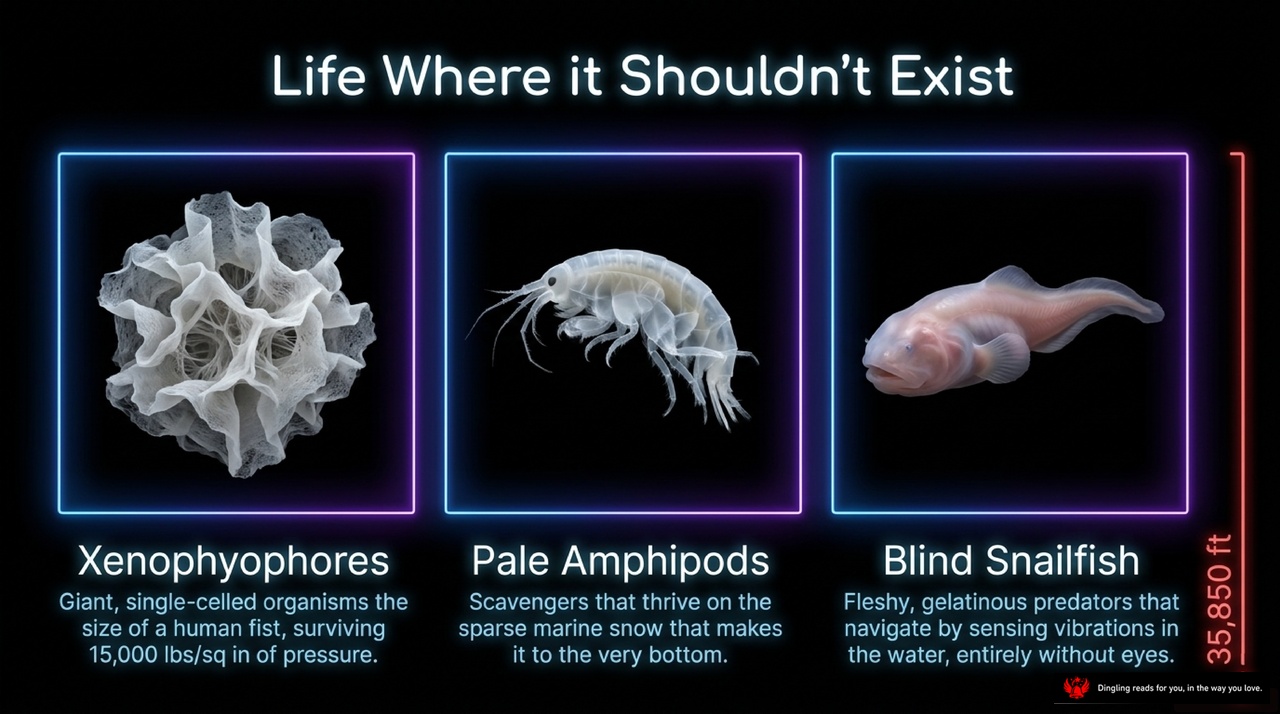
Imagine a world so deep, so dark, and so crushing that logic says nothing should survive. Yet, life not only exists here; it thrives in the most hostile environments on Earth. Today, we are diving into the Hadal Zone, the ocean's deepest realm, where pressure is a thousand times greater than at the surface, and sunlight has never touched.
Here, in the abyss, we find creatures that defy our expectations. First, there are the Xenophyophores. These are giant, single-celled organisms, roughly the size of a human fist, yet they withstand pressures of 15,000 pounds per square inch. Next, look at the Pale Amphipods. These are scavengers that have mastered the art of survival on "marine snow"—the sparse, drifting debris from the upper ocean that sinks down to feed them at the very bottom. Finally, we encounter the Blind Snailfish. These are fleshy, gelatinous predators that navigate this pitch-black world not by sight, but by sensing vibrations in the water, entirely without eyes.
At a depth of over 35,000 feet, these creatures prove that life is far more resilient than we ever imagined. They don't just endure the pressure; they have evolved to embrace it. Their soft, gelatinous bodies prevent them from being crushed, and their unique biological mechanisms allow them to hunt, reproduce, and survive where we would instantly be destroyed. This isn't just a collection of weird animals; it's a testament to the incredible adaptability of life on our planet.
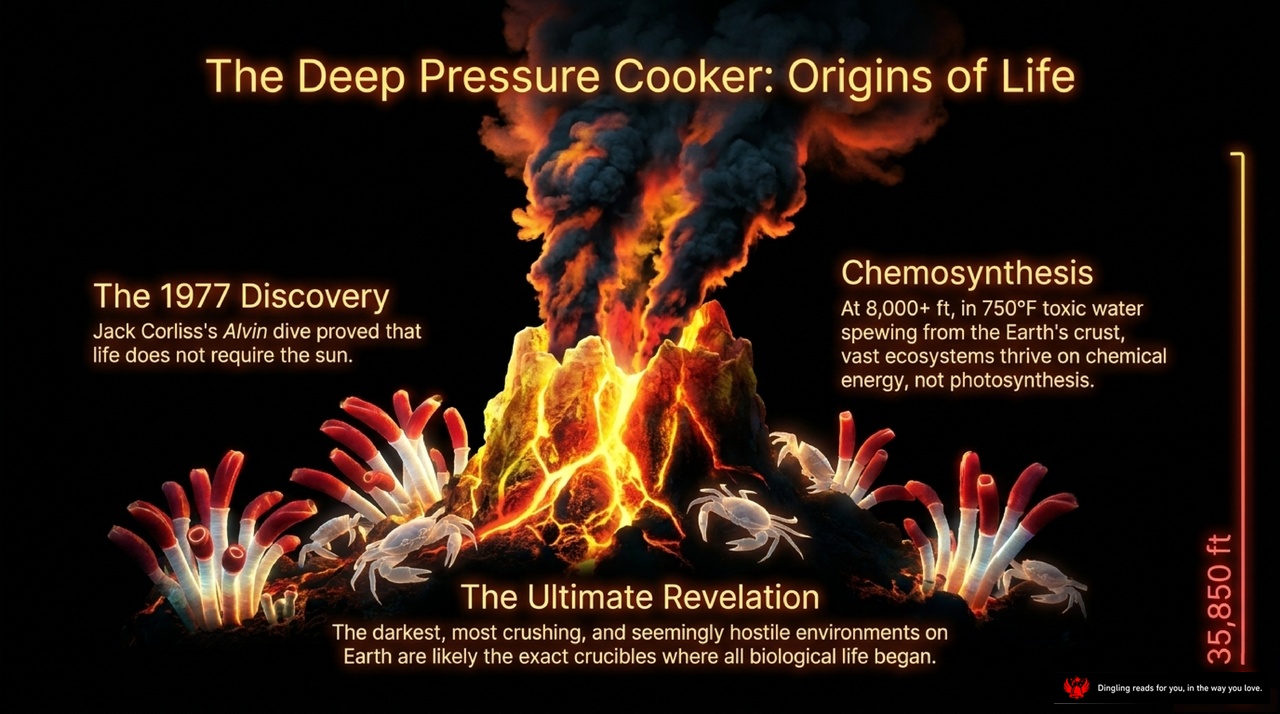
Imagine Earth's deepest trenches not as a silent, dead zone, but as a bustling kitchen where life began without the sun. In 1977, Jack Corliss's dive to 8,000 feet revealed a shocking truth: vibrant ecosystems thrive in 750-degree toxic water, powered entirely by chemical energy rather than photosynthesis. This discovery, the "Ultimate Revelation," shattered the ancient belief that all life needs sunlight. It proved that the darkest, most crushing environments on our planet are actually the exact crucibles where biology was born. Just like a deep pressure cooker, these hydrothermal vents provide the perfect high-pressure, high-heat environment for life to emerge from chemistry. This means the origin of life isn't found in a sunny ocean, but hidden in the dark, boiling depths, waiting for us to uncover the true story of our existence.

Synthesis: The Ancestral Connection. Look at this split image. On the left, a human embryo curled in the womb; on the right, the deep ocean where we truly belong. We are born of the ocean, not just metaphorically, but biologically. Our blood chemistry mirrors seawater perfectly. Think about this: at just one month old, a human embryo develops fins, and by week five, we have a two-chambered heart identical to a fish. We are literally built for the water.
This isn't just about biology; it's about memory. The Mammalian Dive Reflex isn't a skill we learn in the gym; it's a dormant evolutionary memory. When we face cold water, our bodies remember how to survive. The deep ocean is our ancient home, and our bodies still hold the blueprint for thriving there.
As we synthesize these insights, a profound truth emerges: the deep ocean is our ancestral connection. We aren't aliens visiting a foreign planet; we are descendants of the sea, returning to the place where life began. Our bodies remember the pressure, the silence, and the rhythm of the deep, waiting for us to wake up and listen again.

The descent is not a retreat; it is a profound return to our roots. As we plunge into the crushing, lightless depths of the ocean, we do more than just discover alien ecosystems or push against the absolute limits of biology. We unlock dormant, ancient capabilities that have been wired into the very fabric of our human bodies.
Think about it: when we dive deep, we uncover the exact crucible where life on Earth began. We are literally stepping back in time to the conditions that created us. This is why we often look up to the stars for answers to our origins, chasing myths about alien life. But the text asks a powerful, grounding question: Why do we look to the stars for answers to our origins, when our greatest mysteries are sleeping in the black depths of our own ocean?
The answer lies in the fact that the ocean isn't a foreign world to us. It is our ancestral home. By diving down, we reconnect with the biological instincts that allowed us to survive eons ago, proving that our deepest connection isn't out there in the cosmos, but right here, beneath the waves.