
Demystifying the Chinese Economy: Complete Chapter-by-Chapter Summary
Welcome everyone. Today, we're diving into one of the most fascinating economic stories of the modern era: Demystifying the Chinese Economy.
This session is built on the work of Justin Yifu Lin, who provides a comprehensive theoretical framework to make sense of China's unique journey. We'll explore how China diverged historically from the Western path, and we'll break down the mechanics behind its miraculous economic transition.
We'll also look at the strategic blueprint that positions China for future global preeminence. It's not just about the GDP numbers; it's about understanding the logic of the rise. From a struggling agrarian society to a global manufacturing giant, the questions we ask today will shape how we understand the future of the world economy.
Let's get into it.
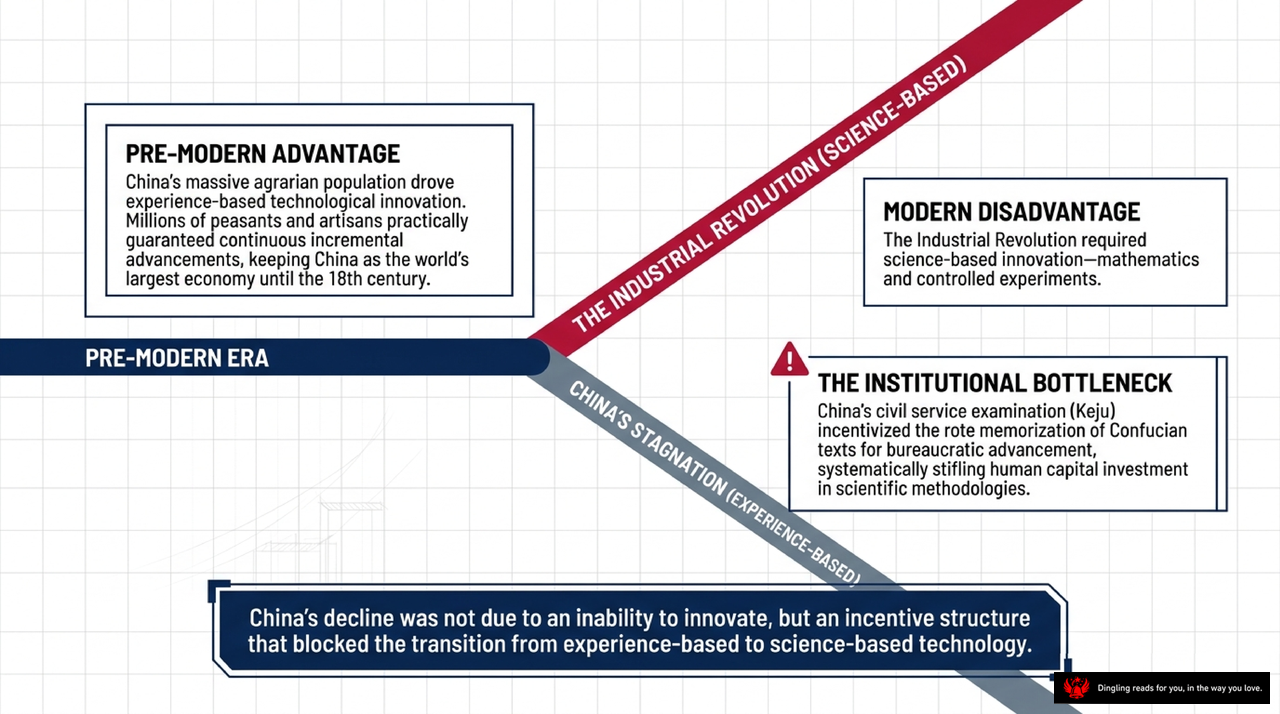
Let's dive into this slide, which visualizes the core of what we call Li Ke-Te's Puzzle. It breaks down the dramatic shift from China's pre-modern dominance to its modern stagnation.
On the left, we have the 'Pre-Modern Advantage.' For nearly two thousand years, China was the world's largest economy. Why? It wasn't magic. It was driven by a massive agrarian population that fostered experience-based technological innovation. Think about it: millions of peasants and artisans constantly tweaking tools and farming techniques. That's why China led the world in technology—gunpowder, the compass, paper, and printing were all Chinese inventions. In fact, by the 13th century, China's steel production was far ahead of Europe's. This guaranteed continuous, incremental advancements. That's why China remained ahead until the 18th century.
But then, look at that red arrow pointing right: 'The Industrial Revolution.' This is the turning point. The modern era required a completely different engine: 'Science-Based' innovation. It demanded mathematics, controlled experiments, and a systematic approach to understanding the natural world. This is the 'Modern Disadvantage' China faced.
Now, here is the critical question: Why did China fail to make this switch? The diagram highlights 'The Institutional Bottleneck.' This is the real culprit. China's Civil Service Exam, known as the Keju, incentivized the rote memorization of Confucian texts for bureaucratic advancement. It systematically stifled human capital investment in scientific methodologies. The brightest minds were funneled into studying classics instead of math or physics. As the text notes, even if someone observed natural phenomena, they lacked the mathematical tools to turn those observations into a scientific theory.
The puzzle has two sides. First, why was China so advanced before? Second, why is it behind now? The answer lies in the incentive structure. The conclusion at the bottom sums it all up: China's decline wasn't due to an inability to innovate. It was an incentive structure that blocked the transition from experience-based to science-based technology. While Europe was building on science, China was building on tradition. That structural mismatch is why the Industrial Revolution bypassed China, leaving it behind. This isn't just about history; it's about understanding how institutions shape economic destiny. If you want to understand China's future, you have to understand this past bottleneck.
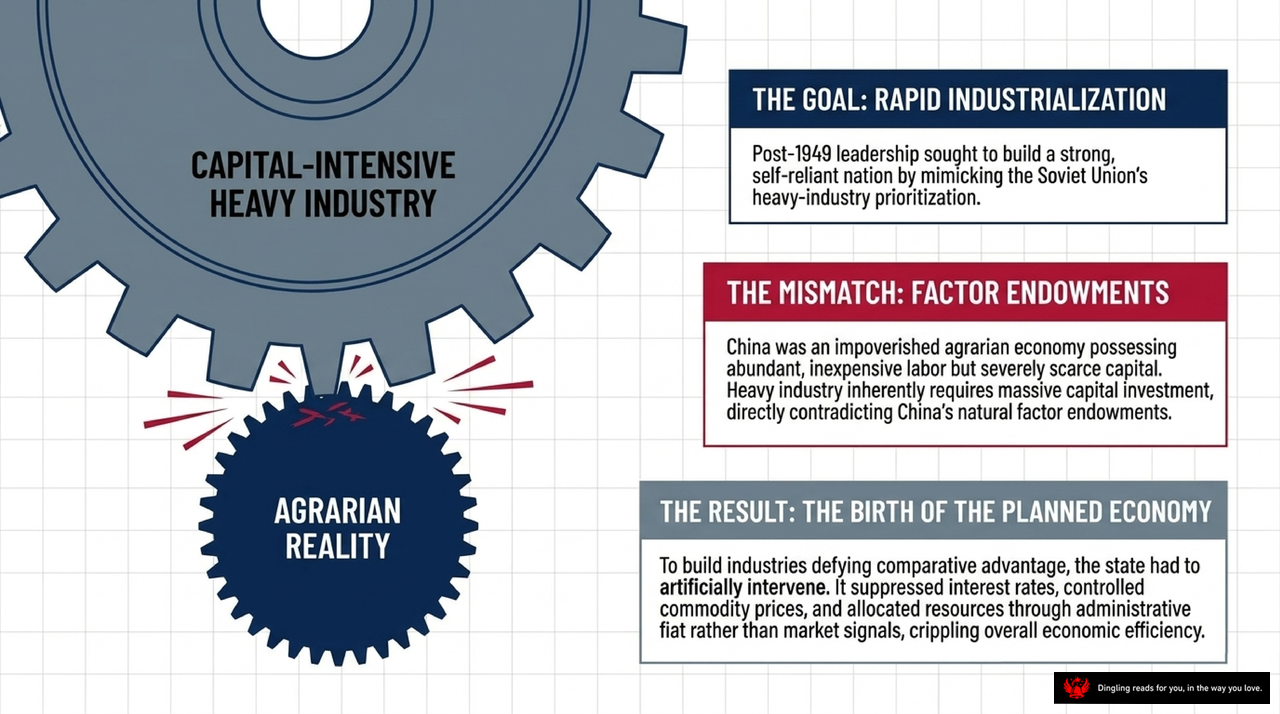
Let's dive into the "East Asian Miracle." After WWII, many developing nations tried to copy the West by building heavy industry immediately. This is what we call the "Leapfrog Strategy." But here's the twist: most failed, while Japan, South Korea, and the "Four Little Dragons" succeeded. Why?
The answer lies in a concept called "Self-Generated Ability." Think of it this way: In a free market, can a company survive without government handouts? If the answer is no, it lacks self-generated ability. In countries with lots of cheap labor but little capital, building capital-heavy industries is like trying to run a Ferrari on a bicycle budget. Those companies can't survive without constant subsidies.
This creates a vicious cycle. Because these companies can't survive on their own, the government keeps pouring money into them. This is known as a "Soft Budget Constraint." Managers stop trying to be efficient because they know the state will bail them out. Resources get wasted, and the economy gets stuck. This is the root of the failure in the Leapfrog Strategy.
The successful Asian economies did it differently. They followed their "Comparative Advantage." Since they had abundant labor, they started with labor-intensive industries. This was a smart move. It generated profits, which allowed them to save and accumulate capital. Once they had enough capital, they naturally moved up to more complex industries.
So, the core lesson is about matching your strategy to your reality. Don't try to build a skyscraper when you only have bricks. Start with what you have. Follow the market signals, not political goals. This approach maximizes efficiency and creates a stable path to growth. This is why following comparative advantage is the key to sustainable development.
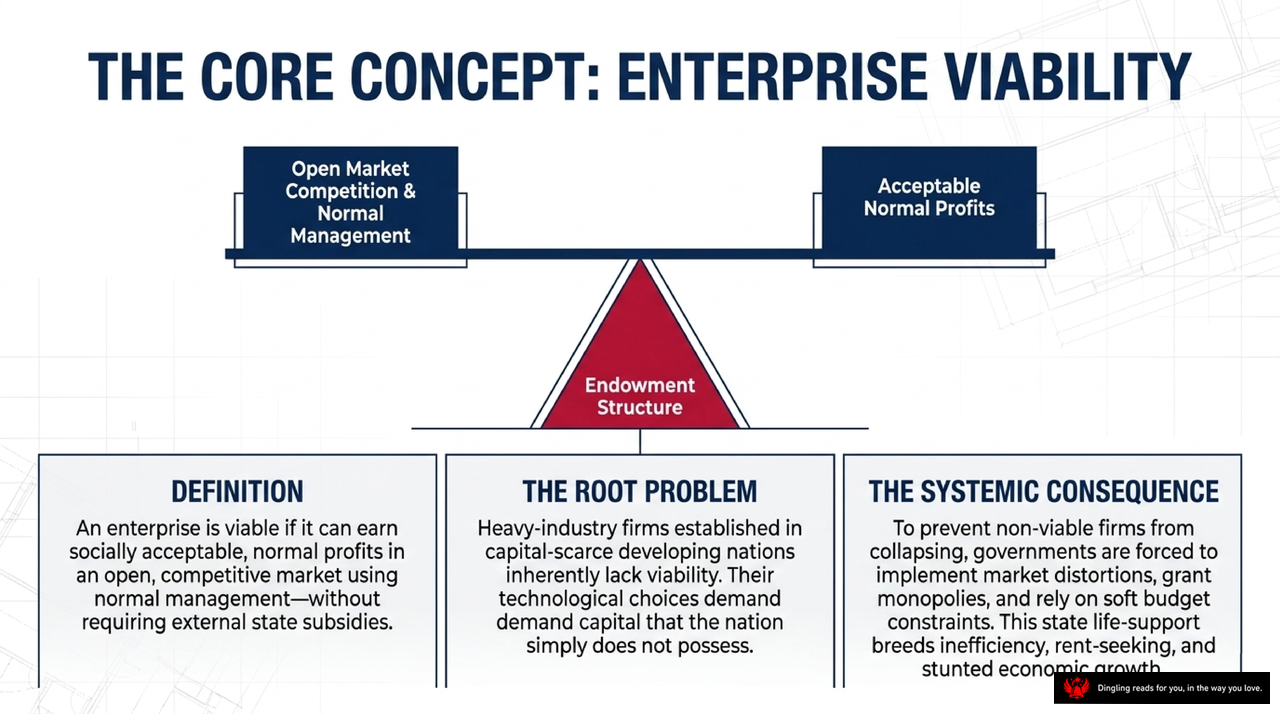
Let's look at the core concept: Enterprise Viability. Imagine this balance scale on the screen. On the left, you have open market competition and normal management. On the right, you have acceptable normal profits. The pivot point holding this all together is the Endowment Structure.
So, what exactly is enterprise viability? An enterprise is viable if it can earn a socially acceptable, normal profit in a competitive market using normal management—without needing external state subsidies. In other words, can the business survive on its own?
Here is where the trouble often begins for developing nations. The root problem is a structural mismatch. Heavy-industry firms established in capital-scarce developing nations inherently lack viability. Think about it: these countries have plenty of labor, but they simply do not possess the massive capital required for heavy industry. Their technological choices demand resources they don't have.
Because these firms cannot survive in a free market, the government is forced to intervene. To prevent non-viable firms from collapsing, states are forced to implement market distortions, grant monopolies, and rely on soft budget constraints. 'Soft budget constraints' means the government guarantees that even if a company fails, it will be bailed out.
This creates a dangerous systemic consequence. This state life-support breeds inefficiency. When managers know they won't go bankrupt, they have no incentive to innovate. Instead, it breeds rent-seeking, where the real game becomes how to get subsidies from the government rather than how to make good products. This ultimately leads to stunted economic growth.
The solution lies in aligning your strategy with your reality. You cannot force a capital-scarce economy to build capital-intensive industries. You must follow the comparative advantage. Start with labor-intensive industries where you have an edge. As you accumulate capital over time, the endowment structure changes, and then you can move up to heavier industries. Only by matching your industrial choices to your actual resources can you create truly viable enterprises and achieve sustainable growth. This logic explains why some nations succeed while others remain stuck in the same trap.
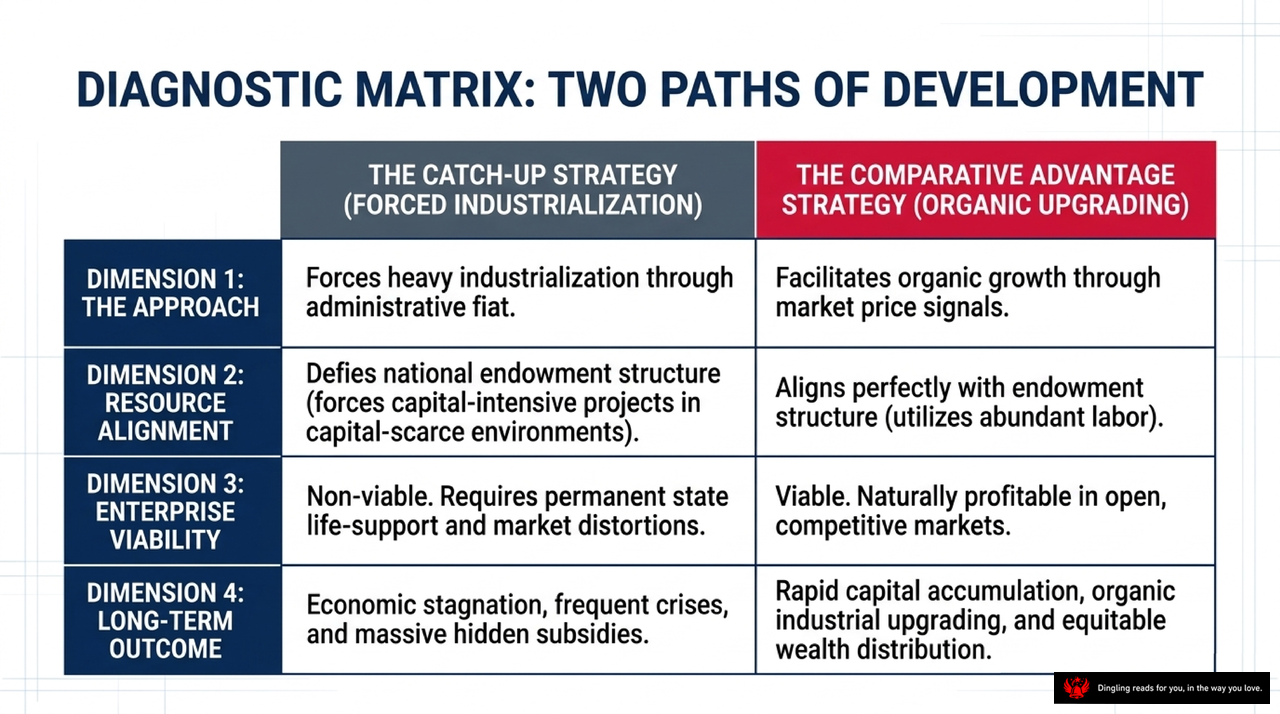
Welcome to the diagnostic matrix. Today, we're comparing two distinct paths of development that determine a nation's economic fate. On the left, you see the Catch-Up Strategy, often labeled Forced Industrialization. On the right, the Comparative Advantage Strategy, or Organic Upgrading.
Let's look at the Catch-Up path. This approach relies on administrative fiat. Governments force heavy industrialization, often ignoring the country's actual resource structure. If a nation is capital-scarce but labor-rich, forcing it into capital-intensive projects is a fundamental mismatch. These enterprises lack self-generation ability. They are non-viable on their own. They require permanent state life-support and market distortions to survive. This creates a "policy burden" where companies rely on subsidies rather than innovation. The long-term outcome? Economic stagnation, frequent crises, and massive hidden subsidies. It's a recipe for a dead end.
Now, look at the right side. The Comparative Advantage Strategy. This facilitates organic growth through market price signals. Instead of forcing a path, it aligns perfectly with the national endowment structure. If you have abundant labor, you utilize that. These enterprises are viable. They are naturally profitable in open, competitive markets because they are playing to their strengths. The outcome is rapid capital accumulation and organic industrial upgrading. As you accumulate capital, you naturally move up the value chain. This leads to equitable wealth distribution and sustainable growth.
This matrix explains why some nations thrive while others struggle. It's not about copying the West's heavy industry immediately. It's about respecting your own economic reality. By following the comparative advantage path, a country can avoid the traps of the catch-up strategy and achieve true, sustainable modernization. This logic is proven by the East Asian Miracle, where nations like Japan and South Korea utilized their labor advantages first before upgrading. Conversely, nations that ignored this often fell into the "Latin American trap" of debt and stagnation. Ultimately, the key to development isn't speed, but alignment.
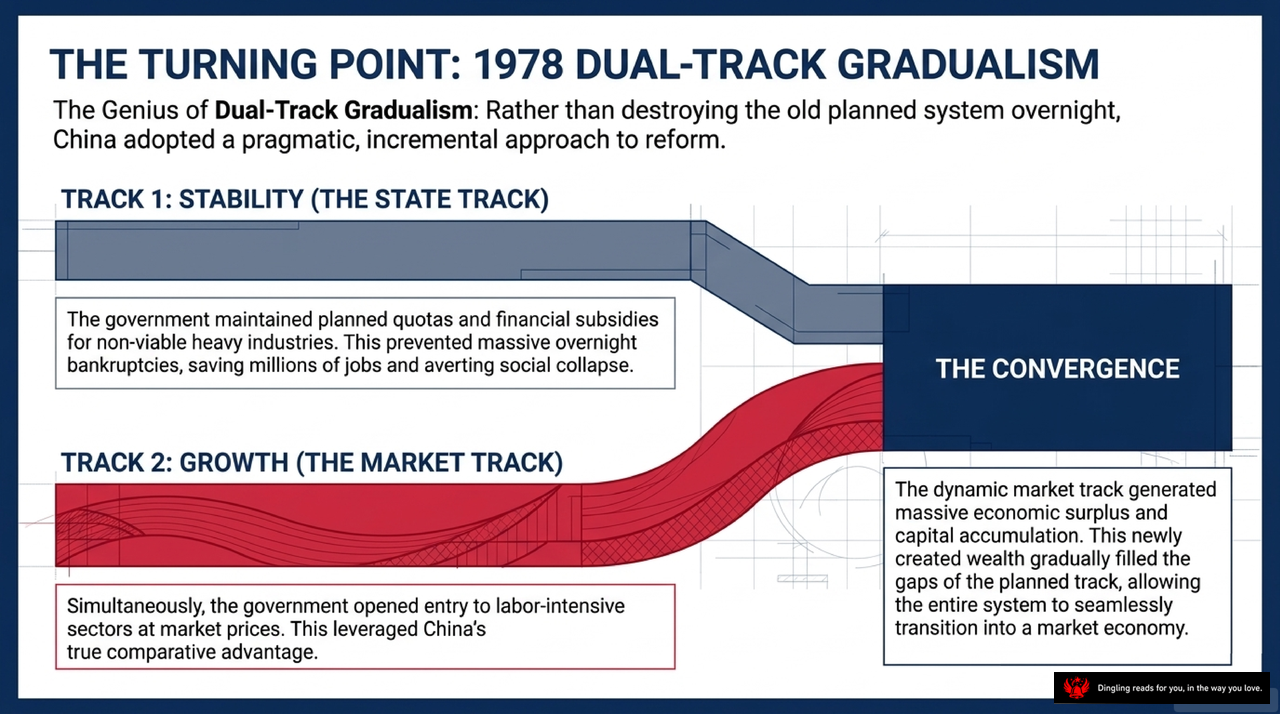
Welcome to this pivotal moment: 1978. This slide illustrates the genius behind China's Dual-Track Gradualism. Unlike the Shock Therapy that failed elsewhere, China chose a pragmatic, incremental path.
Let's look at the two tracks shown here. Track 1, labeled Stability, is the State Track. The government did not abandon the old planned system immediately. Instead, it maintained planned quotas and financial subsidies for those heavy industries that were non-viable. This was a crucial safety net. It prevented massive overnight bankruptcies, saved millions of jobs, and averted social collapse. It kept the old system running long enough to reform it. This is the Stock reform, managing what already exists.
Track 2, labeled Growth, is the Market Track. Simultaneously, the government opened entry for labor-intensive sectors at market prices. This leveraged China's true comparative advantage, its abundant labor force. This dynamic market track generated massive economic surplus and capital accumulation. This is the Incremental reform, creating new growth.
The real magic is in The Convergence. The wealth created by the market track gradually filled the gaps in the planned track. As capital accumulated, the old industries gradually gained competitiveness. This allowed the entire system to transition seamlessly into a market economy. The market track expanded, and the planned track shrank, until they merged into a single market.
Why did this work when others failed? Because it addressed the core issue of enterprise self-generating ability. By following the Comparative Advantage Strategy, China let the market determine what to produce. It did not force capital-intensive industries prematurely. This incremental reform cultivated growth in the new sectors while slowly solving the problems in the old ones. It balanced stability with growth.
In contrast, Shock Therapy ignored this reality, assuming all enterprises were viable. It led to chaos, inflation, GDP decline, and social indicators worsening. Unlike the East European countries that suffered severe economic contraction and social unrest during their transition, China's model ensured continuous growth. This pragmatic transition provided a blueprint for other developing nations seeking stability and growth. It shows that reform is not about a sudden switch, but about managing the transition carefully. This approach, often called Incremental Reform, allowed China to achieve high-speed growth while maintaining social stability, a lesson that remains relevant for developing economies today.
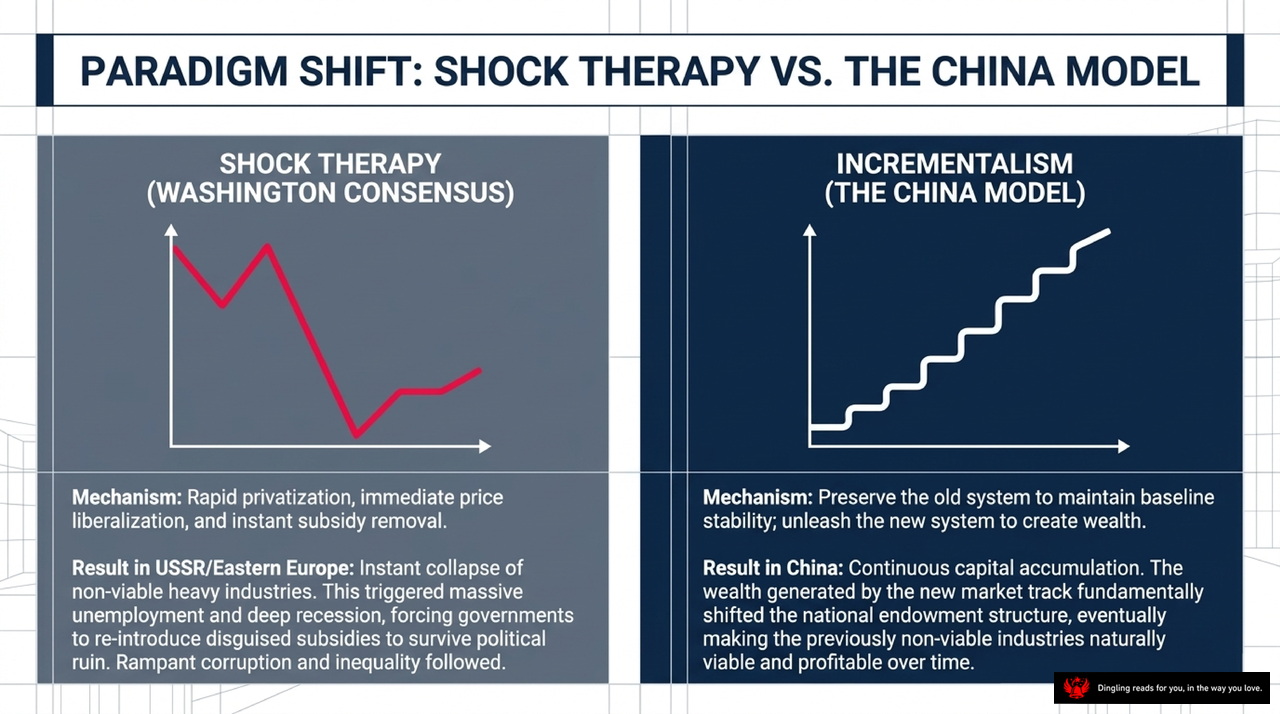
Let's look at this slide comparing two very different paths for economic transformation. On the left, we have 'Shock Therapy,' often linked to the Washington Consensus. The graph shows a volatile, crashing line. This approach demanded rapid privatization, instant price liberalization, and immediate subsidy removal. The result? As the text notes, it led to the instant collapse of non-viable industries in the USSR and Eastern Europe. Massive unemployment, deep recession, and rampant corruption followed. Governments were forced to reintroduce subsidies just to survive politically, creating a cycle of instability.
On the right side, we see 'Incrementalism,' or the China Model. Notice the graph here—it's a steady, step-by-step climb. Instead of ripping out the old system overnight, China preserved the old structure to maintain baseline stability while unleashing the new system to create wealth. This mechanism allowed for continuous capital accumulation. Wealth generated from the new market track shifted the national endowment structure, eventually making previously unviable industries profitable over time. This is a stark contrast to the chaos on the left.
Why did this work? It comes down to one core concept: enterprise self-generating ability. The mainstream theory behind shock therapy assumed that firms were efficient and just needed property rights to survive. But in reality, many state-owned enterprises lacked self-generating ability because they were forced to develop capital-intensive industries in a labor-rich economy. Without government subsidies, they would have failed. Shock therapy ignored this reality, leading to severe crisis.
China's dual-track reform solved this differently. It focused on solving the enterprise self-generating ability issue through incremental reform. By opening up the comparative advantage sectors first, China created new growth momentum. This gave the government time to gradually solve the problems in the traditional sector without causing social collapse. The result? 230 million people lifted out of poverty, becoming the world's second-largest economy, all while maintaining social stability. The annual GDP growth averaged nearly 10% for decades.
Mainstream economic theories often come from developed countries and might not fit developing nations. China's experience shows that you can't just copy-paste institutional forms. You need to understand the real economic constraints. By following the comparative advantage strategy and respecting the self-generating ability of enterprises, China turned a potential crisis into a global success story. We need to stop blindly following Western models and start building theories that fit our own reality. China's experience is a gold mine for theoretical innovation. This is the true path to development.
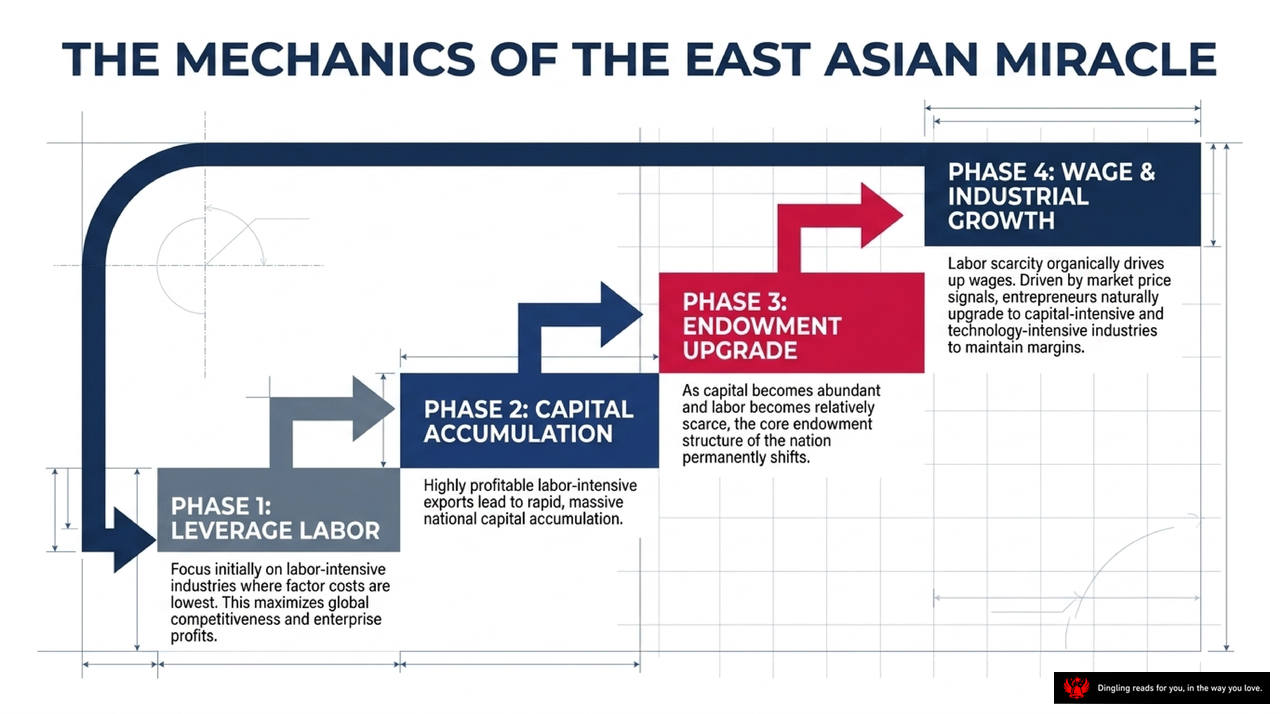
So, let's look at this diagram. It outlines the mechanics behind the East Asian Miracle. It shows a four-step progression that explains how countries like Japan, South Korea, and China achieved rapid growth, transforming from poor agrarian societies into industrial powerhouses.
It starts with Phase 1: Leverage Labor. In the beginning, these nations had plenty of workers but very little capital. The smart move was to focus on labor-intensive industries where their factor costs were lowest. By maximizing global competitiveness through cheap labor, they generated high enterprise profits. This is the foundation of the catch-up advantage.
This leads directly to Phase 2: Capital Accumulation. Those highly profitable labor-intensive exports didn't just sit in foreign markets; they brought in massive foreign exchange. This led to rapid, massive national capital accumulation. Essentially, the profits from the first phase funded the second. This is how they built the financial infrastructure needed for the next stage.
Then comes the critical pivot point: Phase 3: Endowment Upgrade. As capital becomes abundant and labor becomes relatively scarce, the core endowment structure of the nation permanently shifts. You can't keep relying on cheap labor forever. The math of production changes. The book notes that this shift is organic, not forced.
Finally, this drives Phase 4: Wage and Industrial Growth. Labor scarcity organically drives up wages. Driven by market price signals, entrepreneurs naturally upgrade to capital-intensive and technology-intensive industries to maintain margins. This isn't about government forcing change; it's about market signals guiding the economy to higher value sectors.
The book emphasizes that this path is the only sustainable one. If you try to skip these steps and force capital-intensive industries too early, what we call a catch-up strategy without the foundation, you end up with policy burdens and inefficient state-owned enterprises that rely on subsidies. But by following the comparative advantage, matching your industry to your resources at that specific moment, you build self-generating enterprises. This natural progression from labor to capital to technology is why these economies could grow so fast and eventually catch up to the West. It is a structural transformation that prioritizes efficiency and market signals over political mandates. It proves that sustainable development isn't about copying the West's starting point, but about following the right path for your own resources.
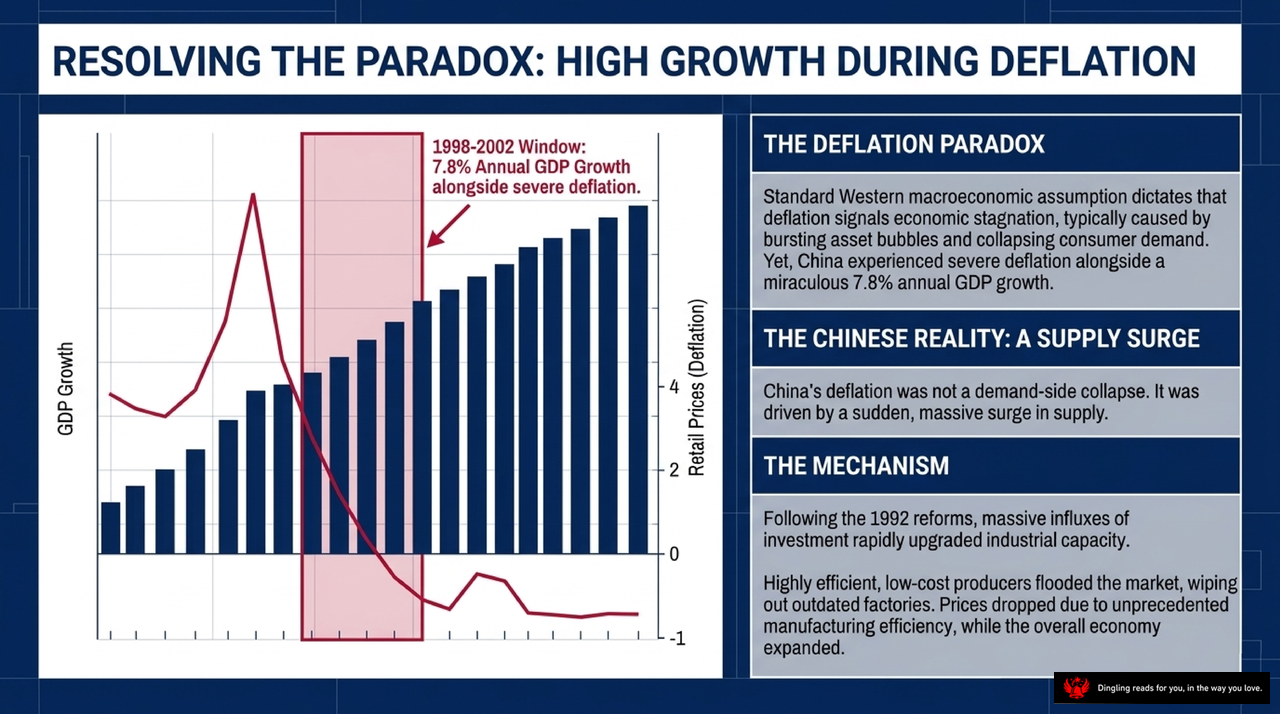
Welcome to this critical section where we resolve a major economic paradox. Look at the chart on the left. It shows a window from 1998 to 2002. During this time, China experienced severe deflation—prices were dropping—yet simultaneously, GDP growth was a miraculous 7.8% annually. Standard Western macroeconomic theory dictates that deflation signals economic stagnation, typically caused by bursting asset bubbles or collapsing consumer demand. If that were true, China should have been in a recession. But it wasn't.
So, what was the Chinese reality? The slide tells us it was a supply-side surge, not a demand-side collapse. This is a crucial distinction. Following the 1992 reforms, massive influxes of investment rapidly upgraded industrial capacity. Highly efficient, low-cost producers flooded the market, wiping out outdated factories. Prices dropped due to unprecedented manufacturing efficiency, while the overall economy expanded.
This phenomenon aligns perfectly with the book's broader argument about comparative advantage and industrial upgrading. In the early stages of development, countries like China leverage their abundant labor to compete on cost. As the book notes, the 'East Asian Miracle' wasn't about copying the West's high-cost model; it was about leveraging comparative advantage. China's deflation wasn't a failure; it was a sign of competitive success. The market was clearing out inefficient players, and the remaining ones were becoming more productive.
Think about the mechanism here. It wasn't that people stopped buying things. It was that things became so much cheaper and better that the economy could grow even while prices fell. This is the power of supply-side reform. By improving efficiency and expanding capacity, China could absorb global demand at lower prices, fueling growth. This challenges the old narrative that deflation is always a crisis. In this context, it was a byproduct of becoming the world's most efficient manufacturer.
So, the paradox resolves when you look at the underlying mechanism. It was a supply-side revolution, driven by industrial upgrading and efficiency gains. This aligns with the book's thesis that following comparative advantage allows for stable, high-speed growth. It's a powerful lesson: sometimes, falling prices are just the cost of becoming the world's factory. Understanding this supply-side dynamic is key to understanding China's unique economic trajectory. This also highlights why the 'catch-up strategy' works when it aligns with the nation's factor endowments, rather than forcing a premature industrial leap that creates 'policy burdens' and 'soft budget constraints' as discussed in the book. By staying true to the supply-side reality, China turned a potential crisis into a period of robust expansion.
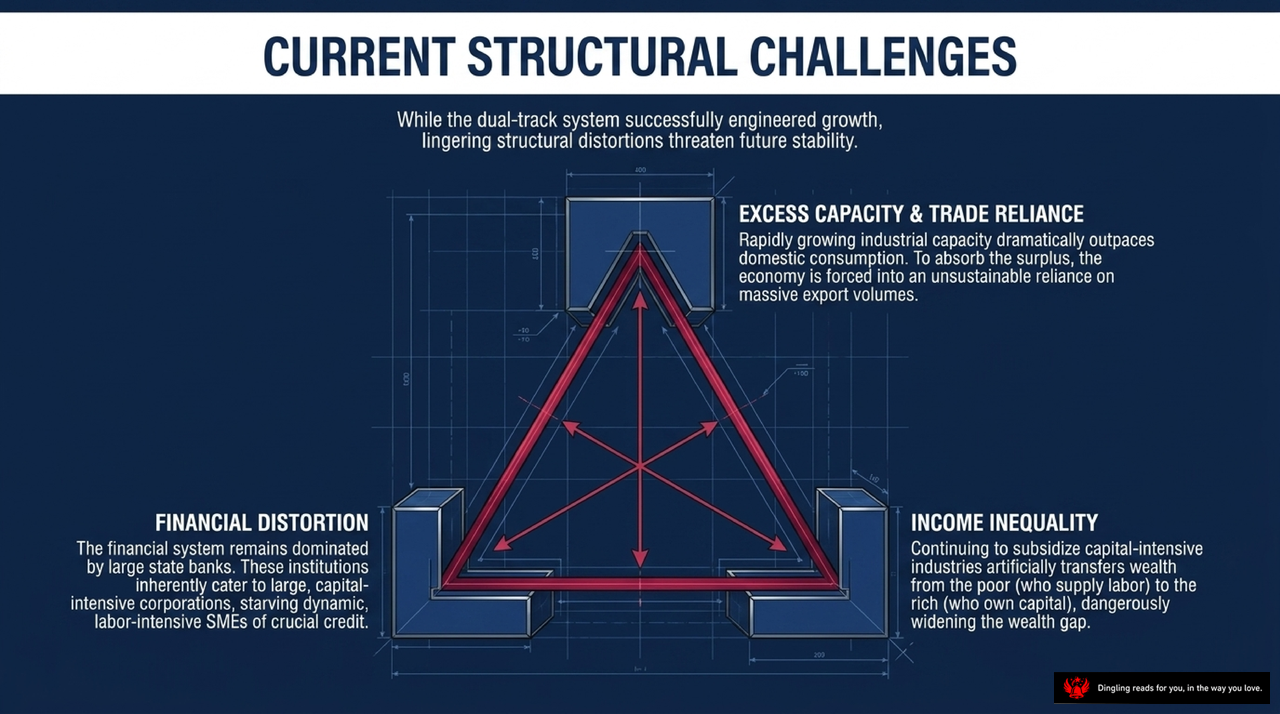
Welcome back. Today we're diving into the "Current Structural Challenges." As this diagram illustrates, while the dual-track system successfully engineered growth for decades, lingering structural distortions now threaten future stability. We need to look closely at the three pillars holding up this triangle.
First, consider Income Inequality. The text explains that continuing to subsidize capital-intensive industries artificially transfers wealth from the poor—who supply labor—to the rich who own capital. This mechanism dangerously widens the wealth gap. It's not just about numbers; it's about social stability. When the majority feels left behind, the foundation of the economy weakens. The book points out that this trend has accelerated, with the Gini coefficient climbing to levels comparable to Latin America, signaling a deepening divide that could undermine long-term social cohesion.
Second, we have Financial Distortion. The financial system remains dominated by large state banks. These institutions inherently cater to large, capital-intensive corporations, effectively starving dynamic, labor-intensive SMEs of crucial credit. This is a critical bottleneck. Small businesses are the engines of innovation and employment, yet they are being cut off from the capital they need to grow. This rigidity in the financial sector prevents the economy from adapting to new opportunities and limits the potential for job creation in the modern sector.
Third, there is Excess Capacity and Trade Reliance. Rapidly growing industrial capacity dramatically outpaces domestic consumption. To absorb this surplus, the economy is forced into an unsustainable reliance on massive export volumes. This creates a vulnerability. If global demand slows, or if trade partners restrict access, the domestic economy lacks the internal demand to sustain itself. The book highlights that this external imbalance puts pressure on the currency and limits the space for monetary policy, making the economy susceptible to external shocks.
These three challenges are deeply interconnected. Inequality reduces domestic consumption; financial distortion prevents the small sector from growing; and trade reliance exposes the economy to external shocks. The text suggests that without resolving these structural issues, the long-term growth potential is compromised. The path forward requires shifting from this distorted model to one that aligns with comparative advantage, prioritizing domestic consumption and fair competition. This isn't just an economic adjustment; it's a necessity for sustainable development and social harmony.
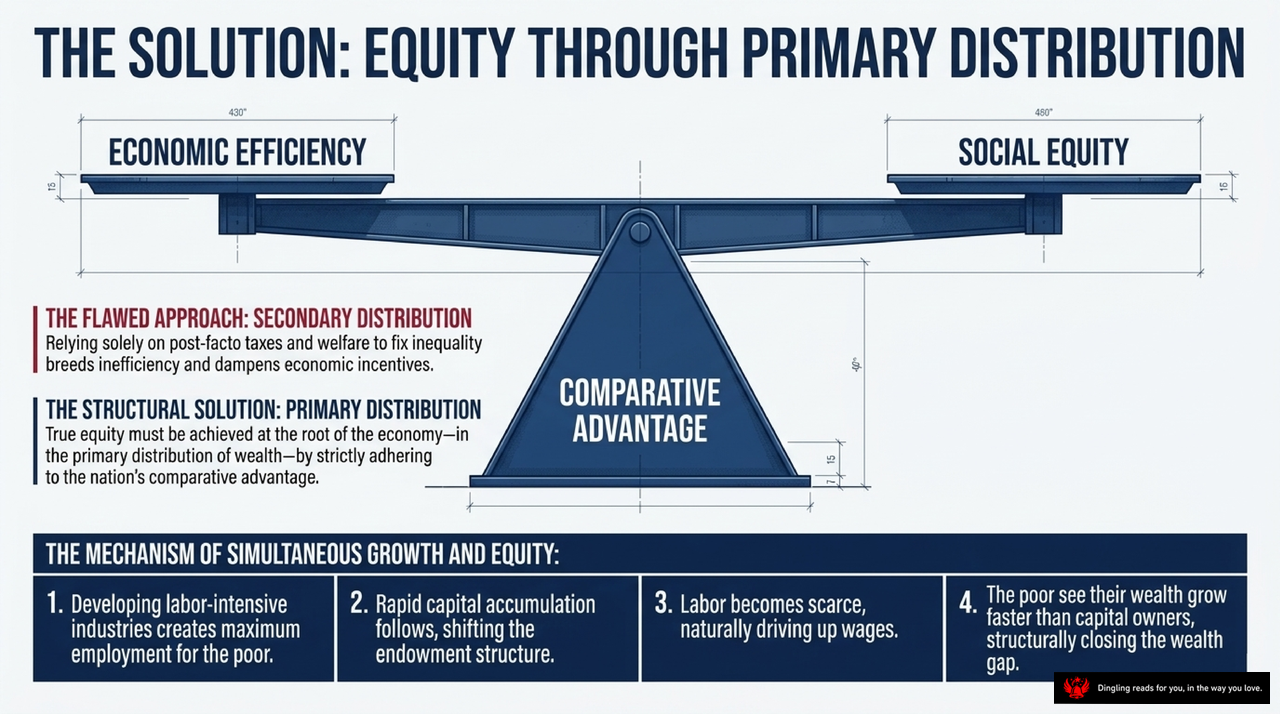
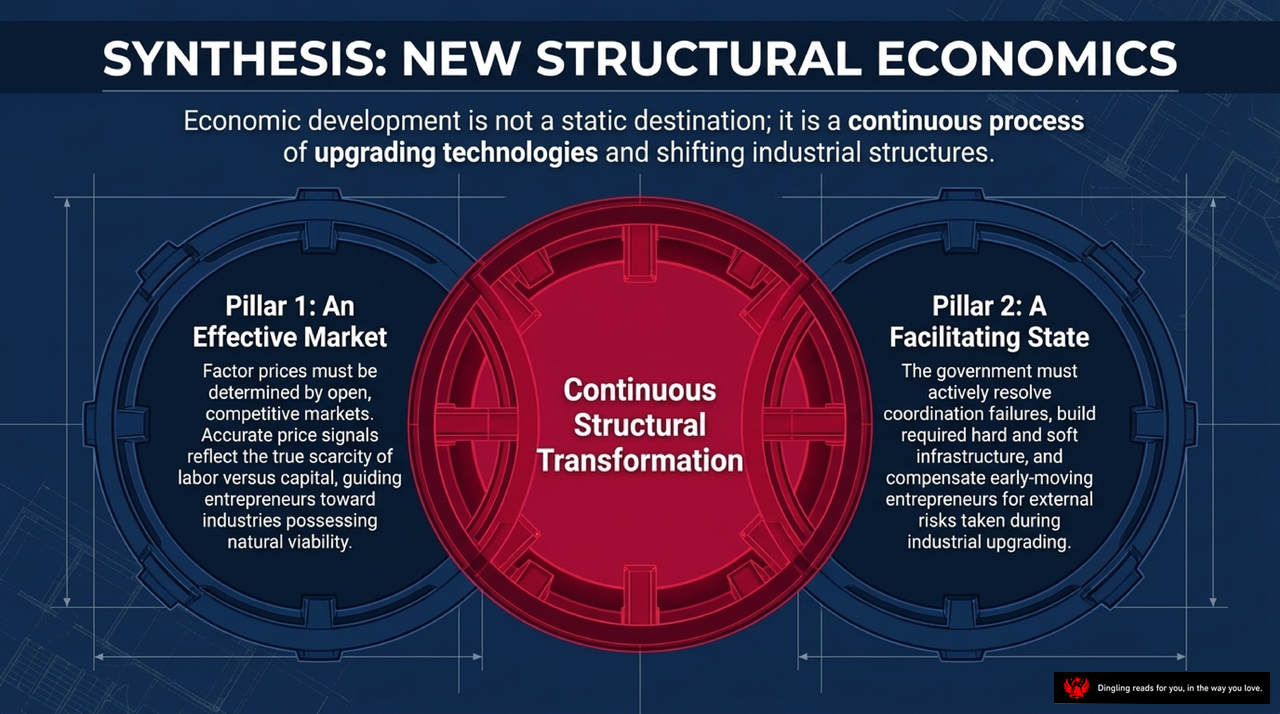
Let's synthesize everything we've discussed into a single, actionable framework. This slide introduces the concept of New Structural Economics. The fundamental takeaway is that economic development is not a static destination. It is a continuous process of upgrading technologies and shifting industrial structures.
To make this happen, we need two supporting pillars. The first is an Effective Market. According to the text, factor prices must be determined by open, competitive markets. This is crucial because accurate price signals reflect the true scarcity of labor versus capital. These signals guide entrepreneurs toward industries that possess natural viability, ensuring that capital flows to where it is most productive. If we distort these prices, we misallocate resources and stifle growth.
The second pillar is a Facilitating State. This isn't about control; it's about enabling. The government must actively resolve coordination failures, build the required hard and soft infrastructure, and compensate early-moving entrepreneurs for the external risks they take during industrial upgrading. The book emphasizes that the government's role is to provide information services, coordinate supporting resources, and eliminate obstacles to industrial upgrading, rather than picking winners directly.
When these two pillars align, you achieve Continuous Structural Transformation. This framework explains the difference between successful and stagnant economies. The text highlights that following a comparative advantage strategy allows enterprises to develop self-generating ability. They can compete without constant subsidies. In contrast, trying to force a catch-up strategy by ignoring factor endowments creates a lack of self-generating ability, leading to inefficiency and the need for endless bailouts.
So, the path to sustainable growth is clear. Align your industrial structure with your factor endowments. Let the market guide the direction through accurate price signals. Ensure the state removes the roadblocks and supports the necessary infrastructure. This isn't just theory; it's the blueprint for the continuous transformation that defines a modern, thriving economy. By understanding these dynamics, we can better navigate the complex challenges of economic development. Ultimately, the goal is to create an environment where innovation thrives and resources flow to where they are most needed.
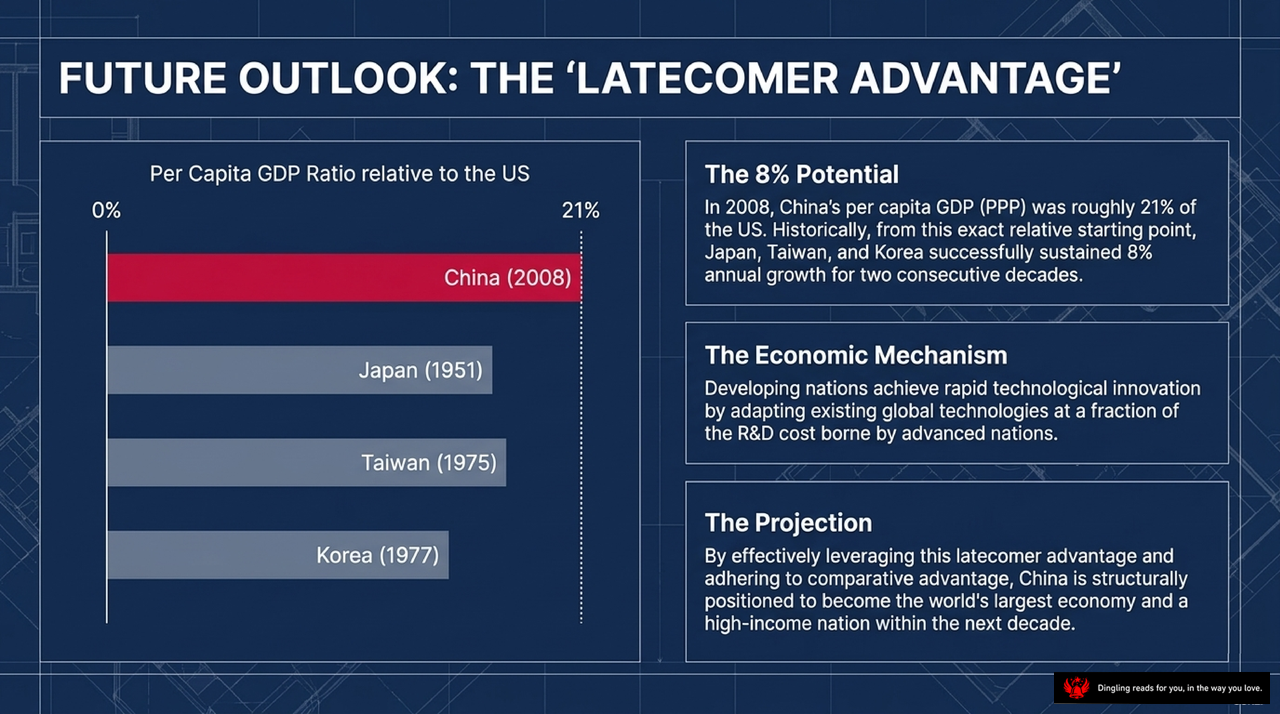
So, let's talk about the future outlook. The core theme here is what we call the 'Latecomer Advantage.' Look at the chart on the left. It shows the Per Capita GDP Ratio relative to the US. In 2008, China's per capita GDP, measured by PPP, was roughly 21% of the US. That red bar is key. Now, compare that to the gray bars below. Japan in 1951, Taiwan in 1975, and Korea in 1977. They all started from that exact same relative starting point.
What happened to those economies? Historically, from this exact relative starting point, Japan, Taiwan, and Korea successfully sustained 8% annual growth for two consecutive decades. This is the 8% Potential. It's a historical proof of concept.
But why does this happen? What is the economic mechanism? Developing nations achieve rapid technological innovation by adapting existing global technologies at a fraction of the R&D cost borne by advanced nations. Advanced nations spend billions on research, and failure rates are high. Developing nations can skip that expensive trial-and-error phase. They buy the technology, learn from it, and improve it. This is why the gap closes so quickly.
Now, what is the projection for China? By effectively leveraging this latecomer advantage and adhering to comparative advantage, China is structurally positioned to become the world's largest economy and a high-income nation within the next decade. The 8% potential is real, but it requires sticking to the strategy that worked for the Asian tigers. It's about smart growth, not just chasing numbers. The path is clear: utilize the gap, adapt the tech, and scale up. If the political and social environment remains stable, this transformation is within reach.
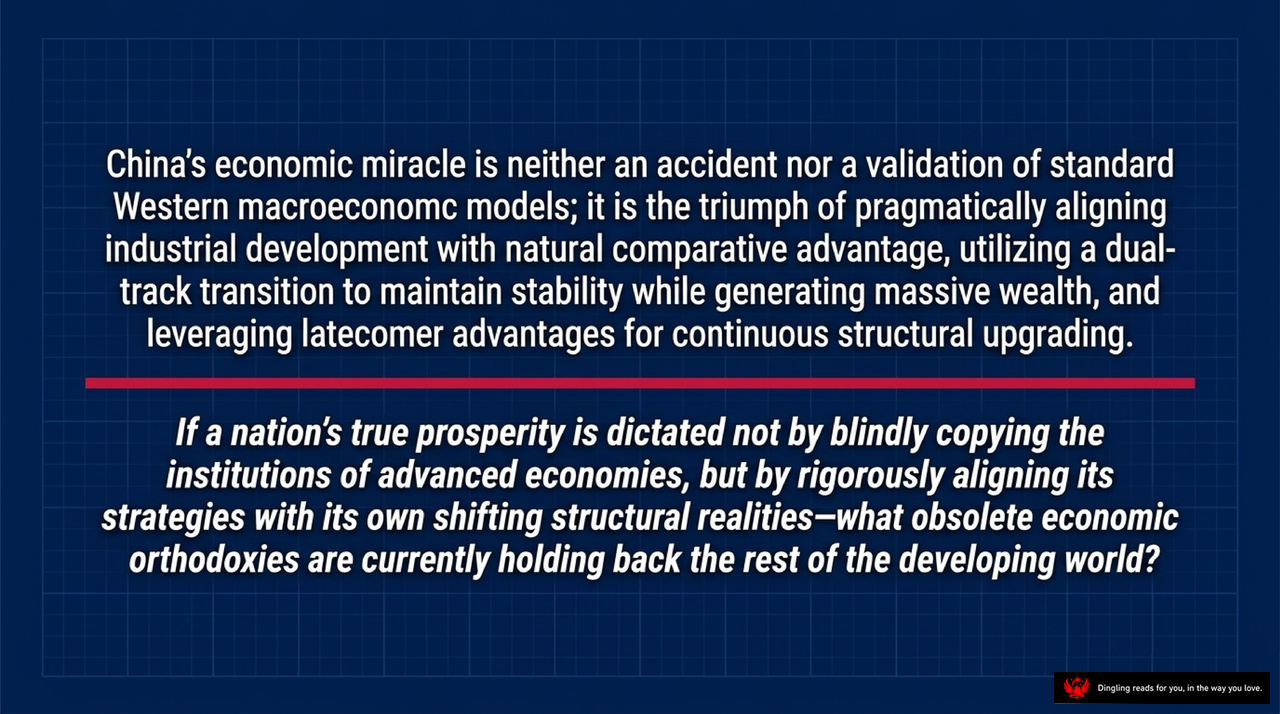
Let's look at this slide. It challenges a common narrative: that China's economic success was just luck or a proof that Western economic models work. Actually, the text suggests the opposite. China's miracle was the triumph of pragmatism.
China didn't try to blindly copy the institutions of advanced economies. Instead, they aligned their strategies with their own shifting structural realities. In the early days, China was capital-scarce but labor-rich. A 'catch-up strategy' that forced capital-heavy industries would have failed because those enterprises lacked 'self-generating ability.' Pursuing such a strategy leads to resource misallocation. But China chose the 'Comparative Advantage Strategy.' They started with labor-intensive industries where they had a competitive edge. This allowed companies to be profitable without needing constant government bailouts.
This approach is also described as a 'Dual-Track Transition.' While the West often pushes for rapid privatization, China grew the new market sector alongside the old planned system. This incremental reform maintained social stability while generating massive wealth. It allowed them to avoid the chaos seen in the 'Shock Therapy' experiments of the Soviet Union, which ultimately failed because those enterprises lacked self-generating ability to begin with.
Furthermore, China leveraged 'Latecomer Advantages.' Developing nations can learn from the technology leaders. Research shows that importing technology costs a fraction of the cost of developing it from scratch. China used this to speed up industrial upgrading, moving from processing to high-tech manufacturing. This mirrors the path taken by the 'East Asian Miracle' economies like Japan and South Korea, who followed a similar trajectory from labor-intensive to capital-intensive industries.
So, the slide ends with a provocative question. If prosperity is dictated by aligning with your own reality rather than copying others, what obsolete economic orthodoxies are holding back the rest of the developing world? Are we still trying to force-fit our economies into models that don't fit our factor endowments? This slide challenges us to look at our own structural realities and stop blindly following the map that worked for someone else. True growth comes from matching your industry choices to your resources, not copying the rules of the rich. It's about continuous structural upgrading based on your own reality.