
Deng Xiaoping and the Transformation of China: Complete Chapter-by-Chapter Summary

Welcome to our book club session on *Deng Xiaoping and the Transformation of China* by Ezra F. Vogel. This presentation serves as the architect's blueprint for understanding how a pragmatic leader navigated extreme ideological constraints to transform a broken, isolated state into an interconnected global economic superpower.
Deng Xiaoping didn't just lead China; he fundamentally reimagined it. Moving away from the rigid ideological constraints of the past, he focused on what actually worked. His famous "cat theory"—that it doesn't matter if a cat is black or white, as long as it catches the mouse—became the guiding principle for his era. He encouraged a "crossing the river by feeling the stones" approach, prioritizing practical results over abstract dogma. This shift allowed China to embrace market reforms, open its doors to foreign investment, and integrate into the global economy, setting the stage for the modern economic powerhouse we see today.

This slide contrasts two distinct eras of China's leadership, setting the stage for a transformation that would redefine the nation. On the left, we see the legacy of Mao Zedong, characterized by a rigid command economy and mass political movements. His legitimacy stemmed from ideological purity and class struggle, while his foreign policy focused on exporting revolution and isolating the West. The red, industrial imagery reflects this era of centralized control and self-reliance.
On the right, we see the blueprint for Deng Xiaoping's approach. His legitimacy was built on rapid economic growth and rising living standards, a stark shift from the previous era. Instead of ideological purity, Deng prioritized pragmatic experimentation and institutional rules. Economically, he introduced the "Socialist Market," embracing foreign investment with the famous mantra, "Let some get rich first." Foreign policy evolved from isolation to integrating with global markets, adopting the strategy of "hiding our capacities and biding our time."
The visual divide between the two sides illustrates the core of Deng's revolution: moving from a closed, command-driven system to an open, market-oriented one. This shift wasn't just about policy; it was about changing the very source of the state's power—from the purity of ideology to the prosperity of the people.

The image on your screen, titled "The Crucible of Exile," captures a pivotal moment in history: the years between 1969 and 1973. It depicts Deng Xiaoping working in a rural tractor factory, a stark contrast to the power he once held. The diagram illustrates his confinement, showing him pacing the courtyard "step by step, circle by circle," trapped within a 45.2-meter circumference.
During these three and a half years, Deng didn't just endure; he observed. He saw a harsh reality that the abstract theories of socialism couldn't explain. He noticed that after 20 years of the system, workers couldn't even afford a radio, and rural villages lacked basic toilets. This wasn't just bad luck or individual errors; Deng realized it was a severe systemic flaw.
This period became the "crucible" where his ideas were forged. He concluded that for China to survive and thrive, it required a complete institutional redesign. However, this redesign had to be implemented carefully enough to maintain the Communist Party's authority and prevent a return to the violent factionalism of the Cultural Revolution. It was in this quiet, confined space, away from the political center, that Deng began to rethink the entire trajectory of China's future, setting the stage for the reforms that would come decades later.

Look at this mechanical diagram: on the left, we have a heavy red block labeled "The Two Whatevers Faction," representing the rigid conservative ideology that insisted "whatever Mao decided" must be upheld. On the right, we see a counterweight labeled "Truth from Facts," which Deng Xiaoping used to lift that heavy block.
This image captures the pivotal moment in 1978 when Deng reinstated pragmatism. Following Mao's death, Deng faced entrenched conservatives like Hua Guofeng who clung to the "Two Whatevers." Instead of using military force, Deng executed a brilliant philosophical pivot. He championed a new standard: "Practice is the sole criterion for testing truth."
This shift is clearly illustrated by the balance in the diagram. By placing "Truth from Facts" on the other side, Deng outmaneuvered the old guard. At the landmark Third Plenum of the 11th Central Committee in December 1978, this pragmatic philosophy officially replaced "class struggle" as the state's guiding principle. The heavy weight of ideological dogma was lifted, and the Deng Era officially began, setting the stage for the reforms that would transform China.

Deng Xiaoping's leadership style was defined by a unique pragmatism, completely different from the rigid ideological purity of his predecessor. Instead of ruling with a grand, inflexible theory, he operated like a seasoned CEO executing a massive corporate turnaround for the nation. His playbook for "Absolute Stability" rested on three non-negotiable pillars. First, stability at all costs was the absolute prerequisite for any modernization to even begin. Second, he championed the shift from ideological purists to experts, promoting educated technocrats who could actually deliver results. This was the core of his famous "Cat Theory"—it doesn't matter if a cat is black or white, as long as it catches mice. If a policy worked, it was good; if it didn't, it was discarded, regardless of its political label. Third, Deng's role wasn't to micromanage every local experiment but to synthesize successful ones, shield reformers from conservative attacks, and maintain the overarching strategic direction. By delegating authority to both technocrats and provincial leaders, he created a flexible system that could adapt and grow, laying the foundation for China's economic miracle.
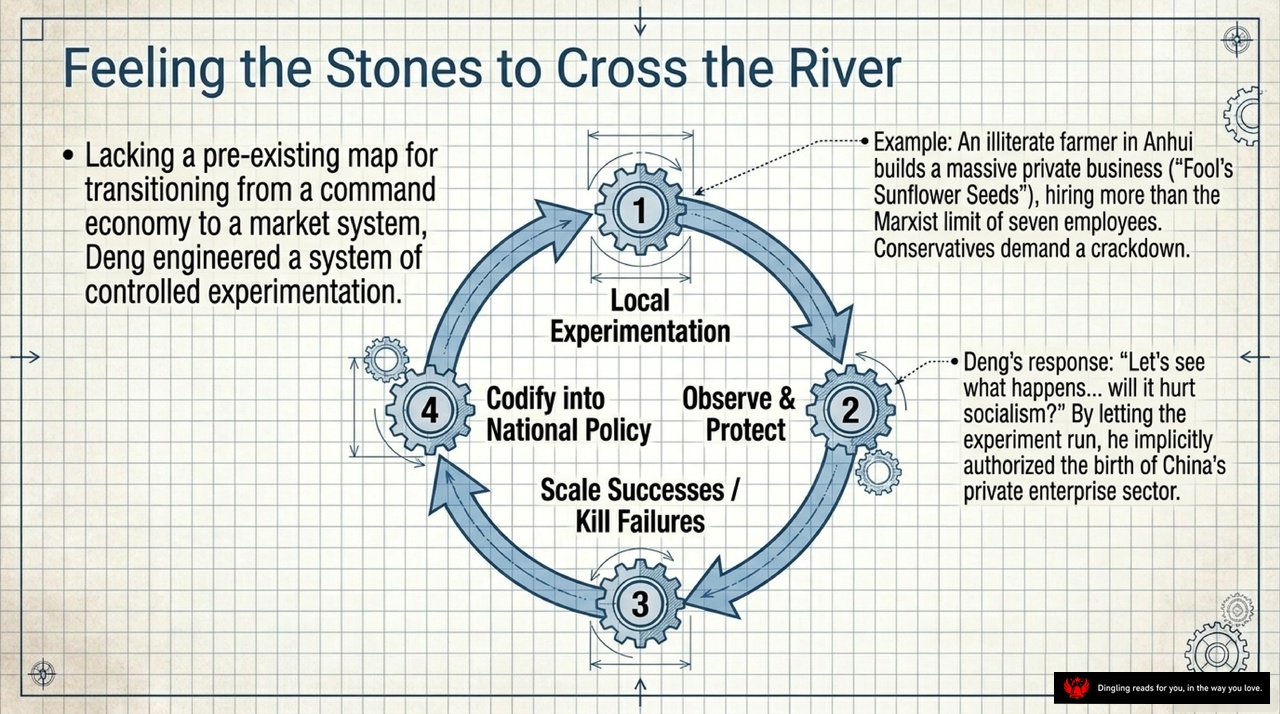
When we talk about China's transformation, we often hear about grand theories, but Deng Xiaoping's genius lay in something far more practical: he refused to wait for a perfect map before starting the journey. Instead, he pioneered a system of "controlled experimentation," famously advising leaders to "feel the stones while crossing the river."
This philosophy is perfectly illustrated by the "Fool's Sunflower Seeds" case. Imagine an illiterate farmer in Anhui who dared to hire more than the Marxist limit of seven employees, building a massive private business. Conservatives demanded an immediate crackdown, fearing a return to capitalism. But Deng's response was characteristically pragmatic: "Let's see what happens... will it hurt socialism?" By allowing this experiment to run, he implicitly authorized the birth of China's private enterprise sector without triggering a political firestorm.
This approach formed a powerful four-step cycle. First, you start with **Local Experimentation**, testing ideas in small, safe environments. Second, you **Observe and Protect**, letting successful models breathe while shielding them from ideological attacks. Third, you **Scale Successes or Kill Failures**; if it works, you expand it nationally; if it fails, you cut losses quickly. Finally, you **Codify into National Policy**, turning what worked locally into the law for the whole country.
This method allowed China to transition from a command economy to a market system without the chaos of a sudden shock. It wasn't about debating abstract ideology; it was about testing reality, learning from the results, and then scaling what worked. It was a brilliant strategy that turned uncertainty into a step-by-step path toward modernization.

Quarantined Capitalism. Imagine trying to open a door to the outside world while keeping your house perfectly safe from any intruders. That was exactly the dilemma Deng Xiaoping faced when he decided to bring foreign capital into China. Opening a closed country posed severe political risks, so instead of a full-scale invasion, Deng created a clever buffer zone. He established Special Economic Zones, like Shenzhen in Guangdong, far away from the political center in Beijing. Think of these zones as quarantine filters. They allowed China to import foreign technology, management practices, and capital on a localized basis. If an experiment failed or caused ideological disruption, the "infection" was contained to the coast; if it succeeded, the economic benefits could be harvested and scaled inward. This strategy protected the nation against spiritual pollution while letting the country learn from the world. It was a masterclass in controlled risk, allowing China to adapt to global markets without losing its core identity.

To achieve modernization, Deng realized China couldn't stay an ideological exporter in Southeast Asia; it needed the capital and technology only the West could provide. So, in late 1978 and early 1979, he executed a massive diplomatic pivot. He signed a peace treaty with Japan, riding the bullet train to signal China's urgent need to catch up, and visited the United States to normalize relations with President Carter. This strategy was purely pragmatic: ally with the West to counter Soviet threats and secure the resources necessary to rebuild the economy.
The visual on the left shows the "Pre-1978: Isolated Ideological Network," where China was disconnected, focused inward with red gears representing rigid, closed-off structures. But look at the right side: the "Post-1978: Global Integration." Suddenly, China is at the center of a vibrant web. Arrows shoot out to Tokyo, Washington, and the Asian Tigers. You see symbols of technology—chips and rockets—and finance, the dollar sign, flowing freely. This shift wasn't just political; it was a total rewiring of the global network. By connecting with these global hubs, China stopped being isolated and started becoming an integrated player, setting the stage for the economic explosion that would follow.

The image illustrates a powerful metaphor: China's reform and opening-up was never a straight line toward Western democracy, but rather a high-speed journey carefully guided by strict guardrails. Think of the road labeled "Socialism with Chinese Characteristics" as the path of economic experimentation. Deng Xiaoping pushed the vehicle to move fast, encouraging bold experiments like the Special Economic Zones and market mechanisms. However, he firmly installed four critical barriers along the sides to prevent the country from crashing.
These guardrails were defined in 1979 as the "Four Cardinal Principles." As the slide highlights, they are non-negotiable: the Socialist Path, the Dictatorship of the Proletariat, the Leadership of the Communist Party, and Marxism-Leninism-Mao Zedong Thought. Deng understood that while economic liberalization could be flexible, these political boundaries were absolute. Without them, the momentum of reform could easily lead to chaos, as seen in the turmoil of the past. By keeping the car within these rails, Deng ensured that China could enjoy the benefits of modernization without losing its core identity or political stability. This delicate balance allowed China to grow into a global powerhouse while maintaining a distinct path from the West.

In 1989, China hit a breaking point. As the nation raced toward modernization, the demands of a rapidly evolving society collided head-on with rigid political guardrails, causing the entire system to fracture. This wasn't just an abstract clash; it was a dramatic confrontation in the streets of Beijing. In the spring of that year, student-led protests in Tiananmen Square demanded political reforms that crossed Deng's unyielding line of Party supremacy. To the leadership, these demonstrations weren't viewed as a democratic awakening, but as an existential threat to national stability and the state itself. Viewing the unrest as a direct challenge to the regime's survival, Deng authorized military force to restore order. The image of a steel pillar cracking under pressure perfectly captures this moment: the trajectory of economic progress was abruptly halted by the sudden, violent enforcement of the old rules. The tragic crackdown reinforced the brutal reality of the General Manager's playbook: order and Party survival superseded all other considerations. While the economy continued its upward climb in the long run, that specific year marked a stark reminder that without absolute control, the system could not tolerate any deviation from its path.

The Final Push: The Southern Tour (1992)
After the turmoil of 1989, conservative forces within the Party tried to halt economic reforms and push China back toward a planned economy, causing the nation's momentum to stall. At 88 years old and officially retired, Deng Xiaoping embarked on a daring "Southern Tour" to Shenzhen and Zhuhai, bypassing Beijing's conservatives to reignite the country's capitalist experiments.
He famously declared, "Development is the absolute principle," decisively ending the ideological debate over whether markets were "capitalist" or "socialist." This intervention finalized the blueprint for China's future. By accelerating fully into the global market, Deng ensured that China would no longer just be a participant, but a dominant force in the world economy.

Between 1978 and 1992, Deng Xiaoping engineered one of the most profound structural turnarounds in human history. He didn't just tweak the system; he fundamentally rewrote the rules for a fractured, isolated agrarian society, transforming it into an industrialized, urbanized global superpower. But how did he do it? He didn't rely on ideological purity or rigid dogma. Instead, he succeeded through relentless pragmatism, controlled experimentation, and an unwavering, often ruthless, commitment to systemic stability.
Think of his approach as a master architect building a skyscraper in a storm. He didn't wait for perfect conditions; he integrated China into the global grid on his own terms, seizing opportunities while managing risks. This era was defined by a delicate balance: economic liberation to fuel growth, paired with strict political control to maintain order. If these twin engines drove China's rise, the question remains today: can this architecture sustain the nation's future, or will the blueprint eventually require a fundamental redesign?