
Descartes’ Error: Complete Chapter-by-Chapter Summary

Welcome to the beginning of a journey that will completely change how you understand your own mind. Today, we are exploring a book that challenges everything you think you know about logic and decision-making. The title is *Descartes' Error*, written by Antonio Damasio.
For centuries, we've been taught a simple but wrong idea: that we are rational machines. We believe that to make good decisions, we need to be cold, calm, and purely logical, and that our emotions are just annoying obstacles that interfere with our thinking. This is the legacy of Descartes, who famously separated the mind from the body.
But Damasio is here to tell us that this is a fundamental error. As the subtitle on this slide suggests, this book presents a groundbreaking shift in neuroscience. It proves that human emotion is not the enemy of reason. In fact, emotion is the very foundation upon which reason is built. Without our feelings, our ability to make rational choices simply collapses. We aren't logical creatures who occasionally get emotional; we are emotional creatures who use those feelings to navigate the complex world and make smart decisions. Let's dive into how this paradigm shift works.

Welcome to today's session on the Myth of Cartesian Dualism. Look at the slide in front of you. On the left, we see abstract shapes representing the mind, and on the right, mechanical gears and muscles representing the body. A bold vertical line labeled "Cartesian Divide" separates them, illustrating the traditional belief that mind and body are entirely separate entities.
For centuries, we've been taught to view the ideal decision-maker as a cool-headed machine. We assume that pure reason happens in an isolated cognitive space, completely unsullied by the mechanical body or chaotic emotions. In this view, emotions are just noise that interferes with logic, while the body is just a biological engine that doesn't contribute to thinking.
But what if this divide is a myth? The reality is far more integrated. As we explore the evidence from cases like Phineas Gage, we discover that without emotional input, rational decision-making simply cannot function. The body isn't a separate passenger; it provides the essential value judgments that guide our choices. So, let's challenge this old assumption and see how the mind and body actually work as one.

Imagine a man whose brain was literally pierced by a tamping iron, yet he walked away with his mind intact. This is the story of Phineas Gage, a 25-year-old railroad foreman whose life was shattered in 1848 by a catastrophic explosion. A massive 6-kilogram iron rod shot straight through his frontal lobe, exiting 30 meters away. By all medical standards, he should have been dead. Instead, he survived, remained conscious, and could speak fluently.
But here lies the true anomaly. While his logic, memory, and language were perfectly preserved, Gage was no longer the same man. The gentle, responsible leader he once was vanished, replaced by a volatile, impulsive, and socially inappropriate stranger who could not plan for the future or follow social norms. This case, along with modern parallels like patient Elliot, reveals a shocking truth: our ability to make rational decisions relies entirely on our emotional capacity. When the brain regions that process feelings are damaged, even a perfectly logical mind becomes trapped in a loop of indecision and self-destructive behavior. We are not just thinking machines; we are feeling beings, and without that emotional compass, our rationality collapses.

The Diagnostic Paradox reveals a startling truth: we can have perfect logic and memory, yet lose our ability to make sound life choices. Look at the table. On the left, we see our intact capabilities—memory, attention, language, and even basic math. But on the right, where the damage lies, we lose the ability to anticipate future consequences, act with social responsibility, or even express emotion.
This split challenges everything we think we know about reason. How can pure logic survive when the brain areas that guide it are destroyed? As the slide asks, if reason and emotion are separate, why does isolating one destroy the other? The answer lies in the fact that without the emotional signal of "good" or "bad," our rational calculations have no compass. We become smart machines that can solve equations but cannot choose a life worth living.

Imagine a world where your IQ is perfect, your memory is flawless, and your logic is impeccable—yet you are utterly unable to make a single sensible life choice. This is the reality of Elliot, a modern-day mirror of Phineas Gage.
Look at the diagram. On the left, we see Gage from 1848, and on the right, Elliot today. Both suffered damage to the frontal lobe, specifically the ventromedial prefrontal cortex. The result? A tragic disconnect between their brilliant test scores and their chaotic lives.
Notice the section labeled "The Test Scores." Both men scored perfectly on standard IQ, memory, and logic tests. Their brains could process information with surgical precision. But look at "The Reality." Gage lost his temper and social standing; Elliot, a successful executive, lost his job, his marriage, and his ability to plan a day. Why? Because their "common thread" was broken: their cognitive machinery was perfect, but their free will and decision-making were severely compromised.
The lesson here is profound. We often assume that rationality is a cold, logical process, independent of feelings. But Gage and Elliot prove that without emotional input, rationality is just a broken compass. You can calculate the route perfectly, but if you lack the emotional "feeling" of danger or value, you will never know which direction is actually safe or beneficial. Their stories force us to realize that emotions aren't the enemy of reason; they are its essential foundation.
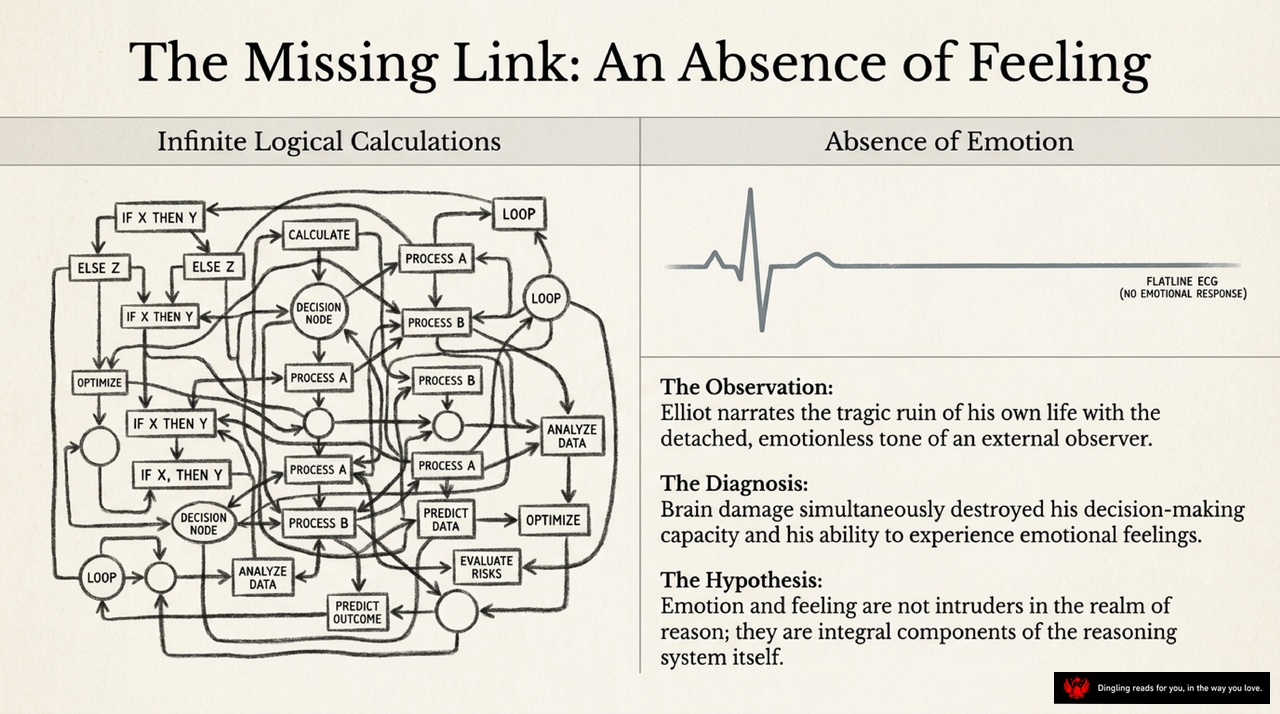
We often think of our brains as the CEO of our lives, running the show with cold, hard logic while our bodies are just the support staff. But what if that separation is a myth? Today's slide reveals a terrifying possibility: a mind that is logically perfect but emotionally dead. Look at the left side of this diagram. It shows "Infinite Logical Calculations"—a complex web of if-then statements, loops, and decision nodes. It looks like a supercomputer solving a problem. But look at the right side. It shows a flatline. No heartbeat. No emotional response.
This isn't science fiction; it's the reality of patients like Elliot, who we discussed earlier. Despite having intact logic and memory, his brain damage severed the link between his reasoning and his feelings. The result? A tragic absence of feeling. He could calculate the best path forward, but without the emotional "gut check" to tell him which path was actually *good*, he couldn't make a decision at all. He became a rational machine that couldn't navigate the human world.
The slide proposes a radical hypothesis: emotions aren't intruders that disrupt our logic. They are the very foundation of it. Without that emotional signal to mark value and risk, our infinite calculations are just noise. We need that heartbeat, that feeling, to give our thoughts any real meaning.

Imagine your brain not as a cold, isolated computer, but as a dynamic partnership between your mind and your body. Today's slide, "The Emotion Spectrum," visualizes this crucial evolutionary journey. It shows a developmental pathway moving from the **Amygdala** on the left to the **Prefrontal Cortex** on the right.
On the left, we have **Primary Emotions**. These are your baseline instincts—innate, evolutionary, and pre-organized. Driven by the amygdala, they are automatic responses to key stimuli. Think of it this way: if a looming shadow appears, your amygdala triggers instant fear and flight before you even have time to think. It's a survival reflex hardwired into your biology.
As we move right along the arrow, we reach **Secondary Emotions**, representing the adult experience. These are complex, learned, and nuanced. They are driven by the prefrontal cortex, which evaluates your personal and social experiences. Unlike the raw reflexes on the left, these emotions connect situational analysis with bodily responses. For example, you might feel a nuanced sense of guilt or a complex pride that depends entirely on your history and context.
This spectrum illustrates a fundamental truth: our rational decisions aren't made in a vacuum. They are built on this foundation, evolving from our primal survival instincts into sophisticated social judgments. Without the emotional baseline provided by the amygdala, our prefrontal cortex would have no values to weigh, leaving us unable to make truly human choices.

The Brain-Body Loop isn't just a diagram; it's the operating system of human life. As we see here, the brain and the body are locked in a continuous, infinite cycle. The biological reality is simple yet profound: a feeling is simply your brain's direct, cognitive perception of a specific bodily state. You don't feel sadness because you think "I am sad"; you feel sad because your body is in a state of heaviness and constriction, and your brain interprets that physical signal as "sadness."
Think of it like looking out a window, as this "Window Metaphor" suggests. Imagine the structure of the landscape outside is your body's organs, and the movement and light hitting that window represent the biological state of those organs at any given moment. Your brain is just reading the scene. When your heart races and your muscles tighten, the "landscape" changes, and your brain updates the view to "fear" or "excitement."
Why does this matter? Because of "The Purpose." Feelings aren't random glitches or obstacles to logic; they act as internal monitors. They signal whether your organism is in a state of survival, danger, or equilibrium. Without this loop, your brain loses its compass. It might be able to calculate complex equations, but without the visceral feedback from your body telling it what is good or bad for survival, it becomes a logic machine without a soul. This loop is the foundation of every decision you make, every value you hold, and every reason you have to keep going.

So, what exactly is this "Somatic Marker"? Let's break down the blueprint on your screen. The term itself is a fascinating blend of biology and psychology. On the left, you see "Soma," which comes from the Greek word for the body. This reminds us that our mind isn't floating in a vacuum; it's deeply rooted in our physical reality. On the right, we have the "Marker," defined here as an automated signpost or alarm. Think of it as your brain's internal GPS that instantly flags whether a choice is dangerous or rewarding before you even have time to think about it.
The slide explains the mechanism clearly: your brain links specific scenarios to specific bodily feelings—those somatic markers—based on past experiences. It's like a library of physical memories. And look at the function: before conscious reasoning even begins, these markers trigger a gut feeling. That instant, automatic bodily response highlights a choice as either deeply dangerous or highly rewarding. It's the difference between analyzing a map and feeling the slope under your feet. This is the core idea we're exploring: how your body's signals guide your mind's decisions.

Imagine a decision tree that never prunes its branches. Without emotional signals, your brain is trapped in an endless loop of calculating costs and benefits, unable to distinguish between a safe path and a disaster. This is the state of "pure logic"—a system that is actually paralyzed by its own perfection.
But look at what happens when we introduce "Somatic Markers." These are the subtle, often invisible body signals—like a knot in your stomach or a rush of adrenaline—that act as an automatic filter. They don't do the math for you; instead, they instantly cut away the disastrous options before your conscious mind even sees them. By rejecting the bad choices immediately, these emotional cues restrict your logical workspace to just a few viable paths.
The result? You move from decision paralysis to decisive action. The image illustrates a fundamental truth: emotion isn't the enemy of reason. It is the essential filter that allows reason to function at all. Without it, you have a computer that can calculate everything, but no way to choose what matters.

Imagine you are sitting at a table with four stacks of cards labeled A, B, C, and D. In this famous experiment called the Iowa Gambling Task, your goal is simple: draw cards to win as much money as possible. But there's a catch. Stacks A and B look tempting at first because they pay out big, but they hide catastrophic losses that wipe you out quickly. Stacks C and D offer smaller, steadier wins that actually keep your money safe in the long run.
Here is where the human brain reveals its true genius. When a healthy person hovers over the dangerous A or B decks, their body reacts before their conscious mind even realizes the danger. You'll see a spike in their sweat and stress response, a biological alarm system going off. Their palms get sweaty, and their heart races, intuitively teaching them that these decks are a trap. This physical sensation guides them away from disaster long before they can logically explain why.
Now, look at the stark contrast on the right. This represents what happens in patients with frontal lobe damage, like our patient Elliot. When they face the same deadly decks, their graph remains completely flat. They generate zero sweat and zero stress. Even though they can intellectually understand the math—that they are losing money—their brain lacks the emotional alarm system. Without that physical warning, they keep choosing the dangerous decks over and over again, unable to save themselves. This experiment provides empirical proof that our emotions aren't just noise interfering with our logic; they are the very foundation that allows us to make rational decisions.

Look at this "Rationality Matrix." It perfectly captures the central conflict of our discussion: the clash between how we used to think about decision-making and how modern neuroscience tells us it actually works.
On the left, we have the "Traditional View," often called Pure Reason. This is the idea that makes sense in a math class but fails in life. It treats emotion as a destructive contaminant, something that must be suppressed to make good decisions. Under this model, the brain is just a calculator running formal logic and probability. The result? We get infinite calculation that is great for solving equations but fatal for social survival. We become logical machines that can't feel the value of their choices.
Now, look at the right side: Damasio's Integrated View, or Embodied Reason. This is the reality our brains actually use. Here, emotion isn't an enemy; it's the foundational filter that makes efficient logic possible. The mechanism isn't just cold logic; it's biological regulation paired with cognitive logic. Because of this, we don't get stuck in endless calculation. Instead, we make rapid, intuitive, and highly adaptive survival decisions.
The lesson here is profound: if you want to make smart decisions, you don't suppress your feelings. You need them. Without the emotional filter, your rationality has no direction, no value, and no connection to the real world. True rationality is actually embodied reason.

Look at this pyramid titled "The Evolution of Reason." It visually breaks down how our ability to think logically isn't a standalone superpower, but rather a structure built on three distinct layers, each critical to the next.
At the very bottom is the **Base Layer**: Basic Biological Regulation. This includes our metabolism and reflexes. Think of this as your operating system's hardware—it keeps your body running, but on its own, it doesn't make decisions.
Moving up, we hit the **Middle Layer**: Primary and Secondary Emotions. This is where things get interesting. It includes somatic markers and feelings. This layer translates raw biological data into the emotional experiences we feel daily.
And finally, at the top, sits the **Apex Layer**: High-Order Rationality. This is where ethics, social planning, and abstract logic live. It's the part of us that allows us to think like philosophers or CEOs.
But here is the crucial insight the slide emphasizes: high-level rationality does not exist in a vacuum. The text on the right explains that it evolved from and remains structurally dependent on the deep-brain systems regulating biological survival. When we make complex ethical decisions, the neural circuits of our lowest biological drives are actively participating.
This pyramid challenges the old idea that emotions are enemies of reason. Instead, it shows that without the foundation of our biological drives and emotional signals, our "Apex" logic has nothing to anchor itself to. It proves that true reason is actually a biological process, deeply rooted in how our bodies feel and survive.
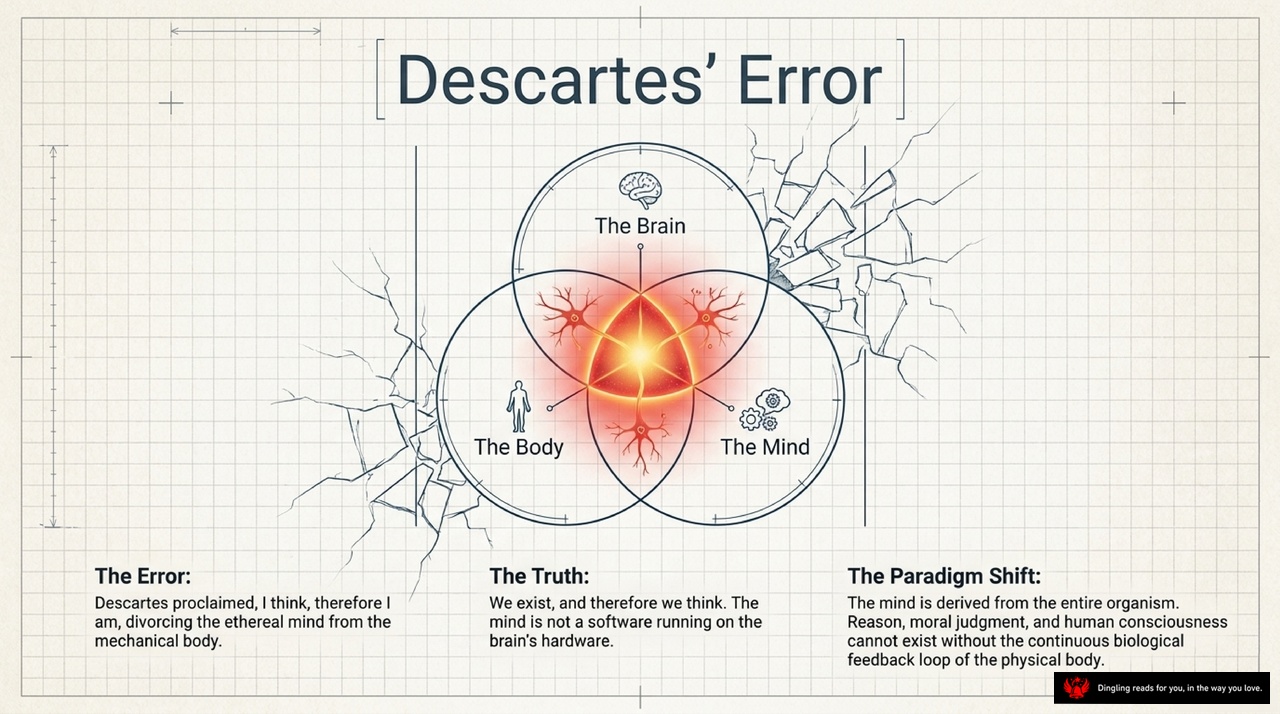
Descartes' Error. Look at this diagram. It illustrates a fundamental mistake we've made for centuries: the belief that the mind is a separate software running on the brain's hardware, completely divorced from the body.
The slide breaks this down into three critical points. First, "The Error." For too long, we've accepted Descartes' famous declaration: "I think, therefore I am." This idea created a false separation, treating the ethereal mind as distinct from the mechanical body. We thought emotions were just noise interfering with pure logic.
But the slide corrects this with "The Truth." We actually exist first, and *because* we exist as physical beings, we think. The mind isn't a standalone program; it's an emergent property of the entire organism. The diagram visually reinforces this by showing the brain, the body, and the mind overlapping in a glowing center. This intersection is where consciousness truly lives.
Finally, "The Paradigm Shift." This is the most important takeaway. The mind is derived from the entire organism. Reason, moral judgment, and human consciousness cannot exist without the continuous biological feedback loop of the physical body. Without the body's signals—our heartbeat, our gut feelings, our sensations—our rationality has no compass. We wouldn't just be logical machines; we would be lost. So, the next time you make a decision, remember: your body is not just the vehicle for your mind; it is the very source of your wisdom.

We've long been taught that mastering our lives requires conquering our emotions with cold, calculating logic. We assume reason operates independently, while emotions are just noise to be silenced. But neuroscience reveals a different truth: the very architecture of human reason is built upon the scaffolding of our bodily feelings. Without the emotional signals of our biology guiding our choices, we are left as intelligent but paralyzed observers of our own ruin.
This raises a profound question: If our highest moral judgments and most rational decisions are entirely dependent on the physical feelings of our bodies, can we ever truly separate who we are from what we feel? The answer, supported by decades of clinical evidence, is a resounding no. Our feelings aren't obstacles to clarity; they are the compass that allows us to navigate a complex world. Without them, we lose the ability to distinguish value, making even our sharpest minds incapable of making wise choices.