
Don't Be a Normal Fool: Complete Chapter-by-Chapter Summary
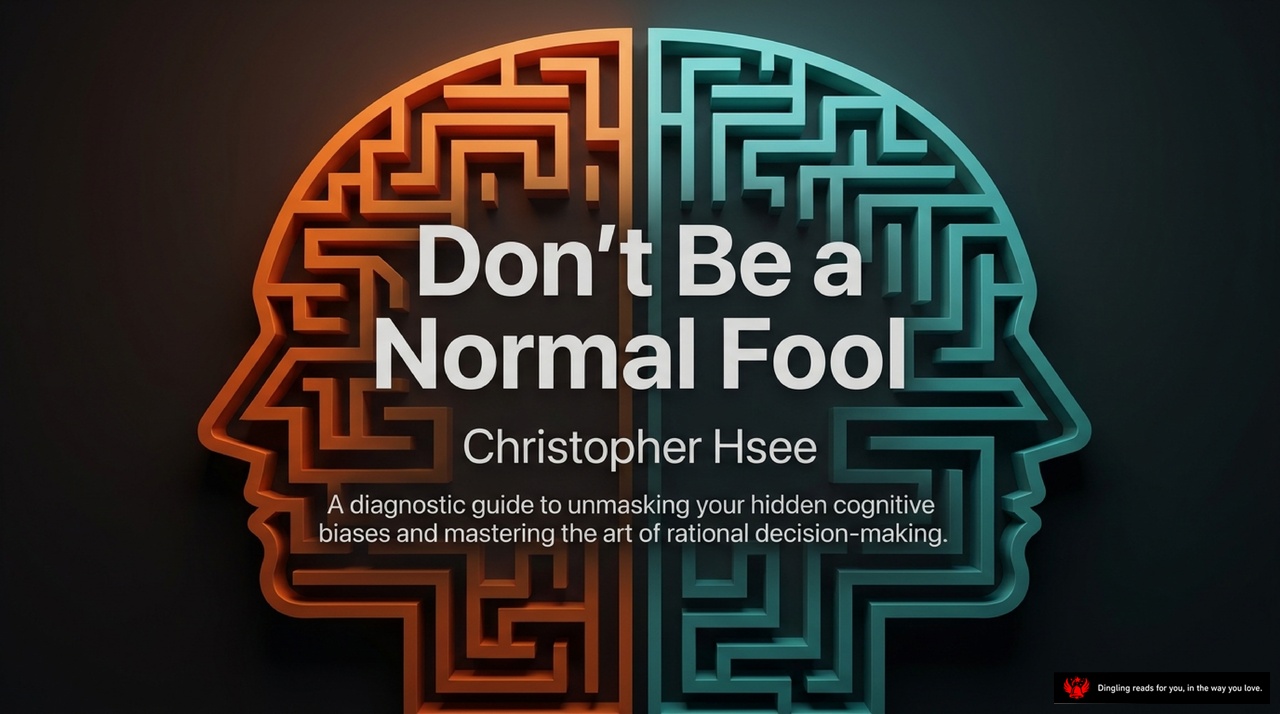
Welcome to today's session on "Don't Be a Normal Fool" by Christopher Hsee. Imagine your brain as a split maze: one side in orange, representing our instinctive, emotional thinking, and the other in teal, symbolizing the rational path we strive for. We often get lost in the orange maze, unaware of the traps our mind sets for us. This book is your diagnostic guide to unmasking those hidden cognitive biases and mastering the art of rational decision-making. It challenges the very way we see money, time, and even happiness. Instead of accepting our first impulses, we learn to step back, analyze our mental shortcuts, and choose the teal path of clarity. Whether you're managing your finances or navigating life's big choices, this journey will help you stop acting on autopilot and start making decisions that truly serve your best interests.
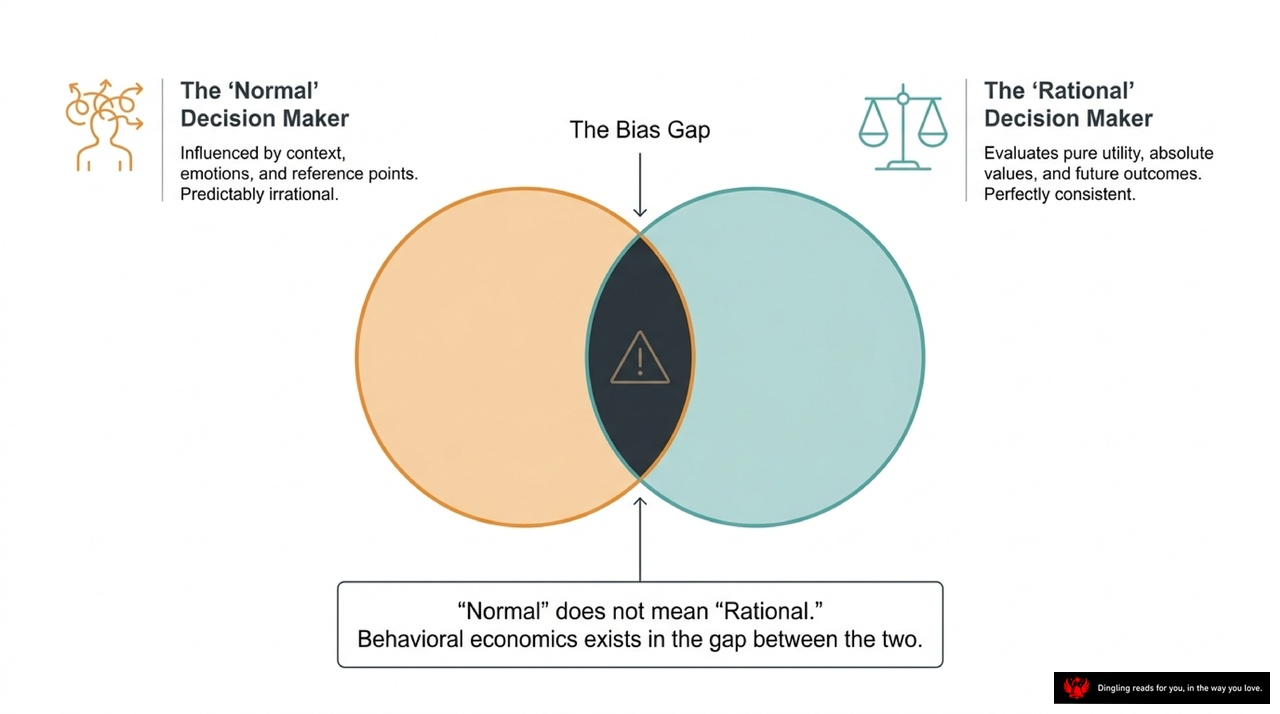
So, let's talk about the invisible gap between how we *should* decide and how we *actually* decide.
On the left, we have the "Normal" Decision Maker. This is you, me, and everyone else. We aren't robots; we are deeply influenced by our emotions, the context we're in, and where we stand right now. We are predictably irrational. On the right, we have the "Rational" Decision Maker—the ideal version of ourselves. This version evaluates pure utility, absolute values, and future outcomes with perfect consistency. It's the scale of justice, weighing things purely on their merit.
But here is the problem: there is a "Bias Gap" between them. This dark zone in the middle is where behavioral economics lives. It exists exactly because "Normal" does not mean "Rational."
Think about it. When you buy something, do you really calculate the absolute value? Or do you get distracted by a "50% off" sign, even if you don't need the item? That's the gap in action. The Normal Decision Maker gets tricked by the *feeling* of a deal, while the Rational one would ask, "Do I actually need this?"
We also fall into traps like the "Bias Gap" when we overestimate our confidence in a plan, ignoring the messy reality of delays and risks. Or when we cling to past mistakes—like holding onto a losing stock just because we've already lost money—instead of looking at the future.
The Rational Decision Maker would cut those losses immediately. The Normal one hesitates, driven by the pain of admitting failure.
So, how do we bridge this gap? We can't turn off our emotions, but we can recognize them. When you feel that rush to buy something because it's "cheap," or that urge to keep investing because you've already spent so much, pause. Ask yourself: "If I weren't feeling this way, what would the Rational Decision Maker do?"
By acknowledging this Bias Gap, you stop being a slave to your impulses. You start making choices that align with your long-term goals, rather than just reacting to the moment. It's about moving from the chaotic orange circle into the steady blue one, just a little bit at a time.

Bias 1: Mental Accounting. We often treat money differently based on where it comes from or what it's supposed to do, creating invisible jars in our minds. Look at this slide: on the left, "The Normal Trap." Imagine you lose a $1,000 concert ticket. You're stuck in an "Entertainment" jar that's now empty, so you refuse to buy another ticket. But if you lost a $1,000 phone card instead, you'd happily buy that concert. Why? Because we mentally label the money. We treat "hard-earned wages" as something to save, while "windfalls" feel like free money to spend.
Now, look at the right side: "The Rational Lens." Here, money is fungible. Losing a ticket or a phone card both reduce your total net worth by exactly $1,000. A rational actor treats all money as identical, regardless of its origin or mental category. The illusion of categorized wealth tricks us into making suboptimal choices. Instead of letting these arbitrary labels dictate your behavior, remember that every dollar has the same purchasing power. Break the jar, and make decisions based on your actual financial reality, not the story you tell yourself about where the money came from.

Imagine you are at Frankfurt Airport, and you have a choice between two identical sleeping pills that will both give you exactly five hours of rest. But the price tag tells a very different story. The first one costs $250, but you remember seeing it listed for $500 in your hometown. The second one costs only $200, but in your hometown, it's practically free at just $5.
Here is where human nature trips us up. Even though the second pill is objectively the better deal, most people will actually grab the $250 version. Why? Because their brain is obsessed with the "discount." They feel a massive surge of satisfaction thinking, "I saved $250!" That feeling of being smart and getting a bargain feels so good that it completely overrides the simple math of paying less money for the same result.
The rational formula, however, is much simpler and colder. It asks us to look past the sticker shock and focus on the utility: "Utility of 5 Hours of Sleep > Absolute Price." A truly rational actor would ignore the hometown reference price entirely, because that number is irrelevant to the current situation. They would simply buy the cheaper $200 pill because it costs less for the exact same benefit.
But we aren't always rational actors. We are easily hijacked by the illusion of a "good deal." We let the gap between the original price and the sale price drive our decision, rather than focusing on whether we actually need the product or if it's truly the best value. This transaction bias tricks us into buying things that feel like a bargain, even when they are the more expensive option. To avoid this trap, remember that the only thing that matters is what you get for what you pay, not how much you "saved" compared to a price you never actually paid.

Bias 2b is all about the "Relativity Trap"—a classic case where our brains get confused by percentages instead of actual numbers. Look at the chart: the "Normal Fool" will happily ride a bike for 10 extra minutes just to save 40% on a cheap alarm clock, but they will refuse to do the exact same 10-minute ride to save 0.75% on a luxury watch. Even though saving 50 dollars is mathematically better than saving 40, the human brain gets hijacked by the visual appeal of a higher percentage. We are tricked into thinking the smaller discount is "bigger" because it looks larger on a scale, while ignoring that the absolute dollar amount is actually less. This is proportional bias in action: we chase the look of a deal rather than the reality of the savings. To make smarter choices, we need to step out of this trap and always ask ourselves, "How much actual money am I keeping in my pocket?" rather than "What percentage did I save?" Because in the end, the absolute value is what truly matters to our wallet.

Look at this trash can on the left. Inside, we see a "$5 Million R&D Investment" and an "$800 Concert Ticket." These are the classic examples of sunk costs—money already spent that has no memory and cannot be recovered. Once that cash is in the past, it's gone. A rational actor knows this.
Now, look at the timeline leading to "The Present." Imagine you are the CEO of a pharmaceutical company. You've already poured $5 million into a new painkiller. But here's the reality check: the market has shifted, and continuing the project gives you a 90% chance to lose another $5 million. Or, think of yourself trudging through a blizzard to hear a concert, risking illness for a miserable experience just because you bought the ticket.
The bias here is the weight of the past. We often think, "I've already spent so much, I can't quit now." But that's a trap. The rational decision isn't about recovering the $5 million you lost; it's about whether the *future* utility is worth the *future* cost. If the future outlook is negative, the past investment is irrelevant. You must cut the cord. Don't let the ghost of your past spending dictate your future choices.

The Substitution Method is your brain's built-in defense against value illusions. Think of it as a mental toolkit with two simple steps. First, identify your emotional attachment. Ask yourself: Are you holding onto this stock just because of the price you paid? Or are you attending this event solely because you bought the ticket? Often, we confuse ownership with value.
Next, perform a perspective swap. Imagine you didn't already own this asset. Would you buy it today at the current price? Or, if that concert ticket was handed to you for free by your company, would you still walk through a blizzard to attend? If the answer to these questions is no, it's time for rational action. Don't let sunk costs or emotional baggage trap you. Sell the stock, stay home, and let the market take its course.

Bias 4—Overconfidence: The Illusion of Knowledge. Have you ever thought you know more than you actually do? Let's look at the evidence.
In this slide, we see a striking example of how we overestimate our own contributions. When spouses are surveyed about their share of household chores, both the husband and the wife independently estimate they do 65% of the work. Mathematically, that adds up to 130% total. It's impossible, yet it happens every time. This is the "Knowledge Trap." We are convinced our memory and judgment are flawless, leading us to believe we are doing far more than our partner.
But the problem goes deeper than just chores. When we face trivia questions, we estimate our accuracy at 70%, when the reality is strictly 50%. We suffer from "Confirmation Bias," constantly seeking only the evidence that supports our initial assumptions. This creates a self-fulfilling prophecy of unearned confidence. We stop looking for facts that might prove us wrong because we already believe we are right.
So, what's the danger? Overconfidence blinds us to reality. It makes us think we have mastered a skill when we haven't, or that we understand a situation better than we do. This illusion of knowledge is the root of many poor decisions, from underestimating project timelines to making reckless financial bets. True wisdom isn't about being sure; it's about knowing how much you *don't* know.

Bias 4b — The Planning Fallacy & Market Hubris. How overconfidence destroys schedules and capital.
Look at this slide. We're looking at the gap between our "Expectation" and "Reality." The top orange bar shows the Sydney Opera House Plan: 6 years and $7 million. This represents the confident baseline. We assume everything goes exactly as planned, ignoring unknown variables. We think we can control the timeline and the budget.
But look at the bottom teal arrow. That's "The Reality." The actual timeline stretched to 16 years, and the cost ballooned to $102 million. Notice how that arrow expands and gets jagged with warning triangles. This is the inevitable expansion. It happens because we fail to account for the chaos of execution.
This isn't just about construction; it's a fundamental flaw in how we think. The text reminds us that 80% of startups fail, yet 100% of founders believe they are the exception. This is the core of Market Hubris. Overconfident investors over-trade based on the illusion of superior market knowledge. They think they can pick the winners and time the market, but in reality, they are just generating vastly higher transaction costs and lower net returns than their patient counterparts.
We fall into this trap because we overestimate our ability to plan and underestimate the complexity of the world. We build our plans on a straight line, but reality is a jagged arrow. The penalty for this hubris is heavy: destroyed schedules, blown budgets, and lost capital. To succeed, we need to stop assuming we are the exception and start respecting the uncertainty that defines every single project.

Look at this graph, it perfectly illustrates a psychological trap we all fall into: the Hedonic Treadmill, or what the book calls Adaptation Bias.
Here's the core idea: we vastly overestimate how long good and bad events will dictate our emotional state. We think winning the lottery will make us happy forever, or that a life-altering accident will keep us in misery forever. But the human mind is highly adaptable. As the chart shows, whether you win millions or lose your mobility, your subjective happiness level eventually returns to your default psychological baseline.
Notice the two lines here. The lottery winner's happiness spikes initially but slowly drifts back down to the baseline within a year. Similarly, the person with a paraplegic accident hits rock bottom but gradually climbs back up. We underestimate our ability to adjust. We spend too much energy chasing the high of new acquisitions or fearing the low of new losses, forgetting that our emotions are temporary.
The lesson is simple: don't bet your future happiness on a single event. Instead of buying more stuff to chase that fleeting spike, invest in experiences and relationships that enrich your life today without the inevitable crash tomorrow. Your baseline is where you belong, and you can choose to make that baseline higher through how you live, not just what you own.

Here is the spoken script for Slide 10, tailored for an American audience:
"Let's talk about where you actually spend your money to break free from the happiness treadmill. This is the Adaptation Matrix. On the left, we have things that fade fast—highly adaptable stuff. Think of buying a bigger house, upgrading to a luxury car, or just getting a pure income raise. The problem is, you adapt to these quickly. That extra square footage or that fancy leather seat feels amazing for a few weeks, but then you just go back to your baseline happiness. You've spent a lot, but you feel just as happy as you did before. Don't overspend here.
On the right, we have things that persist—non-adaptable factors. This is where you should invest your money. These are the things that continuously impact your daily psychology and resist adaptation. Instead of buying more stuff, invest in experiences like travel that create lasting memories. Invest in eliminating unpredictable noise in your life or shortening those grueling daily commutes. Even avoiding environments where you feel constantly judged by others falls here.
The logic is simple: material upgrades wear off because we get used to them, but life experiences and environmental stability stick. If you want to defeat the hedonic treadmill, stop chasing the shiny new house or the expensive car, and start funding the things that actually change how you feel every single day. That's where the real happiness lives."

Synthesis: The Normal Fool vs. The Rational Actor. Let's cut through the noise and look at the big picture. We've explored five specific traps that derail our judgment, and now it's time to see how they all fit together.
On the left, we see "The Normal Trap"—the instinctive, often flawed way we operate. Take Mental Accounting: we treat money differently depending on where it came from, whether it's "hard-earned wages" or "lucky windfalls." Or consider Transaction Bias, where we chase the thrill of a "deal" rather than the actual utility of the item. We cling to Sunk Costs because admitting failure hurts our ego, we suffer from Overconfidence that blinds us to risks, and we buy static things hoping for lasting joy, ignoring Adaptation Bias.
But on the right, we have "The Rational Lens." This is how a smart investor or decision-maker actually thinks. It treats all money as fungible—dollar for dollar, regardless of the source. It focuses purely on absolute utility and cost, ignoring the emotional high of a discount. It evaluates only future costs and benefits, letting go of the past. It applies objective statistics to your own plans, fighting that urge to be the exception. And finally, it shifts focus from owning things to investing in dynamic experiences, knowing that happiness comes from what you do, not what you have.
The shift from the Normal Trap to the Rational Lens isn't just about math; it's about reclaiming control. It means stopping the game of labels and starting the game of value. By adopting this rational lens, we stop making decisions based on feelings and start making them based on reality. That is the true path to better financial and life choices.

Have you ever wondered why your brain treats every dollar differently, depending on where it came from? We aren't wired to be rational; instead, our minds are hardwired for illusion. We react to the context of a choice, not the reality of the outcome.
Look at this slide. It asks a critical question: Will you let the comforting illusions of the 'Normal' mind write your future, or will you accept the uncomfortable clarity of the Rational decision maker?
In the book, we explore how this "normal" mind tricks us. For instance, money earned from hard work feels like something we must protect, so we save it. But money from a bonus or a lucky win feels like "free" money, so we spend it recklessly on things we don't really need. Even the timing matters. A monthly paycheck feels like it's for survival, so we spend carefully. But a year-end bonus feels like a bonus, so we buy expensive trips or risky investments.
We also fall into the trap of the "small money, big money" error. We treat a small windfall as disposable cash to spend on snacks, while we treat a large lump sum as a serious asset to save.
The core issue is that we label money in different mental accounts. We give different tags to the same currency based on its source, time, or size. But rationally, every single dollar has the exact same purchasing power.
So, here is the challenge for you: Will you stay in the comfortable illusion that some money is more important than others, or will you step up and see the truth? Will you choose to be the Rational decision maker who treats every dollar with equal respect and makes choices based on actual value, rather than emotional labels? That is the shift that changes everything.