
Drive: Complete Chapter-by-Chapter Summary
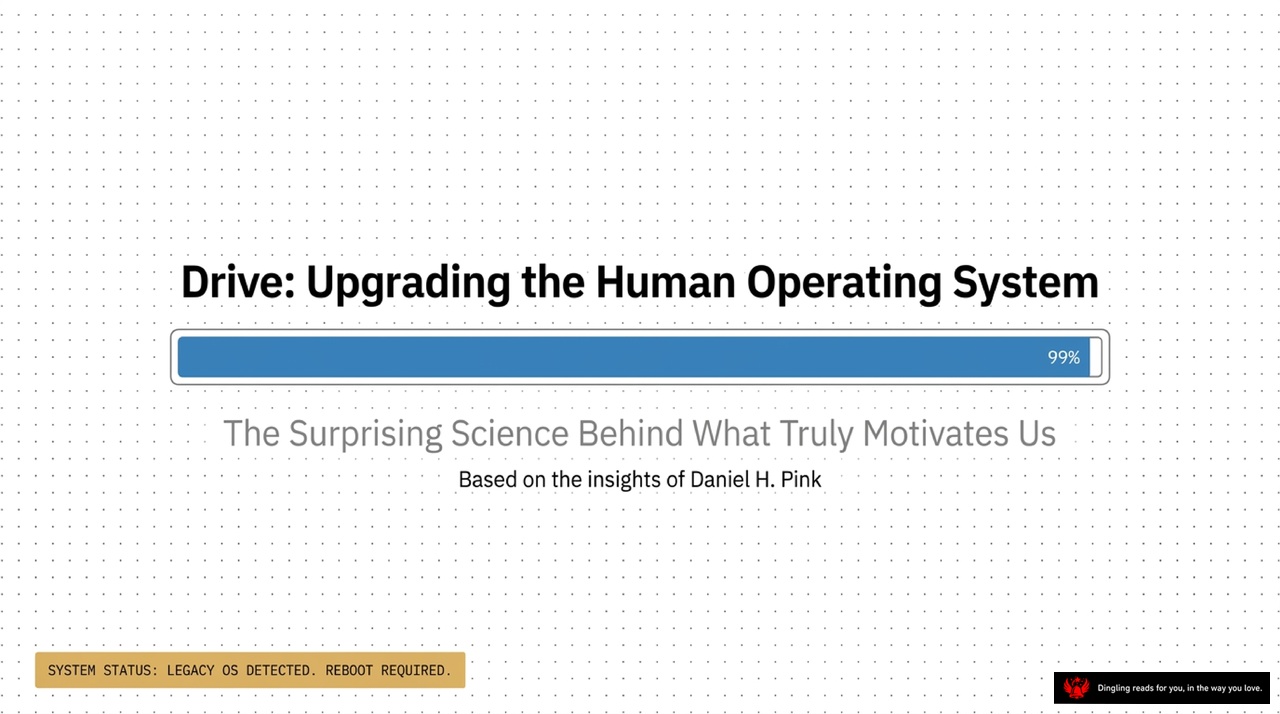
Welcome to a session that promises to upgrade your very own operating system. Imagine your mind not as a fixed state, but as software running on an ancient legacy OS. Today, we're looking at *Drive* by Daniel H. Pink, a book that challenges how we think about motivation.
The slide you see right now captures the core tension perfectly. It asks us to consider "Drive: Upgrading the Human Operating System." Look closely at that progress bar showing 99%. It suggests we are almost ready for the next version, yet the system status at the bottom left warns us: "Legacy OS detected. Reboot required."
This isn't just a metaphor; it's the scientific reality of our lives. For most of history, we've been running on Drive 2.0, a system built on external rewards and punishments—the classic "carrot and stick." We were told that to get results, we just needed to incentivize good behavior and penalize bad behavior. It worked well for the industrial age, treating people like machines that respond predictably to pressure.
But here's the problem: that old system is hitting a wall. As we move into an era requiring creativity, empathy, and complex problem-solving, the 2.0 model starts to fail. It can't explain why people volunteer for causes they believe in, or why they pour their hearts into open-source projects without a paycheck. The legacy code is simply incompatible with the new demands of our world.
So, what's the solution? We need to reboot. We need to move from a system driven by external control to one driven by internal fulfillment. This journey from an outdated model to a modern, human-centric approach is exactly what we'll explore together. Let's dive in and see how we can actually upgrade the software running in our heads.
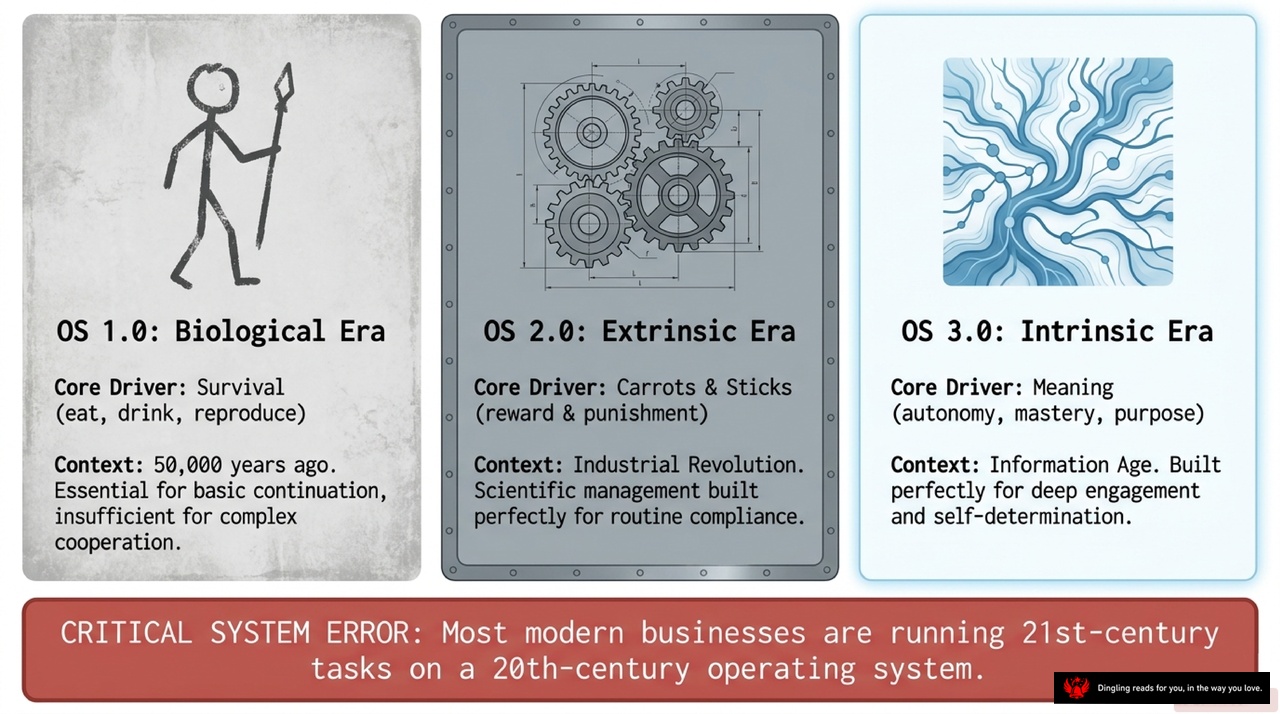
Look at this slide. It lays out the evolution of human motivation through three distinct operating systems.
On the left, we have OS 1.0, the Biological Era. Back 50,000 years ago, our core driver was pure survival—eat, drink, reproduce. It kept us alive, but it wasn't enough to coordinate complex cooperation among strangers.
Then came OS 2.0, the Extrinsic Era, born during the Industrial Revolution. This is the system most of us are still running today. Here, the core driver is "carrots and sticks"—reward and punishment. Think of Frederick Taylor's scientific management: treating people like machine parts, using external incentives to ensure routine compliance. It powered the 20th century brilliantly for repetitive tasks.
But look at the third panel: OS 3.0, the Intrinsic Era. This is the Information Age. The core driver shifts to "meaning"—autonomy, mastery, and purpose. This system is built for deep engagement and self-determination, perfectly matching the creative work of the 21st century.
The red banner at the bottom highlights the critical problem: most modern businesses are running 21st-century tasks on a 20th-century operating system. We are trying to drive creativity with a system designed for factory assembly lines. That mismatch is where the real friction happens.

Look at this split screen. On the left, we have "Algorithmic Work," the Left-Brain approach. It's all about following a set path to a single, known conclusion. Think assembly lines or data entry—tasks where OS 2.0 actually works perfectly. External rewards here are a superpower; they effectively boost speed on these routine, mechanical tasks.
Now, look at the right side: "Heuristic Work," the Right-Brain domain. This is about experimenting with possibilities to design novel, non-routine solutions. That's where innovation lives. But here's the kicker: the status for OS 2.0 is "Crashes Here." If-Then rewards actively destroy performance and narrow creative focus when you need to break the mold.
And the stakes? McKinsey Research tells us that 70% of US job growth comes from this heuristic, non-routine work. The old carrot-and-stick system is great for keeping a machine running, but it's completely incompatible with the creative engine driving our future. We can't just reward the outcome; we have to fuel the exploration.

Today's slide lays out the seven deadly bugs that plague our legacy systems. When we rely on simple "if-then" rewards, we don't just motivate people; we actually break them. Let's look at the first three. First, it extinguishes intrinsic motivation. Think of the "Sawyer Effect," where giving rewards turns fun play into boring work. Second, it diminishes high performance. Surprisingly, bigger financial incentives often lead to worse results on complex cognitive tasks. And third, it crushes creativity. Rewards narrow our focus, making it nearly impossible to think outside the box.
But the damage doesn't stop there. Look at points four through seven. Fourth, it crowds out good behavior, turning moral obligations into cold transactions. Fifth, it encourages unethical shortcuts, pushing people to cheat or take dangerous risks just to hit a target. Sixth, it creates dangerous addiction, triggering dopamine hits similar to illicit drugs that require ever-larger doses to maintain. Finally, seventh, it fosters short-term thinking, sacrificing long-term viability for immediate quarterly gains. These aren't just theoretical risks; they are the systemic failures that happen when we try to drive complex human behavior with simple, external rewards.
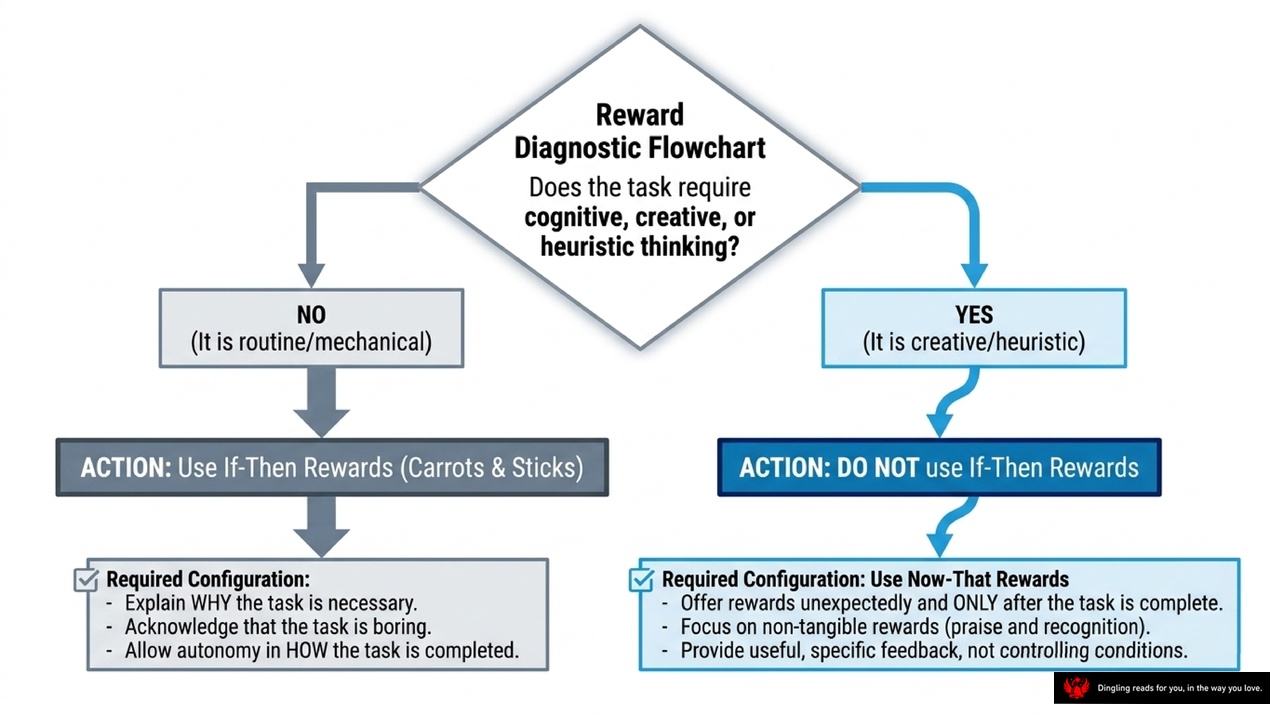
Look at this diagram. It's a diagnostic flowchart designed to help us decide exactly how to motivate people, and the answer depends entirely on the type of thinking the task requires.
First, ask yourself: Does this task require cognitive, creative, or heuristic thinking? If the answer is "No," if it's just routine or mechanical work, then the chart tells us to use "If-Then Rewards." Think of it as carrots and sticks. For these predictable tasks, you need to explain why the work is necessary, acknowledge that it might be boring, and most importantly, give people autonomy over *how* they complete it.
However, if the answer is "Yes," if the work demands creativity or complex problem-solving, the chart gives a very different instruction: Do not use If-Then rewards. Instead, you must use Now-That rewards. This means offering rewards unexpectedly, only after the task is complete, focusing on non-tangible things like praise and recognition, and providing useful feedback rather than controlling conditions.
This distinction is crucial because trying to motivate creative work with rigid, pre-set rewards often kills the very creativity you're trying to spark. The right approach depends entirely on what kind of thinking you need from your team.
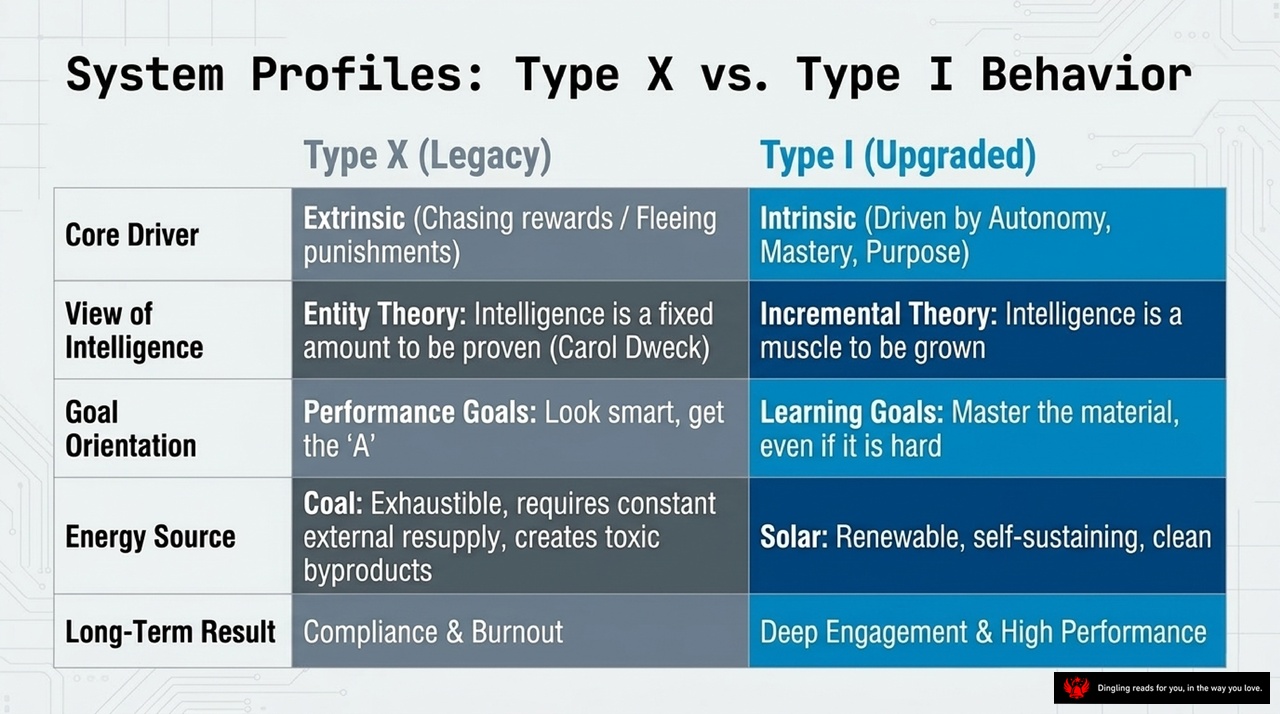
Look at this slide comparing Type X and Type I behaviors. On the left, you see the legacy model—Type X—driven by extrinsic rewards and fears. It operates on an entity theory where intelligence is fixed, focused on performance goals like getting an 'A', fueled by coal-like energy that burns out, ultimately leading to compliance and burnout.
Now, look at the upgraded Type I profile on the right. This is the future we're building. It's intrinsically driven by autonomy, mastery, and purpose. Instead of a fixed mindset, it embraces incremental theory—viewing intelligence as a muscle to grow. The goal shifts from looking smart to actually mastering the material, even when it's hard. The energy source isn't exhaustible coal; it's solar—renewable, self-sustaining, and clean. This shift transforms long-term results from mere compliance into deep engagement and high performance.
The core driver here is simple: stop chasing external validation and start connecting with your inner purpose. When you move from Type X to Type I, you stop burning out and start thriving. You stop fearing failure and start embracing growth. This isn't just about working harder; it's about working with a sustainable, renewable engine that powers you for the long haul.
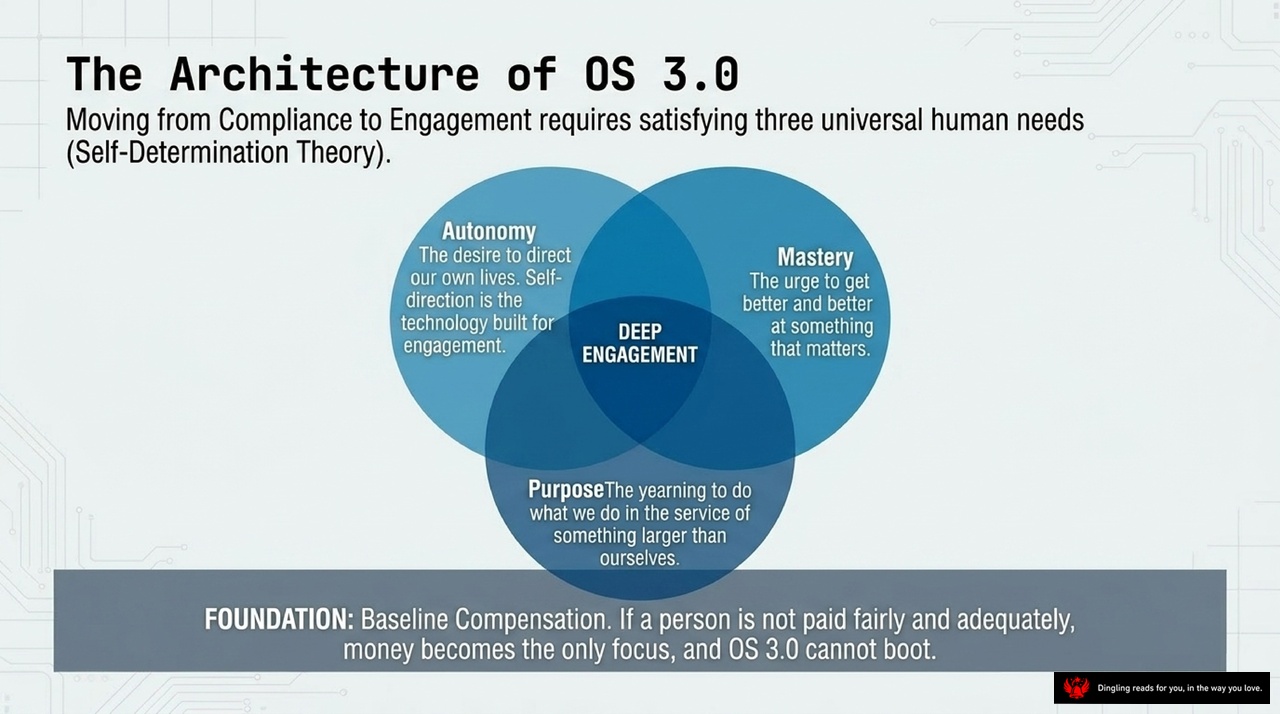
Today's slide reveals the operating system of human engagement: OS 3.0. It argues that moving from simple compliance to deep engagement isn't about better rewards or stricter rules; it's about satisfying three universal human needs rooted in Self-Determination Theory.
Look at the intersection in the center. That dark blue zone is where **Deep Engagement** lives. It happens only when three circles overlap: Autonomy, Mastery, and Purpose.
First, **Autonomy**. This is the desire to direct our own lives. It's the belief that self-direction is the technology built for true engagement. When people feel they own their choices, they shift from being managed to becoming self-managers.
Second, **Mastery**. This is the urge to get better and better at something that matters. It's not just about doing a task; it's about the pursuit of excellence and the joy of growing your skills.
Third, **Purpose**. This is the yearning to do what we do in the service of something larger than ourselves. It connects our daily work to a bigger mission, giving it meaning beyond just a paycheck.
But here is the critical foundation at the bottom of our architecture. You cannot have OS 3.0 without a solid base. That foundation is **Baseline Compensation**. If a person is not paid fairly and adequately, money becomes the only focus, and the entire system cannot boot. Without fair pay, Autonomy, Mastery, and Purpose become irrelevant because survival takes over.
So, to build an engaged workforce, we must first ensure fair pay, then design work that offers real choice, clear paths to mastery, and a compelling purpose. Only when all four elements align do we unlock the power of Deep Engagement.

Pillar 1: Autonomy. The slide clearly states that autonomy isn't about rugged independence, but rather choice within interdependence. Let's break down the "4 T's Dashboard" to see how this works in practice.
First, look at the **Task**. It's about what people do. Companies like Atlassian and Google allow dedicated time for self-directed projects, proving that when you trust employees to choose their work, innovation flourishes.
Next is **Time**. This is about when they do it. By abandoning the billable hour and the punch clock, companies like Best Buy with their ROWE model show that focusing on output, not hours, leads to higher productivity and loyalty.
Then we have **Technique**. This covers how they do it. Removing rigid scripts and micromanagement, as Zappos does with its unscripted customer service, creates an environment where employees can truly excel and build deep customer loyalty.
Finally, **Team**. This is about who they do it with. Creating self-assembling project groups, like at Whole Foods where peers vote on hiring new members, ensures that teams are built on trust and shared purpose rather than top-down mandates.
When you align these four elements—Task, Time, Technique, and Team—you stop treating employees like machines and start empowering them as partners. This shift from control to autonomy is the foundation of driving true engagement and innovation in the modern workplace.

Look at this diagram. We are exploring Pillar 2: Mastery and the Flow Channel. Imagine your work as a balance between your skill level and the challenge you face. If the challenge is too low, you fall into boredom. If it's too high, you sink into anxiety. But right in the middle, where the challenge perfectly matches your growing skills, lies "The Flow Channel." This is what psychologists call an "autotelic experience"—a state where the activity itself becomes its own reward.
In this sweet spot, we find what the book calls "Goldilocks Tasks." These are tasks that are neither too hot nor too cold; they stretch your current abilities just enough to demand total focus. Research shows that people actually experience this flow state more often at work than in their leisure time, yet arbitrary controls and rigid rules frequently disrupt it. True mastery begins by engineering environments rich in these Goldilocks Tasks. Instead of forcing people into boxes of boredom or anxiety, we need to design work that naturally invites us into the flow, turning routine into a deeply engaging and fulfilling journey.
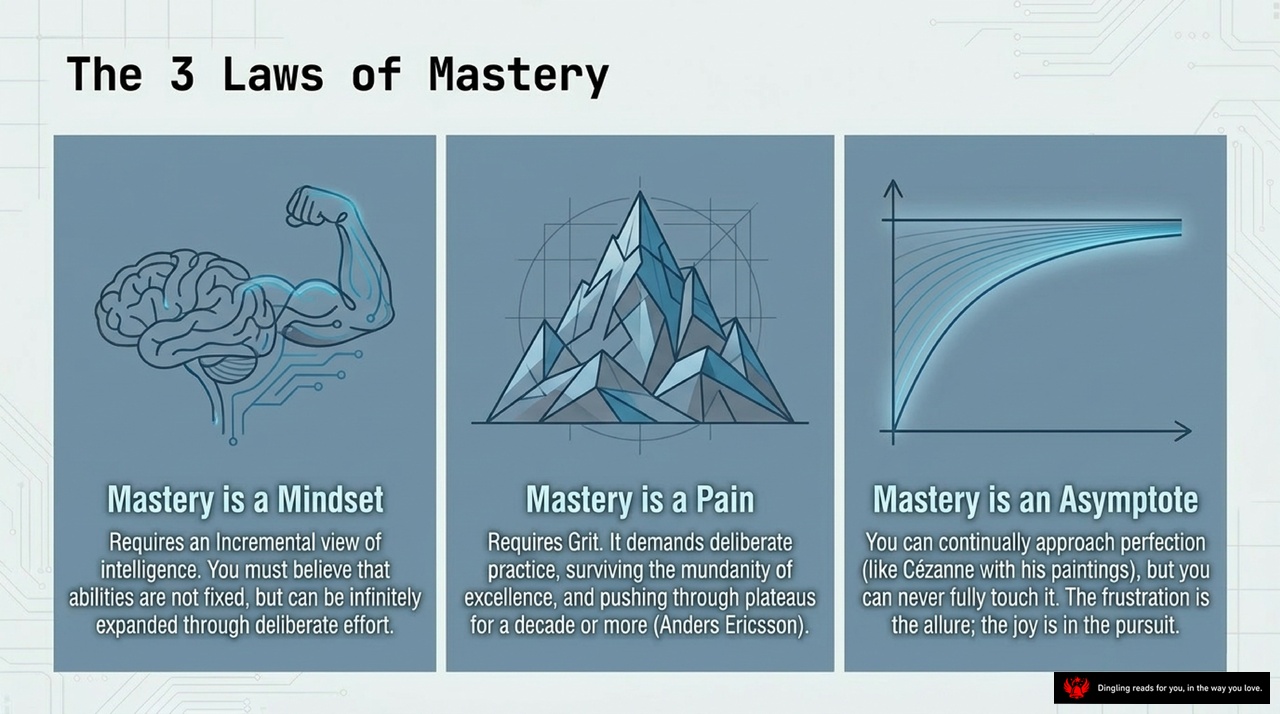
Let's talk about the true nature of mastery. The slide breaks it down into three powerful laws. First, mastery is a mindset. It requires what we call an incremental view of intelligence. You have to believe that your abilities aren't fixed traits you're born with, but something that can be infinitely expanded through deliberate effort.
Second, mastery is a pain. It demands grit. Think about the mountain in the middle of the slide. Real excellence requires surviving the mundanity of practice and pushing through plateaus for a decade or more. As Anders Ericsson notes, there is no shortcut; you have to endure the discomfort of getting better.
Finally, mastery is an asymptote. Look at that graph on the right. You can continually approach perfection—just like Cézanne did with his paintings—but you can never fully touch it. The frustration of that endless pursuit is actually the allure. The joy isn't in reaching a final destination; the joy is entirely in the pursuit itself.

Welcome back to our deep dive into the future of work. Today, we're shifting our focus to the third and most critical pillar of OS 3.0: Purpose Maximization.
Look at this scale. On the left, we have Profit Maximization, the engine of the old world. On the right sits Purpose Maximization. The slide clearly states that while OS 2.0 treated purpose as merely a decorative accessory, OS 3.0 places it alongside profit as a core operational engine. This isn't about choosing one over the other; it's about recognizing that purpose is now a fundamental driver of value.
To make this real, let's look at the three arenas where this shift happens. First, our Goals. We are moving beyond purely financial targets. Think of TOMS Shoes and their "buy one, give one" model. Here, the act of selling a pair is inextricably linked to giving a pair away. The business model itself is built on a social mission, proving that helping people can be a primary business strategy, not just a side charity.
Second, our Words. This is about shifting our organizational language. The slide highlights the "Robert Reich Pronoun Test." Do employees refer to the company as "They"—which signals disconnection—or "We," which signals deep engagement? When a company succeeds, it's not just because of its products, but because its people feel they are part of the story. Using "We" fosters that sense of shared ownership and belonging that drives true innovation.
Finally, our Policies. This is where we align daily actions with broader meaning. A powerful example given is allowing employees to direct corporate charitable giving to maximize their subjective well-being. When you give people the autonomy to choose where the company's resources go, you aren't just spending money; you're activating their inner desire to contribute.
In essence, Purpose Maximization transforms the workplace from a place where people are paid to execute tasks, into a community where people are empowered to create meaning. It's the difference between working for a paycheck and working for a purpose.
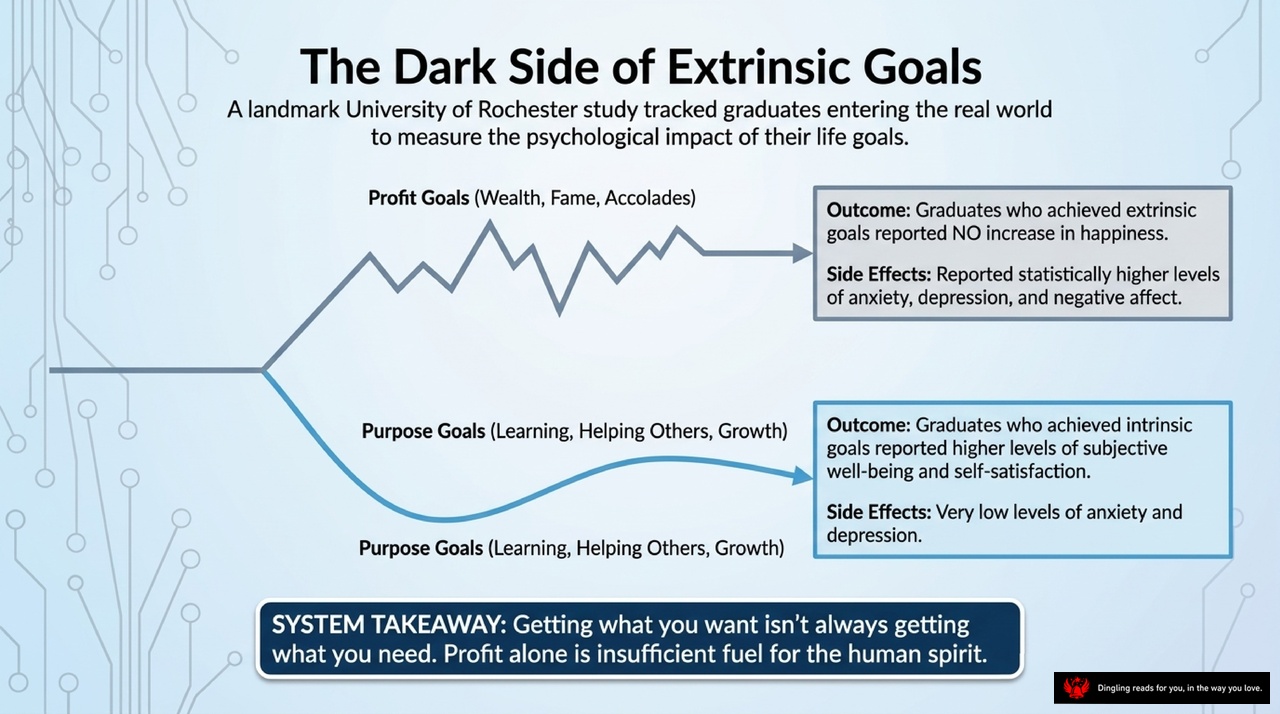
The dark side of extrinsic goals is a powerful reminder that chasing what we want doesn't always lead to getting what we need. A landmark study from the University of Rochester tracked graduates entering the real world, and the results were striking. Those who achieved profit goals—wealth, fame, accolades—reported no increase in happiness. Instead, they experienced statistically higher levels of anxiety, depression, and negative affect. It's as if the pursuit of external rewards created a psychological toll that money couldn't fix.
In contrast, graduates who focused on purpose goals—learning, helping others, growth—found something different. They reported significantly higher levels of subjective well-being and self-satisfaction. Surprisingly, these individuals also had very low levels of anxiety and depression. When we align our actions with our deeper values and contribute to something larger than ourselves, we don't just achieve more; we feel better.
The takeaway is clear: profit alone is insufficient fuel for the human spirit. Getting what you want isn't the same as getting what you need. True fulfillment comes from purpose, not just possession.
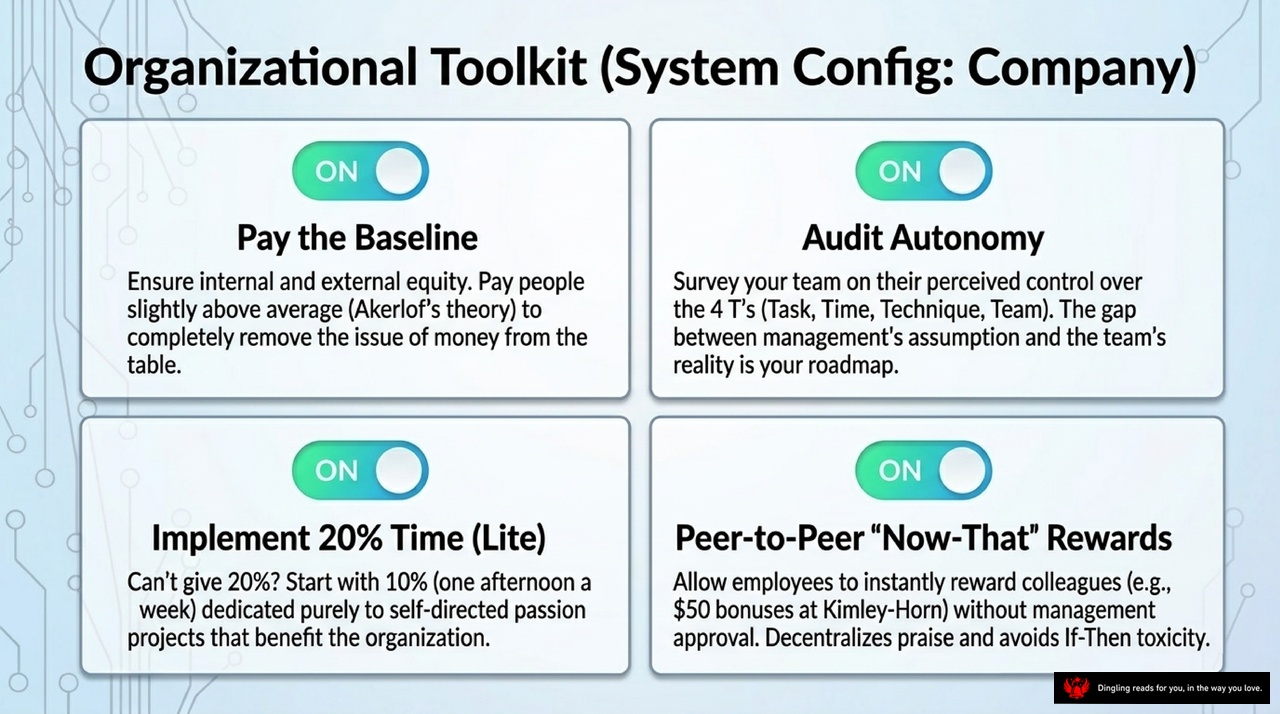
Imagine a company where you don't just clock in and out, but truly own your workday. That's the promise of the "Organizational Toolkit" we're exploring today. Think of it as the ultimate system configuration for a modern company, designed to unlock deep human motivation instead of relying on old-school control.
First, let's talk about money. The toolkit suggests we should "Pay the Baseline." This means ensuring your salary is fair both internally compared to colleagues and externally compared to the market. The logic here is powerful: if you pay people slightly above average, you completely remove money from the table as a daily stressor. When the paycheck is secure and fair, employees stop worrying about survival and start focusing on their actual work.
Next, we need to "Audit Autonomy." Managers often assume they know how employees want to work, but they're usually wrong. The fix is simple: survey your team on their perceived control over four key areas: Task, Time, Technique, and Team. The gap between what management thinks and what employees actually feel is your roadmap for improvement.
Then, consider "Implement 20% Time." Inspired by giants like Google and 3M, this allows employees to dedicate a portion of their week—ideally 20%, or a "Lite" version of 10%—to self-directed passion projects. Whether it's Gmail or Post-it notes, the best innovations often come from this unstructured time. If you can't give the full 20%, start small; just one afternoon a week dedicated purely to what excites you can yield massive results.
Finally, we have "Peer-to-Peer 'Now-That' Rewards." This flips the traditional boss-employee dynamic. Instead of waiting for a manager to hand out a bonus, allow employees to instantly reward colleagues for great work—think of a $50 bonus given on the spot without needing approval. This decentralizes praise, making it immediate and authentic, which avoids the toxicity of transactional "if-then" rewards.
By turning these four switches on, you shift from a command-and-control factory to a thriving ecosystem where autonomy, purpose, and trust drive performance.
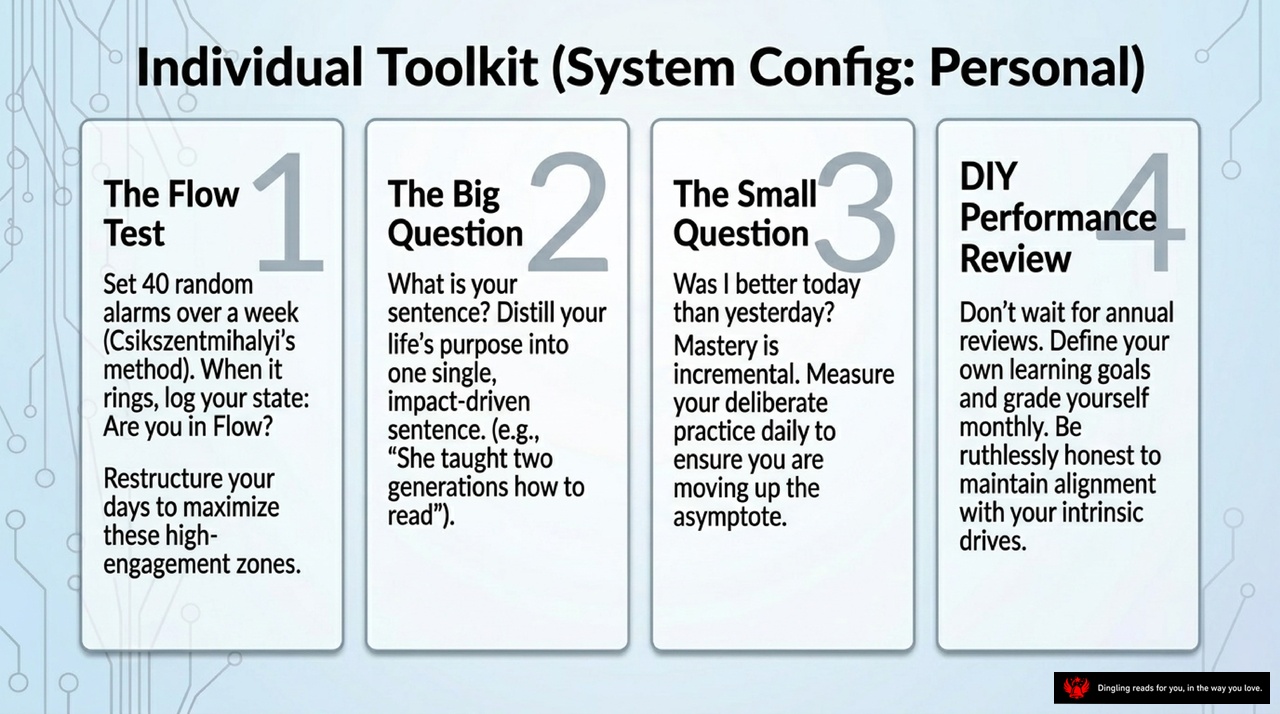
Today's slide outlines your personal toolkit for mastering the new way of working. Think of this as your system configuration for becoming an "I-type" person—someone driven by internal purpose rather than external rewards.
First, let's talk about **The Flow Test**. This is based on Csikszentmihalyi's method. Your challenge is simple: set 40 random alarms over the next week. Every time it rings, pause and ask yourself: "Am I in flow?" Are you so engaged that you lose track of time? The goal isn't just to count them, but to restructure your days to maximize these high-engagement zones where your best work happens.
Next is **The Big Question**. Distill your life's purpose into one single, impact-driven sentence. Maybe it's "She taught two generations how to read," or something that resonates with your own values. This sentence becomes your compass, anchoring your decisions when the path gets unclear.
Then, we have **The Small Question**. This is about incremental mastery. Every night, ask yourself: "Was I better today than yesterday?" Mastery isn't a destination; it's a curve. Measure your deliberate practice daily to ensure you are steadily moving up the asymptote, getting closer to your potential without needing to hit a final finish line.
Finally, let's look at the **DIY Performance Review**. Stop waiting for annual reviews that feel too far away. Instead, define your own learning goals and grade yourself monthly. Be ruthlessly honest about your alignment with your intrinsic drives. When you take ownership of your own growth, you stop being a passenger in your career and start steering the ship.

Look at this slide titled "SYSTEM REBOOT COMPLETE." It captures the exact moment we've reached in our journey: the realization that the old way of managing people—relying on biological drives and simple rewards and punishments—is simply not enough anymore.
The text here highlights what we call the "third drive." It's that deep-seated desire within every human to direct their own lives, to expand their abilities, and to live a life of purpose. This is the missing piece that the previous systems ignored.
Think about your own operating system. For too long, we've treated human beings like machines to be programmed. We built organizations on the assumption that people only work if they are being rewarded or punished. We created a system built for compliance, not for engagement. But as we've seen, this approach hits a wall when it comes to creativity, complex problem-solving, and genuine passion.
When you try to motivate someone with a carrot or a stick, you often end up narrowing their focus to just the reward, killing the very creativity you hoped to unlock. You create a cycle of dependency where people stop doing things because they want to, and start doing them only because they have to.
But what happens when we flip the script? What happens when we design systems that trust people? When we give them autonomy over their work, flexibility over their time, and the power to choose their teams? Suddenly, we unlock a different kind of energy. We tap into that third drive.
The human operating system isn't broken; it was just built for the wrong era. It's time to reboot. We need to move from a culture of compliance to a culture of engagement. We need to stop asking, "How do I control this person?" and start asking, "How can I empower this person to direct their own life and contribute to something bigger than themselves?"
This reboot isn't just about better productivity metrics; it's about unlocking the full potential of the human spirit. It's about creating an environment where people don't just show up to work, but where they actually want to be there, where they feel safe to fail, safe to innovate, and safe to be themselves. That is the foundation of a truly high-performance system.