
The Ego and the Id: Complete Chapter-by-Chapter Summary

Welcome to today's session on Sigmund Freud's groundbreaking work, *The Ego and the Id*. As you see on this slide, we are diving into a structural and dynamic mapping of the human psyche. This isn't just about abstract theory; it's the foundation for understanding our instinctual drives and the very roots of group psychology.
Freud proposed that our minds aren't a single, unified entity. Instead, they are split into distinct forces that constantly interact. At the core is the tension between the Id, driven by primal urges and the pleasure principle, and the Ego, which must navigate the harsh realities of the external world. This internal conflict shapes everything from our daily decisions to our deepest anxieties.
But it gets even deeper. Freud's insights laid the groundwork for understanding how individuals transform into collectives. He argued that the same forces binding us internally—the need for connection, the influence of authority figures, and the unconscious sharing of emotional states—are what hold societies together. From the structure of a military unit to the unity of a religious congregation, the psychological mechanisms are remarkably similar.
We are about to explore how these individual internal struggles scale up to shape the human experience on a societal level, revealing the hidden architecture of our collective mind.
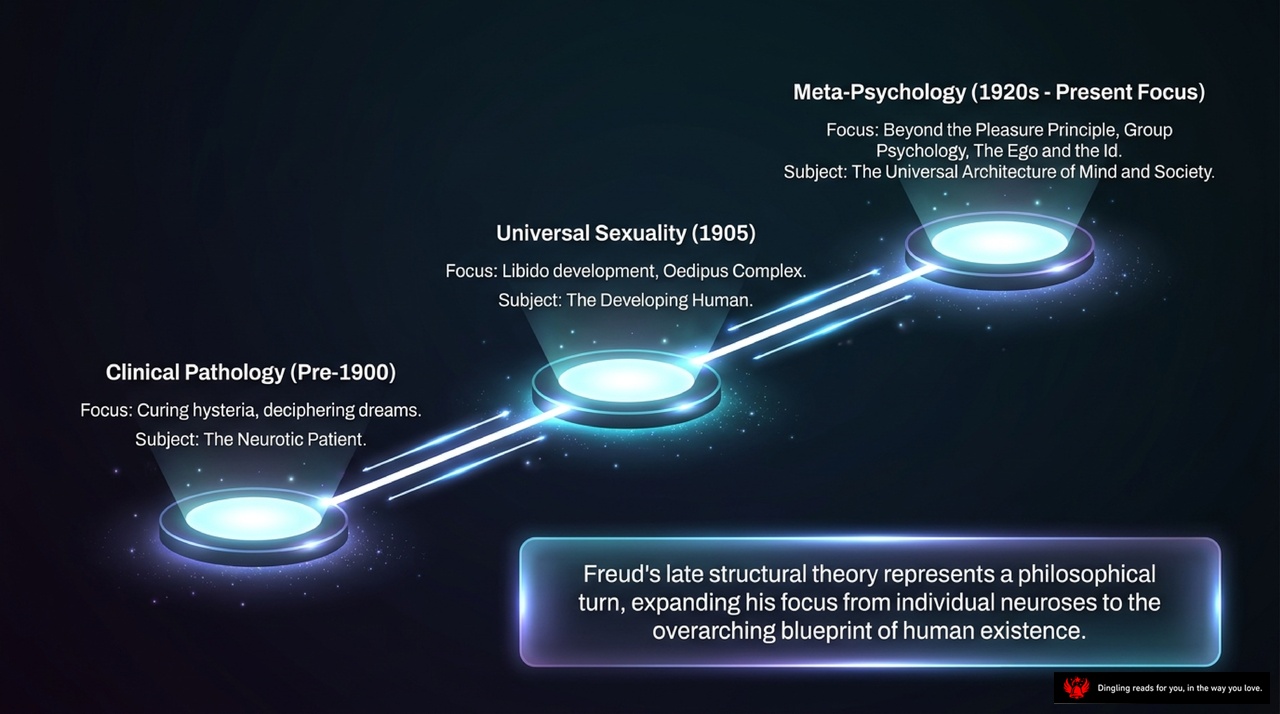
Freud's journey wasn't just about treating patients; it was a grand architectural shift in how we understand the human mind. Look at this timeline: we start in the **Clinical Pathology** era, pre-1900, where the focus was narrow—just curing hysteria and deciphering dreams for the neurotic patient. Then, in 1905, everything exploded with the concept of **Universal Sexuality**. Freud realized the mind wasn't just a medical problem; it was a story of **libido development** and the **Oedipus Complex**, shifting the subject to the **developing human**.
But the real revolution happened in the **Meta-Psychology** era, from the 1920s to the present. Here, Freud moved **beyond the pleasure principle** to explore **group psychology**, the dynamics of the **ego and the id**, and the **universal architecture of mind and society**. As the text highlights, this late structural theory represents a profound **philosophical turn**. It expanded his focus from individual neuroses to the **overarching blueprint of human existence**. He stopped asking "how do we cure this symptom?" and started asking "how does the human mind actually work at its core?" This shift laid the foundation for understanding the deep, often unconscious structures that drive our lives today.

Imagine the mind as a delicate balance scale, constantly weighing two opposing forces to keep us sane. On one side, we have the Pleasure Principle: our psyche's automatic drive to keep excitement and tension at the lowest possible level. It seeks immediate discharge of unbound energy, craving instant gratification while doing everything possible to avoid any pain or discomfort. It's the ultimate shortcut, always looking for the path of least resistance.
But life isn't always a straight line to happiness. That's where the Reality Principle steps in. This is the modification of the Pleasure Principle, born from our need for self-preservation. Instead of demanding instant relief, it enforces a temporary tolerance of displeasure. It teaches us to delay gratification, allowing us to navigate the complex external world safely. Think of it as the difference between grabbing a candy bar now versus saving money to buy a house later. The Pleasure Principle wants the candy; the Reality Principle understands that the house is what truly keeps us safe and secure in the long run.
In our daily lives, this internal tug-of-war is constant. We feel the pull of immediate satisfaction, but our survival instincts often force us to wait, to endure short-term discomfort for long-term gain. Without this balance, we'd be impulsive and vulnerable, unable to function in a world that rarely offers instant rewards. Understanding this dynamic helps us make better choices, recognizing when we are being hijacked by the urge for instant pleasure versus when we are wisely exercising patience for a greater future. It's the fundamental engine that drives our psychological maturity, ensuring we don't just survive the moment, but live a sustainable life.
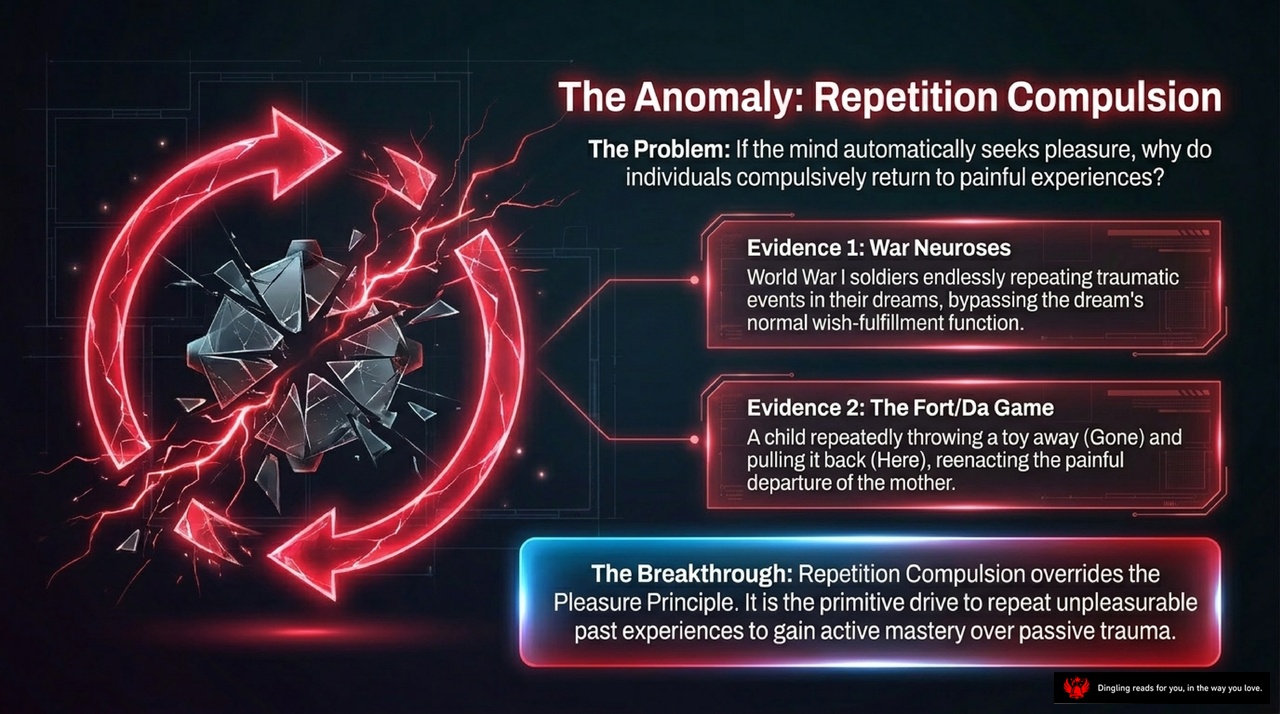
So, why do we keep doing the same thing, even when it hurts? This slide tackles a psychological paradox known as "Repetition Compulsion." It asks a simple but mind-bending question: If our minds are wired to seek pleasure, why do we compulsively return to painful experiences?
Look at the evidence provided here. First, we see "War Neuroses." World War I soldiers didn't just forget their trauma; their dreams endlessly replayed the traumatic events, completely bypassing the normal function of dreams to wish for something better. Second, there's "The Fort/Da Game." Think of a toddler throwing a toy away to say "Gone" and then pulling it back to say "Here." They are actively reenacting the painful departure of their mother, turning a terrifying loss into a game they control.
The breakthrough here is crucial: Repetition Compulsion actually overrides the Pleasure Principle. Instead of avoiding pain, the psyche has a primitive drive to repeat unpleasurable past experiences. Why? To gain active mastery over passive trauma. By repeating the pain, we try to move from being a helpless victim of the past to the director of the scene. It's a desperate attempt to master the unmanageable.

Welcome to the next chapter of our journey into the human psyche. Today, we're diving deep into the "Dual Instinct Theory," a concept that fundamentally reshapes how we understand the driving forces of life.
On the left, you see **Eros**, or the Life Instinct. Think of Eros as the creative, expansive force that binds us together. Its core energy is what we call Libido—love in its broadest sense, not just sexual, but the very glue that connects distinct entities into greater unities. The ultimate goal of Eros is simple yet profound: to preserve living substance, prolong the journey of life, and keep us moving forward.
On the right, we have **Thanatos**, the Death Instinct. This is the counterforce, conservative and destructive. Its nature is to unbind and return to the status quo. The core energy here isn't love, but aggression and a compulsion to repeat. Its ultimate goal is the inherent inertia of organic life—to return living matter to its original, tensionless, inorganic state. In other words, it seeks the ultimate peace of nothingness.
So, what does this mean for us? Life isn't just about growth and creation; it's a constant tug-of-war between the urge to build and connect, and the deep, silent drive to return to silence. We are the battleground where these two macro-forces collide, creating the complex, dynamic reality of our existence.
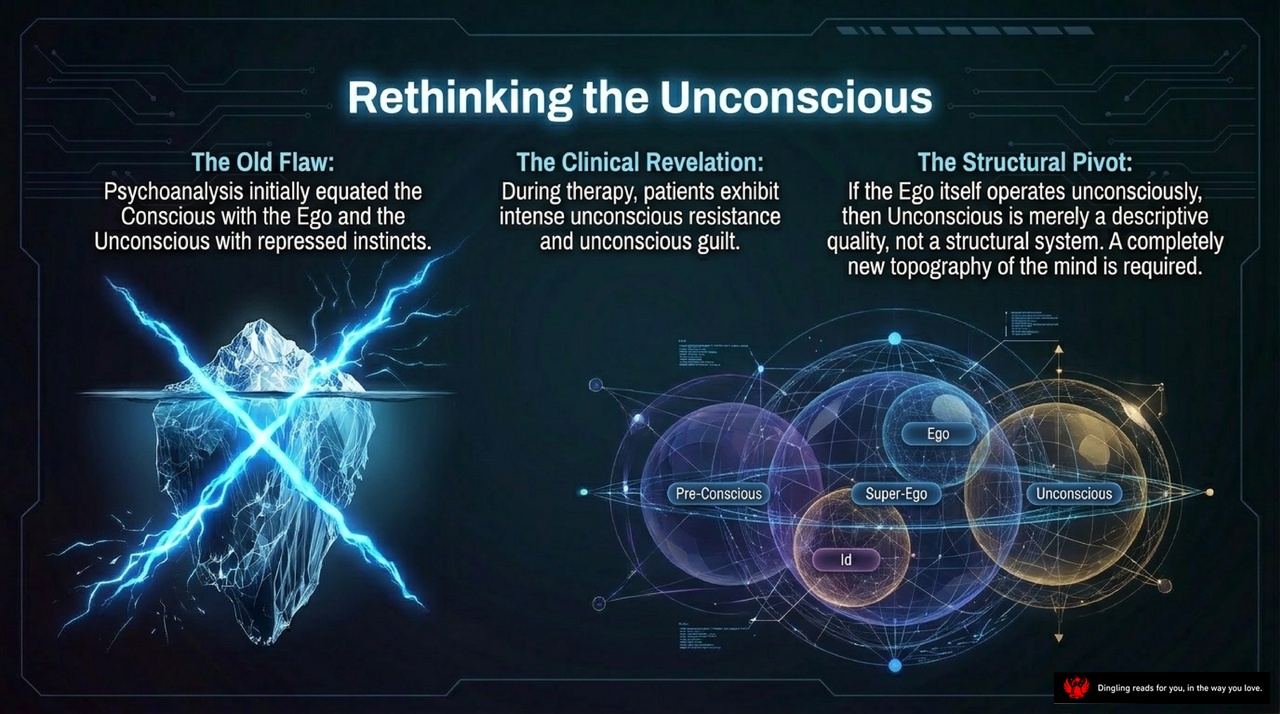
Rethinking the Unconscious: A New Topography of the Mind
We've all heard the famous iceberg metaphor, where the conscious mind is just the tiny tip above the water, and the vast, hidden depths represent the unconscious. For decades, psychoanalysis equated the conscious with the Ego and the unconscious with repressed instincts. But as we look deeper into clinical reality, this old model starts to crack. During therapy, patients don't just reveal hidden memories; they exhibit intense unconscious resistance and unconscious guilt. This suggests that the Ego itself operates unconsciously. If the Ego is part of the unconscious, then the unconscious isn't just a structural box containing repressed desires; it's a descriptive quality of the mind itself.
This realization forces a structural pivot. We need a completely new topography of the mind. Look at the diagram on the right: it moves beyond the simple split. Here, we see the Ego, the Super-Ego, the Id, and the Unconscious all interwoven in a complex network. The Ego isn't purely rational or conscious; it has unconscious parts that generate anxiety and guilt. The Super-Ego acts as an internal judge, often operating in the dark. And the Unconscious permeates everything, influencing our thoughts and behaviors without us realizing it.
This shift changes how we understand our inner world. We are not just passengers in our own minds; we are constantly navigating a landscape where our conscious intentions are constantly being shaped by forces we can't see. The unconscious isn't a separate room we visit; it's the very fabric of our psychological life. Understanding this complex interplay between the conscious, pre-conscious, and unconscious layers is the key to unlocking the mysteries of human behavior and mental health.
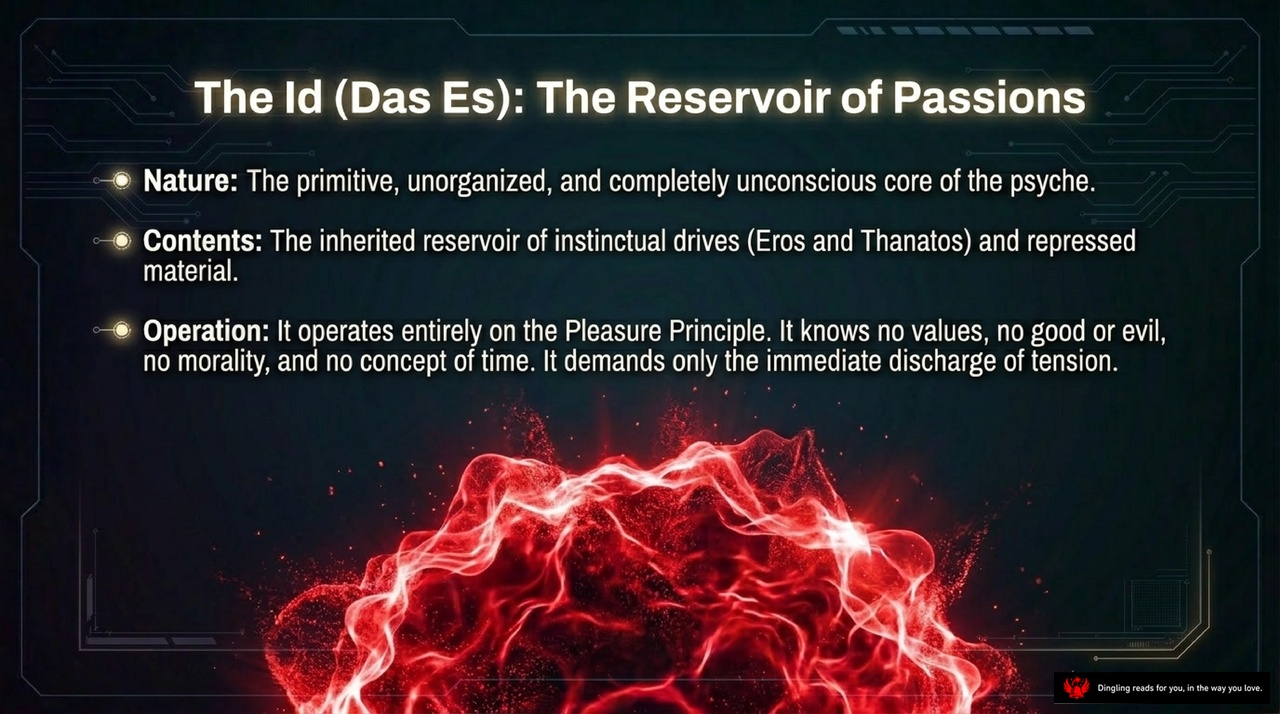
Imagine your mind as a battlefield where two ancient, opposing forces are locked in an eternal struggle. This slide introduces the core of that conflict: the Id, or *Das Es*. Think of it as the primitive, chaotic core of your psyche—a completely unconscious reservoir where your deepest passions live. It has no morals, no sense of time, and knows nothing of good or evil. Its only goal is simple and immediate: discharge tension. It operates on the Pleasure Principle, demanding instant gratification for Eros, the life instinct, and Thanatos, the death instinct.
But here's the twist that changes everything. While the Id pushes for immediate release, the Self tries to hold back. This creates a constant tension. When the Id's demands clash with reality or the Self's need for safety, the result is anxiety. The Self isn't just a rational ruler; it's a fragile mediator trying to delay the inevitable explosion of these unconscious drives. We are essentially managing a storm inside our own heads, trying to balance the chaotic energy of the Id with the structured demands of the real world. This struggle defines much of our psychological life, from our daily frustrations to our deepest fears.
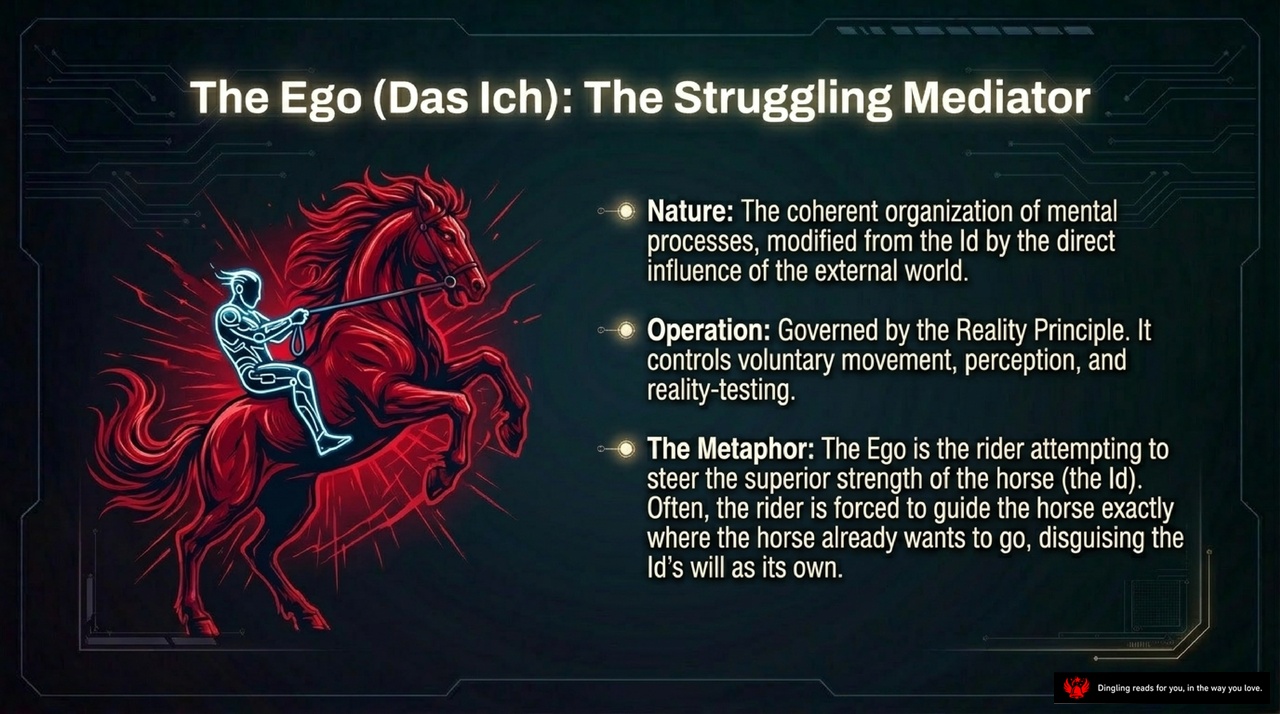
The ego is often pictured as the rational rider trying to steer a powerful, wild horse. In our slide, that horse represents the Id—the raw, primal force of our instincts—while the rider is the Ego, or "Das Ich," acting as the struggling mediator between us and our deepest drives.
Think of the Ego not as a master, but as a co-pilot constantly fighting to keep the plane on course. Its nature is defined by how it organizes our mental life, constantly adjusting the Id's raw impulses based on what the outside world demands. It doesn't just follow our instincts; it modifies them to fit reality.
This brings us to the most critical rule the Ego operates under: the Reality Principle. While our Id screams for instant gratification, the Ego says, "Wait." It controls our voluntary movements, our perception, and our ability to test reality. It forces us to delay satisfaction, to tolerate discomfort, and to navigate the complex world around us rather than just charging forward blindly.
But here is the hard truth illustrated by our metaphor: the rider is often outmatched. The Ego is frequently forced to guide the horse exactly where the horse already wants to go. In those moments, the Ego disguises the Id's will as its own, making our impulsive desires feel like our own rational choices. We think we are in control, but often, we are just trying to steer a superior strength that refuses to be tamed. This internal struggle defines our daily lives.
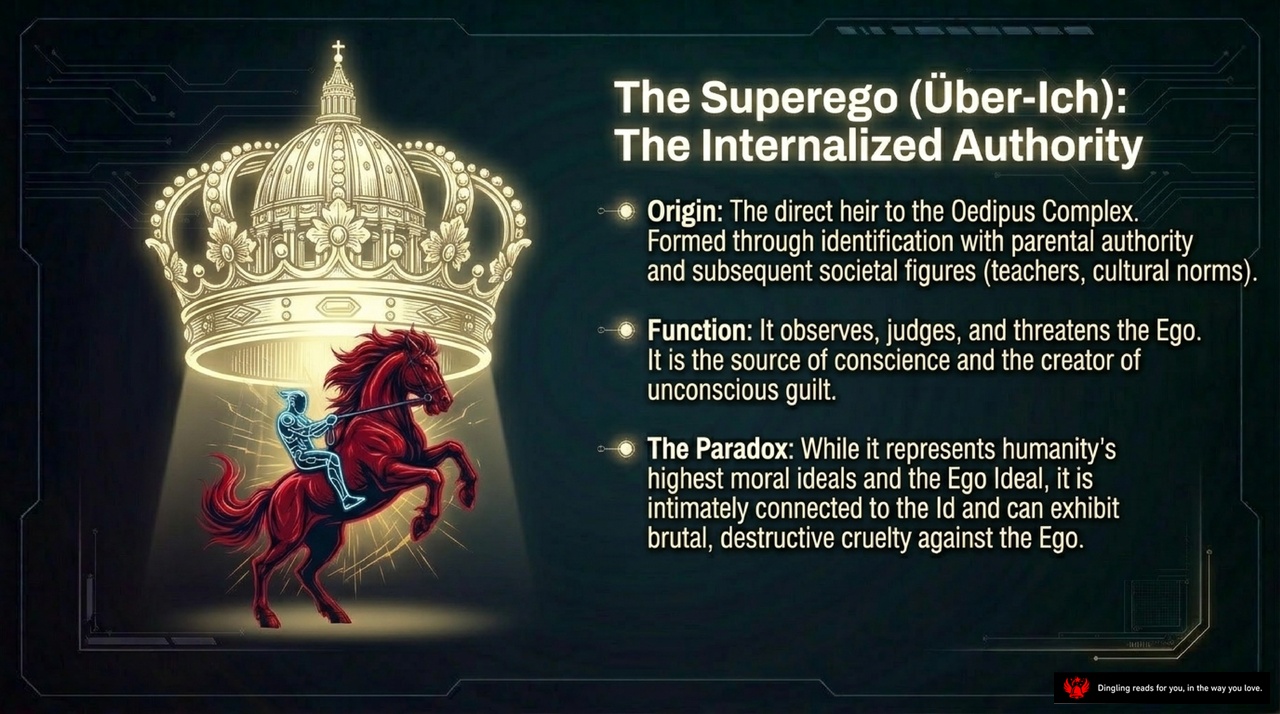
The Superego, often called the "Über-Ich," is essentially the internalized authority we all carry within us. Think of it as a golden crown hovering over your head, constantly judging your every move. As the slide illustrates, its origin is directly tied to the Oedipus Complex. It forms when we identify with our parents and later with societal figures like teachers and cultural norms, effectively internalizing their rules.
Its primary function is to observe, judge, and threaten the ego. It is the very source of our conscience, but it is also the creator of unconscious guilt. Here lies the paradox: while the Superego represents our highest moral ideals and the Ego Ideal, it is intimately connected to the Id. This connection means it can sometimes exhibit brutal, destructive cruelty against the ego, punishing us far harsher than reality might warrant.
So, we are essentially riding a wild horse of our own desires, while this internal crown watches us, ready to strike whenever we stray from its strict moral code. It's the ultimate internal boss, blending our noblest aspirations with our deepest, darkest impulses.
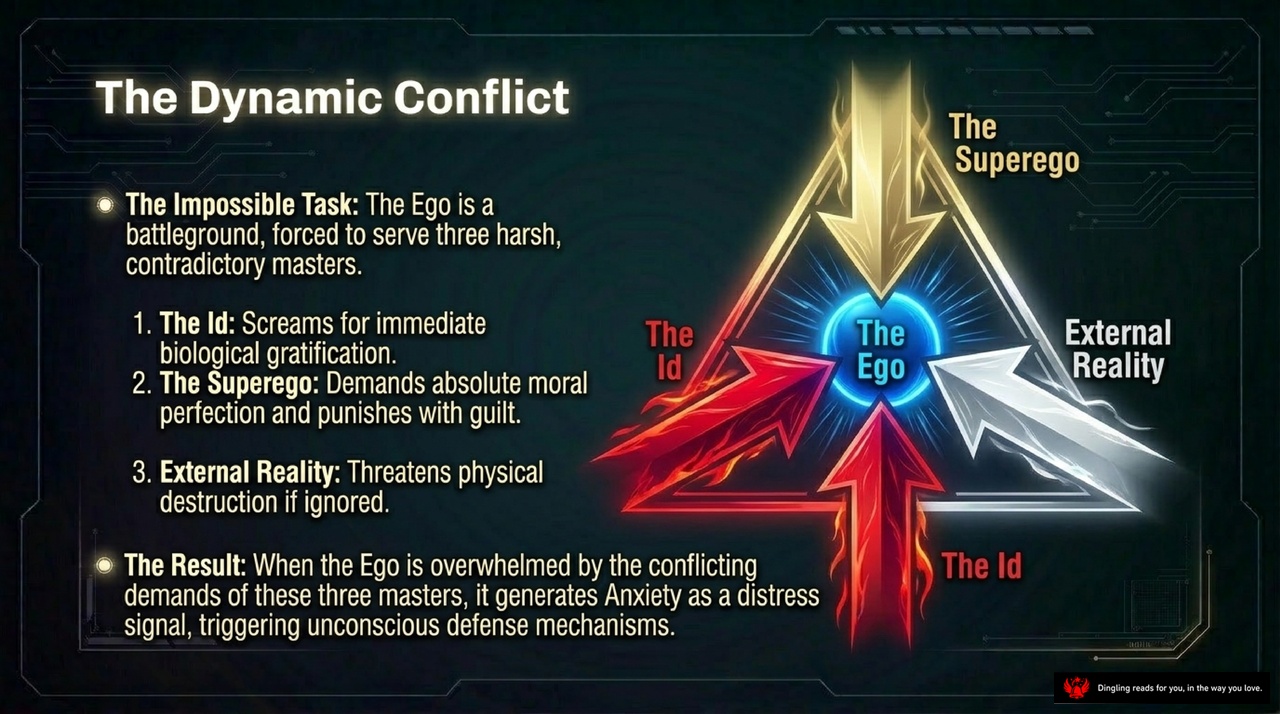
Imagine the human mind not as a calm ocean, but as a chaotic battlefield where three ruthless generals are constantly at war, and you are the exhausted soldier in the middle trying to survive. This is what we call "The Dynamic Conflict," a concept that perfectly illustrates why anxiety feels so inescapable.
At the center of this triangle sits your **Ego**. It is trapped, forced to serve three contradictory masters, each screaming for something completely different. First, there is **The Id**, represented here by the fiery red arrows. This is your primitive, biological self, screaming for immediate gratification. It wants pleasure now, regardless of the consequences. It doesn't care about rules or reality; it only wants to satisfy its urges.
Opposing the Id is **The Superego**, the golden arrow pointing down. This is your internal judge, your conscience, and your moral compass. It demands absolute perfection and purity. It punishes you with guilt if you even think about breaking the rules. It wants you to be better than you are, constantly criticizing your every move.
Then, cutting through the middle, is **External Reality**, the white arrow. This represents the harsh world around you. It threatens physical destruction if you ignore the laws of physics, social norms, or practical limitations. You can't just fly to the moon or eat the furniture because External Reality says no.
The result of this impossible task is clear: Anxiety. When the Ego is overwhelmed by these conflicting demands—the Id's hunger, the Superego's judgment, and Reality's threats—it generates anxiety as a distress signal. This isn't just a feeling; it's a survival mechanism triggering your unconscious defense mechanisms to try and protect you from this internal chaos.
So, when you feel anxious, remember: you aren't just being weak. You are the Ego in the middle of a war, trying to balance your desires, your morals, and the real world. Understanding this dynamic conflict is the first step to realizing that your anxiety has a logical, albeit painful, origin.
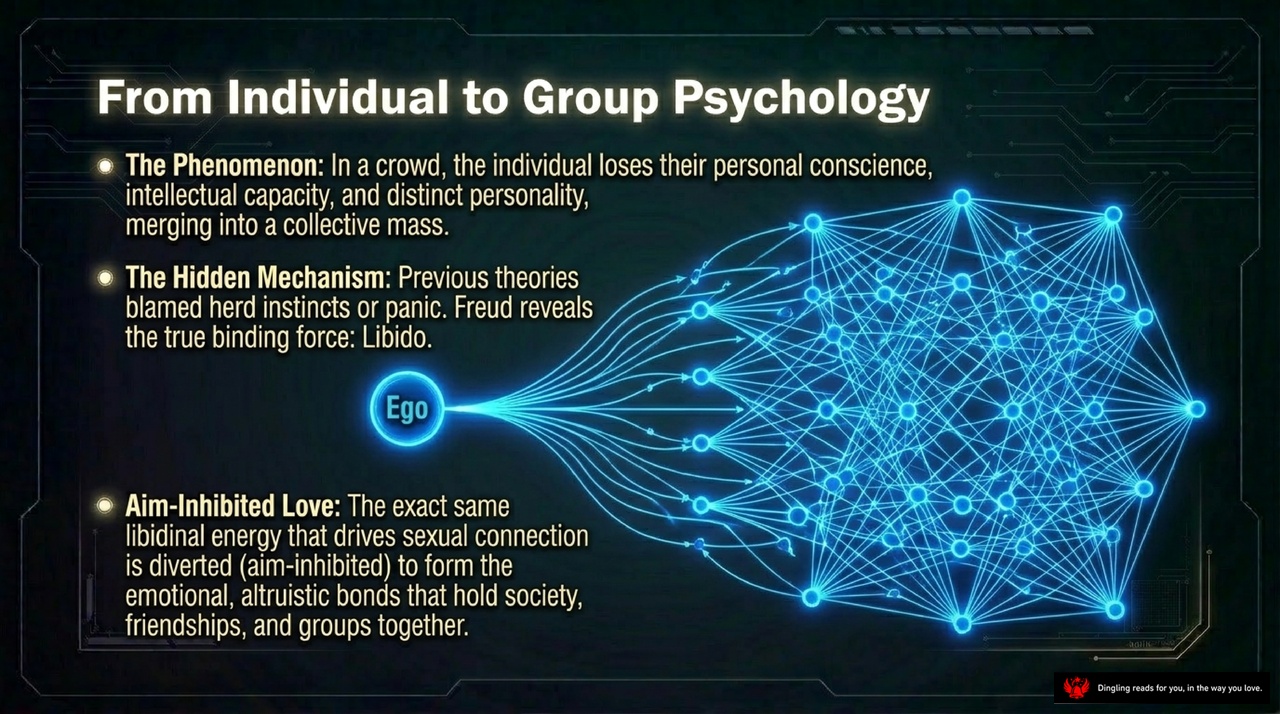
Imagine a single individual stepping into a massive crowd. Suddenly, something profound happens: their personal conscience, their intellect, even their distinct personality begins to dissolve. They aren't just standing there anymore; they are merging into a collective mass, losing the ability to think critically or act with restraint. This is the phenomenon of the crowd, and for decades, we blamed it on primitive herd instincts or sheer panic. But what if that explanation was missing the real point?
Freud discovered the true binding force behind this transformation: Libido. It's not about fear; it's about love. When an individual joins a group, their sexual energy—the same drive that seeks a specific partner—gets diverted. This is what we call "aim-inhibited love." Instead of pointing toward a single romantic object, this libidinal energy is redirected outward to form emotional, altruistic bonds with everyone in the group.
Think of it this way: the "Ego" of an individual doesn't vanish; it expands. That personal energy spreads out, connecting to dozens or hundreds of others, creating a web of shared affection. This shift explains why people in a crowd lose their individuality. They are no longer isolated selves; they are part of a unified whole, bound together by this redirected love. It's the same energy that builds families and friendships, but on a grand, collective scale. This is the hidden mechanism of group psychology: a society held together not by logic or rules, but by a deep, unconscious web of love.
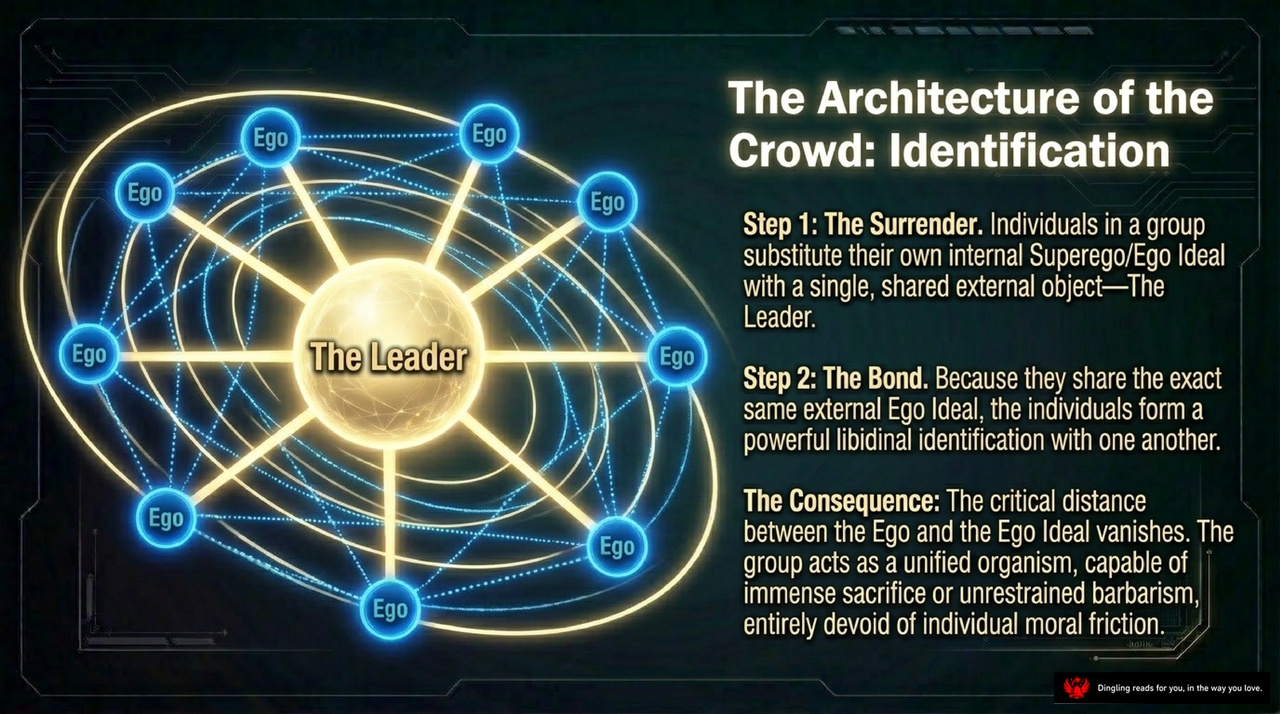
Imagine a single, powerful leader standing at the center of a vast, glowing network, surrounded by individuals who have all surrendered their own internal compass to follow this one figure. This is the architecture of the crowd, where the "Ego" of each person abandons its unique ideal and replaces it with a single, shared external object—the Leader. Because everyone now shares this exact same external Ego Ideal, a powerful bond forms instantly. It's not just a group of people standing together; it's a unified organism where the critical distance between the individual self and the ideal vanishes.
In this state, the group becomes capable of immense sacrifice or unrestrained barbarism, entirely devoid of individual moral friction. The logic is simple yet terrifying: by surrendering to the leader, we all become the same thing. We lose our personal moral guard, and what remains is a collective force that acts as one. This is how a crowd transforms from a collection of individuals into a single, unstoppable entity, driven by a shared fantasy and a total loss of self.
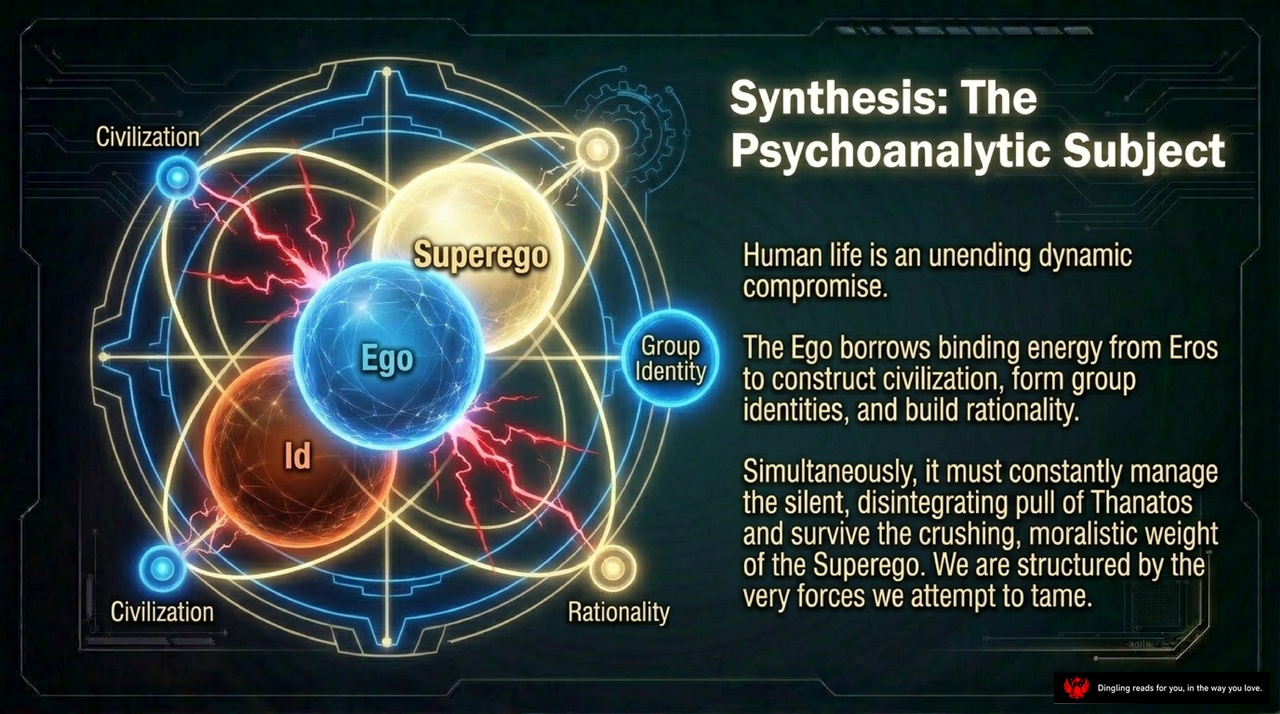
Synthesis: The Psychoanalytic Subject
Look at this diagram. It visualizes the human psyche not as a static entity, but as a chaotic, high-voltage system in constant negotiation. At the center sits the Ego, the manager trying to keep order, but it is surrounded by three powerful, often conflicting forces: the Id, the Superego, and the collective pull of Group Identity.
The text on the right captures the essence of this struggle perfectly. It tells us that human life is an "unending dynamic compromise." The Ego isn't in charge; it's a borrower. It borrows binding energy from Eros—the life drive—to construct civilization, form our identities, and build rationality. But look at the red lightning bolts in the diagram; that represents the silent, disintegrating pull of Thanatos, the death drive. The Ego must constantly manage this crushing, moralistic weight of the Superego while trying to survive the very forces it attempts to tame.
We are structured by the very forces we try to control. We are caught between the urge to return to an inorganic state and the drive to create complex life. It's a perpetual tension where we try to synthesize these opposing currents into a coherent self, yet we remain fundamentally structured by the chaos we seek to order.

Freud's ultimate model reveals that we are not the masters of our own minds. We are dynamic battlegrounds where primitive biological drives of life and death, the demands of external reality, and the internalized ghosts of societal authority constantly collide.
If our most rational thoughts and highest moral ideals are secretly fueled by the same unconscious, primal energies that drive our darkest destructiveness, can we ever truly claim to act out of complete free will?