
Einstein: His Life and Universe: Complete Chapter-by-Chapter Summary

Welcome to our journey into the mind of genius. Today, we explore the life and universe of Albert Einstein, as told by Walter Isaacson.
Imagine a rebellious patent clerk who dared to rewrite the rules of reality. This is the story of a man who started as a quiet observer, fascinated by a compass that hinted at invisible forces, and grew into a thinker who shattered our understanding of time and space.
The cover of this book sets the stage perfectly. It captures the essence of Einstein's legacy: a harmony of the cosmos discovered by a lone mind, only to find himself eventually isolated by the chaotic randomness of the quantum world. From the equations floating in the background to the vast stars surrounding his face, this image reminds us that Einstein was both a product of human curiosity and a bridge to the infinite mysteries of the universe.
His journey wasn't just about math; it was about the courage to question everything. He taught us that imagination is more important than knowledge, and that true progress comes from challenging the status quo. As we turn the page, we will dive into the miracle year of 1905, the birth of relativity, and the profound debates that shaped modern science.
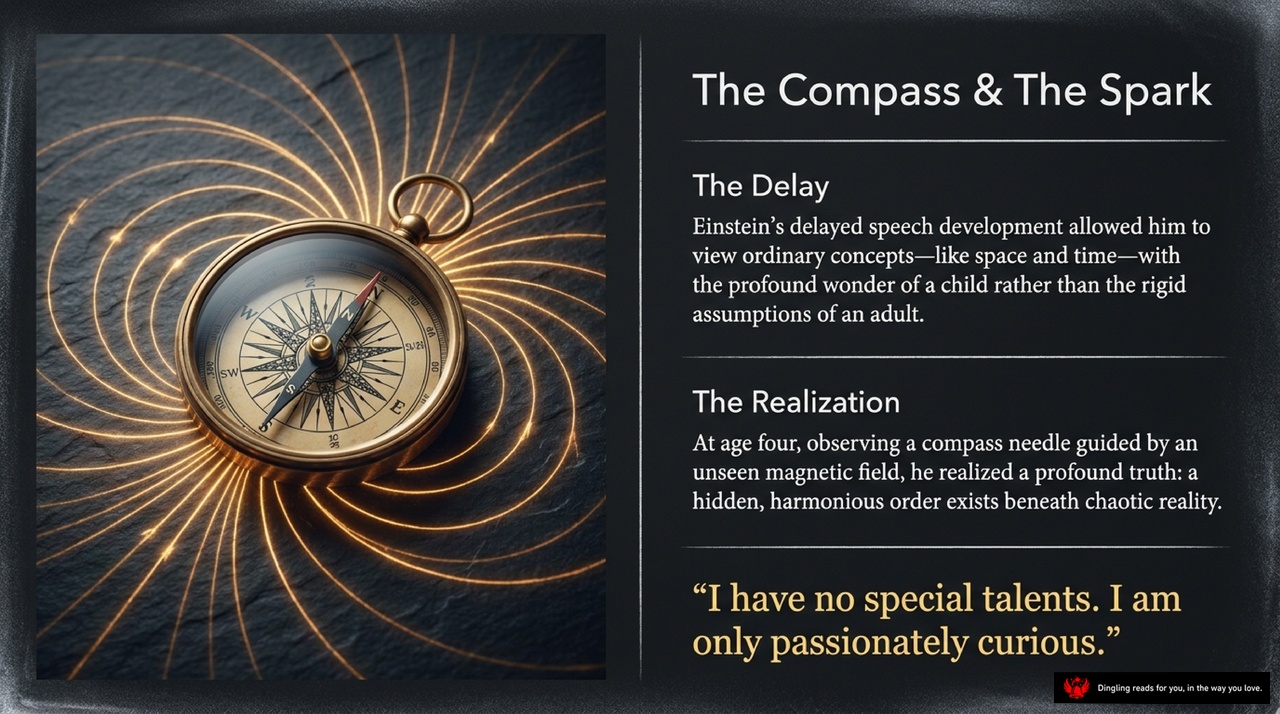
Look at this compass and the glowing lines radiating from it. This image captures the exact moment Einstein's mind ignited. The text on your slide highlights two pivotal moments: "The Delay" and "The Realization."
Let's talk about the delay. While many see late speech as a setback, for Einstein, it was a superpower. It gave him the perspective of a child, allowing him to see ordinary concepts like space and time with fresh wonder, rather than the rigid assumptions adults have built up. He wasn't just learning physics; he was rediscovering it.
Then, look at that compass needle in the image. At just four years old, Einstein watched a compass needle align with an invisible magnetic force. That moment sparked a profound realization: beneath the chaotic reality we see, there exists a hidden, harmonious order. He realized the universe wasn't random; it was guided by invisible laws.
This curiosity led him to say, "I have no special talents. I am only passionately curious." That single line, paired with the image of the magnetic field, defines his legacy. It wasn't about genius; it was about the relentless drive to uncover the invisible structures that hold our universe together.

The rebellious patent clerk. This isn't just a title; it's the story of how a man who felt like an outsider became the most famous scientist in human history. Look at this slide. On the left, we see the chains of rigid academic tradition and the graduation cap representing the German establishment that rejected him. Einstein despised that coercion and rote learning, earning him the disdain of his professors. Because of this intellectual exile, unable to secure an academic post, he took a humble job as a third-class examiner at the Swiss Patent Office in Bern. But don't mistake this for a failure. This was his sanctuary.
Isolated from the mainstream academia, he formed a bohemian reading group with friends. Free from institutional dogma, he devoured philosophy, forging his own scientific worldview. This is the Olympian Academy. It was here, in that quiet office, that he had the freedom to think differently. While others were busy checking patents, Einstein was checking the fabric of reality itself. And his attitude was clear: "Long live impudence! It is my guardian angel in this world." He believed that blind obedience to authority was the greatest enemy of truth. It was this rebellious spirit, born from being an outcast, that allowed him to eventually shatter the laws of physics and rewrite our understanding of the universe.
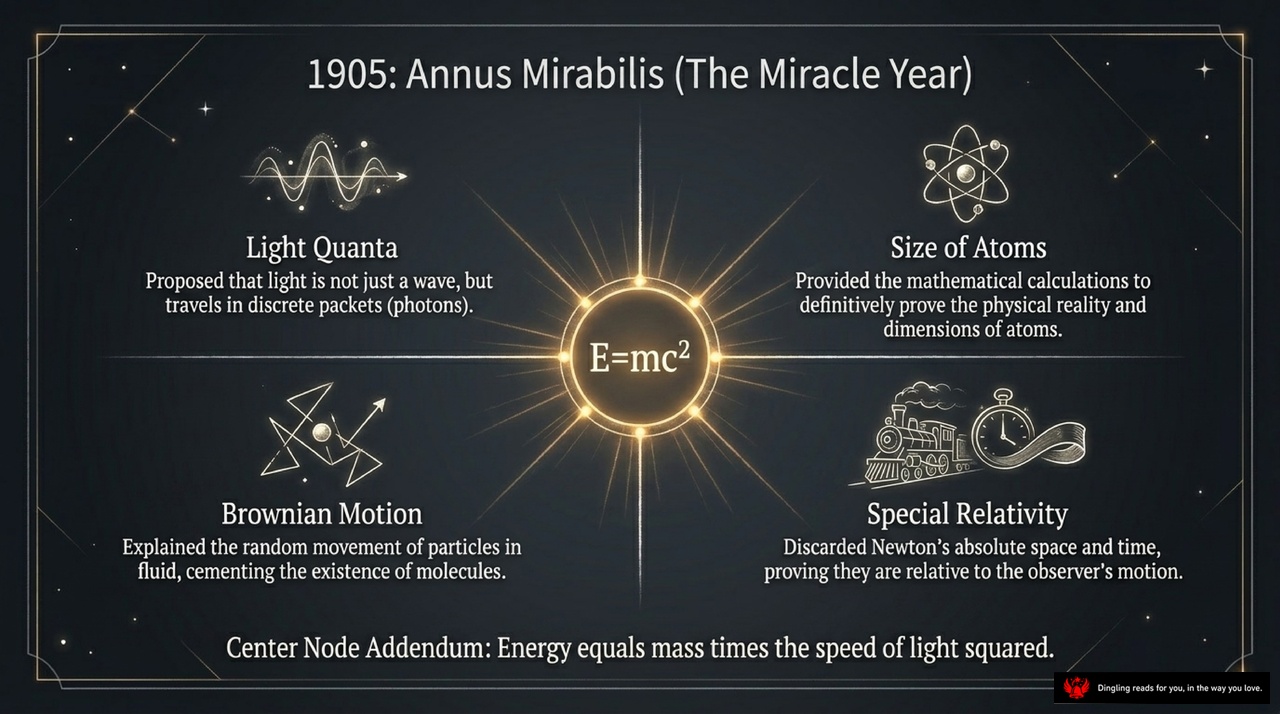
1905 wasn't just a year; it was a cosmic explosion. In the middle of a quiet patent office, Einstein dropped a bombshell on physics with four papers that would change everything. At the heart of it all sits the equation everyone knows: E equals mc squared. It's the ultimate reminder that mass and energy are two sides of the same coin, meaning even the tiniest amount of matter holds unimaginable power. But that wasn't the only revolution happening that year. Look at the top left: Light Quanta. Einstein proposed that light isn't just a smooth wave but travels in discrete packets called photons, a radical idea that birthed quantum mechanics. On the top right, we see the Size of Atoms. He provided the math to prove atoms are real physical objects, finally ending a decades-long debate about whether they existed at all. Down on the left, the image shows Brownian Motion. He explained the random jitter of particles in fluid, cementing the existence of molecules through statistical proof. And finally, bottom right, Special Relativity. He discarded Newton's idea of absolute space and time, proving that time and space are relative to the observer's motion. These four breakthroughs didn't just update science; they rewrote the rules of the universe.

Imagine a train speeding past you, lightning striking both its ends at the exact same moment from your perspective on the platform. But here's the mind-bending twist: a passenger moving toward one flash and away from the other sees them happen at different times. This simple thought experiment, visualized by Einstein, shattered the idea of absolute time. He realized that time isn't a universal ticking clock; it bends and stretches depending on your state of motion. By prioritizing imagination over complex math, Einstein proved that our perception of reality is relative. This insight didn't just change physics—it redefined our understanding of the universe itself, showing that what we consider "now" is entirely dependent on where we are and how we move.

Welcome to the mind-bending world of General Relativity. Published in 1915, this theory completely rewrote our understanding of gravity. Forget the old idea of gravity as a mysterious magnetic pull across empty space. Einstein gave us a stunning new picture: imagine a bowling ball resting on a trampoline. It curves the fabric, causing rolling marbles to spiral toward it. That is the core metaphor. In reality, mass curves the four-dimensional fabric of spacetime itself. This curvature is exactly what we experience as gravity.
Think of it like a blind beetle crawling on a curved branch. The beetle doesn't notice that its path is curved; it just thinks it's moving straight. Einstein was lucky enough to notice what the beetle didn't. He realized that gravity isn't a force pulling objects, but rather the shape of space and time itself bending around massive objects like planets and stars. This simple yet profound shift allowed him to explain phenomena Newton's laws couldn't, like the precise orbit of Mercury. It transformed gravity from a force into a geometry, forever changing how we see the universe.
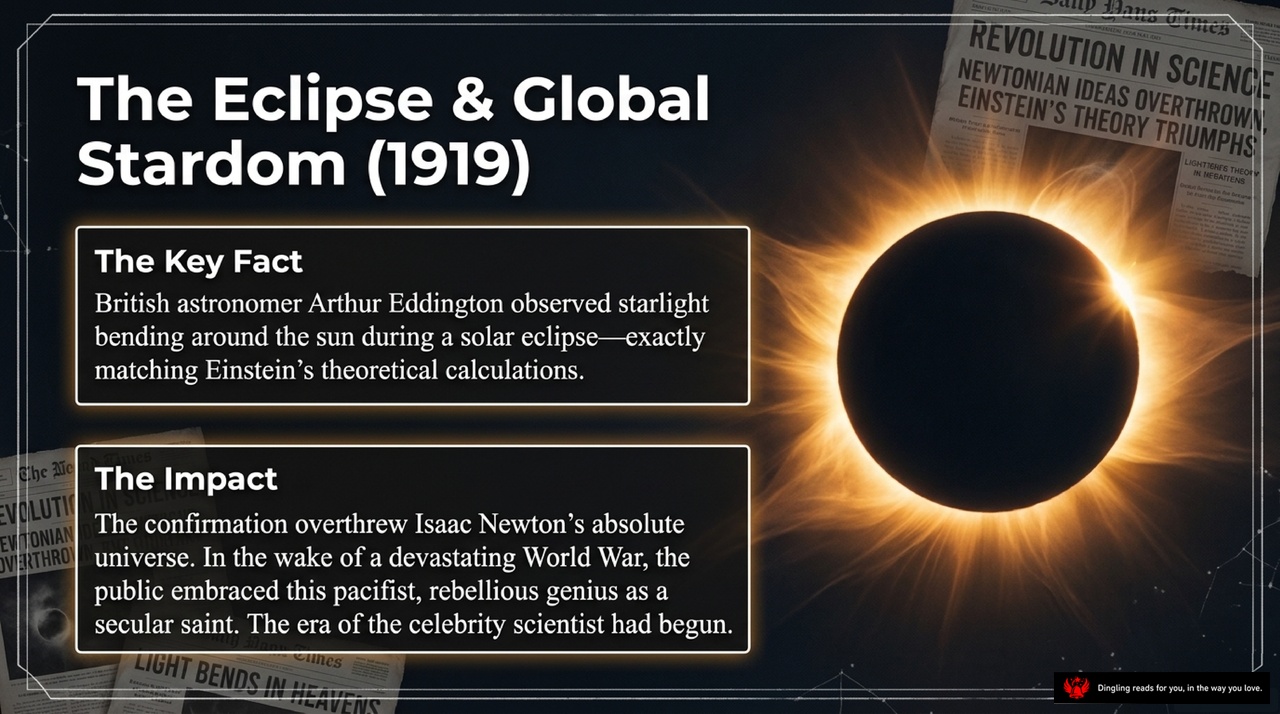
Picture this: the sun completely swallowed by darkness, yet the stars around it seem to shift, bending in ways Newton's laws never predicted. This was the scene in 1919, a moment that changed history forever. British astronomer Arthur Eddington traveled to remote locations to observe a total solar eclipse, capturing the exact moment starlight curved around the sun's gravity. The results matched Einstein's theoretical calculations perfectly, proving that gravity isn't just a force, but a curvature of space and time itself.
This single confirmation did more than validate a math equation; it toppled Isaac Newton's absolute universe. In the wake of a devastating World War, the public, exhausted by conflict, embraced this rebellious genius as a secular saint. He was no longer just a scientist in a lab; he was a global icon, a pacifist voice who dared to rethink reality. The era of the celebrity scientist had officially begun, transforming physics from an abstract academic pursuit into a spectacle that captivated the entire world.

Look at this slide, "The Cost of Genius: A Life Compartmentalized." It reveals the painful duality of Einstein's personal life, a stark contrast to his unified theories of physics. On the left, we see Mileva Marić, his first wife and the true physics partner. She was his sounding board during his miraculous year, yet their marriage ended in bitter alienation. In a move that highlights his extreme prioritization of his scientific legacy, he even surrendered his entire Nobel Prize money to secure their divorce. On the right stands Elsa Einstein, his cousin and second wife. While she was uninterested in the complexities of relativity, she served as the essential maternal protector. She provided the bourgeois comfort and management Einstein desperately needed to function as a global icon, allowing him to retreat into his work. This visual captures the central paradox of his existence: Einstein possessed a profound, transcendent love for humanity as a whole, yet he frequently maintained a cold, objective detachment from those closest to him. He loved the universe enough to change it, but often found it too difficult to love the people who lived in it.

Picture this: the ultimate clash between two giants of physics, a debate that didn't just shape science, but fundamentally altered how we see reality itself. On the left, we have Einstein and his theory of Relativity. He believed in a universe that is objective, existing independently of us. For Einstein, the cosmos was deterministic, strictly causal, and governed by a beautiful, absolute harmony—a universe where Spinoza's God reigns supreme. His famous verdict was clear: "God does not play dice with the universe."
On the right stands Niels Bohr and the revolution of Quantum Mechanics. Here, reality is subjective, defined entirely by the act of observation. The mechanics are probabilistic and inherently uncertain. At the subatomic level, there is no grand design, only fundamental randomness. Bohr's retort to Einstein was equally iconic: "Einstein, stop telling God what to do."
This slide captures the Quantum Divide, the battle for reality. It's the tension between a predictable, orderly cosmos and a chaotic, observer-dependent one. Einstein fought his entire life to prove that the universe is complete and knowable, while Bohr argued that at its core, nature is fundamentally unpredictable. This wasn't just a scientific disagreement; it was a philosophical war that continues to echo today, forcing us to ask: is the universe a fixed stage, or does it only exist when we look at it?

Look at this slide, "The Irony of Authority." It captures a profound paradox in Albert Einstein's life: the man who spent his entire career rebelling against dogma and authority, only to become the ultimate authority himself.
On the left, we see "The Rebel." This is the Einstein who upended classical physics by refusing to accept established dogma. For the last 30 years of his life, he relentlessly invented thought experiments to disprove the randomness of quantum mechanics, only to be refuted daily by Niels Bohr. He famously said, "Blind worship of authority is the greatest enemy of truth." He stood alone against the scientific consensus, challenging the very foundations of how we understand the universe.
But look at the shift to the right: "The Authority." This is the tragic twist of fate. As he fought the system, the system fought back, elevating him to the very pedestal he despised. The quote on the right says it all: "To punish me for my contempt for authority, fate made me an authority myself."
This irony wasn't just about fame; it was about the human condition. Einstein started as a patent clerk, a nobody who questioned the giants. Yet, by the time he was debunking Bohr's certainty, he was the one everyone listened to. He became the very thing he warned us against. It's a powerful reminder that even the most rebellious thinkers can become the establishment, and that true independence of mind is perhaps the hardest thing of all to maintain once you've become the boss.

Look at this map. It tells the story of a man who never truly belonged to any single nation, yet became a citizen of the entire world. At the center, we see "The Stateless Humanitarian." This was Albert Einstein's defining identity.
First, look to the left. In 1933, forced to flee Nazi Germany, he left everything behind—his property, his ties to the Prussian Academy—and found permanent refuge in Princeton. He was an exile, but he refused to let his exile define his spirit.
Now, look to the bottom. This is "The Atomic Tragedy." In 1939, he co-signed a letter to President Roosevelt warning of German nuclear research. That letter indirectly catalyzed the Manhattan Project. It was a moment of profound moral weight. As he later confessed, "If I had known the Germans would not succeed in constructing the atom bomb, I would never have lifted a finger."
Finally, see the right side. He was "The Pacifist & Zionist." A lifelong opponent of nationalism and militarism, he used his immense moral authority to champion the establishment of a Jewish homeland. He believed that true security could only come from a world government that stood above all nations.
Einstein's life was a journey across borders, but his heart remained anchored to humanity. He proved that while borders divide people, universal citizenship can unite them.

Look at this lone figure walking beneath a cosmos of stars and constellations. This image captures the final, defining quest of Albert Einstein: The Unified Field Theory. In his final decades at Princeton, Einstein spent his life chasing a single, elegant equation that would unite electromagnetism and gravity into one grand framework.
But this was a tragedy of noble proportions. While the rest of physics moved forward to embrace the strong and weak nuclear forces, Einstein deliberately ignored them. He marched alone into a mathematical wilderness, driven by an unbreakable faith in the universe's ultimate elegance. He couldn't accept a cosmos that relied on randomness or chance. As the slide beautifully puts it, "God is subtle, but he is not malicious." Einstein believed the universe was a deterministic, logical place, not a casino where "God plays dice."
He was willing to spend the rest of his life on a wild goose chase rather than admit that his vision of a perfectly ordered universe might be wrong. It was a beautiful failure, driven by a refusal to compromise his deepest beliefs. Even as he lay dying in 1955, with his unified field equations still incomplete on his desk, he never wavered from this conviction. He died not with a bang, but with a quiet, stubborn persistence in a universe he believed was far more elegant than we could ever imagine.

Today, we're peeling back the layers of Einstein's genius to reveal what truly made him tick. Think of his mind as a temple built on three pillars: Visual Imagination, Defiant Rebellion, and Cosmic Awe.
First, let's talk about his **Visual Imagination**. Einstein didn't just solve equations; he thought in pictures. He famously imagined riding a light beam or watching a train zoom by, and even used blind beetles as inspiration for his math. For him, pure imagination was far more powerful than dry knowledge.
Second, we see **Defiant Rebellion**. His greatest breakthroughs required him to completely reject the accepted dogmas of his time. He refused to conform to authority, even when the world told him he was wrong. As he once said, "blind worship of authority is the greatest enemy of truth." This rebellious spirit is what allowed him to shatter the old physics and rewrite the rules of the universe.
Finally, there is **Cosmic Awe**. Einstein possessed a profound, almost religious reverence for the hidden harmonies of nature. He believed he was reading the mind of the creator through the elegance of physics. He trusted that the universe was not chaotic, but governed by a beautiful, orderly logic waiting to be discovered.
These three forces—seeing the world vividly, daring to challenge the status quo, and feeling a deep connection to the cosmos—combined to create the man who changed everything.
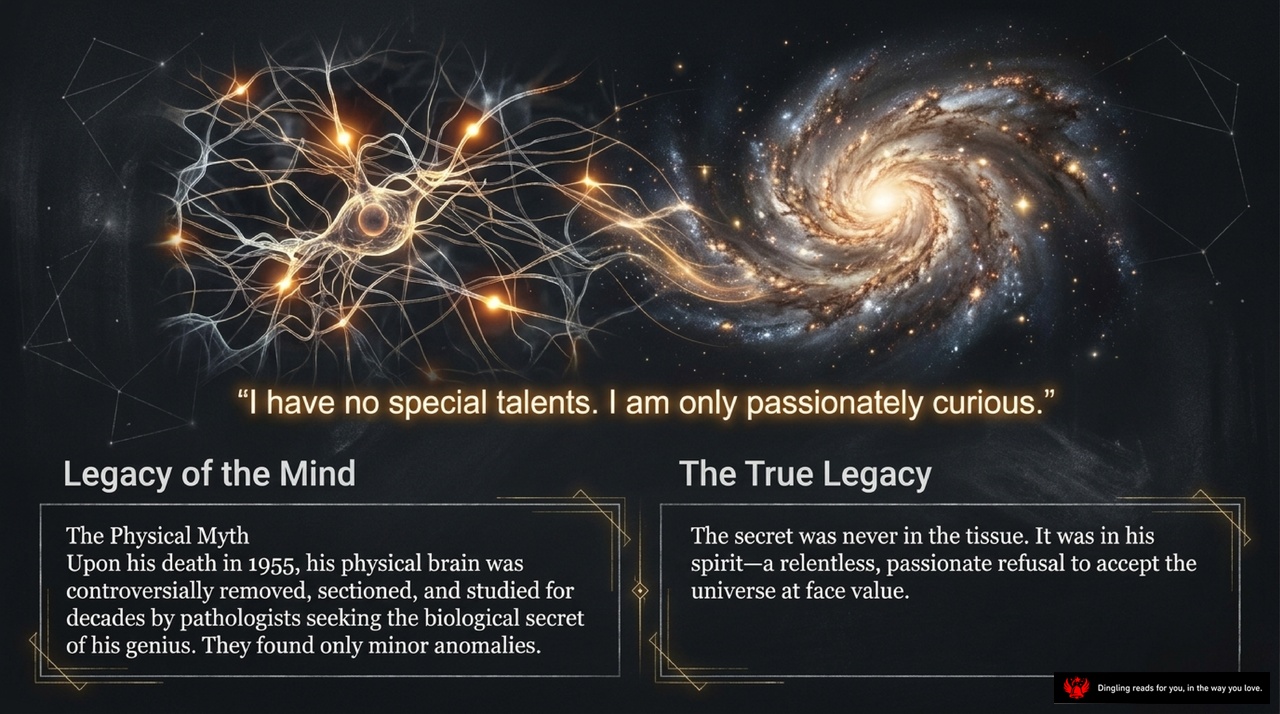
Look at this stunning visual: a neuron on the left, its glowing connections stretching out to merge with a swirling galaxy on the right. It's a powerful metaphor for the mind's reach. At the center, we see Einstein's famous words: "I have no special talents. I am only passionately curious."
This slide contrasts two very different views of his legacy. On the left, under "The Physical Myth," it tells us that after Einstein died in 1955, his brain was removed and dissected for decades. Scientists hoped to find the biological secret of his genius within the tissue, but they only found minor anomalies. They were looking for a physical cause.
But look at the right side, "The True Legacy." It reveals the real secret was never in the tissue. It was in his spirit—a relentless, passionate refusal to accept the universe at face value. His brain didn't make him a genius; his curiosity did. He didn't just observe the cosmos; he dared to imagine it differently, connecting the smallest particle of thought to the vastness of the stars. That is the true legacy of Albert Einstein.

Imagine a universe where nothing is as it seems, where time stretches and contracts like taffy, and where the very fabric of reality bends under the weight of gravity. This isn't science fiction; it is the revolutionary legacy of Albert Einstein, the man who dared to rethink the cosmos.
Today, we look at the moment Einstein truly became a legend. In 1919, a total solar eclipse offered the world a chance to test his boldest prediction: that light from distant stars would curve as it passed near the Sun, bending by 1.7 arcseconds due to the warping of spacetime. British astronomer Arthur Eddington led a daring expedition to verify this, traveling to the equator to capture the image. When the photos were developed, they matched Einstein's prediction perfectly, proving Newton's laws were incomplete and confirming that space itself is a dynamic, flexible entity.
The news exploded globally. Overnight, Einstein transformed from a quiet patent clerk into a global icon. Newspapers from London to New York hailed him as a genius who had rewritten the rules of the universe. Yet, despite the fame, Einstein remained a complex figure. He loved the spotlight but often chafed under it, even complaining that "fame makes me increasingly stupid." He preferred the company of his own thoughts, describing himself as a "lonely wanderer" who never fully belonged to any nation or family.
This era also marked the beginning of his most controversial battle: the fight against the emerging quantum mechanics. While he helped birth the theory of light's wave-particle duality, he couldn't accept its core tenet—that the universe is fundamentally random. He famously declared, "God does not play dice," insisting that there must be a hidden order behind the apparent chaos. This philosophical clash with Niels Bohr would define the rest of his life, turning him into a stubborn guardian of a deterministic universe against the tide of modern physics.
As the 20th century closed, Einstein's focus shifted from pure physics to the urgent need for global peace. Horrified by the atomic bomb's destruction and the rise of totalitarian regimes, he spent his final decades advocating for a "world government" to prevent future nuclear wars. He believed that only a supranational authority could stop humanity from destroying itself, a vision that often made him seem naive to politicians but remained his unwavering moral compass.
In the end, Einstein's life was a testament to the power of a single, rebellious idea. He taught us that the most profound truths often come not from accumulating more data, but from asking the simplest, most dangerous questions: What if time isn't absolute? What if space can bend? And what if we can choose a different future?